
Part II Research Methods 20 A case study

- Slides: 23
Part II: Research Methods
20. A case study is: A) An extensive examination of the behavior and mental processes associated with a specific person B) A study done over an entire life span of one individual, giving the psychologist detailed information one’s psyche C) A study that exposes the subject to some event and measures coping skills D) An independent study used outside the natural environments of the subject E) A comparative study of various people of different ages at the same time
20. A case study is: A) An extensive examination of the behavior and mental processes associated with a specific person - analysis of one’s behaviors, fears, and impulses B) A study done over an entire life span of one individual, giving the psychologist detailed information one’s psyche – longitudinal study C) A study that exposes the subject to some event and measures coping skills D) An independent study used outside the natural environments of the subject E) A comparative study of various people of different ages at the same time – cross-sectional correlation study
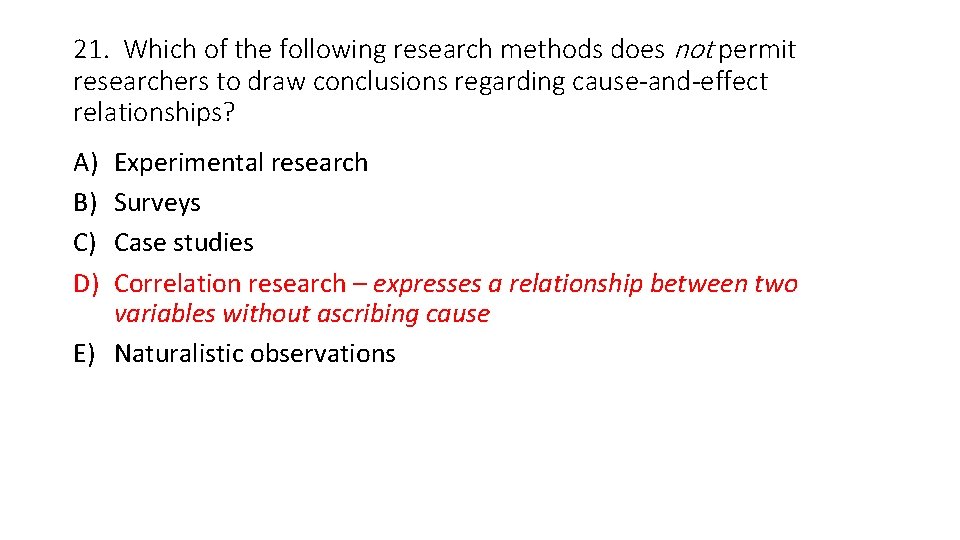
21. Which of the following research methods does not permit researchers to draw conclusions regarding cause-and-effect relationships? A) B) C) D) E) Experimental research Surveys Case studies Correlation research Naturalistic observations
21. Which of the following research methods does not permit researchers to draw conclusions regarding cause-and-effect relationships? A) B) C) D) Experimental research Surveys Case studies Correlation research – expresses a relationship between two variables without ascribing cause E) Naturalistic observations
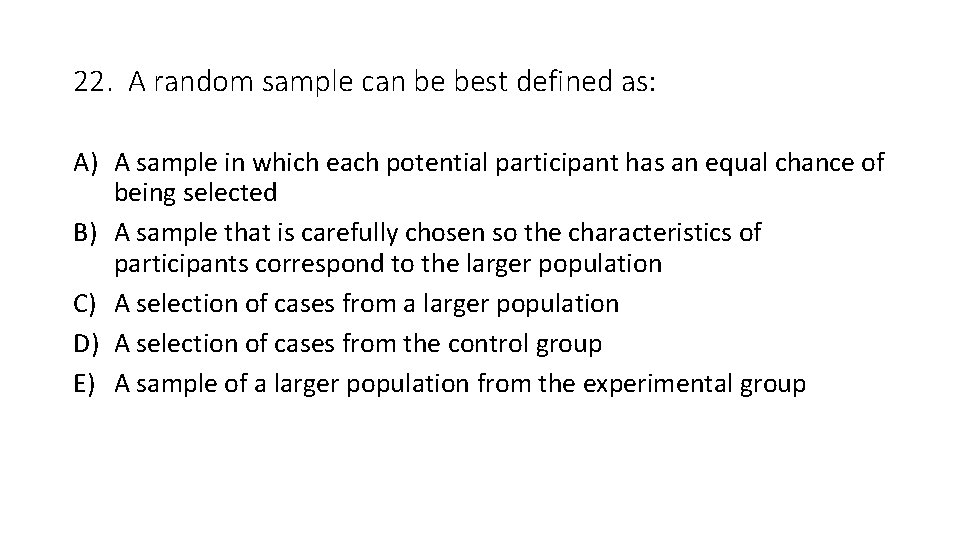
22. A random sample can be best defined as: A) A sample in which each potential participant has an equal chance of being selected B) A sample that is carefully chosen so the characteristics of participants correspond to the larger population C) A selection of cases from a larger population D) A selection of cases from the control group E) A sample of a larger population from the experimental group
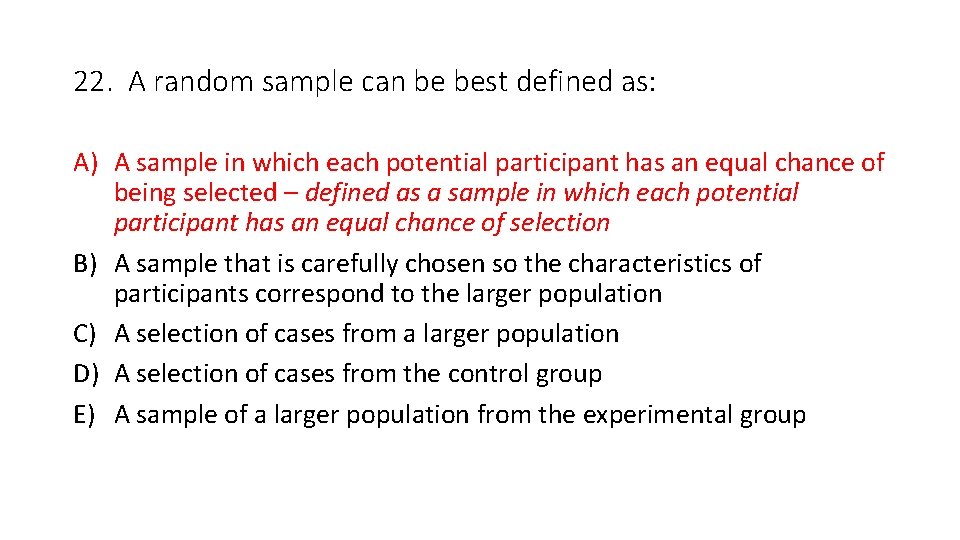
22. A random sample can be best defined as: A) A sample in which each potential participant has an equal chance of being selected – defined as a sample in which each potential participant has an equal chance of selection B) A sample that is carefully chosen so the characteristics of participants correspond to the larger population C) A selection of cases from a larger population D) A selection of cases from the control group E) A sample of a larger population from the experimental group
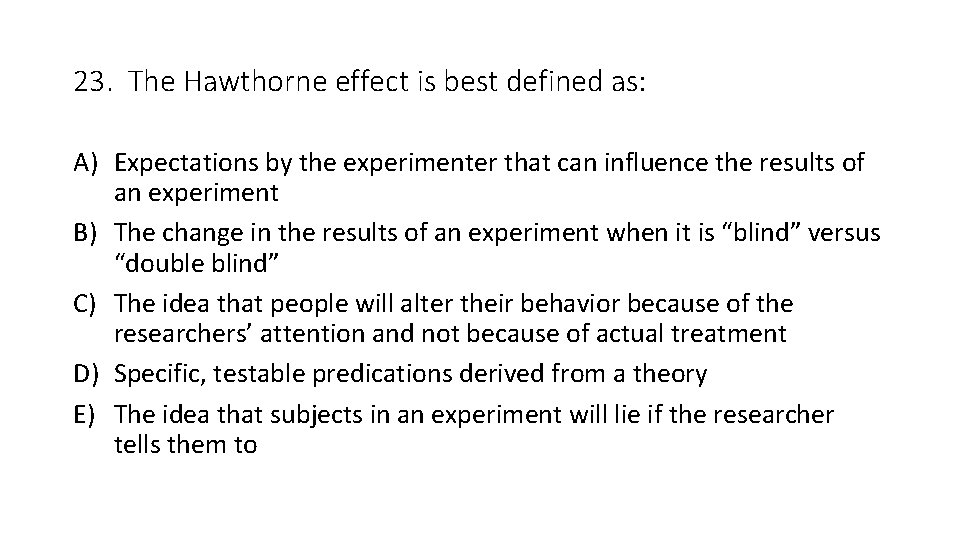
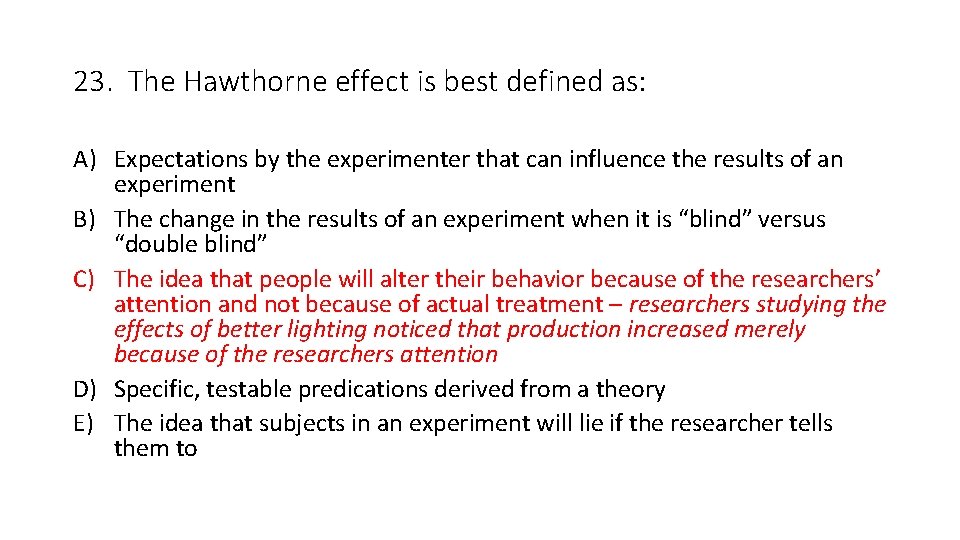
23. The Hawthorne effect is best defined as: A) Expectations by the experimenter that can influence the results of an experiment B) The change in the results of an experiment when it is “blind” versus “double blind” C) The idea that people will alter their behavior because of the researchers’ attention and not because of actual treatment D) Specific, testable predications derived from a theory E) The idea that subjects in an experiment will lie if the researcher tells them to
23. The Hawthorne effect is best defined as: A) Expectations by the experimenter that can influence the results of an experiment B) The change in the results of an experiment when it is “blind” versus “double blind” C) The idea that people will alter their behavior because of the researchers’ attention and not because of actual treatment – researchers studying the effects of better lighting noticed that production increased merely because of the researchers attention D) Specific, testable predications derived from a theory E) The idea that subjects in an experiment will lie if the researcher tells them to
Dr. Bisell conducts an experiment to see whether hunger makes mice run faster through a maze. He randomly assigns 25 mice to a control group or experimental group. Which cannot be a confounding variable? 24. A) B) C) D) E) Where the experiment takes place How hungry the mice were before the experiment How fast the mice were before the race When the experiment takes place The population from which he selected the mice
24. Dr. Bisell conducts an experiment to see whether hunger makes mice run faster through a maze. He randomly assigns 25 mice to a control group or experimental group. Which cannot be a confounding variable? A) B) C) D) E) Where the experiment takes place How hungry the mice were before the experiment How fast the mice were before the race When the experiment takes place The population from which he selected the mice
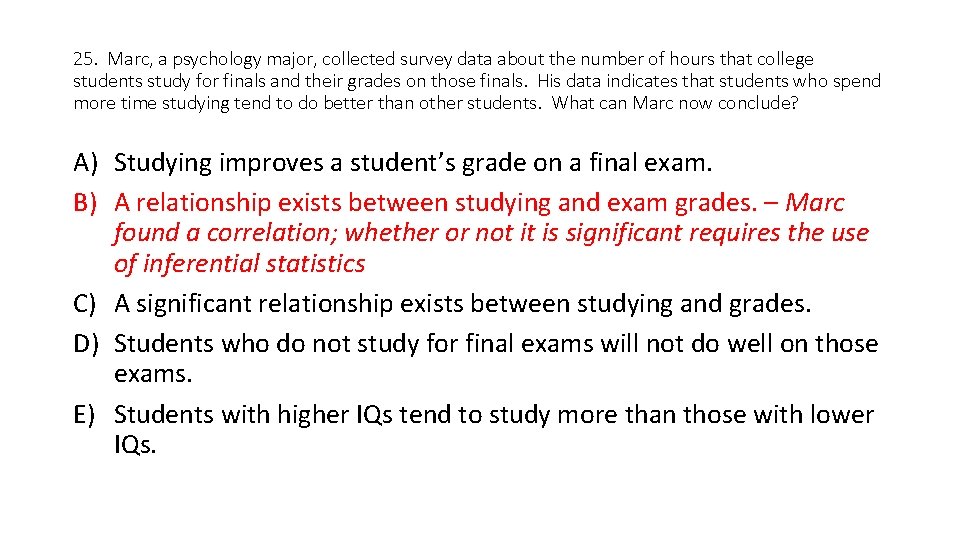
25. Marc, a psychology major, collected survey data about the number of hours that college students study for finals and their grades on those finals. His data indicates that students who spend more time studying tend to do better than other students. What can Marc now conclude? A) B) C) D) Studying improves a student’s grade on a final exam. A relationship exists between studying and exam grades. A significant relationship exists between studying and grades. Students who do not study for final exams will not do well on those exams. E) Students with higher IQs tend to study more than those with lower IQs.
25. Marc, a psychology major, collected survey data about the number of hours that college students study for finals and their grades on those finals. His data indicates that students who spend more time studying tend to do better than other students. What can Marc now conclude? A) Studying improves a student’s grade on a final exam. B) A relationship exists between studying and exam grades. – Marc found a correlation; whether or not it is significant requires the use of inferential statistics C) A significant relationship exists between studying and grades. D) Students who do not study for final exams will not do well on those exams. E) Students with higher IQs tend to study more than those with lower IQs.
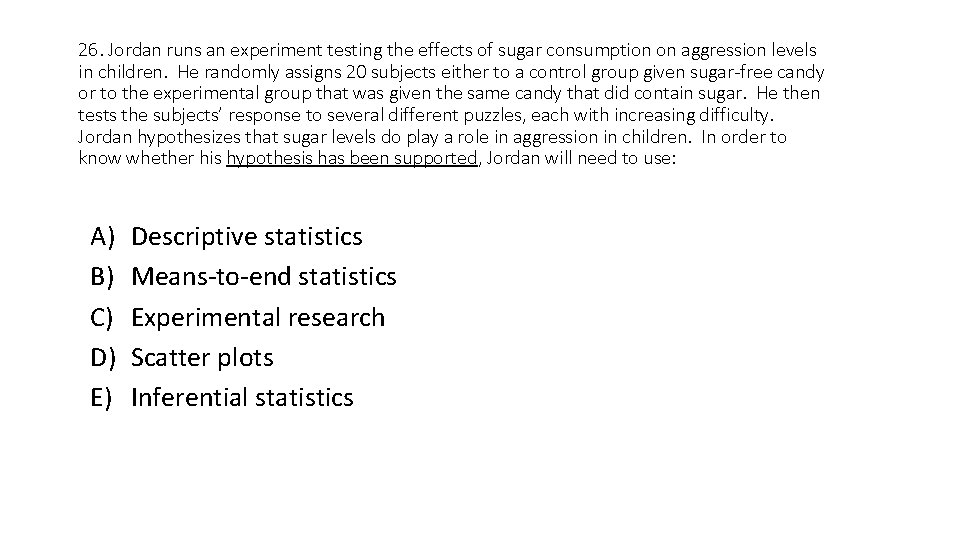
26. Jordan runs an experiment testing the effects of sugar consumption on aggression levels in children. He randomly assigns 20 subjects either to a control group given sugar-free candy or to the experimental group that was given the same candy that did contain sugar. He then tests the subjects’ response to several different puzzles, each with increasing difficulty. Jordan hypothesizes that sugar levels do play a role in aggression in children. In order to know whether his hypothesis has been supported, Jordan will need to use: A) B) C) D) E) Descriptive statistics Means-to-end statistics Experimental research Scatter plots Inferential statistics
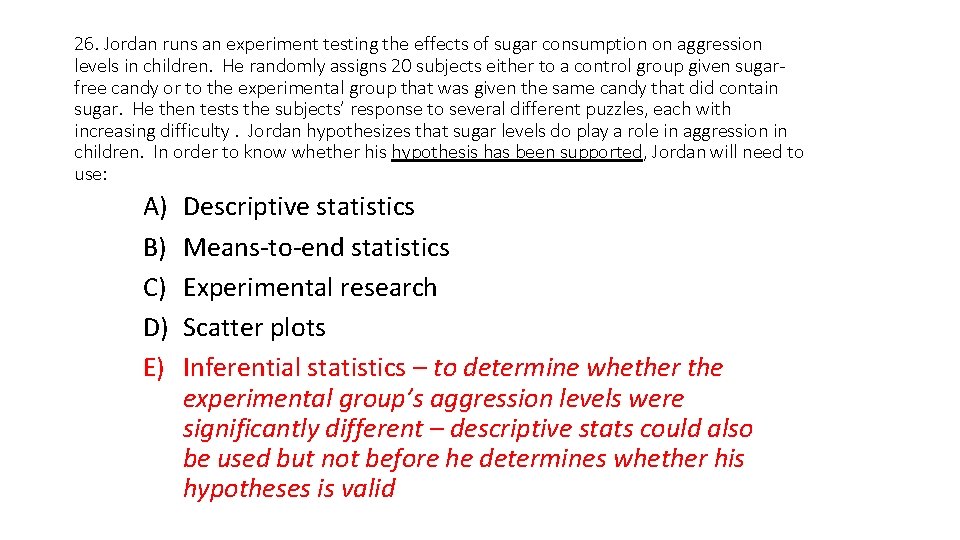
26. Jordan runs an experiment testing the effects of sugar consumption on aggression levels in children. He randomly assigns 20 subjects either to a control group given sugarfree candy or to the experimental group that was given the same candy that did contain sugar. He then tests the subjects’ response to several different puzzles, each with increasing difficulty. Jordan hypothesizes that sugar levels do play a role in aggression in children. In order to know whether his hypothesis has been supported, Jordan will need to use: A) B) C) D) E) Descriptive statistics Means-to-end statistics Experimental research Scatter plots Inferential statistics – to determine whether the experimental group’s aggression levels were significantly different – descriptive stats could also be used but not before he determines whether his hypotheses is valid
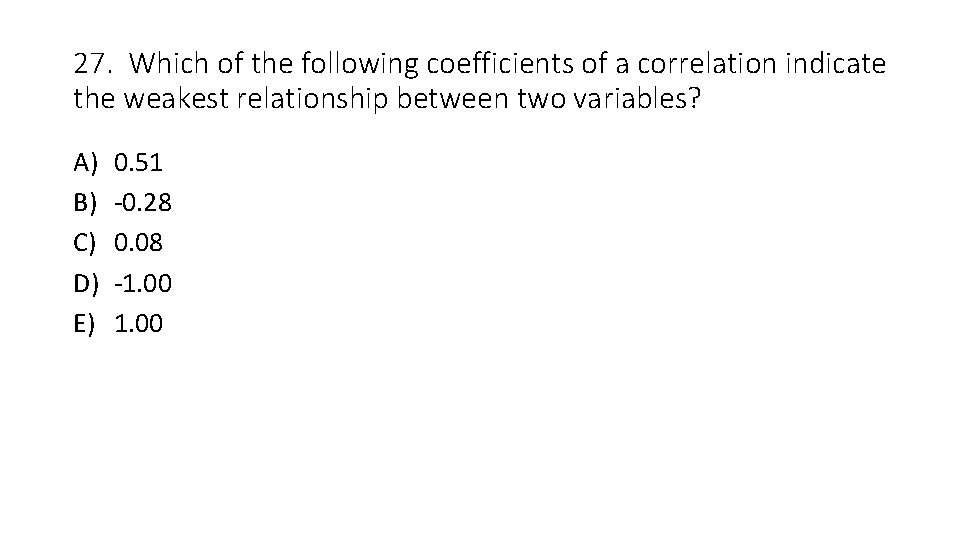
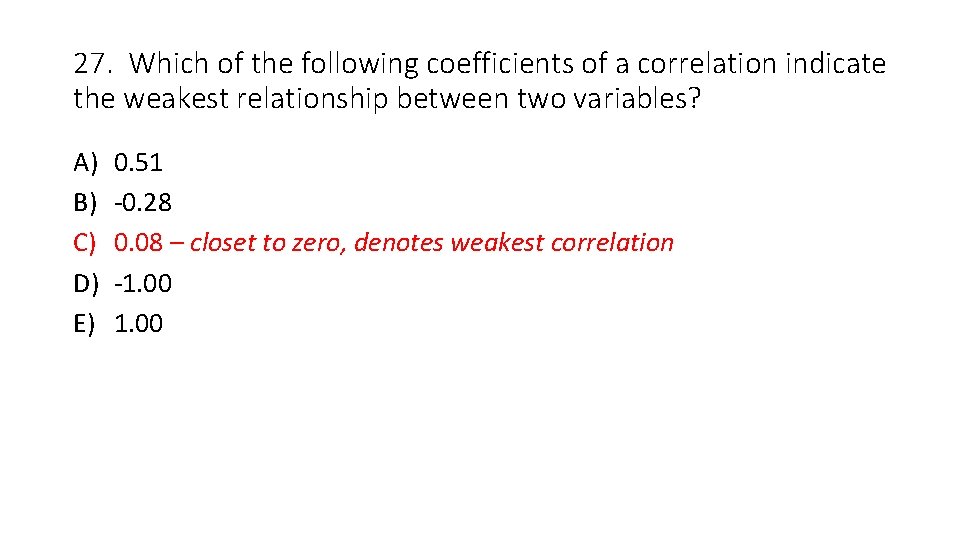
27. Which of the following coefficients of a correlation indicate the weakest relationship between two variables? A) B) C) D) E) 0. 51 -0. 28 0. 08 -1. 00
27. Which of the following coefficients of a correlation indicate the weakest relationship between two variables? A) B) C) D) E) 0. 51 -0. 28 0. 08 – closet to zero, denotes weakest correlation -1. 00
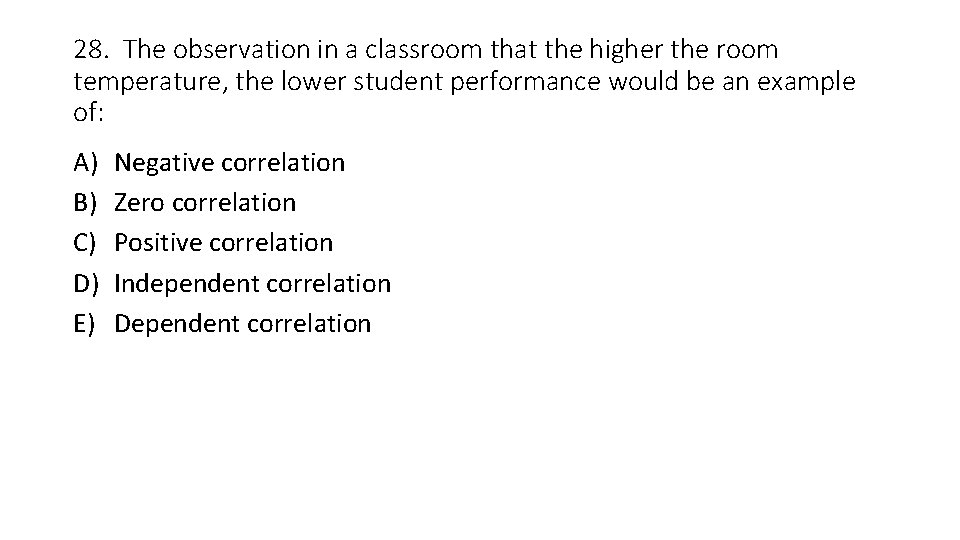
28. The observation in a classroom that the higher the room temperature, the lower student performance would be an example of: A) B) C) D) E) Negative correlation Zero correlation Positive correlation Independent correlation Dependent correlation
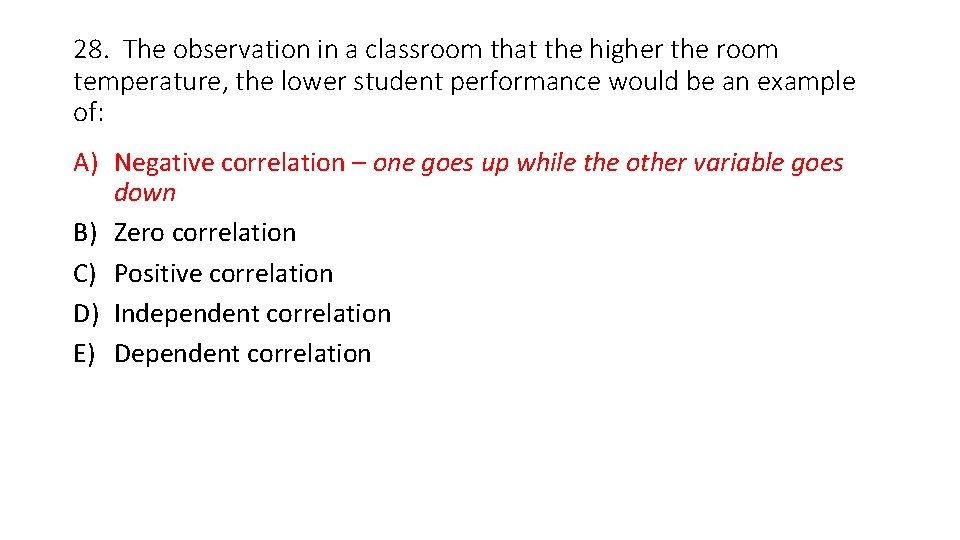
28. The observation in a classroom that the higher the room temperature, the lower student performance would be an example of: A) Negative correlation – one goes up while the other variable goes down B) Zero correlation C) Positive correlation D) Independent correlation E) Dependent correlation
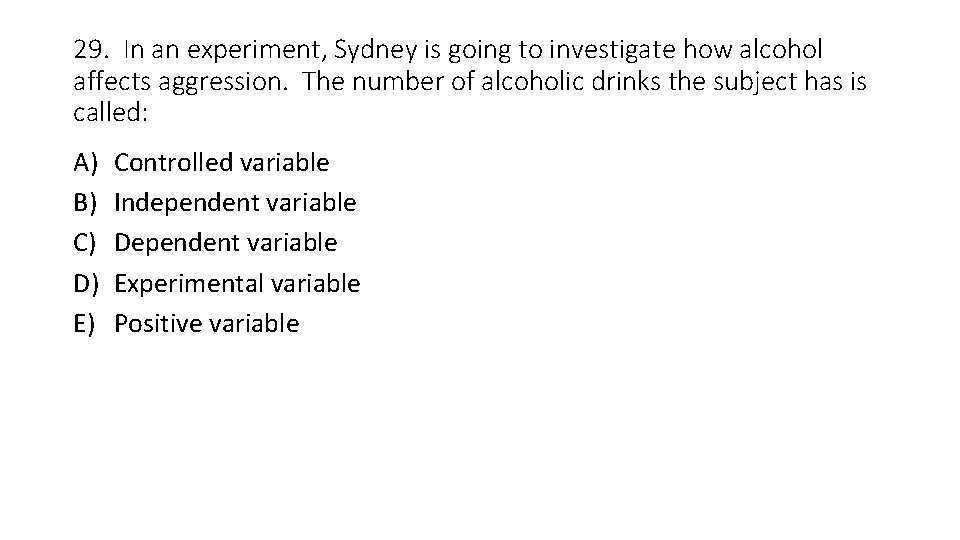
29. In an experiment, Sydney is going to investigate how alcohol affects aggression. The number of alcoholic drinks the subject has is called: A) B) C) D) E) Controlled variable Independent variable Dependent variable Experimental variable Positive variable
29. In an experiment, Sydney is going to investigate how alcohol affects aggression. The number of alcoholic drinks the subject has is called: A) Controlled variable B) Independent variable – the variable that is manipulated to test its effects on the other, dependent variable C) Dependent variable D) Experimental variable E) Positive variable
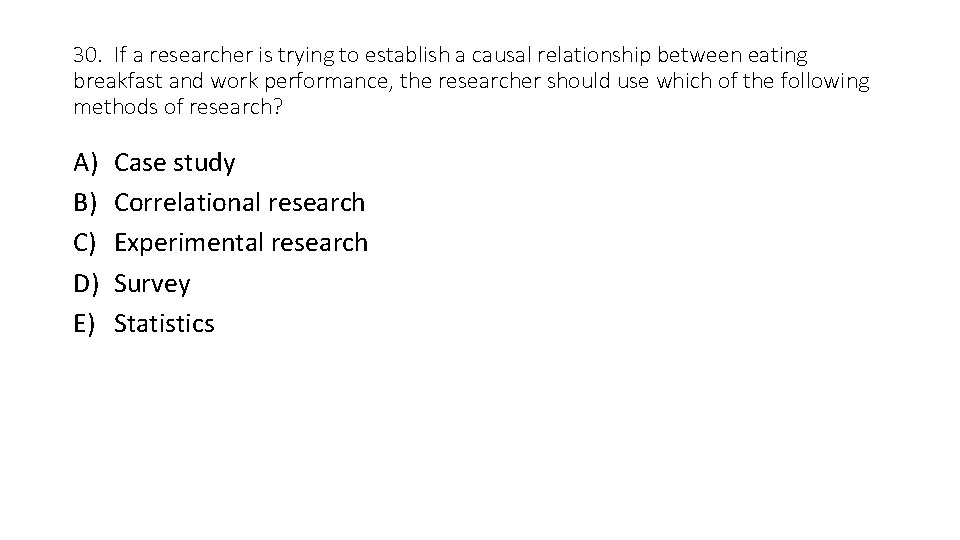
30. If a researcher is trying to establish a causal relationship between eating breakfast and work performance, the researcher should use which of the following methods of research? A) B) C) D) E) Case study Correlational research Experimental research Survey Statistics
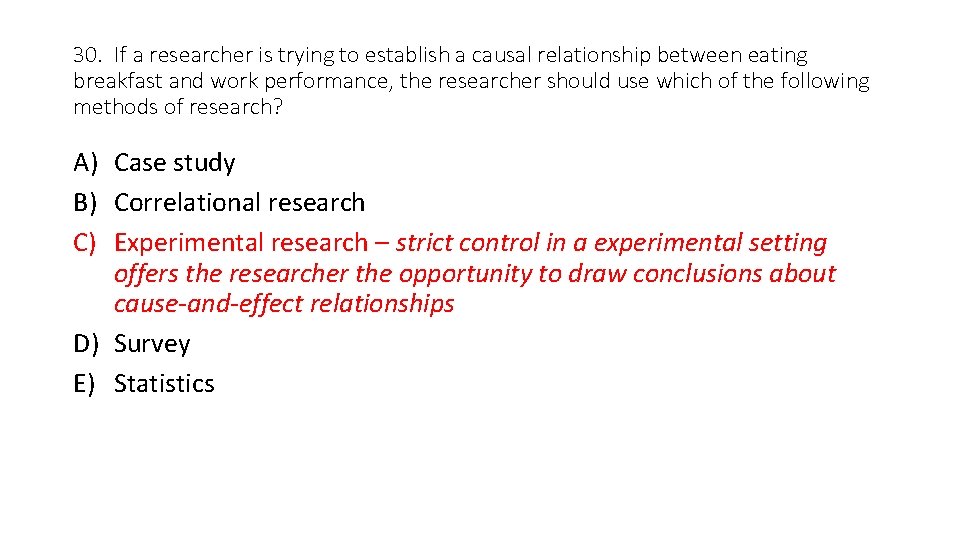
30. If a researcher is trying to establish a causal relationship between eating breakfast and work performance, the researcher should use which of the following methods of research? A) Case study B) Correlational research C) Experimental research – strict control in a experimental setting offers the researcher the opportunity to draw conclusions about cause-and-effect relationships D) Survey E) Statistics