
Part II Political Institutions What Are They How

- Slides: 27
Part II: Political Institutions – What Are They? How Can We Assess Them? January 26 th, 2006
Political Institutions. . . n what are political institutions? « widely-held and deeply-ingrained sets of shared understandings • about the appropriate process for collective decision-making • about the spheres subject to collective decisions (vs. those reserved for the individual)
Political Institutions. . . u solidified relationships of political power « rigid – i. e. difficult to change « institutions are never neutral • they privilege some interests over others • they organize some issues into politics and organize some issues out of politics
Political Institutions. . . u how might we assess political institutions? « democracy • set of normative ideas about how power is legitimately exercised
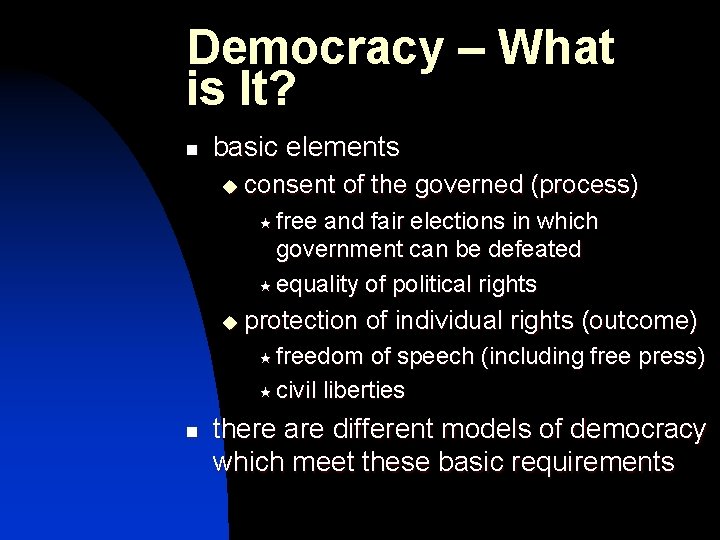
Democracy – What is It? n basic elements u consent of the governed (process) « free and fair elections in which government can be defeated « equality of political rights u protection of individual rights (outcome) « freedom of speech (including free press) « civil liberties n there are different models of democracy which meet these basic requirements
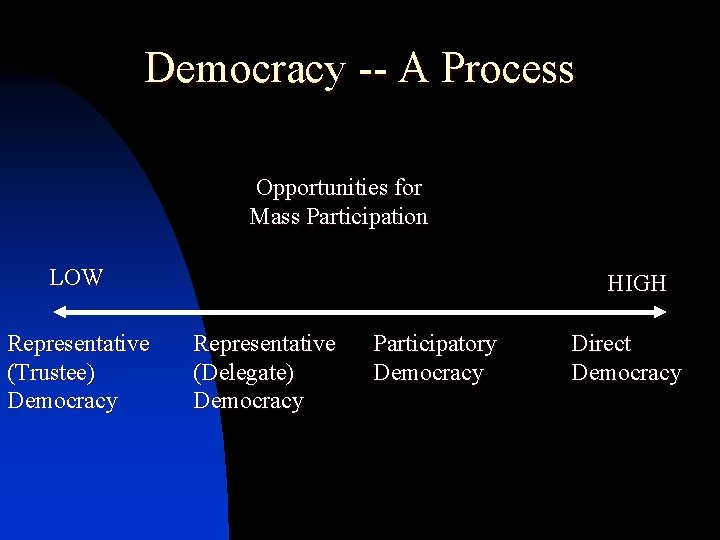
Democracy -- A Process Opportunities for Mass Participation LOW Representative (Trustee) Democracy HIGH Representative (Delegate) Democracy Participatory Democracy Direct Democracy
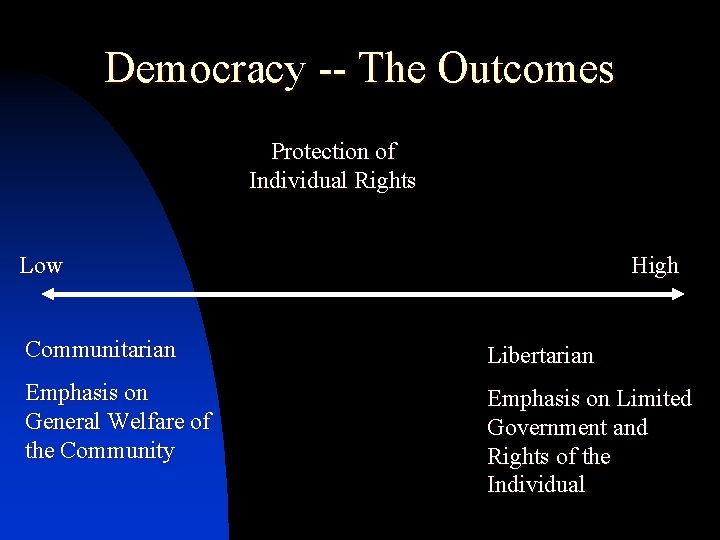
Democracy -- The Outcomes Protection of Individual Rights High Low Communitarian Libertarian Emphasis on General Welfare of the Community Emphasis on Limited Government and Rights of the Individual
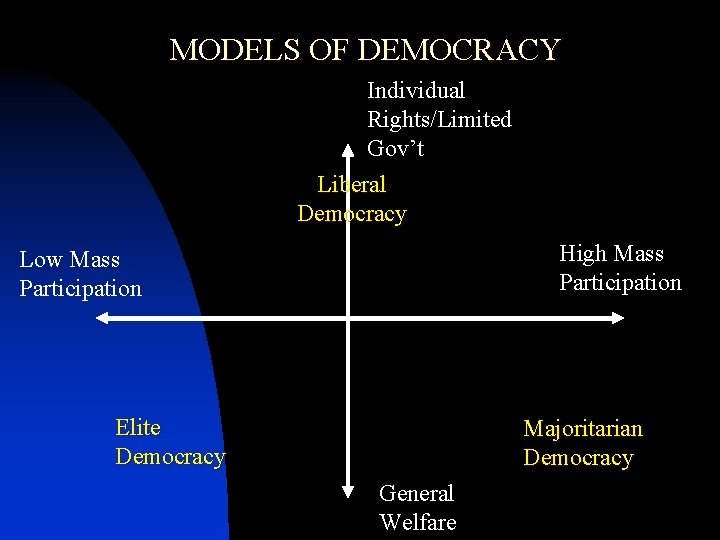
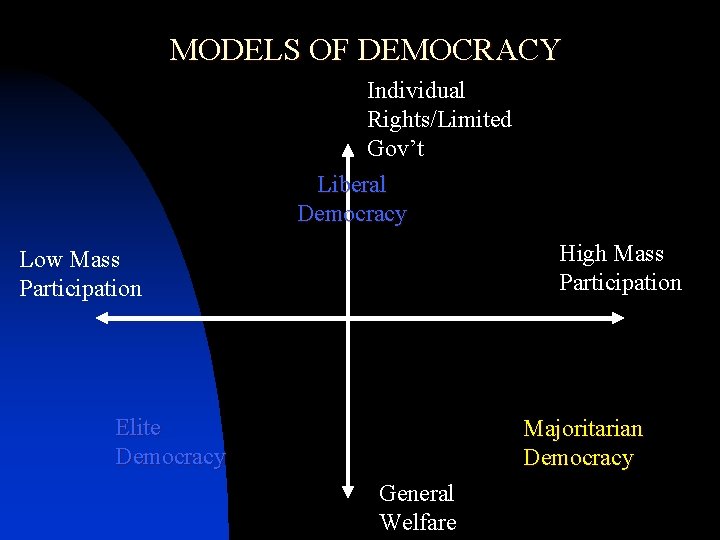
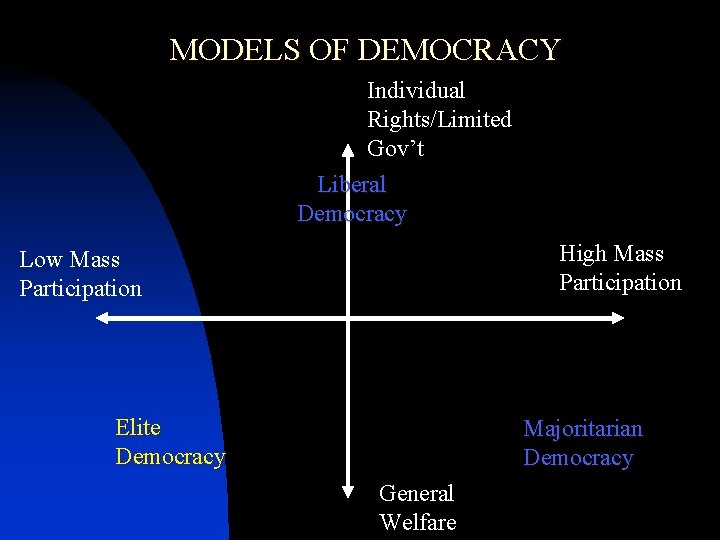
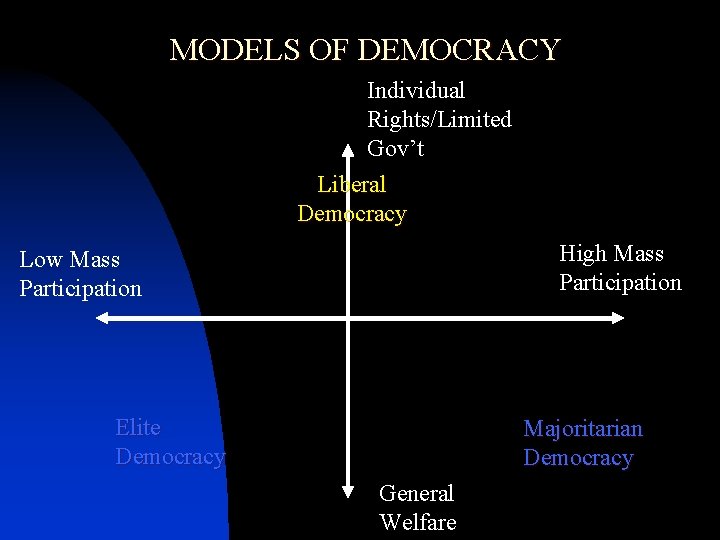
MODELS OF DEMOCRACY Individual Rights/Limited Gov’t Liberal Democracy High Mass Participation Low Mass Participation Elite Democracy Majoritarian Democracy General Welfare
MODELS OF DEMOCRACY Individual Rights/Limited Gov’t Liberal Democracy High Mass Participation Low Mass Participation Elite Democracy Majoritarian Democracy General Welfare
Models of Democracy n majoritarian democracy « most important goal is maximizing mass participation « high mass participation will result in decisions being made that maximize the general welfare
MODELS OF DEMOCRACY Individual Rights/Limited Gov’t Liberal Democracy High Mass Participation Low Mass Participation Elite Democracy Majoritarian Democracy General Welfare
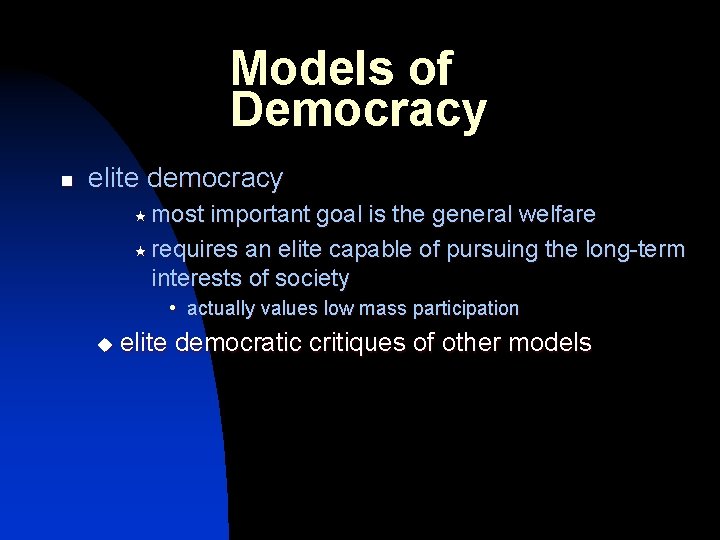
Models of Democracy n elite democracy « most important goal is the general welfare « requires an elite capable of pursuing the long-term interests of society • actually values low mass participation
MODELS OF DEMOCRACY Individual Rights/Limited Gov’t Liberal Democracy High Mass Participation Low Mass Participation Elite Democracy Majoritarian Democracy General Welfare
Models of Democracy n liberal democracy « most important goal is protecting individual rights « does not prefer low mass participation but may be willing to accept it
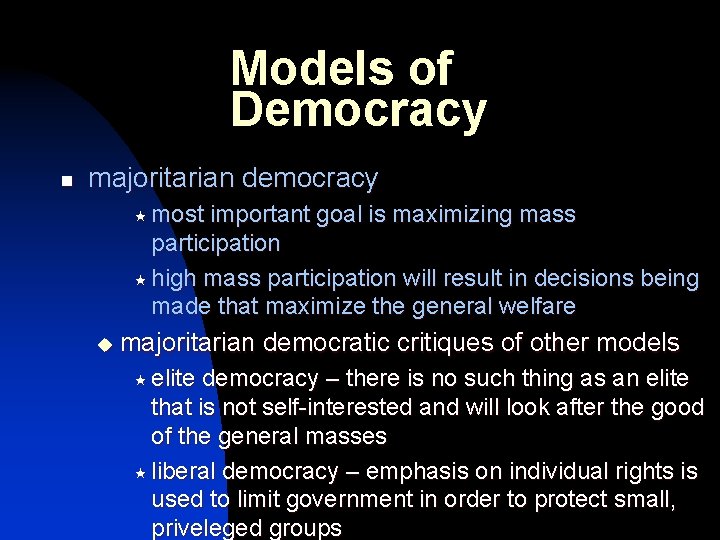
Models of Democracy n majoritarian democracy « most important goal is maximizing mass participation « high mass participation will result in decisions being made that maximize the general welfare u majoritarian democratic critiques of other models
Models of Democracy n majoritarian democracy « most important goal is maximizing mass participation « high mass participation will result in decisions being made that maximize the general welfare u majoritarian « elite democratic critiques of other models democracy – there is no such thing as an elite that is not self-interested and will look after the good of the general masses
Models of Democracy n majoritarian democracy « most important goal is maximizing mass participation « high mass participation will result in decisions being made that maximize the general welfare u majoritarian « elite democratic critiques of other models democracy – there is no such thing as an elite that is not self-interested and will look after the good of the general masses « liberal democracy – emphasis on individual rights is used to limit government in order to protect small, priveleged groups
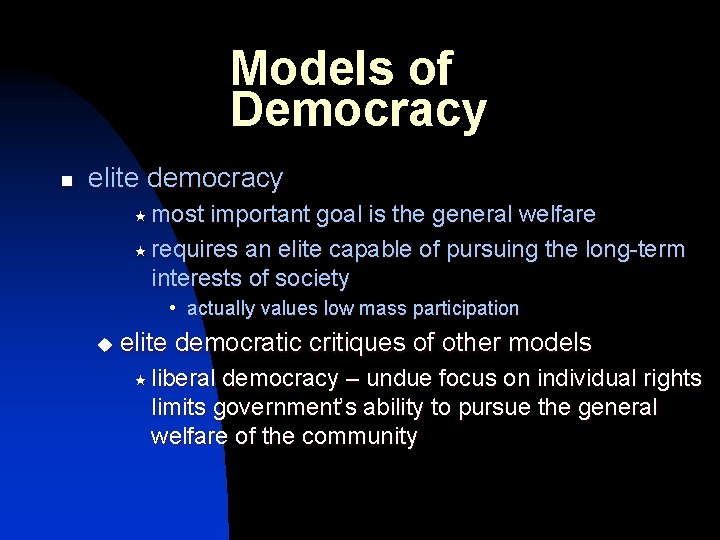
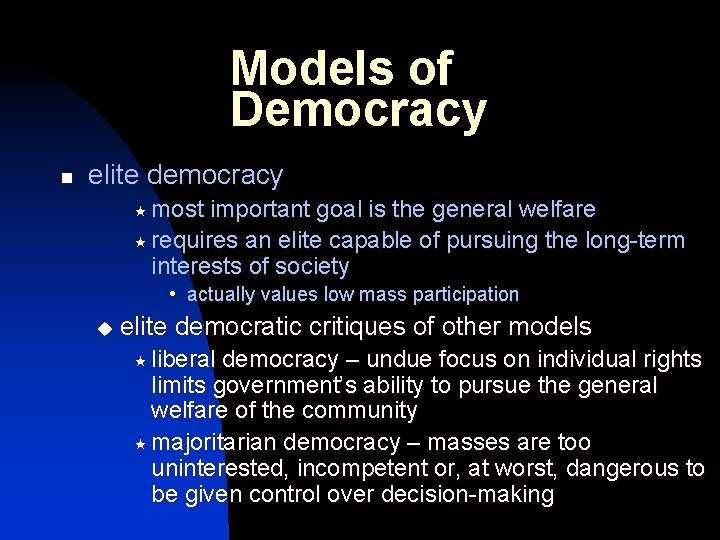
Models of Democracy n elite democracy « most important goal is the general welfare « requires an elite capable of pursuing the long-term interests of society • actually values low mass participation u elite democratic critiques of other models
Models of Democracy n elite democracy « most important goal is the general welfare « requires an elite capable of pursuing the long-term interests of society • actually values low mass participation u elite democratic critiques of other models « liberal democracy – undue focus on individual rights limits government’s ability to pursue the general welfare of the community
Models of Democracy n elite democracy « most important goal is the general welfare « requires an elite capable of pursuing the long-term interests of society • actually values low mass participation u elite democratic critiques of other models « liberal democracy – undue focus on individual rights limits government’s ability to pursue the general welfare of the community « majoritarian democracy – masses are too uninterested, incompetent or, at worst, dangerous to be given control over decision-making
Models of Democracy n liberal democracy « most important goal is protecting individual rights « does not prefer low mass participation but may be willing to accept it u liberal democratic critiques of other models
Models of Democracy n liberal democracy « most important goal is protecting individual rights « does not prefer low mass participation but may be willing to accept it u liberal « in democratic critiques of other models majoritarian democracies, majorities will use their power to infringe rights of individuals and minorities (tyranny of the majority) in the name of the general welfare
Models of Democracy n liberal democracy « most important goal is protecting individual rights « does not prefer low mass participation but may be willing to accept it u liberal « in democratic critiques of other models majoritarian democracies, majorities will use their power to infringe rights of individuals and minorities (tyranny of the majority) in the name of the general welfare « in elite democracies, elites will use their power to infringe the rights of individuals in the name of the general welfare
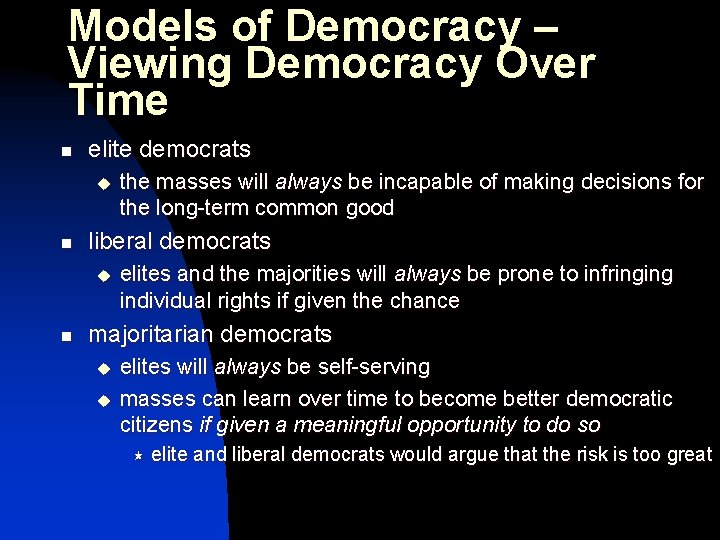
Models of Democracy – Viewing Democracy Over Time n elite democrats u n liberal democrats u n the masses will always be incapable of making decisions for the long-term common good elites and the majorities will always be prone to infringing individual rights if given the chance majoritarian democrats u u elites will always be self-serving masses can learn over time to become better democratic citizens if given a meaningful opportunity to do so « elite and liberal democrats would argue that the risk is too great
CLASSIFYING DEMOCRACIES. . . n typology of models of democracy as a “map” for comparing democratic systems u tells us what to look at in undertaking comparisons u emphasizes the relative nature of models of democracy « democracy complex as a concept is multi-faceted and
Things to Remember. . . n n within a range incorporating some minimum amount of meaningful citizen input and some minimum protection of basic rights, there are different models of democracy choice of models is completely normative « there is no “right” model « the best model of democracy is contestable