
Part II Noise Reduction Beamforming Reinhold HaebUmbach Speech
Part II. Noise Reduction – Beamforming Reinhold Haeb-Umbach
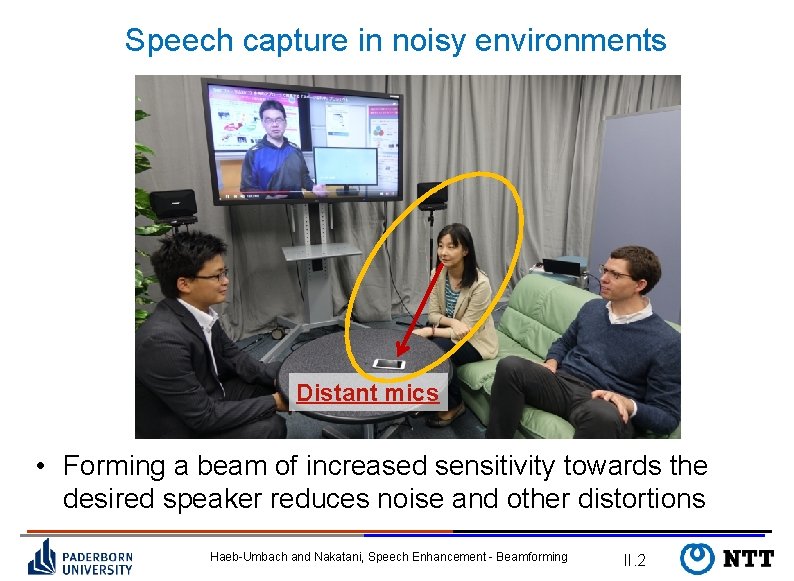
Speech capture in noisy environments Distant mics • Forming a beam of increased sensitivity towards the desired speaker reduces noise and other distortions Haeb-Umbach and Nakatani, Speech Enhancement - Beamforming II. 2
Table of contents in part II • • Some physics From physics to signal processing Optimal beamforming design criteria Speech presence probability (mask) estimation – Spatial mixture models – Neural networks • Speaker-conditioned spectrogram masking Haeb-Umbach and Nakatani, Speech Enhancement - Beamforming II. 3
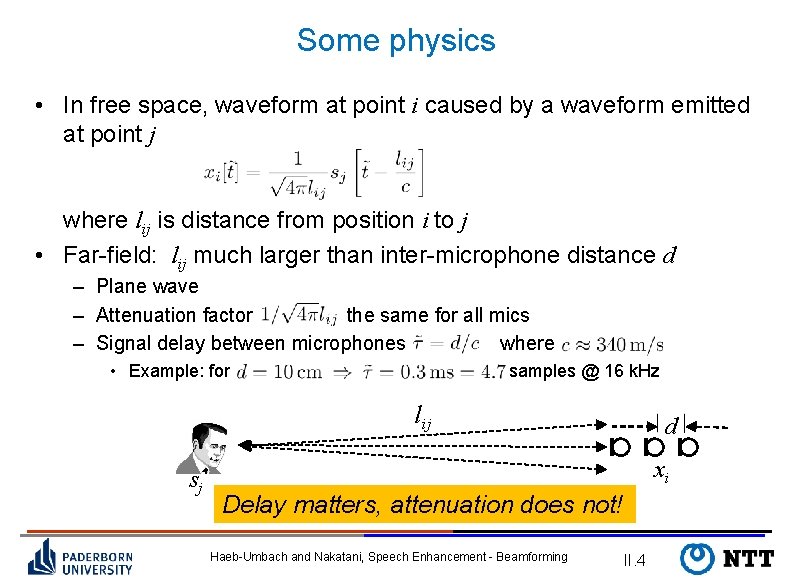
Some physics • In free space, waveform at point i caused by a waveform emitted at point j where lij is distance from position i to j • Far-field: lij much larger than inter-microphone distance d – Plane wave – Attenuation factor the same for all mics – Signal delay between microphones where • Example: for samples @ 16 k. Hz lij sj d xi Delay matters, attenuation does not! Haeb-Umbach and Nakatani, Speech Enhancement - Beamforming II. 4
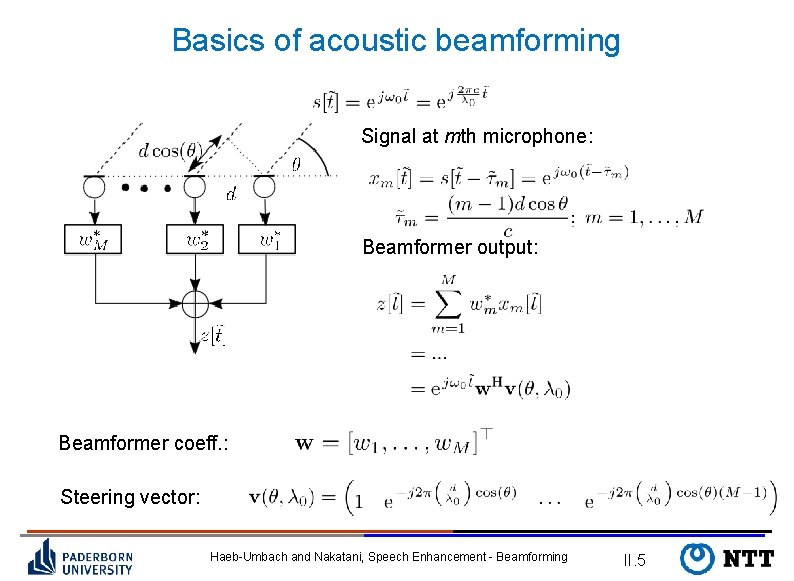
Basics of acoustic beamforming Signal at mth microphone: Beamformer output: Beamformer coeff. : Steering vector: Haeb-Umbach and Nakatani, Speech Enhancement - Beamforming II. 5
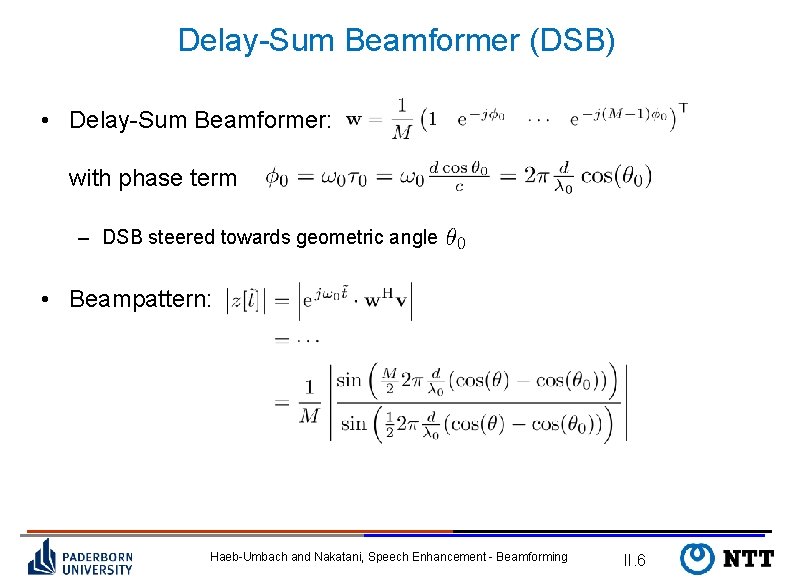
Delay-Sum Beamformer (DSB) • Delay-Sum Beamformer: with phase term – DSB steered towards geometric angle • Beampattern: Haeb-Umbach and Nakatani, Speech Enhancement - Beamforming II. 6
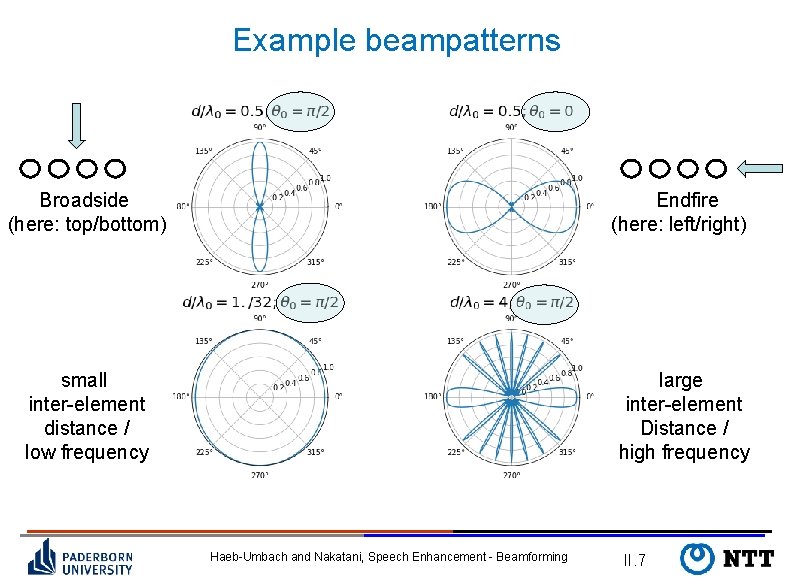
Example beampatterns Broadside (here: top/bottom) Endfire (here: left/right) small inter-element distance / low frequency large inter-element Distance / high frequency Haeb-Umbach and Nakatani, Speech Enhancement - Beamforming II. 7
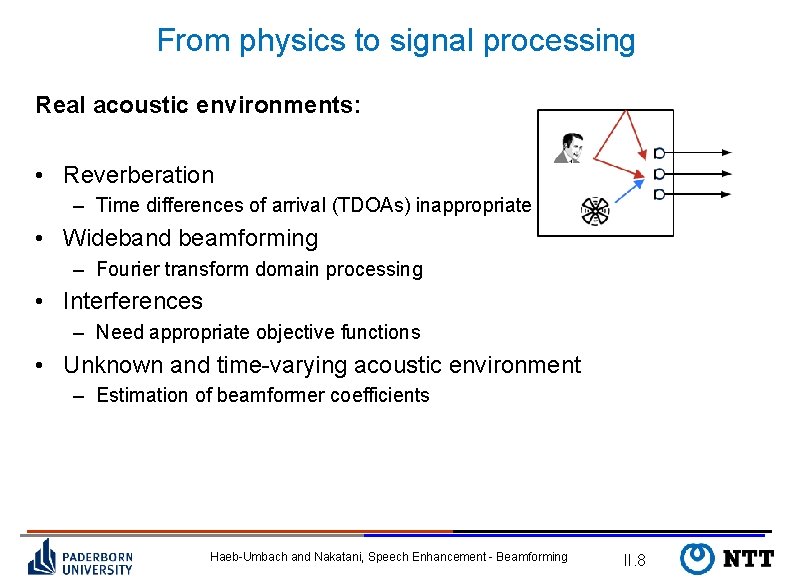
From physics to signal processing Real acoustic environments: • Reverberation – Time differences of arrival (TDOAs) inappropriate • Wideband beamforming – Fourier transform domain processing • Interferences – Need appropriate objective functions • Unknown and time-varying acoustic environment – Estimation of beamformer coefficients Haeb-Umbach and Nakatani, Speech Enhancement - Beamforming II. 8
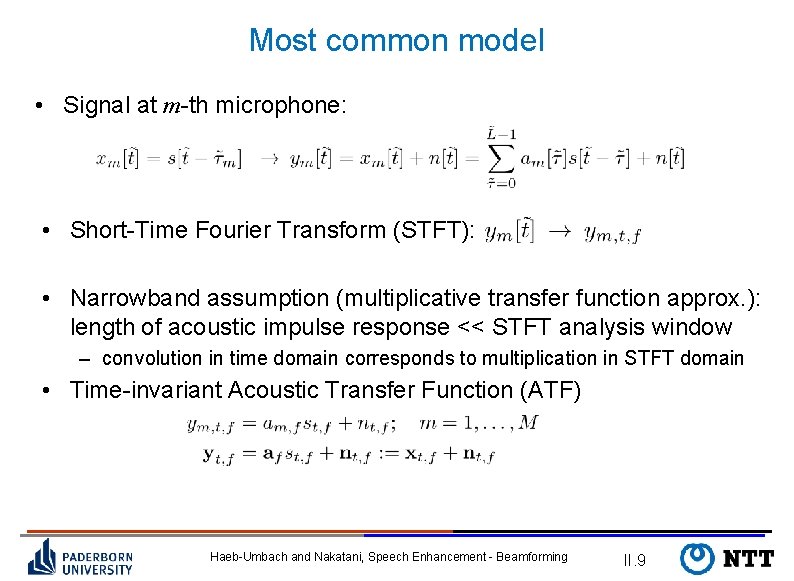
Most common model • Signal at m-th microphone: • Short-Time Fourier Transform (STFT): • Narrowband assumption (multiplicative transfer function approx. ): length of acoustic impulse response << STFT analysis window – convolution in time domain corresponds to multiplication in STFT domain • Time-invariant Acoustic Transfer Function (ATF) Haeb-Umbach and Nakatani, Speech Enhancement - Beamforming II. 9
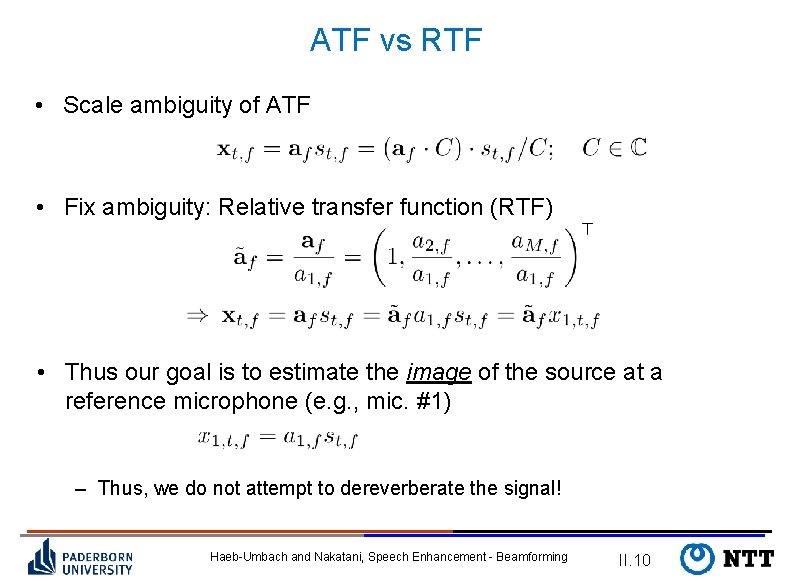
ATF vs RTF • Scale ambiguity of ATF • Fix ambiguity: Relative transfer function (RTF) • Thus our goal is to estimate the image of the source at a reference microphone (e. g. , mic. #1) – Thus, we do not attempt to dereverberate the signal! Haeb-Umbach and Nakatani, Speech Enhancement - Beamforming II. 10
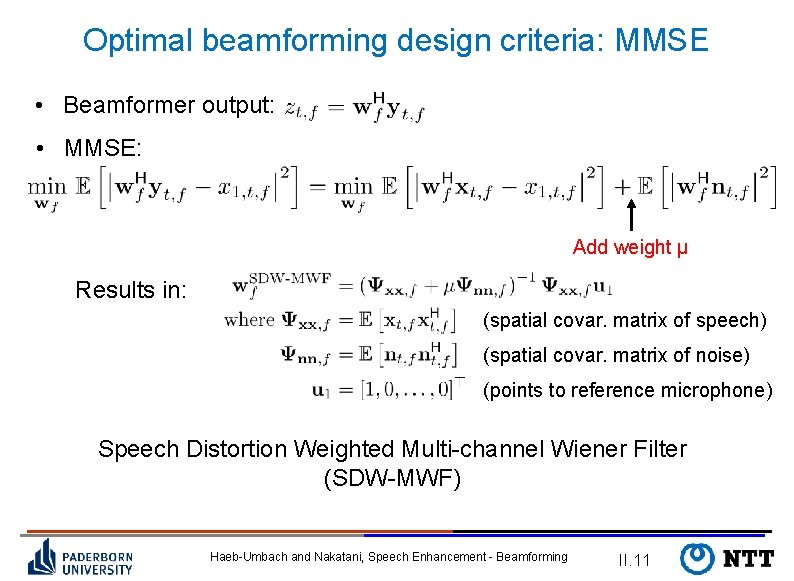
Optimal beamforming design criteria: MMSE • Beamformer output: • MMSE: Add weight µ Results in: (spatial covar. matrix of speech) (spatial covar. matrix of noise) (points to reference microphone) Speech Distortion Weighted Multi-channel Wiener Filter (SDW-MWF) Haeb-Umbach and Nakatani, Speech Enhancement - Beamforming II. 11
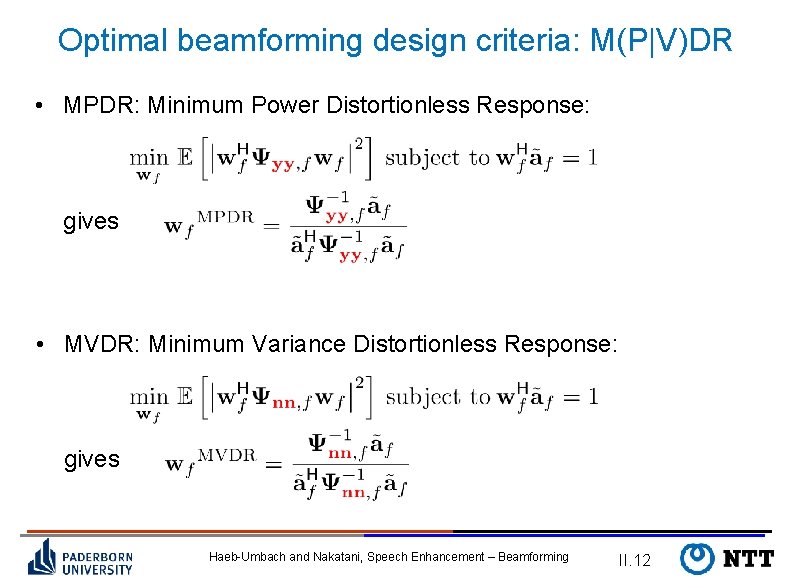
Optimal beamforming design criteria: M(P|V)DR • MPDR: Minimum Power Distortionless Response: gives • MVDR: Minimum Variance Distortionless Response: gives Haeb-Umbach and Nakatani, Speech Enhancement – Beamforming II. 12
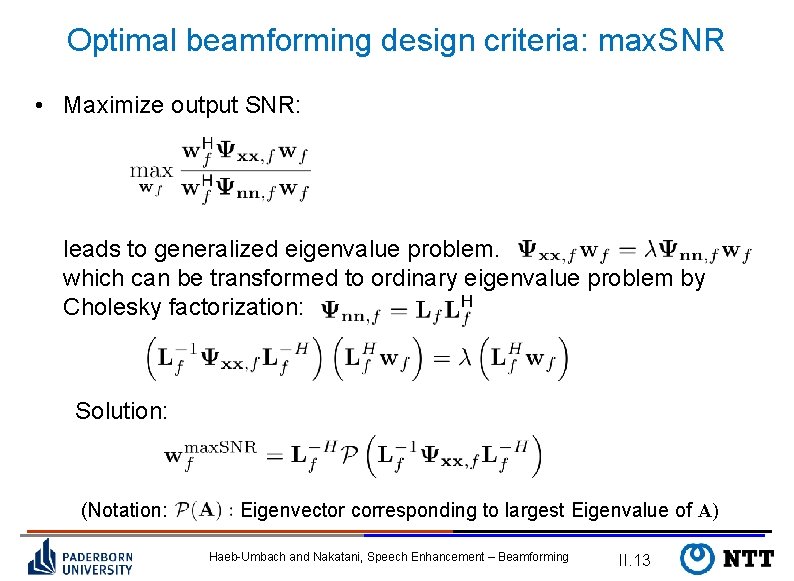
Optimal beamforming design criteria: max. SNR • Maximize output SNR: leads to generalized eigenvalue problem. which can be transformed to ordinary eigenvalue problem by Cholesky factorization: Solution: (Notation: Eigenvector corresponding to largest Eigenvalue of A) Haeb-Umbach and Nakatani, Speech Enhancement – Beamforming II. 13
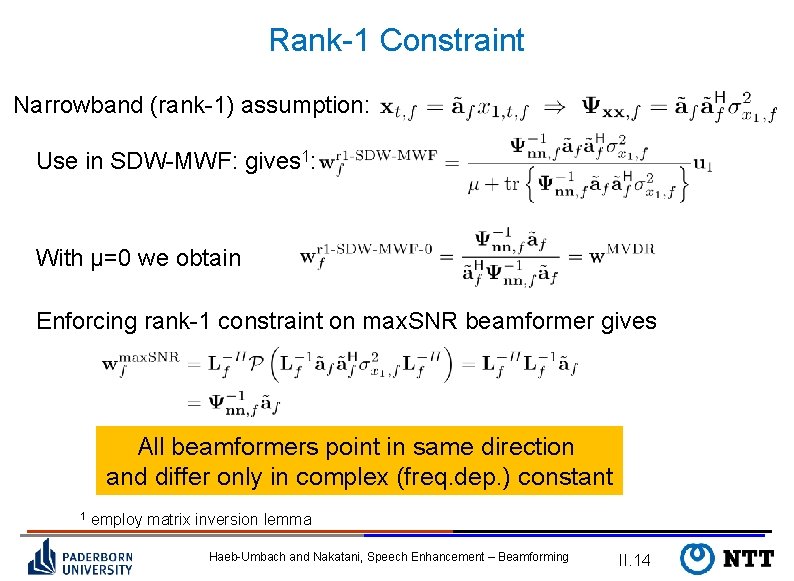
Rank-1 Constraint Narrowband (rank-1) assumption: Use in SDW-MWF: gives 1: With µ=0 we obtain Enforcing rank-1 constraint on max. SNR beamformer gives All beamformers point in same direction and differ only in complex (freq. dep. ) constant 1 employ matrix inversion lemma Haeb-Umbach and Nakatani, Speech Enhancement – Beamforming II. 14
Beamforming Criteria: Discussion • max. SNR beamformer introduces speech distortions, while MVDR does not – Can be compensated by postfilter [Warsitz and Haeb-Umbach, 2007] • There is no unanimous opinion which of the beamformers performs best for enhancement for ASR – Advice: try out all of them • A good estimate of the spatial covariance matrices is more important Haeb-Umbach and Nakatani, Speech Enhancement – Beamforming II. 15
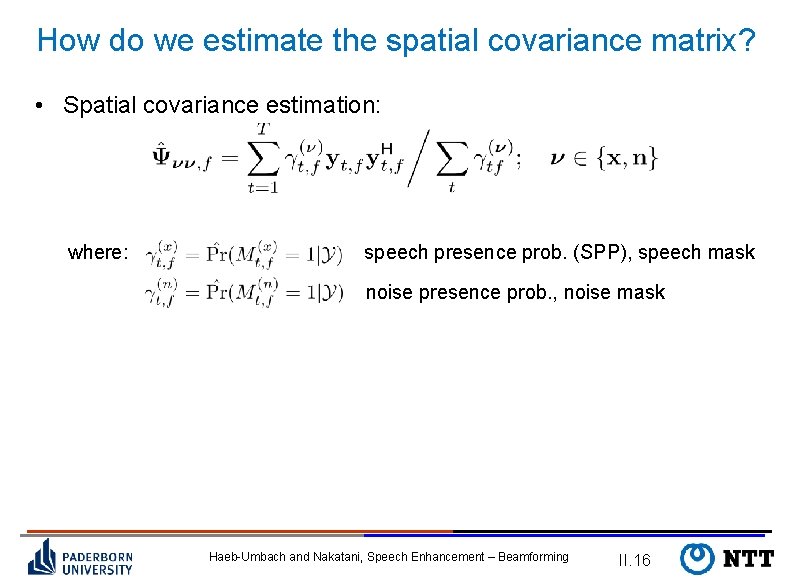
How do we estimate the spatial covariance matrix? • Spatial covariance estimation: where: speech presence prob. (SPP), speech mask noise presence prob. , noise mask Haeb-Umbach and Nakatani, Speech Enhancement – Beamforming II. 16
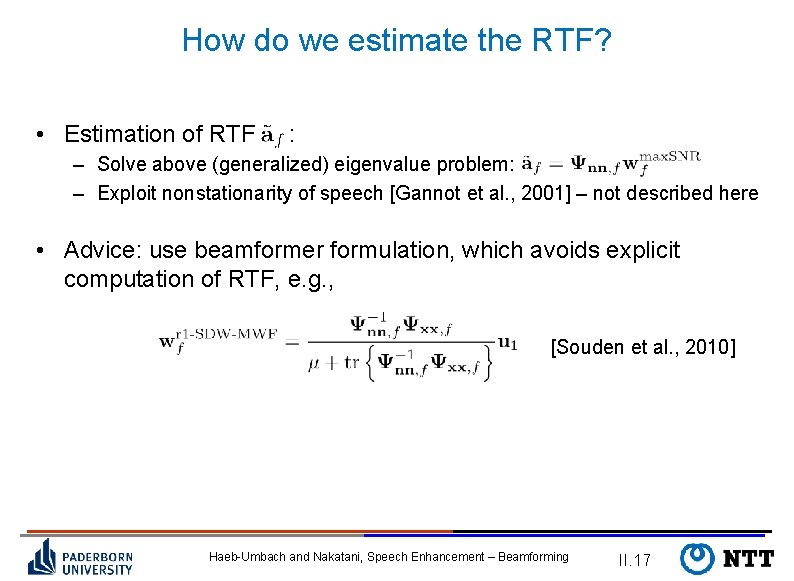
How do we estimate the RTF? • Estimation of RTF : – Solve above (generalized) eigenvalue problem: – Exploit nonstationarity of speech [Gannot et al. , 2001] – not described here • Advice: use beamformer formulation, which avoids explicit computation of RTF, e. g. , [Souden et al. , 2010] Haeb-Umbach and Nakatani, Speech Enhancement – Beamforming II. 17
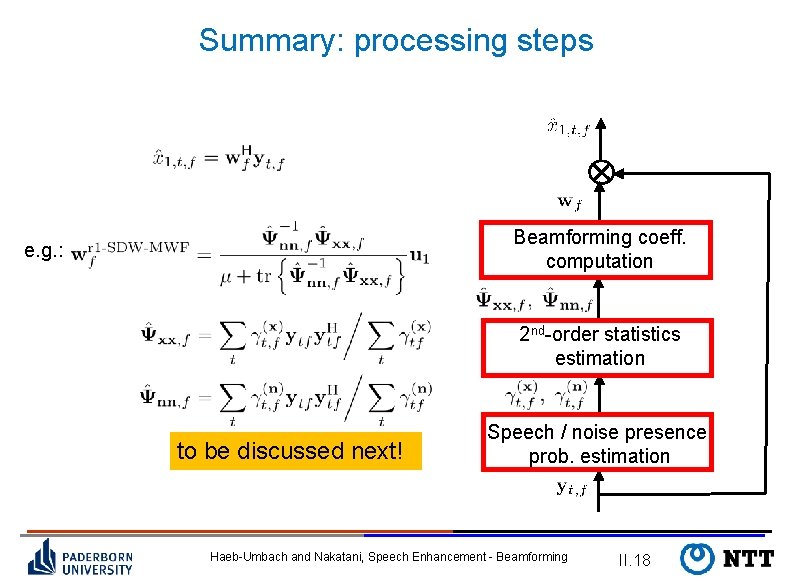
Summary: processing steps Beamforming coeff. computation e. g. : 2 nd-order statistics estimation to be discussed next! Speech / noise presence prob. estimation Haeb-Umbach and Nakatani, Speech Enhancement - Beamforming II. 18
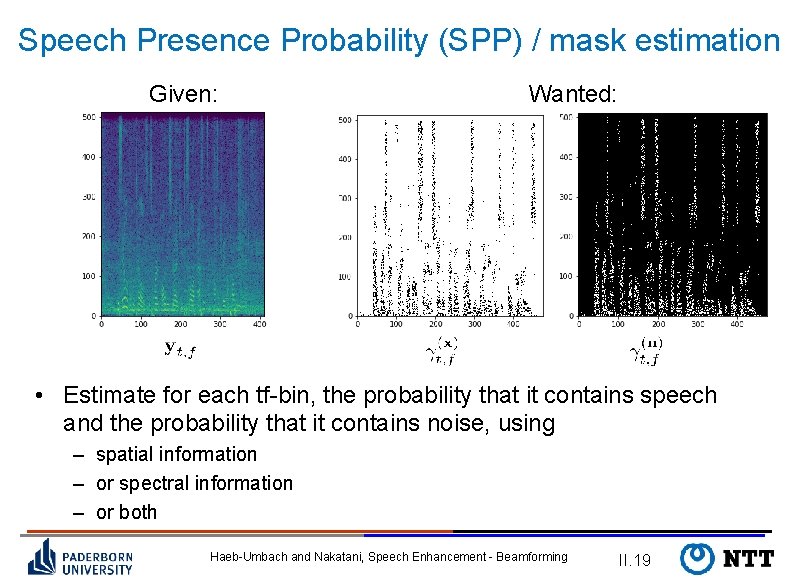
Speech Presence Probability (SPP) / mask estimation Given: Wanted: • Estimate for each tf-bin, the probability that it contains speech and the probability that it contains noise, using – spatial information – or spectral information – or both Haeb-Umbach and Nakatani, Speech Enhancement - Beamforming II. 19
Options for SPP estimation • Hand-crafted spectro-temporal smoothing • Spatial mixture models • Neural networks Haeb-Umbach and Nakatani, Speech Enhancement - Beamforming II. 20
![Spatial mixture model • Sparsity assumption [Yilmaz and Rickard, 2004] – 90% of the](http://slidetodoc.com/presentation_image_h2/766630922f7d87ef57a74c1d242c4d10/image-21.jpg "Spatial mixture model • Sparsity assumption [Yilmaz and Rickard, 2004] – 90% of the")
Spatial mixture model • Sparsity assumption [Yilmaz and Rickard, 2004] – 90% of the speech power is concentrated in 10% of the tf-bins – sparsity most pronounced for STFT window lengths of approx 64 ms f • Mixture model for vector of microphone signals or for representation derived from it Haeb-Umbach and Nakatani, Speech Enhancement - Beamforming t II. 21
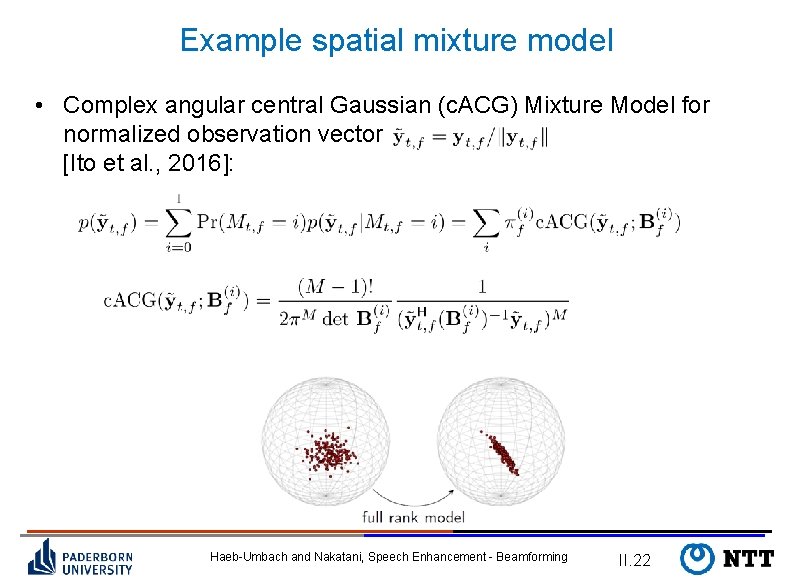
Example spatial mixture model • Complex angular central Gaussian (c. ACG) Mixture Model for normalized observation vector [Ito et al. , 2016]: Haeb-Umbach and Nakatani, Speech Enhancement - Beamforming II. 22
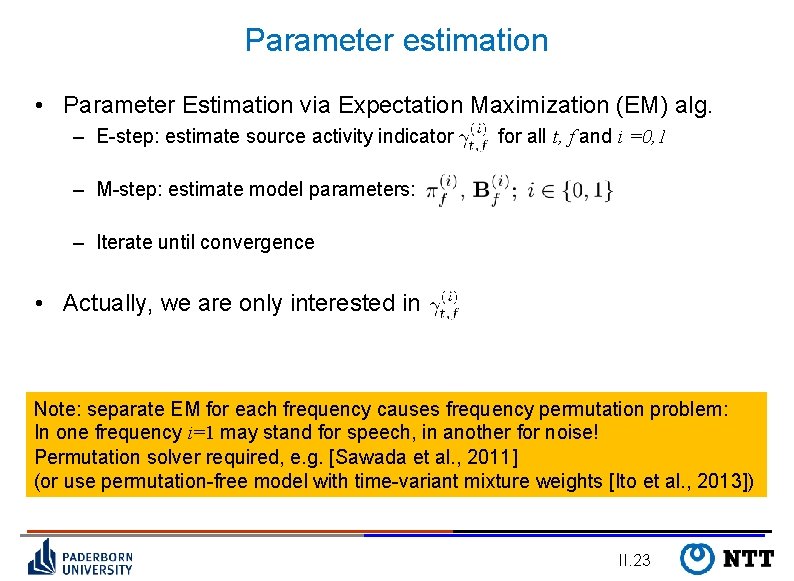
Parameter estimation • Parameter Estimation via Expectation Maximization (EM) alg. – E-step: estimate source activity indicator for all t, f and i =0, 1 – M-step: estimate model parameters: – Iterate until convergence • Actually, we are only interested in Note: separate EM for each frequency causes frequency permutation problem: In one frequency i=1 may stand for speech, in another for noise! Permutation solver required, e. g. [Sawada et al. , 2011] (or use permutation-free model with time-variant mixture weights [Ito et al. , 2013]) II. 23
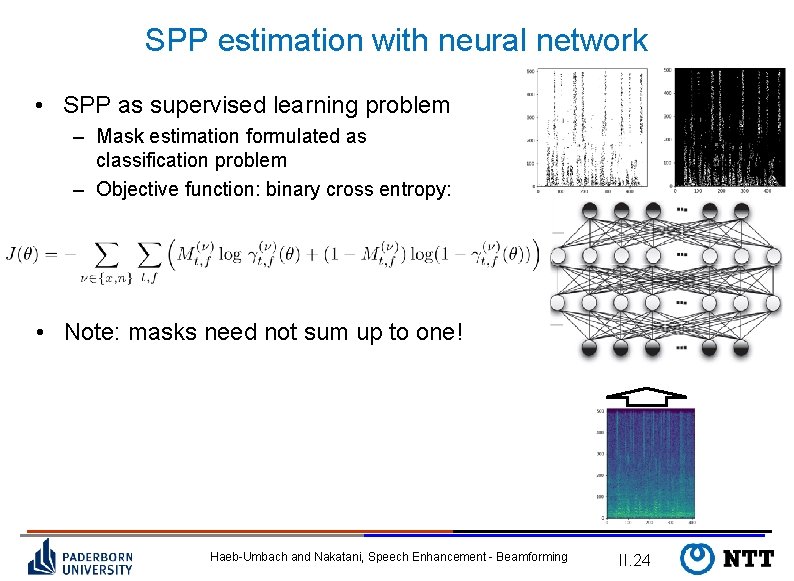
SPP estimation with neural network • SPP as supervised learning problem – Mask estimation formulated as classification problem – Objective function: binary cross entropy: • Note: masks need not sum up to one! Haeb-Umbach and Nakatani, Speech Enhancement - Beamforming II. 24
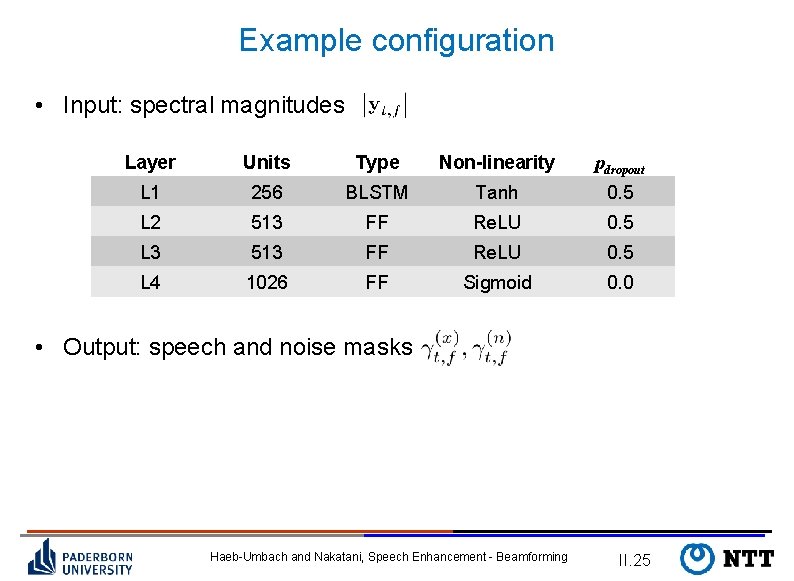
Example configuration • Input: spectral magnitudes Layer Units Type Non-linearity pdropout L 1 256 BLSTM Tanh 0. 5 L 2 513 FF Re. LU 0. 5 L 3 513 FF Re. LU 0. 5 L 4 1026 FF Sigmoid 0. 0 • Output: speech and noise masks Haeb-Umbach and Nakatani, Speech Enhancement - Beamforming II. 25
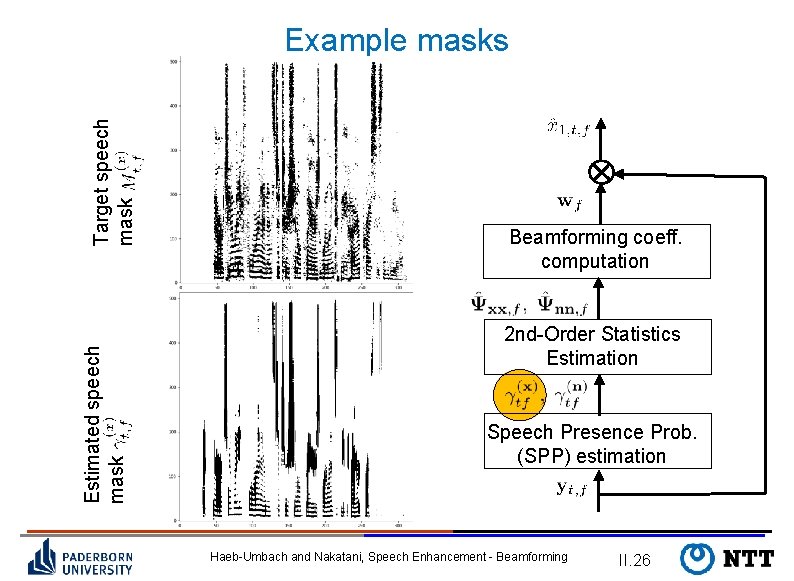
Estimated speech mask Target speech mask Example masks Beamforming coeff. computation 2 nd-Order Statistics Estimation Speech Presence Prob. (SPP) estimation Haeb-Umbach and Nakatani, Speech Enhancement - Beamforming II. 26
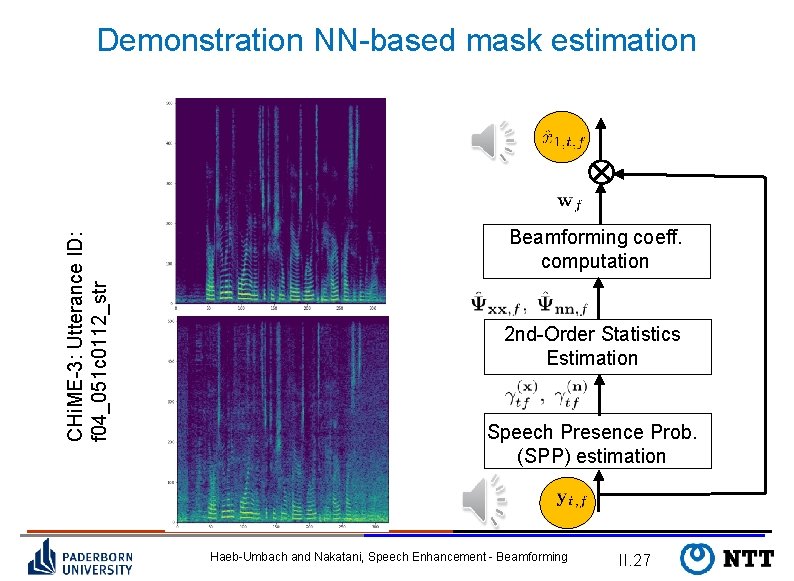
CHi. ME-3: Utterance ID: f 04_051 c 0112_str Demonstration NN-based mask estimation Beamforming coeff. computation 2 nd-Order Statistics Estimation Speech Presence Prob. (SPP) estimation Haeb-Umbach and Nakatani, Speech Enhancement - Beamforming II. 27
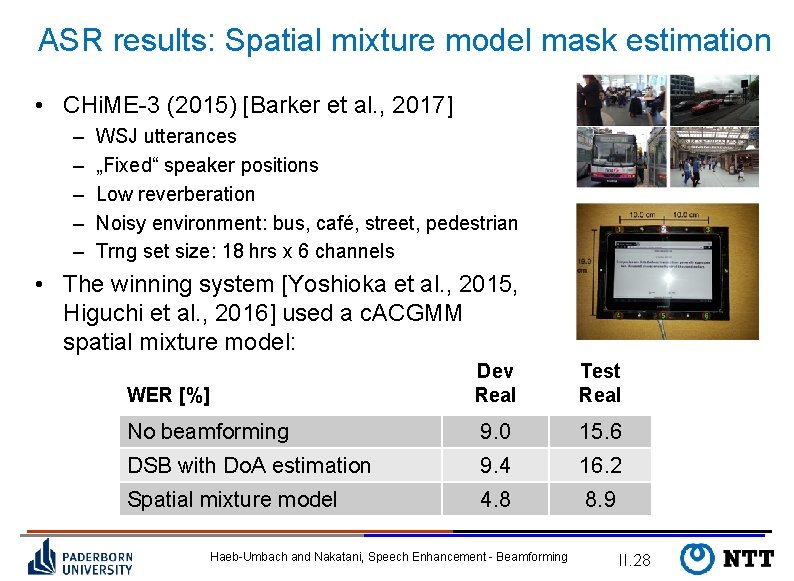
ASR results: Spatial mixture model mask estimation • CHi. ME-3 (2015) [Barker et al. , 2017] – – – WSJ utterances „Fixed“ speaker positions Low reverberation Noisy environment: bus, café, street, pedestrian Trng set size: 18 hrs x 6 channels • The winning system [Yoshioka et al. , 2015, Higuchi et al. , 2016] used a c. ACGMM spatial mixture model: WER [%] Dev Real Test Real No beamforming 9. 0 15. 6 DSB with Do. A estimation 9. 4 16. 2 Spatial mixture model 4. 8 8. 9 Haeb-Umbach and Nakatani, Speech Enhancement - Beamforming II. 28
![ASR results: Neural network mask estimation • CHi. ME-3 [Heymann et al. , 2015]](http://slidetodoc.com/presentation_image_h2/766630922f7d87ef57a74c1d242c4d10/image-29.jpg "ASR results: Neural network mask estimation • CHi. ME-3 [Heymann et al. , 2015]")
ASR results: Neural network mask estimation • CHi. ME-3 [Heymann et al. , 2015] – Absolute WER values not comparable with last slide (different acoustic model, language model, data augmentation) WER [%] Dev Real Test Real No beamforming 18. 7 33. 2 NN supported beamforming 10. 4 16. 5 • CHi. ME-4 (2016): – All top 5 systems used mask-based beamforming (either NN or spatial mixture model) Haeb-Umbach and Nakatani, Speech Enhancement - Beamforming II. 29
Extensions • Spatial mixture models – Other mixture models, e. g. , Watson MM [Tran Vu and Haeb-Umbach, 2010] – On test utterance, with NN-based masks as priors [Nakatani et al. , 2017] • NN-Supported Beamforming – Cross-channel features, e. g. , [Liu et al. , 2018] – Block-online processing, e. g. , [Boeddeker et al. , 2018] – Used for dereverberation [Heymann et al. , 2017 b] Haeb-Umbach and Nakatani, Speech Enhancement - Beamforming II. 30
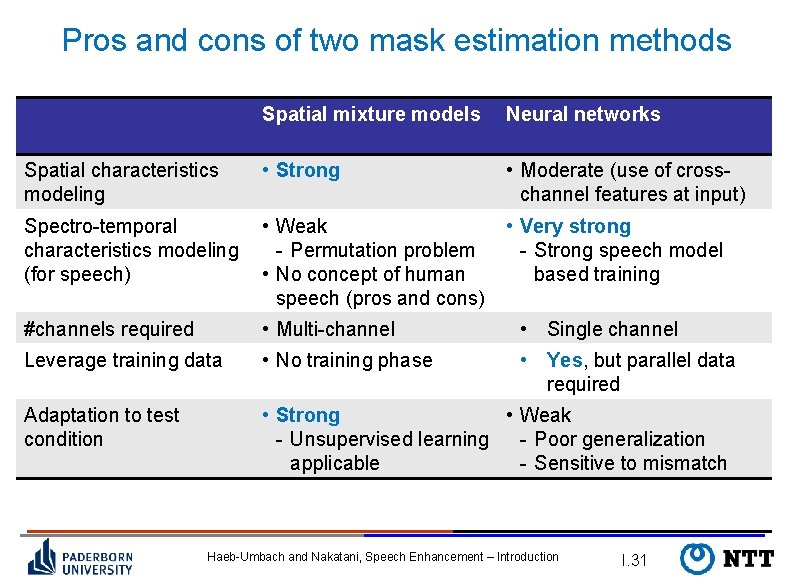
Pros and cons of two mask estimation methods Spatial mixture models Neural networks Spatial characteristics modeling • Strong • Moderate (use of crosschannel features at input) Spectro-temporal characteristics modeling (for speech) • Weak - Permutation problem • No concept of human speech (pros and cons) • Very strong - Strong speech model based training #channels required • Multi-channel • Single channel Leverage training data • No training phase • Yes, but parallel data required Adaptation to test condition • Strong • Weak - Unsupervised learning - Poor generalization applicable - Sensitive to mismatch Haeb-Umbach and Nakatani, Speech Enhancement – Introduction I. 31
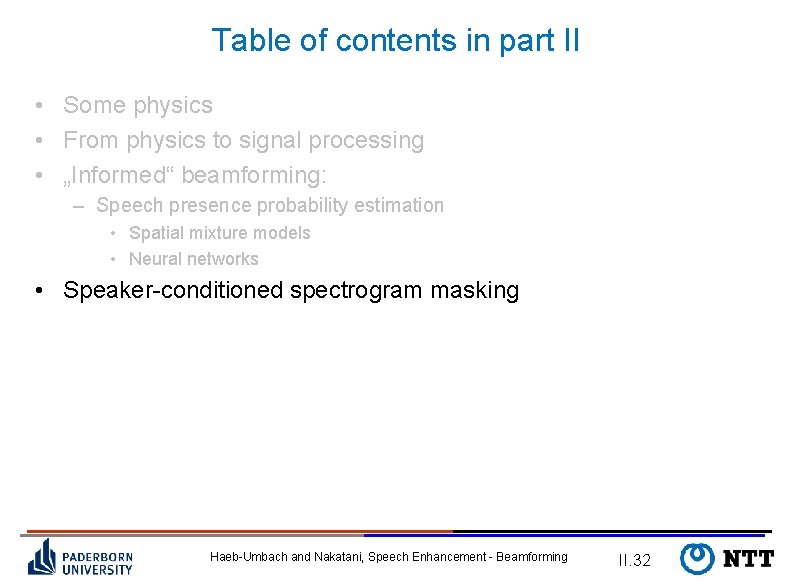
Table of contents in part II • Some physics • From physics to signal processing • „Informed“ beamforming: – Speech presence probability estimation • Spatial mixture models • Neural networks • Speaker-conditioned spectrogram masking Haeb-Umbach and Nakatani, Speech Enhancement - Beamforming II. 32
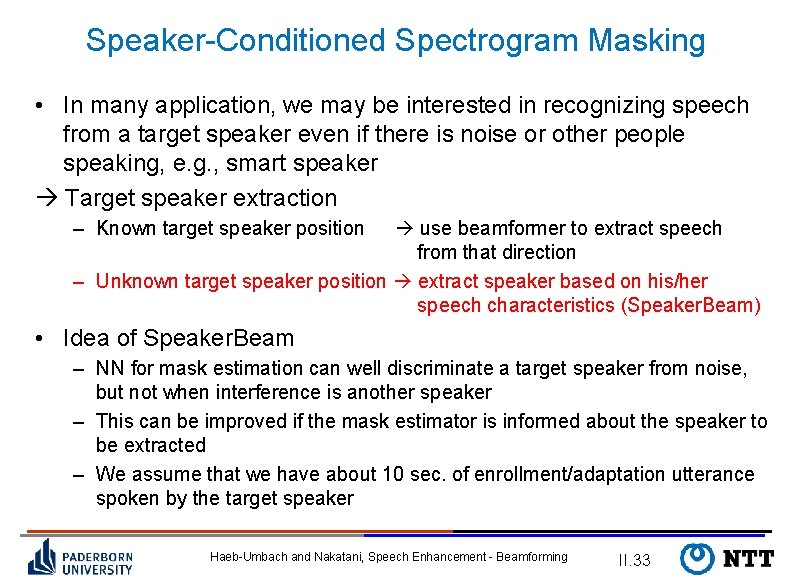
Speaker-Conditioned Spectrogram Masking • In many application, we may be interested in recognizing speech from a target speaker even if there is noise or other people speaking, e. g. , smart speaker Target speaker extraction – Known target speaker position use beamformer to extract speech from that direction – Unknown target speaker position extract speaker based on his/her speech characteristics (Speaker. Beam) • Idea of Speaker. Beam – NN for mask estimation can well discriminate a target speaker from noise, but not when interference is another speaker – This can be improved if the mask estimator is informed about the speaker to be extracted – We assume that we have about 10 sec. of enrollment/adaptation utterance spoken by the target speaker Haeb-Umbach and Nakatani, Speech Enhancement - Beamforming II. 33
![Speaker. Beam [Zmolikova et al. , 2017] • – Drive NN to output mask](http://slidetodoc.com/presentation_image_h2/766630922f7d87ef57a74c1d242c4d10/image-34.jpg "Speaker. Beam [Zmolikova et al. , 2017] • – Drive NN to output mask")
Speaker. Beam [Zmolikova et al. , 2017] • – Drive NN to output mask for the target speaker only, given target speaker embedding – Different implementations possible, e. g. factorized layer, scaling, etc. Time Frequency mask of the target speaker Auxiliary network Adaptation layer Speech mixture Adaptation layer Speaker embedding • – Compute speaker embedding given the enrollment/adaptation utterance – Implemented using sequence summary network [Vesely et al. 016] – Jointly optimized with mask estimation NN Time avg. Target Speaker Auxiliary network • Speaker. Beam performs 1 ch processing to compute mask, but it can be combined with beamforming for multi-ch processing Haeb-Umbach and Nakatani, Speech Enhancement – Beamforming II. 34
![Results [Zmolikova et al. , 2019] • WSJ 2 mix-MC – Artificial 2 -speaker](http://slidetodoc.com/presentation_image_h2/766630922f7d87ef57a74c1d242c4d10/image-35.jpg "Results [Zmolikova et al. , 2019] • WSJ 2 mix-MC – Artificial 2 -speaker")
Results [Zmolikova et al. , 2019] • WSJ 2 mix-MC – Artificial 2 -speaker mixtures from WSJ utterances – 1 ch no reverberation – 8 channels with reverberation T 60 = 0. 2 – 0. 6 s 1 ch (no reverb) 8 ch (w/ reverb) Single speaker 12. 2 16. 2 Mixtures 73. 4 85. 2 Speaker. Beam (1 ch) 30. 6 - Speaker. Beam + Beamformer - 22. 5 Speaker. Beam + Beamformer - 20. 7 WER [%] (w/ AM joint training) Haeb-Umbach and Nakatani, Speech Enhancement - Beamforming II. 35
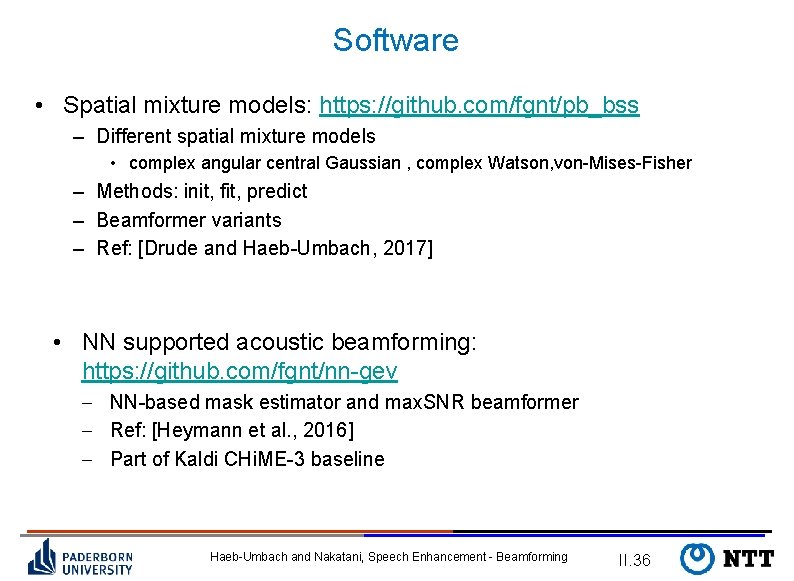
Software • Spatial mixture models: https: //github. com/fgnt/pb_bss – Different spatial mixture models • complex angular central Gaussian , complex Watson, von-Mises-Fisher – Methods: init, fit, predict – Beamformer variants – Ref: [Drude and Haeb-Umbach, 2017] • NN supported acoustic beamforming: https: //github. com/fgnt/nn-gev - NN-based mask estimator and max. SNR beamformer - Ref: [Heymann et al. , 2016] - Part of Kaldi CHi. ME-3 baseline Haeb-Umbach and Nakatani, Speech Enhancement - Beamforming II. 36
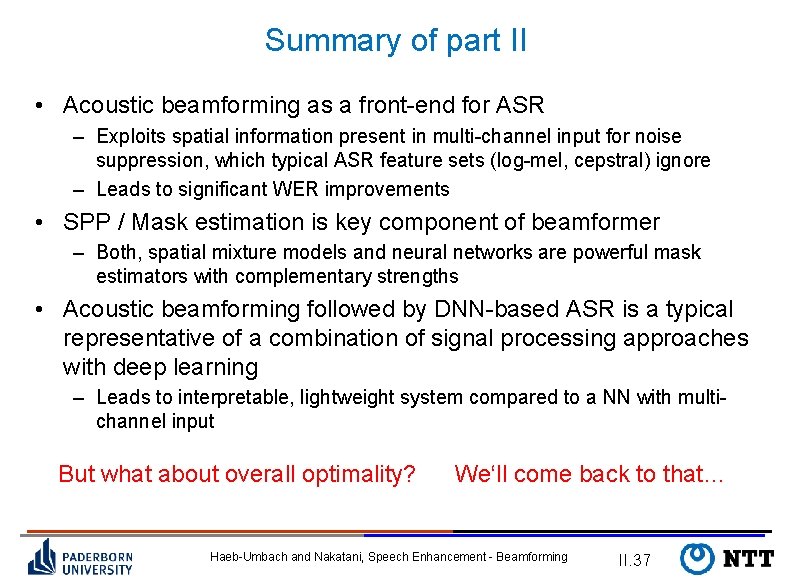
Summary of part II • Acoustic beamforming as a front-end for ASR – Exploits spatial information present in multi-channel input for noise suppression, which typical ASR feature sets (log-mel, cepstral) ignore – Leads to significant WER improvements • SPP / Mask estimation is key component of beamformer – Both, spatial mixture models and neural networks are powerful mask estimators with complementary strengths • Acoustic beamforming followed by DNN-based ASR is a typical representative of a combination of signal processing approaches with deep learning – Leads to interpretable, lightweight system compared to a NN with multichannel input But what about overall optimality? We‘ll come back to that… Haeb-Umbach and Nakatani, Speech Enhancement - Beamforming II. 37
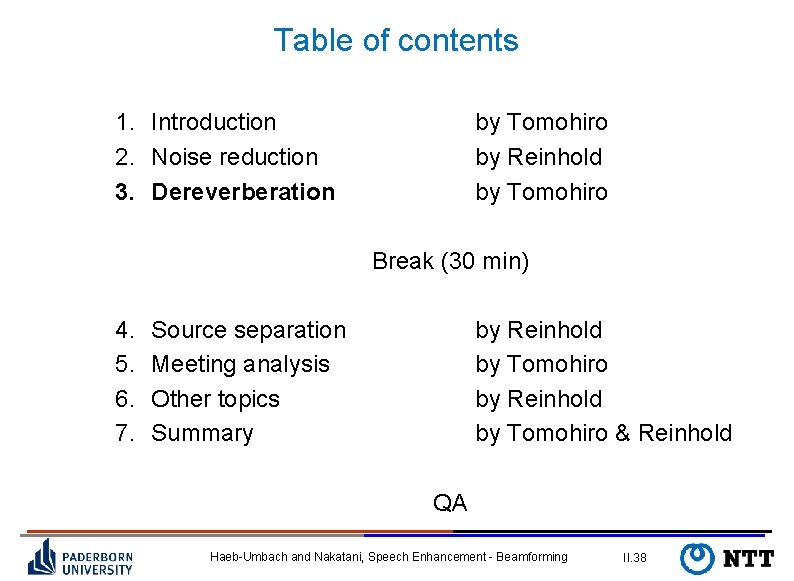
Table of contents 1. Introduction 2. Noise reduction 3. Dereverberation by Tomohiro by Reinhold by Tomohiro Break (30 min) 4. 5. 6. 7. Source separation Meeting analysis Other topics Summary by Reinhold by Tomohiro & Reinhold QA Haeb-Umbach and Nakatani, Speech Enhancement - Beamforming II. 38
- Slides: 38