
Part II General Integer Programming II 1 Theory
- Slides: 16
Part II General Integer Programming II. 1 Theory of Valid Inequalities 1
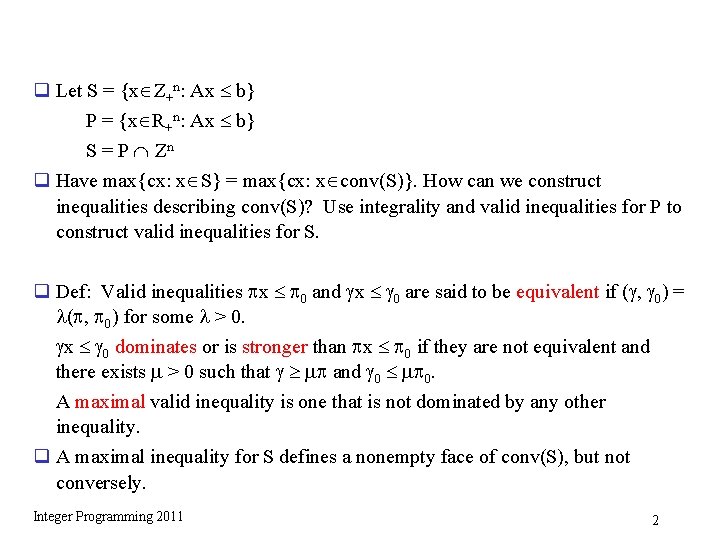
q Let S = {x Z+n: Ax b} P = {x R+n: Ax b} S = P Zn q Have max{cx: x S} = max{cx: x conv(S)}. How can we construct inequalities describing conv(S)? Use integrality and valid inequalities for P to construct valid inequalities for S. q Def: Valid inequalities x 0 and x 0 are said to be equivalent if ( , 0) = ( , 0) for some > 0. x 0 dominates or is stronger than x 0 if they are not equivalent and there exists > 0 such that and 0 0. A maximal valid inequality is one that is not dominated by any other inequality. q A maximal inequality for S defines a nonempty face of conv(S), but not conversely. Integer Programming 2011 2
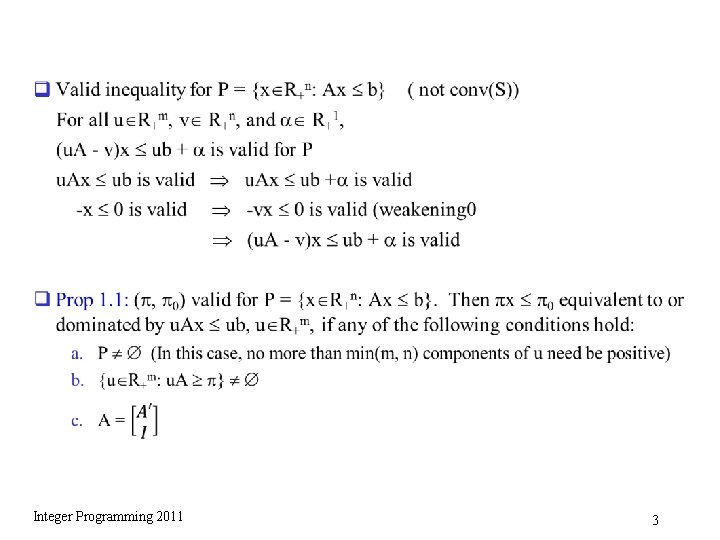
q Integer Programming 2011 3
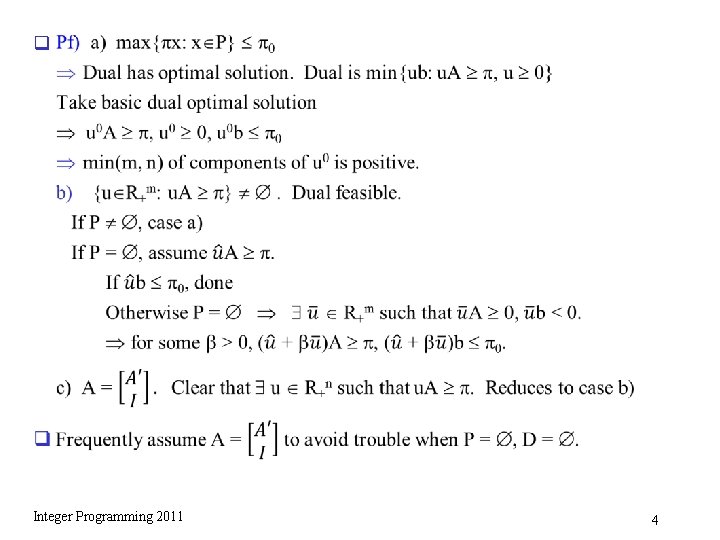
q Integer Programming 2011 4
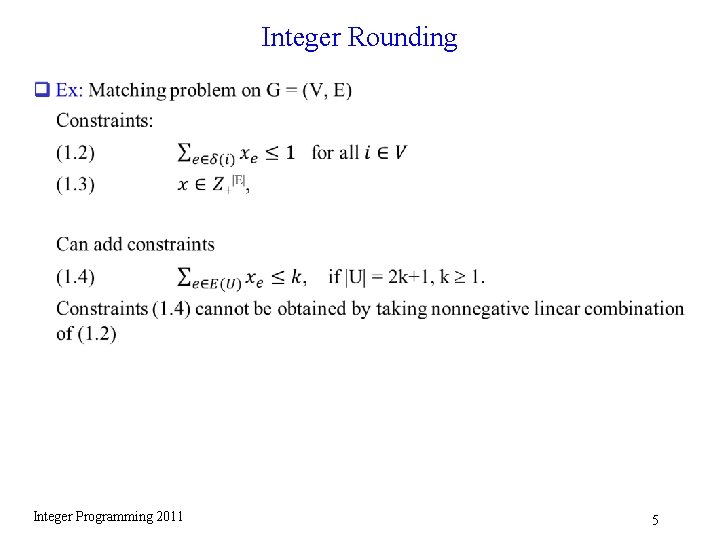
Integer Rounding q Integer Programming 2011 5
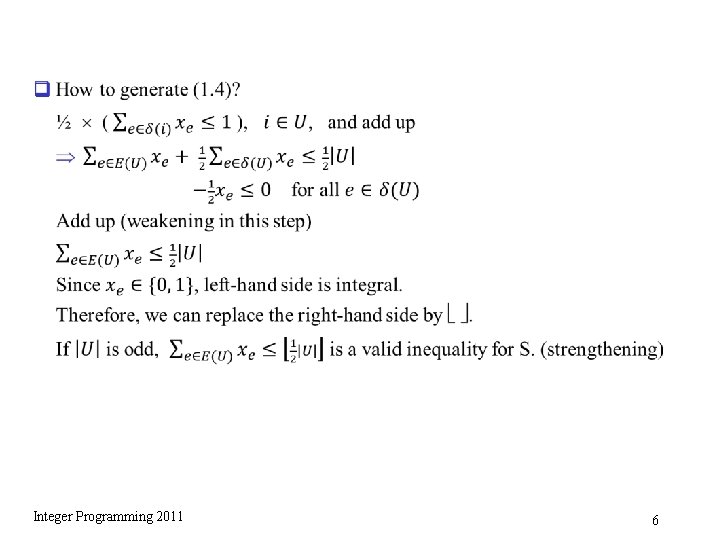
q Integer Programming 2011 6
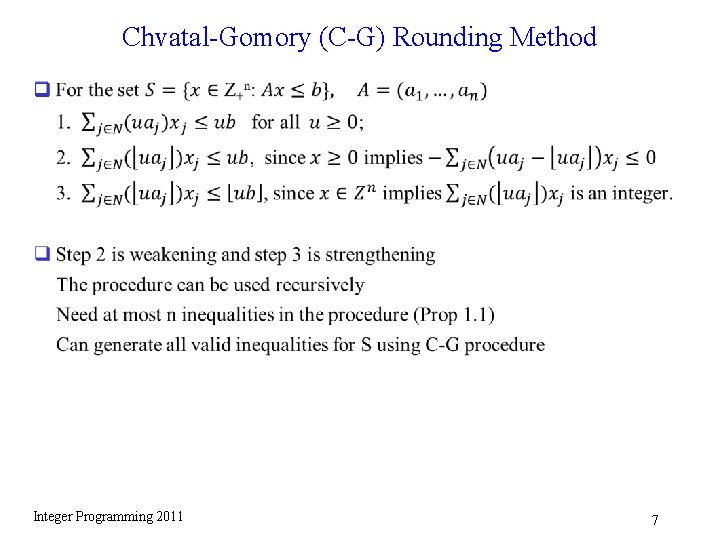
Chvatal-Gomory (C-G) Rounding Method q Integer Programming 2011 7
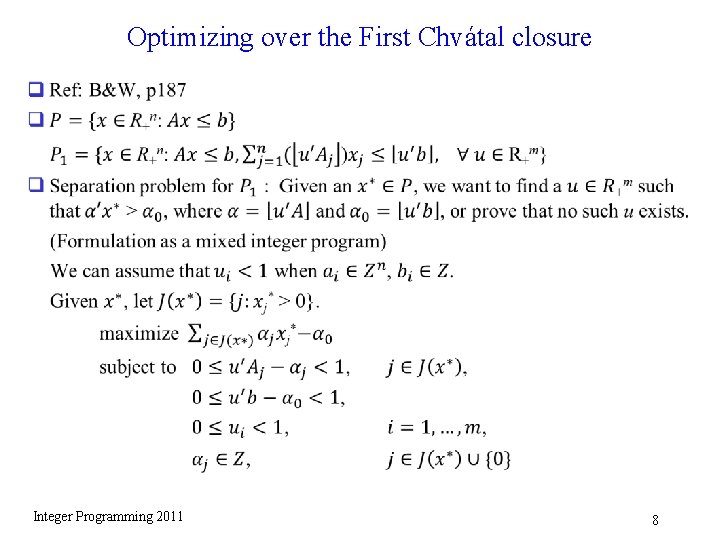
Optimizing over the First Chvátal closure q Integer Programming 2011 8
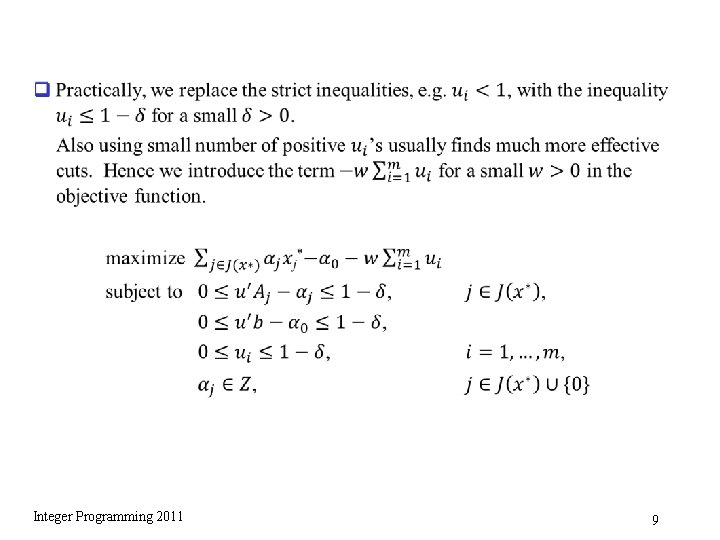
q Integer Programming 2011 9
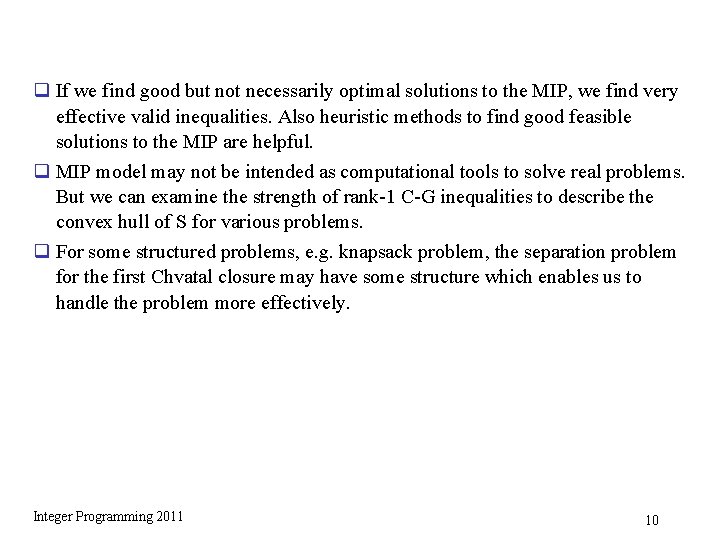
q If we find good but not necessarily optimal solutions to the MIP, we find very effective valid inequalities. Also heuristic methods to find good feasible solutions to the MIP are helpful. q MIP model may not be intended as computational tools to solve real problems. But we can examine the strength of rank-1 C-G inequalities to describe the convex hull of S for various problems. q For some structured problems, e. g. knapsack problem, the separation problem for the first Chvatal closure may have some structure which enables us to handle the problem more effectively. Integer Programming 2011 10
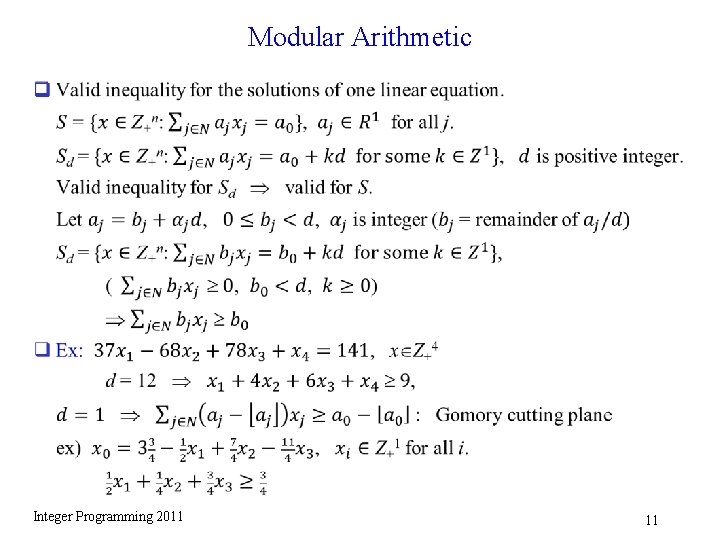
Modular Arithmetic q Integer Programming 2011 11
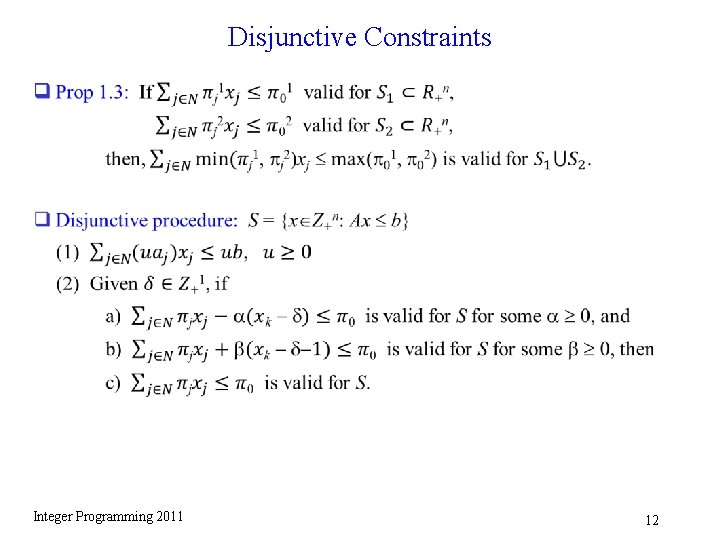
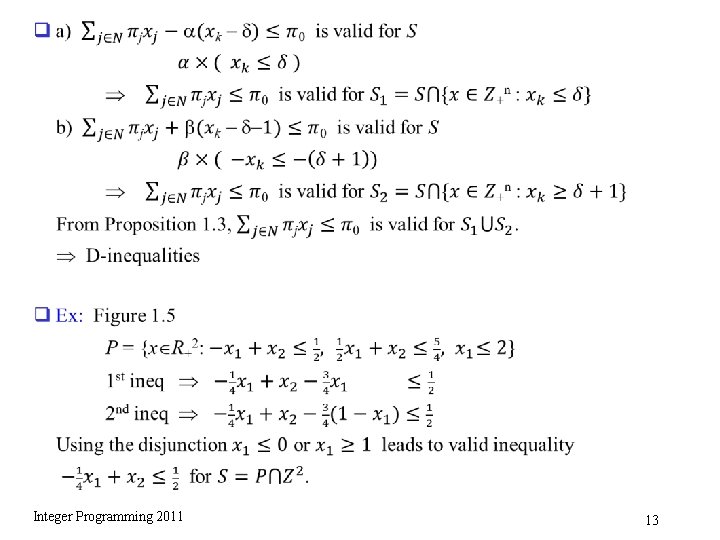
Disjunctive Constraints q Integer Programming 2011 12
q Integer Programming 2011 13
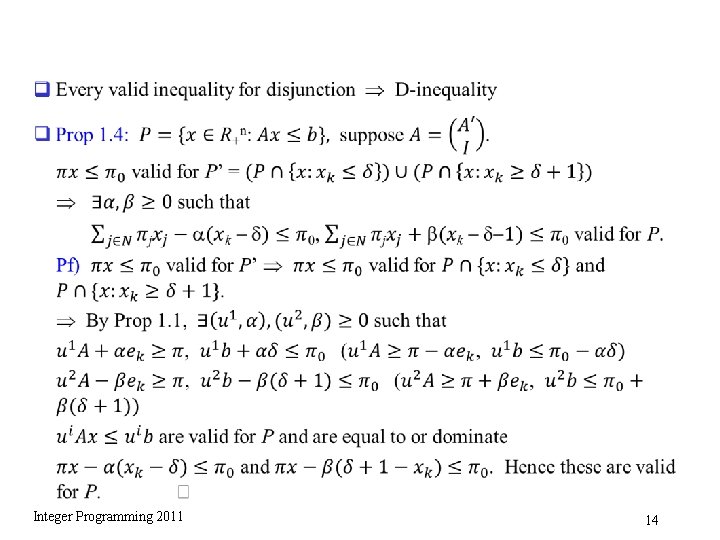
q Integer Programming 2011 14
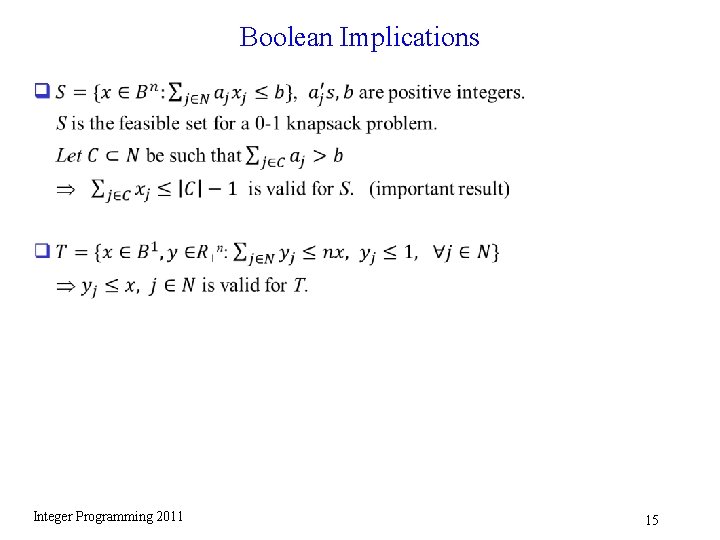
Boolean Implications q Integer Programming 2011 15
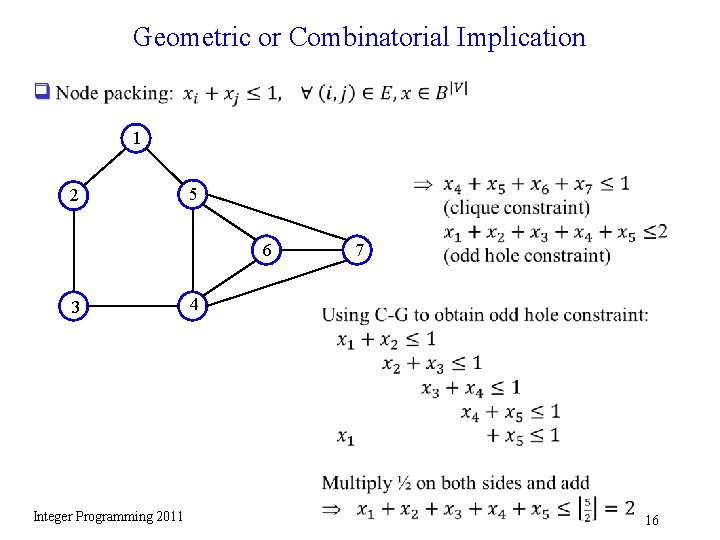
Geometric or Combinatorial Implication q 1 2 5 6 3 Integer Programming 2011 7 4 16