
Part I The AngloSaxon Period I The Making
- Slides: 17
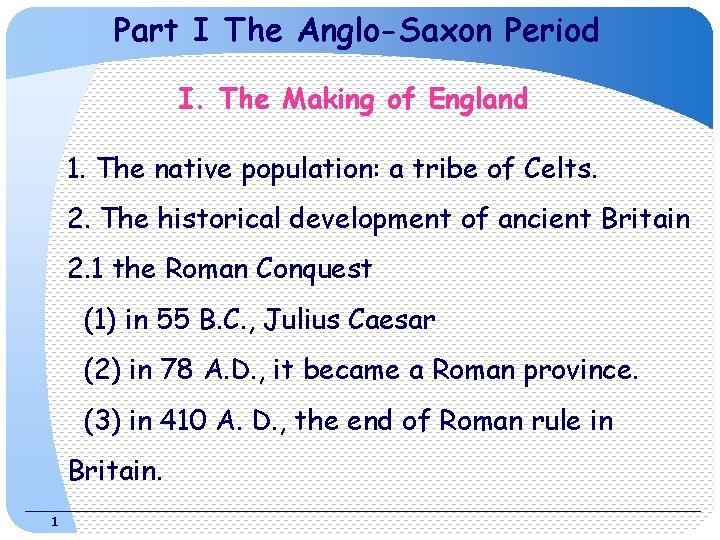
Part I The Anglo-Saxon Period I. The Making of England 1. The native population: a tribe of Celts. 2. The historical development of ancient Britain 2. 1 the Roman Conquest (1) in 55 B. C. , Julius Caesar (2) in 78 A. D. , it became a Roman province. (3) in 410 A. D. , the end of Roman rule in Britain. 1
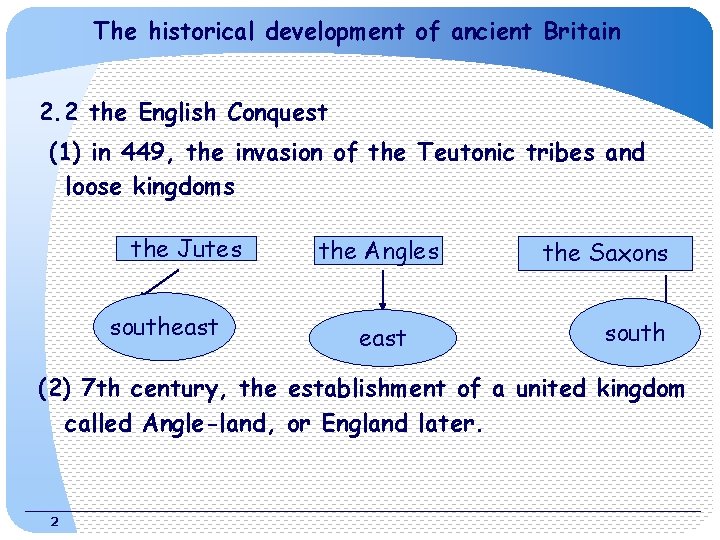
The historical development of ancient Britain 2. 2 the English Conquest (1) in 449, the invasion of the Teutonic tribes and loose kingdoms the Jutes southeast the Angles east the Saxons south (2) 7 th century, the establishment of a united kingdom called Angle-land, or England later. 2
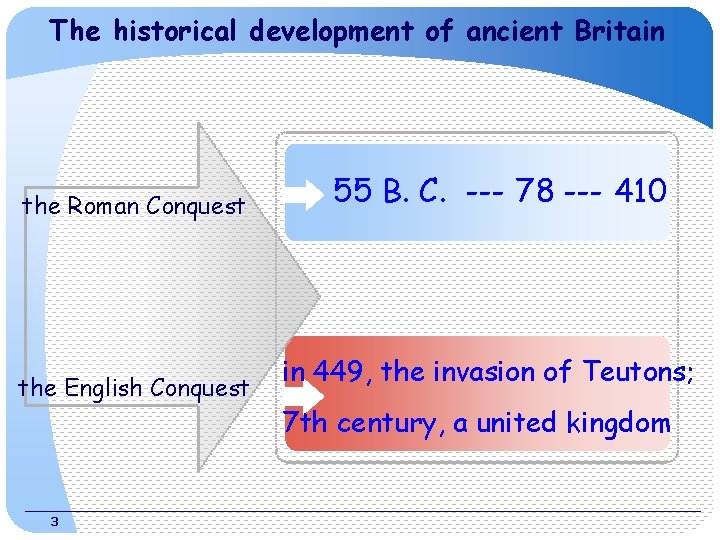
The historical development of ancient Britain the Roman Conquest the English Conquest 3 55 B. C. --- 78 --- 410 in 449, the invasion of Teutons; 7 th century, a united kingdom
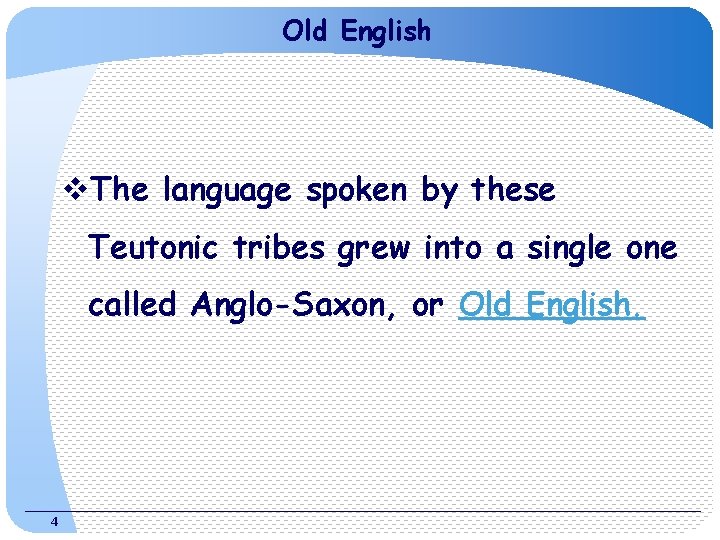
Old English v. The language spoken by these Teutonic tribes grew into a single one called Anglo-Saxon, or Old English. 4
Old English (1) the Germanic language spoken in the southern part of the island of Britain before the Norman Conquest in 1066; (2) the ancestor of the Modern English Middle English (about 1100 -1500? ) Modern English (about 1500 -present) 5
The social condition of the Anglo-Saxons 1. in a tribal society; 2. The Anglo-Saxon period witnessed a transition from a tribal society to feudalism. 6
II. The Literature in the Anglo-Saxon Period 1. The Anglo-Saxon religious belief 1. 1 They were heathen. “Religion arose in very primitive times from erroneous, primitive conceptions of men about their own nature and external nature surrounding them. ” --- Engels 7
1. 2 England’s Christianization (1) in 579, the arrival of a Christian mission; (2) By the end of the 7 th century, all England had been christianized. 8
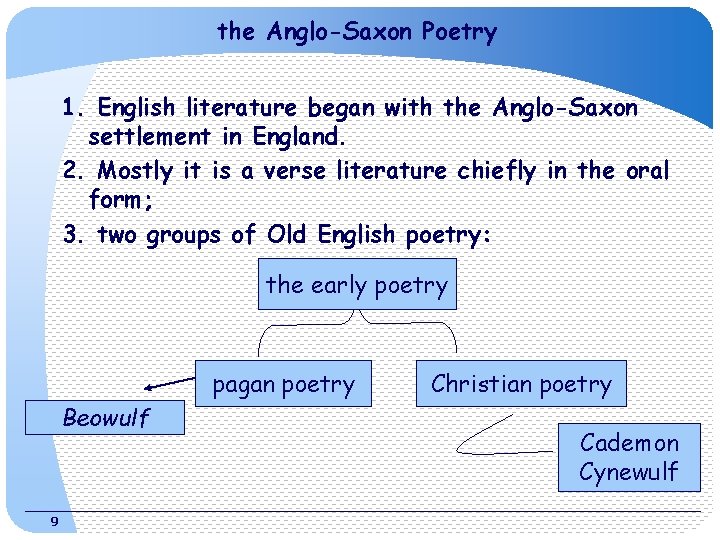
the Anglo-Saxon Poetry 1. English literature began with the Anglo-Saxon settlement in England. 2. Mostly it is a verse literature chiefly in the oral form; 3. two groups of Old English poetry: the early poetry pagan poetry Beowulf 9 Christian poetry Cademon Cynewulf
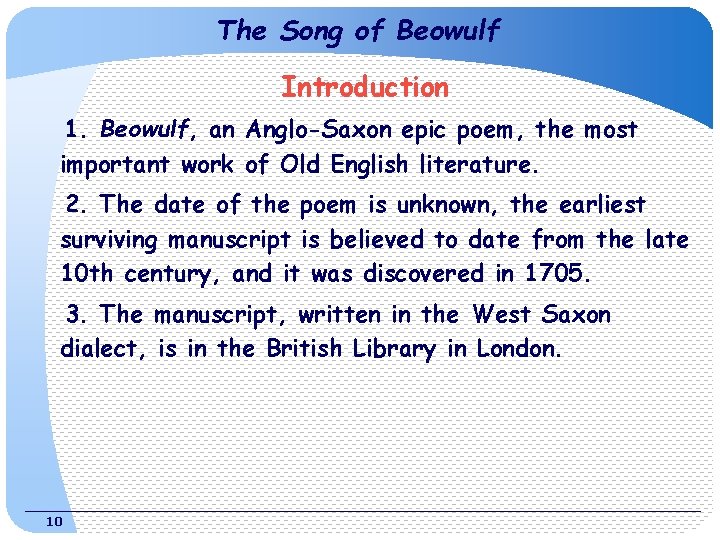
The Song of Beowulf Introduction 1. Beowulf, an Anglo-Saxon epic poem, the most important work of Old English literature. 2. The date of the poem is unknown, the earliest surviving manuscript is believed to date from the late 10 th century, and it was discovered in 1705. 3. The manuscript, written in the West Saxon dialect, is in the British Library in London. 10
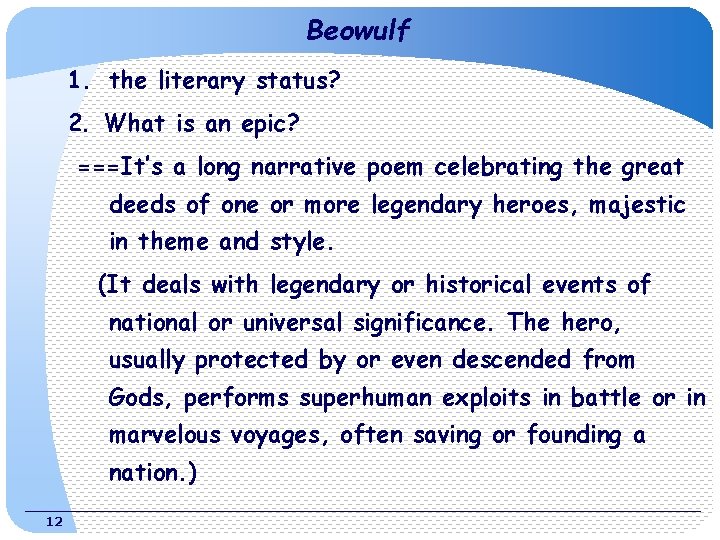
Beowulf 1. the literary status? 2. What is an epic? ===It’s a long narrative poem celebrating the great deeds of one or more legendary heroes, majestic in theme and style. (It deals with legendary or historical events of national or universal significance. The hero, usually protected by or even descended from Gods, performs superhuman exploits in battle or in marvelous voyages, often saving or founding a nation. ) 12
Beowulf Example of epics: Homer’s Epics: Iliad Odyssey 13
Beowulf 3. Features of the poem (1) alliteration (2) metaphor (3) understatements 14
4. theme of Beowulf? Thematically, the poem presents a vivid picture of how the primitive people wage struggles against the hostile forces of the natural world under a wise and mighty leader. 15
5. the heroic qualities of Beowulf? wisdom; strength & courage; responsibility ready death for his people. . . 16
17