
Part I Neurological Exam Part II Coma Connie
- Slides: 29
Part I: Neurological Exam Part II: Coma Connie Chen Neurology Consultants of Dallas
Part I Neurological Exam
Neurological Exam: Some Basics n Purpose of exam: differential diagnosis n The mantra: – History comes first! – Exam is next best option. – “Pan-scanning” is a poor substitute for exam. – “Pan-scanning” results in “missing the boat”.
Neurological Exam: More Basics n Lecture goal: – Moving past medical school --see the forests, not the trees. – Tailor your exam to meet your needs. – Full neurological exams will waste your time?
Case example n 65 yo with low back pain. n Pain radiates down right leg. n He notes new acute weakness in right leg. n Differential? n How can the exam support/aid in diagnosis?
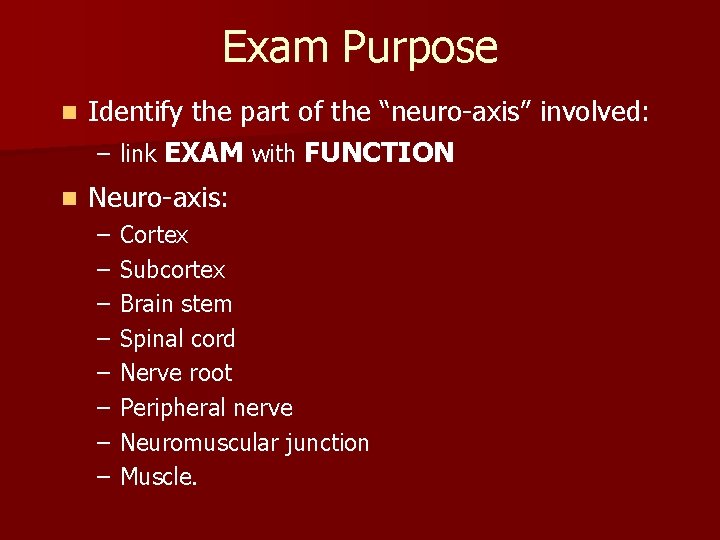
Exam Purpose n Identify the part of the “neuro-axis” involved: – link EXAM with FUNCTION n Neuro-axis: – – – – Cortex Subcortex Brain stem Spinal cord Nerve root Peripheral nerve Neuromuscular junction Muscle.
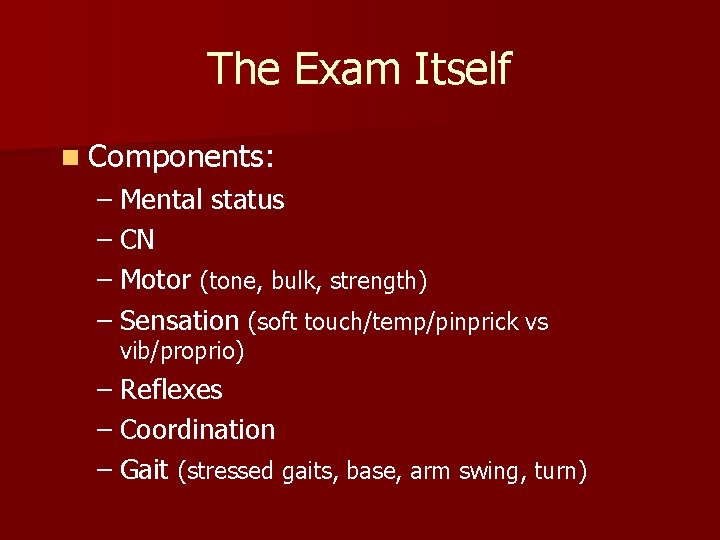
The Exam Itself n Components: – Mental status – CN – Motor (tone, bulk, strength) – Sensation (soft touch/temp/pinprick vs vib/proprio) – Reflexes – Coordination – Gait (stressed gaits, base, arm swing, turn)
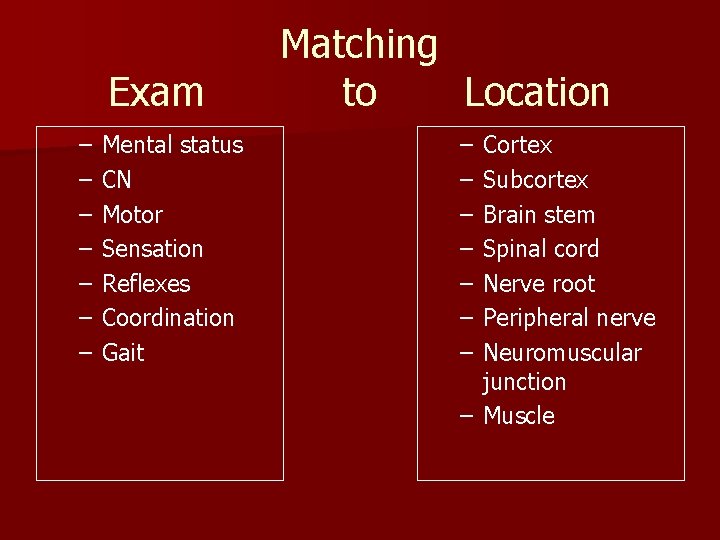
Exam – – – – Mental status CN Motor Sensation Reflexes Coordination Gait Matching to Location – – – – Cortex Subcortex Brain stem Spinal cord Nerve root Peripheral nerve Neuromuscular junction – Muscle
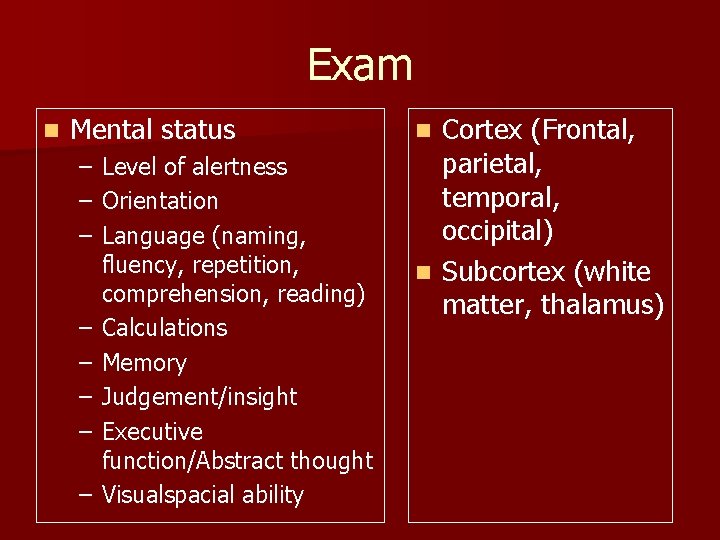
Exam n Mental status – – – – Level of alertness Orientation Language (naming, fluency, repetition, comprehension, reading) Calculations Memory Judgement/insight Executive function/Abstract thought Visualspacial ability Cortex (Frontal, parietal, temporal, occipital) n Subcortex (white matter, thalamus) n
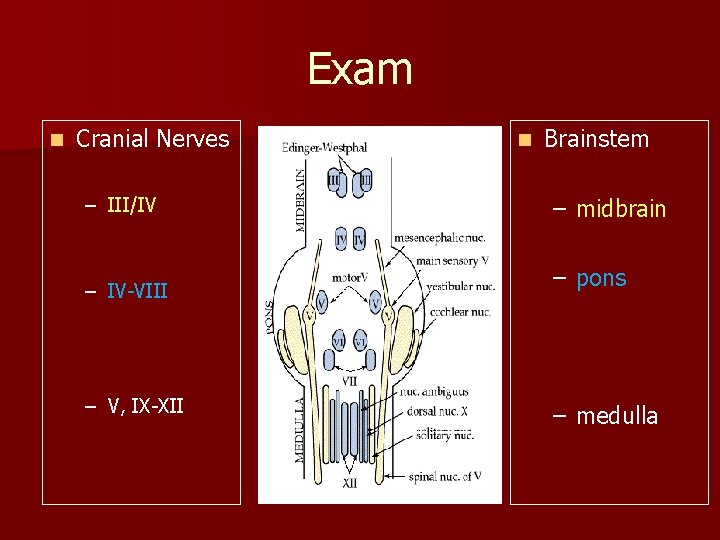
Exam n Cranial Nerves – III/IV – IV-VIII – V, IX-XII n Brainstem – midbrain – pons – medulla
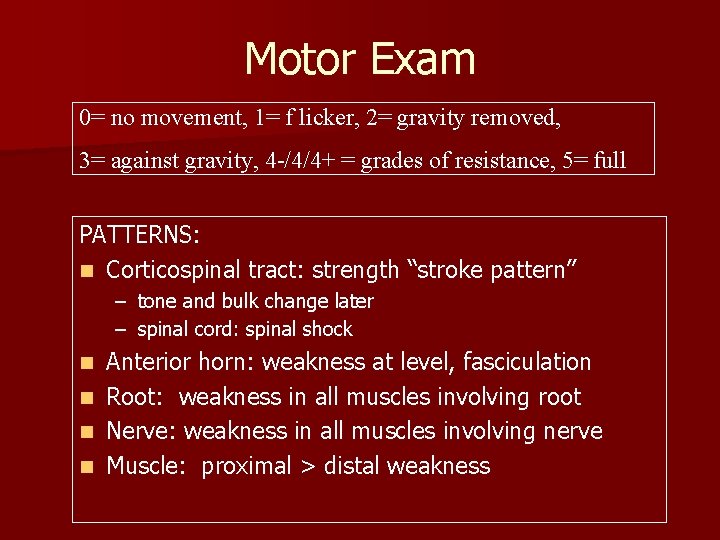
Motor Exam 0= no movement, 1= f licker, 2= gravity removed, 3= against gravity, 4 -/4/4+ = grades of resistance, 5= full PATTERNS: n Corticospinal tract: strength “stroke pattern” – tone and bulk change later – spinal cord: spinal shock n n Anterior horn: weakness at level, fasciculation Root: weakness in all muscles involving root Nerve: weakness in all muscles involving nerve Muscle: proximal > distal weakness
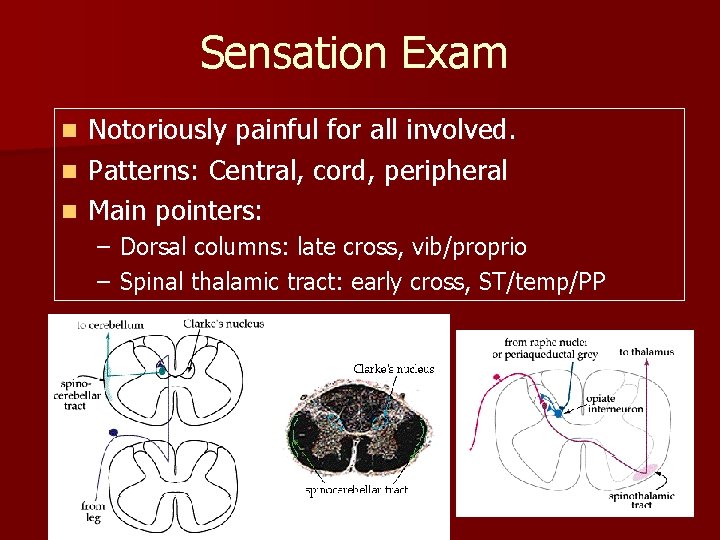
Sensation Exam Notoriously painful for all involved. n Patterns: Central, cord, peripheral n Main pointers: n – Dorsal columns: late cross, vib/proprio – Spinal thalamic tract: early cross, ST/temp/PP
Reflexes n n n 0: absent 1: present with distraction 2: present without distraction 3: spreads across more than one joint 4: Clonus- sustained and non-sustained. PATTERNS: n “UMN”: Brain, spine (before anterior horn) n “LMN”: Spine (after anterior horn), root, nerve
Coordination=Cerebellum n Rapid alternating movements (dysdiadokinesia) n Past pointing n Dysmetria: finger nose/heel to shin n ? ? romberg-- not really n Wide based stance n (nystagmus at primary gaze) n ***Pre-existing weakness can fool you
Gait n The best part of exam n Evaluates strength, coordination, sensation n look at arm swing, base of stance, steps, turn, n stressed gaits will bring out subtleties. n What are matching anatomical locations?
Case Revisited n 60 something yo with bilateral UE pain. n Weakness bilateral UE. n Differential? n Exam expectations?
Case Series n 67 yo fell off of a horse and has developed bilateral LE weakness over the course of days. n Differential? n Exam findings? n What other pertinent HPI questions would have helped?
Case series n 25 yo notes water feels “funny” on right hand, and then his right leg felt strange. n Differential? n Exam findings?
Case Series n 40 yo notes left face and arm feels funny since last night and notes left arm and leg weakness. n Differential? n Exam findings?
Case Series n 78 yo fell and couldn’t get up. “I knew I was going to get stuck [on the floor] for weeks now. ” Why is he weak? n Differential? n Exam findings?
Case Series n 26 yo notes stumbling when walking and an inability to make his jump shots with basketball over the course of 2 days. His toes tingle. n Differential? n Exam findings?
Case series n 74 yo wm notes left face and arm weakness that lasts only 30 minutes. Later that day she develops vertigo, slurred speech, and diplopia. She can’t walk because she feels “like I’m drunk. ” She has right carotid stenosis. Differential? n Exam findings? n Right carotid stenosis relevance? n
Part II: Coma
Coma Definition n State of sustained unconsciousness n Ascertained by exam
How Coma Happens n Structural causes: – Bilateral supratentorial disruption – Disruption of the RAS of the brainstem n Practical thoughts (linking history, exam, and structure): – “metabolic”causes affect brain globally – “Vascular” causes are not equal: unilateral carotid artery vs. vertebral artery vs. basilar artery.
Coma Prognostication n Gauging coma: – History – Exam – Ancillary studies n History cannot accurately predict outcome of coma.
Coma Prognostication n Ancillary studies/imaging cannot accurately ascertain coma emergence n Exception: – SSEP’s performed days 1 -3 after coma. – Absence of cortical response shows poor prognosis.
Coma Prognosis n Exam – Glascow coma score (eye opening, motor response, verbal response) rather useless in prognositication Better: – Motor: Command>purposeful>flexor>extensor>flaccid – Cranial nerves: present>absent – Roving eye movements > no spontaneous
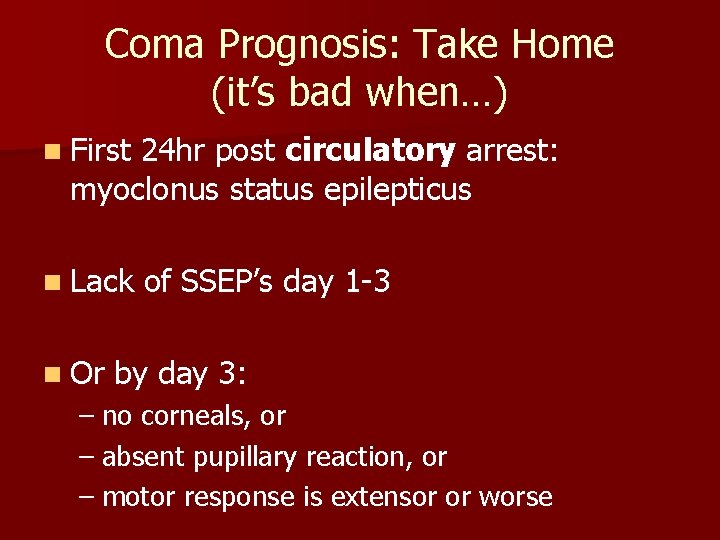
Coma Prognosis: Take Home (it’s bad when…) n First 24 hr post circulatory arrest: myoclonus status epilepticus n Lack n Or of SSEP’s day 1 -3 by day 3: – no corneals, or – absent pupillary reaction, or – motor response is extensor or worse