
Part I Mechanics Chapter 2 Newtons First Law
- Slides: 20
Part I: Mechanics Chapter 2 Newton’s First Law of Motion Physics 1 (Garcia) SJSU
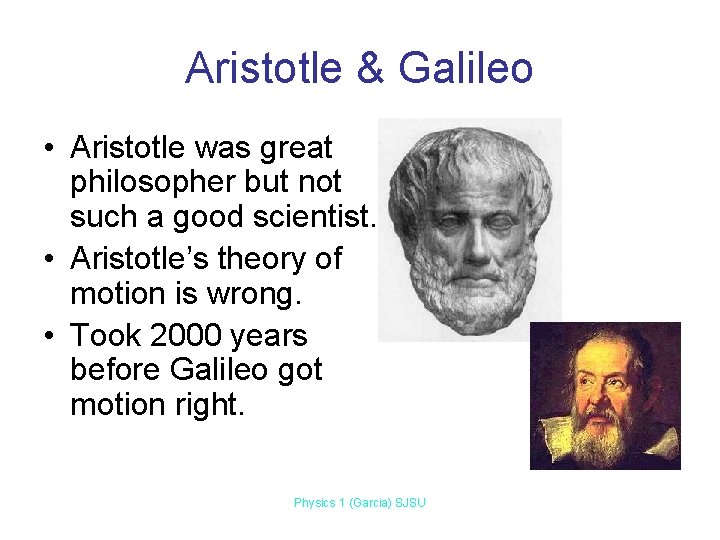
Aristotle & Galileo • Aristotle was great philosopher but not such a good scientist. • Aristotle’s theory of motion is wrong. • Took 2000 years before Galileo got motion right. Physics 1 (Garcia) SJSU
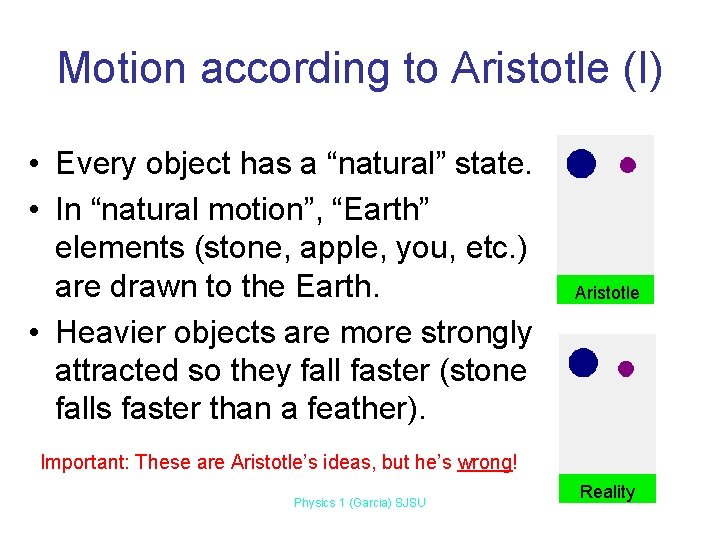
Motion according to Aristotle (I) • Every object has a “natural” state. • In “natural motion”, “Earth” elements (stone, apple, you, etc. ) are drawn to the Earth. • Heavier objects are more strongly attracted so they fall faster (stone falls faster than a feather). Aristotle Important: These are Aristotle’s ideas, but he’s wrong! Physics 1 (Garcia) SJSU Reality
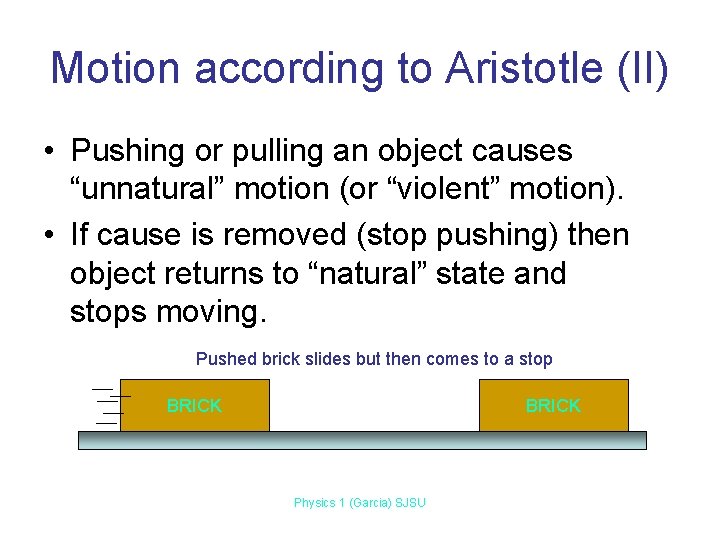
Motion according to Aristotle (II) • Pushing or pulling an object causes “unnatural” motion (or “violent” motion). • If cause is removed (stop pushing) then object returns to “natural” state and stops moving. Pushed brick slides but then comes to a stop BRICK Physics 1 (Garcia) SJSU
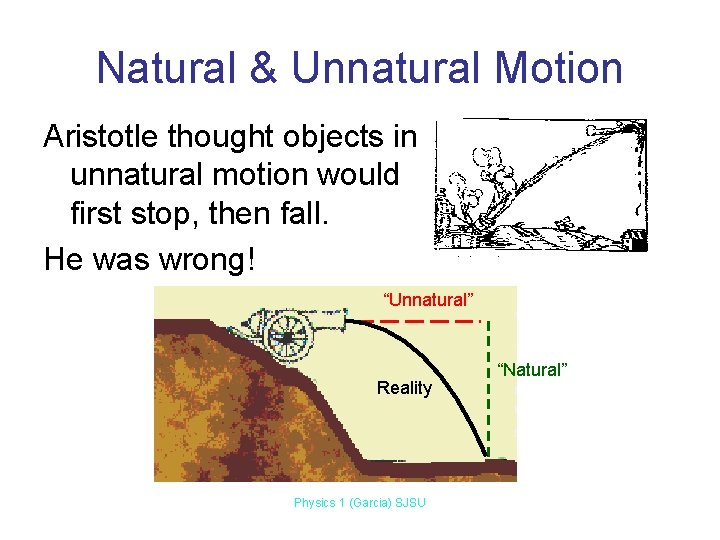
Natural & Unnatural Motion Aristotle thought objects in unnatural motion would first stop, then fall. He was wrong! “Unnatural” Reality Physics 1 (Garcia) SJSU “Natural”
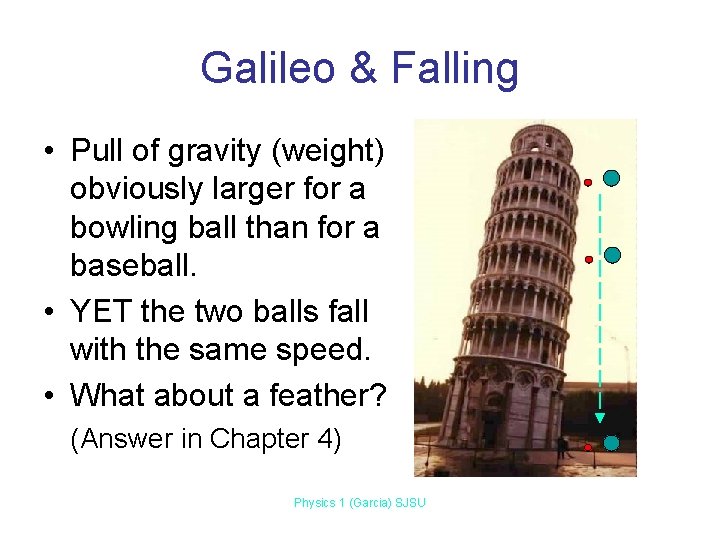
Galileo & Falling • Pull of gravity (weight) obviously larger for a bowling ball than for a baseball. • YET the two balls fall with the same speed. • What about a feather? (Answer in Chapter 4) Physics 1 (Garcia) SJSU
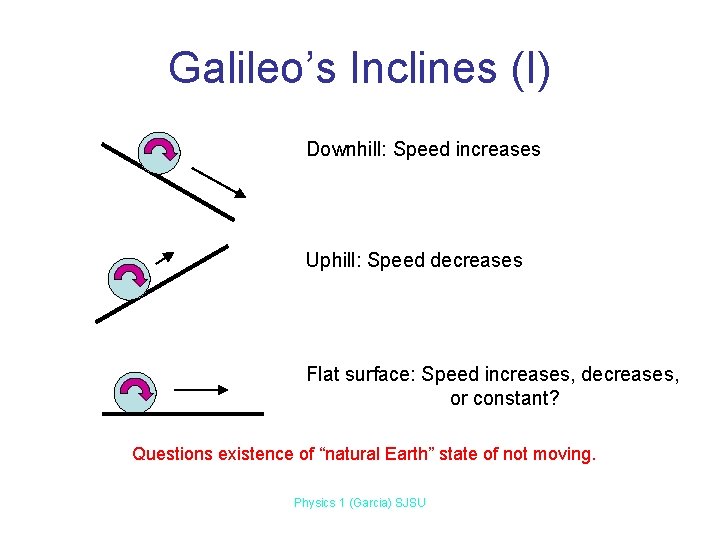
Galileo’s Inclines (I) Downhill: Speed increases Uphill: Speed decreases Flat surface: Speed increases, decreases, or constant? Questions existence of “natural Earth” state of not moving. Physics 1 (Garcia) SJSU
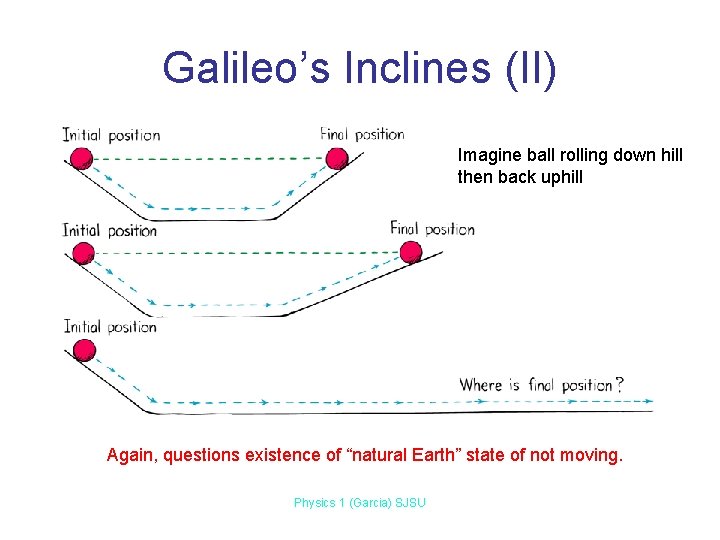
Galileo’s Inclines (II) Imagine ball rolling down hill then back uphill Again, questions existence of “natural Earth” state of not moving. Physics 1 (Garcia) SJSU
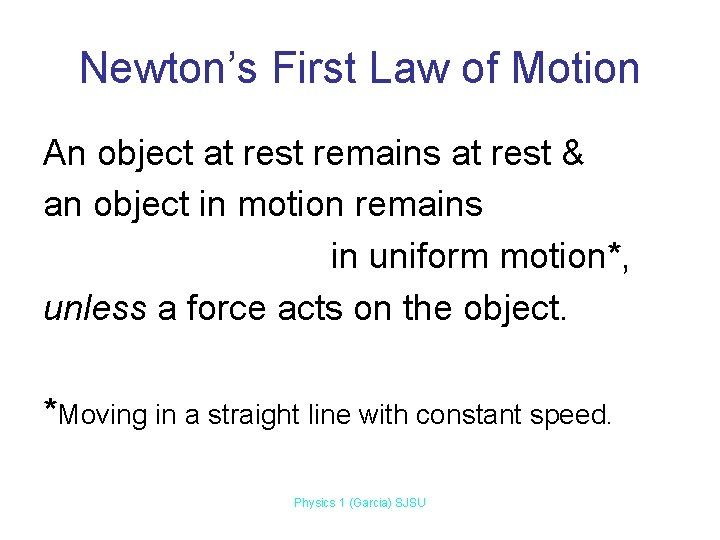
Newton’s First Law of Motion An object at rest remains at rest & an object in motion remains in uniform motion*, unless a force acts on the object. *Moving in a straight line with constant speed. Physics 1 (Garcia) SJSU
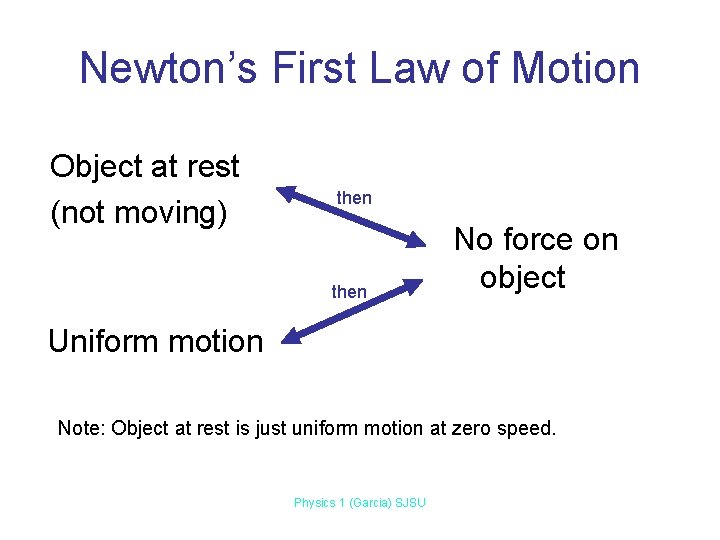
Newton’s First Law of Motion Object at rest (not moving) then No force on object Uniform motion Note: Object at rest is just uniform motion at zero speed. Physics 1 (Garcia) SJSU
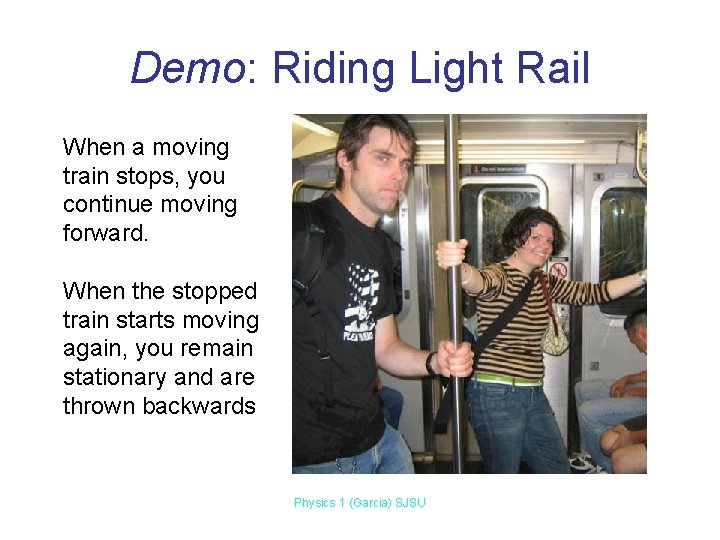
Demo: Riding Light Rail When a moving train stops, you continue moving forward. When the stopped train starts moving again, you remain stationary and are thrown backwards Physics 1 (Garcia) SJSU
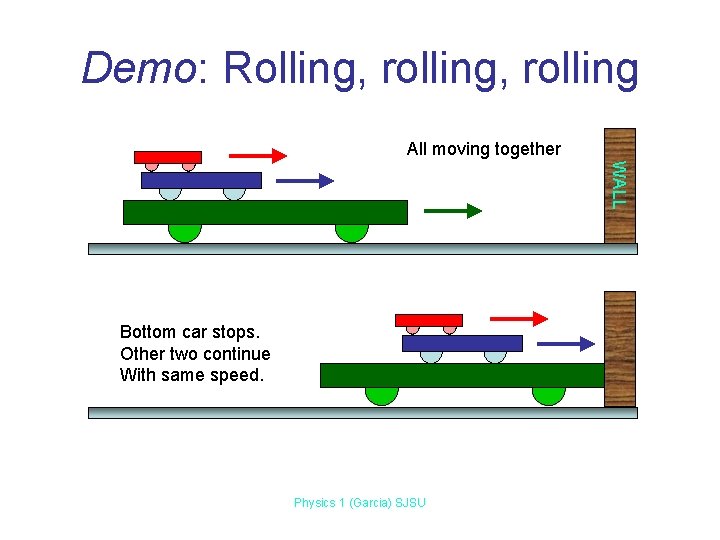
Demo: Rolling, rolling All moving together WALL Bottom car stops. Other two continue With same speed. Physics 1 (Garcia) SJSU
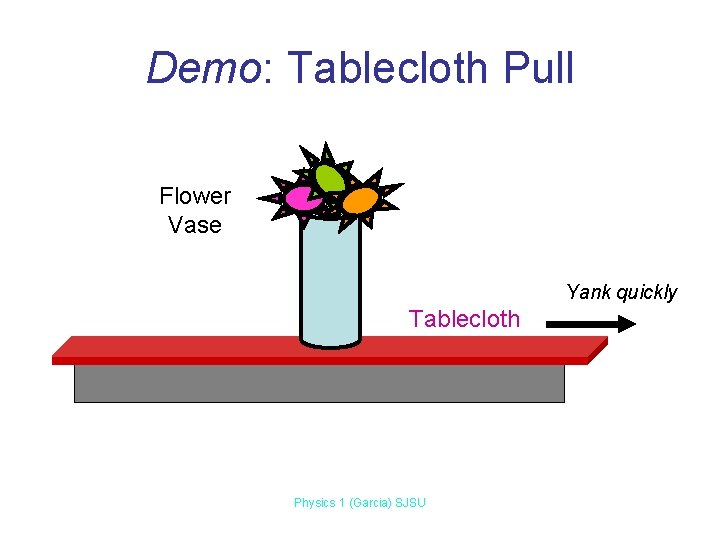
Demo: Tablecloth Pull Flower Vase Yank quickly Tablecloth Physics 1 (Garcia) SJSU
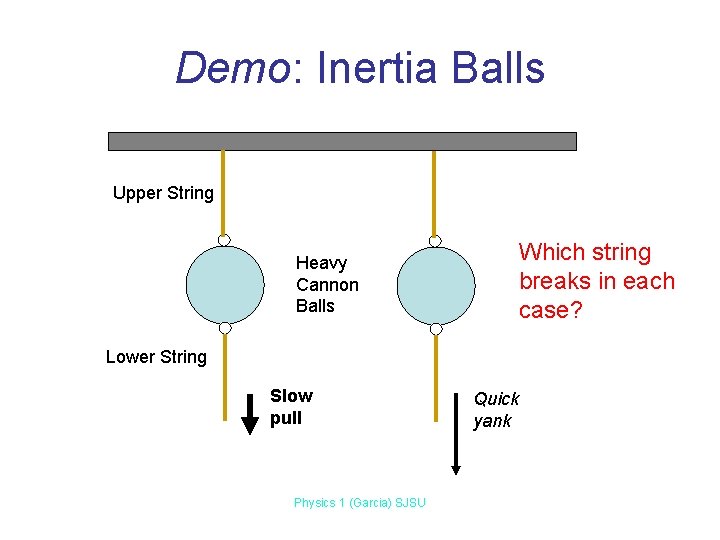
Demo: Inertia Balls Upper String Which string breaks in each case? Heavy Cannon Balls Lower String Slow pull Physics 1 (Garcia) SJSU Quick yank
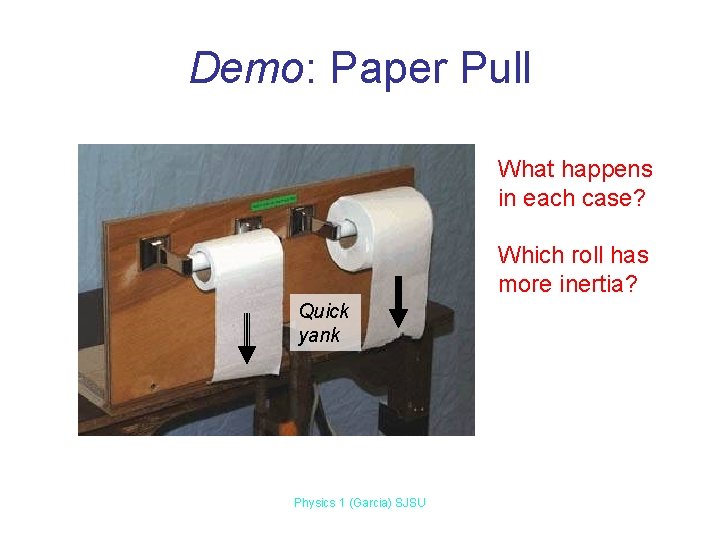
Demo: Paper Pull What happens in each case? Which roll has more inertia? Quick yank Physics 1 (Garcia) SJSU
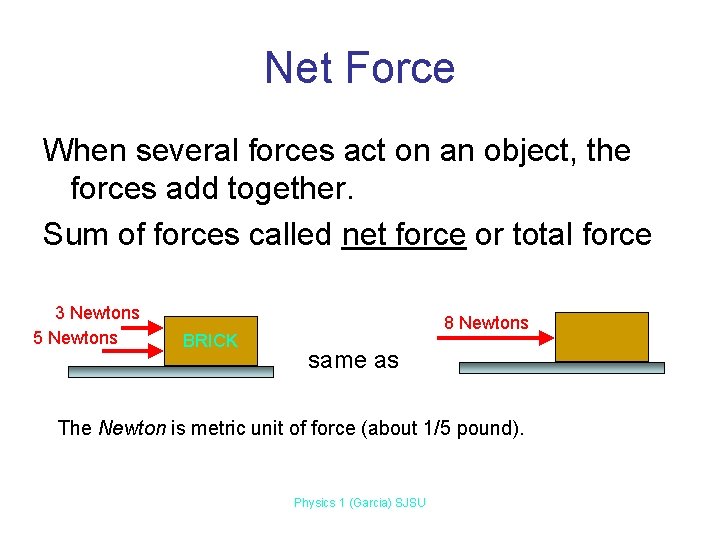
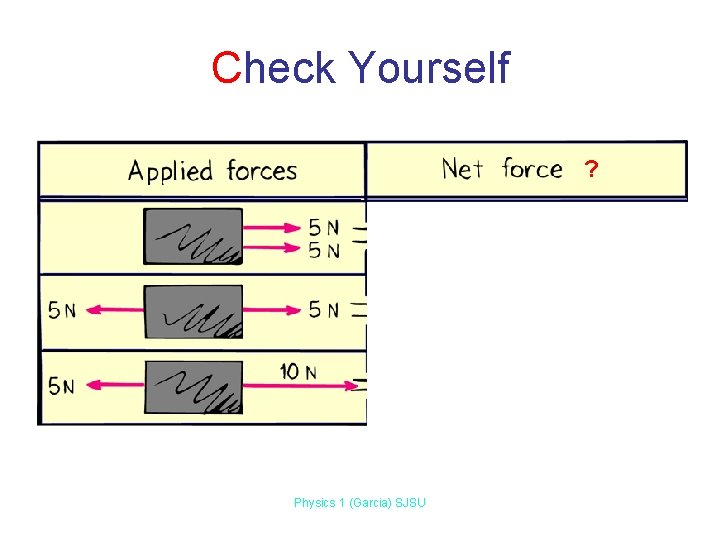
Net Force When several forces act on an object, the forces add together. Sum of forces called net force or total force 3 Newtons 5 Newtons BRICK 8 Newtons same as The Newton is metric unit of force (about 1/5 pound). Physics 1 (Garcia) SJSU
Check Yourself ? Physics 1 (Garcia) SJSU
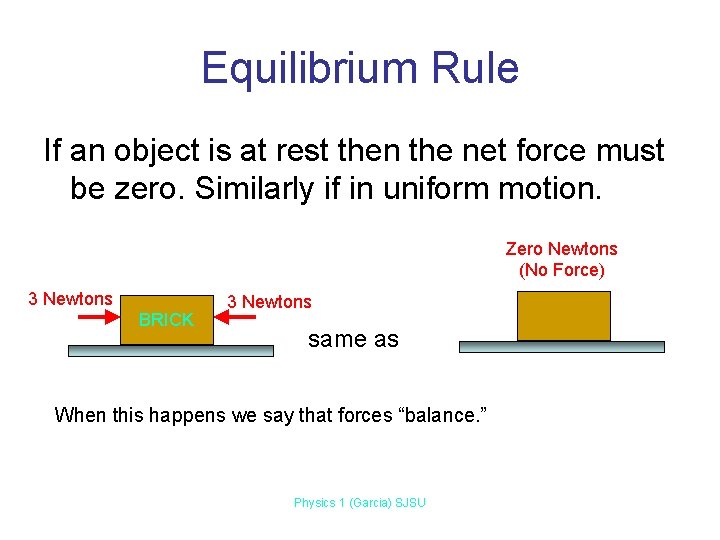
Equilibrium Rule If an object is at rest then the net force must be zero. Similarly if in uniform motion. Zero Newtons (No Force) 3 Newtons BRICK 3 Newtons same as When this happens we say that forces “balance. ” Physics 1 (Garcia) SJSU
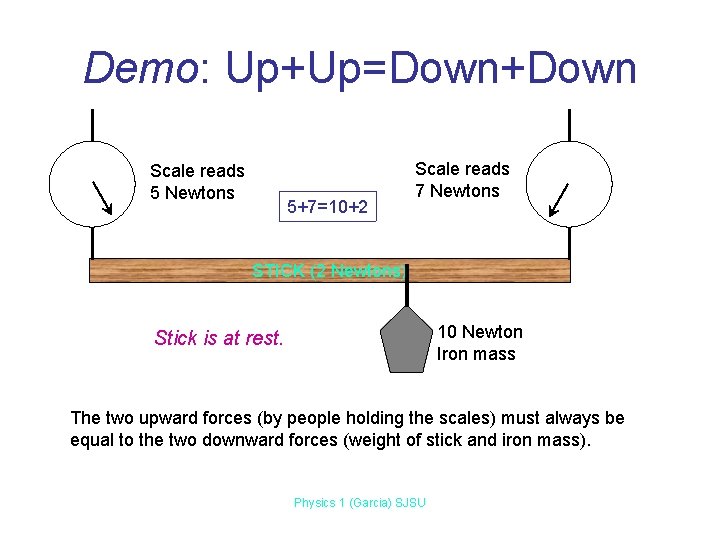
Demo: Up+Up=Down+Down Scale reads 5 Newtons 5+7=10+2 Scale reads 7 Newtons STICK (2 Newtons) 10 Newton Iron mass Stick is at rest. The two upward forces (by people holding the scales) must always be equal to the two downward forces (weight of stick and iron mass). Physics 1 (Garcia) SJSU
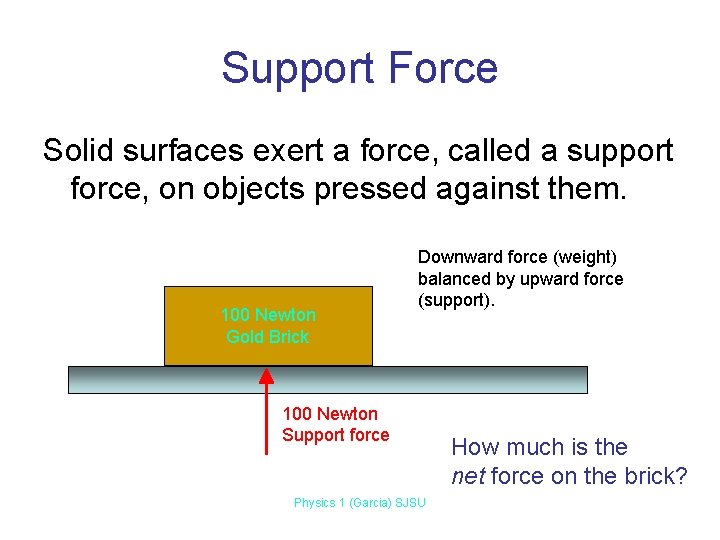
Support Force Solid surfaces exert a force, called a support force, on objects pressed against them. 100 Newton Gold Brick Downward force (weight) balanced by upward force (support). 100 Newton Support force Physics 1 (Garcia) SJSU How much is the net force on the brick?