
Part I Linking Future Value with Current Value
- Slides: 24
Part I Linking Future Value with Current Value By Kevin Gillogly HDIC Education Segment March 14, 2005 www. bivio. com/hdic 1
Reasons Most People Fail in the Stock Market n n n They Invest in Companies They Don’t Understand They Don’t Know How to Value a Stock They Pay Too Much March 14, 2005 www. bivio. com/hdic 2
Linking Current Value & Future Value Current Value is _______? n Future Value is based on ____? n Knowing these two terms is a simple, yet effective way, to protect yourself from overpaying for a stock n n Value of Classic’s Stock Wizard n Use red alerts to guide you March 14, 2005 www. bivio. com/hdic 3
Stock Valuation Is a method of directly connecting the stock price to the company’s profits (EPS), and is expressed as a ratio of price to EPS. P/E Ratio = Stock Price / EPS n Wall Street’s way of measuring the value of the growth of the company n March 14, 2005 www. bivio. com/hdic 4
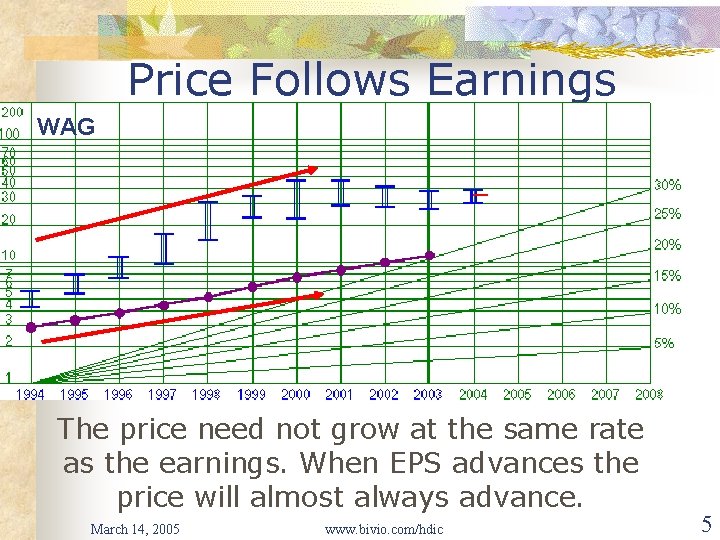
Price Follows Earnings WAG The price need not grow at the same rate as the earnings. When EPS advances the price will almost always advance. March 14, 2005 www. bivio. com/hdic 5
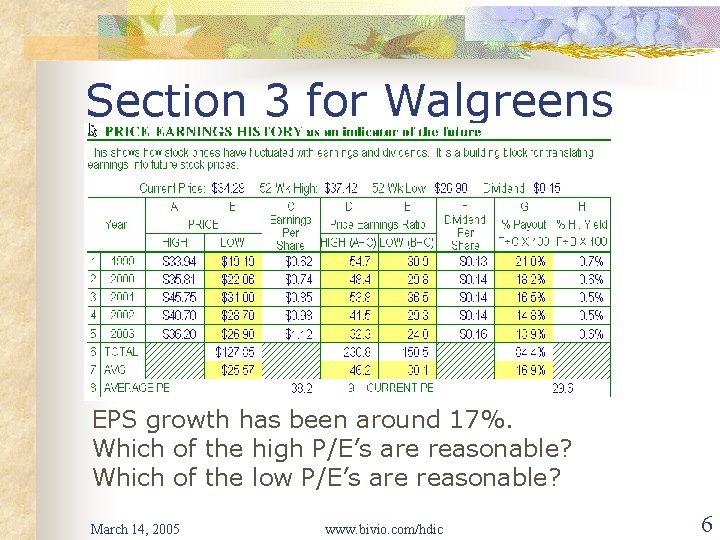
Section 3 for Walgreens EPS growth has been around 17%. Which of the high P/E’s are reasonable? Which of the low P/E’s are reasonable? March 14, 2005 www. bivio. com/hdic 6
“Companies … with long records of above average growth tend to sell at higher P/Es, but their highs are usually not sustainable. ” -- Handbook, 130 www. bivio. com/hdic 7
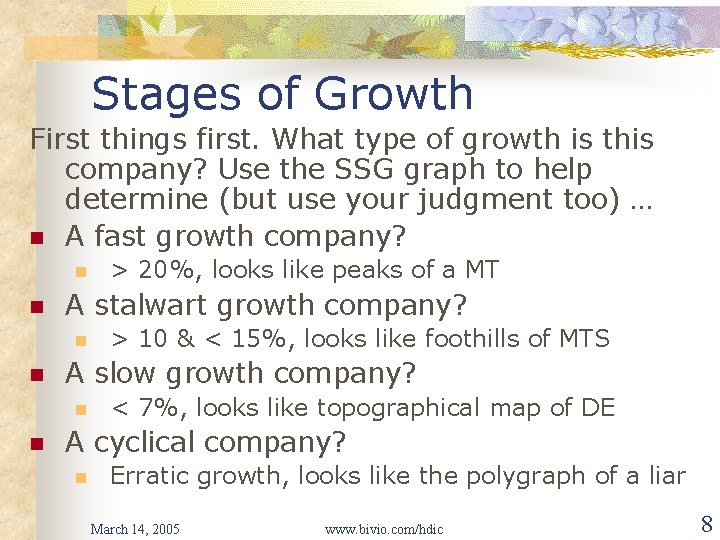
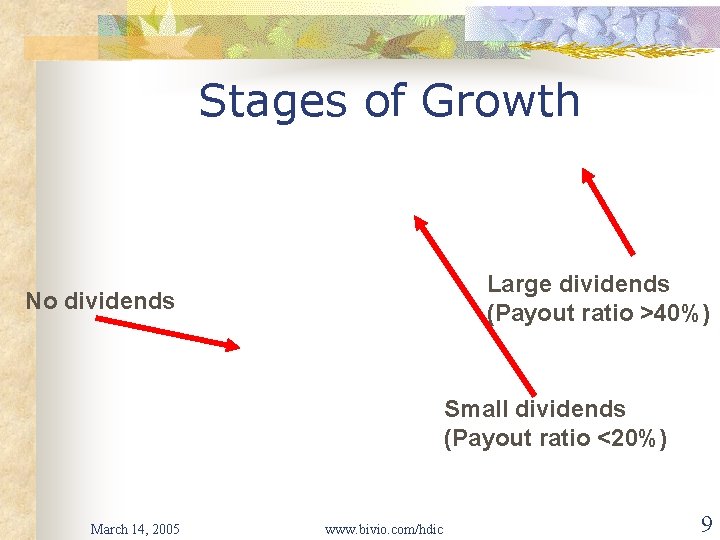
Stages of Growth First things first. What type of growth is this company? Use the SSG graph to help determine (but use your judgment too) … n A fast growth company? n n A stalwart growth company? n n > 10 & < 15%, looks like foothills of MTS A slow growth company? n n > 20%, looks like peaks of a MT < 7%, looks like topographical map of DE A cyclical company? n Erratic growth, looks like the polygraph of a liar March 14, 2005 www. bivio. com/hdic 8
Stages of Growth Large dividends (Payout ratio >40%) No dividends Small dividends (Payout ratio <20%) March 14, 2005 www. bivio. com/hdic 9
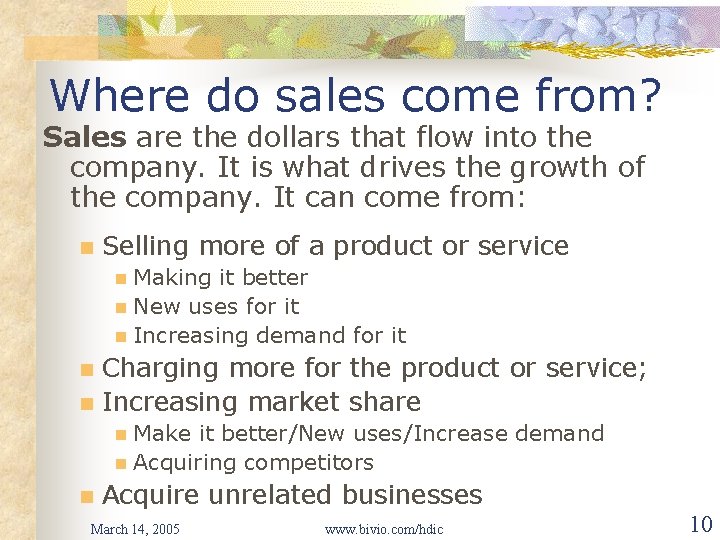
Where do sales come from? Sales are the dollars that flow into the company. It is what drives the growth of the company. It can come from: n Selling more of a product or service Making it better n New uses for it n Increasing demand for it n Charging more for the product or service; n Increasing market share n Make it better/New uses/Increase demand n Acquiring competitors n n Acquire unrelated businesses March 14, 2005 www. bivio. com/hdic 10
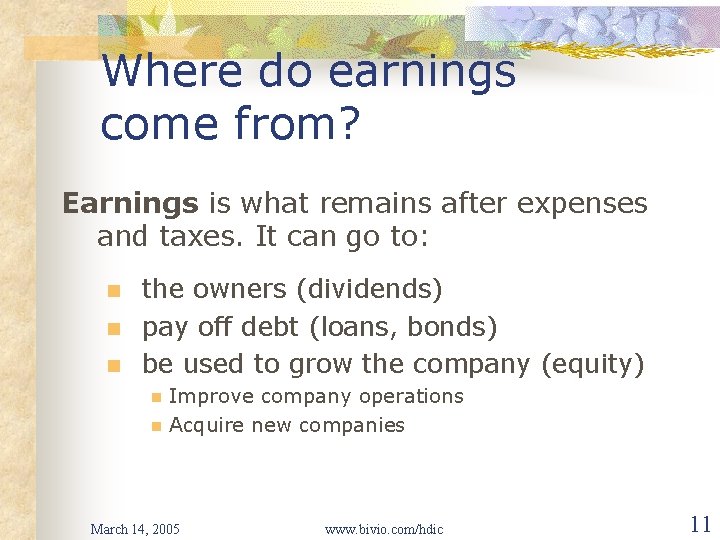
Where do earnings come from? Earnings is what remains after expenses and taxes. It can go to: n n n the owners (dividends) pay off debt (loans, bonds) be used to grow the company (equity) n n Improve company operations Acquire new companies March 14, 2005 www. bivio. com/hdic 11
“Buy the rights stocks at the wrong price at the wrong time and you’ll suffer great losses. ” Peter Lynch, One Up On Wall Street, Pg. 72. March 14, 2005 www. bivio. com/hdic 12
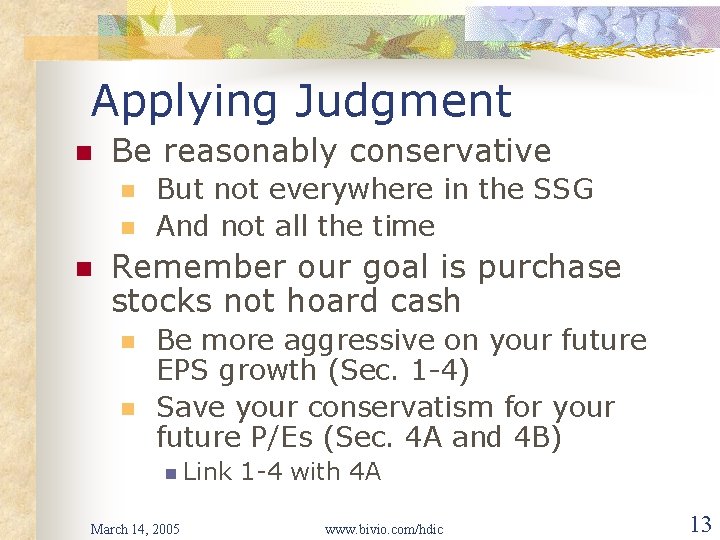
Applying Judgment n Be reasonably conservative n n n But not everywhere in the SSG And not all the time Remember our goal is purchase stocks not hoard cash n n Be more aggressive on your future EPS growth (Sec. 1 -4) Save your conservatism for your future P/Es (Sec. 4 A and 4 B) n Link March 14, 2005 1 -4 with 4 A www. bivio. com/hdic 13
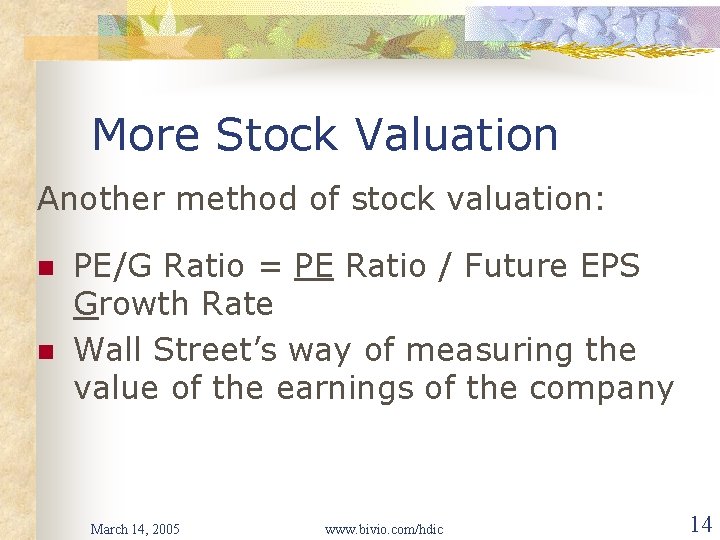
More Stock Valuation Another method of stock valuation: n n PE/G Ratio = PE Ratio / Future EPS Growth Rate Wall Street’s way of measuring the value of the earnings of the company March 14, 2005 www. bivio. com/hdic 14
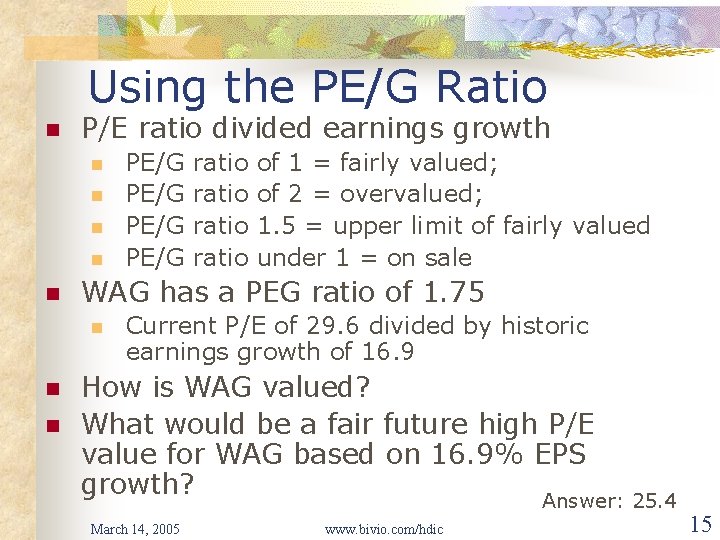
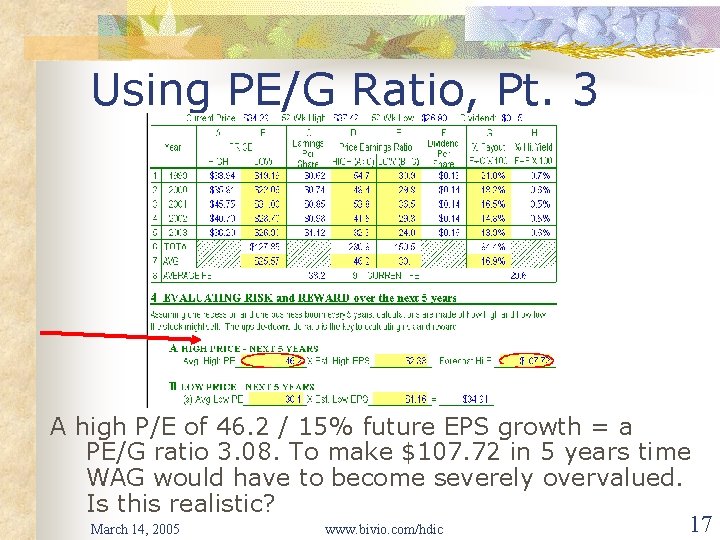
Using the PE/G Ratio n P/E ratio divided earnings growth n n n ratio of 1 = fairly valued; of 2 = overvalued; 1. 5 = upper limit of fairly valued under 1 = on sale WAG has a PEG ratio of 1. 75 n n PE/G Current P/E of 29. 6 divided by historic earnings growth of 16. 9 How is WAG valued? What would be a fair future high P/E value for WAG based on 16. 9% EPS growth? Answer: 25. 4 March 14, 2005 www. bivio. com/hdic 15
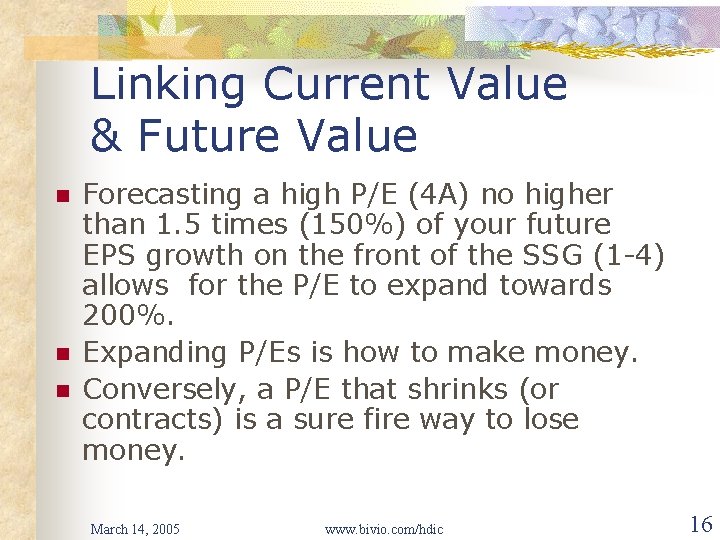
Linking Current Value & Future Value n n n Forecasting a high P/E (4 A) no higher than 1. 5 times (150%) of your future EPS growth on the front of the SSG (1 -4) allows for the P/E to expand towards 200%. Expanding P/Es is how to make money. Conversely, a P/E that shrinks (or contracts) is a sure fire way to lose money. March 14, 2005 www. bivio. com/hdic 16
Using PE/G Ratio, Pt. 3 A high P/E of 46. 2 / 15% future EPS growth = a PE/G ratio 3. 08. To make $107. 72 in 5 years time WAG would have to become severely overvalued. Is this realistic? 17 March 14, 2005 www. bivio. com/hdic
Linking Current Value & Future Value n n This allows us to test the reasonableness of our estimated EPS growth vs. our estimated PE ratios Sect. 4 A ties high P/Es in Sect. 3 with our future earnings growth in Sect. 1 -4 March 14, 2005 www. bivio. com/hdic 18
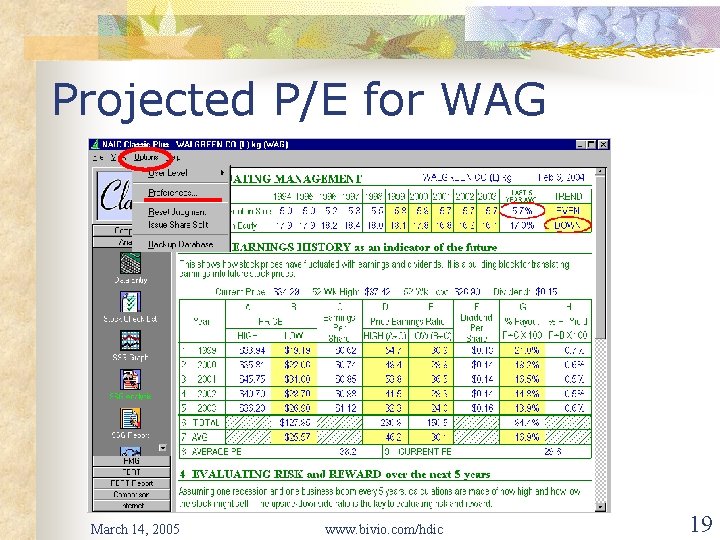
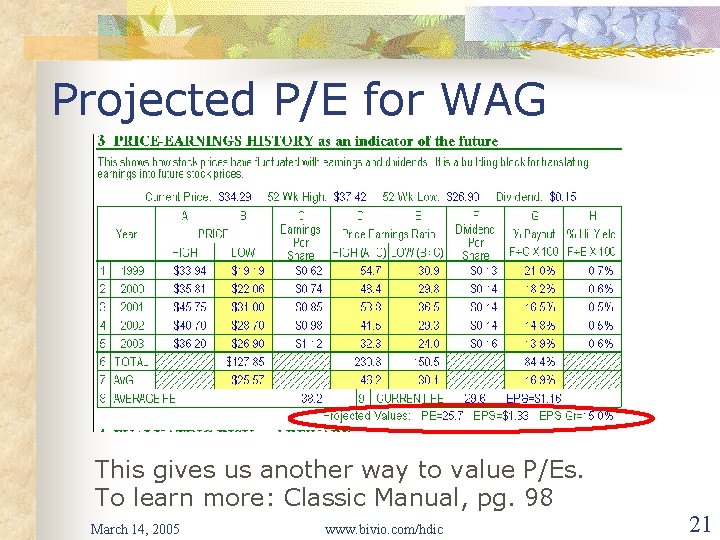
Projected P/E for WAG March 14, 2005 www. bivio. com/hdic 19
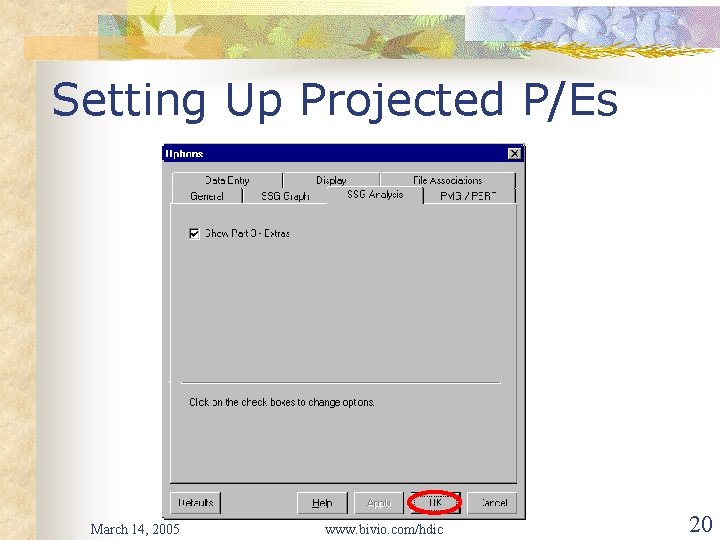
Setting Up Projected P/Es March 14, 2005 www. bivio. com/hdic 20
Projected P/E for WAG This gives us another way to value P/Es. To learn more: Classic Manual, pg. 98 March 14, 2005 www. bivio. com/hdic 21
Another Way to Determine Future Value n Add future P/Es along with future EPS growth n n WAG has a projected P/E of 25. 6 divided by future earnings growth of 15. 0 for a PEG ratio of 1. 71 How does this change WAG’s valued? Answer: No matter which metric we use WAG is overvalued using the SSG. This is not surprising for a well managed company with consistent EPS growth. March 14, 2005 www. bivio. com/hdic 22
Conclusion n n Look at the graph is it steady and growing? Compare EPS growth with Divided Payout Ratio (Sec. 3 -G-7) n Are dividends growing faster than EPS? n n Link future value (Sec. 1 -4) with the current value (Sec. 3 -9) n Reasonableness (of this link) is found in Sec. 4 -A (future high PE) n n That would be “pink” flag Limit 4 -A (future high PE) to no more than 150% of 1 -4 (future EPS) Test the reasonableness of your judgments March 14, 2005 www. bivio. com/hdic 23
Questions March 14, 2005 www. bivio. com/hdic 24