
Part I Introduction to the ACA Minimum Essential


- Slides: 36
Part I: Introduction to the ACA Minimum Essential Coverage Current as of October 30, 2014
Welcome to the ACA
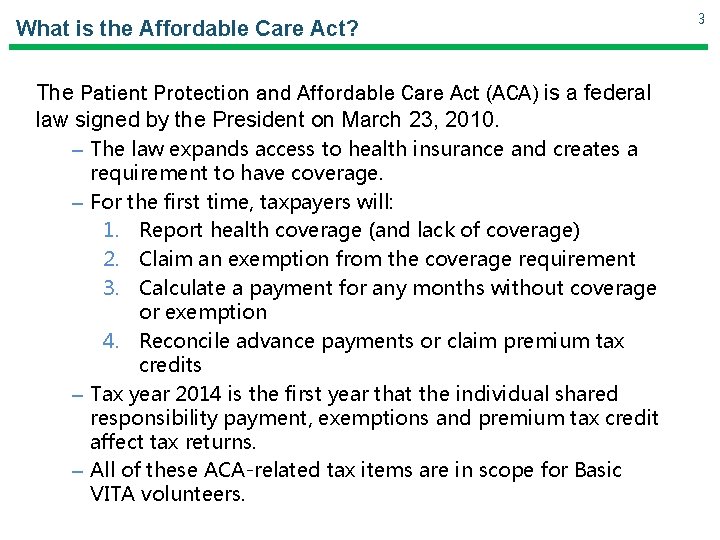
What is the Affordable Care Act? The Patient Protection and Affordable Care Act (ACA) is a federal law signed by the President on March 23, 2010. – The law expands access to health insurance and creates a requirement to have coverage. – For the first time, taxpayers will: 1. Report health coverage (and lack of coverage) 2. Claim an exemption from the coverage requirement 3. Calculate a payment for any months without coverage or exemption 4. Reconcile advance payments or claim premium tax credits – Tax year 2014 is the first year that the individual shared responsibility payment, exemptions and premium tax credit affect tax returns. – All of these ACA-related tax items are in scope for Basic VITA volunteers. 3
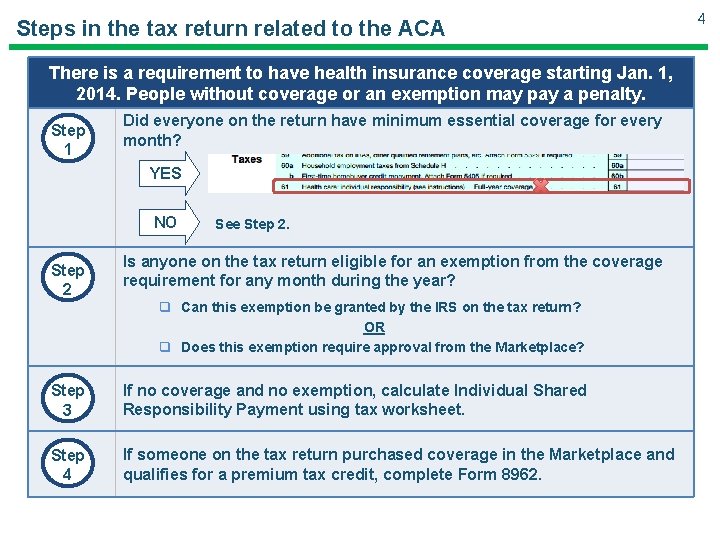
Steps in the tax return related to the ACA There is a requirement to have health insurance coverage starting Jan. 1, 2014. People without coverage or an exemption may pay a penalty. Step 1 Did everyone on the return have minimum essential coverage for every month? YES NO Step 2 See Step 2. Is anyone on the tax return eligible for an exemption from the coverage requirement for any month during the year? q Can this exemption be granted by the IRS on the tax return? OR q Does this exemption require approval from the Marketplace? Step 3 If no coverage and no exemption, calculate Individual Shared Responsibility Payment using tax worksheet. Step 4 If someone on the tax return purchased coverage in the Marketplace and qualifies for a premium tax credit, complete Form 8962. 4
How Does the ACA Work?
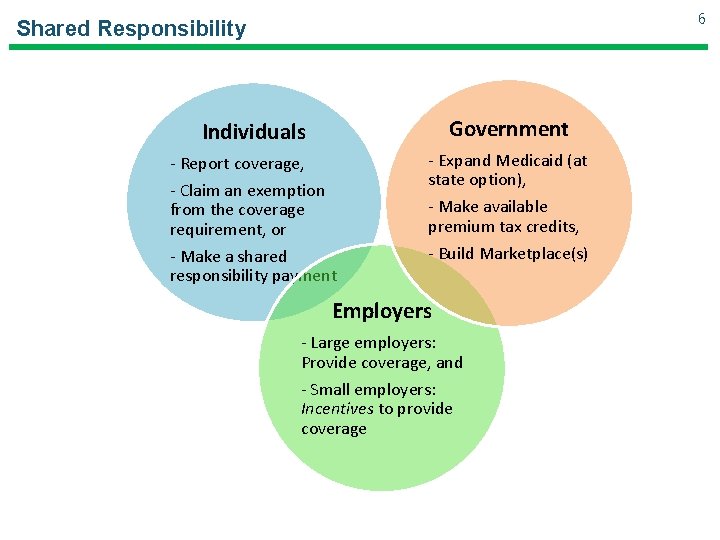
6 Shared Responsibility Government Individuals - Report coverage, - Claim an exemption from the coverage requirement, or - Expand Medicaid (at state option), - Make a shared responsibility payment - Build Marketplace(s) - Make available premium tax credits, Employers - Large employers: Provide coverage, and - Small employers: Incentives to provide coverage
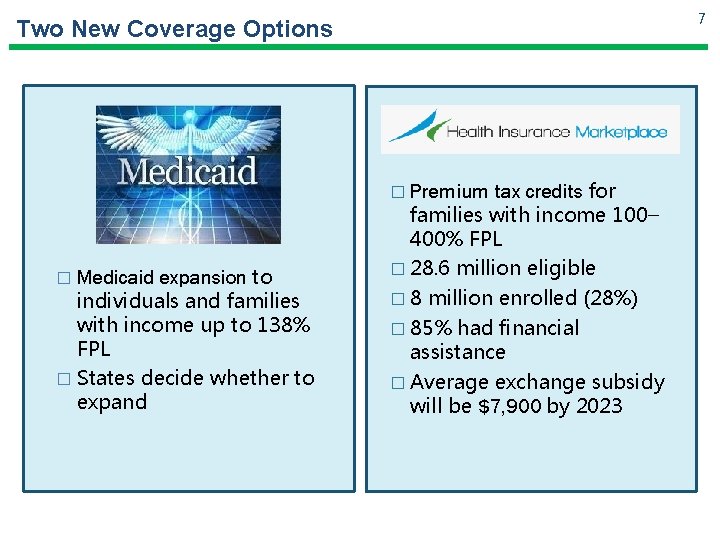
7 Two New Coverage Options � Premium tax credits for � Medicaid expansion to individuals and families with income up to 138% FPL � States decide whether to expand families with income 100– 400% FPL � 28. 6 million eligible � 8 million enrolled (28%) � 85% had financial assistance � Average exchange subsidy will be $7, 900 by 2023
What Are Premium Tax Credits (PTC)? • Assistance with the cost of health coverage for people purchasing coverage in a Health Insurance Marketplace – Some states use the Federally Facilitated Marketplace (FFM) at www. healthcare. gov. Other states have their own Marketplace. The same rules apply to both. – Insurance can be purchased only during open enrollment or if a person has cause for a special enrollment period. • Administered by CCIIO (Center for Consumer Information and Insurance Oversight) 8
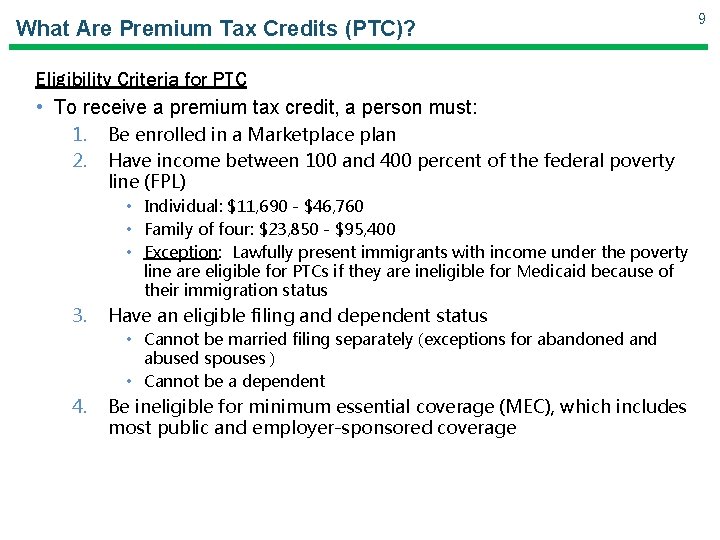
What Are Premium Tax Credits (PTC)? Eligibility Criteria for PTC • To receive a premium tax credit, a person must: 1. 2. Be enrolled in a Marketplace plan Have income between 100 and 400 percent of the federal poverty line (FPL) • Individual: $11, 690 - $46, 760 • Family of four: $23, 850 - $95, 400 • Exception: Lawfully present immigrants with income under the poverty line are eligible for PTCs if they are ineligible for Medicaid because of their immigration status 3. Have an eligible filing and dependent status • Cannot be married filing separately (exceptions for abandoned and abused spouses ) • Cannot be a dependent 4. Be ineligible for minimum essential coverage (MEC), which includes most public and employer-sponsored coverage 9
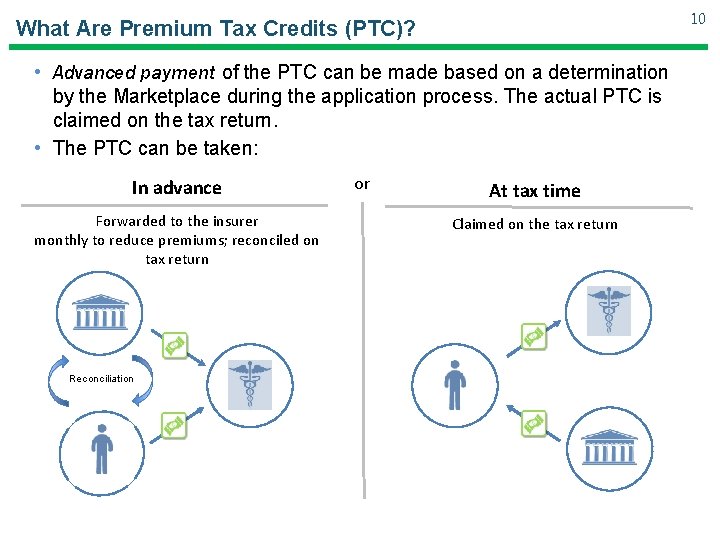
10 What Are Premium Tax Credits (PTC)? • Advanced payment of the PTC can be made based on a determination by the Marketplace during the application process. The actual PTC is claimed on the tax return. • The PTC can be taken: In advance Forwarded to the insurer monthly to reduce premiums; reconciled on tax return Reconciliation or At tax time Claimed on the tax return
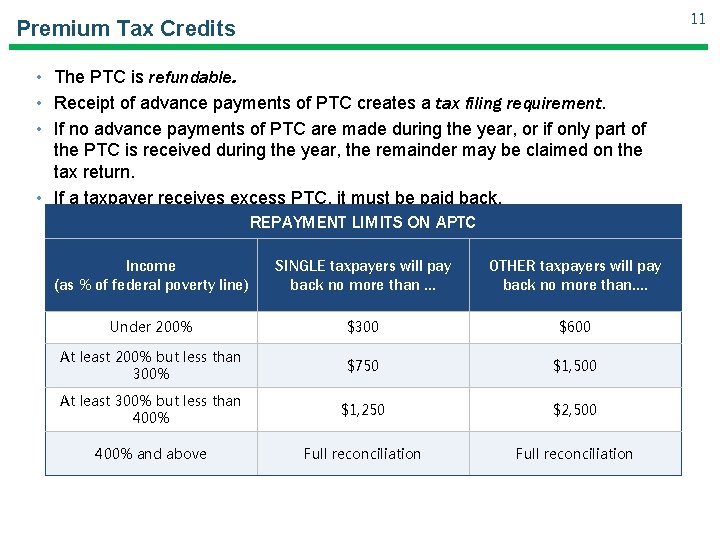
11 Premium Tax Credits • The PTC is refundable. • Receipt of advance payments of PTC creates a tax filing requirement. • If no advance payments of PTC are made during the year, or if only part of the PTC is received during the year, the remainder may be claimed on the tax return. • If a taxpayer receives excess PTC, it must be paid back. REPAYMENT LIMITS ON APTC Income (as % of federal poverty line) SINGLE taxpayers will pay back no more than … OTHER taxpayers will pay back no more than…. Under 200% $300 $600 At least 200% but less than 300% $750 $1, 500 At least 300% but less than 400% $1, 250 $2, 500 400% and above Full reconciliation
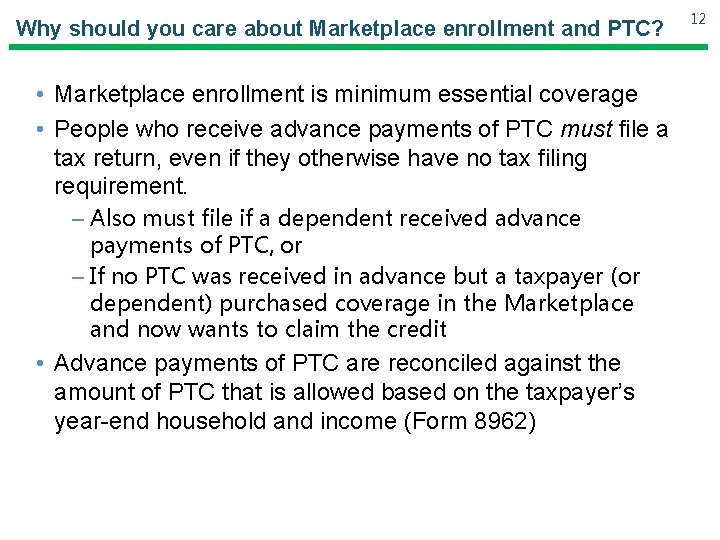
Why should you care about Marketplace enrollment and PTC? • Marketplace enrollment is minimum essential coverage • People who receive advance payments of PTC must file a tax return, even if they otherwise have no tax filing requirement. – Also must file if a dependent received advance payments of PTC, or – If no PTC was received in advance but a taxpayer (or dependent) purchased coverage in the Marketplace and now wants to claim the credit • Advance payments of PTC are reconciled against the amount of PTC that is allowed based on the taxpayer’s year-end household and income (Form 8962) 12
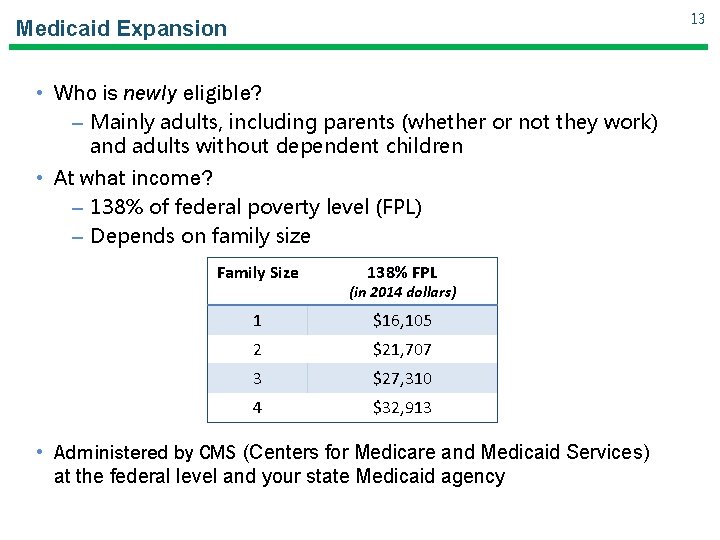
13 Medicaid Expansion • Who is newly eligible? – Mainly adults, including parents (whether or not they work) and adults without dependent children • At what income? – 138% of federal poverty level (FPL) – Depends on family size Family Size 138% FPL (in 2014 dollars) 1 $16, 105 2 $21, 707 3 $27, 310 4 $32, 913 • Administered by CMS (Centers for Medicare and Medicaid Services) at the federal level and your state Medicaid agency
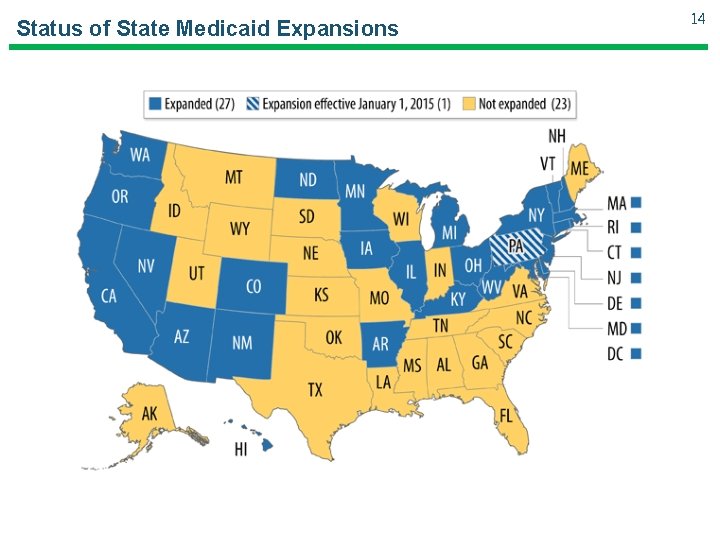
Status of State Medicaid Expansions 14
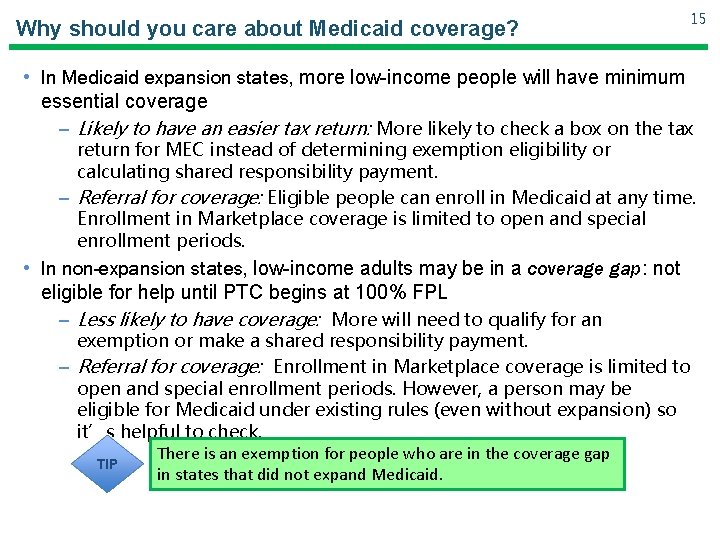
Why should you care about Medicaid coverage? 15 • In Medicaid expansion states, more low-income people will have minimum essential coverage – Likely to have an easier tax return: More likely to check a box on the tax return for MEC instead of determining exemption eligibility or calculating shared responsibility payment. – Referral for coverage: Eligible people can enroll in Medicaid at any time. Enrollment in Marketplace coverage is limited to open and special enrollment periods. • In non-expansion states, low-income adults may be in a coverage gap: not eligible for help until PTC begins at 100% FPL – Less likely to have coverage: More will need to qualify for an exemption or make a shared responsibility payment. – Referral for coverage: Enrollment in Marketplace coverage is limited to open and special enrollment periods. However, a person may be eligible for Medicaid under existing rules (even without expansion) so it’s helpful to check. There is an exemption for people who are in the coverage gap TIP in states that did not expand Medicaid.
Minimum Essential Coverage
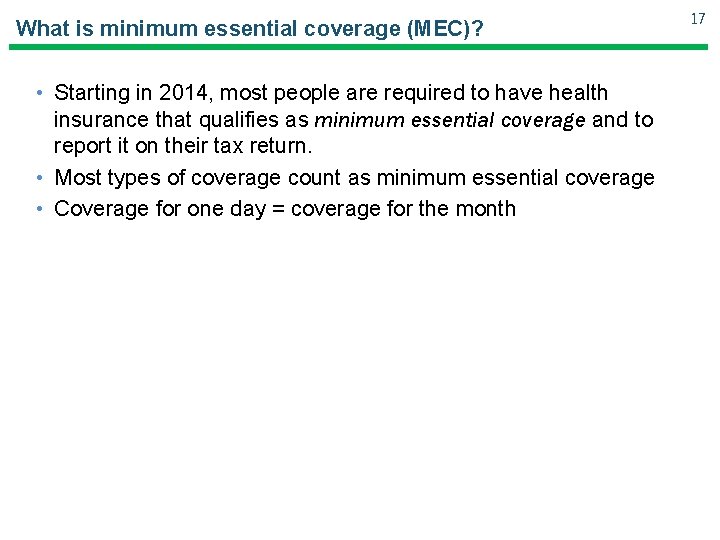
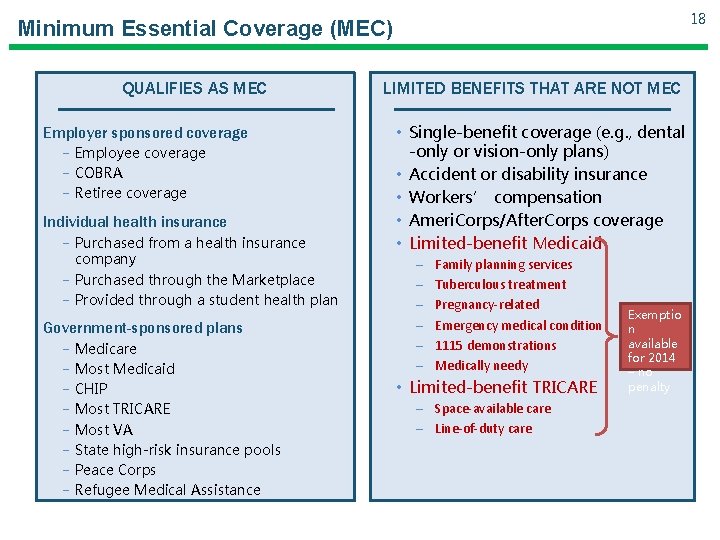
What is minimum essential coverage (MEC)? • Starting in 2014, most people are required to have health insurance that qualifies as minimum essential coverage and to report it on their tax return. • Most types of coverage count as minimum essential coverage • Coverage for one day = coverage for the month 17
18 Minimum Essential Coverage (MEC) QUALIFIES AS MEC Employer sponsored coverage − Employee coverage − COBRA − Retiree coverage Individual health insurance − Purchased from a health insurance company − Purchased through the Marketplace − Provided through a student health plan Government-sponsored plans − Medicare − Most Medicaid − CHIP − Most TRICARE − Most VA − State high-risk insurance pools − Peace Corps − Refugee Medical Assistance LIMITED BENEFITS THAT ARE NOT MEC • Single-benefit coverage (e. g. , dental -only or vision-only plans) • Accident or disability insurance • Workers’ compensation • Ameri. Corps/After. Corps coverage • Limited-benefit Medicaid – – – Family planning services Tuberculous treatment Pregnancy-related Emergency medical condition 1115 demonstrations Medically needy • Limited-benefit TRICARE – Space-available care – Line-of-duty care Exemptio n available for 2014 – no penalty
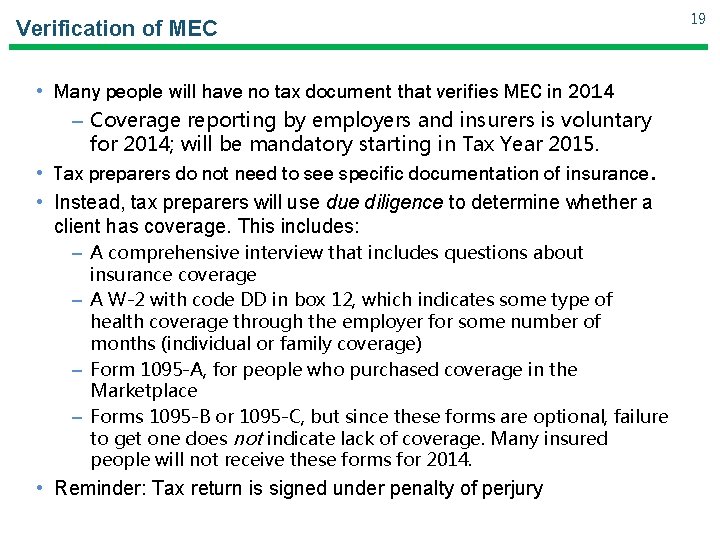
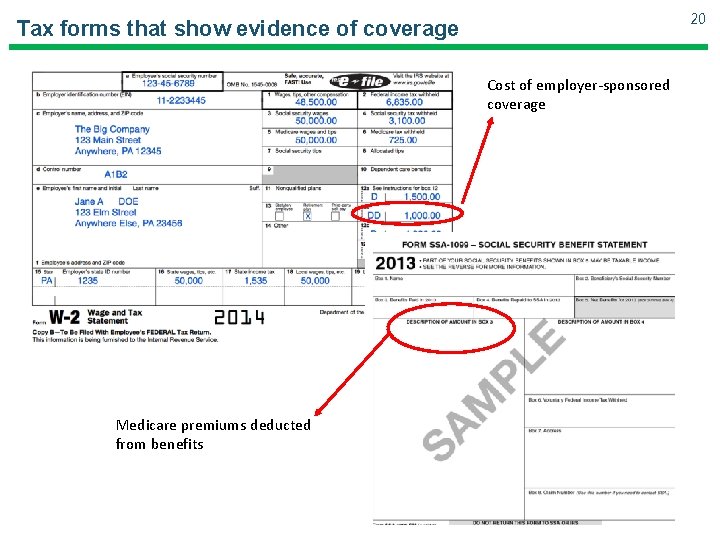
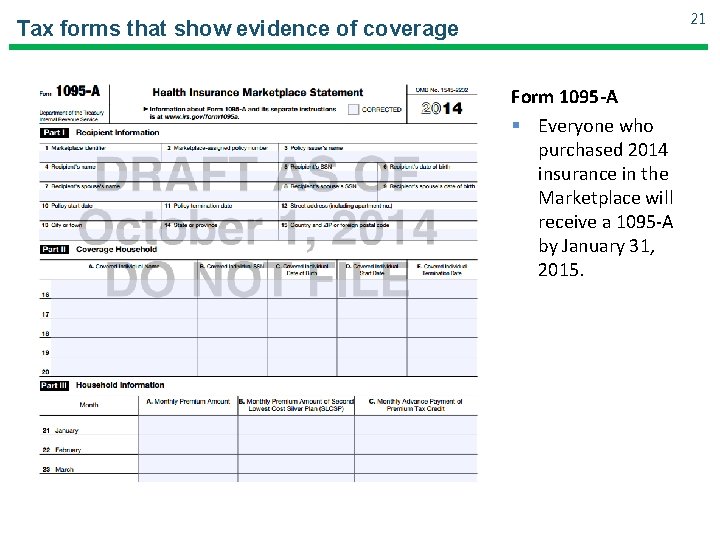
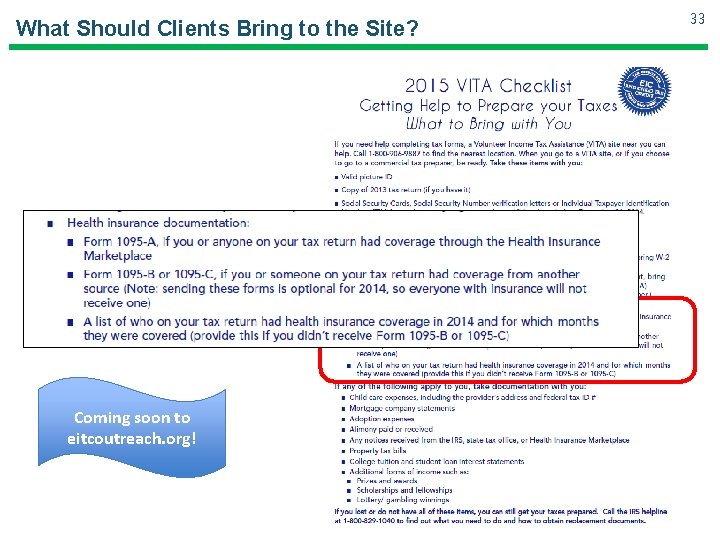
Verification of MEC • Many people will have no tax document that verifies MEC in 2014 – Coverage reporting by employers and insurers is voluntary for 2014; will be mandatory starting in Tax Year 2015. • Tax preparers do not need to see specific documentation of insurance. • Instead, tax preparers will use due diligence to determine whether a client has coverage. This includes: – A comprehensive interview that includes questions about insurance coverage – A W-2 with code DD in box 12, which indicates some type of health coverage through the employer for some number of months (individual or family coverage) – Form 1095 -A, for people who purchased coverage in the Marketplace – Forms 1095 -B or 1095 -C, but since these forms are optional, failure to get one does not indicate lack of coverage. Many insured people will not receive these forms for 2014. • Reminder: Tax return is signed under penalty of perjury 19
20 Tax forms that show evidence of coverage Cost of employer-sponsored coverage Medicare premiums deducted from benefits
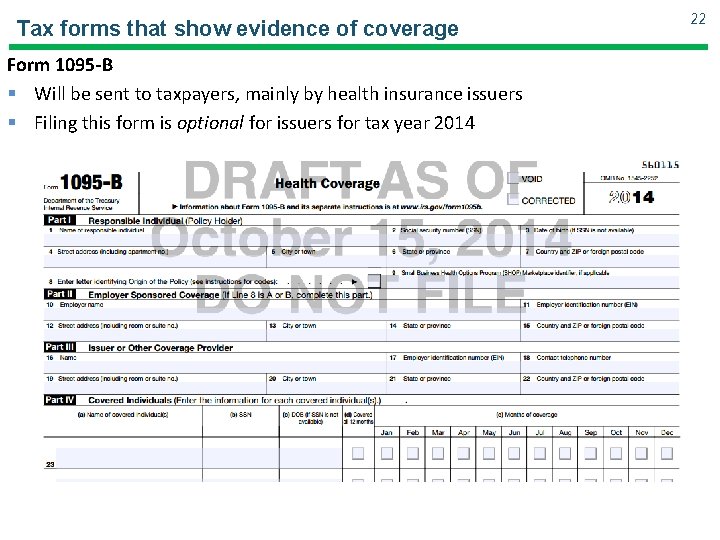
21 Tax forms that show evidence of coverage Form 1095 -A § Everyone who purchased 2014 insurance in the Marketplace will receive a 1095 -A by January 31, 2015.
Tax forms that show evidence of coverage Form 1095 -B § Will be sent to taxpayers, mainly by health insurance issuers § Filing this form is optional for issuers for tax year 2014 22
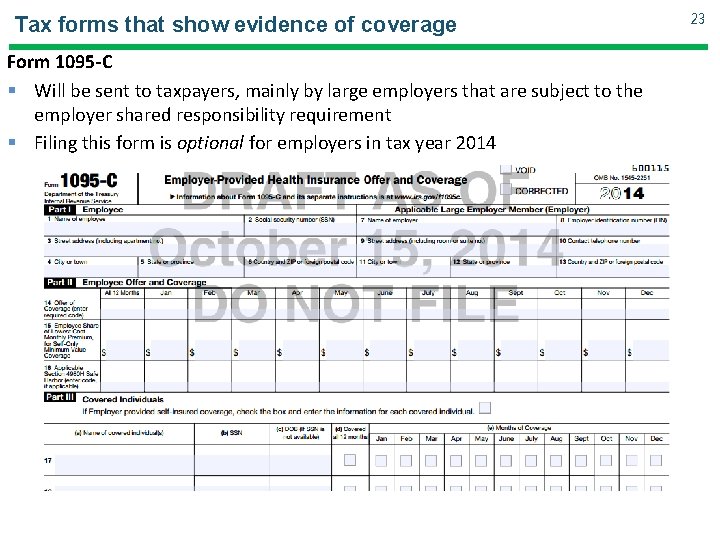
Tax forms that show evidence of coverage Form 1095 -C § Will be sent to taxpayers, mainly by large employers that are subject to the employer shared responsibility requirement § Filing this form is optional for employers in tax year 2014 23
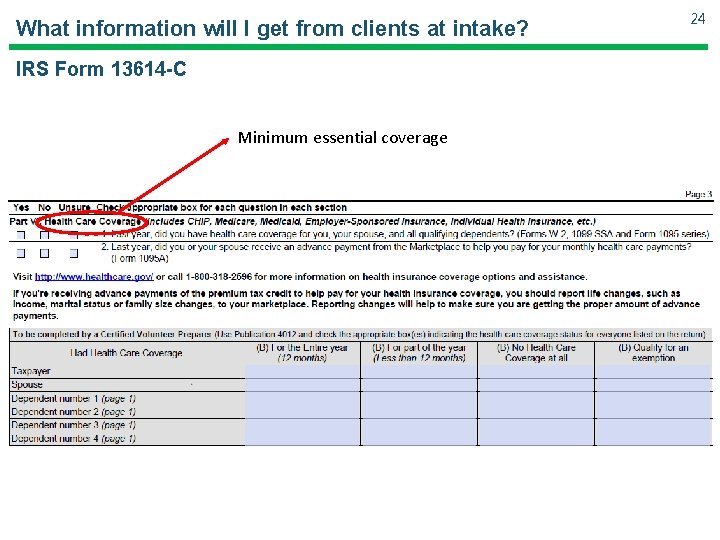
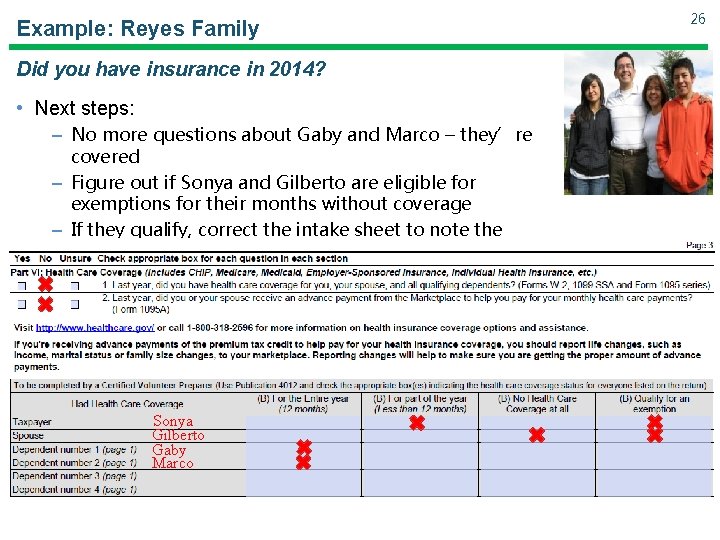
What information will I get from clients at intake? IRS Form 13614 -C Minimum essential coverage 24
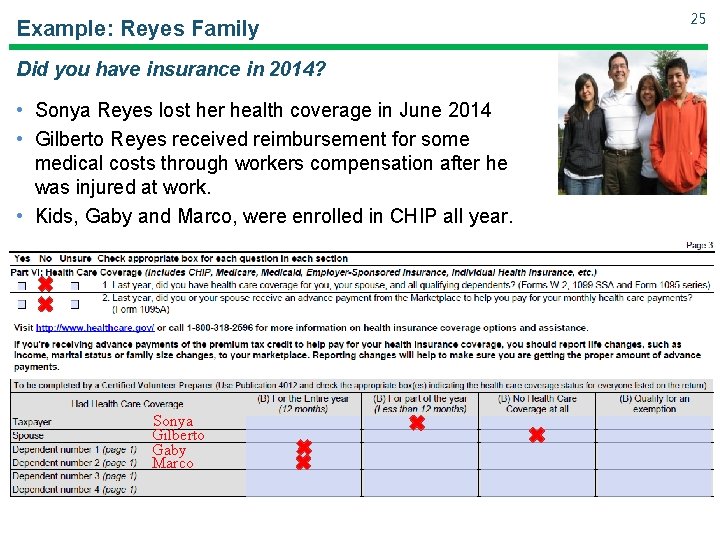
Example: Reyes Family Did you have insurance in 2014? • Sonya Reyes lost her health coverage in June 2014 • Gilberto Reyes received reimbursement for some medical costs through workers compensation after he was injured at work. • Kids, Gaby and Marco, were enrolled in CHIP all year. Sonya Gilberto Gaby Marco 25
Example: Reyes Family Did you have insurance in 2014? • Next steps: – No more questions about Gaby and Marco – they’re covered – Figure out if Sonya and Gilberto are eligible for exemptions for their months without coverage – If they qualify, correct the intake sheet to note the exemption Sonya Gilberto Gaby Marco 26
Common Questions
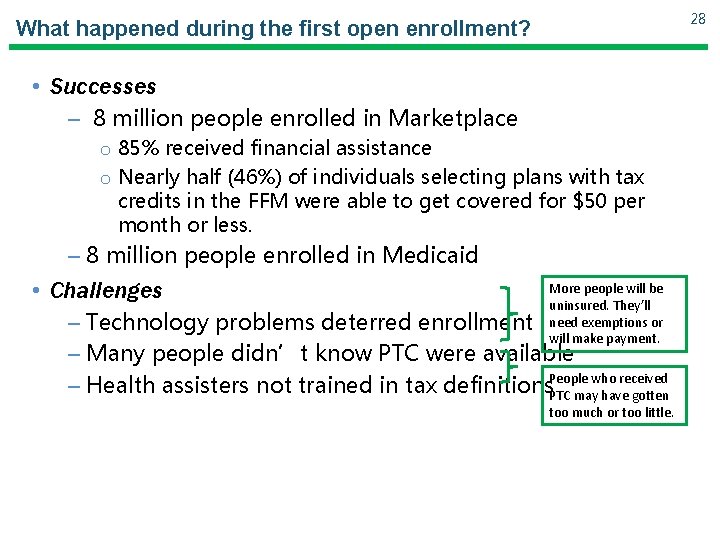
28 What happened during the first open enrollment? • Successes – 8 million people enrolled in Marketplace o 85% received financial assistance o Nearly half (46%) of individuals selecting plans with tax credits in the FFM were able to get covered for $50 per month or less. – 8 million people enrolled in Medicaid • Challenges More people will be uninsured. They’ll need exemptions or will make payment. – Technology problems deterred enrollment – Many people didn’t know PTC were available who received – Health assisters not trained in tax definitions. People PTC may have gotten too much or too little.
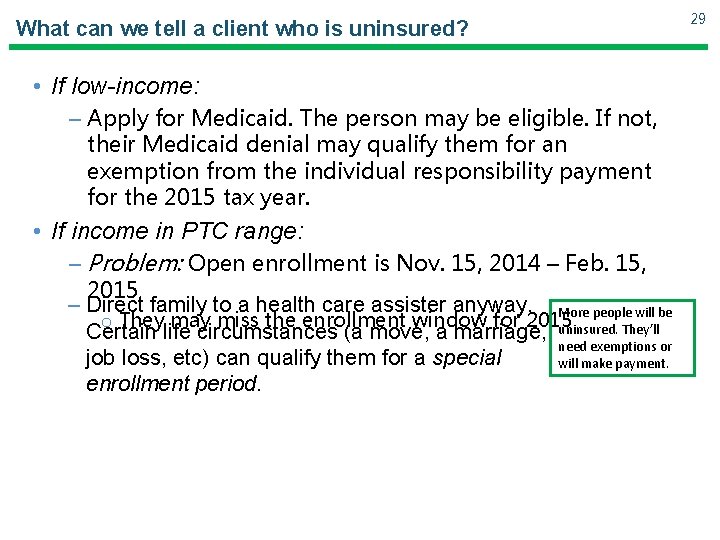
What can we tell a client who is uninsured? • If low-income: – Apply for Medicaid. The person may be eligible. If not, their Medicaid denial may qualify them for an exemption from the individual responsibility payment for the 2015 tax year. • If income in PTC range: – Problem: Open enrollment is Nov. 15, 2014 – Feb. 15, 2015 – Direct family to a health care assister anyway. More people will be o They may miss the enrollment window for 2015 Certain life circumstances (a move, a marriage, uninsured. They’ll need exemptions or job loss, etc) can qualify them for a special will make payment. enrollment period. 29
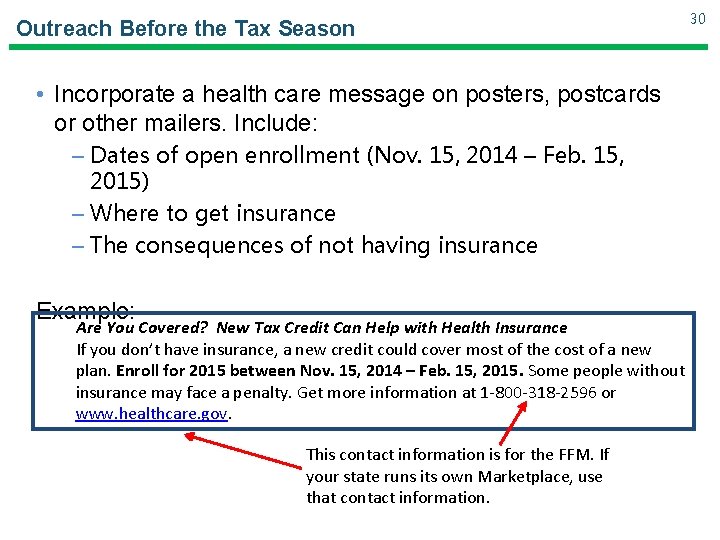
Outreach Before the Tax Season • Incorporate a health care message on posters, postcards or other mailers. Include: – Dates of open enrollment (Nov. 15, 2014 – Feb. 15, 2015) – Where to get insurance – The consequences of not having insurance Example: Are You Covered? New Tax Credit Can Help with Health Insurance If you don’t have insurance, a new credit could cover most of the cost of a new plan. Enroll for 2015 between Nov. 15, 2014 – Feb. 15, 2015. Some people without insurance may face a penalty. Get more information at 1 -800 -318 -2596 or www. healthcare. gov. This contact information is for the FFM. If your state runs its own Marketplace, use that contact information. 30
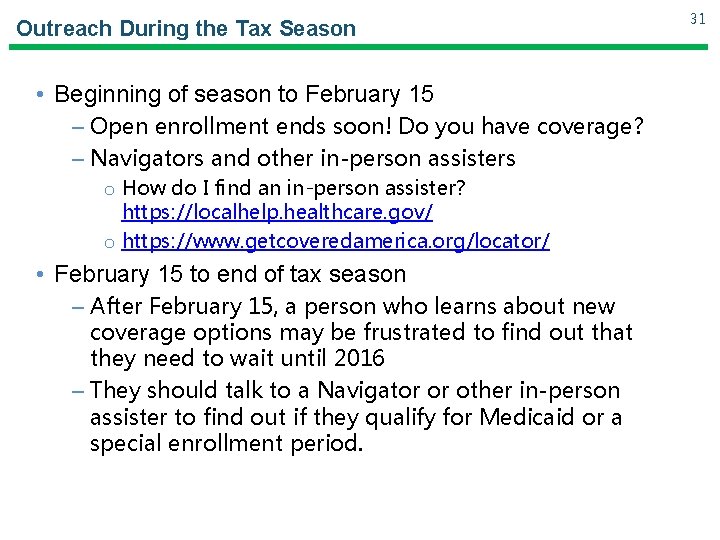
Outreach During the Tax Season • Beginning of season to February 15 – Open enrollment ends soon! Do you have coverage? – Navigators and other in-person assisters o How do I find an in-person assister? https: //localhelp. healthcare. gov/ o https: //www. getcoveredamerica. org/locator/ • February 15 to end of tax season – After February 15, a person who learns about new coverage options may be frustrated to find out that they need to wait until 2016 – They should talk to a Navigator or other in-person assister to find out if they qualify for Medicaid or a special enrollment period. 31
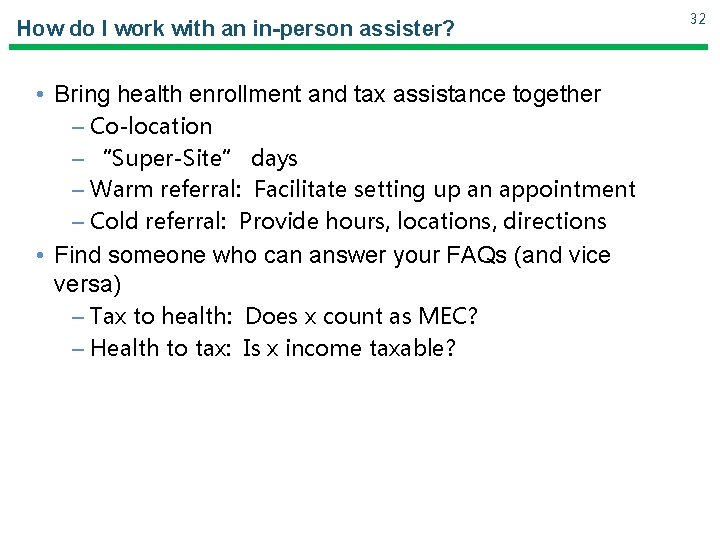
How do I work with an in-person assister? • Bring health enrollment and tax assistance together – Co-location – “Super-Site” days – Warm referral: Facilitate setting up an appointment – Cold referral: Provide hours, locations, directions • Find someone who can answer your FAQs (and vice versa) – Tax to health: Does x count as MEC? – Health to tax: Is x income taxable? 32
What Should Clients Bring to the Site? Coming soon to eitcoutreach. org! 33
34 EITC Outreach
CBPP's National Tax Credit Outreach Campaign • The Campaign provides: – Trainings – Technical assistance and support – Connection to a network of outreach organizations – Tax Credit Outreach Kit – Online resources at www. eitcoutreach. org 35
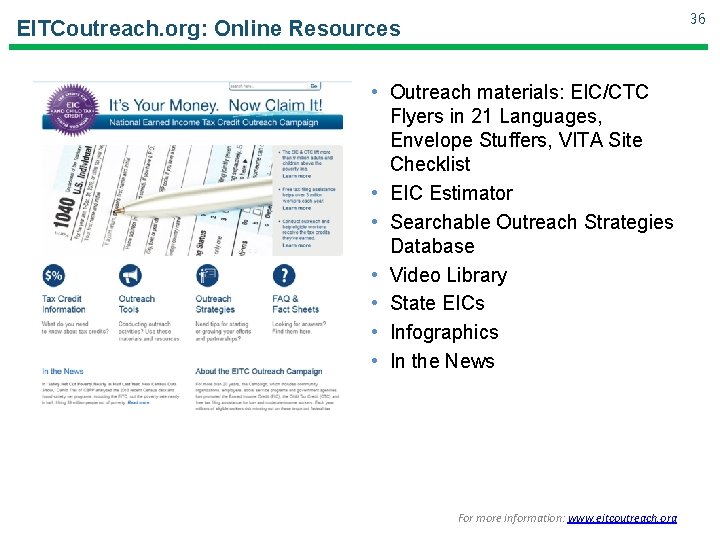
36 EITCoutreach. org: Online Resources • Outreach materials: EIC/CTC Flyers in 21 Languages, Envelope Stuffers, VITA Site Checklist • EIC Estimator • Searchable Outreach Strategies Database • Video Library • State EICs • Infographics • In the News For more information: www. eitcoutreach. org