
PART A Ordinary Differential Equations ODEs Part A
- Slides: 44
PART A Ordinary Differential Equations (ODEs) Part A p 1 Advanced Engineering Mathematics, 10/e by Edwin Kreyszig Copyright 2011 by John Wiley & Sons. All rights reserved.
CHAPTER 3 Higher Order Linear ODEs Chapter 3 p 2 Advanced Engineering Mathematics, 10/e by Edwin Kreyszig Copyright 2011 by John Wiley & Sons. All rights reserved.
3. 1 Section 3. 1 p 3 Homogeneous Linear ODEs Advanced Engineering Mathematics, 10/e by Edwin Kreyszig Copyright 2011 by John Wiley & Sons. All rights reserved.
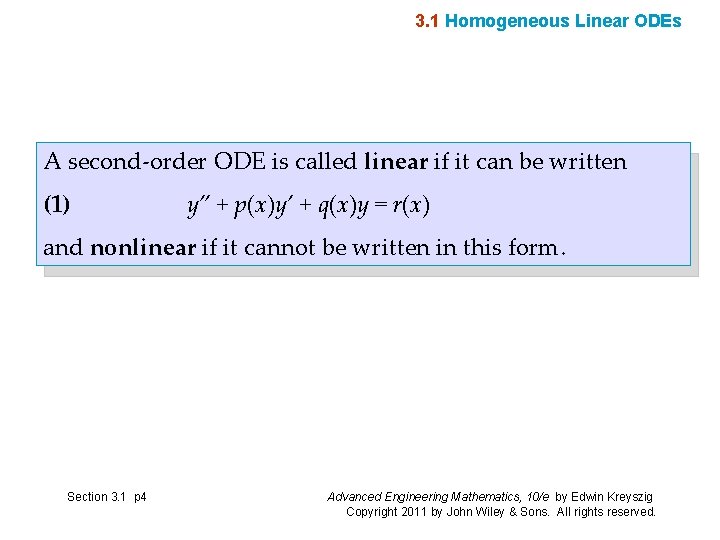
3. 1 Homogeneous Linear ODEs A second-order ODE is called linear if it can be written (1) y” + p(x)y’ + q(x)y = r(x) and nonlinear if it cannot be written in this form. Section 3. 1 p 4 Advanced Engineering Mathematics, 10/e by Edwin Kreyszig Copyright 2011 by John Wiley & Sons. All rights reserved.
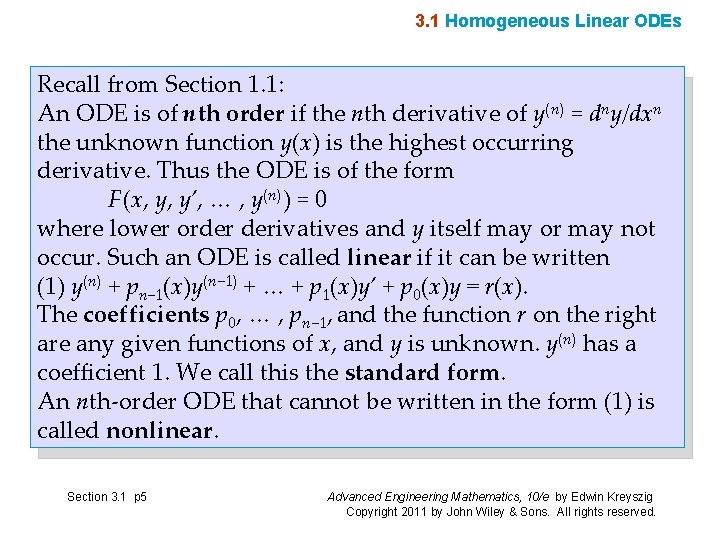
3. 1 Homogeneous Linear ODEs Recall from Section 1. 1: An ODE is of nth order if the nth derivative of y(n) = dny/dxn the unknown function y(x) is the highest occurring derivative. Thus the ODE is of the form F(x, y, y’, … , y(n)) = 0 where lower order derivatives and y itself may or may not occur. Such an ODE is called linear if it can be written (1) y(n) + pn− 1(x)y(n− 1) + … + p 1(x)y’ + p 0(x)y = r(x). The coefficients p 0, … , pn− 1, and the function r on the right are any given functions of x, and y is unknown. y(n) has a coefficient 1. We call this the standard form. An nth-order ODE that cannot be written in the form (1) is called nonlinear. Section 3. 1 p 5 Advanced Engineering Mathematics, 10/e by Edwin Kreyszig Copyright 2011 by John Wiley & Sons. All rights reserved.
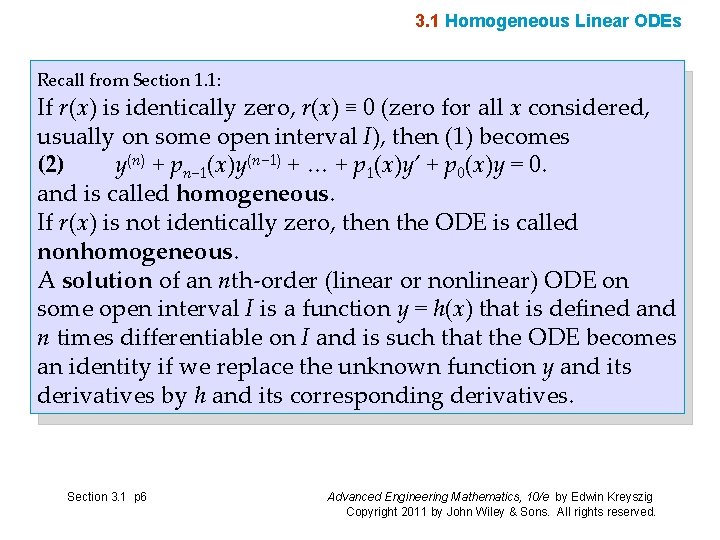
3. 1 Homogeneous Linear ODEs Recall from Section 1. 1: If r(x) is identically zero, r(x) ≡ 0 (zero for all x considered, usually on some open interval I), then (1) becomes (2) y(n) + pn− 1(x)y(n− 1) + … + p 1(x)y’ + p 0(x)y = 0. and is called homogeneous. If r(x) is not identically zero, then the ODE is called nonhomogeneous. A solution of an nth-order (linear or nonlinear) ODE on some open interval I is a function y = h(x) that is defined and n times differentiable on I and is such that the ODE becomes an identity if we replace the unknown function y and its derivatives by h and its corresponding derivatives. Section 3. 1 p 6 Advanced Engineering Mathematics, 10/e by Edwin Kreyszig Copyright 2011 by John Wiley & Sons. All rights reserved.
3. 1 Homogeneous Linear ODEs: Superposition Principle. General Solution The basic superposition or linearity principle of Sec. 2. 1 extends to nth order homogeneous linear ODEs as follows. Section 3. 1 p 7 Advanced Engineering Mathematics, 10/e by Edwin Kreyszig Copyright 2011 by John Wiley & Sons. All rights reserved.
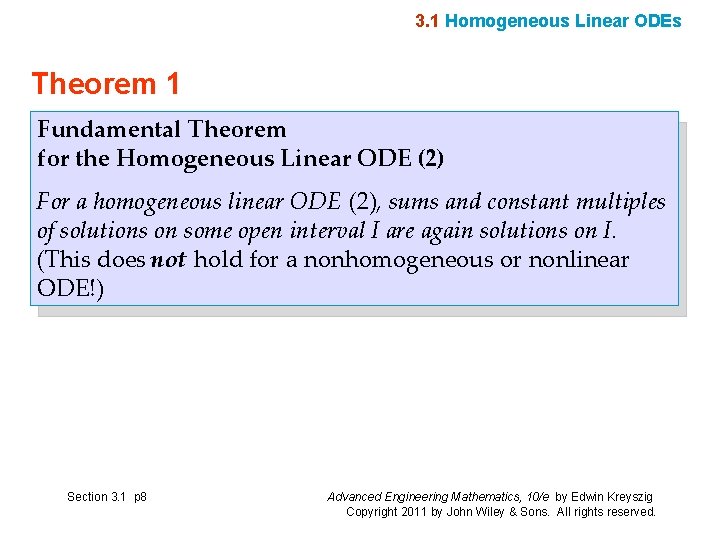
3. 1 Homogeneous Linear ODEs Theorem 1 Fundamental Theorem for the Homogeneous Linear ODE (2) For a homogeneous linear ODE (2), sums and constant multiples of solutions on some open interval I are again solutions on I. (This does not hold for a nonhomogeneous or nonlinear ODE!) Section 3. 1 p 8 Advanced Engineering Mathematics, 10/e by Edwin Kreyszig Copyright 2011 by John Wiley & Sons. All rights reserved.
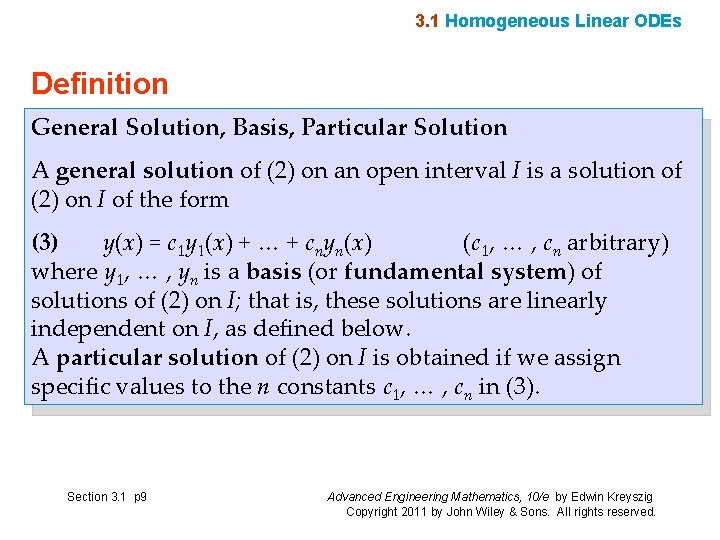
3. 1 Homogeneous Linear ODEs Definition General Solution, Basis, Particular Solution A general solution of (2) on an open interval I is a solution of (2) on I of the form (3) y(x) = c 1 y 1(x) + … + cnyn(x) (c 1, … , cn arbitrary) where y 1, … , yn is a basis (or fundamental system) of solutions of (2) on I; that is, these solutions are linearly independent on I, as defined below. A particular solution of (2) on I is obtained if we assign specific values to the n constants c 1, … , cn in (3). Section 3. 1 p 9 Advanced Engineering Mathematics, 10/e by Edwin Kreyszig Copyright 2011 by John Wiley & Sons. All rights reserved.
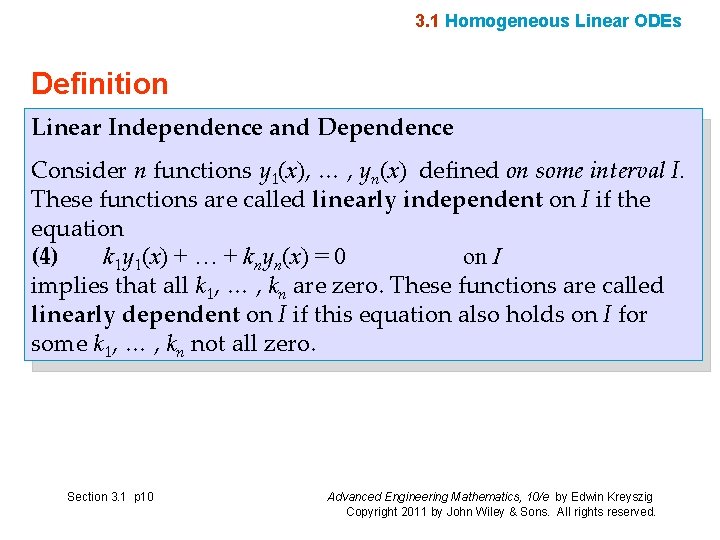
3. 1 Homogeneous Linear ODEs Definition Linear Independence and Dependence Consider n functions y 1(x), … , yn(x) defined on some interval I. These functions are called linearly independent on I if the equation (4) k 1 y 1(x) + … + knyn(x) = 0 on I implies that all k 1, … , kn are zero. These functions are called linearly dependent on I if this equation also holds on I for some k 1, … , kn not all zero. Section 3. 1 p 10 Advanced Engineering Mathematics, 10/e by Edwin Kreyszig Copyright 2011 by John Wiley & Sons. All rights reserved.
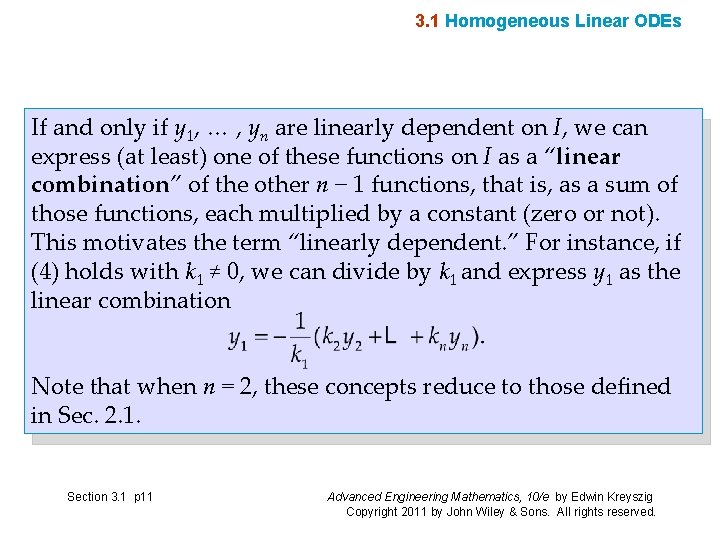
3. 1 Homogeneous Linear ODEs If and only if y 1, … , yn are linearly dependent on I, we can express (at least) one of these functions on I as a “linear combination” of the other n − 1 functions, that is, as a sum of those functions, each multiplied by a constant (zero or not). This motivates the term “linearly dependent. ” For instance, if (4) holds with k 1 ≠ 0, we can divide by k 1 and express y 1 as the linear combination Note that when n = 2, these concepts reduce to those defined in Sec. 2. 1. Section 3. 1 p 11 Advanced Engineering Mathematics, 10/e by Edwin Kreyszig Copyright 2011 by John Wiley & Sons. All rights reserved.
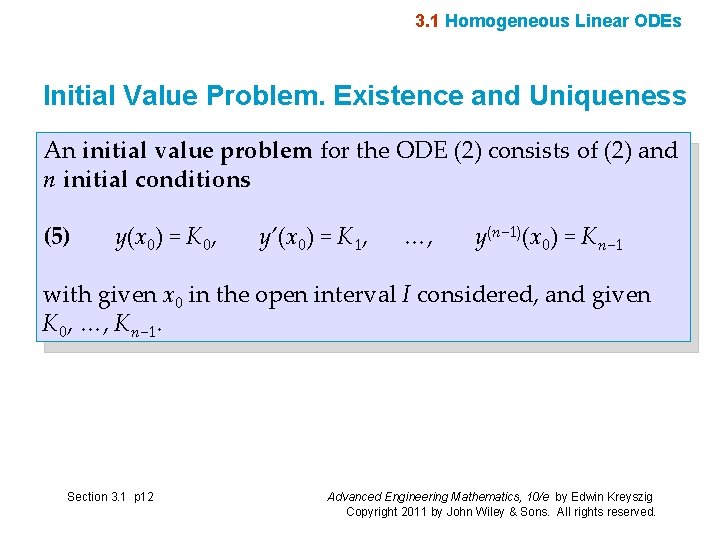
3. 1 Homogeneous Linear ODEs Initial Value Problem. Existence and Uniqueness An initial value problem for the ODE (2) consists of (2) and n initial conditions (5) y(x 0) = K 0, y’(x 0) = K 1, …, y(n− 1)(x 0) = Kn− 1 with given x 0 in the open interval I considered, and given K 0, …, Kn− 1. Section 3. 1 p 12 Advanced Engineering Mathematics, 10/e by Edwin Kreyszig Copyright 2011 by John Wiley & Sons. All rights reserved.
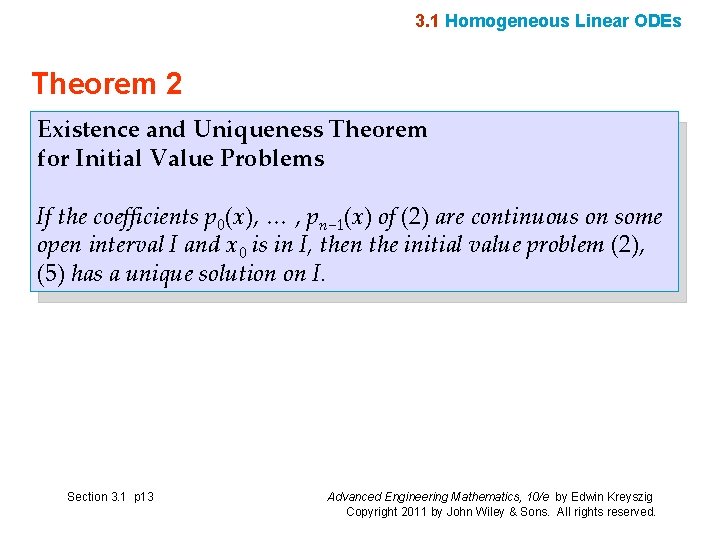
3. 1 Homogeneous Linear ODEs Theorem 2 Existence and Uniqueness Theorem for Initial Value Problems If the coefficients p 0(x), … , pn− 1(x) of (2) are continuous on some open interval I and x 0 is in I, then the initial value problem (2), (5) has a unique solution on I. Section 3. 1 p 13 Advanced Engineering Mathematics, 10/e by Edwin Kreyszig Copyright 2011 by John Wiley & Sons. All rights reserved.
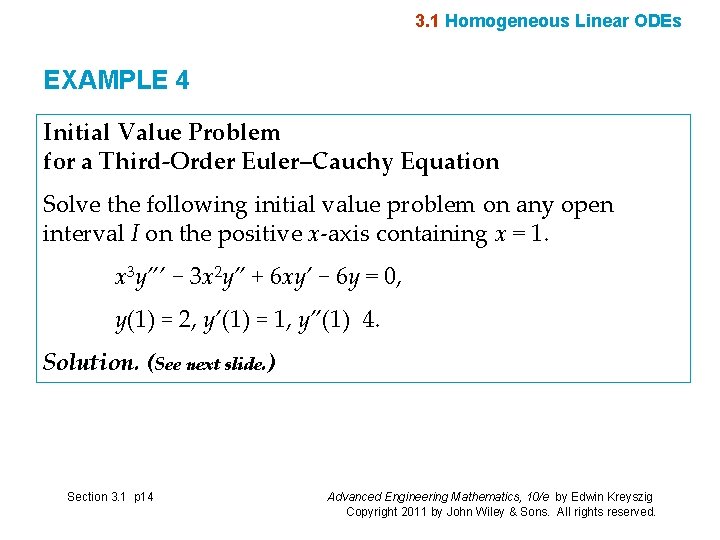
3. 1 Homogeneous Linear ODEs EXAMPLE 4 Initial Value Problem for a Third-Order Euler–Cauchy Equation Solve the following initial value problem on any open interval I on the positive x-axis containing x = 1. x 3 y”’ − 3 x 2 y” + 6 xy’ − 6 y = 0, y(1) = 2, y’(1) = 1, y”(1) 4. Solution. (See next slide. ) Section 3. 1 p 14 Advanced Engineering Mathematics, 10/e by Edwin Kreyszig Copyright 2011 by John Wiley & Sons. All rights reserved.
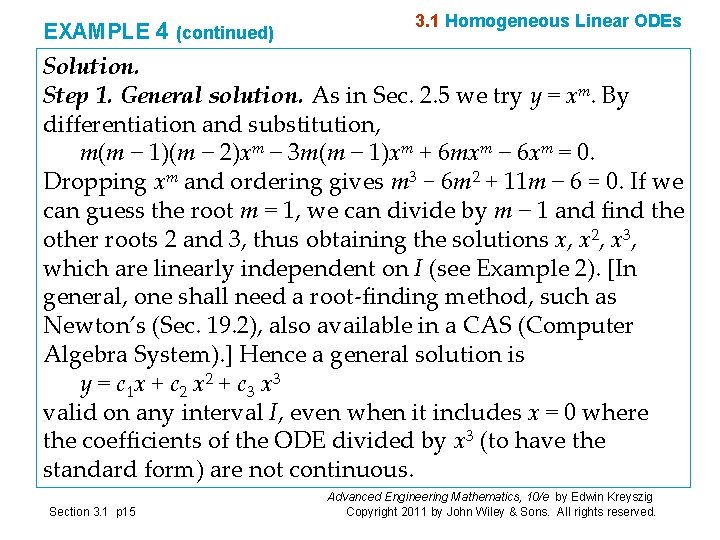
EXAMPLE 4 (continued) 3. 1 Homogeneous Linear ODEs Solution. Step 1. General solution. As in Sec. 2. 5 we try y = xm. By differentiation and substitution, m(m − 1)(m − 2)xm − 3 m(m − 1)xm + 6 mxm − 6 xm = 0. Dropping xm and ordering gives m 3 − 6 m 2 + 11 m − 6 = 0. If we can guess the root m = 1, we can divide by m − 1 and find the other roots 2 and 3, thus obtaining the solutions x, x 2, x 3, which are linearly independent on I (see Example 2). [In general, one shall need a root-finding method, such as Newton’s (Sec. 19. 2), also available in a CAS (Computer Algebra System). ] Hence a general solution is y = c 1 x + c 2 x 2 + c 3 x 3 valid on any interval I, even when it includes x = 0 where the coefficients of the ODE divided by x 3 (to have the standard form) are not continuous. Section 3. 1 p 15 Advanced Engineering Mathematics, 10/e by Edwin Kreyszig Copyright 2011 by John Wiley & Sons. All rights reserved.
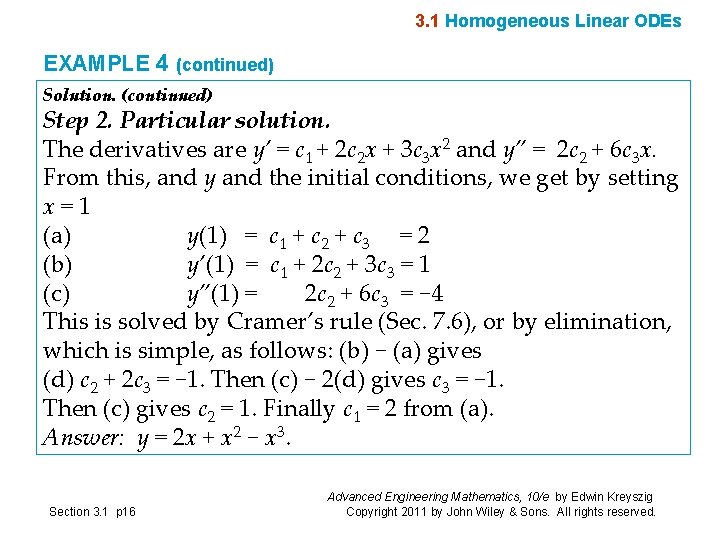
3. 1 Homogeneous Linear ODEs EXAMPLE 4 (continued) Solution. (continued) Step 2. Particular solution. The derivatives are y’ = c 1 + 2 c 2 x + 3 c 3 x 2 and y” = 2 c 2 + 6 c 3 x. From this, and y and the initial conditions, we get by setting x=1 (a) y(1) = c 1 + c 2 + c 3 = 2 (b) y’(1) = c 1 + 2 c 2 + 3 c 3 = 1 (c) y”(1) = 2 c 2 + 6 c 3 = − 4 This is solved by Cramer’s rule (Sec. 7. 6), or by elimination, which is simple, as follows: (b) − (a) gives (d) c 2 + 2 c 3 = − 1. Then (c) − 2(d) gives c 3 = − 1. Then (c) gives c 2 = 1. Finally c 1 = 2 from (a). Answer: y = 2 x + x 2 − x 3. Section 3. 1 p 16 Advanced Engineering Mathematics, 10/e by Edwin Kreyszig Copyright 2011 by John Wiley & Sons. All rights reserved.
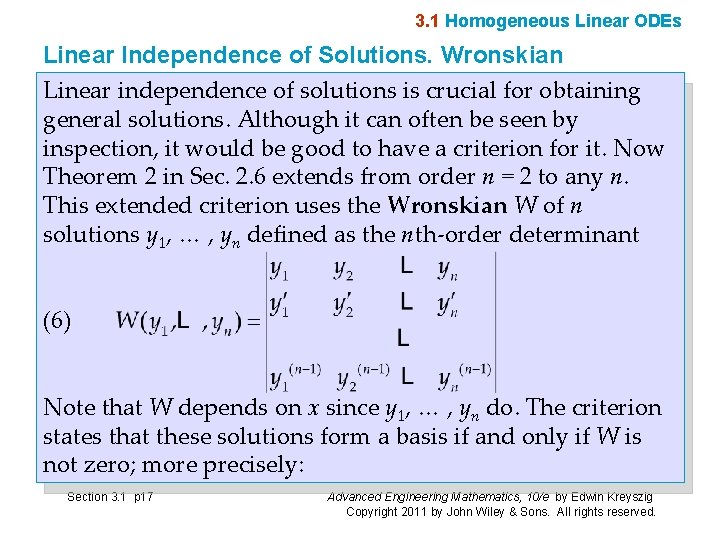
3. 1 Homogeneous Linear ODEs Linear Independence of Solutions. Wronskian Linear independence of solutions is crucial for obtaining general solutions. Although it can often be seen by inspection, it would be good to have a criterion for it. Now Theorem 2 in Sec. 2. 6 extends from order n = 2 to any n. This extended criterion uses the Wronskian W of n solutions y 1, … , yn defined as the nth-order determinant (6) Note that W depends on x since y 1, … , yn do. The criterion states that these solutions form a basis if and only if W is not zero; more precisely: Section 3. 1 p 17 Advanced Engineering Mathematics, 10/e by Edwin Kreyszig Copyright 2011 by John Wiley & Sons. All rights reserved.
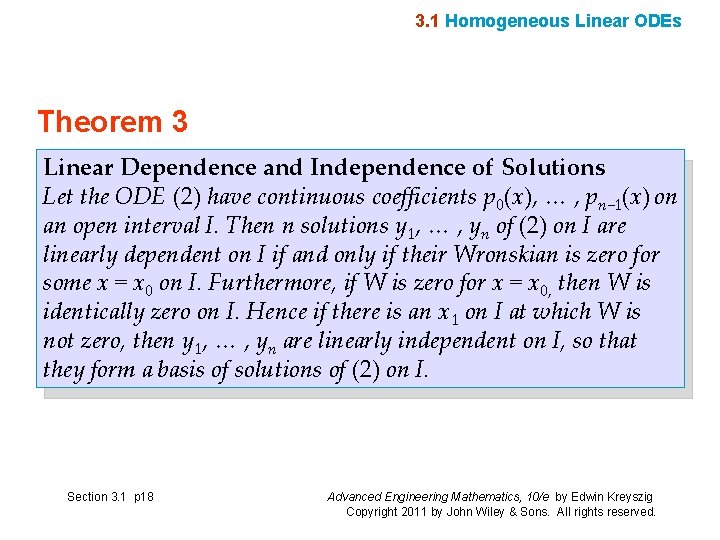
3. 1 Homogeneous Linear ODEs Theorem 3 Linear Dependence and Independence of Solutions Let the ODE (2) have continuous coefficients p 0(x), … , pn− 1(x) on an open interval I. Then n solutions y 1, … , yn of (2) on I are linearly dependent on I if and only if their Wronskian is zero for some x = x 0 on I. Furthermore, if W is zero for x = x 0, then W is identically zero on I. Hence if there is an x 1 on I at which W is not zero, then y 1, … , yn are linearly independent on I, so that they form a basis of solutions of (2) on I. Section 3. 1 p 18 Advanced Engineering Mathematics, 10/e by Edwin Kreyszig Copyright 2011 by John Wiley & Sons. All rights reserved.
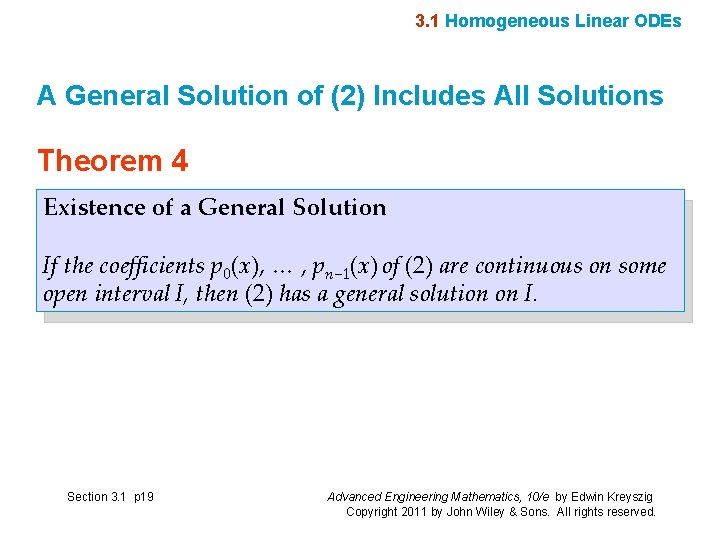
3. 1 Homogeneous Linear ODEs A General Solution of (2) Includes All Solutions Theorem 4 Existence of a General Solution If the coefficients p 0(x), … , pn− 1(x) of (2) are continuous on some open interval I, then (2) has a general solution on I. Section 3. 1 p 19 Advanced Engineering Mathematics, 10/e by Edwin Kreyszig Copyright 2011 by John Wiley & Sons. All rights reserved.
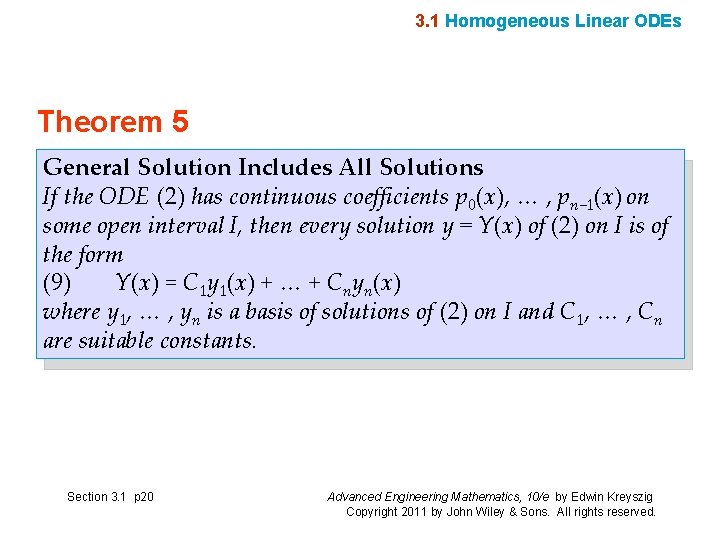
3. 1 Homogeneous Linear ODEs Theorem 5 General Solution Includes All Solutions If the ODE (2) has continuous coefficients p 0(x), … , pn− 1(x) on some open interval I, then every solution y = Y(x) of (2) on I is of the form (9) Y(x) = C 1 y 1(x) + … + Cnyn(x) where y 1, … , yn is a basis of solutions of (2) on I and C 1, … , Cn are suitable constants. Section 3. 1 p 20 Advanced Engineering Mathematics, 10/e by Edwin Kreyszig Copyright 2011 by John Wiley & Sons. All rights reserved.
3. 2 Homogeneous Linear ODEs with Constant Coefficients Section 3. 2 p 21 Advanced Engineering Mathematics, 10/e by Edwin Kreyszig Copyright 2011 by John Wiley & Sons. All rights reserved.
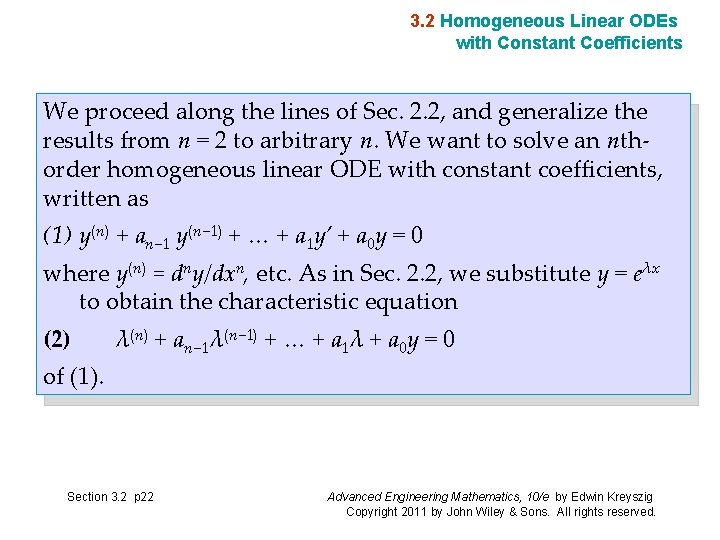
3. 2 Homogeneous Linear ODEs with Constant Coefficients We proceed along the lines of Sec. 2. 2, and generalize the results from n = 2 to arbitrary n. We want to solve an nthorder homogeneous linear ODE with constant coefficients, written as (1) y(n) + an− 1 y(n− 1) + … + a 1 y’ + a 0 y = 0 where y(n) = dny/dxn, etc. As in Sec. 2. 2, we substitute y = eλx to obtain the characteristic equation (2) λ(n) + an− 1λ(n− 1) + … + a 1λ + a 0 y = 0 of (1). Section 3. 2 p 22 Advanced Engineering Mathematics, 10/e by Edwin Kreyszig Copyright 2011 by John Wiley & Sons. All rights reserved.
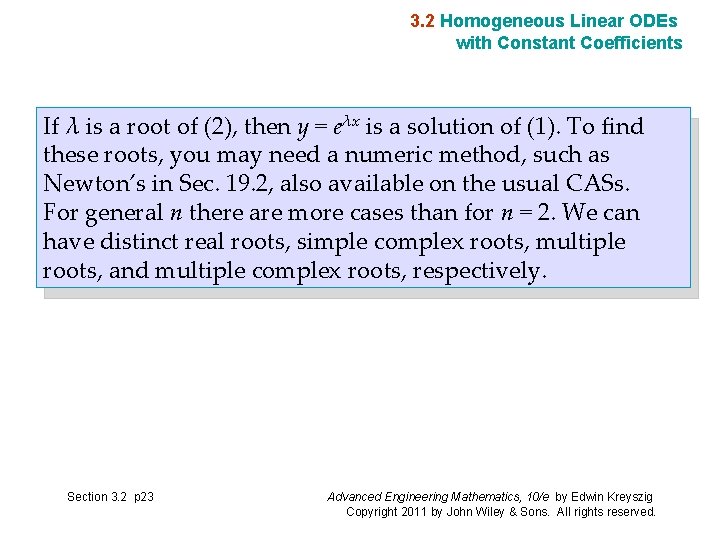
3. 2 Homogeneous Linear ODEs with Constant Coefficients If λ is a root of (2), then y = eλx is a solution of (1). To find these roots, you may need a numeric method, such as Newton’s in Sec. 19. 2, also available on the usual CASs. For general n there are more cases than for n = 2. We can have distinct real roots, simple complex roots, multiple roots, and multiple complex roots, respectively. Section 3. 2 p 23 Advanced Engineering Mathematics, 10/e by Edwin Kreyszig Copyright 2011 by John Wiley & Sons. All rights reserved.
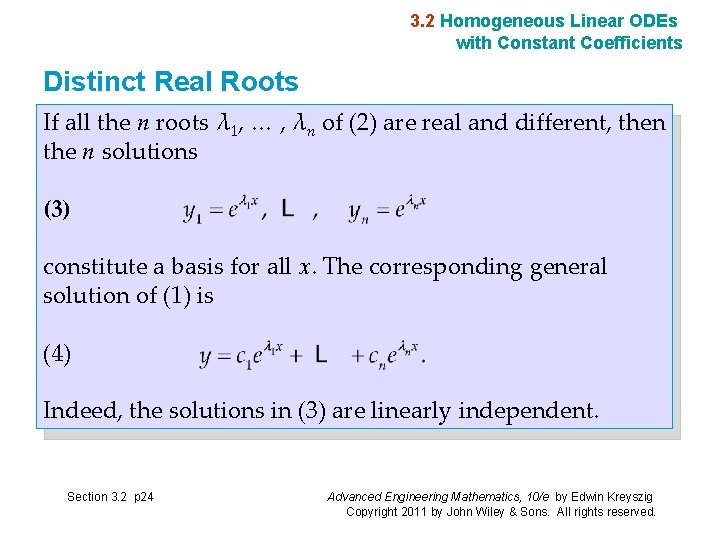
3. 2 Homogeneous Linear ODEs with Constant Coefficients Distinct Real Roots If all the n roots λ 1, … , λn of (2) are real and different, then the n solutions (3) constitute a basis for all x. The corresponding general solution of (1) is (4) Indeed, the solutions in (3) are linearly independent. Section 3. 2 p 24 Advanced Engineering Mathematics, 10/e by Edwin Kreyszig Copyright 2011 by John Wiley & Sons. All rights reserved.
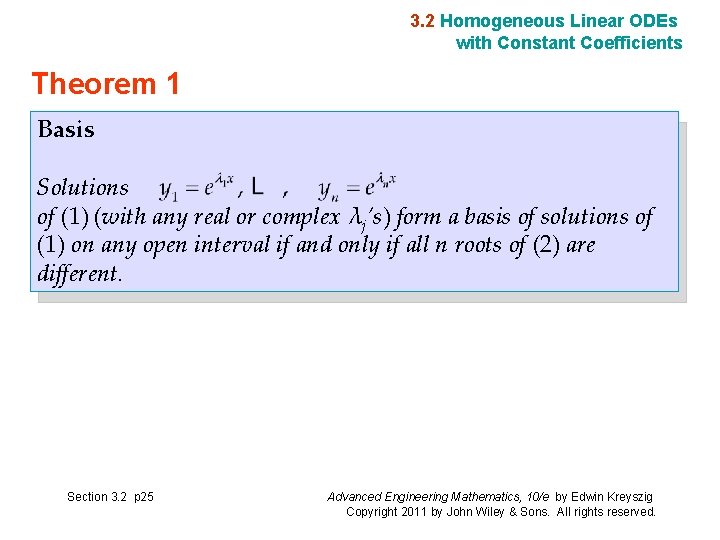
3. 2 Homogeneous Linear ODEs with Constant Coefficients Theorem 1 Basis Solutions of (1) (with any real or complex λj’s) form a basis of solutions of (1) on any open interval if and only if all n roots of (2) are different. Section 3. 2 p 25 Advanced Engineering Mathematics, 10/e by Edwin Kreyszig Copyright 2011 by John Wiley & Sons. All rights reserved.
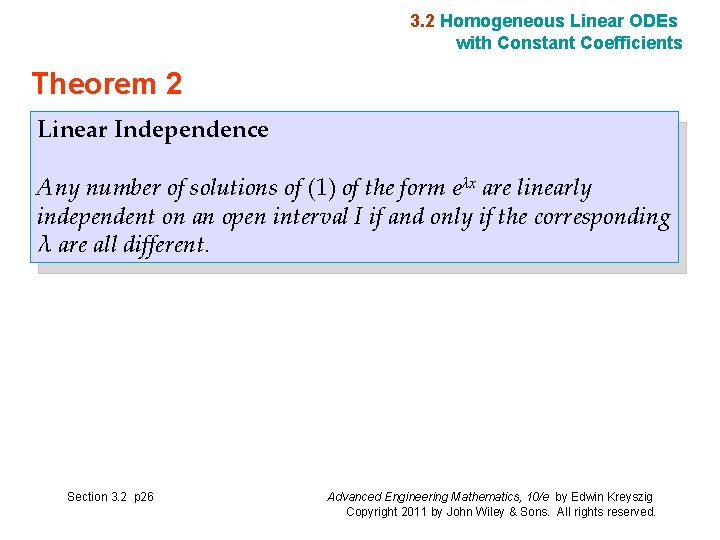
3. 2 Homogeneous Linear ODEs with Constant Coefficients Theorem 2 Linear Independence Any number of solutions of (1) of the form eλx are linearly independent on an open interval I if and only if the corresponding λ are all different. Section 3. 2 p 26 Advanced Engineering Mathematics, 10/e by Edwin Kreyszig Copyright 2011 by John Wiley & Sons. All rights reserved.
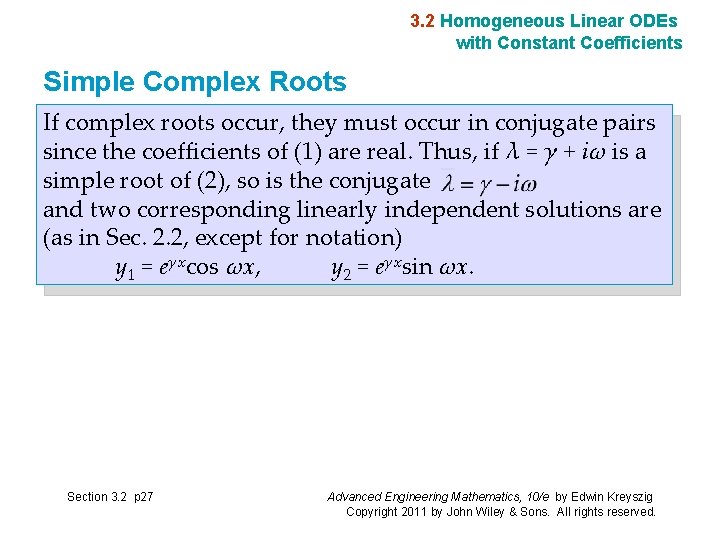
3. 2 Homogeneous Linear ODEs with Constant Coefficients Simple Complex Roots If complex roots occur, they must occur in conjugate pairs since the coefficients of (1) are real. Thus, if λ = γ + iω is a simple root of (2), so is the conjugate and two corresponding linearly independent solutions are (as in Sec. 2. 2, except for notation) y 1 = eγxcos ωx, y 2 = eγxsin ωx. Section 3. 2 p 27 Advanced Engineering Mathematics, 10/e by Edwin Kreyszig Copyright 2011 by John Wiley & Sons. All rights reserved.
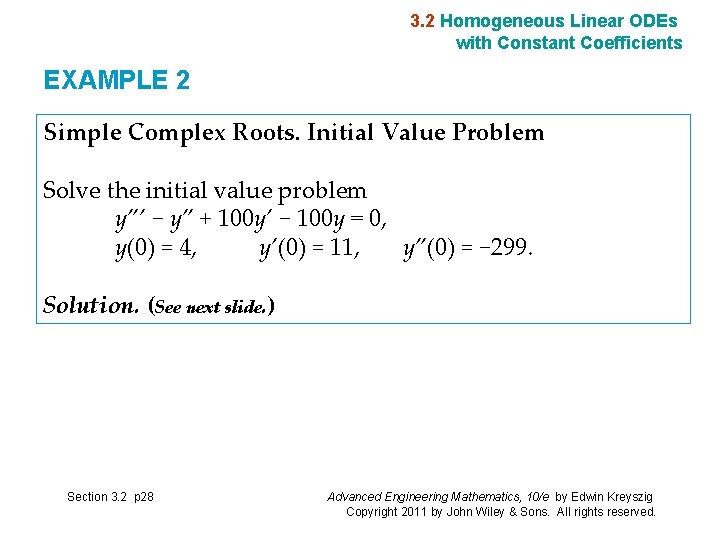
3. 2 Homogeneous Linear ODEs with Constant Coefficients EXAMPLE 2 Simple Complex Roots. Initial Value Problem Solve the initial value problem y”’ − y” + 100 y’ − 100 y = 0, y(0) = 4, y’(0) = 11, y”(0) = − 299. Solution. (See next slide. ) Section 3. 2 p 28 Advanced Engineering Mathematics, 10/e by Edwin Kreyszig Copyright 2011 by John Wiley & Sons. All rights reserved.
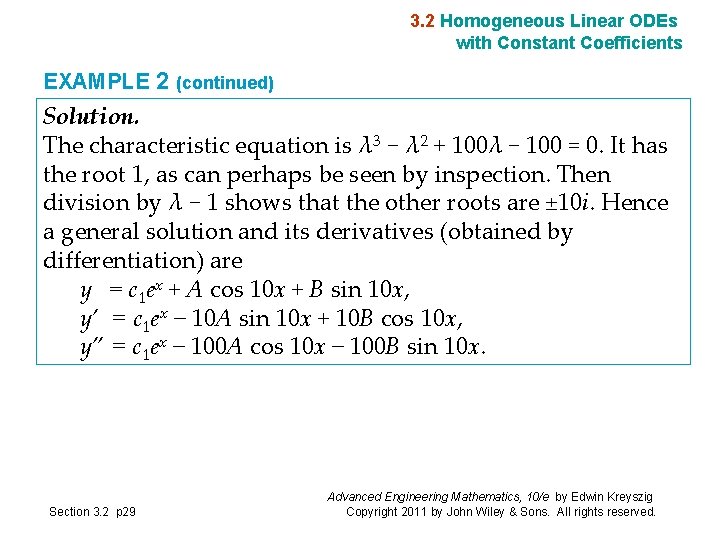
3. 2 Homogeneous Linear ODEs with Constant Coefficients EXAMPLE 2 (continued) Solution. The characteristic equation is λ 3 − λ 2 + 100λ − 100 = 0. It has the root 1, as can perhaps be seen by inspection. Then division by λ − 1 shows that the other roots are ± 10 i. Hence a general solution and its derivatives (obtained by differentiation) are y = c 1 ex + A cos 10 x + B sin 10 x, y’ = c 1 ex − 10 A sin 10 x + 10 B cos 10 x, y” = c 1 ex − 100 A cos 10 x − 100 B sin 10 x. Section 3. 2 p 29 Advanced Engineering Mathematics, 10/e by Edwin Kreyszig Copyright 2011 by John Wiley & Sons. All rights reserved.
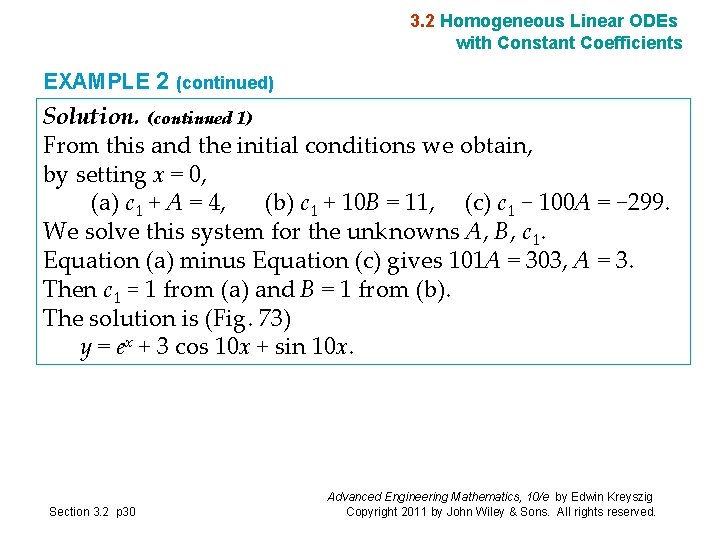
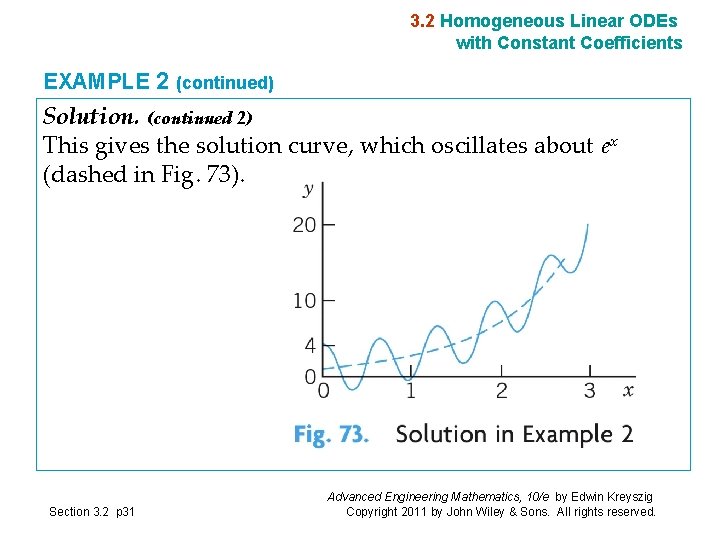
3. 2 Homogeneous Linear ODEs with Constant Coefficients EXAMPLE 2 (continued) Solution. (continued 1) From this and the initial conditions we obtain, by setting x = 0, (a) c 1 + A = 4, (b) c 1 + 10 B = 11, (c) c 1 − 100 A = − 299. We solve this system for the unknowns A, B, c 1. Equation (a) minus Equation (c) gives 101 A = 303, A = 3. Then c 1 = 1 from (a) and B = 1 from (b). The solution is (Fig. 73) y = ex + 3 cos 10 x + sin 10 x. Section 3. 2 p 30 Advanced Engineering Mathematics, 10/e by Edwin Kreyszig Copyright 2011 by John Wiley & Sons. All rights reserved.
3. 2 Homogeneous Linear ODEs with Constant Coefficients EXAMPLE 2 (continued) Solution. (continued 2) This gives the solution curve, which oscillates about ex (dashed in Fig. 73). Section 3. 2 p 31 Advanced Engineering Mathematics, 10/e by Edwin Kreyszig Copyright 2011 by John Wiley & Sons. All rights reserved.
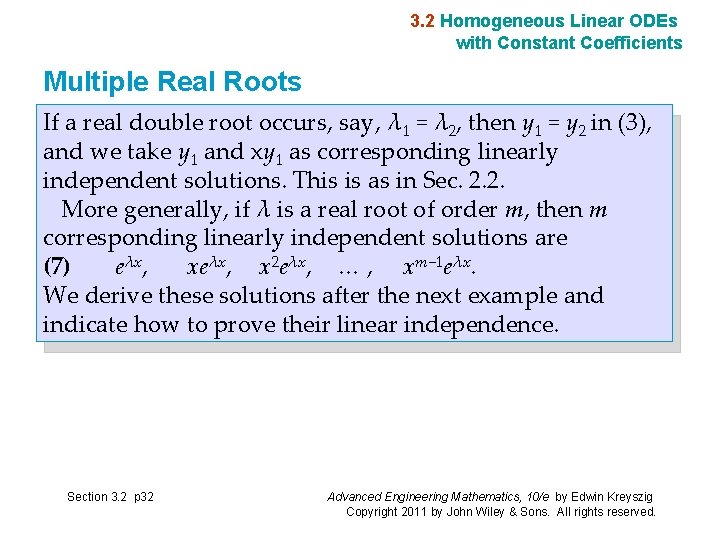
3. 2 Homogeneous Linear ODEs with Constant Coefficients Multiple Real Roots If a real double root occurs, say, λ 1 = λ 2, then y 1 = y 2 in (3), and we take y 1 and xy 1 as corresponding linearly independent solutions. This is as in Sec. 2. 2. More generally, if λ is a real root of order m, then m corresponding linearly independent solutions are (7) eλx, x 2 eλx, … , xm− 1 eλx. We derive these solutions after the next example and indicate how to prove their linear independence. Section 3. 2 p 32 Advanced Engineering Mathematics, 10/e by Edwin Kreyszig Copyright 2011 by John Wiley & Sons. All rights reserved.
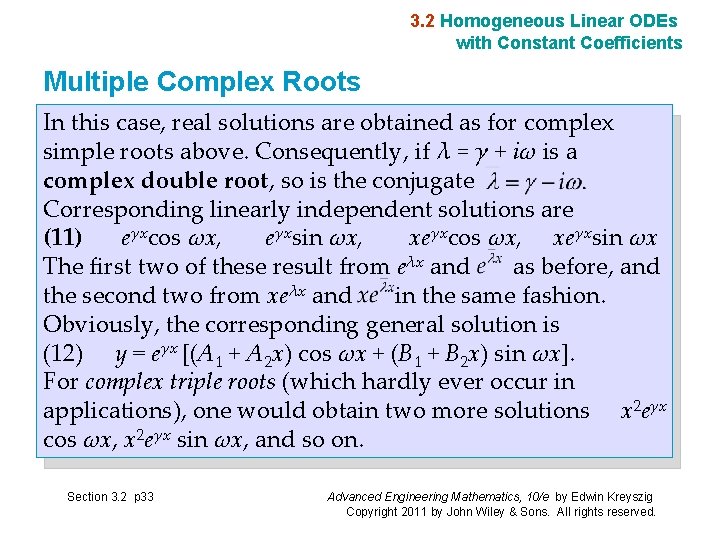
3. 2 Homogeneous Linear ODEs with Constant Coefficients Multiple Complex Roots In this case, real solutions are obtained as for complex simple roots above. Consequently, if λ = γ + iω is a complex double root, so is the conjugate Corresponding linearly independent solutions are (11) eγxcos ωx, eγxsin ωx, xeγxcos ωx, xeγxsin ωx The first two of these result from eλx and as before, and the second two from xeλx and in the same fashion. Obviously, the corresponding general solution is (12) y = eγx [(A 1 + A 2 x) cos ωx + (B 1 + B 2 x) sin ωx]. For complex triple roots (which hardly ever occur in applications), one would obtain two more solutions x 2 eγx cos ωx, x 2 eγx sin ωx, and so on. Section 3. 2 p 33 Advanced Engineering Mathematics, 10/e by Edwin Kreyszig Copyright 2011 by John Wiley & Sons. All rights reserved.
3. 3 Section 3. 3 p 34 Nonhomogeneous Linear ODEs Advanced Engineering Mathematics, 10/e by Edwin Kreyszig Copyright 2011 by John Wiley & Sons. All rights reserved.
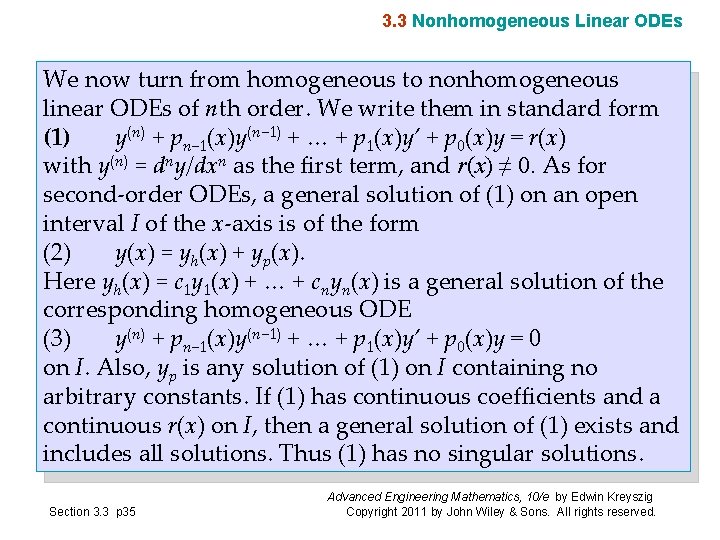
3. 3 Nonhomogeneous Linear ODEs We now turn from homogeneous to nonhomogeneous linear ODEs of nth order. We write them in standard form (1) y(n) + pn− 1(x)y(n− 1) + … + p 1(x)y’ + p 0(x)y = r(x) with y(n) = dny/dxn as the first term, and r(x) ≠ 0. As for second-order ODEs, a general solution of (1) on an open interval I of the x-axis is of the form (2) y(x) = yh(x) + yp(x). Here yh(x) = c 1 y 1(x) + … + cnyn(x) is a general solution of the corresponding homogeneous ODE (3) y(n) + pn− 1(x)y(n− 1) + … + p 1(x)y’ + p 0(x)y = 0 on I. Also, yp is any solution of (1) on I containing no arbitrary constants. If (1) has continuous coefficients and a continuous r(x) on I, then a general solution of (1) exists and includes all solutions. Thus (1) has no singular solutions. Section 3. 3 p 35 Advanced Engineering Mathematics, 10/e by Edwin Kreyszig Copyright 2011 by John Wiley & Sons. All rights reserved.
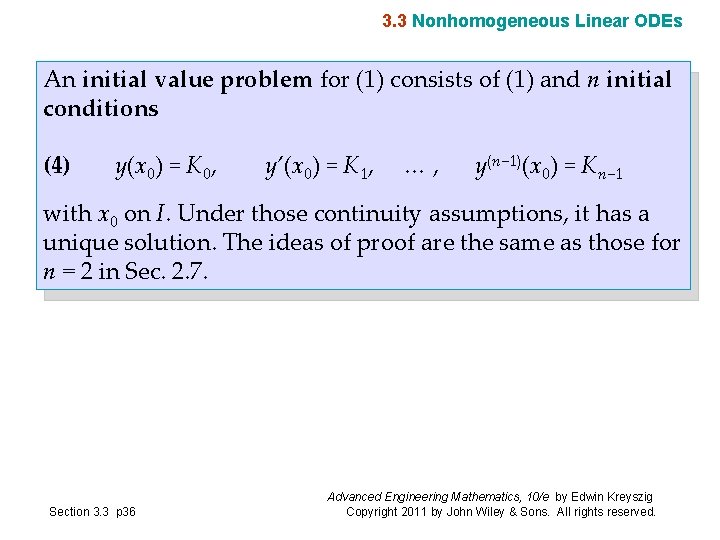
3. 3 Nonhomogeneous Linear ODEs An initial value problem for (1) consists of (1) and n initial conditions (4) y(x 0) = K 0, y’(x 0) = K 1, …, y(n− 1)(x 0) = Kn− 1 with x 0 on I. Under those continuity assumptions, it has a unique solution. The ideas of proof are the same as those for n = 2 in Sec. 2. 7. Section 3. 3 p 36 Advanced Engineering Mathematics, 10/e by Edwin Kreyszig Copyright 2011 by John Wiley & Sons. All rights reserved.
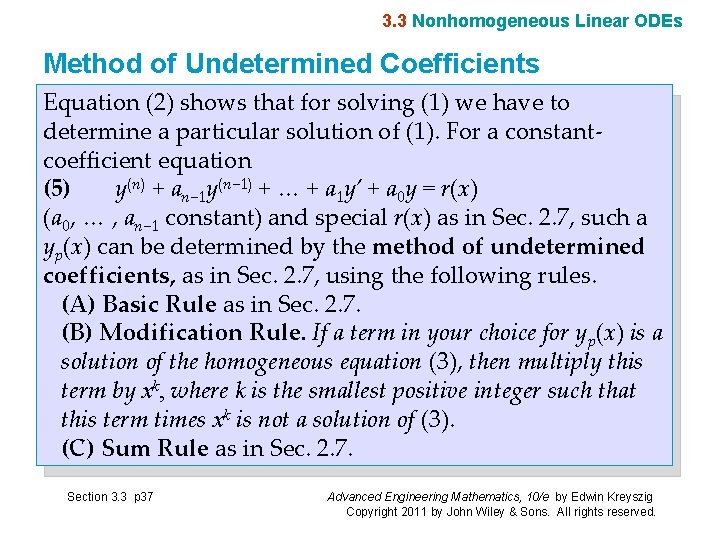
3. 3 Nonhomogeneous Linear ODEs Method of Undetermined Coefficients Equation (2) shows that for solving (1) we have to determine a particular solution of (1). For a constantcoefficient equation (5) y(n) + an− 1 y(n− 1) + … + a 1 y’ + a 0 y = r(x) (a 0, … , an− 1 constant) and special r(x) as in Sec. 2. 7, such a yp(x) can be determined by the method of undetermined coefficients, as in Sec. 2. 7, using the following rules. (A) Basic Rule as in Sec. 2. 7. (B) Modification Rule. If a term in your choice for yp(x) is a solution of the homogeneous equation (3), then multiply this term by xk, where k is the smallest positive integer such that this term times xk is not a solution of (3). (C) Sum Rule as in Sec. 2. 7. Section 3. 3 p 37 Advanced Engineering Mathematics, 10/e by Edwin Kreyszig Copyright 2011 by John Wiley & Sons. All rights reserved.
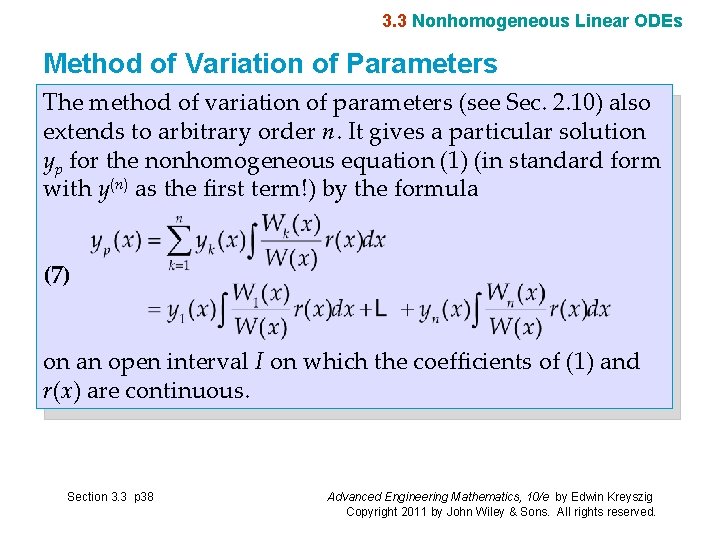
3. 3 Nonhomogeneous Linear ODEs Method of Variation of Parameters The method of variation of parameters (see Sec. 2. 10) also extends to arbitrary order n. It gives a particular solution yp for the nonhomogeneous equation (1) (in standard form with y(n) as the first term!) by the formula (7) on an open interval I on which the coefficients of (1) and r(x) are continuous. Section 3. 3 p 38 Advanced Engineering Mathematics, 10/e by Edwin Kreyszig Copyright 2011 by John Wiley & Sons. All rights reserved.
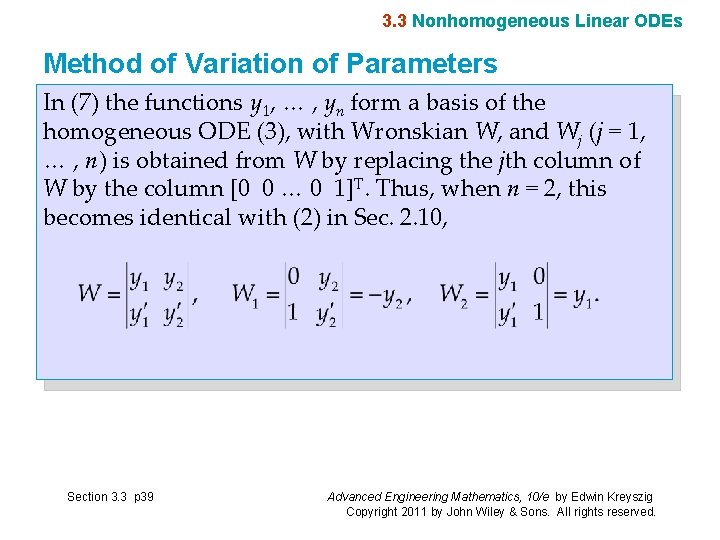
3. 3 Nonhomogeneous Linear ODEs Method of Variation of Parameters In (7) the functions y 1, … , yn form a basis of the homogeneous ODE (3), with Wronskian W, and Wj (j = 1, … , n) is obtained from W by replacing the jth column of W by the column [0 0 … 0 1]T. Thus, when n = 2, this becomes identical with (2) in Sec. 2. 10, Section 3. 3 p 39 Advanced Engineering Mathematics, 10/e by Edwin Kreyszig Copyright 2011 by John Wiley & Sons. All rights reserved.
3 Higher Order Linear ODEs SUMMARY OF CHAPTER Section 3. Summary p 40 Advanced Engineering Mathematics, 10/e by Edwin Kreyszig Copyright 2011 by John Wiley & Sons. All rights reserved.
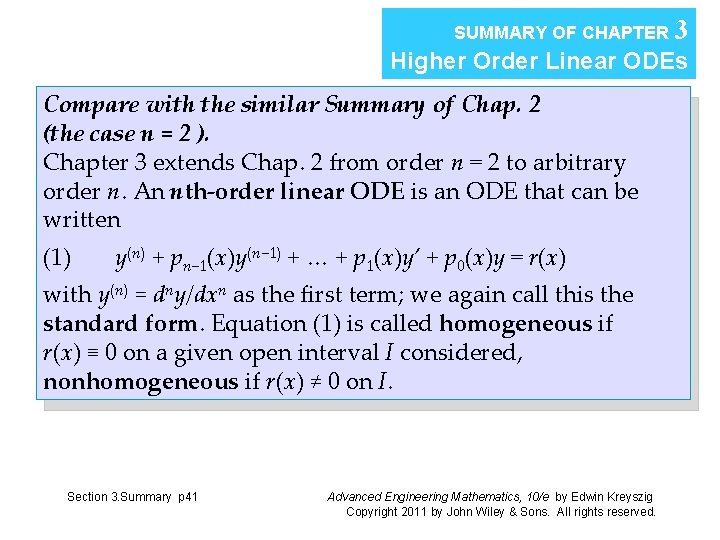
SUMMARY OF CHAPTER 3 Higher Order Linear ODEs Compare with the similar Summary of Chap. 2 (the case n = 2 ). Chapter 3 extends Chap. 2 from order n = 2 to arbitrary order n. An nth-order linear ODE is an ODE that can be written (1) y(n) + pn− 1(x)y(n− 1) + … + p 1(x)y’ + p 0(x)y = r(x) with y(n) = dny/dxn as the first term; we again call this the standard form. Equation (1) is called homogeneous if r(x) ≡ 0 on a given open interval I considered, nonhomogeneous if r(x) ≠ 0 on I. Section 3. Summary p 41 Advanced Engineering Mathematics, 10/e by Edwin Kreyszig Copyright 2011 by John Wiley & Sons. All rights reserved.
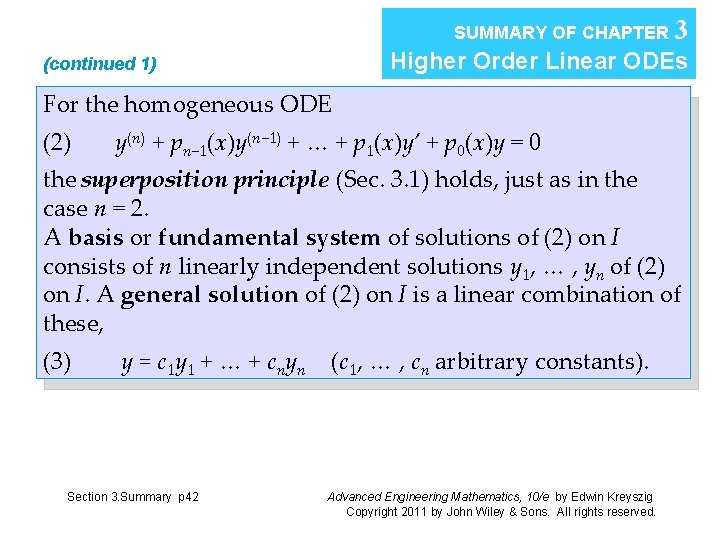
SUMMARY OF CHAPTER 3 Higher Order Linear ODEs (continued 1) For the homogeneous ODE (2) y(n) + pn− 1(x)y(n− 1) + … + p 1(x)y’ + p 0(x)y = 0 the superposition principle (Sec. 3. 1) holds, just as in the case n = 2. A basis or fundamental system of solutions of (2) on I consists of n linearly independent solutions y 1, … , yn of (2) on I. A general solution of (2) on I is a linear combination of these, (3) y = c 1 y 1 + … + cnyn Section 3. Summary p 42 (c 1, … , cn arbitrary constants). Advanced Engineering Mathematics, 10/e by Edwin Kreyszig Copyright 2011 by John Wiley & Sons. All rights reserved.
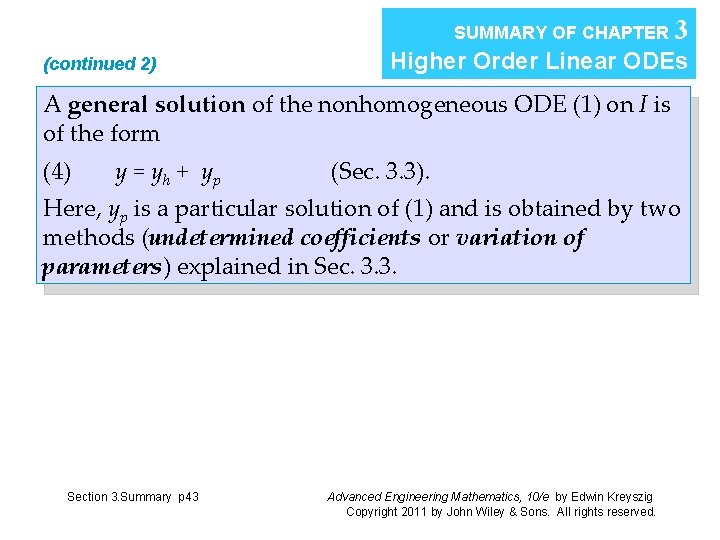
SUMMARY OF CHAPTER (continued 2) 3 Higher Order Linear ODEs A general solution of the nonhomogeneous ODE (1) on I is of the form (4) y = yh + yp (Sec. 3. 3). Here, yp is a particular solution of (1) and is obtained by two methods (undetermined coefficients or variation of parameters) explained in Sec. 3. 3. Section 3. Summary p 43 Advanced Engineering Mathematics, 10/e by Edwin Kreyszig Copyright 2011 by John Wiley & Sons. All rights reserved.
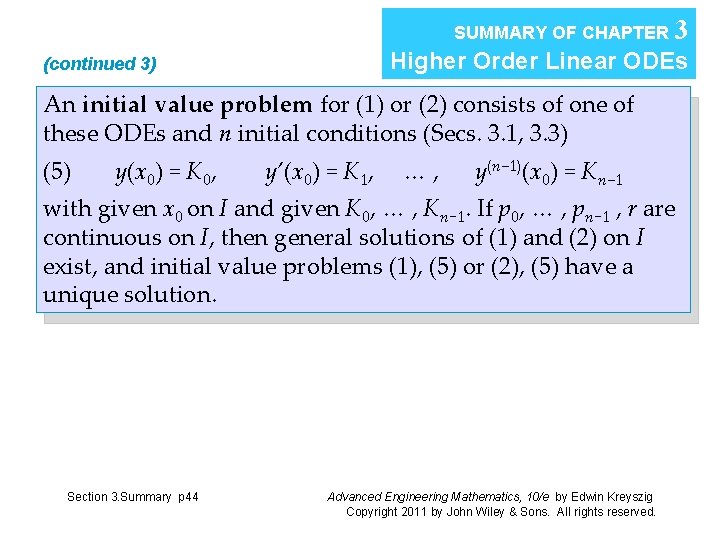
SUMMARY OF CHAPTER 3 Higher Order Linear ODEs (continued 3) An initial value problem for (1) or (2) consists of one of these ODEs and n initial conditions (Secs. 3. 1, 3. 3) (5) y(x 0) = K 0, y’(x 0) = K 1, …, y(n− 1)(x 0) = Kn− 1 with given x 0 on I and given K 0, … , Kn− 1. If p 0, … , pn− 1 , r are continuous on I, then general solutions of (1) and (2) on I exist, and initial value problems (1), (5) or (2), (5) have a unique solution. Section 3. Summary p 44 Advanced Engineering Mathematics, 10/e by Edwin Kreyszig Copyright 2011 by John Wiley & Sons. All rights reserved.