
Part 5 Parameter Identification Model CalibrationUpdating Calibration using

Part 5 Parameter Identification (Model Calibration/Updating)
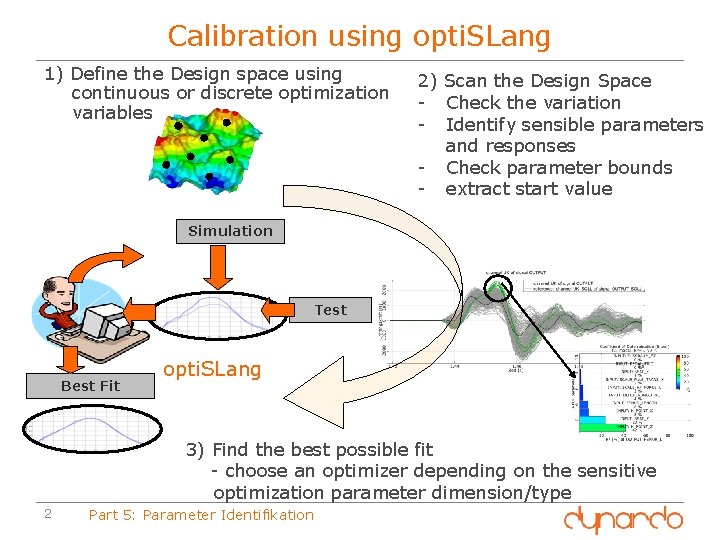
Calibration using opti. SLang 1) Define the Design space using continuous or discrete optimization variables 2) Scan the Design Space - Check the variation - Identify sensible parameters and responses - Check parameter bounds - extract start value Simulation Test Best Fit opti. SLang 3) Find the best possible fit - choose an optimizer depending on the sensitive optimization parameter dimension/type 2 Part 5: Parameter Identifikation
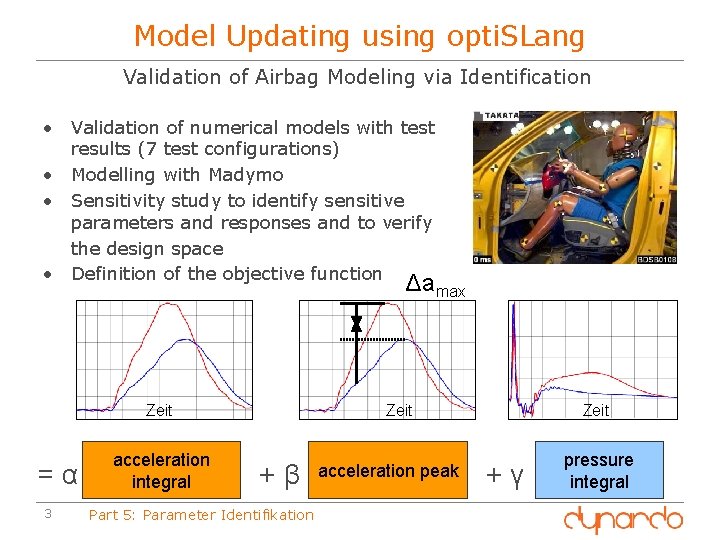
Model Updating using opti. SLang Validation of Airbag Modeling via Identification • Validation of numerical models with test results (7 test configurations) • Modelling with Madymo • Sensitivity study to identify sensitive parameters and responses and to verify the design space • Definition of the objective function Δamax Zeit =α 3 acceleration integral Zeit +β Part 5: Parameter Identifikation acceleration peak Zeit +γ pressure integral

Model Updating using opti. SLang Validation of Airbag Modeling via Identification • opti. SLang’s genetic algorithm for global search • 15 generation *10 individuals *7 test configuration • (Total: 11 h CPU) Simulation Test Best Fit 4 opti. SLang Part 5: Parameter Identifikation
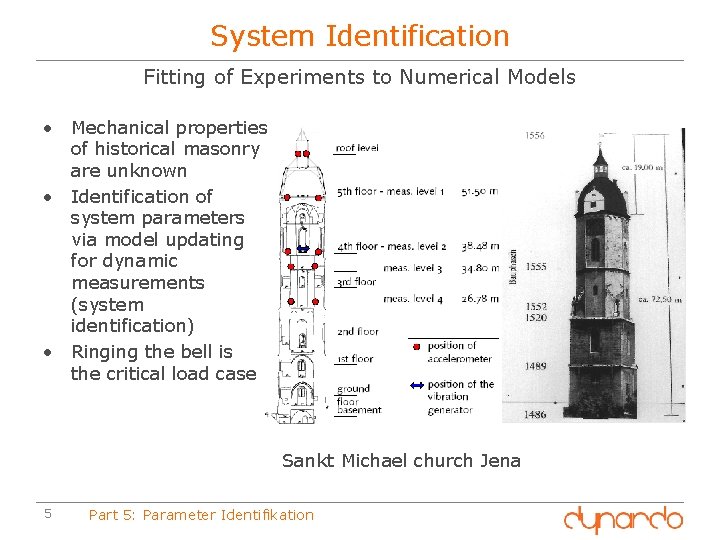
System Identification Fitting of Experiments to Numerical Models • Mechanical properties of historical masonry are unknown • Identification of system parameters via model updating for dynamic measurements (system identification) • Ringing the bell is the critical load case Sankt Michael church Jena 5 Part 5: Parameter Identifikation
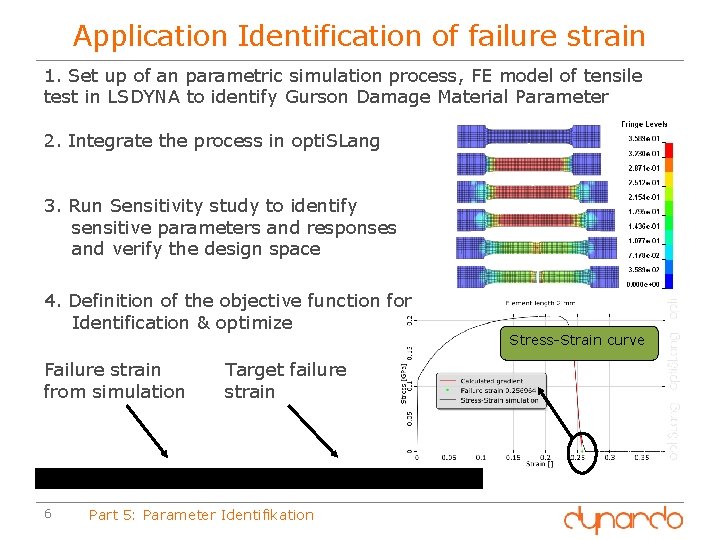
Application Identification of failure strain 1. Set up of an parametric simulation process, FE model of tensile test in LSDYNA to identify Gurson Damage Material Parameter 2. Integrate the process in opti. SLang 3. Run Sensitivity study to identify sensitive parameters and responses and verify the design space 4. Definition of the objective function for Identification & optimize Failure strain from simulation Target failure strain obj_func = |FAIL_STRAIN – TARGET_STRAIN| 0 6 Part 5: Parameter Identifikation Stress-Strain curve

Identification of one experiment • Identify one set of Gurson material values (FC, FF, EN) for mean experimental value • 7 Parameter using ARSM algorithm for global search 1 start design from sensitivity (best design) • 4 min/design (Total: 8 h 1 CPU) 7 Best Fit Part 5: Parameter Identifikation 2 mm 4 mm 10 mm Simulation 3 calculations per design
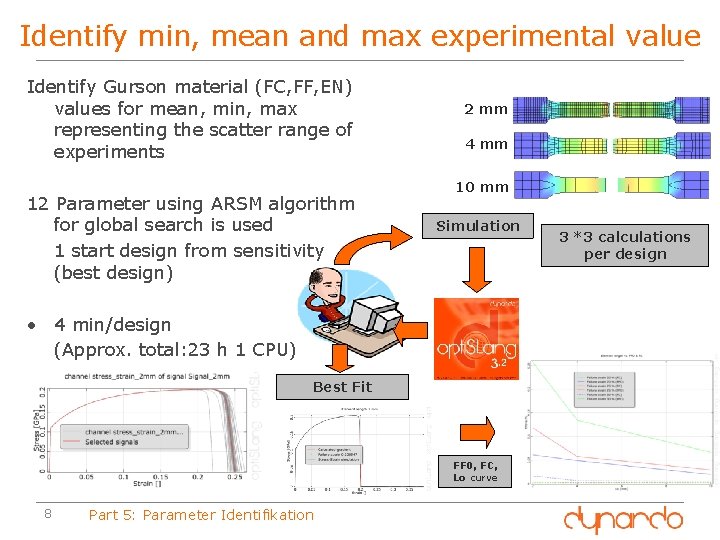
Identify min, mean and max experimental value Identify Gurson material (FC, FF, EN) values for mean, min, max representing the scatter range of experiments 12 Parameter using ARSM algorithm for global search is used 1 start design from sensitivity (best design) 2 mm 4 mm 10 mm Simulation • 4 min/design (Approx. total: 23 h 1 CPU) Best Fit FF 0, FC, Lo curve 8 Part 5: Parameter Identifikation 3 *3 calculations per design
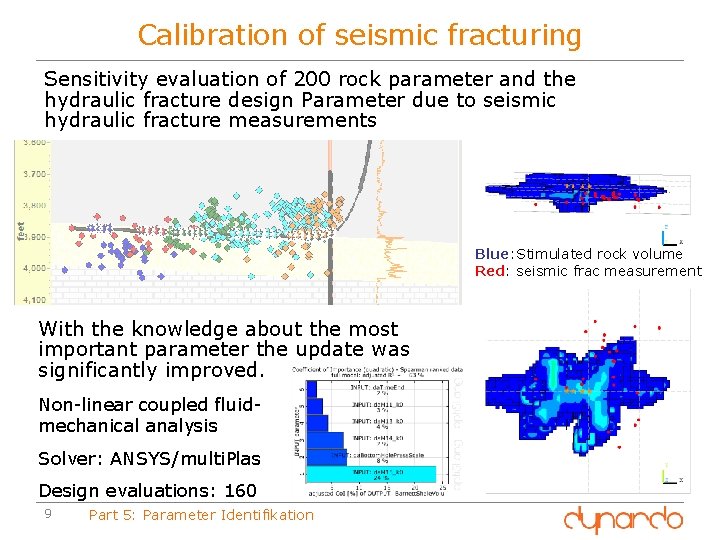
Calibration of seismic fracturing Sensitivity evaluation of 200 rock parameter and the hydraulic fracture design Parameter due to seismic hydraulic fracture measurements Blue: Stimulated rock volume Red: seismic frac measurement With the knowledge about the most important parameter the update was significantly improved. Non-linear coupled fluidmechanical analysis Solver: ANSYS/multi. Plas Design evaluations: 160 9 Part 5: Parameter Identifikation
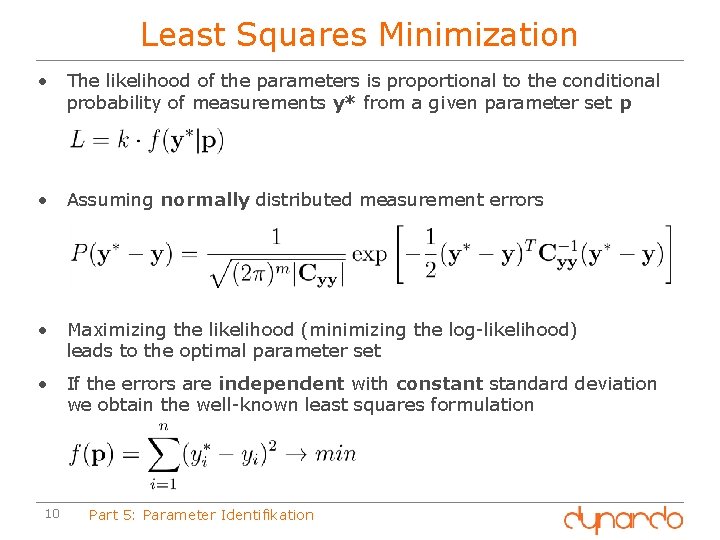
Least Squares Minimization • The likelihood of the parameters is proportional to the conditional probability of measurements y* from a given parameter set p • Assuming normally distributed measurement errors • Maximizing the likelihood (minimizing the log-likelihood) leads to the optimal parameter set • If the errors are independent with constant standard deviation we obtain the well-known least squares formulation 10 Part 5: Parameter Identifikation
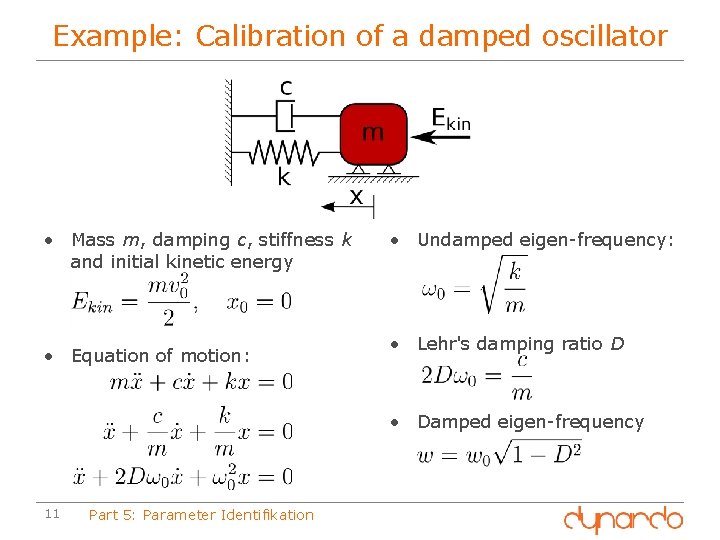
Example: Calibration of a damped oscillator • Mass m, damping c, stiffness k and initial kinetic energy • Equation of motion: • Undamped eigen-frequency: • Lehr's damping ratio D • Damped eigen-frequency 11 Part 5: Parameter Identifikation
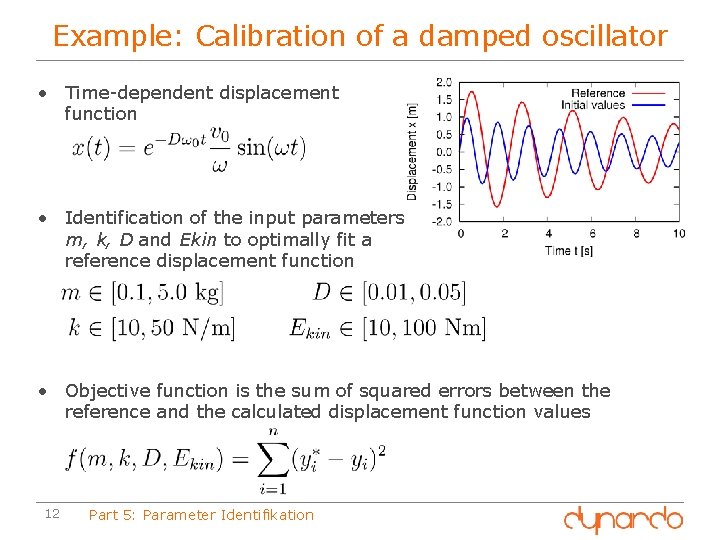
Example: Calibration of a damped oscillator • Time-dependent displacement function • Identification of the input parameters m, k, D and Ekin to optimally fit a reference displacement function • Objective function is the sum of squared errors between the reference and the calculated displacement function values 12 Part 5: Parameter Identifikation
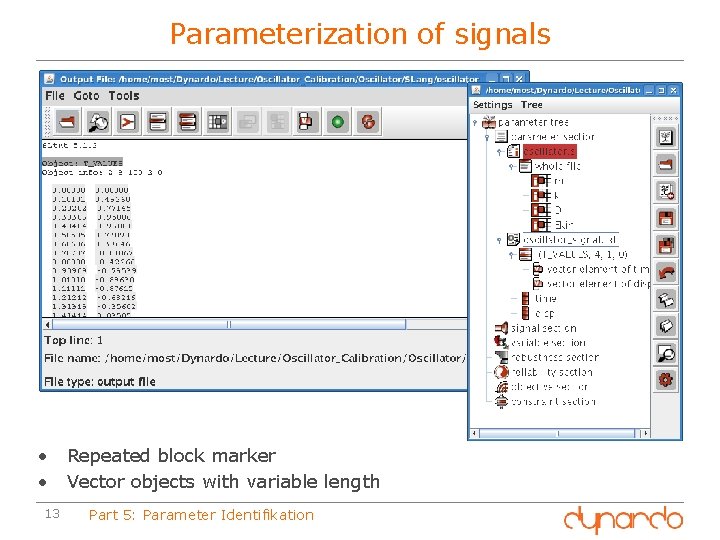
Parameterization of signals • Repeated block marker • Vector objects with variable length 13 Part 5: Parameter Identifikation
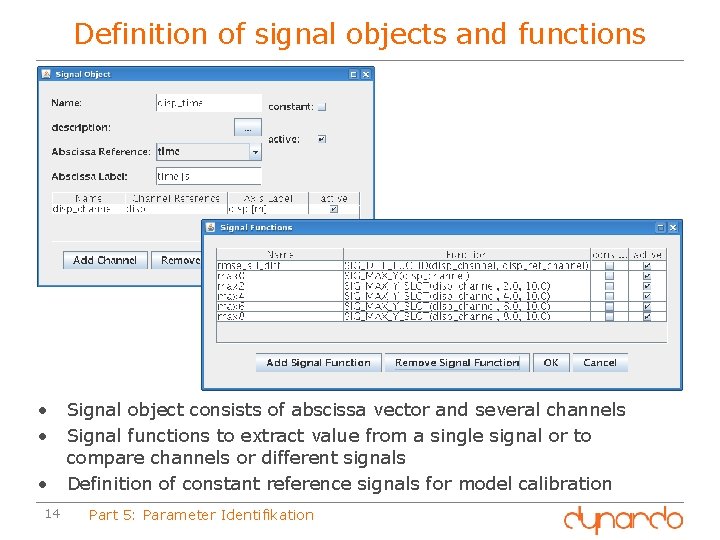
Definition of signal objects and functions • Signal object consists of abscissa vector and several channels • Signal functions to extract value from a single signal or to compare channels or different signals • Definition of constant reference signals for model calibration 14 Part 5: Parameter Identifikation
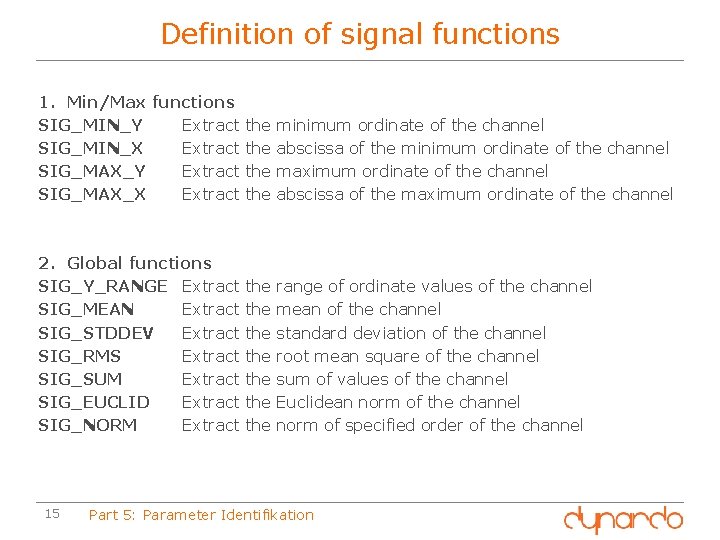
Definition of signal functions 1. Min/Max functions SIG_MIN_Y Extract the minimum ordinate of the channel SIG_MIN_X Extract the abscissa of the minimum ordinate of the channel SIG_MAX_Y Extract the maximum ordinate of the channel SIG_MAX_X Extract the abscissa of the maximum ordinate of the channel 2. Global functions SIG_Y_RANGE Extract SIG_MEAN Extract SIG_STDDEV Extract SIG_RMS Extract SIG_SUM Extract SIG_EUCLID Extract SIG_NORM Extract 15 the the range of ordinate values of the channel mean of the channel standard deviation of the channel root mean square of the channel sum of values of the channel Euclidean norm of the channel norm of specified order of the channel Part 5: Parameter Identifikation
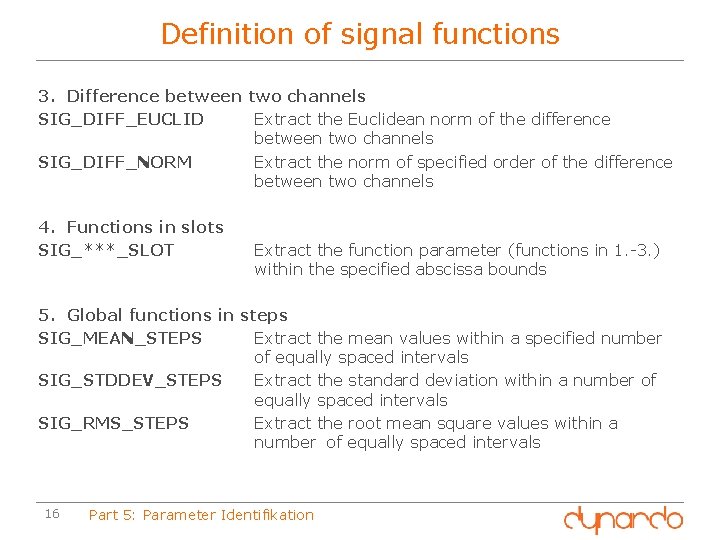
Definition of signal functions 3. Difference between two channels SIG_DIFF_EUCLID Extract the Euclidean norm of the difference between two channels SIG_DIFF_NORM Extract the norm of specified order of the difference between two channels 4. Functions in slots SIG_***_SLOT Extract the function parameter (functions in 1. -3. ) within the specified abscissa bounds 5. Global functions in steps SIG_MEAN_STEPS Extract the mean values within a specified number of equally spaced intervals SIG_STDDEV_STEPS Extract the standard deviation within a number of equally spaced intervals SIG_RMS_STEPS Extract the root mean square values within a number of equally spaced intervals 16 Part 5: Parameter Identifikation
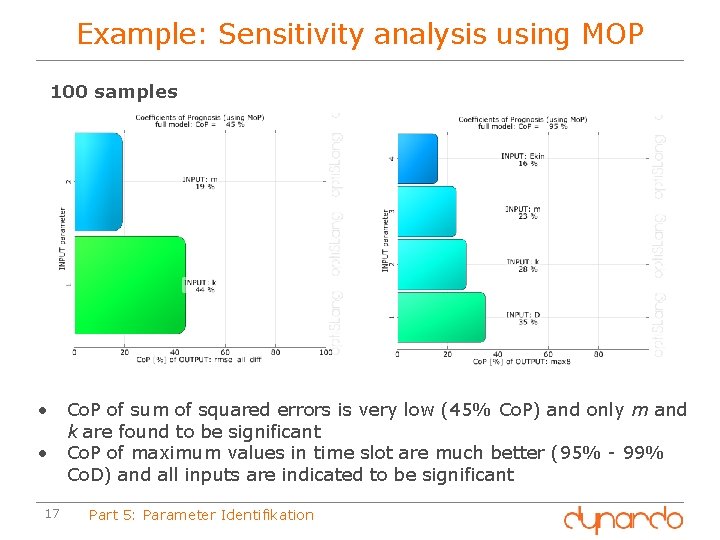
Example: Sensitivity analysis using MOP 100 samples • Co. P of sum of squared errors is very low (45% Co. P) and only m and k are found to be significant • Co. P of maximum values in time slot are much better (95% - 99% Co. D) and all inputs are indicated to be significant 17 Part 5: Parameter Identifikation
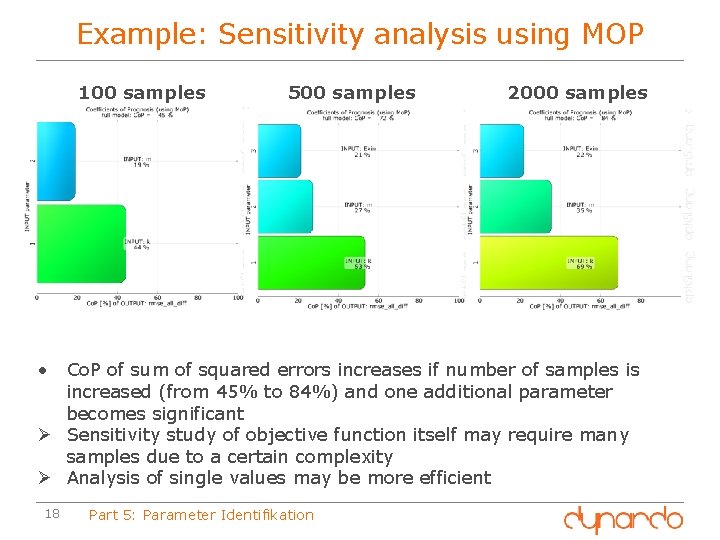
Example: Sensitivity analysis using MOP 100 samples 500 samples 2000 samples • Co. P of sum of squared errors increases if number of samples is increased (from 45% to 84%) and one additional parameter becomes significant Ø Sensitivity study of objective function itself may require many samples due to a certain complexity Ø Analysis of single values may be more efficient 18 Part 5: Parameter Identifikation
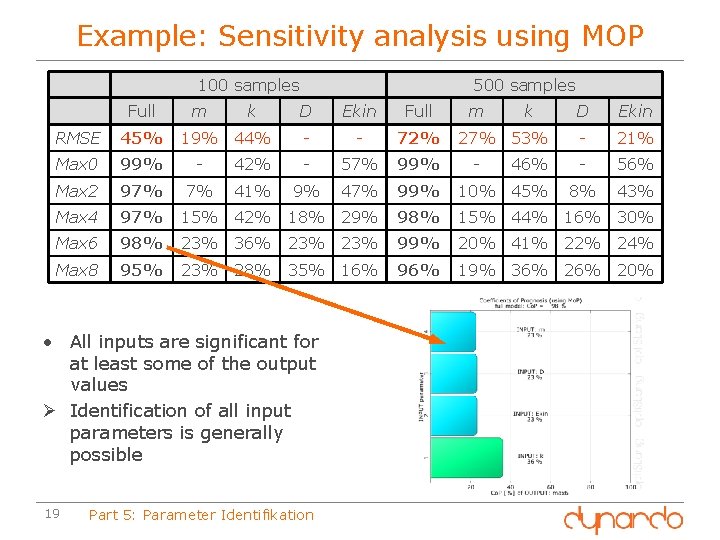
Example: Sensitivity analysis using MOP 100 samples Full m k 19% 44% 500 samples D Ekin Full - - 72% m k Ekin - 21% - 56% 8% 43% RMSE 45% Max 0 99% - 42% - 57% 99% Max 2 97% 7% 41% 9% 47% 99% 10% 45% Max 4 97% 15% 42% 18% 29% 98% 15% 44% 16% 30% Max 6 98% 23% 36% 23% 99% 20% 41% 22% 24% Max 8 95% 23% 28% 35% 16% 96% 19% 36% 20% • All inputs are significant for at least some of the output values Ø Identification of all input parameters is generally possible 19 Part 5: Parameter Identifikation 27% 53% D - 46%
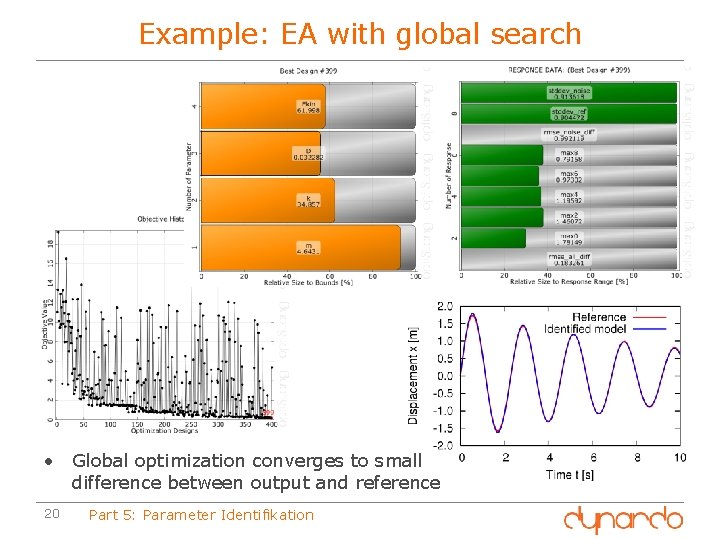
Example: EA with global search • Global optimization converges to small difference between output and reference 20 Part 5: Parameter Identifikation
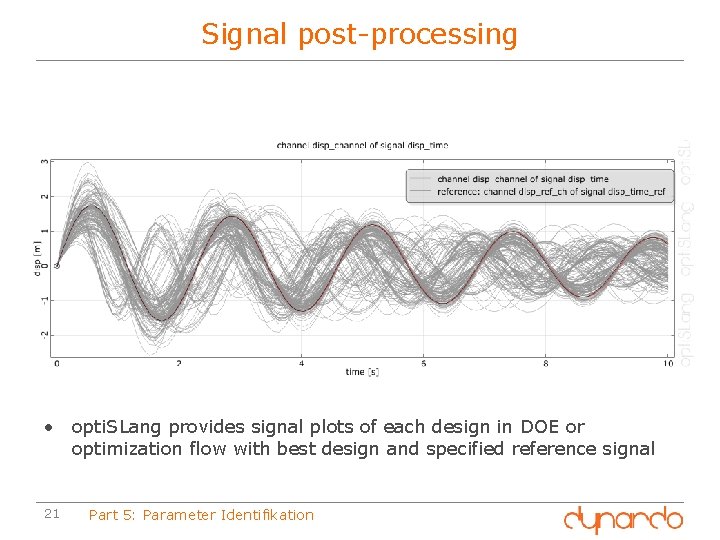
Signal post-processing • opti. SLang provides signal plots of each design in DOE or optimization flow with best design and specified reference signal 21 Part 5: Parameter Identifikation
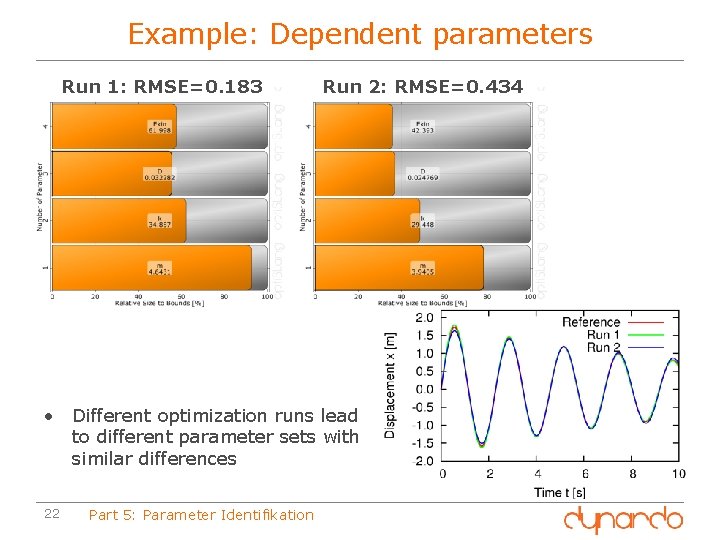
Example: Dependent parameters Run 1: RMSE=0. 183 Run 2: RMSE=0. 434 • Different optimization runs lead to different parameter sets with similar differences 22 Part 5: Parameter Identifikation
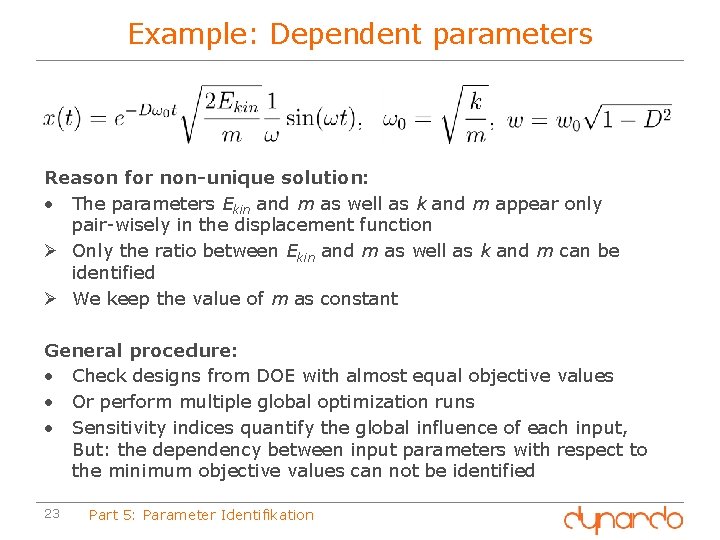
Example: Dependent parameters Reason for non-unique solution: • The parameters Ekin and m as well as k and m appear only pair-wisely in the displacement function Ø Only the ratio between Ekin and m as well as k and m can be identified Ø We keep the value of m as constant General procedure: • Check designs from DOE with almost equal objective values • Or perform multiple global optimization runs • Sensitivity indices quantify the global influence of each input, But: the dependency between input parameters with respect to the minimum objective values can not be identified 23 Part 5: Parameter Identifikation
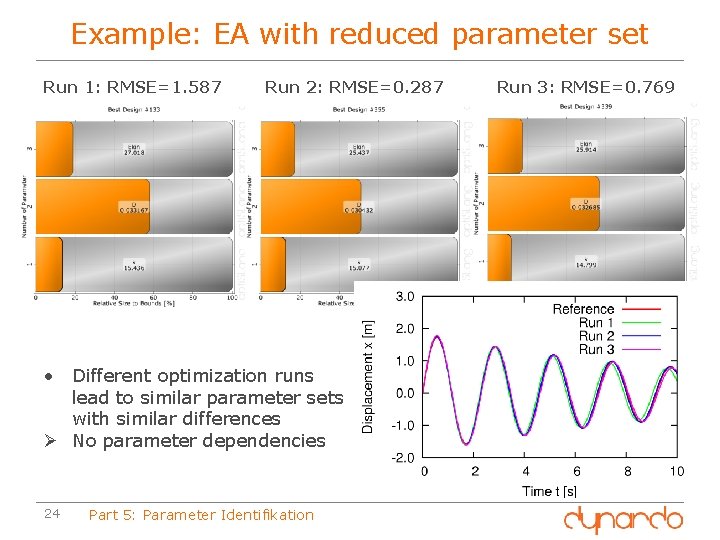
Example: EA with reduced parameter set Run 1: RMSE=1. 587 Run 2: RMSE=0. 287 • Different optimization runs lead to similar parameter sets with similar differences Ø No parameter dependencies 24 Part 5: Parameter Identifikation Run 3: RMSE=0. 769
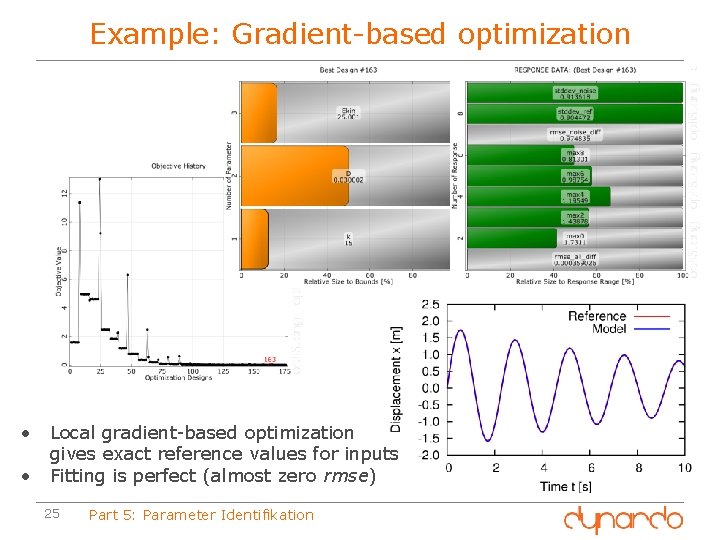
Example: Gradient-based optimization • Local gradient-based optimization gives exact reference values for inputs • Fitting is perfect (almost zero rmse) 25 Part 5: Parameter Identifikation
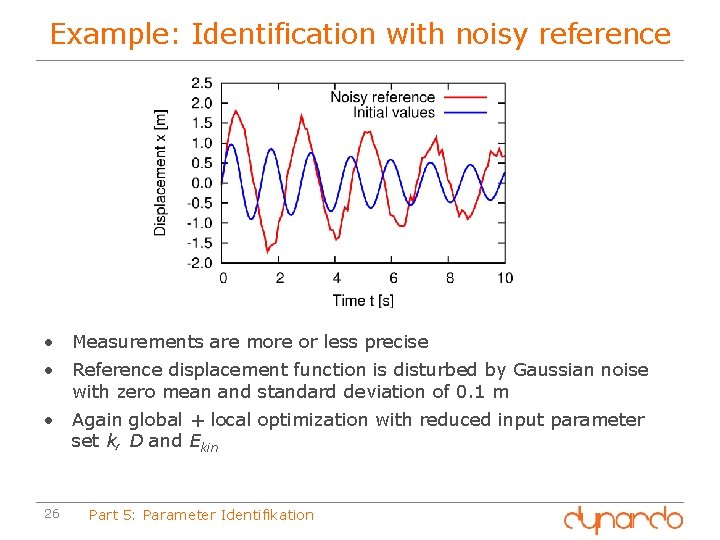
Example: Identification with noisy reference • Measurements are more or less precise • Reference displacement function is disturbed by Gaussian noise with zero mean and standard deviation of 0. 1 m • Again global + local optimization with reduced input parameter set k, D and Ekin 26 Part 5: Parameter Identifikation
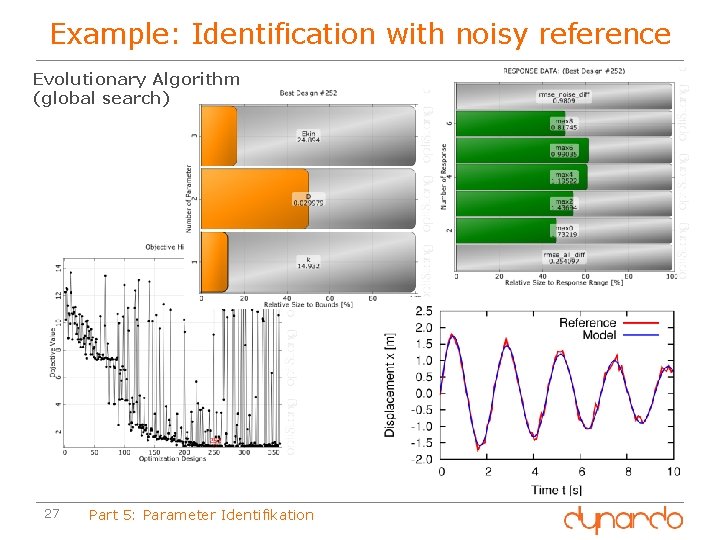
Example: Identification with noisy reference Evolutionary Algorithm (global search) 27 Part 5: Parameter Identifikation
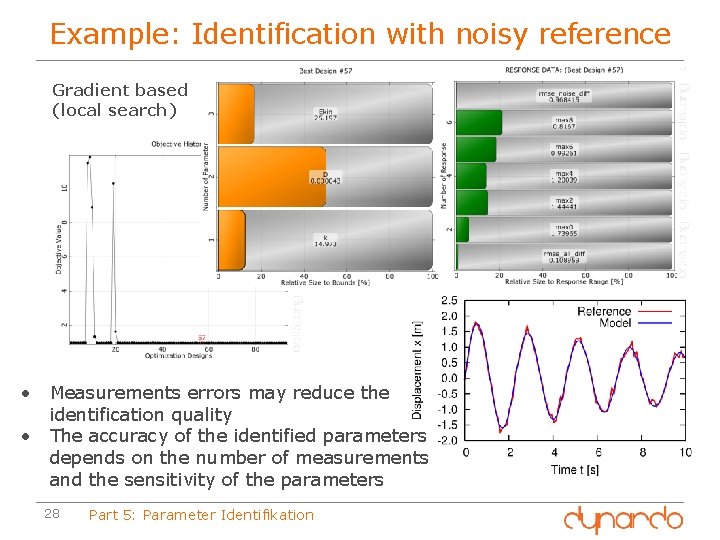
Example: Identification with noisy reference Gradient based (local search) • Measurements errors may reduce the identification quality • The accuracy of the identified parameters depends on the number of measurements and the sensitivity of the parameters 28 Part 5: Parameter Identifikation
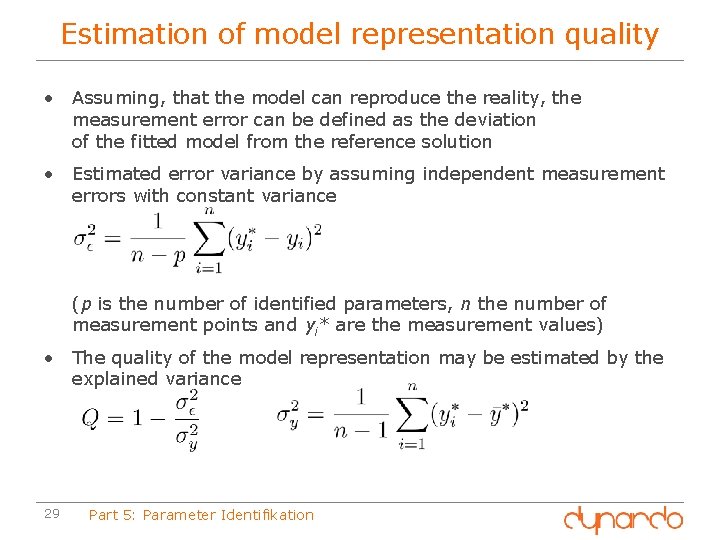
Estimation of model representation quality • Assuming, that the model can reproduce the reality, the measurement error can be defined as the deviation of the fitted model from the reference solution • Estimated error variance by assuming independent measurement errors with constant variance (p is the number of identified parameters, n the number of measurement points and yi* are the measurement values) • The quality of the model representation may be estimated by the explained variance 29 Part 5: Parameter Identifikation
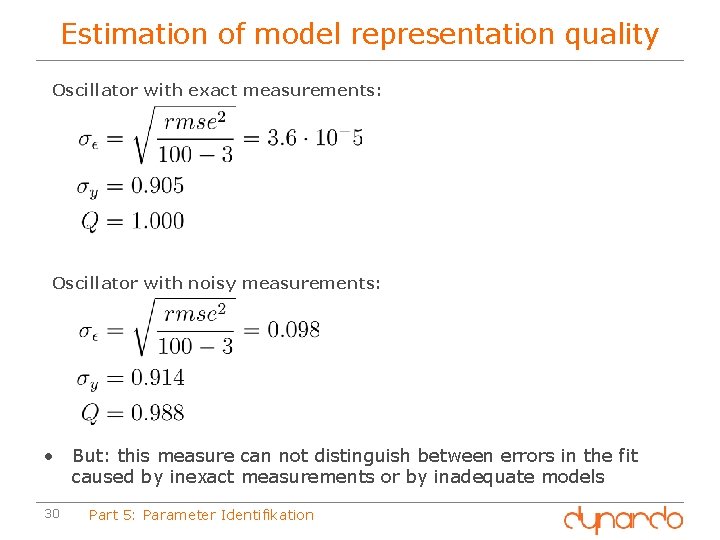
Estimation of model representation quality Oscillator with exact measurements: Oscillator with noisy measurements: • But: this measure can not distinguish between errors in the fit caused by inexact measurements or by inadequate models 30 Part 5: Parameter Identifikation
- Slides: 30