
PART 5 MICROECONOMICS FACTOR MARKETS For use with




- Slides: 17
PART 5 MICROECONOMICS – FACTOR MARKETS For use with Business Economics 1 e By N. Gregory Mankiw, Mark P. Taylor, and Andrew Ashwin ISBN: 978 -1 -4080 -6981 -3 © Cengage Learning 1 of 38
14 LABOUR MARKETS For use with Business Economics 1 e By N. Gregory Mankiw, Mark P. Taylor, and Andrew Ashwin ISBN: 978 -1 -4080 -6981 -3 © Cengage Learning 2 Chapter of 38 14 2 of 17
1. The Demand for labour For use with Business Economics 1 e By N. Gregory Mankiw, Mark P. Taylor, and Andrew Ashwin ISBN: 978 -1 -4080 -6981 -3 © Cengage Learning 3 Chapter of 38 14 3 of 17
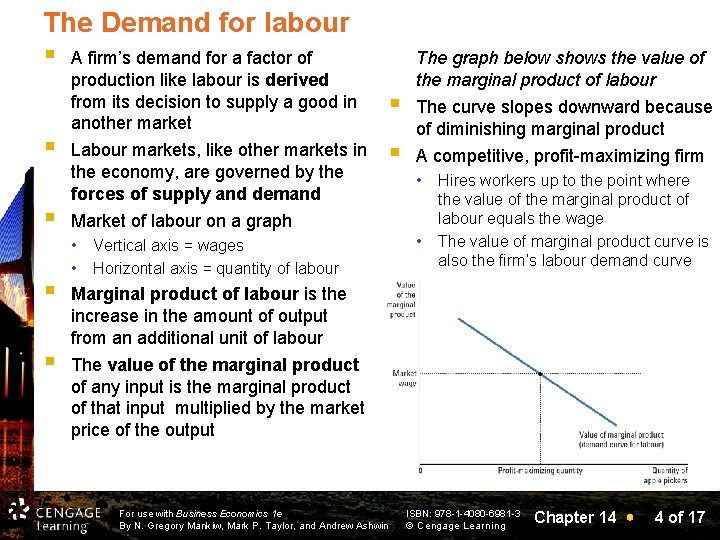
The Demand for labour § A firm’s demand for a factor of § § production like labour is derived from its decision to supply a good in another market Labour markets, like other markets in the economy, are governed by the forces of supply and demand § § The graph below shows the value of the marginal product of labour The curve slopes downward because of diminishing marginal product A competitive, profit-maximizing firm • Market of labour on a graph • • Vertical axis = wages Horizontal axis = quantity of labour • Hires workers up to the point where the value of the marginal product of labour equals the wage The value of marginal product curve is also the firm’s labour demand curve Marginal product of labour is the increase in the amount of output from an additional unit of labour The value of the marginal product of any input is the marginal product of that input multiplied by the market price of the output For use with Business Economics 1 e By N. Gregory Mankiw, Mark P. Taylor, and Andrew Ashwin ISBN: 978 -1 -4080 -6981 -3 © Cengage Learning 4 Chapter of 38 14 4 of 17
What causes the demand curve to shift? § Output price. An increase in the price of the output item: • Increases marginal product of labour • In turn, increases the demand for labour at each wage level § Technological change • Technological advance raises the marginal product of labour § Supply of the other factors For use with Business Economics 1 e By N. Gregory Mankiw, Mark P. Taylor, and Andrew Ashwin ISBN: 978 -1 -4080 -6981 -3 © Cengage Learning 5 Chapter of 38 14 5 of 17
2. The Supply of Labour For use with Business Economics 1 e By N. Gregory Mankiw, Mark P. Taylor, and Andrew Ashwin ISBN: 978 -1 -4080 -6981 -3 © Cengage Learning 6 Chapter of 38 14 6 of 17
The Trade-off between Work and Leisure § The labour supply curve reflects how workers’ decisions about the labour– leisure trade-off respond to a change in that opportunity cost § An increase in the wage induces workers to increase the quantity of labour they supply § Workers respond to the increase in the opportunity cost of leisure by taking less of it. § Note that the labour supply curve need not be upward sloping • The extra income from higher wages means workers can more afford leisure For use with Business Economics 1 e By N. Gregory Mankiw, Mark P. Taylor, and Andrew Ashwin ISBN: 978 -1 -4080 -6981 -3 © Cengage Learning 7 Chapter of 38 14 7 of 17
What Causes the Labour Supply Curve to Shift? § Changes in tastes • More women are in work and § Changes in Alternative Opportunities • Reflects increasing labour mobility § Immigration For use with Business Economics 1 e By N. Gregory Mankiw, Mark P. Taylor, and Andrew Ashwin ISBN: 978 -1 -4080 -6981 -3 © Cengage Learning 8 Chapter of 38 14 8 of 17
3. Equilibrium in the Labour Market For use with Business Economics 1 e By N. Gregory Mankiw, Mark P. Taylor, and Andrew Ashwin ISBN: 978 -1 -4080 -6981 -3 © Cengage Learning 9 Chapter of 38 14 9 of 17
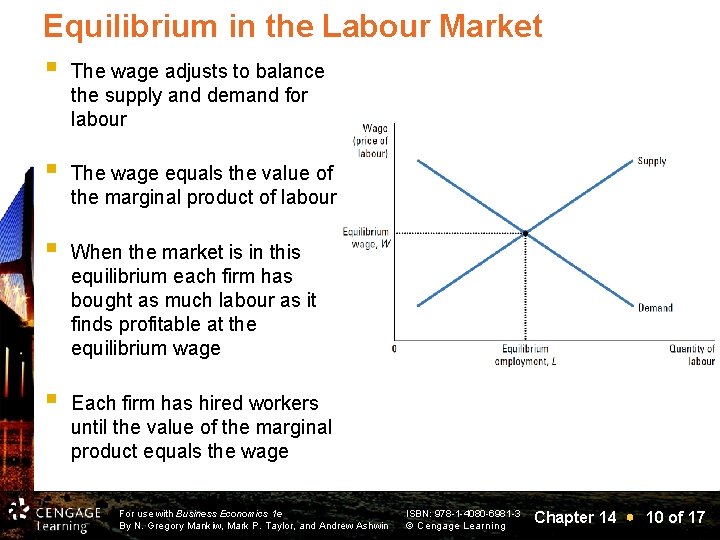
Equilibrium in the Labour Market § The wage adjusts to balance the supply and demand for labour § The wage equals the value of the marginal product of labour § When the market is in this equilibrium each firm has bought as much labour as it finds profitable at the equilibrium wage § Each firm has hired workers until the value of the marginal product equals the wage For use with Business Economics 1 e By N. Gregory Mankiw, Mark P. Taylor, and Andrew Ashwin ISBN: 978 -1 -4080 -6981 -3 © Cengage Learning 10 Chapter of 38 14 10 of 17
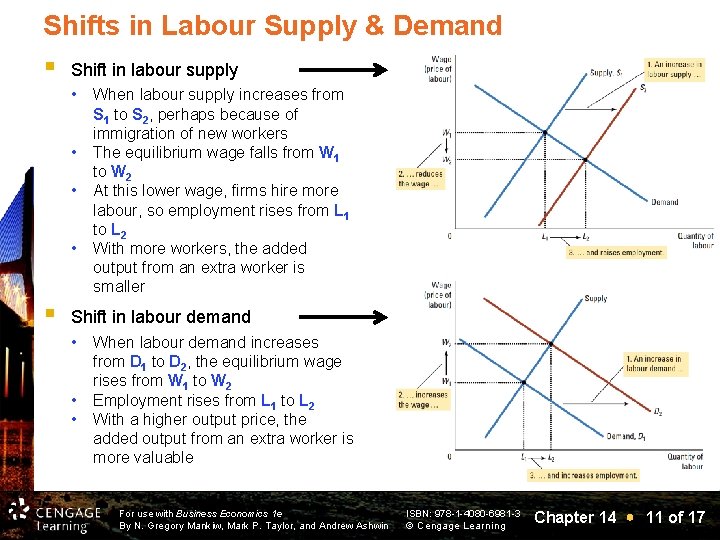
Shifts in Labour Supply & Demand § Shift in labour supply • • § When labour supply increases from S 1 to S 2, perhaps because of immigration of new workers The equilibrium wage falls from W 1 to W 2 At this lower wage, firms hire more labour, so employment rises from L 1 to L 2 With more workers, the added output from an extra worker is smaller Shift in labour demand • • • When labour demand increases from D 1 to D 2, the equilibrium wage rises from W 1 to W 2 Employment rises from L 1 to L 2 With a higher output price, the added output from an extra worker is more valuable For use with Business Economics 1 e By N. Gregory Mankiw, Mark P. Taylor, and Andrew Ashwin ISBN: 978 -1 -4080 -6981 -3 © Cengage Learning 11 Chapter of 38 14 11 of 17
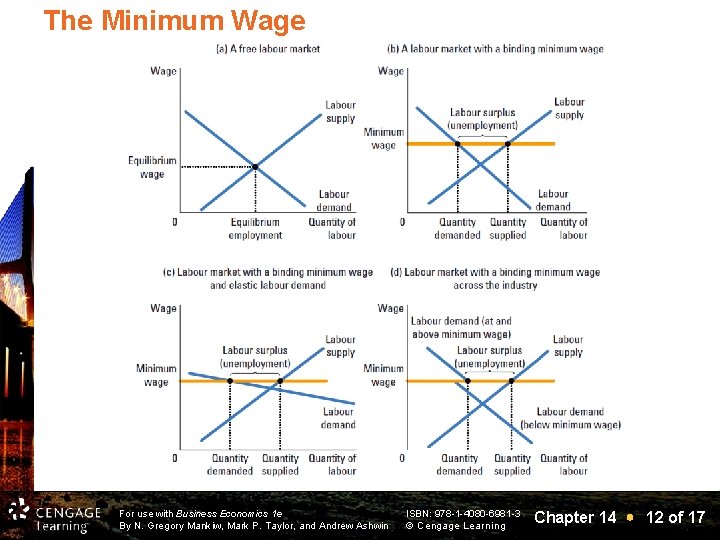
The Minimum Wage For use with Business Economics 1 e By N. Gregory Mankiw, Mark P. Taylor, and Andrew Ashwin ISBN: 978 -1 -4080 -6981 -3 © Cengage Learning 12 Chapter of 38 14 12 of 17
4. Earnings & Discrimination For use with Business Economics 1 e By N. Gregory Mankiw, Mark P. Taylor, and Andrew Ashwin ISBN: 978 -1 -4080 -6981 -3 © Cengage Learning 13 Chapter of 38 14 13 of 17
Market Imperfections Lead to Wage Rate Anomalies § Compensating differential to refers to a difference in wages that arises from non-monetary characteristics of different jobs § Human capital is the accumulation of investments in people that make them more productive • Education • Training § § § Ability, effort and chance factors Education as a signal to employers of people’s ability Above-equilibrium wages • Minimum wage laws • Power of labour unions and collective bargaining • Efficiency Wages (paid by firms to increase worker productivity For use with Business Economics 1 e By N. Gregory Mankiw, Mark P. Taylor, and Andrew Ashwin ISBN: 978 -1 -4080 -6981 -3 © Cengage Learning 14 Chapter of 38 14 14 of 17
5. The Economics of Discrimination For use with Business Economics 1 e By N. Gregory Mankiw, Mark P. Taylor, and Andrew Ashwin ISBN: 978 -1 -4080 -6981 -3 © Cengage Learning 15 Chapter of 38 14 15 of 17
Labour Market Discrimination § Discrimination occurs when the marketplace offers different opportunities because of: • • § Race Ethnicity Age Gender Most economists believe that some of the observed wage differentials are attributable to discrimination, but not all. § Other factors might include; job experience, nature of jobs, educational chances For use with Business Economics 1 e By N. Gregory Mankiw, Mark P. Taylor, and Andrew Ashwin ISBN: 978 -1 -4080 -6981 -3 © Cengage Learning 16 Chapter of 38 14 16 of 17
End of Chapter 14 For use with Business Economics 1 e By N. Gregory Mankiw, Mark P. Taylor, and Andrew Ashwin ISBN: 978 -1 -4080 -6981 -3 © Cengage Learning 17 Chapter of 38 14 17 of 17