
Part 5 Growth and Development of Entrepreneurial Ventures
- Slides: 25
Part 5 Growth and Development of Entrepreneurial Ventures CHAPTER 15 Strategic Planning for Emerging Ventures Entrepreneurship Power. Point Presentation by Charlie Cook The University of West Alabama © 2007 Thomson/South-Western. All rights reserved. theory | process | practice Seventh edition Donald F. Kuratko • Richard M. Hodgetts
Chapter Objectives Studying this chapter should provide you with the entrepreneurial knowledge needed: 1. To introduce the importance of planning for an entrepreneurial venture 2. To discuss the nature of strategic planning 3. To examine the key dimensions that influence a firm’s planning process 4. To discuss some of the reasons why entrepreneurs do not carry out strategic planning 5. To relate some of the benefits of strategic planning © 2007 Thomson/South-Western. All rights reserved. 15– 2 2
Chapter Objectives Studying this chapter should provide you with the entrepreneurial knowledge needed: 6. To examine four of the most common approaches entrepreneurs use to implement a strategic plan 7. To review the nature of operational planning for a venture © 2007 Thomson/South-Western. All rights reserved. 15– 3 3
The Nature of Planning in Emerging Firms Most entrepreneurs’ planning for their ventures is informal and unsystematic. The need formal, systematic planning arises when: The firm is expanding with constantly increasing personnel size and market operations Ø A high degree of uncertainty exists Ø There is strong competition Ø There is a lack of adequate experience, either technological or business Ø © 2007 Thomson/South-Western. All rights reserved. 4
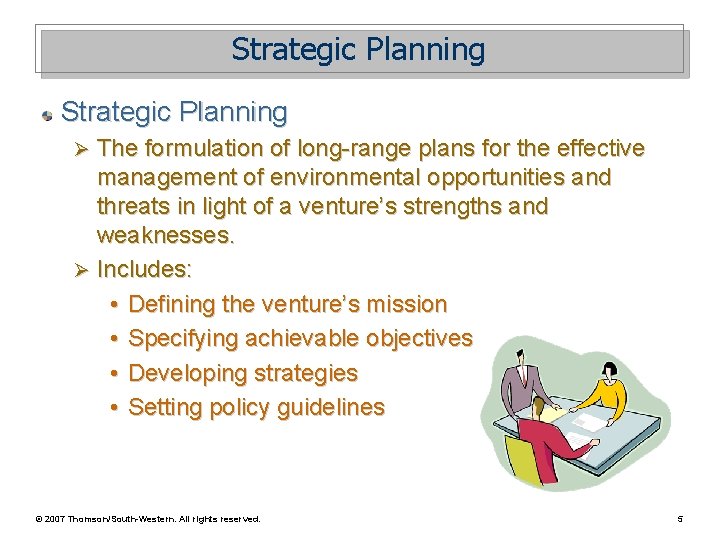
Strategic Planning The formulation of long-range plans for the effective management of environmental opportunities and threats in light of a venture’s strengths and weaknesses. Ø Includes: • Defining the venture’s mission • Specifying achievable objectives • Developing strategies • Setting policy guidelines Ø © 2007 Thomson/South-Western. All rights reserved. 5
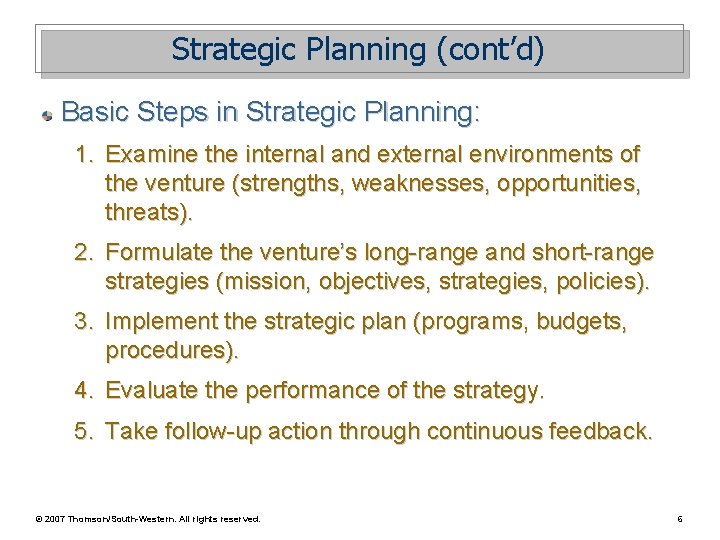
Strategic Planning (cont’d) Basic Steps in Strategic Planning: 1. Examine the internal and external environments of the venture (strengths, weaknesses, opportunities, threats). 2. Formulate the venture’s long-range and short-range strategies (mission, objectives, strategies, policies). 3. Implement the strategic plan (programs, budgets, procedures). 4. Evaluate the performance of the strategy. 5. Take follow-up action through continuous feedback. © 2007 Thomson/South-Western. All rights reserved. 6
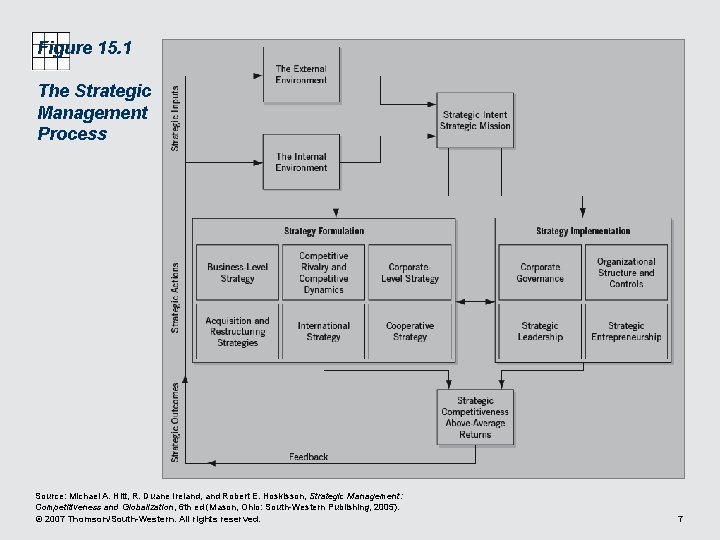
Figure 15. 1 The Strategic Management Process Source: Michael A. Hitt, R. Duane Ireland, and Robert E. Hoskisson, Strategic Management: Competitiveness and Globalization, 6 th ed (Mason, Ohio: South-Western Publishing, 2005). © 2007 Thomson/South-Western. All rights reserved. 7
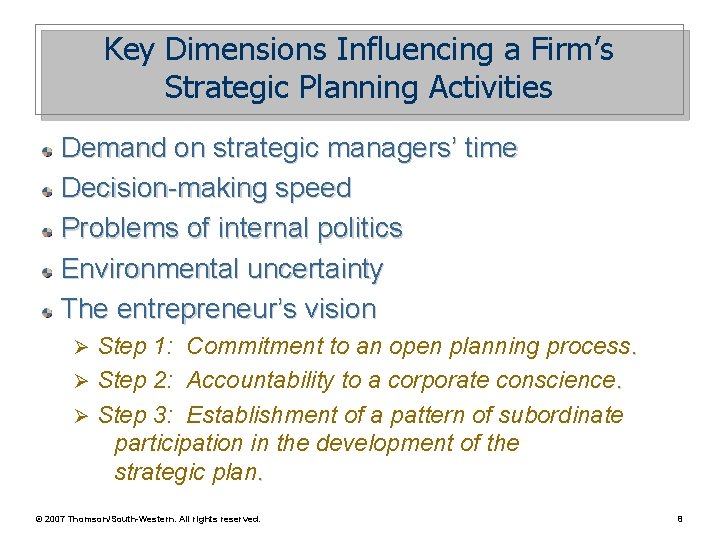
Key Dimensions Influencing a Firm’s Strategic Planning Activities Demand on strategic managers’ time Decision-making speed Problems of internal politics Environmental uncertainty The entrepreneur’s vision Step 1: Commitment to an open planning process. Ø Step 2: Accountability to a corporate conscience. Ø Step 3: Establishment of a pattern of subordinate participation in the development of the strategic plan. Ø © 2007 Thomson/South-Western. All rights reserved. 8
Strategic Planning (cont’d) Reasons for the Lack of Strategic Planning Time scarcity Ø Lack of knowledge Ø Lack of expertise/skills Ø Lack of trust and openness Ø Perception of high cost Ø © 2007 Thomson/South-Western. All rights reserved. 9
The Value of Strategic Planning Findings of Strategic Planning Studies Ø Strategic planning is of value to a venture and that planning influences a venture’s survival. Benefits of Long-Range Planning Cost savings Ø More efficient resource allocation Ø Improved competitive position Ø More timely information Ø More accurate forecasts Ø Reduced feelings of uncertainty Ø Faster decision making Ø Fewer cash-flow problems Ø © 2007 Thomson/South-Western. All rights reserved. 10
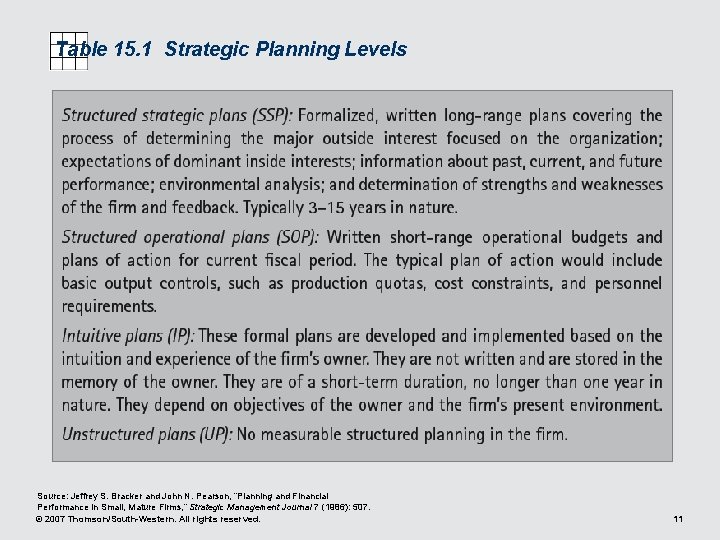
Table 15. 1 Strategic Planning Levels Source: Jeffrey S. Bracker and John N. Pearson, “Planning and Financial Performance in Small, Mature Firms, ” Strategic Management Journal 7 (1986): 507. © 2007 Thomson/South-Western. All rights reserved. 11
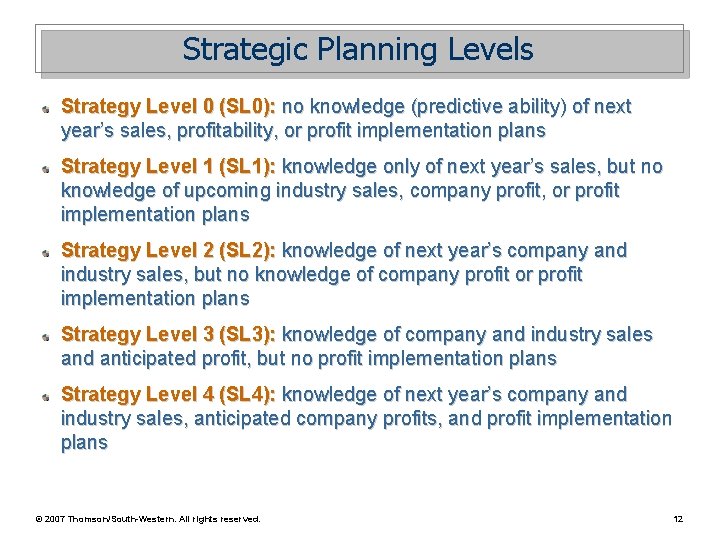
Strategic Planning Levels Strategy Level 0 (SL 0): no knowledge (predictive ability) of next year’s sales, profitability, or profit implementation plans Strategy Level 1 (SL 1): knowledge only of next year’s sales, but no knowledge of upcoming industry sales, company profit, or profit implementation plans Strategy Level 2 (SL 2): knowledge of next year’s company and industry sales, but no knowledge of company profit or profit implementation plans Strategy Level 3 (SL 3): knowledge of company and industry sales and anticipated profit, but no profit implementation plans Strategy Level 4 (SL 4): knowledge of next year’s company and industry sales, anticipated company profits, and profit implementation plans © 2007 Thomson/South-Western. All rights reserved. 12
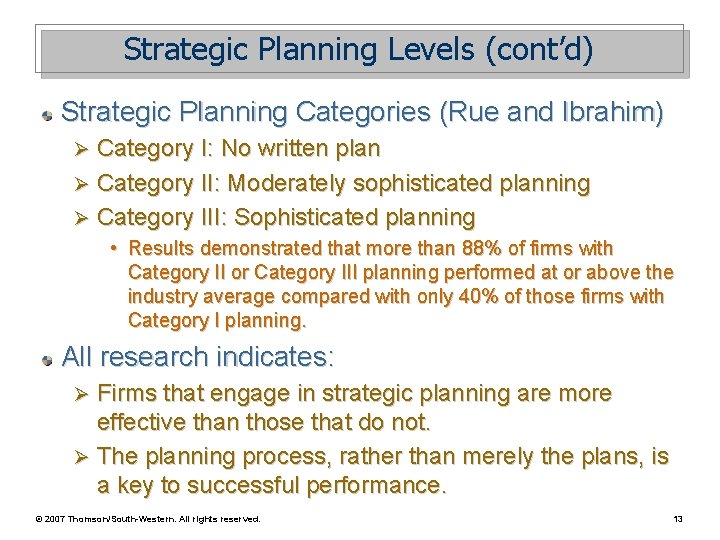
Strategic Planning Levels (cont’d) Strategic Planning Categories (Rue and Ibrahim) Category I: No written plan Ø Category II: Moderately sophisticated planning Ø Category III: Sophisticated planning Ø • Results demonstrated that more than 88% of firms with Category II or Category III planning performed at or above the industry average compared with only 40% of those firms with Category I planning. All research indicates: Firms that engage in strategic planning are more effective than those that do not. Ø The planning process, rather than merely the plans, is a key to successful performance. Ø © 2007 Thomson/South-Western. All rights reserved. 13
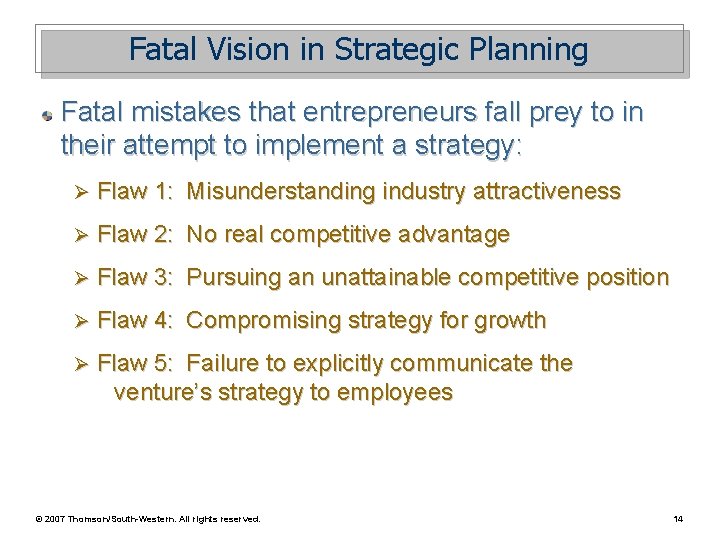
Fatal Vision in Strategic Planning Fatal mistakes that entrepreneurs fall prey to in their attempt to implement a strategy: Ø Flaw 1: Misunderstanding industry attractiveness Ø Flaw 2: No real competitive advantage Ø Flaw 3: Pursuing an unattainable competitive position Ø Flaw 4: Compromising strategy for growth Ø Flaw 5: Failure to explicitly communicate the venture’s strategy to employees © 2007 Thomson/South-Western. All rights reserved. 14
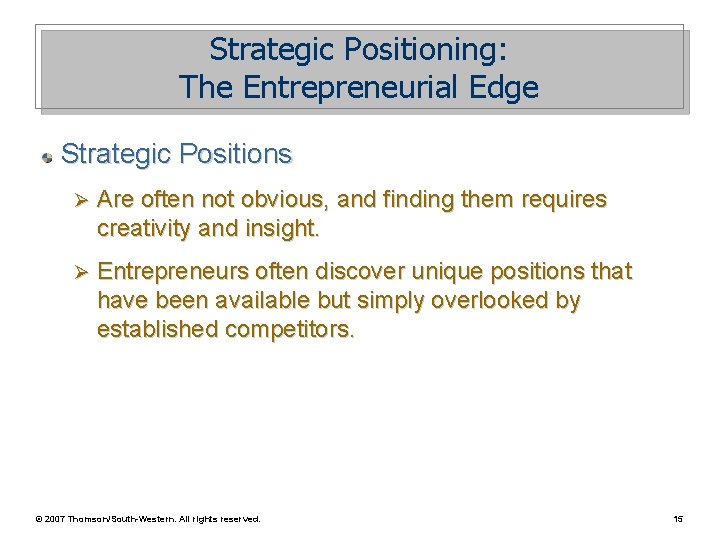
Strategic Positioning: The Entrepreneurial Edge Strategic Positions Ø Are often not obvious, and finding them requires creativity and insight. Ø Entrepreneurs often discover unique positions that have been available but simply overlooked by established competitors. © 2007 Thomson/South-Western. All rights reserved. 15
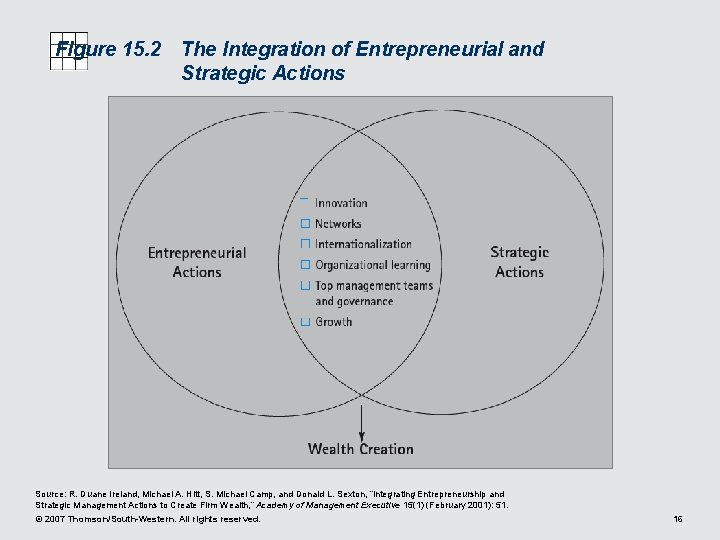
Figure 15. 2 The Integration of Entrepreneurial and Strategic Actions Source: R. Duane Ireland, Michael A. Hitt, S. Michael Camp, and Donald L. Sexton, “Integrating Entrepreneurship and Strategic Management Actions to Create Firm Wealth, ” Academy of Management Executive 15(1) (February 2001): 51. © 2007 Thomson/South-Western. All rights reserved. 16
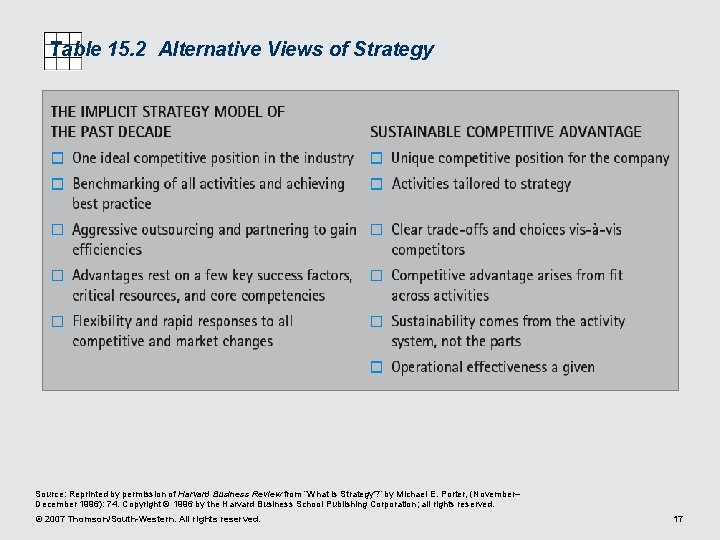
Table 15. 2 Alternative Views of Strategy Source: Reprinted by permission of Harvard Business Review from “What Is Strategy? ” by Michael E. Porter, (November– December 1996): 74. Copyright © 1996 by the Harvard Business School Publishing Corporation; all rights reserved. © 2007 Thomson/South-Western. All rights reserved. 17
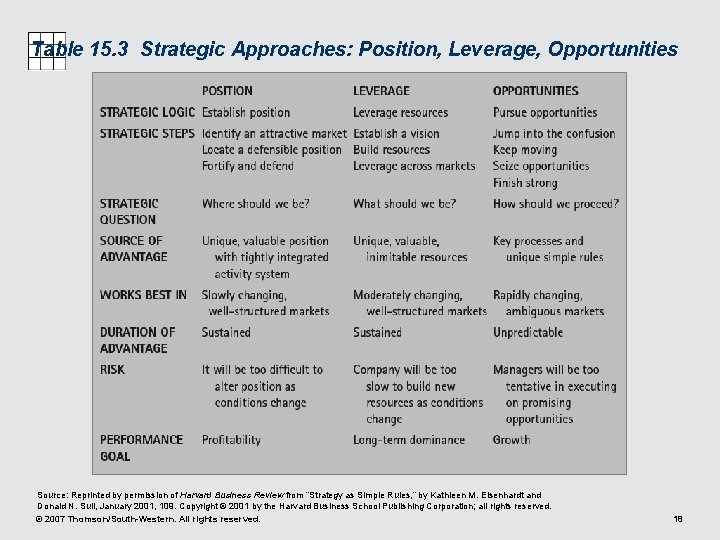
Table 15. 3 Strategic Approaches: Position, Leverage, Opportunities Source: Reprinted by permission of Harvard Business Review from “Strategy as Simple Rules, ” by Kathleen M. Eisenhardt and Donald N. Sull, January 2001, 109. Copyright © 2001 by the Harvard Business School Publishing Corporation; all rights reserved. © 2007 Thomson/South-Western. All rights reserved. 18
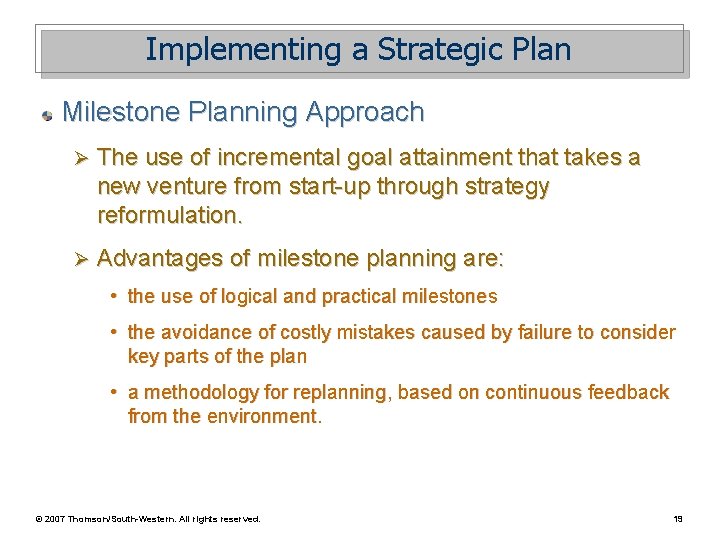
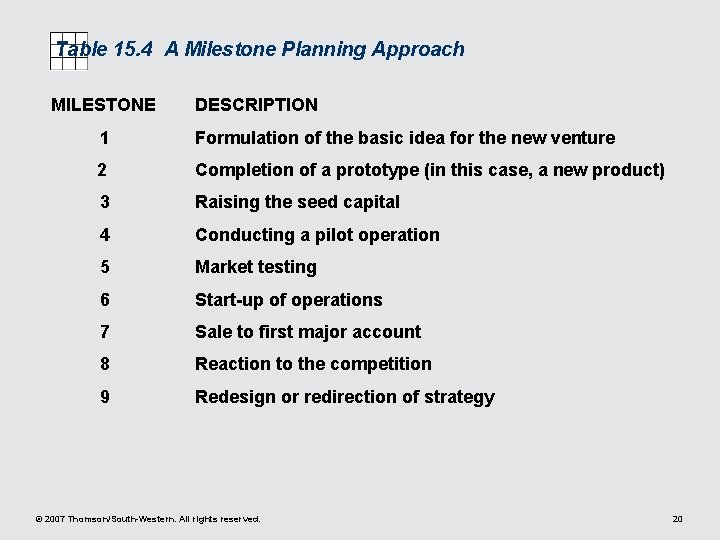
Implementing a Strategic Plan Milestone Planning Approach Ø The use of incremental goal attainment that takes a new venture from start-up through strategy reformulation. Ø Advantages of milestone planning are: • the use of logical and practical milestones • the avoidance of costly mistakes caused by failure to consider key parts of the plan • a methodology for replanning, based on continuous feedback from the environment. © 2007 Thomson/South-Western. All rights reserved. 19
Table 15. 4 A Milestone Planning Approach MILESTONE DESCRIPTION 1 Formulation of the basic idea for the new venture 2 Completion of a prototype (in this case, a new product) 3 Raising the seed capital 4 Conducting a pilot operation 5 Market testing 6 Start-up of operations 7 Sale to first major account 8 Reaction to the competition 9 Redesign or redirection of strategy © 2007 Thomson/South-Western. All rights reserved. 20
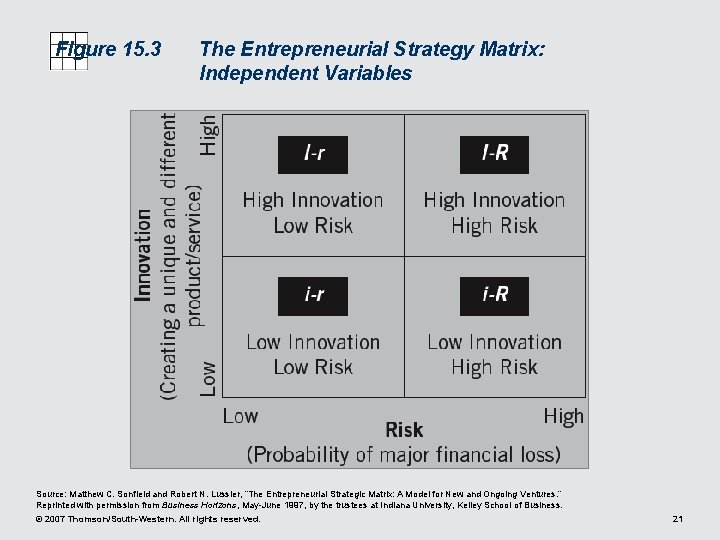
Figure 15. 3 The Entrepreneurial Strategy Matrix: Independent Variables Source: Matthew C. Sonfield and Robert N. Lussier, “The Entrepreneurial Strategic Matrix: A Model for New and Ongoing Ventures. “ Reprinted with permission from Business Horizons, May-June 1997, by the trustees at Indiana University, Kelley School of Business. © 2007 Thomson/South-Western. All rights reserved. 21
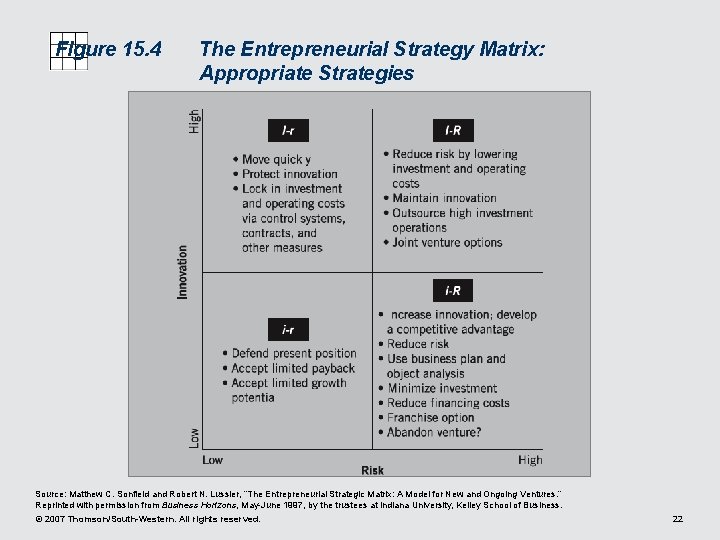
Figure 15. 4 The Entrepreneurial Strategy Matrix: Appropriate Strategies Source: Matthew C. Sonfield and Robert N. Lussier, “The Entrepreneurial Strategic Matrix: A Model for New and Ongoing Ventures. ” Reprinted with permission from Business Horizons, May-June 1997, by the trustees at Indiana University, Kelley School of Business. © 2007 Thomson/South-Western. All rights reserved. 22
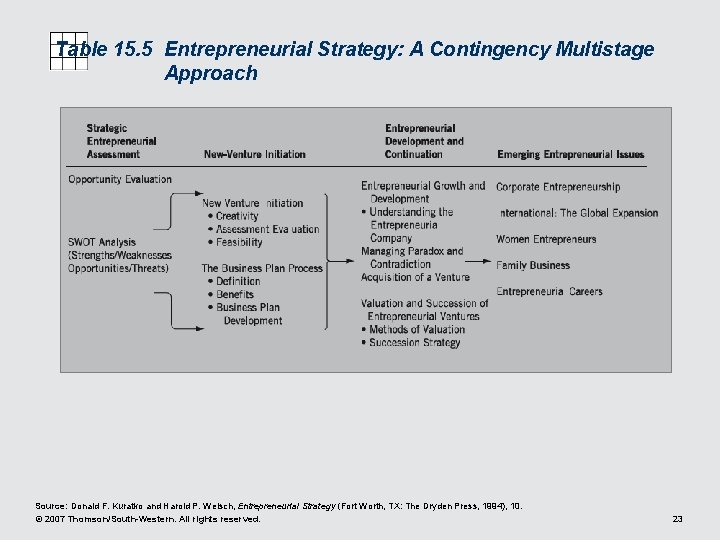
Table 15. 5 Entrepreneurial Strategy: A Contingency Multistage Approach Source: Donald F. Kuratko and Harold P. Welsch, Entrepreneurial Strategy (Fort Worth, TX: The Dryden Press, 1994), 10. © 2007 Thomson/South-Western. All rights reserved. 23
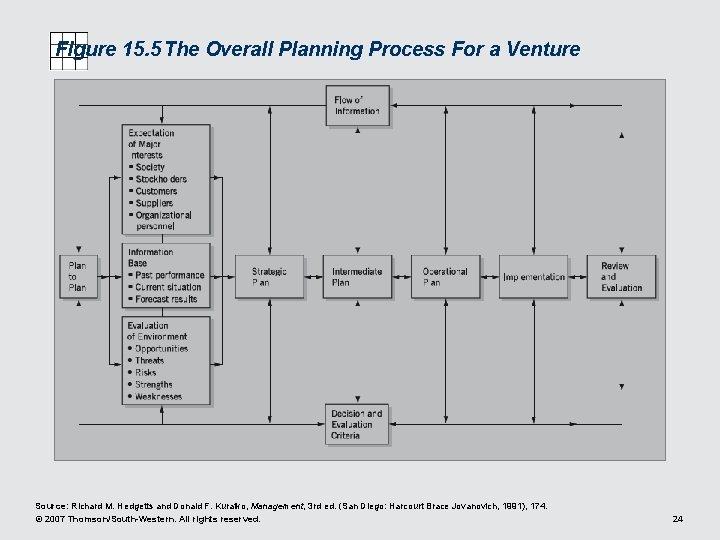
Figure 15. 5 The Overall Planning Process For a Venture Source: Richard M. Hedgetts and Donald F. Kuratko, Management, 3 rd ed. (San Diego: Harcourt Brace Jovanovich, 1991), 174. © 2007 Thomson/South-Western. All rights reserved. 24
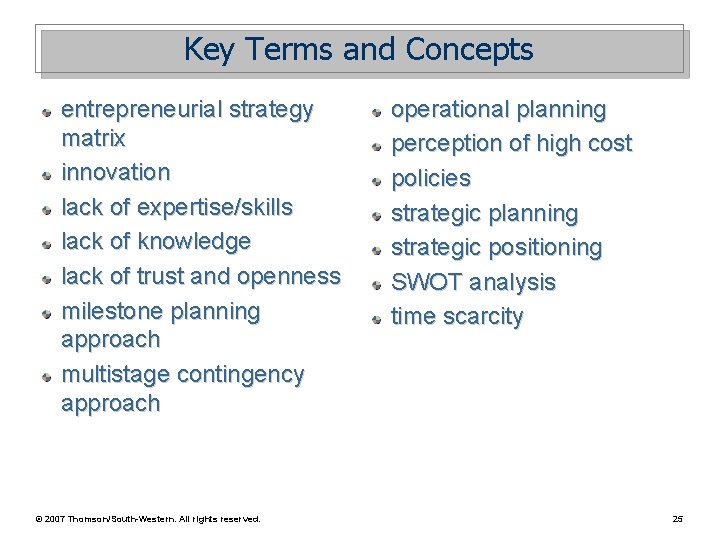
Key Terms and Concepts entrepreneurial strategy matrix innovation lack of expertise/skills lack of knowledge lack of trust and openness milestone planning approach multistage contingency approach © 2007 Thomson/South-Western. All rights reserved. operational planning perception of high cost policies strategic planning strategic positioning SWOT analysis time scarcity 25