
Part 5 Distribution Decisions 13 Marketing Channels and
Part 5: Distribution Decisions 13. Marketing Channels and Supply Chain Management 14. Direct Marketing and Marketing Resellers: Retailers and Wholesalers Copyright © 2006 by South-Western, a division of Thomson Learning, Inc. All rights reserved.
Chapter 13 Marketing Channels and Supply Chain Management Copyright © 2006 by South-Western, a division of Thomson Learning, Inc. All rights reserved.
Chapter Objectives 1. Describe the types of marketing channels and roles they play in marketing strategy. 2. Outline the major channel strategy decisions. 3. Describe the concepts of channel management, conflict, and cooperation. 4. Identify and describe the different vertical marketing systems. 5. Explain the roles of logistics and supply-chain management in an overall distribution strategy. 6. Identify the major components of a physical distribution system. 7. Compare the major modes of transportation. 8. Discuss how transportation intermediaries and combined transportation modes can improve physical distribution. 9. Identify and briefly describe the different types of warehousing. Copyright © 2006 by South-Western, a division of Thomson Learning, Inc. All rights reserved. 3
The Role of Marketing Channels in Marketing Strategy n Channels provide the means by which the firm moves the goods and services it produces to ultimate users üFacilitate the exchange process by cutting the number of contacts necessary üAdjust for discrepancies in the market’s assortment of goods and services via sorting üStandardize exchange transactions üFacilitate searches by both buyers and sellers Copyright © 2006 by South-Western, a division of Thomson Learning, Inc. All rights reserved. 4
Types of Marketing Channels n Marketing channel: channel system of marketing institutions that promotes the physical flow of goods and services, along with ownership title, from producers to consumer or business user; also called a distribution channel n Marketing intermediary: intermediary wholesaler or retailer that operates between producers and consumers or business users; also called a middleman n Wholesaler: Wholesaler marketing intermediary that takes title to goods and then distributes these goods further; also called a jobber or distributor Copyright © 2006 by South-Western, a division of Thomson Learning, Inc. All rights reserved. 5
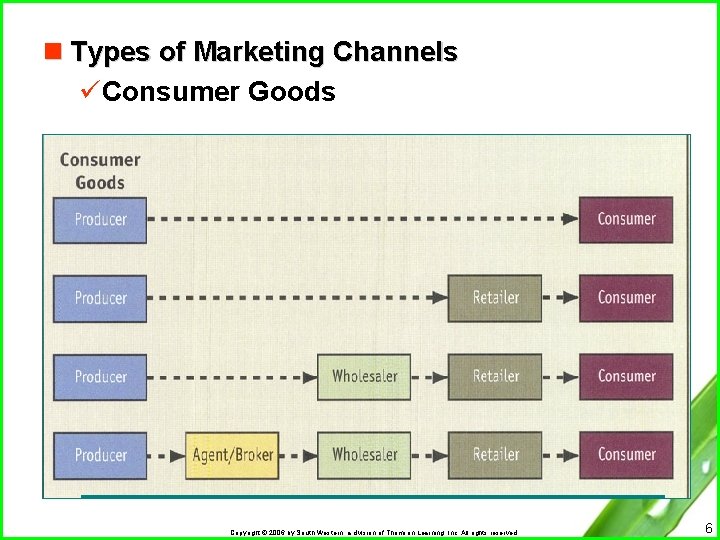
n Types of Marketing Channels üConsumer Goods Copyright © 2006 by South-Western, a division of Thomson Learning, Inc. All rights reserved. 6
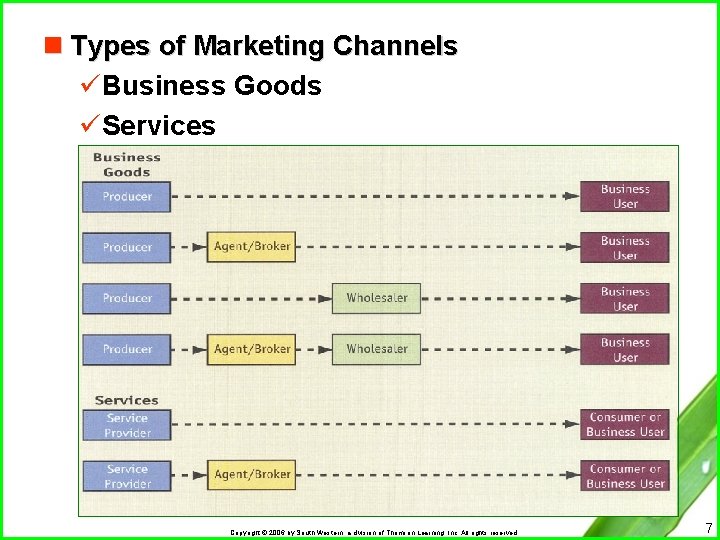
n Types of Marketing Channels üBusiness Goods üServices Copyright © 2006 by South-Western, a division of Thomson Learning, Inc. All rights reserved. 7
n Direct Selling üDirect channel: channel marketing channel that moves goods directly from a producer to ultimate user üDirect selling: selling strategy designed to establish direct sales contract between producer and final user Copyright © 2006 by South-Western, a division of Thomson Learning, Inc. All rights reserved. 8
n Channels Using Marketing Intermediaries üProducer to wholesaler to retailer to consumer üProducer to wholesaler to business user üProducer to agent to wholesaler to retailer to consumer üProducer to agent to wholesaler to business user üProducer to agent to business user Copyright © 2006 by South-Western, a division of Thomson Learning, Inc. All rights reserved. 9
n Dual Distribution: Distribution Network that moves products to a firm’s target market through more than one marketing channel n Reverse Channels: Channels designed to return goods to their producers Copyright © 2006 by South-Western, a division of Thomson Learning, Inc. All rights reserved. 10
Channel Strategy Decisions n Selection of a Marketing Channel n Factors which impact the selection of a marketing channel include: üMarket factors üProduct factors üOrganizational factors üCompetitive factors Copyright © 2006 by South-Western, a division of Thomson Learning, Inc. All rights reserved. 11
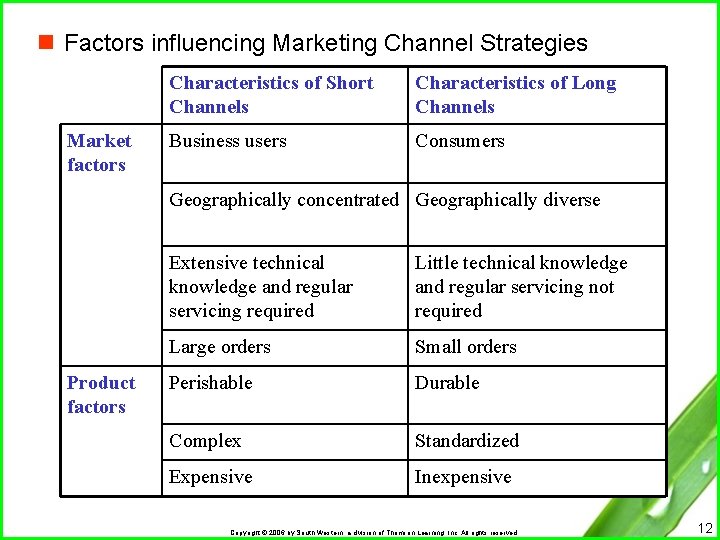
n Factors influencing Marketing Channel Strategies Market factors Characteristics of Short Channels Characteristics of Long Channels Business users Consumers Geographically concentrated Geographically diverse Extensive technical knowledge and regular servicing required Little technical knowledge and regular servicing not required Large orders Small orders Product factors Perishable Durable Complex Standardized Expensive Inexpensive Copyright © 2006 by South-Western, a division of Thomson Learning, Inc. All rights reserved. 12
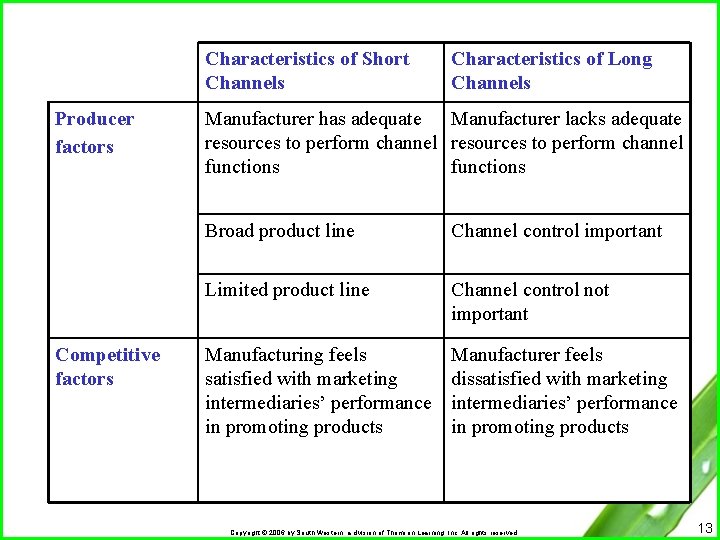
Characteristics of Short Channels Producer factors Competitive factors Characteristics of Long Channels Manufacturer has adequate Manufacturer lacks adequate resources to perform channel functions Broad product line Channel control important Limited product line Channel control not important Manufacturing feels satisfied with marketing intermediaries’ performance in promoting products Manufacturer feels dissatisfied with marketing intermediaries’ performance in promoting products Copyright © 2006 by South-Western, a division of Thomson Learning, Inc. All rights reserved. 13
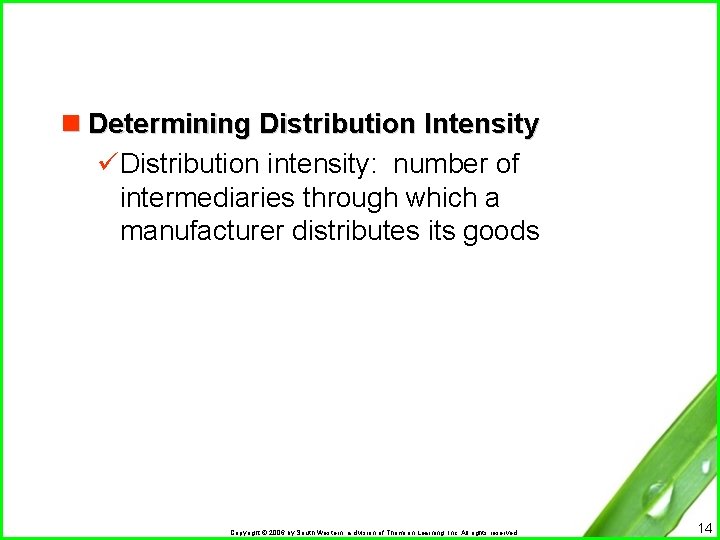
n Determining Distribution Intensity üDistribution intensity: number of intermediaries through which a manufacturer distributes its goods Copyright © 2006 by South-Western, a division of Thomson Learning, Inc. All rights reserved. 14
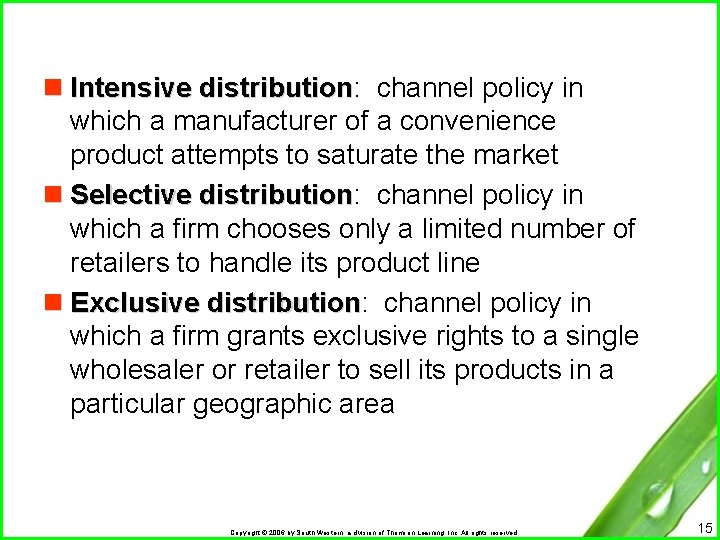
n Intensive distribution: distribution channel policy in which a manufacturer of a convenience product attempts to saturate the market n Selective distribution: distribution channel policy in which a firm chooses only a limited number of retailers to handle its product line n Exclusive distribution: distribution channel policy in which a firm grants exclusive rights to a single wholesaler or retailer to sell its products in a particular geographic area Copyright © 2006 by South-Western, a division of Thomson Learning, Inc. All rights reserved. 15
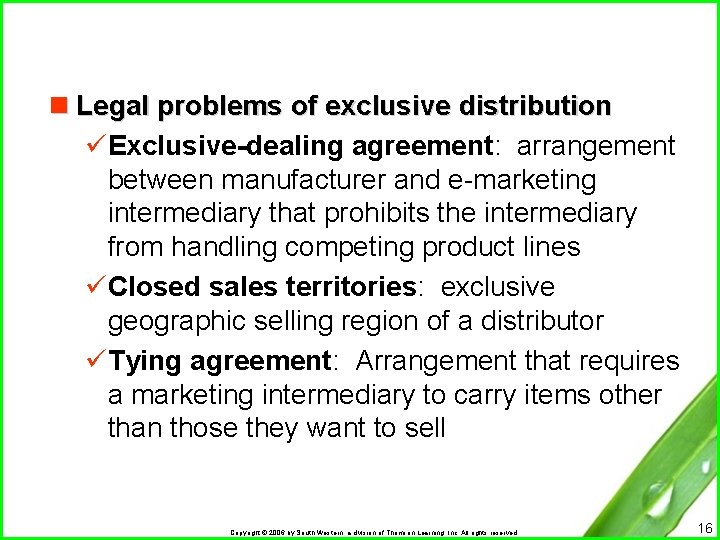
n Legal problems of exclusive distribution üExclusive-dealing agreement: arrangement between manufacturer and e-marketing intermediary that prohibits the intermediary from handling competing product lines üClosed sales territories: exclusive geographic selling region of a distributor üTying agreement: Arrangement that requires a marketing intermediary to carry items other than those they want to sell Copyright © 2006 by South-Western, a division of Thomson Learning, Inc. All rights reserved. 16
n Who Should Perform Channel Functions? üFundamental principle that governs channel decisions üChannel members can shift responsibilities for the performance of certain marketing functions, but they cannot eliminate central functions Copyright © 2006 by South-Western, a division of Thomson Learning, Inc. All rights reserved. 17
Channel Management and Leadership n Channel Captain: Captain a dominant and controlling member of a marketing channel n Channel Conflict üHorizontal Conflict w Most often, horizontal conflict causes sparks between different types of marketing intermediaries that handle similar products w Sometimes results from disagreements among channel members at the same level Copyright © 2006 by South-Western, a division of Thomson Learning, Inc. All rights reserved. 18
üVertical Conflict w Channel members at different levels find many reasons for disputes w Example: when retailers develop private brands to compete with producers’ brands or when producers establish their own retail outlets or WWW Sites üThe Gray Market w Grey Good: product made abroad under license from a U. S. firm and then sold in the U. S. market in competition with that firm’s own domestic output w Viewed by producers as undesired competition Copyright © 2006 by South-Western, a division of Thomson Learning, Inc. All rights reserved. 19
n Achieving Channel Cooperation üChannel Cooperation, achieved via effective cooperation among channel members, is the desired antidote to channel conflict üIt is Best achieved when all channel members regard themselves as components of the same organization Copyright © 2006 by South-Western, a division of Thomson Learning, Inc. All rights reserved. 20
Vertical Marketing Systems n Vertical marketing system (VMS): planned channel system designed to improve distribution efficiency and cost effectiveness by integrating various functions throughout the distribution chain üForward integration üBackward integration Copyright © 2006 by South-Western, a division of Thomson Learning, Inc. All rights reserved. 21
n Administered marketing system: system VMS that achieves channel coordination when a dominant channel member exercises its power n Corporate marketing system: system a VMS in which a single owner operates at each stage in its marketing channel Copyright © 2006 by South-Western, a division of Thomson Learning, Inc. All rights reserved. 22
n Contractual marketing system: system VMS that coordinates channel activities through formal agreements among channel members like: üWholesaler-Sponsored Voluntary Chains üRetail Cooperatives üFranchises Copyright © 2006 by South-Western, a division of Thomson Learning, Inc. All rights reserved. 23
Logistics and Supply Chain Management n Supply (value) chain: chain sequence of suppliers that contributes to the creation and delivery of a good or service üUpstream management üDownstream management Copyright © 2006 by South-Western, a division of Thomson Learning, Inc. All rights reserved. 24
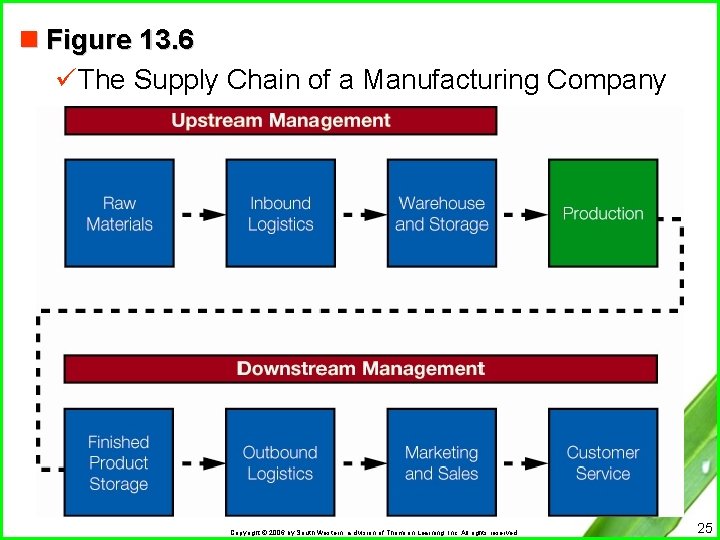
n Figure 13. 6 üThe Supply Chain of a Manufacturing Company Copyright © 2006 by South-Western, a division of Thomson Learning, Inc. All rights reserved. 25
n Radio Frequency Identification (RFID) üTechnology that uses a tiny chip with identification information that can be read by a scanner using radio waves from a distance n Enterprise Resource Planning üSoftware system that consolidates data among a firm’s units n Logistical Cost Control üThird party (contract) logistics firm: company that specializes in handling logistics activities for other firms Copyright © 2006 by South-Western, a division of Thomson Learning, Inc. All rights reserved. 26
Physical Distribution n A company’s physical distribution system contains the following elements: üCustomer Service üTransportation üInventory Control üProtective packaging and materials handling üOrder Processing üWarehousing Copyright © 2006 by South-Western, a division of Thomson Learning, Inc. All rights reserved. 27
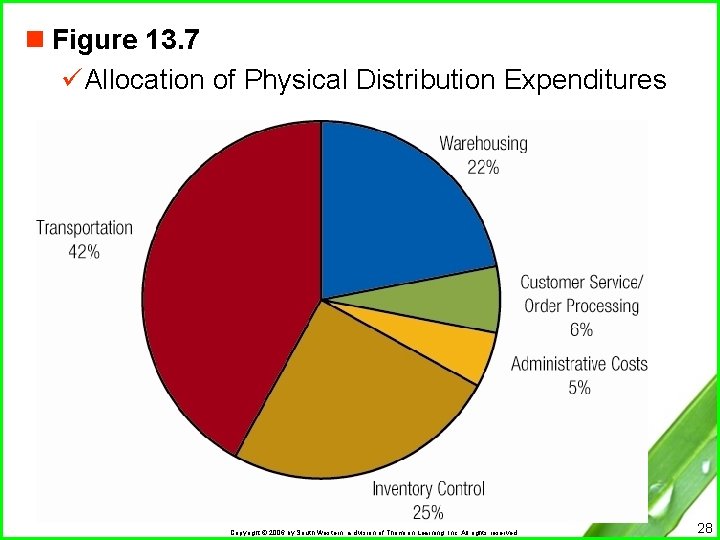
n Figure 13. 7 üAllocation of Physical Distribution Expenditures Copyright © 2006 by South-Western, a division of Thomson Learning, Inc. All rights reserved. 28
n The Problem of Suboptimization üCondition that results when individual operations achieve their objectives but interfere with progress toward broader organizational goals n Customer Service Standards üStatement of goals and acceptable performance for the quality of service that a firm expects to deliver to its customers Copyright © 2006 by South-Western, a division of Thomson Learning, Inc. All rights reserved. 29
n Transportation üClass Rate üCommodity Rate üClasses of Carriers w Common carriers move freight via all modes of transportation for the general public w Contract carriers do not serve the general public w Private carriers do not offer services for hire, but provide transportation services solely for internally generated freight Copyright © 2006 by South-Western, a division of Thomson Learning, Inc. All rights reserved. 30
n Major Modes of Transportation üRailroads üMotor Carriers üWater Carriers üPipelines üAir Freight üFreight Forwarders and Supplemental Carriers üIntermodal Coordination Copyright © 2006 by South-Western, a division of Thomson Learning, Inc. All rights reserved. 31
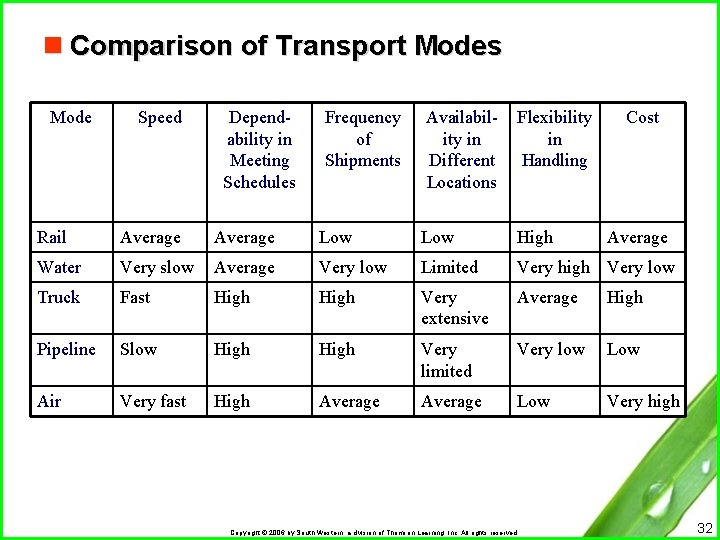
n Comparison of Transport Modes Mode Speed Dependability in Meeting Schedules Frequency of Shipments Availability in Different Locations Flexibility in Handling Cost Rail Average Low High Water Very slow Average Very low Limited Very high Very low Truck Fast High Very extensive Average High Pipeline Slow High Very limited Very low Low Air Very fast High Average Low Very high Copyright © 2006 by South-Western, a division of Thomson Learning, Inc. All rights reserved. Average 32
n Warehousing üStorage warehouse üDistribution warehouse üAutomated Warehouse Technology w Distribution costs can be cut and customer service improved by automating warehouse systems Copyright © 2006 by South-Western, a division of Thomson Learning, Inc. All rights reserved. 33
üWarehouse Locations w Major logistics decision involving the number and location(s) of storage facilities w Two cost categories influence the choice: Warehousing and materials-handling costs Delivery costs from warehouse to customers Copyright © 2006 by South-Western, a division of Thomson Learning, Inc. All rights reserved. 34
n Inventory Control Systems üImportant since firms need to maintain enough inventory to meet customer demand without incurring unneeded costs for carrying excess inventory üJust-in-time (JIT) production üVendor-managed inventory (VMI) n Order Processing üStockout: order for a product that is unavailable for shipment or sale Copyright © 2006 by South-Western, a division of Thomson Learning, Inc. All rights reserved. 35
n Protective Packaging and Materials Handling üMaterials Handling: set of activities that move production inputs and other goods within plants, warehouses, and transportation terminals w Unitizing: process of combining individual materials into large loads for easy handling w Containerization: process of combining several unitized loads into a single, wellprotected load Copyright © 2006 by South-Western, a division of Thomson Learning, Inc. All rights reserved. 36
- Slides: 36