
PART 4 Buffer Solutions and Salt Hydrolysis IB
PART 4: Buffer Solutions and Salt Hydrolysis IB Topics 8 & 18
Buffer solution: a solution that resists a change in p. H on the addition of small amounts of acid or alkali. ¡ Two types: l acidic buffers – maintain p. H value < 7 l basic buffers – maintain p. H value > 7 ¡ Mixture of two solutions, combined in such a way that they each contain the two species of a conjugate acid-base pair.
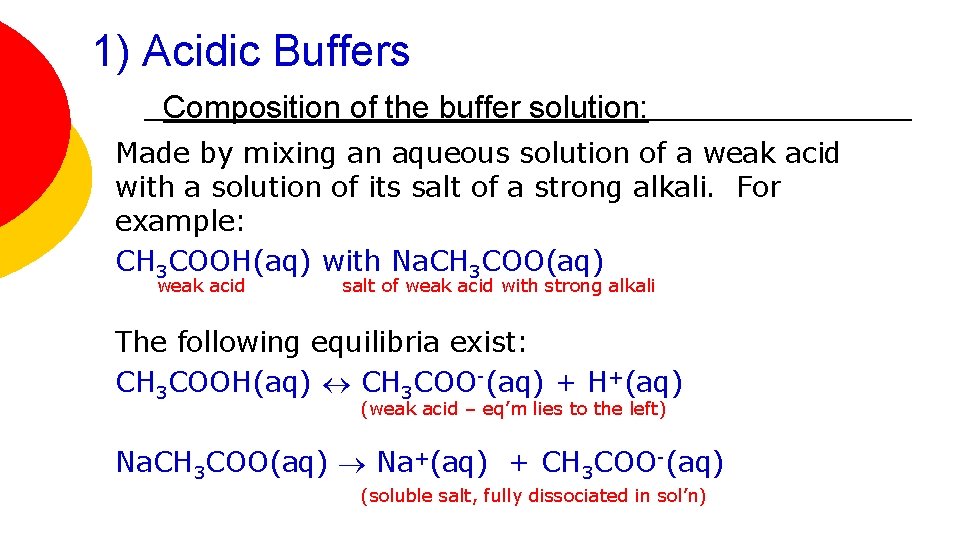
1) Acidic Buffers Composition of the buffer solution: Made by mixing an aqueous solution of a weak acid with a solution of its salt of a strong alkali. For example: CH 3 COOH(aq) with Na. CH 3 COO(aq) weak acid salt of weak acid with strong alkali The following equilibria exist: CH 3 COOH(aq) CH 3 COO-(aq) + H+(aq) (weak acid – eq’m lies to the left) Na. CH 3 COO(aq) Na+(aq) + CH 3 COO-(aq) (soluble salt, fully dissociated in sol’n)
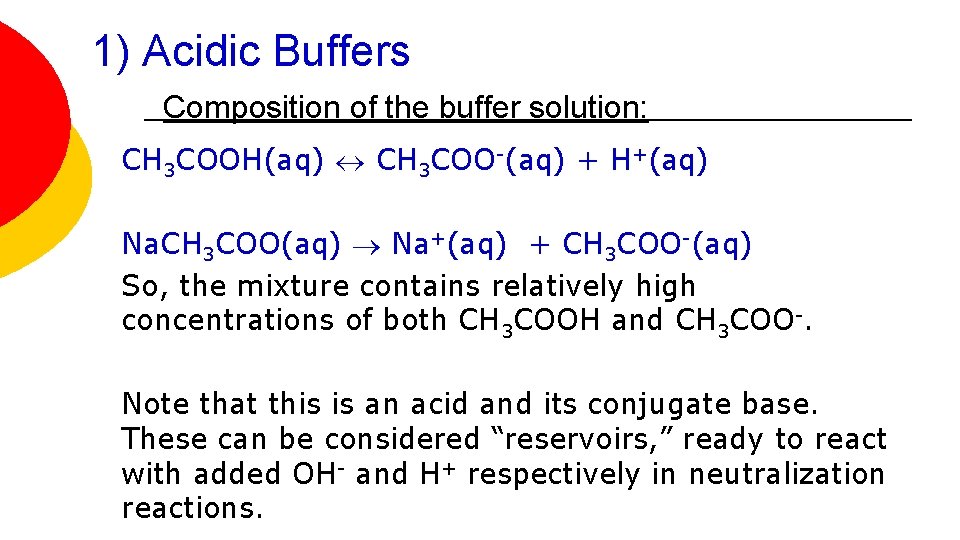
1) Acidic Buffers Composition of the buffer solution: CH 3 COOH(aq) CH 3 COO-(aq) + H+(aq) Na. CH 3 COO(aq) Na+(aq) + CH 3 COO-(aq) So, the mixture contains relatively high concentrations of both CH 3 COOH and CH 3 COO-. Note that this is an acid and its conjugate base. These can be considered “reservoirs, ” ready to react with added OH- and H+ respectively in neutralization reactions.
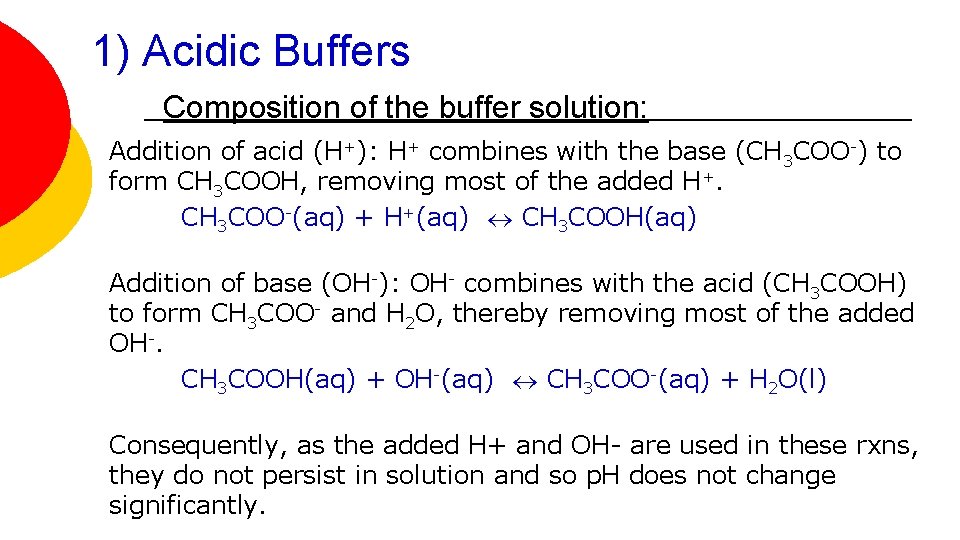
1) Acidic Buffers Composition of the buffer solution: Addition of acid (H+): H+ combines with the base (CH 3 COO-) to form CH 3 COOH, removing most of the added H+. CH 3 COO-(aq) + H+(aq) CH 3 COOH(aq) Addition of base (OH-): OH- combines with the acid (CH 3 COOH) to form CH 3 COO- and H 2 O, thereby removing most of the added OH-. CH 3 COOH(aq) + OH-(aq) CH 3 COO-(aq) + H 2 O(l) Consequently, as the added H+ and OH- are used in these rxns, they do not persist in solution and so p. H does not change significantly.
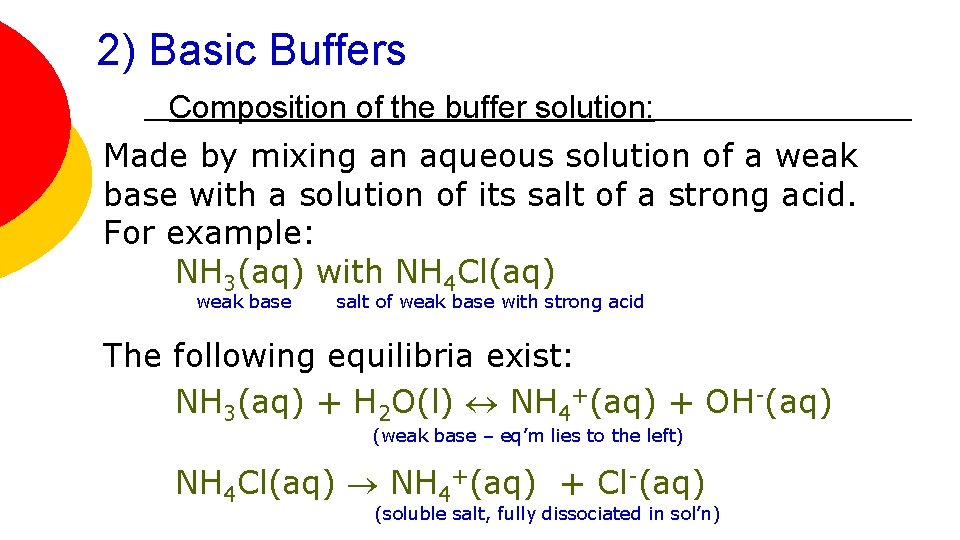
2) Basic Buffers Composition of the buffer solution: Made by mixing an aqueous solution of a weak base with a solution of its salt of a strong acid. For example: NH 3(aq) with NH 4 Cl(aq) weak base salt of weak base with strong acid The following equilibria exist: NH 3(aq) + H 2 O(l) NH 4+(aq) + OH-(aq) (weak base – eq’m lies to the left) NH 4 Cl(aq) NH 4+(aq) + Cl-(aq) (soluble salt, fully dissociated in sol’n)
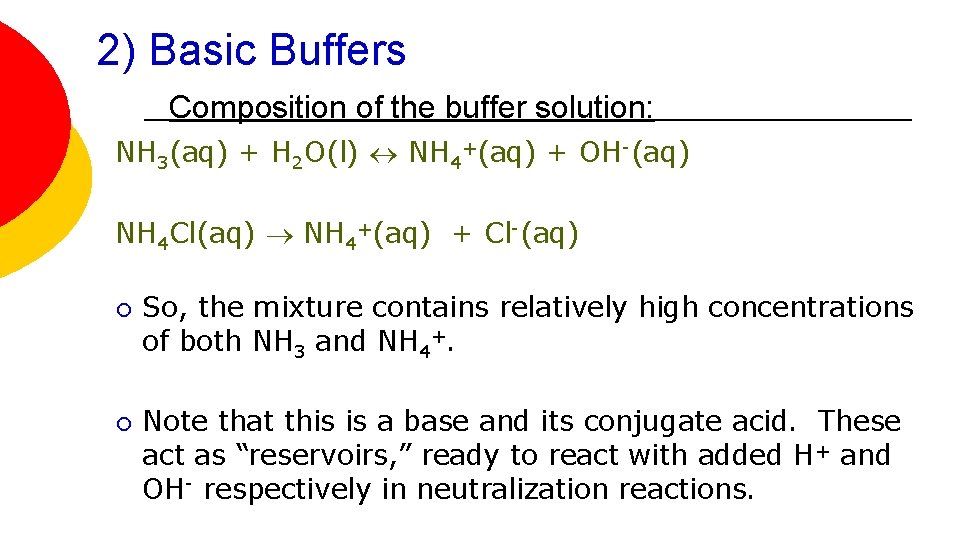
2) Basic Buffers Composition of the buffer solution: NH 3(aq) + H 2 O(l) NH 4+(aq) + OH-(aq) NH 4 Cl(aq) NH 4+(aq) + Cl-(aq) ¡ ¡ So, the mixture contains relatively high concentrations of both NH 3 and NH 4+. Note that this is a base and its conjugate acid. These act as “reservoirs, ” ready to react with added H+ and OH- respectively in neutralization reactions.
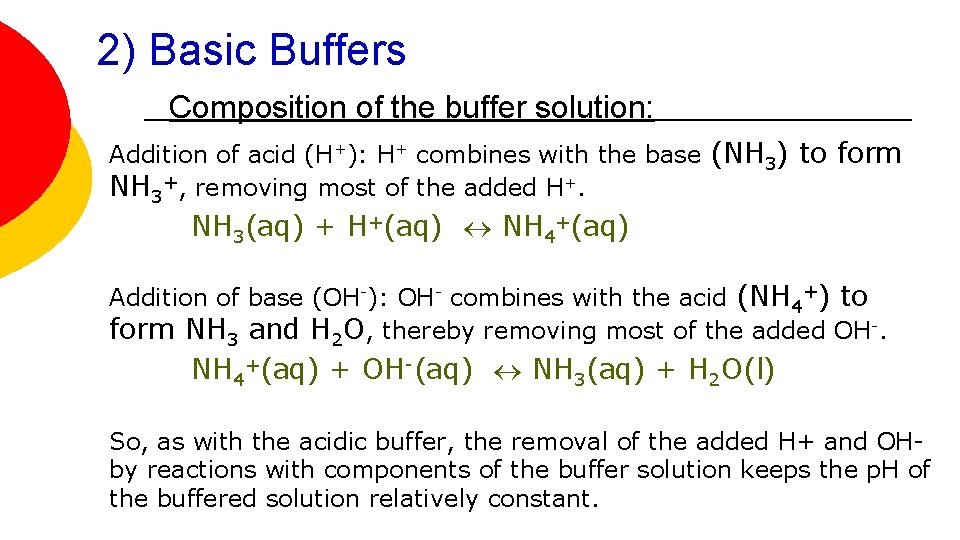
2) Basic Buffers Composition of the buffer solution: Addition of acid (H+): H+ combines with the base (NH 3) to form NH 3+, removing most of the added H+. NH 3(aq) + H+(aq) NH 4+(aq) Addition of base (OH-): OH- combines with the acid (NH 4+) to form NH 3 and H 2 O, thereby removing most of the added OH-. NH 4+(aq) + OH-(aq) NH 3(aq) + H 2 O(l) So, as with the acidic buffer, the removal of the added H+ and OHby reactions with components of the buffer solution keeps the p. H of the buffered solution relatively constant.
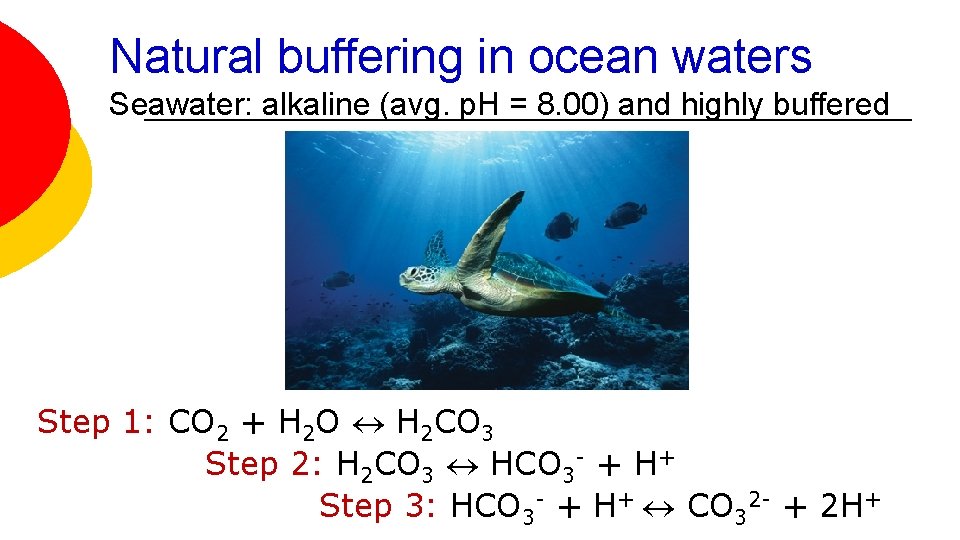
Natural buffering in ocean waters Seawater: alkaline (avg. p. H = 8. 00) and highly buffered Step 1: CO 2 + H 2 O H 2 CO 3 Step 2: H 2 CO 3 HCO 3 - + H+ Step 3: HCO 3 - + H+ CO 32 - + 2 H+
Buffering in your Blood ¡Your blood can absorb acids and bases produced in biologic rxns without changing its p. H ¡Constant p. H is vital for cell survival
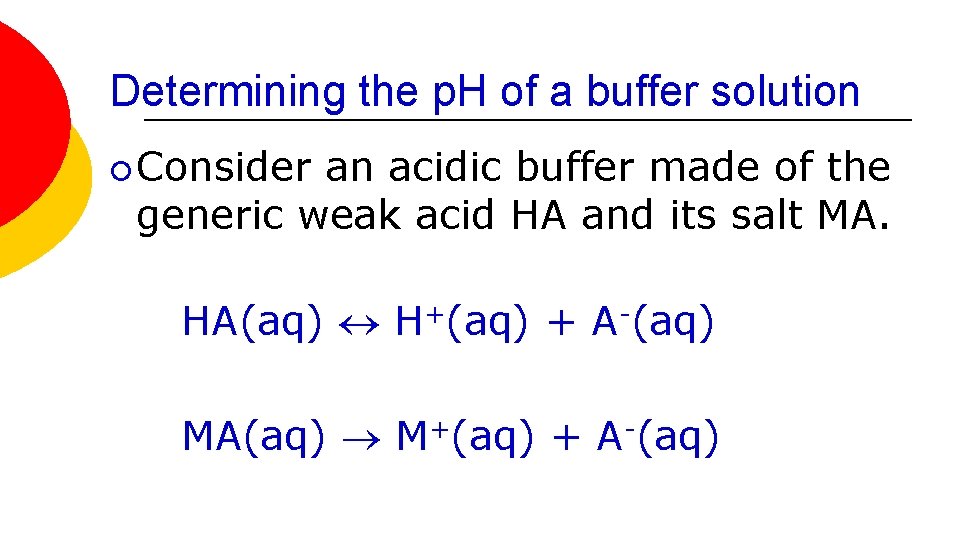
Determining the p. H of a buffer solution ¡ Consider an acidic buffer made of the generic weak acid HA and its salt MA. HA(aq) H+(aq) + A-(aq) MA(aq) M+(aq) + A-(aq)
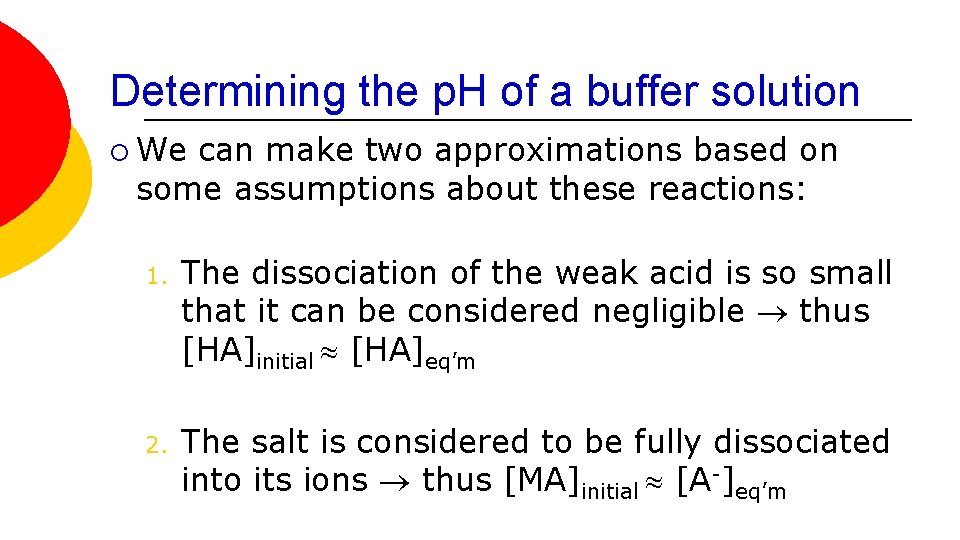
Determining the p. H of a buffer solution ¡ We can make two approximations based on some assumptions about these reactions: 1. The dissociation of the weak acid is so small that it can be considered negligible thus [HA]initial [HA]eq’m 2. The salt is considered to be fully dissociated into its ions thus [MA]initial [A-]eq’m
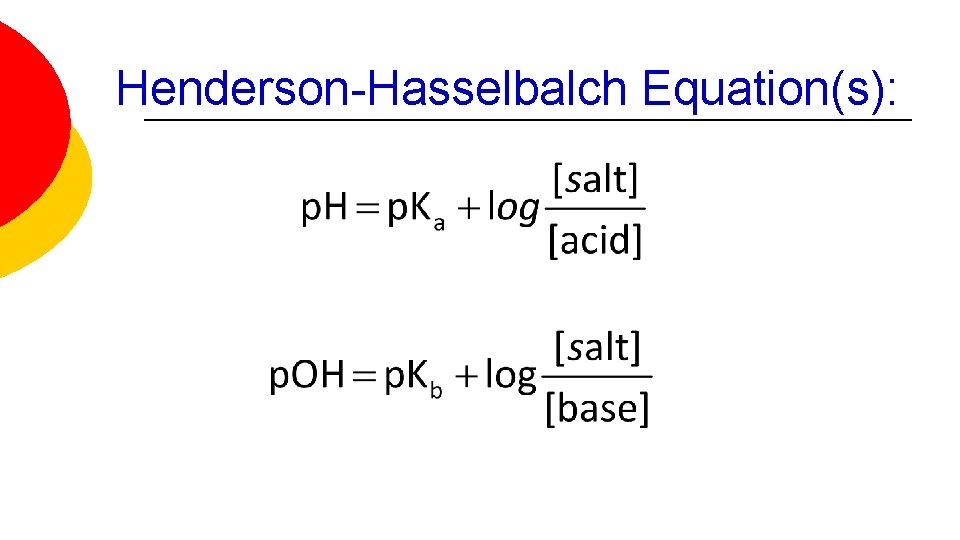
Henderson-Hasselbalch Equation(s):
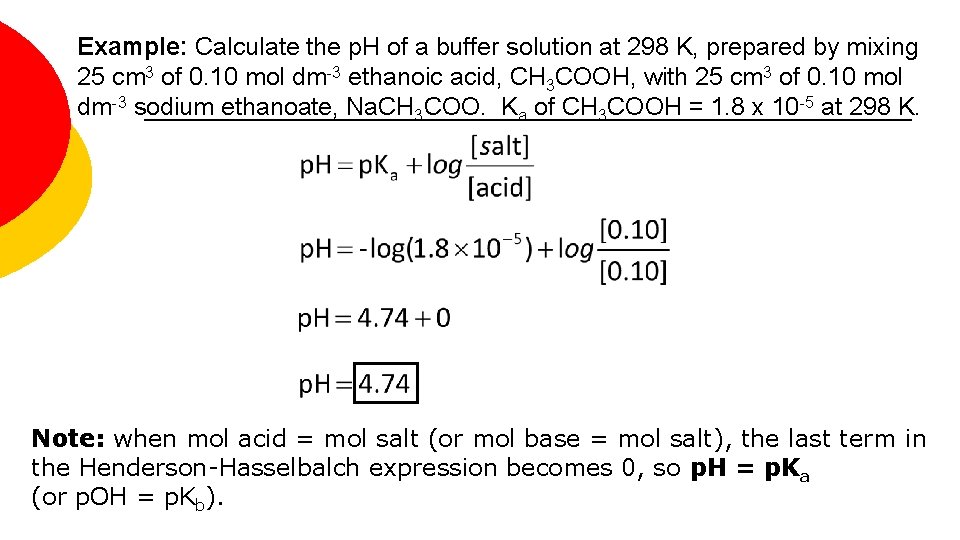
Example: Calculate the p. H of a buffer solution at 298 K, prepared by mixing 25 cm 3 of 0. 10 mol dm-3 ethanoic acid, CH 3 COOH, with 25 cm 3 of 0. 10 mol dm-3 sodium ethanoate, Na. CH 3 COO. Ka of CH 3 COOH = 1. 8 x 10 -5 at 298 K. Note: when mol acid = mol salt (or mol base = mol salt), the last term in the Henderson-Hasselbalch expression becomes 0, so p. H = p. Ka (or p. OH = p. Kb).
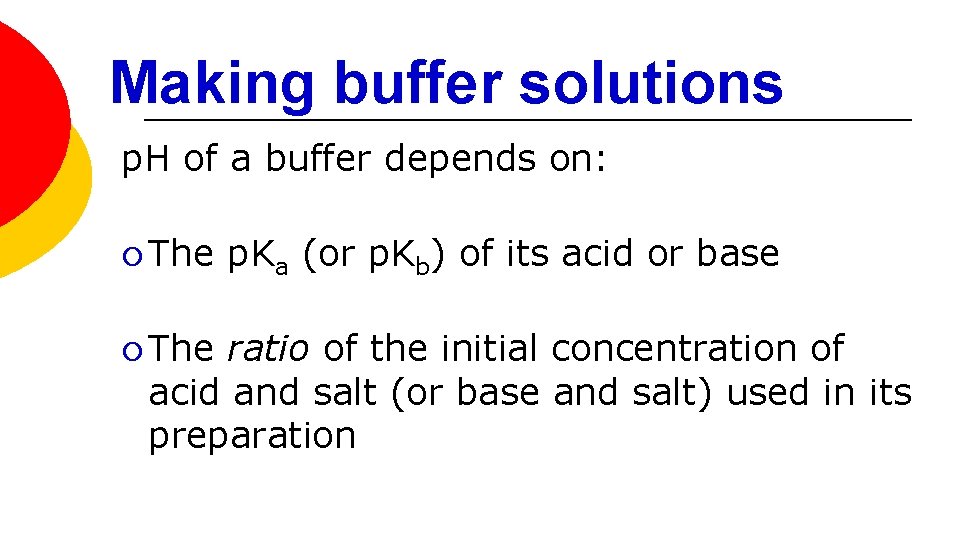
Making buffer solutions p. H of a buffer depends on: ¡ The p. Ka (or p. Kb) of its acid or base ratio of the initial concentration of acid and salt (or base and salt) used in its preparation
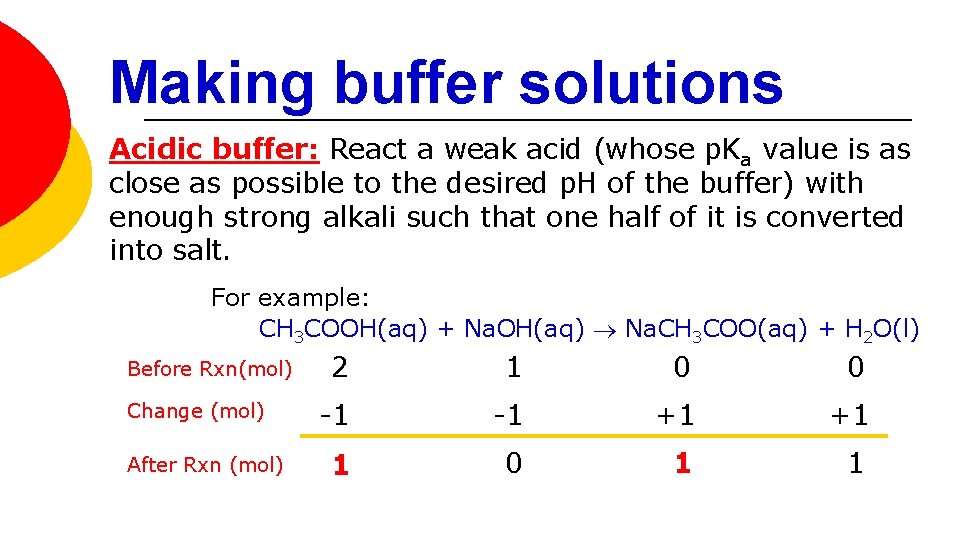
Making buffer solutions Acidic buffer: React a weak acid (whose p. Ka value is as close as possible to the desired p. H of the buffer) with enough strong alkali such that one half of it is converted into salt. For example: CH 3 COOH(aq) + Na. OH(aq) Na. CH 3 COO(aq) + H 2 O(l) Before Rxn(mol) Change (mol) After Rxn (mol) 2 1 0 0 -1 -1 +1 +1 1 0 1 1
Making buffer solutions Basic buffer: React a weak base (whose p. Kb value is as close as possible to the desired p. OH of the buffer) with enough strong acid such that one half of it is converted into salt.
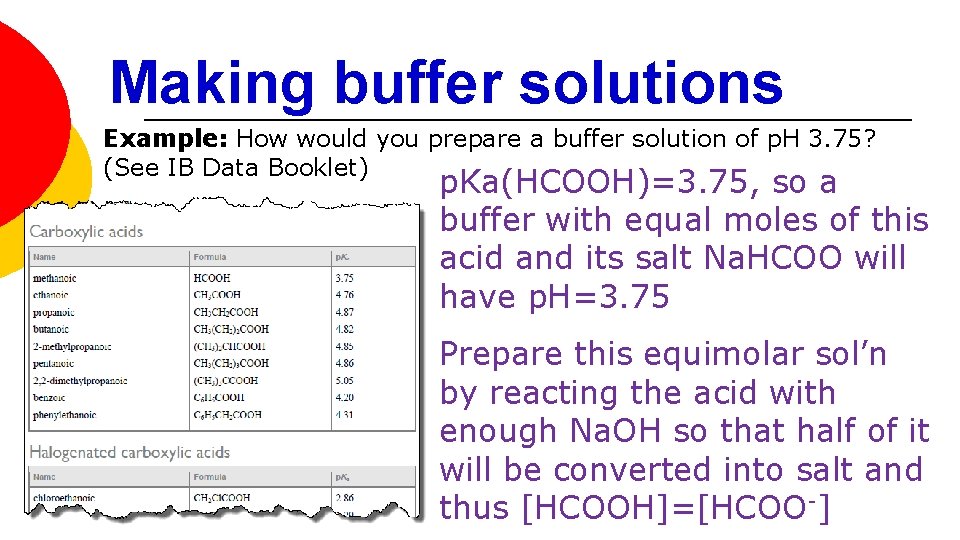
Making buffer solutions Example: How would you prepare a buffer solution of p. H 3. 75? (See IB Data Booklet) p. Ka(HCOOH)=3. 75, so a buffer with equal moles of this acid and its salt Na. HCOO will have p. H=3. 75 Prepare this equimolar sol’n by reacting the acid with enough Na. OH so that half of it will be converted into salt and thus [HCOOH]=[HCOO-]
Factors that can influence buffers ¡ Dilution: does not change p. H (Ka and Kb are constant & ratio of acid or base to salt does not change), but does decrease buffering capacity (amt. of acid or base the sol’n can absorb without a significant change in p. H) ¡ Temperature: As temp. affects the values of Ka and Kb, the p. H of the buffer is affected accordingly.
SALT HYDROLYSIS ¡ Neutralization rxn: acid + base salt + water p. H of resulting solution depends on relative strengths of acid and base
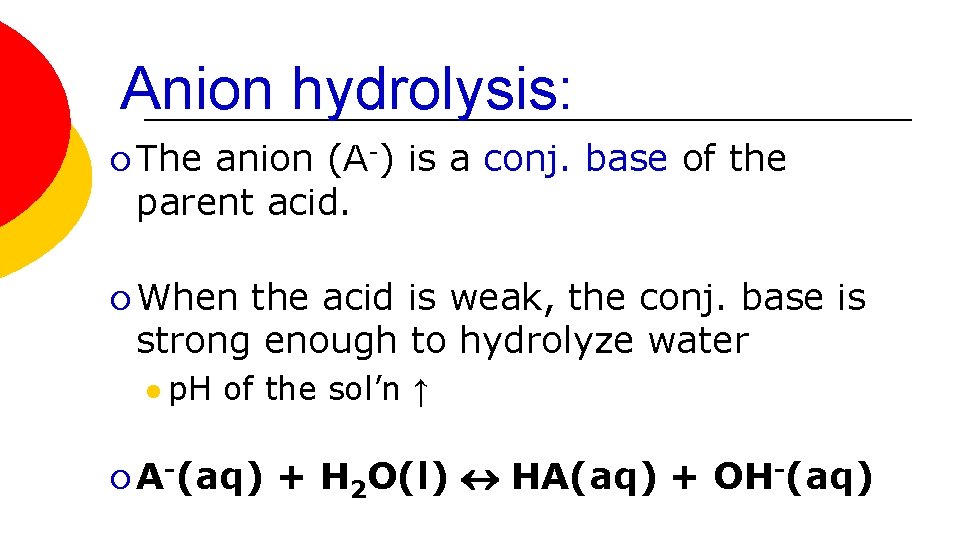
Anion hydrolysis: ¡ The anion (A-) is a conj. base of the parent acid. ¡ When the acid is weak, the conj. base is strong enough to hydrolyze water l p. H of the sol’n ↑ ¡ A-(aq) + H 2 O(l) HA(aq) + OH-(aq)
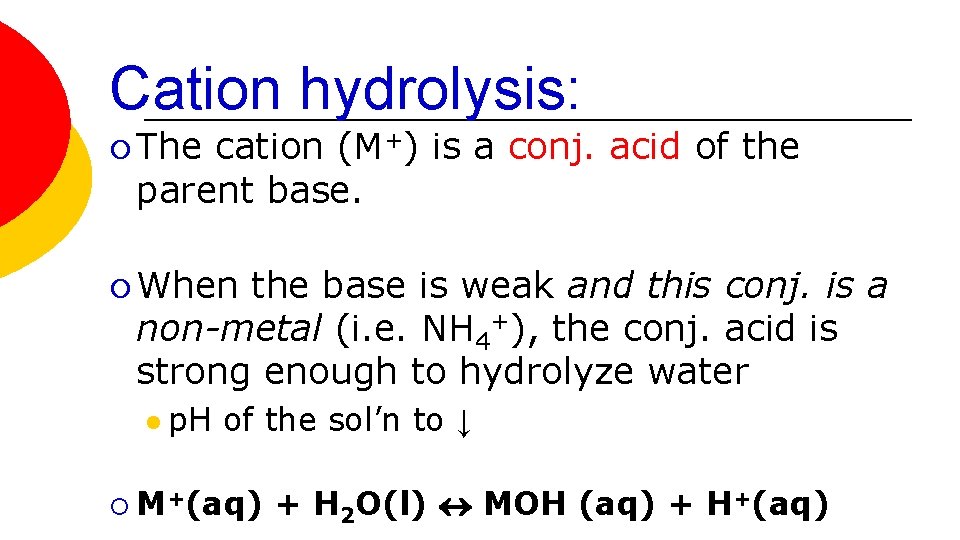
Cation hydrolysis: ¡ The cation (M+) is a conj. acid of the parent base. ¡ When the base is weak and this conj. is a non-metal (i. e. NH 4+), the conj. acid is strong enough to hydrolyze water l p. H of the sol’n to ↓ ¡ M+(aq) + H 2 O(l) MOH (aq) + H+(aq)
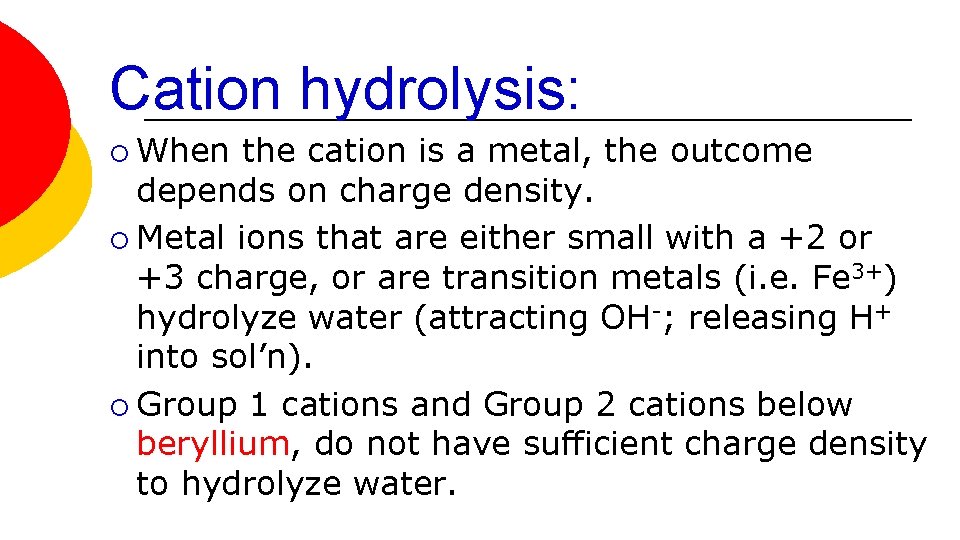
Cation hydrolysis: ¡ When the cation is a metal, the outcome depends on charge density. ¡ Metal ions that are either small with a +2 or +3 charge, or are transition metals (i. e. Fe 3+) hydrolyze water (attracting OH-; releasing H+ into sol’n). ¡ Group 1 cations and Group 2 cations below beryllium, do not have sufficient charge density to hydrolyze water.
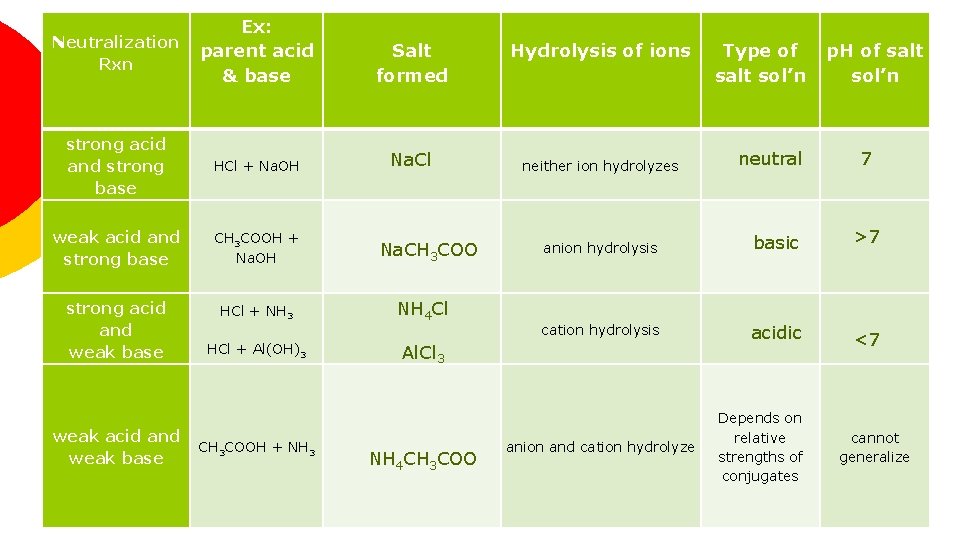
Neutralization Rxn Ex: parent acid & base Salt formed strong acid and strong base HCl + Na. OH Na. Cl weak acid and strong base CH 3 COOH + Na. OH strong acid and weak base HCl + NH 3 weak acid and weak base HCl + Al(OH)3 CH 3 COOH + NH 3 Na. CH 3 COO NH 4 Cl Hydrolysis of ions neither ion hydrolyzes neutral p. H of salt sol’n 7 anion hydrolysis basic >7 cation hydrolysis acidic <7 Al. Cl 3 NH 4 CH 3 COO Type of salt sol’n anion and cation hydrolyze Depends on relative strengths of conjugates cannot generalize
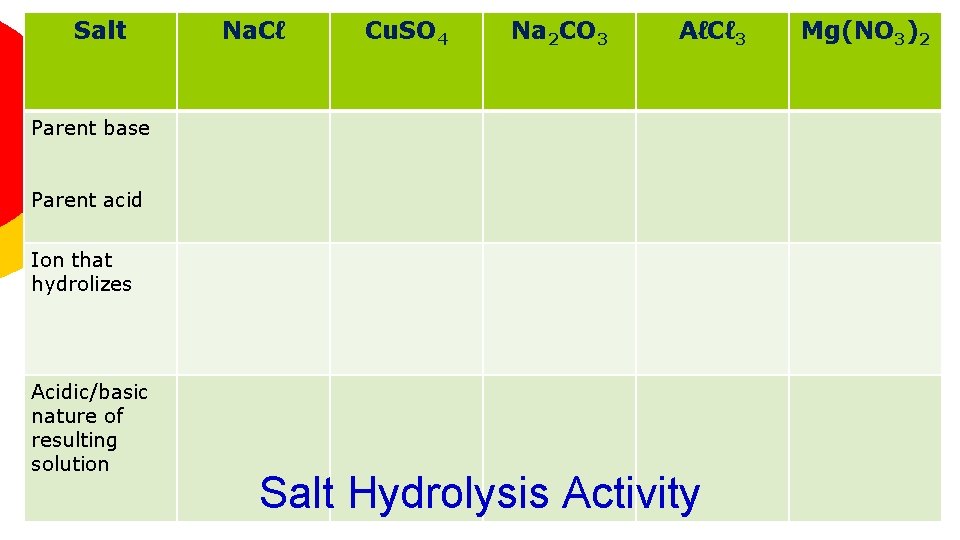
Salt Na. Cℓ Cu. SO 4 Na 2 CO 3 AℓCℓ 3 Parent base Parent acid Ion that hydrolizes Acidic/basic nature of resulting solution Salt Hydrolysis Activity Mg(NO 3)2
- Slides: 26