
Part 4 0 Standardised Interpretation of Paediatric Cervical
- Slides: 30
Part 4. 0 Standardised Interpretation of Paediatric Cervical Spine Radiographs Done in collaboration with: The Northern School of Radiology, UK County Durham and Darlington NHS Foundation Trust Authors: Dr. Nadia Mcallister MD Dr. Alasdair Mackie MD Dr. Abdelrahman Omer MD Dr. Ramdas Senasi MD Dr. Sarath Bethapudi MD
Aim Ø Demonstrate a systematic approach in the interpretation of paediatric C-spine x rays using ABCDEF approach.
Systematic approach • • Technique A – alignment B – bones C – cartilage D – disc (and other) spaces E – effusion (soft tissues) F – foreign body
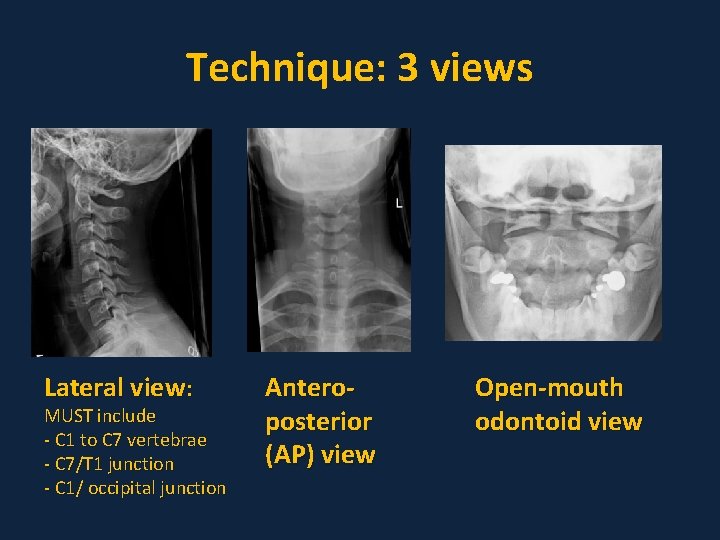
Technique: 3 views Lateral view: MUST include - C 1 to C 7 vertebrae - C 7/T 1 junction - C 1/ occipital junction Anteroposterior (AP) view Open-mouth odontoid view
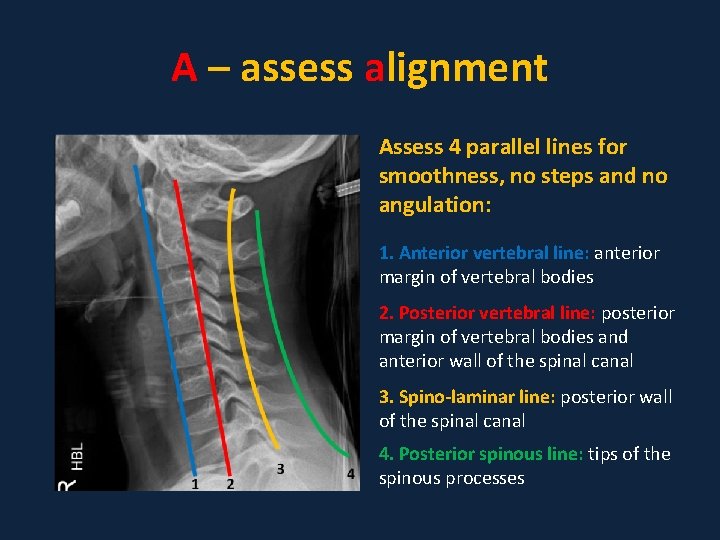
A – assess alignment Assess 4 parallel lines for smoothness, no steps and no angulation: 1. Anterior vertebral line: anterior margin of vertebral bodies 2. Posterior vertebral line: posterior margin of vertebral bodies and anterior wall of the spinal canal 3. Spino-laminar line: posterior wall of the spinal canal 4. Posterior spinous line: tips of the spinous processes
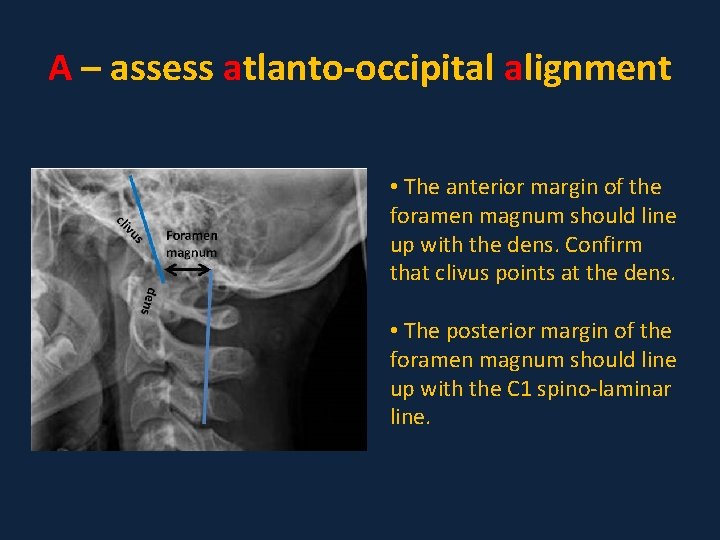
A – assess atlanto-occipital alignment • The anterior margin of the foramen magnum should line up with the dens. Confirm that clivus points at the dens. • The posterior margin of the foramen magnum should line up with the C 1 spino-laminar line.
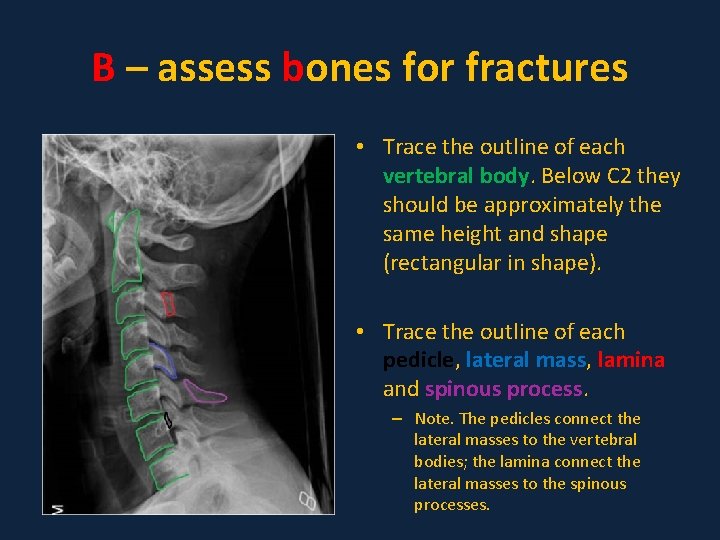
B – assess bones for fractures • Trace the outline of each vertebral body. Below C 2 they should be approximately the same height and shape (rectangular in shape). • Trace the outline of each pedicle, lateral mass, lamina and spinous process. – Note. The pedicles connect the lateral masses to the vertebral bodies; the lamina connect the lateral masses to the spinous processes.
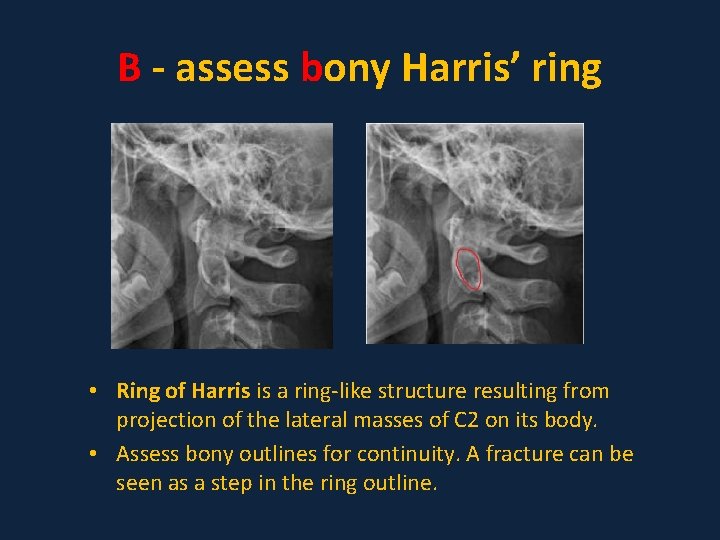
B - assess bony Harris’ ring • Ring of Harris is a ring-like structure resulting from projection of the lateral masses of C 2 on its body. • Assess bony outlines for continuity. A fracture can be seen as a step in the ring outline.
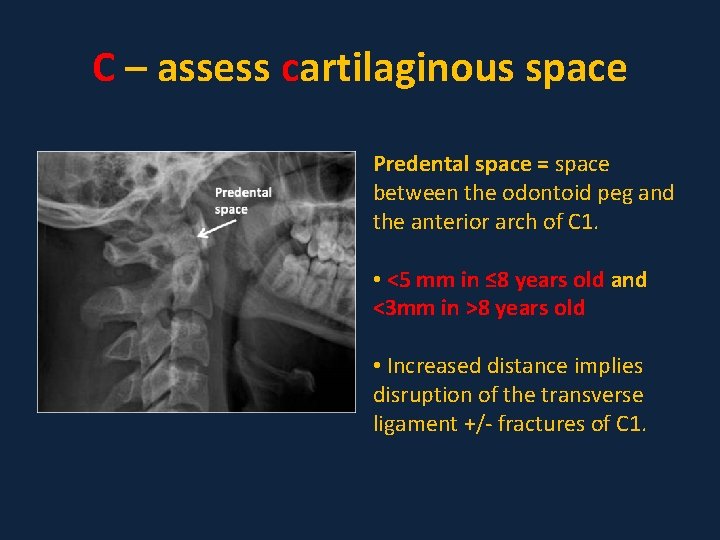
C – assess cartilaginous space Predental space = space between the odontoid peg and the anterior arch of C 1. • <5 mm in ≤ 8 years old and <3 mm in >8 years old • Increased distance implies disruption of the transverse ligament +/- fractures of C 1.
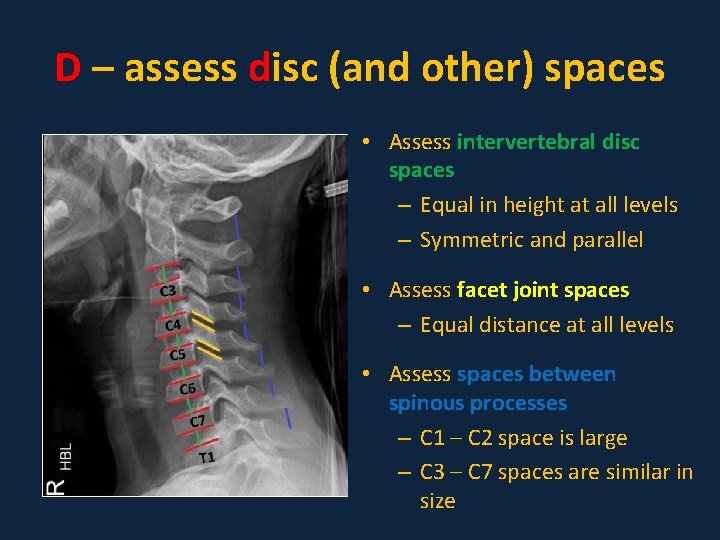
D – assess disc (and other) spaces • Assess intervertebral disc spaces – Equal in height at all levels – Symmetric and parallel • Assess facet joint spaces – Equal distance at all levels • Assess spaces between spinous processes – C 1 – C 2 space is large – C 3 – C 7 spaces are similar in size
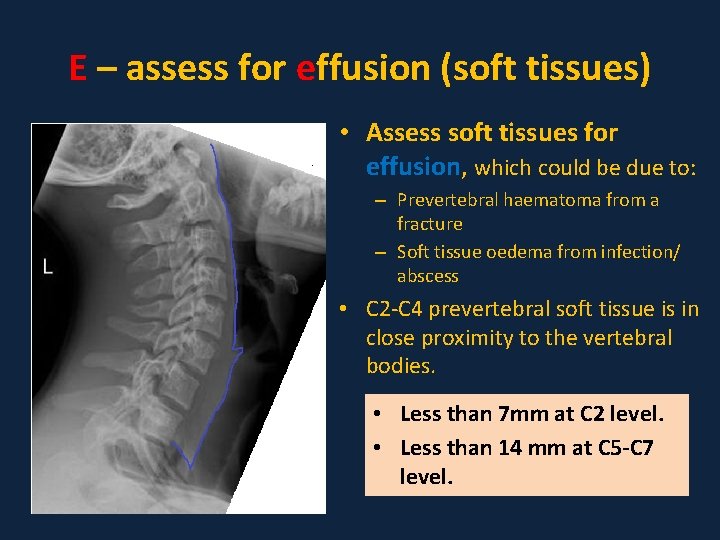
E – assess for effusion (soft tissues) • Assess soft tissues for effusion, which could be due to: – Prevertebral haematoma from a fracture – Soft tissue oedema from infection/ abscess • C 2 -C 4 prevertebral soft tissue is in close proximity to the vertebral bodies. • Less than 7 mm at C 2 level. • Less than 14 mm at C 5 -C 7 level.
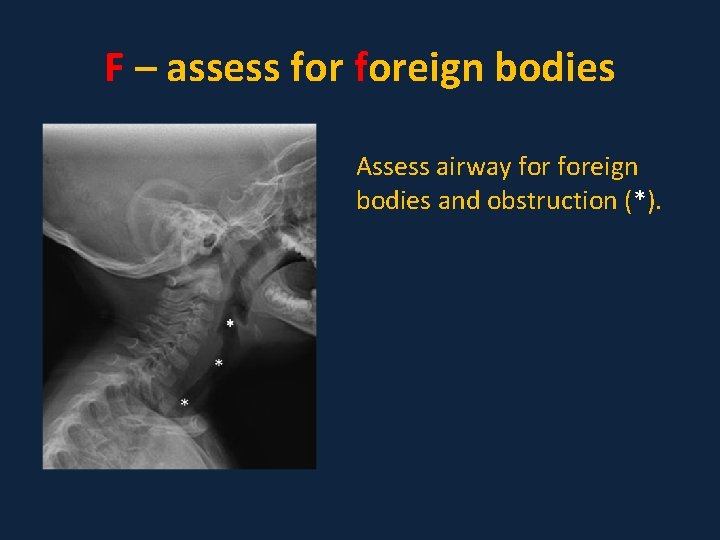
F – assess foreign bodies Assess airway foreign bodies and obstruction (*).
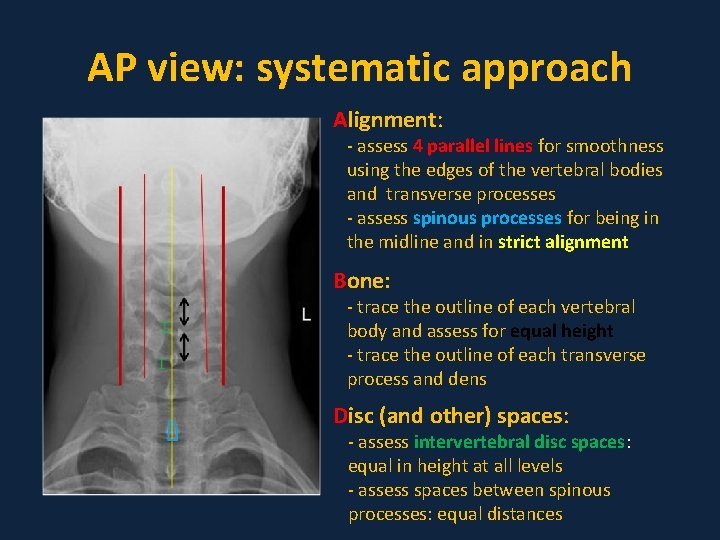
AP view: systematic approach Alignment: - assess 4 parallel lines for smoothness using the edges of the vertebral bodies and transverse processes - assess spinous processes for being in the midline and in strict alignment Bone: - trace the outline of each vertebral body and assess for equal height - trace the outline of each transverse process and dens Disc (and other) spaces: - assess intervertebral disc spaces: equal in height at all levels - assess spaces between spinous processes: equal distances
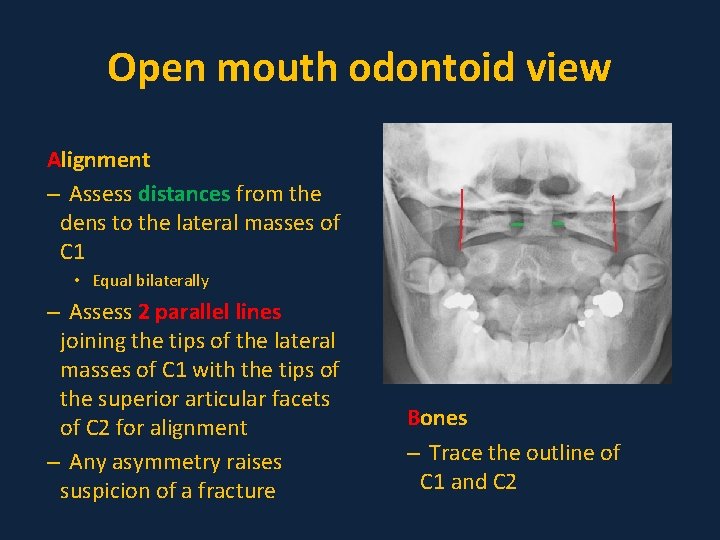
Open mouth odontoid view Alignment – Assess distances from the dens to the lateral masses of C 1 • Equal bilaterally – Assess 2 parallel lines joining the tips of the lateral masses of C 1 with the tips of the superior articular facets of C 2 for alignment – Any asymmetry raises suspicion of a fracture Bones – Trace the outline of C 1 and C 2
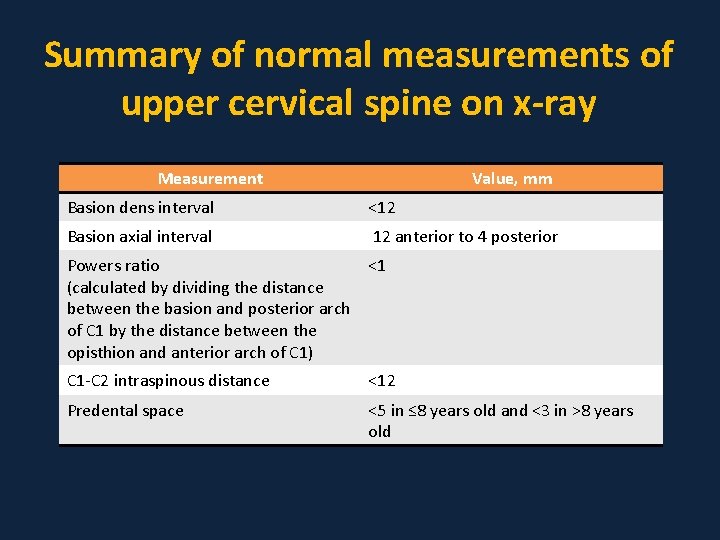
Summary of normal measurements of upper cervical spine on x-ray Measurement Value, mm Basion dens interval <12 Basion axial interval 12 anterior to 4 posterior Powers ratio <1 (calculated by dividing the distance between the basion and posterior arch of C 1 by the distance between the opisthion and anterior arch of C 1) C 1 -C 2 intraspinous distance <12 Predental space <5 in ≤ 8 years old and <3 in >8 years old
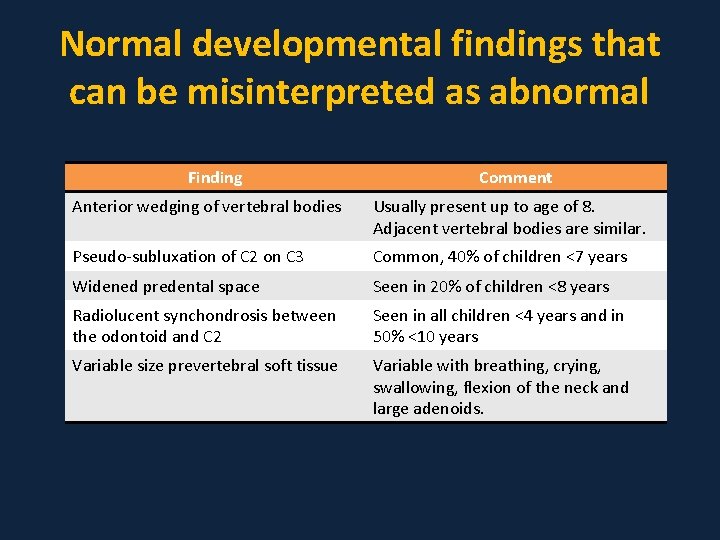
Normal developmental findings that can be misinterpreted as abnormal Finding Comment Anterior wedging of vertebral bodies Usually present up to age of 8. Adjacent vertebral bodies are similar. Pseudo-subluxation of C 2 on C 3 Common, 40% of children <7 years Widened predental space Seen in 20% of children <8 years Radiolucent synchondrosis between the odontoid and C 2 Seen in all children <4 years and in 50% <10 years Variable size prevertebral soft tissue Variable with breathing, crying, swallowing, flexion of the neck and large adenoids.
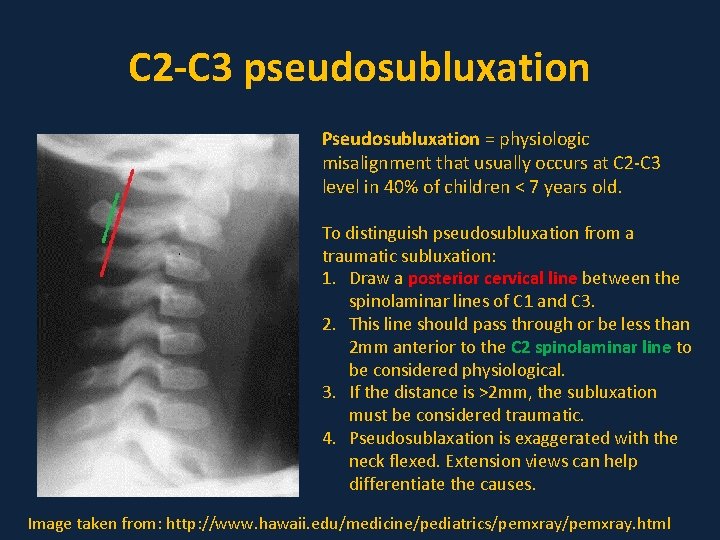
C 2 -C 3 pseudosubluxation Pseudosubluxation = physiologic misalignment that usually occurs at C 2 -C 3 level in 40% of children < 7 years old. To distinguish pseudosubluxation from a traumatic subluxation: 1. Draw a posterior cervical line between the spinolaminar lines of C 1 and C 3. 2. This line should pass through or be less than 2 mm anterior to the C 2 spinolaminar line to be considered physiological. 3. If the distance is >2 mm, the subluxation must be considered traumatic. 4. Pseudosublaxation is exaggerated with the neck flexed. Extension views can help differentiate the causes. Image taken from: http: //www. hawaii. edu/medicine/pediatrics/pemxray. html
How will you approach the following radiographs?
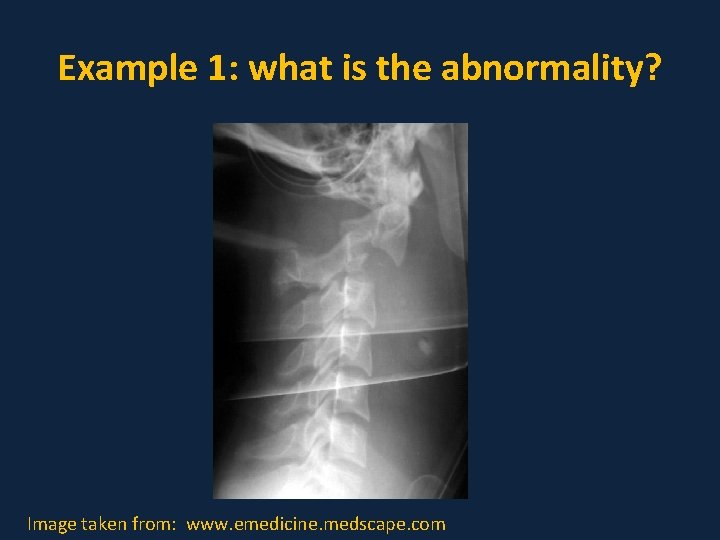
Example 1: what is the abnormality? Image taken from: www. emedicine. medscape. com
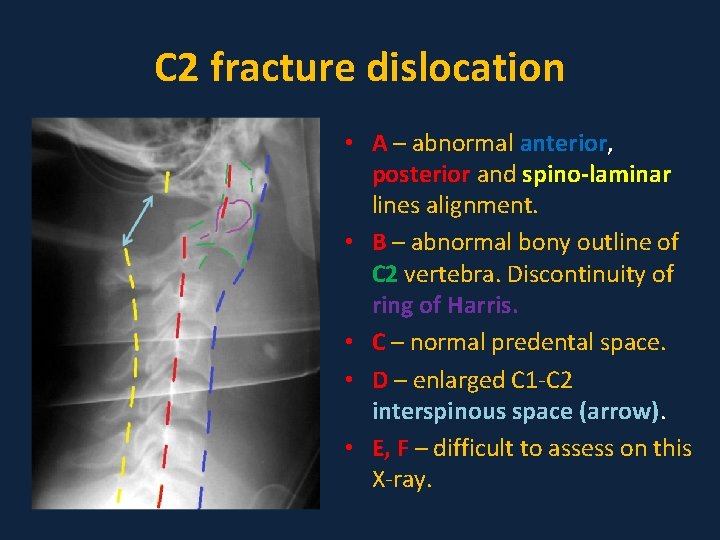
C 2 fracture dislocation • A – abnormal anterior, posterior and spino-laminar lines alignment. • B – abnormal bony outline of C 2 vertebra. Discontinuity of ring of Harris. • C – normal predental space. • D – enlarged C 1 -C 2 interspinous space (arrow). • E, F – difficult to assess on this X-ray.
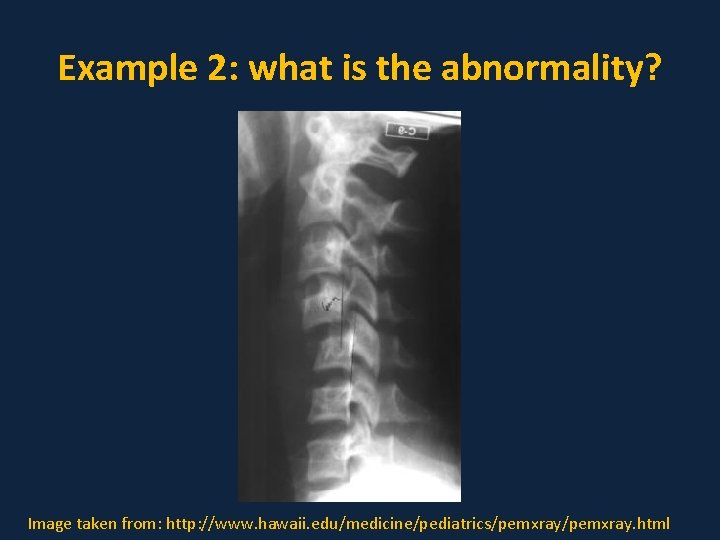
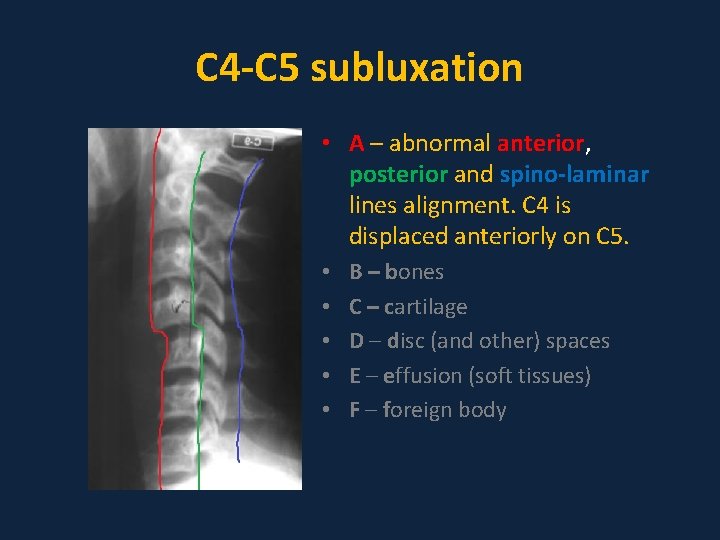
Example 2: what is the abnormality? Image taken from: http: //www. hawaii. edu/medicine/pediatrics/pemxray. html
C 4 -C 5 subluxation • A – abnormal anterior, posterior and spino-laminar lines alignment. C 4 is displaced anteriorly on C 5. • • • B – bones C – cartilage D – disc (and other) spaces E – effusion (soft tissues) F – foreign body
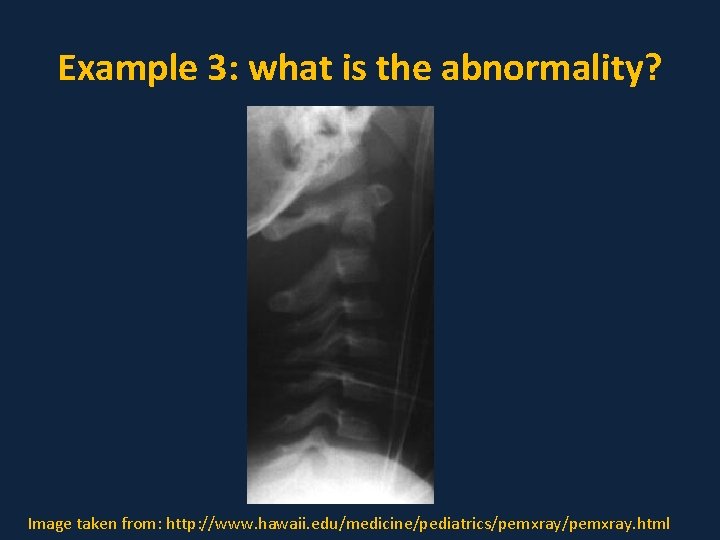
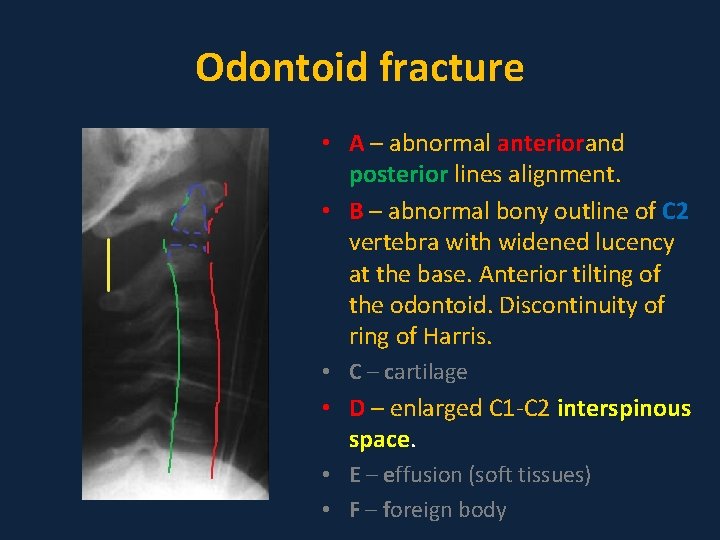
Example 3: what is the abnormality? Image taken from: http: //www. hawaii. edu/medicine/pediatrics/pemxray. html
Odontoid fracture • A – abnormal anteriorand posterior lines alignment. • B – abnormal bony outline of C 2 vertebra with widened lucency at the base. Anterior tilting of the odontoid. Discontinuity of ring of Harris. • C – cartilage • D – enlarged C 1 -C 2 interspinous space. • E – effusion (soft tissues) • F – foreign body
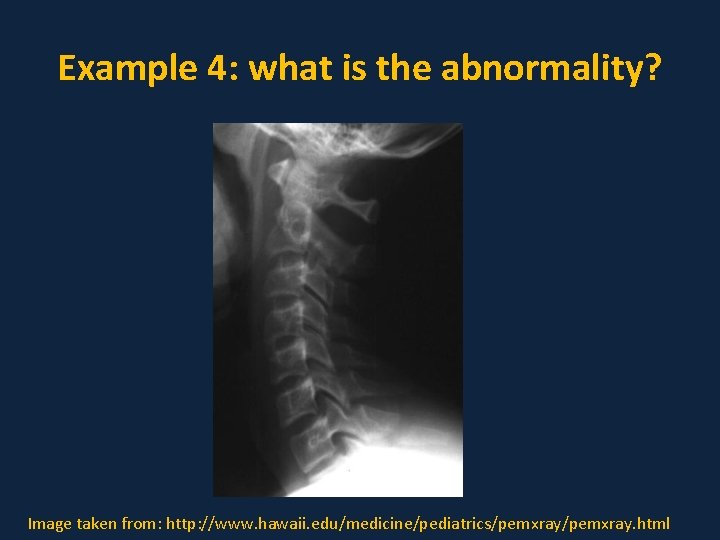
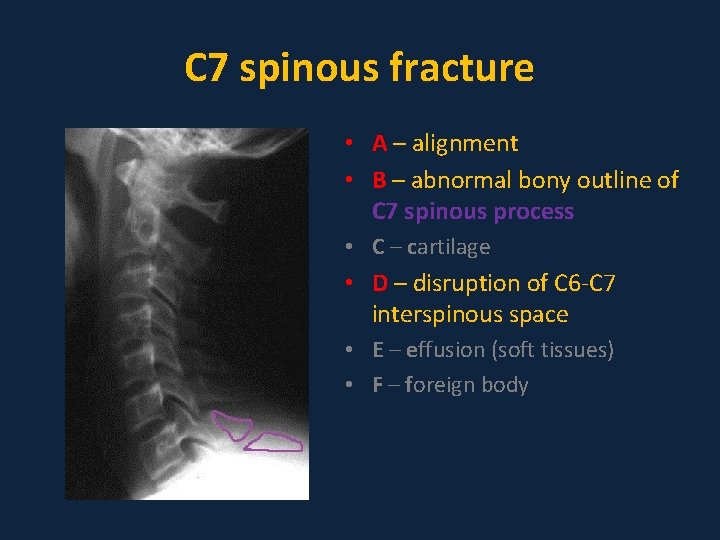
Example 4: what is the abnormality? Image taken from: http: //www. hawaii. edu/medicine/pediatrics/pemxray. html
C 7 spinous fracture • A – alignment • B – abnormal bony outline of C 7 spinous process • C – cartilage • D – disruption of C 6 -C 7 interspinous space • E – effusion (soft tissues) • F – foreign body
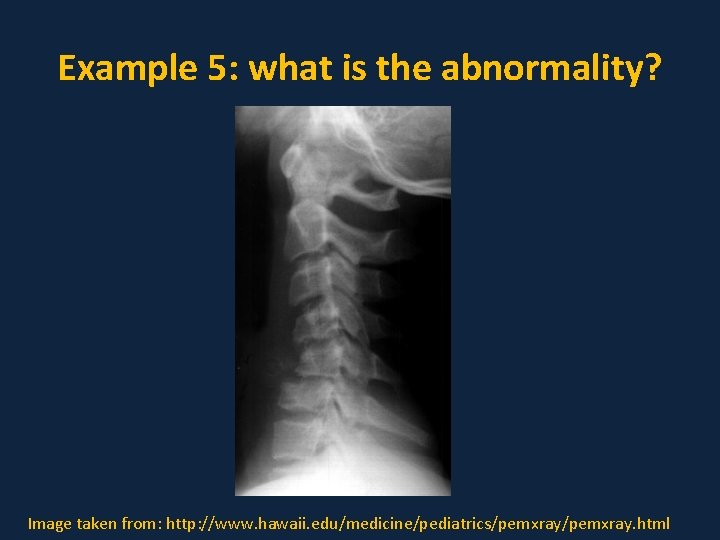
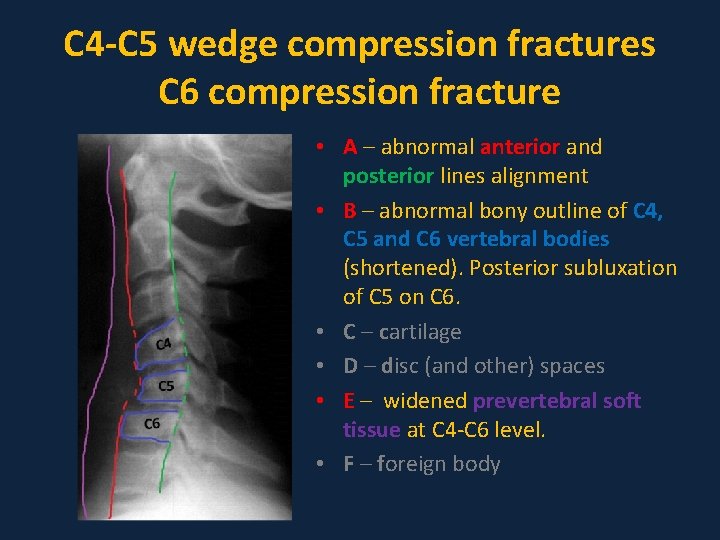
Example 5: what is the abnormality? Image taken from: http: //www. hawaii. edu/medicine/pediatrics/pemxray. html
C 4 -C 5 wedge compression fractures C 6 compression fracture • A – abnormal anterior and posterior lines alignment • B – abnormal bony outline of C 4, C 5 and C 6 vertebral bodies (shortened). Posterior subluxation of C 5 on C 6. • C – cartilage • D – disc (and other) spaces • E – widened prevertebral soft tissue at C 4 -C 6 level. • F – foreign body
Summary Ø Ensure cervical spine has been adequately imaged. Ø Adopt a systematic approach. Ø Knowledge of normal developmental anatomy and normal variants is important. Ø Imaging findings are to be interpreted in the context of age and mechanism of injury. Ø Upper cervical spine injuries are more common in paediatric population. Ø In the context of trauma, consider cross-sectional CT/MR imaging if X-rays are inconclusive and cannot safely exclude underlying cervical spine injury.
References Ø Booth TN. Cervical spine evaluation in pediatric trauma. AJR: 198, May 2012. Ø The Royal College of Radiologists. Paediatric trauma protocols. London: The Royal College of Radiologists, 2014. Ø O. Adib, E. NOIZET, D. Loisel et al. Radiographic atlas of pediatric cervical spine in emergency: normal anatomy, variants and pitfalls. European Society of Radiology, ECR Congress 2014.