
Part 3 Whats in our Future Worm Control

- Slides: 74
Part 3. What’s in our Future? Worm Control Strategies in Development
Fecal Fungus – Duddingtonia flagrans • There are >100 species of Nematophagus (nematode eating) fungi. Many are found in livestock feces where they trap and eat gastrointestinal worm larvae as they hatch and molt. • The most heavily researched is D. flagrans. Originally much of the research on it was done by Hansen Biosystems. When they ceased work on it, International Animal Health, an Australian company, continued lab and field testing of the fungus, identifying the strain IAH 1297 as having the most suitable properties for commercial production. • Applications for approval as a new active ingredient and for commercial marketing have been submitted in Australia, New Zealand the United States. • The EPA public comment period has passed in the U. S. and the FDA has approved the product. It is currently “in the hands” of the Regulators in all three countries with anticipation of commercial release sometime in 2018.
Feeding protocol for D. Flagrans • D. Flagrans does not kill either mature worms or larvae inside the goat or sheep. Instead, it kills larvae in the feces, reducing pasture contamination and breaking the cycle of infection. • International Animal Health is seeking to market two products: 1) Bio. Worma (500, 000 chlamydospores/gram ) designed to be top dressed or incorporated into a feed supplement , and 2) Livamol with Bio. Worma (an Australian supplement with Bio. Worma already added). • After ingestion by livestock in their feed, the D. flagrans spores readily survive passage through the digestive tract to be excreted in the animal’s manure along with any worm eggs the animal is passing simultaneously. Once excreted, the spores germinate and trap and consume the newly hatched worm larvae. Livestock must eat the fungal spores (chlamydospores) daily to have sufficiently constant supply in the feces to impact the worm population in the pastures. • International Animal Health recommends that farmers start feeding the spores to their livestock at the beginning of the grazing season or earlier before barber pole worm or other strongyles become a major problem, and continue feeding it through the worst of the worm season. • duddingtonia. com/ is a website set up to inform interested farmers about the product and alert them when anf if it is released into the general market. • https: //archive. apvma. gov. au/application_summaries/106347. pdf 40 pages of d. flagrans lists several pages of past testing on d. flagrans.
New Class of Dewormer • Zolvix (monepantel) by Novartix in Australia & NZ Kills almost all worms resistant to current dewormers. Monepantel acts on a particular nicotinic acetylcholine receptor subunit (Hco-MPTL-1) present only in nematodes and absent in mammals and other organisms. Monepantel blocks these receptors causing the worm to become paralyzed and either die or be expelled. • Expensive, and Worms in some flocks/herds in Australia, NZ and Europe showed drug resistance within the first 2 years of use. • In June 2013 was “close to FDA approval”. However, Novartix was acquired by Elanco in 2014 and the approval process had to “restart”. It is thought that Elanco then decided not to pursue it. Elanco did submit a request to the EPA in 2015 for establishing an import tolerance for monepantel for lamb imported from Australia and NZ and the request was granted.
Zolvix® is currently registered in the following countries: • European Union • Iceland (ISL) • Liechtenstein • Norway • Switzerland • South Africa • Australia • New Zealand • Argentina • Chile • Uruguay • https: //www. fda. gov/downloads/Animal. Veterinary/Products/Import. Expo rts/UCM 482354. pdf • http: //www. airr. com. au/news/elanco-zolvix-plus-new-to-market. html
Vaccines • Breakthrough grow adult worms in lambs, harvest at slaughter, method developed to centrifuge worms and harvest the specific immunity-inducing antigen. Further breakthrough now only need to slaughter 1 sheep to get enough antigen to vaccinate 100 sheep. Still dependent on having slaughterhouses that process lots of lambs or goats. • Vaccine called Barber. Va. X started being marketed in Australia in October 2014. Attempted to extend registration to goats but vaccine effectiveness was too variable among the 3 study farms and request denied in 2017. • The vaccine requires 5 boosters, first 3 are given 3 to 4 weeks apart, next 2 are given 6 weeks apart. Protection only lasts ~6 weeks and does not start until 3 rd dosage. Cost effective? Not much savings over deworming. • General thought is that it is unlikely to be marketed in U. S.
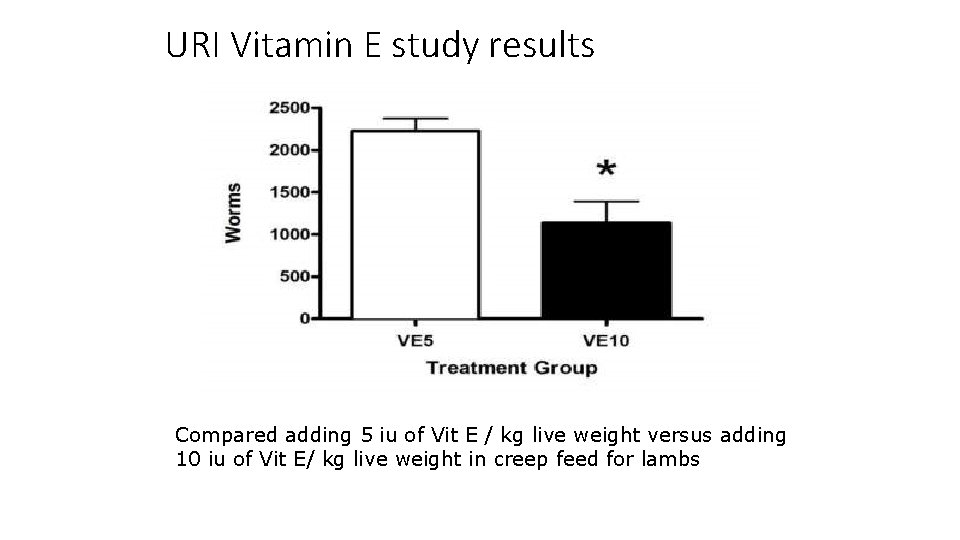
University of Rhode Island Research • Effect of Vitamin E supplementation on parasite resistance • Elevated levels of vitamin E supplementation had beneficial effect on the abomasal worm burden. • VE 10 lambs tended to have • Lower mean FEC • Higher eosinophil and globule leukocyte counts • Compared adding 5 iu of Vitamin E/kg live weight to adding 10 iu of Vit E/kg (most recent NRC recommendation) live weight in creep feed.
URI Vitamin E study results Compared adding 5 iu of Vit E / kg live weight versus adding 10 iu of Vit E/ kg live weight in creep feed for lambs *p = 0. 002 vs VE 5
• For the last 4 years, Cornell has collaborated on studies testing: the effectiveness of dosing sheep and goats with copper oxide wire particles (COWP) to control Haemonchus contortus (barber pole worm), • whether establishing and grazing birdsfoot trefoil pastures has potential to control barber pole worm and other strongyles, and • whether ivermectin should be included in the arsenal of treatments of animals infected with deer-worm. • Funding thru NESARE, USDA OREI, Federal Formula Funds and NNY Ag Dev. Program.
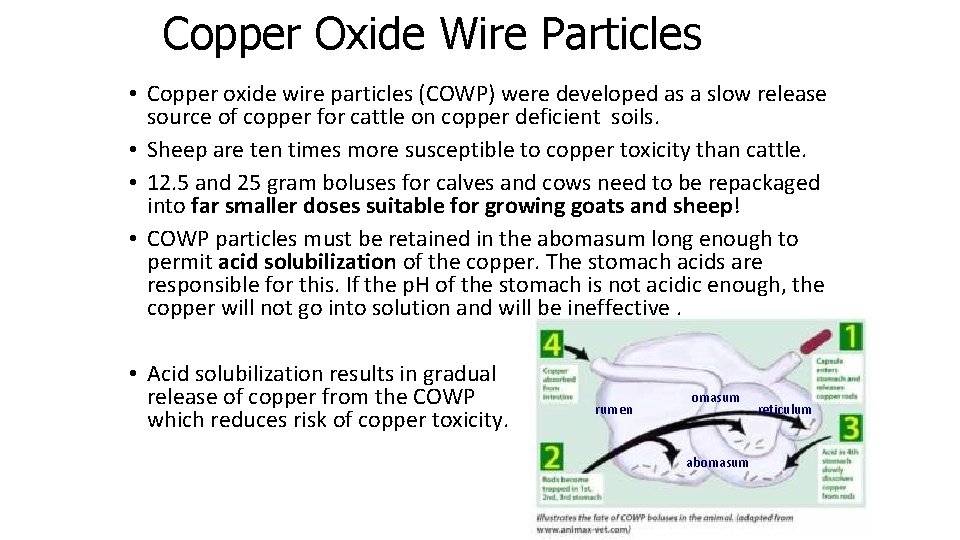
Copper Oxide Wire Particles • Copper oxide wire particles (COWP) were developed as a slow release source of copper for cattle on copper deficient soils. • Sheep are ten times more susceptible to copper toxicity than cattle. • 12. 5 and 25 gram boluses for calves and cows need to be repackaged into far smaller doses suitable for growing goats and sheep! • COWP particles must be retained in the abomasum long enough to permit acid solubilization of the copper. The stomach acids are responsible for this. If the p. H of the stomach is not acidic enough, the copper will not go into solution and will be ineffective. • Acid solubilization results in gradual release of copper from the COWP which reduces risk of copper toxicity. rumen omasum abomasum reticulum
Copper Oxide Wire Particles • Works only on worms in stomach, not worms in intestines. Damages barber pole worm but not brown stomach worm. • If there are too many brown stomach worms, the copper will not be available, why? • SE researchers said - worked poorly in animals that were stressed or run down. Did not appear effective in just weaned kids or lambs – instead give 2 weeks before or after weaning • When it worked Quite effective, killing 75 -95% of Barber pole worms
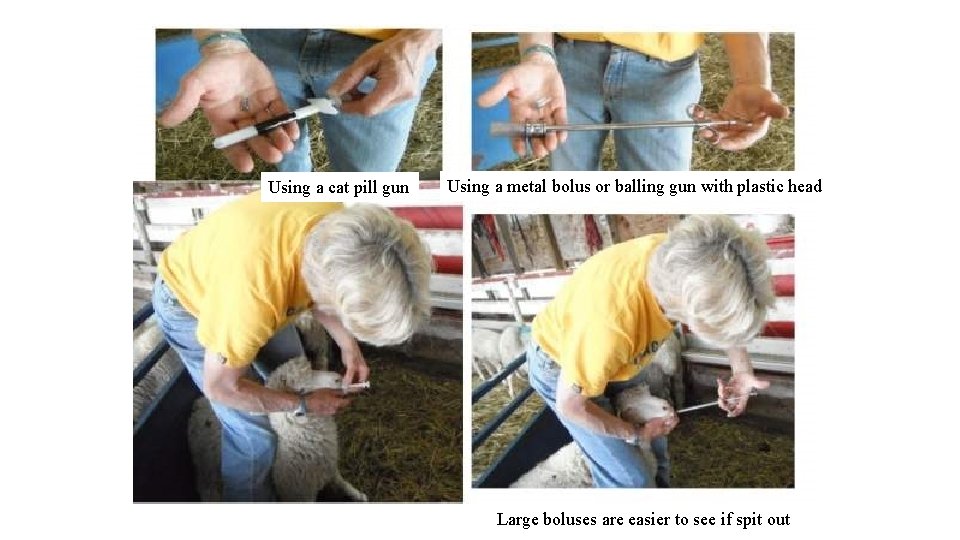
Using a cat pill gun Using a metal bolus or balling gun with plastic head Large boluses are easier to see if spit out
NEW YORK 1 Goat Dairy • Treatments consisted of • 1 gram COWP/head, • 2 gram COWP/head, or • 1 gram COWP/22 lb. live weight • 15 to 16 lactating does per treatment • Looked at fecal egg counts, FAMACHA scores, curd formation in 4 cheeses, Cu in milk, AST in blood)
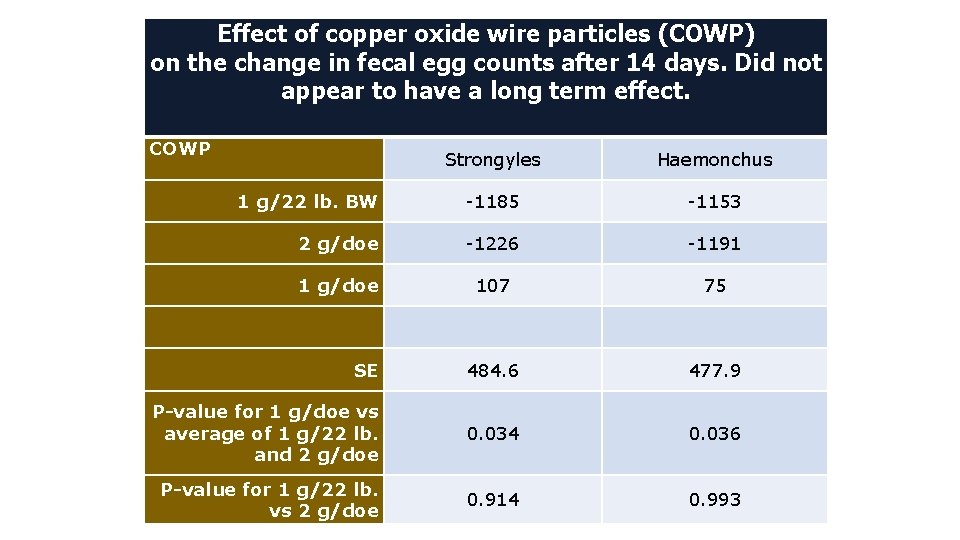
Effect of copper oxide wire particles (COWP) on the change in fecal egg counts after 14 days. Did not appear to have a long term effect. COWP Strongyles Haemonchus 1 g/22 lb. BW -1185 -1153 2 g/doe -1226 -1191 1 g/doe 107 75 SE 484. 6 477. 9 P-value for 1 g/doe vs average of 1 g/22 lb. and 2 g/doe 0. 034 0. 036 P-value for 1 g/22 lb. vs 2 g/doe 0. 914 0. 993
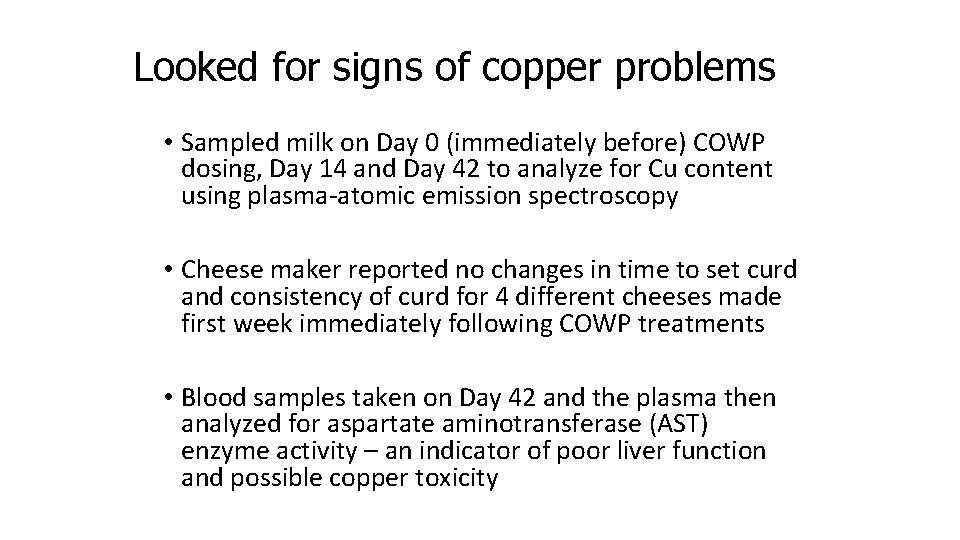
Looked for signs of copper problems • Sampled milk on Day 0 (immediately before) COWP dosing, Day 14 and Day 42 to analyze for Cu content using plasma-atomic emission spectroscopy • Cheese maker reported no changes in time to set curd and consistency of curd for 4 different cheeses made first week immediately following COWP treatments • Blood samples taken on Day 42 and the plasma then analyzed for aspartate aminotransferase (AST) enzyme activity – an indicator of poor liver function and possible copper toxicity
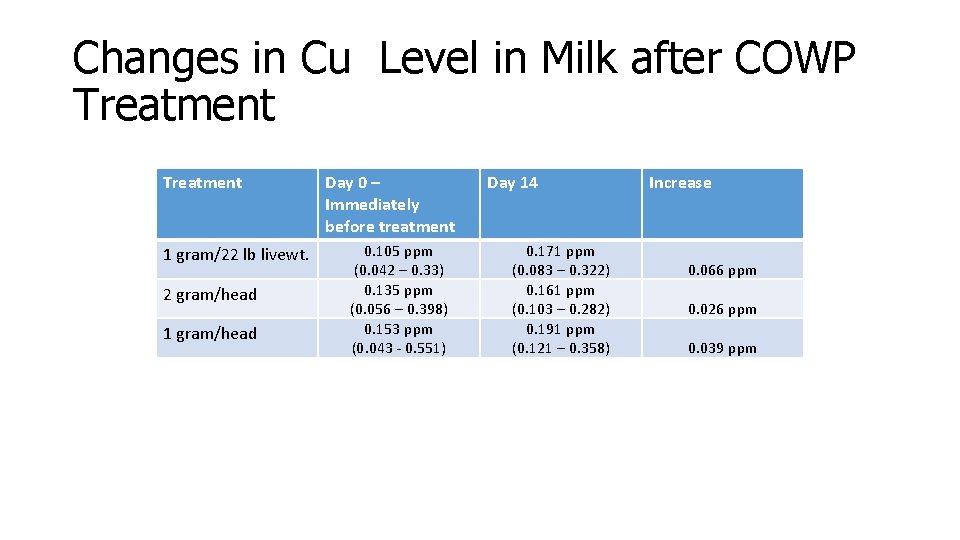
Changes in Cu Level in Milk after COWP Treatment 1 gram/22 lb livewt. 2 gram/head 1 gram/head Day 0 – Immediately before treatment 0. 105 ppm (0. 042 – 0. 33) 0. 135 ppm (0. 056 – 0. 398) 0. 153 ppm (0. 043 - 0. 551) Day 14 0. 171 ppm (0. 083 – 0. 322) 0. 161 ppm (0. 103 – 0. 282) 0. 191 ppm (0. 121 – 0. 358) Increase 0. 066 ppm 0. 026 ppm 0. 039 ppm
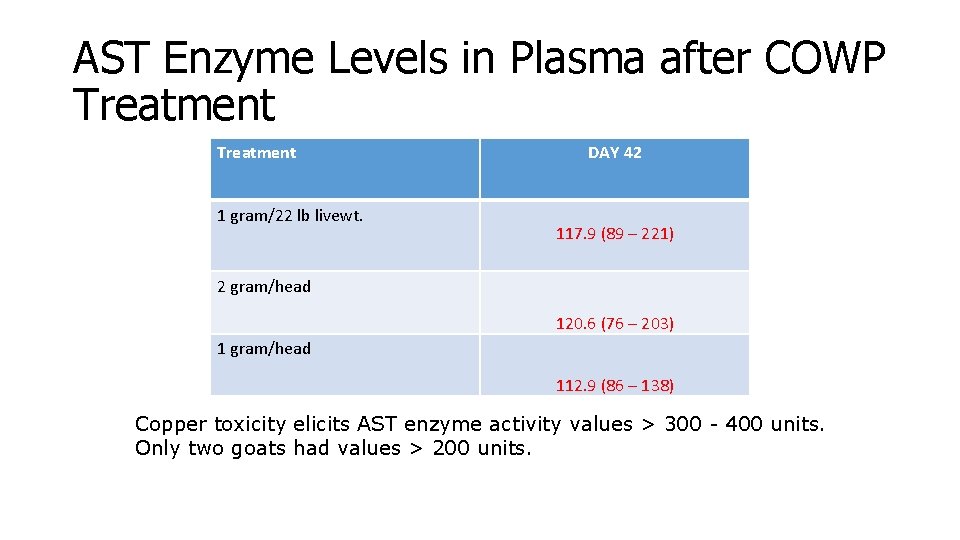
AST Enzyme Levels in Plasma after COWP Treatment 1 gram/22 lb livewt. DAY 42 117. 9 (89 – 221) 2 gram/head 120. 6 (76 – 203) 1 gram/head 112. 9 (86 – 138) Copper toxicity elicits AST enzyme activity values > 300 - 400 units. Only two goats had values > 200 units.
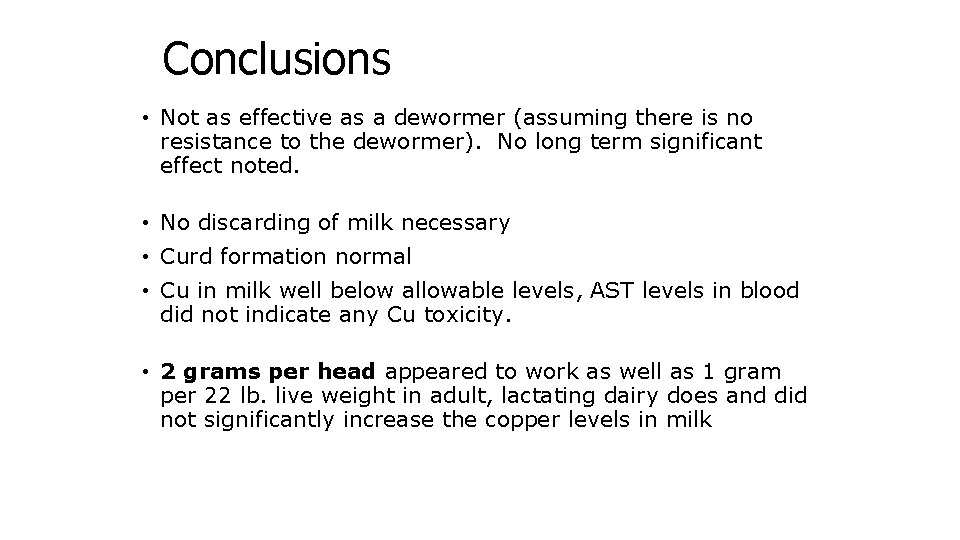
Conclusions • Not as effective as a dewormer (assuming there is no resistance to the dewormer). No long term significant effect noted. • No discarding of milk necessary • Curd formation normal • Cu in milk well below allowable levels, AST levels in blood did not indicate any Cu toxicity. • 2 grams per head appeared to work as well as 1 gram per 22 lb. live weight in adult, lactating dairy does and did not significantly increase the copper levels in milk
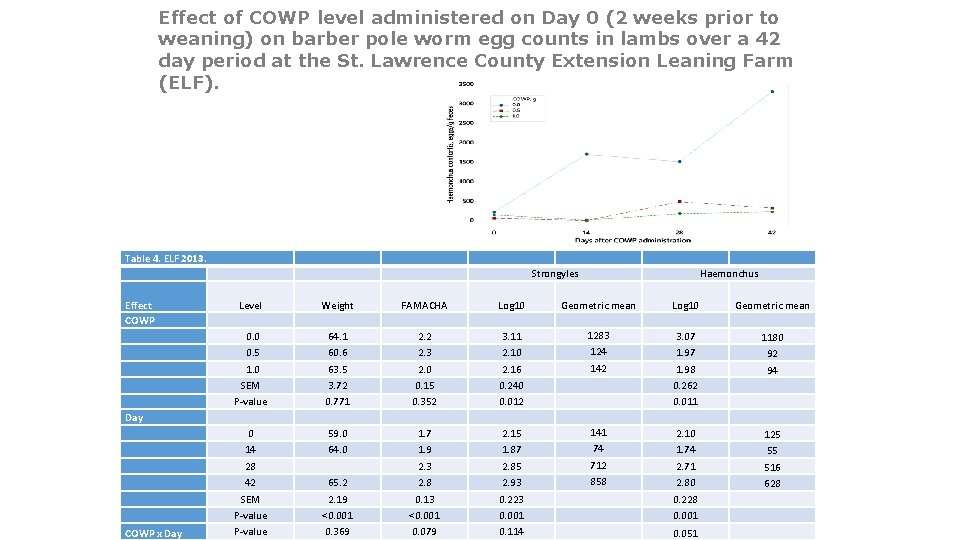
Effect of COWP level administered on Day 0 (2 weeks prior to weaning) on barber pole worm egg counts in lambs over a 42 day period at the St. Lawrence County Extension Leaning Farm (ELF). Table 4. ELF 2013. Strongyles Effect COWP Haemonchus Level Weight FAMACHA Log 10 Geometric mean 0. 0 0. 5 1. 0 SEM P-value 64. 1 60. 6 63. 5 3. 72 0. 771 2. 2 2. 3 2. 0 0. 15 0. 352 3. 11 2. 10 2. 16 0. 240 0. 012 1283 124 142 3. 07 1. 98 0. 262 0. 011 1180 92 94 0 14 28 42 SEM P-value 59. 0 64. 0 1. 7 1. 9 2. 3 2. 8 0. 13 <0. 001 0. 079 2. 15 1. 87 2. 85 2. 93 0. 223 0. 001 0. 114 141 74 712 858 2. 10 1. 74 2. 71 2. 80 0. 228 0. 001 125 55 516 628 Day COWP x Day 65. 2 2. 19 <0. 001 0. 369 0. 051
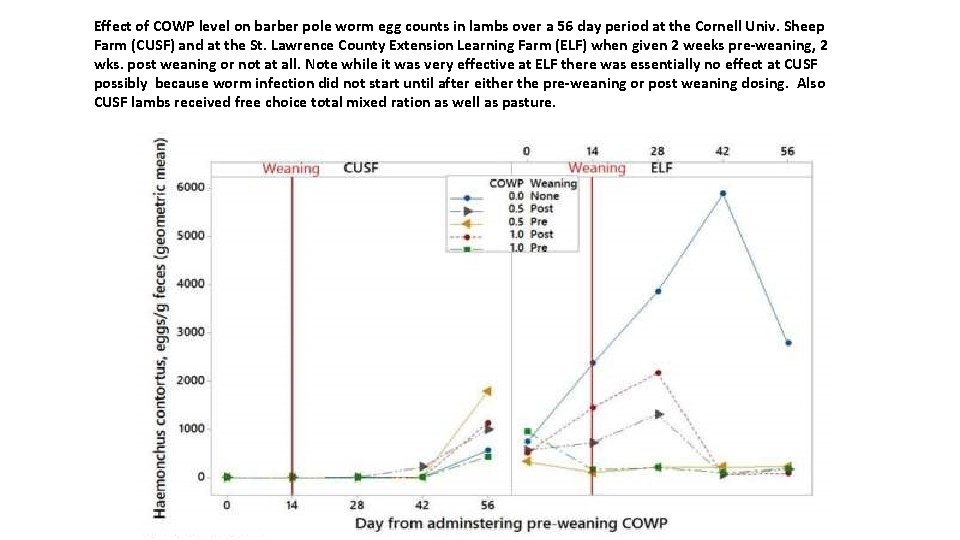
Effect of COWP level on barber pole worm egg counts in lambs over a 56 day period at the Cornell Univ. Sheep Farm (CUSF) and at the St. Lawrence County Extension Learning Farm (ELF) when given 2 weeks pre-weaning, 2 wks. post weaning or not at all. Note while it was very effective at ELF there was essentially no effect at CUSF possibly because worm infection did not start until after either the pre-weaning or post weaning dosing. Also CUSF lambs received free choice total mixed ration as well as pasture.
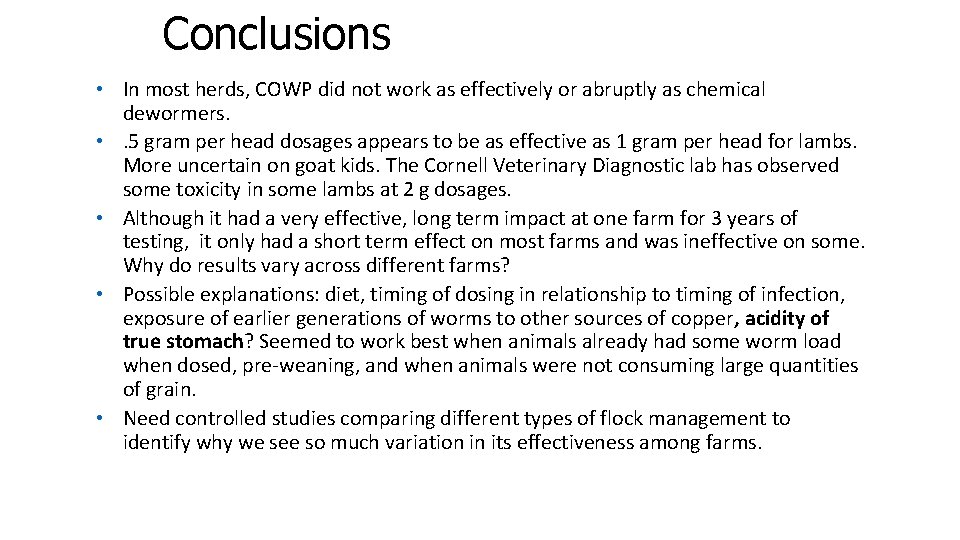
Conclusions • In most herds, COWP did not work as effectively or abruptly as chemical dewormers. • . 5 gram per head dosages appears to be as effective as 1 gram per head for lambs. More uncertain on goat kids. The Cornell Veterinary Diagnostic lab has observed some toxicity in some lambs at 2 g dosages. • Although it had a very effective, long term impact at one farm for 3 years of testing, it only had a short term effect on most farms and was ineffective on some. Why do results vary across different farms? • Possible explanations: diet, timing of dosing in relationship to timing of infection, exposure of earlier generations of worms to other sources of copper, acidity of true stomach? Seemed to work best when animals already had some worm load when dosed, pre-weaning, and when animals were not consuming large quantities of grain. • Need controlled studies comparing different types of flock management to identify why we see so much variation in its effectiveness among farms.
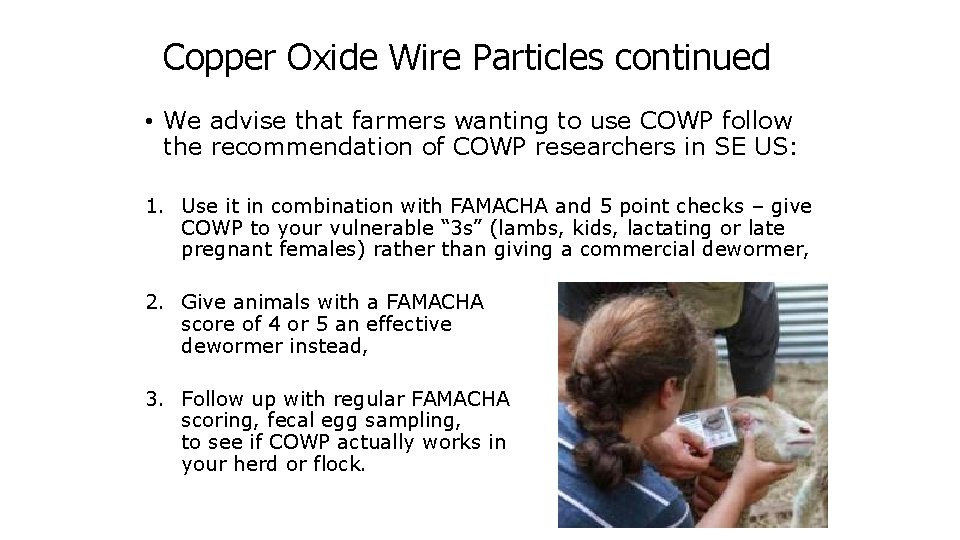
Copper Oxide Wire Particles continued • We advise that farmers wanting to use COWP follow the recommendation of COWP researchers in SE US: 1. Use it in combination with FAMACHA and 5 point checks – give COWP to your vulnerable “ 3 s” (lambs, kids, lactating or late pregnant females) rather than giving a commercial dewormer, 2. Give animals with a FAMACHA score of 4 or 5 an effective dewormer instead, 3. Follow up with regular FAMACHA scoring, fecal egg sampling, to see if COWP actually works in your herd or flock.
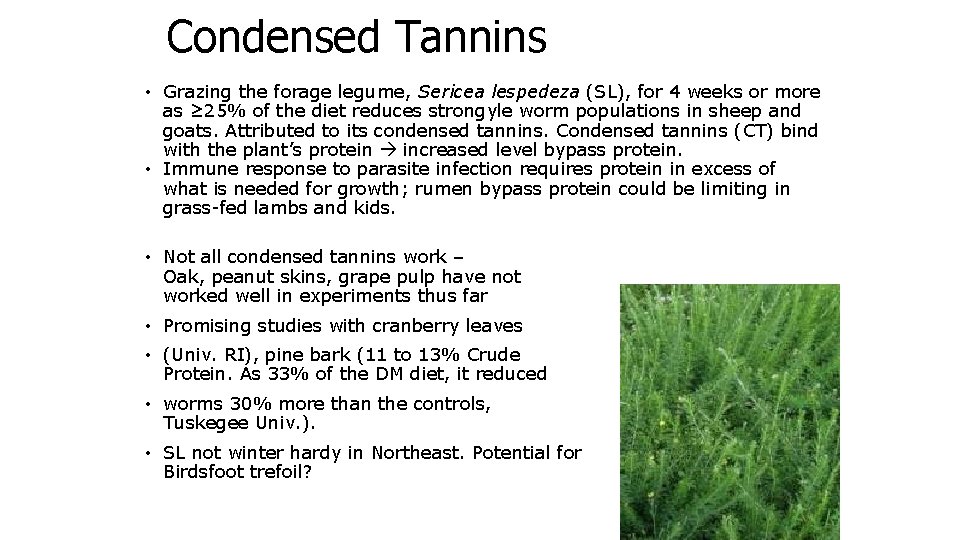
Condensed Tannins • Grazing the forage legume, Sericea lespedeza (SL), for 4 weeks or more as ≥ 25% of the diet reduces strongyle worm populations in sheep and goats. Attributed to its condensed tannins. Condensed tannins (CT) bind with the plant’s protein increased level bypass protein. • Immune response to parasite infection requires protein in excess of what is needed for growth; rumen bypass protein could be limiting in grass-fed lambs and kids. • Not all condensed tannins work – Oak, peanut skins, grape pulp have not worked well in experiments thus far • Promising studies with cranberry leaves • (Univ. RI), pine bark (11 to 13% Crude Protein. As 33% of the DM diet, it reduced • worms 30% more than the controls, Tuskegee Univ. ). • SL not winter hardy in Northeast. Potential for Birdsfoot trefoil?
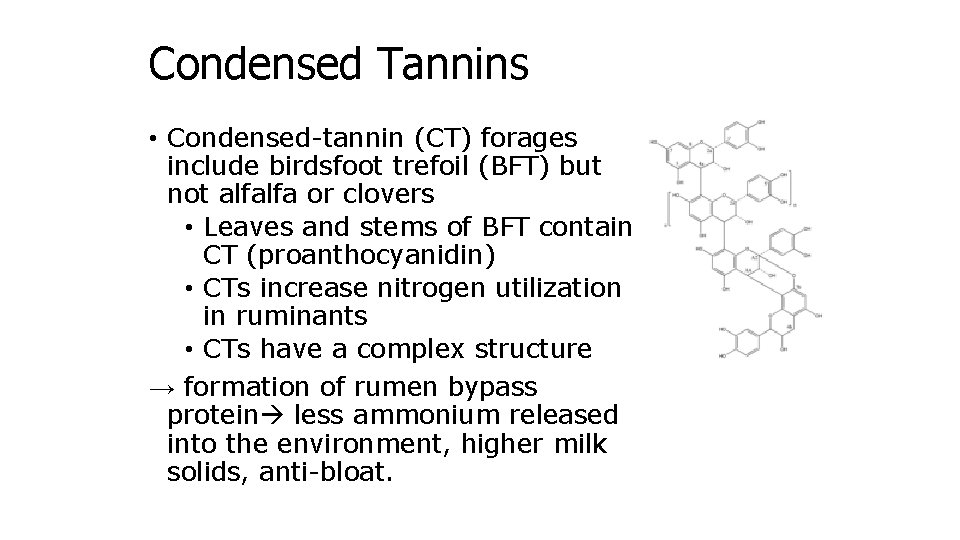
Condensed Tannins • Condensed-tannin (CT) forages include birdsfoot trefoil (BFT) but not alfalfa or clovers • Leaves and stems of BFT contain CT (proanthocyanidin) • CTs increase nitrogen utilization in ruminants • CTs have a complex structure → formation of rumen bypass protein less ammonium released into the environment, higher milk solids, anti-bloat.
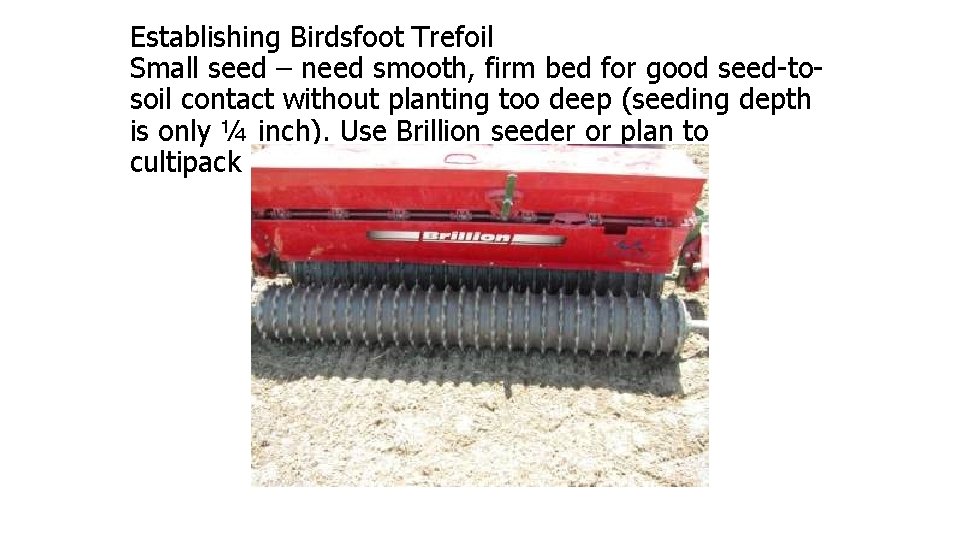
Establishing Birdsfoot Trefoil Small seed – need smooth, firm bed for good seed-tosoil contact without planting too deep (seeding depth is only ¼ inch). Use Brillion seeder or plan to cultipack before and after seeding
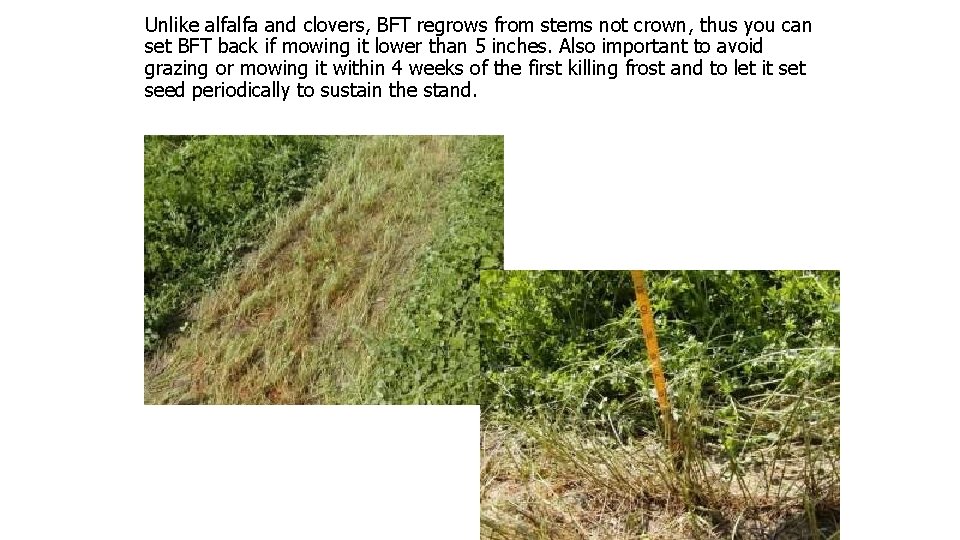
Unlike alfalfa and clovers, BFT regrows from stems not crown, thus you can set BFT back if mowing it lower than 5 inches. Also important to avoid grazing or mowing it within 4 weeks of the first killing frost and to let it seed periodically to sustain the stand.
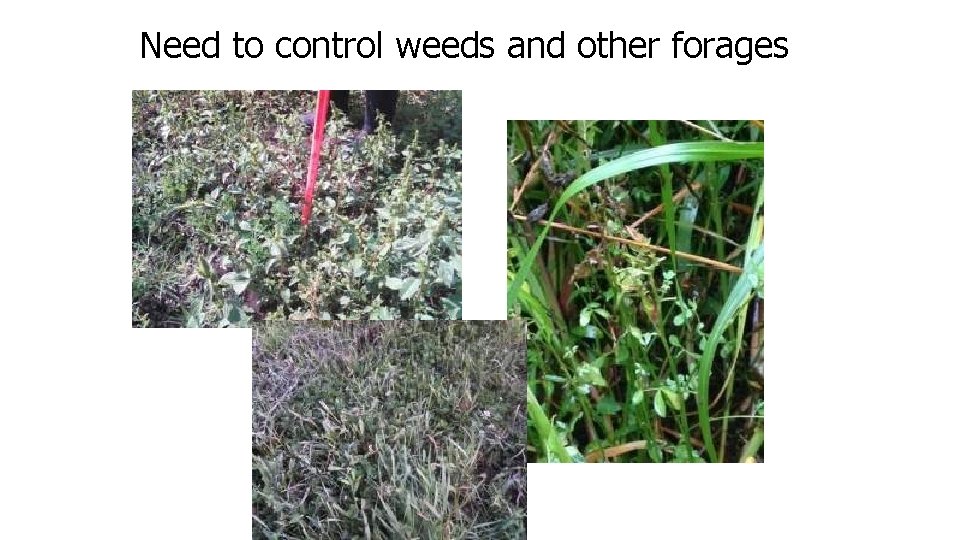
Need to control weeds and other forages
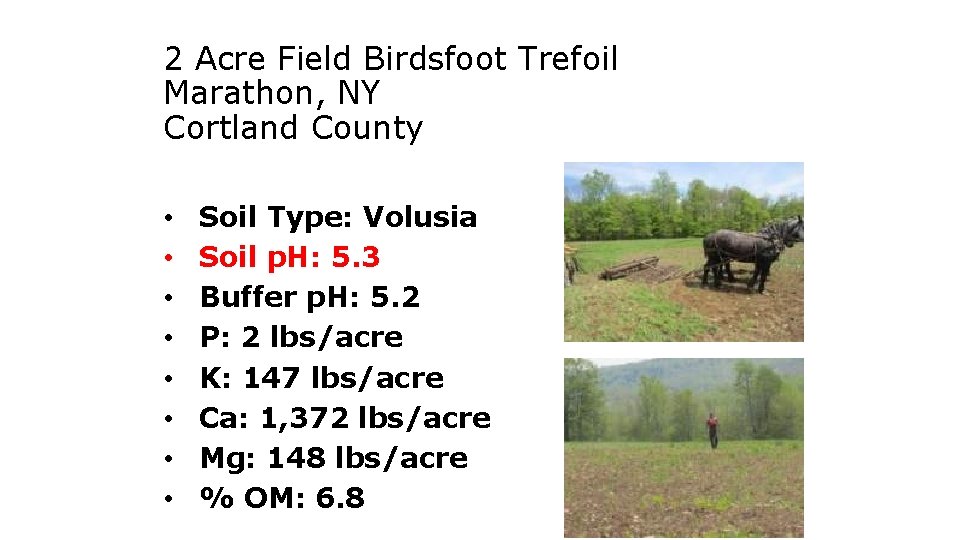
2 Acre Field Birdsfoot Trefoil Marathon, NY Cortland County • • Soil Type: Volusia Soil p. H: 5. 3 Buffer p. H: 5. 2 P: 2 lbs/acre K: 147 lbs/acre Ca: 1, 372 lbs/acre Mg: 148 lbs/acre % OM: 6. 8
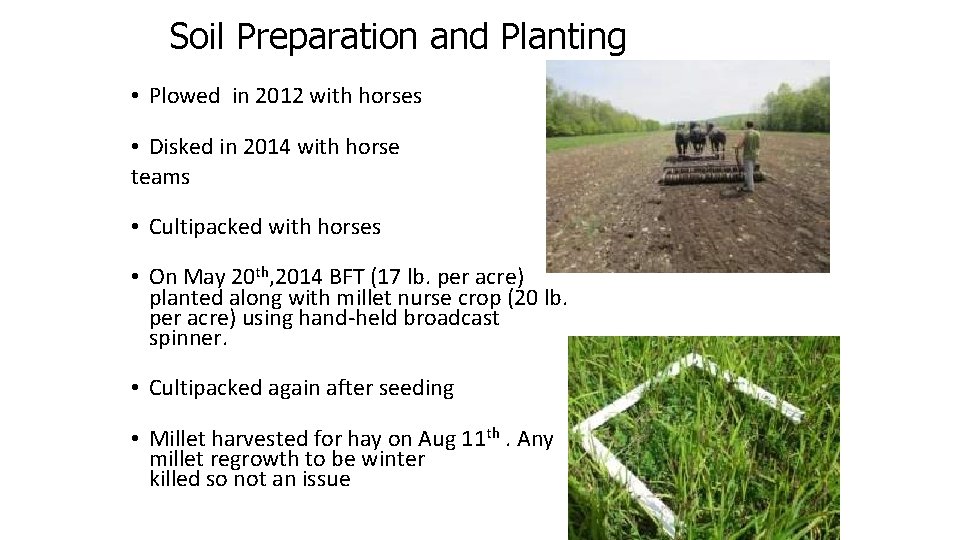
Soil Preparation and Planting • Plowed in 2012 with horses • Disked in 2014 with horse teams • Cultipacked with horses • On May 20 th, 2014 BFT (17 lb. per acre) planted along with millet nurse crop (20 lb. per acre) using hand-held broadcast spinner. • Cultipacked again after seeding • Millet harvested for hay on Aug 11 th. Any millet regrowth to be winter killed so not an issue
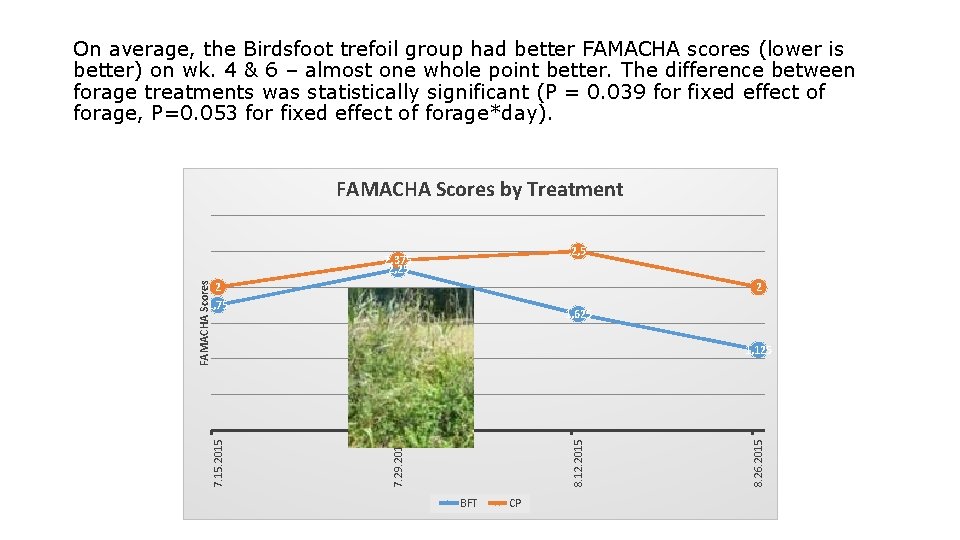
On average, the Birdsfoot trefoil group had better FAMACHA scores (lower is better) on wk. 4 & 6 – almost one whole point better. The difference between forage treatments was statistically significant (P = 0. 039 for fixed effect of forage, P=0. 053 for fixed effect of forage*day). FAMACHA Scores by Treatment 2, 5 2, 375 2, 25 2 1, 625 8. 12. 2015 BFT CP 8. 26. 2015 1, 125 7. 29. 2015 7. 15. 2015 FAMACHA Scores 2 1, 75
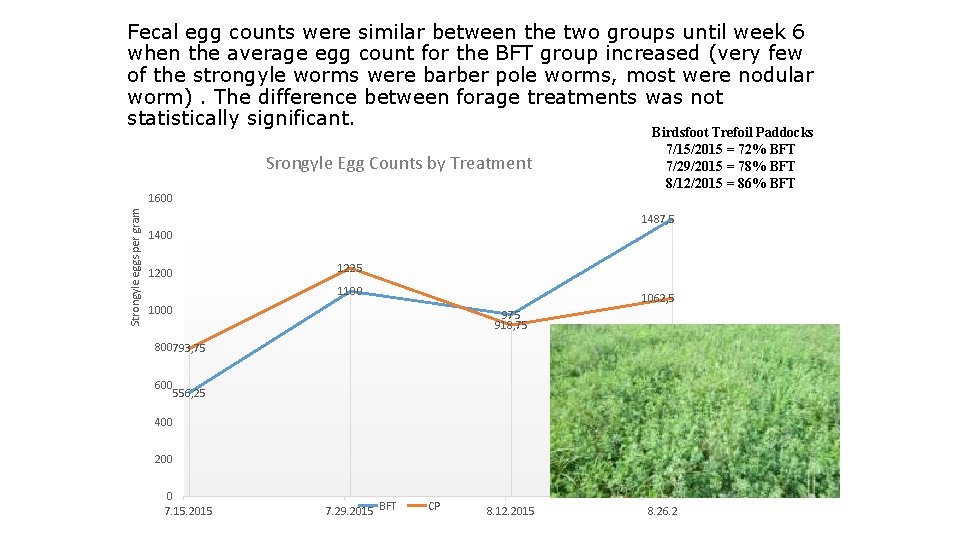
Fecal egg counts were similar between the two groups until week 6 when the average egg count for the BFT group increased (very few of the strongyle worms were barber pole worms, most were nodular worm). The difference between forage treatments was not statistically significant. Srongyle Egg Counts by Treatment Birdsfoot Trefoil Paddocks 7/15/2015 = 72% BFT 7/29/2015 = 78% BFT 8/12/2015 = 86% BFT Strongyle eggs per gram 1600 1487, 5 1400 1225 1100 1062, 5 1000 975 918, 75 800793, 75 600 556, 25 400 200 0 7. 15. 2015 7. 29. 2015 BFT CP 8. 12. 2015 8. 26. 2015
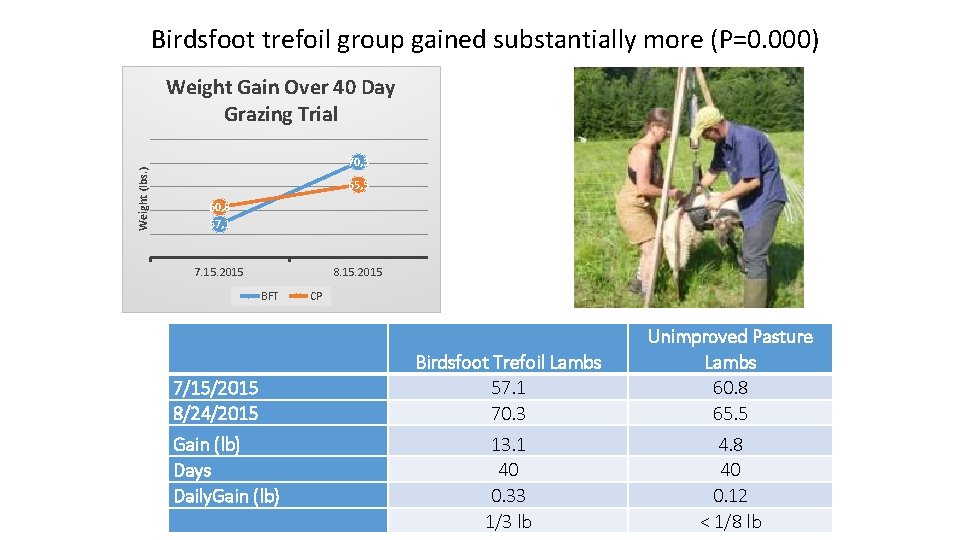
Birdsfoot trefoil group gained substantially more (P=0. 000) Weight (lbs. ) Weight Gain Over 40 Day Grazing Trial 70, 3 65, 5 60, 8 57, 1 7. 15. 2015 8. 15. 2015 BFT 7/15/2015 8/24/2015 Gain (lb) Days Daily. Gain (lb) CP Birdsfoot Trefoil Lambs 57. 1 70. 3 Unimproved Pasture Lambs 60. 8 65. 5 13. 1 40 0. 33 1/3 lb 4. 8 40 0. 12 < 1/8 lb
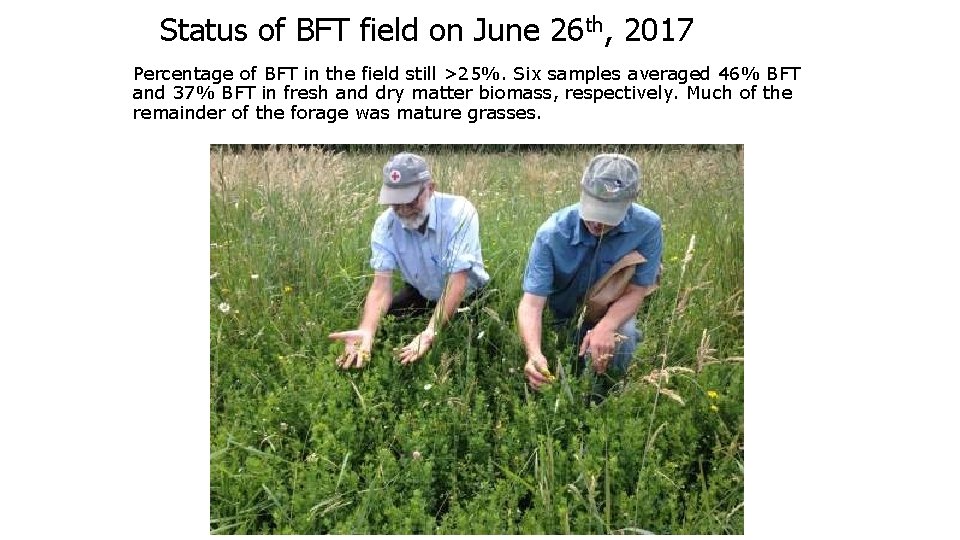
Status of BFT field on June 26 th, 2017 Percentage of BFT in the field still >25%. Six samples averaged 46% BFT and 37% BFT in fresh and dry matter biomass, respectively. Much of the remainder of the forage was mature grasses.
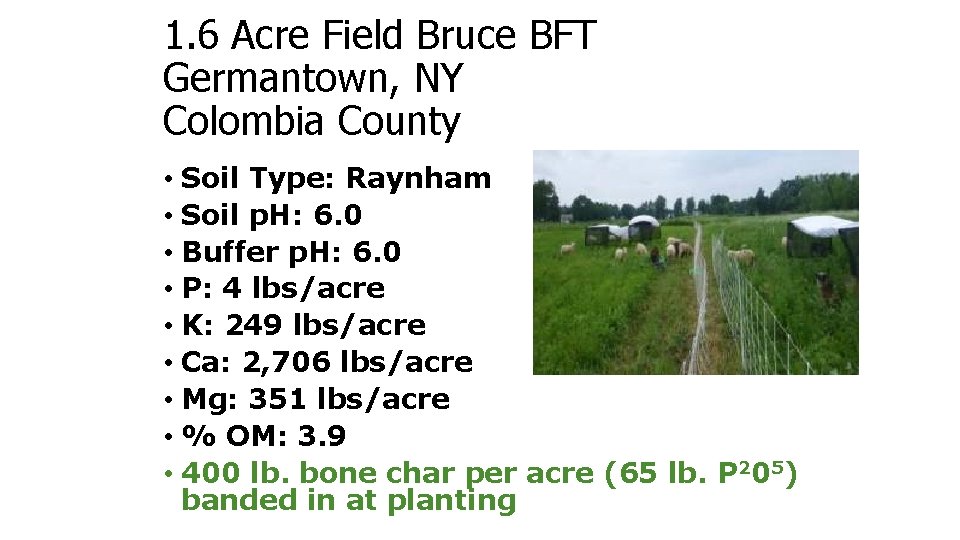
1. 6 Acre Field Bruce BFT Germantown, NY Colombia County • Soil Type: Raynham • Soil p. H: 6. 0 • Buffer p. H: 6. 0 • P: 4 lbs/acre • K: 249 lbs/acre • Ca: 2, 706 lbs/acre • Mg: 351 lbs/acre • % OM: 3. 9 • 400 lb. bone char per acre (65 lb. P 205) banded in at planting
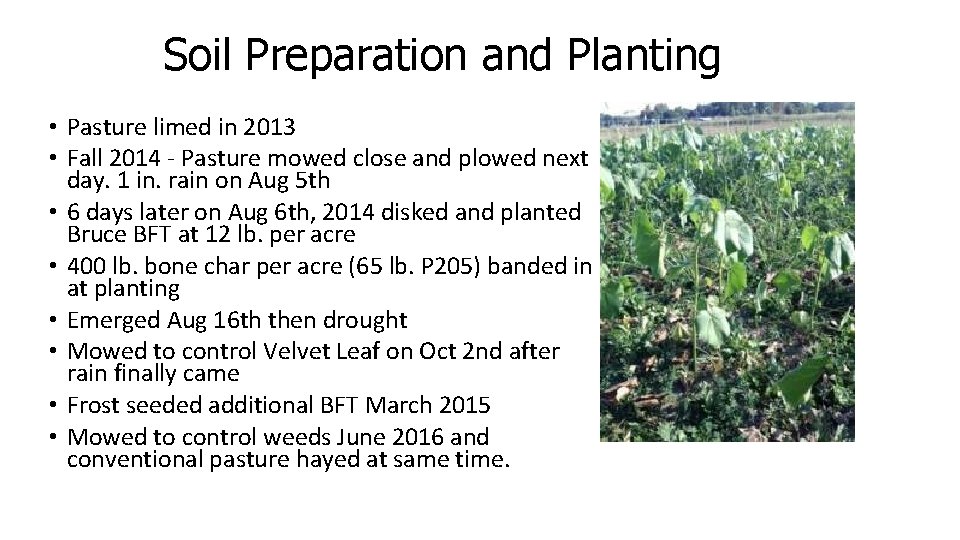
Soil Preparation and Planting • Pasture limed in 2013 • Fall 2014 - Pasture mowed close and plowed next day. 1 in. rain on Aug 5 th • 6 days later on Aug 6 th, 2014 disked and planted Bruce BFT at 12 lb. per acre • 400 lb. bone char per acre (65 lb. P 205) banded in at planting • Emerged Aug 16 th then drought • Mowed to control Velvet Leaf on Oct 2 nd after rain finally came • Frost seeded additional BFT March 2015 • Mowed to control weeds June 2016 and conventional pasture hayed at same time.
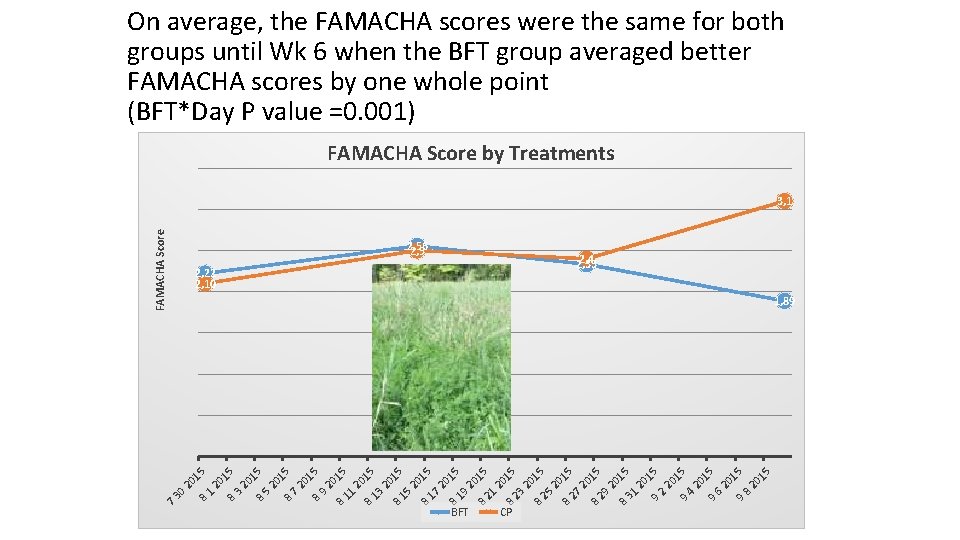
On average, the FAMACHA scores were the same for both groups until Wk 6 when the BFT group averaged better FAMACHA scores by one whole point (BFT*Day P value =0. 001) FAMACHA Score by Treatments FAMACHA Score 3, 1 2, 56 2, 5 2, 4 2, 33 2, 22 2, 10 15 8. 3. 20 15 8. 5. 20 15 8. 7. 20 15 8. 9. 20 1 8. 11 5. 2 01 8. 13 5. 2 01 8. 15 5. 2 01 8. 17 5. 2 01 8. 19 5. 2 01 8. 21 5. 2 01 8. 23 5. 2 01 8. 25 5. 2 01 8. 27 5. 2 01 8. 29 5. 2 01 8. 31 5. 2 01 5 9. 2. 20 15 9. 4. 20 15 9. 6. 20 15 9. 8. 20 15 20 8. 1. 7. 30 . 2 0 15 1, 89 BFT CP
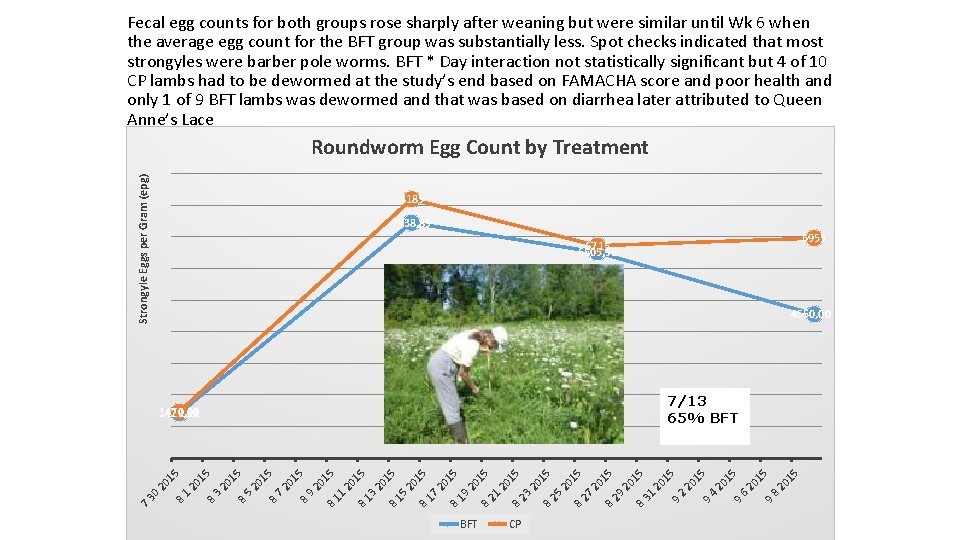
Fecal egg counts for both groups rose sharply after weaning but were similar until Wk 6 when the average egg count for the BFT group was substantially less. Spot checks indicated that most strongyles were barber pole worms. BFT * Day interaction not statistically significant but 4 of 10 CP lambs had to be dewormed at the study’s end based on FAMACHA score and poor health and only 1 of 9 BFT lambs was dewormed and that was based on diarrhea later attributed to Queen Anne’s Lace Strongyle Eggs per Gram (epg) Roundworm Egg Count by Treatment 8185 7438, 89 6955 6715 6505, 56 4550, 00 7/13 65% BFT 20 15 8. 11. 2 01 5 8. 13. 2 01 5 8. 15. 2 01 5 8. 17. 2 01 5 8. 19. 2 01 5 8. 21. 2 01 5 8. 23. 2 01 5 8. 25. 2 01 5 8. 27. 2 01 5 8. 29. 2 01 5 8. 31. 2 01 5 9. 2. 20 15 9. 4. 20 15 9. 6. 20 15 9. 8. 20 15 15 8. 9. 20 15 8. 7. 20 15 8. 5. 20 15 8. 3. 20 8. 1. 7. 30 . 2 0 15 1470, 00 1422, 22 BFT CP
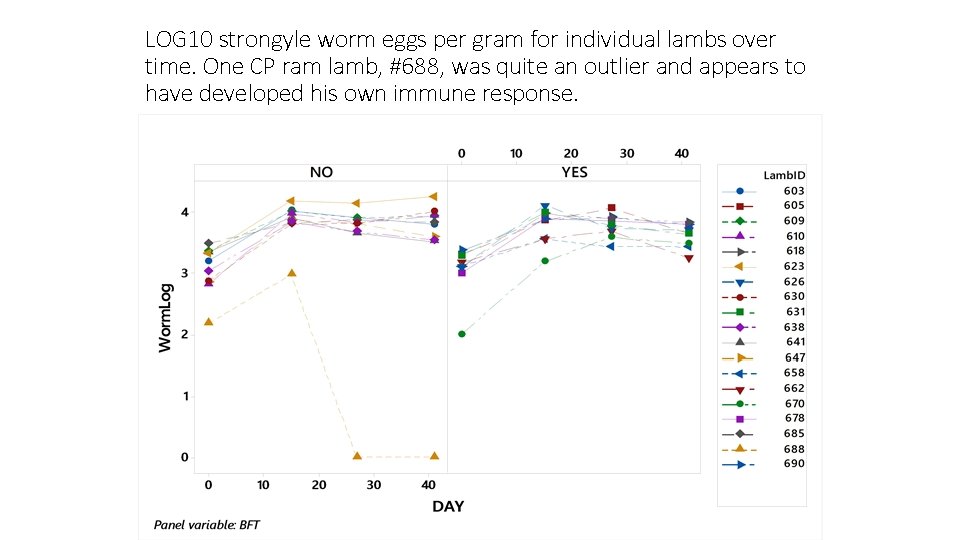
LOG 10 strongyle worm eggs per gram for individual lambs over time. One CP ram lamb, #688, was quite an outlier and appears to have developed his own immune response.
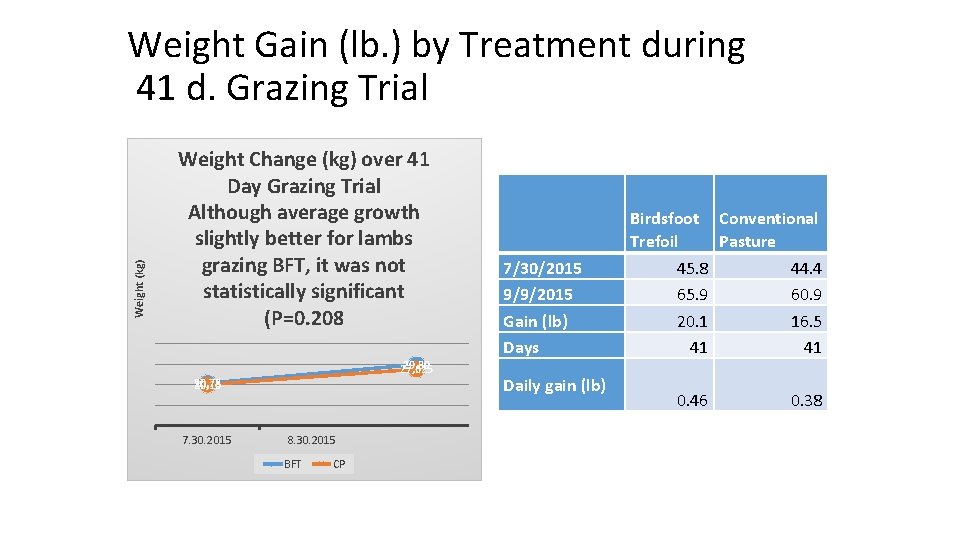
Weight (kg) Weight Gain (lb. ) by Treatment during 41 d. Grazing Trial Weight Change (kg) over 41 Day Grazing Trial Although average growth slightly better for lambs grazing BFT, it was not statistically significant (P=0. 208 29, 89 27, 625 20, 78 20, 13 7. 30. 2015 8. 30. 2015 BFT CP 7/30/2015 9/9/2015 Gain (lb) Days Daily gain (lb) Birdsfoot Conventional Trefoil Pasture 45. 8 44. 4 65. 9 60. 9 20. 1 41 16. 5 41 0. 46 0. 38
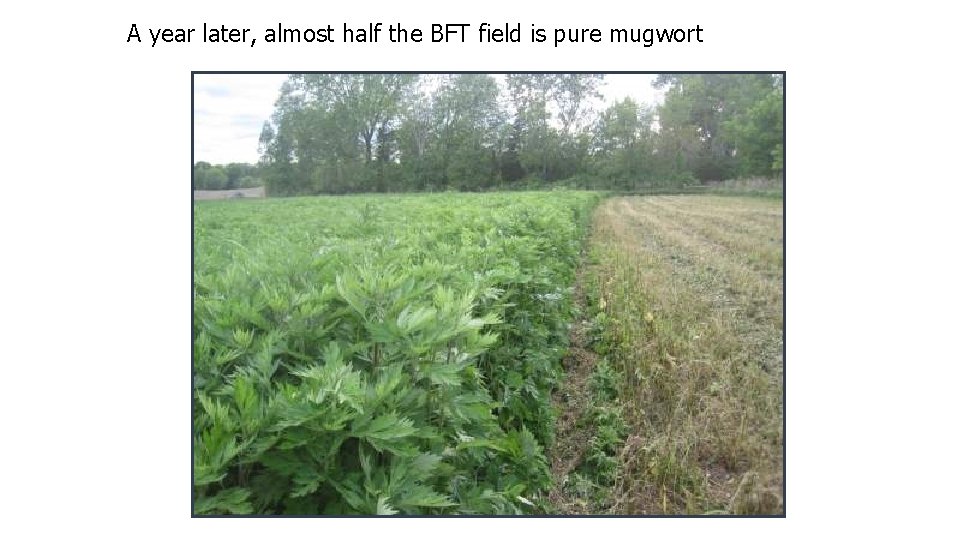
A year later, almost half the BFT field is pure mugwort
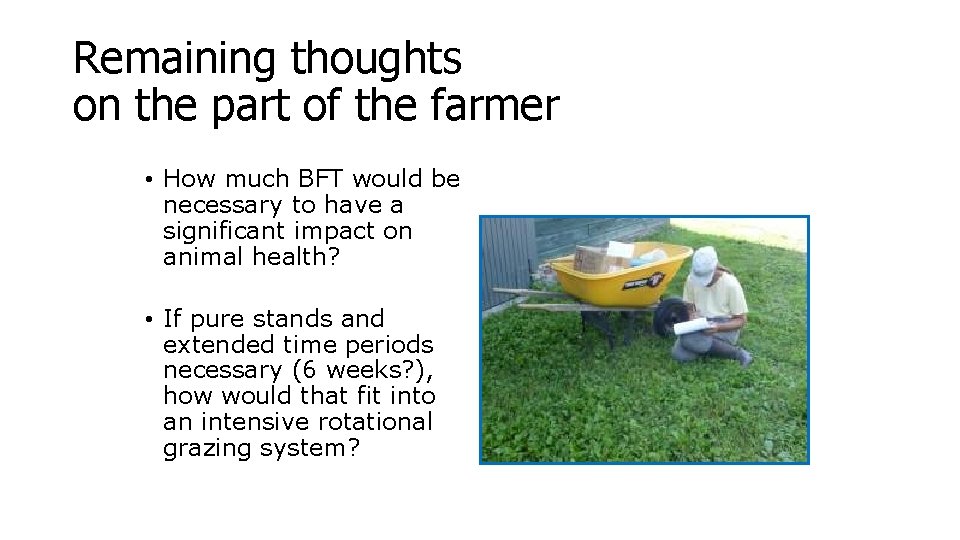
Remaining thoughts on the part of the farmer • How much BFT would be necessary to have a significant impact on animal health? • If pure stands and extended time periods necessary (6 weeks? ), how would that fit into an intensive rotational grazing system?
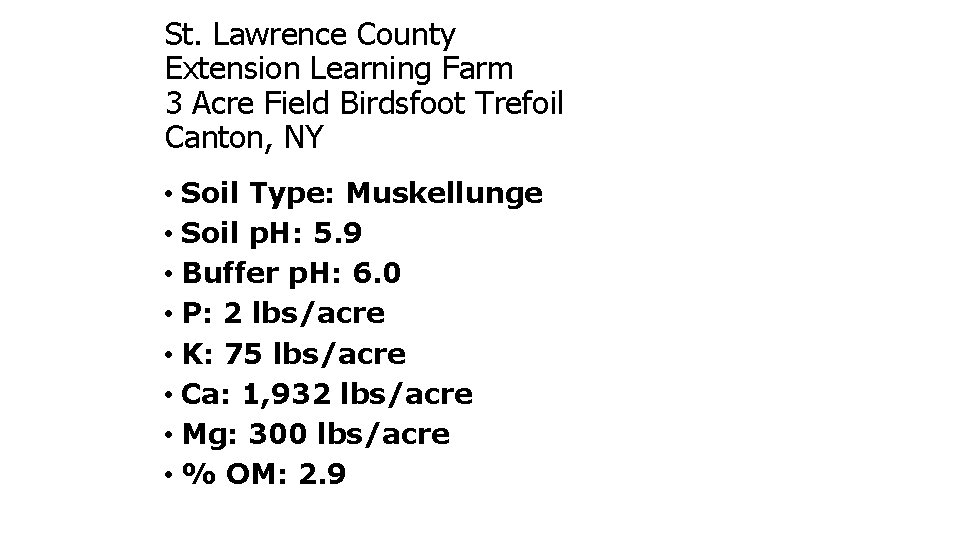
St. Lawrence County Extension Learning Farm 3 Acre Field Birdsfoot Trefoil Canton, NY • Soil Type: Muskellunge • Soil p. H: 5. 9 • Buffer p. H: 6. 0 • P: 2 lbs/acre • K: 75 lbs/acre • Ca: 1, 932 lbs/acre • Mg: 300 lbs/acre • % OM: 2. 9
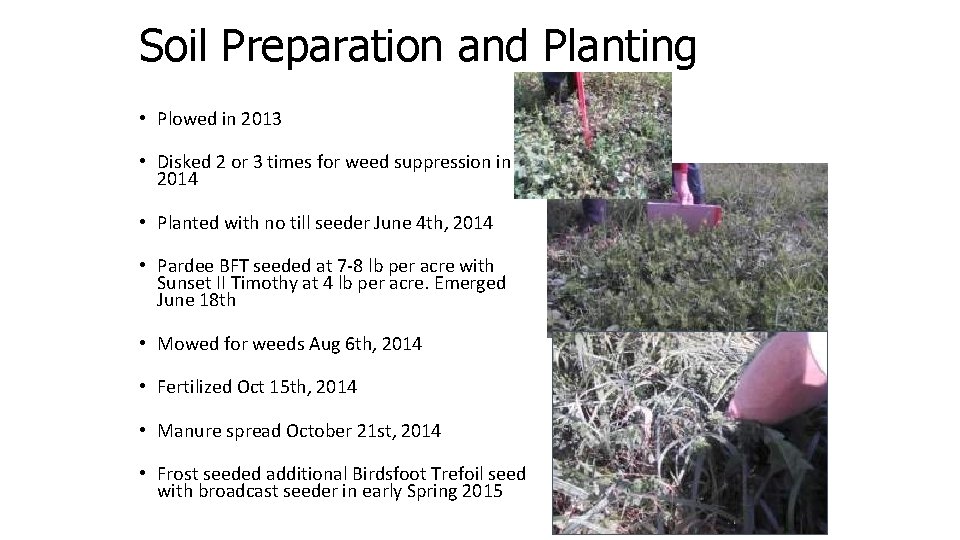
Soil Preparation and Planting • Plowed in 2013 • Disked 2 or 3 times for weed suppression in 2014 • Planted with no till seeder June 4 th, 2014 • Pardee BFT seeded at 7 -8 lb per acre with Sunset II Timothy at 4 lb per acre. Emerged June 18 th • Mowed for weeds Aug 6 th, 2014 • Fertilized Oct 15 th, 2014 • Manure spread October 21 st, 2014 • Frost seeded additional Birdsfoot Trefoil seed with broadcast seeder in early Spring 2015
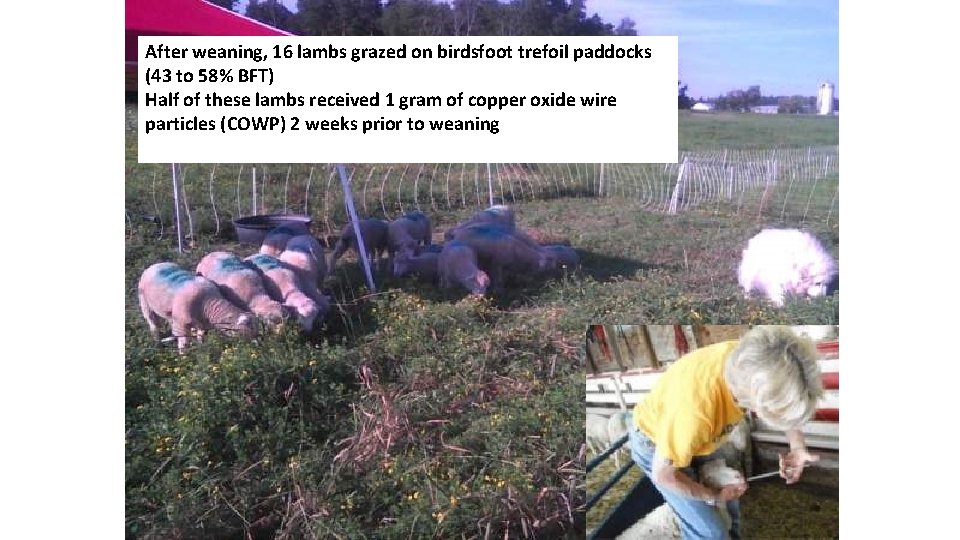
After weaning, 16 lambs grazed on birdsfoot trefoil paddocks (43 to 58% BFT) Half of these lambs received 1 gram of copper oxide wire particles (COWP) 2 weeks prior to weaning
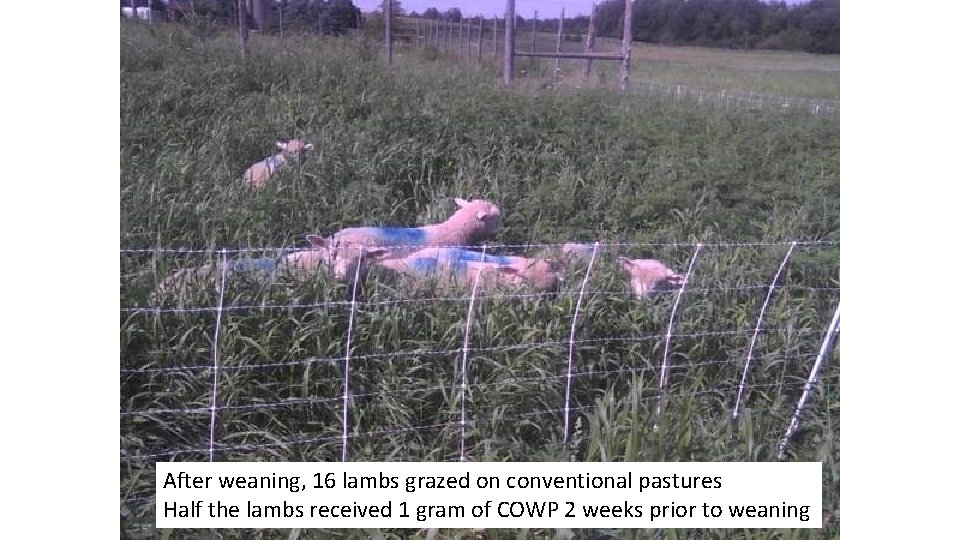
After weaning, 16 lambs grazed on conventional pastures Half the lambs received 1 gram of COWP 2 weeks prior to weaning
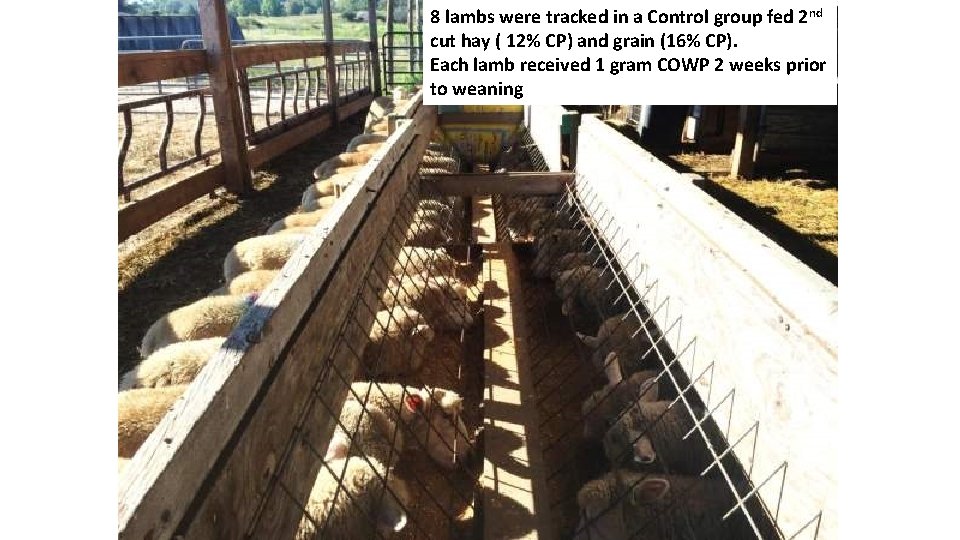
8 lambs were tracked in a Control group fed 2 nd cut hay ( 12% CP) and grain (16% CP). Each lamb received 1 gram COWP 2 weeks prior to weaning
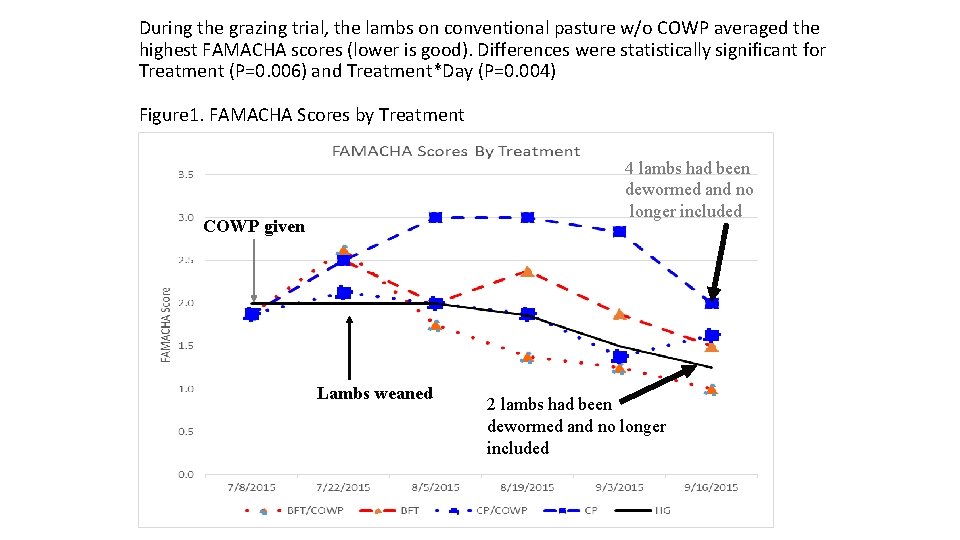
During the grazing trial, the lambs on conventional pasture w/o COWP averaged the highest FAMACHA scores (lower is good). Differences were statistically significant for Treatment (P=0. 006) and Treatment*Day (P=0. 004) Figure 1. FAMACHA Scores by Treatment 4 lambs had been dewormed and no longer included COWP given Lambs weaned 2 lambs had been dewormed and no longer included
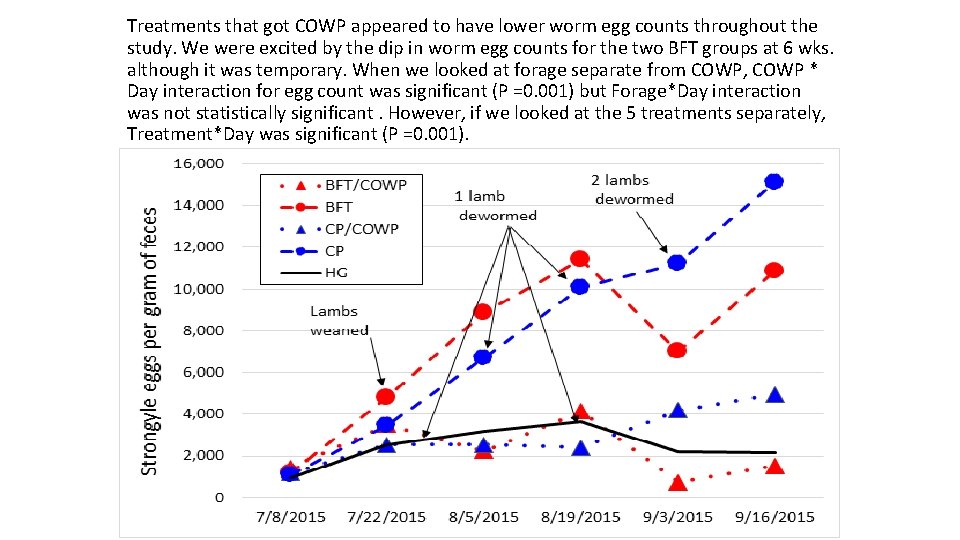
Treatments that got COWP appeared to have lower worm egg counts throughout the study. We were excited by the dip in worm egg counts for the two BFT groups at 6 wks. although it was temporary. When we looked at forage separate from COWP, COWP * Day interaction for egg count was significant (P =0. 001) but Forage*Day interaction was not statistically significant. However, if we looked at the 5 treatments separately, Treatment*Day was significant (P =0. 001).
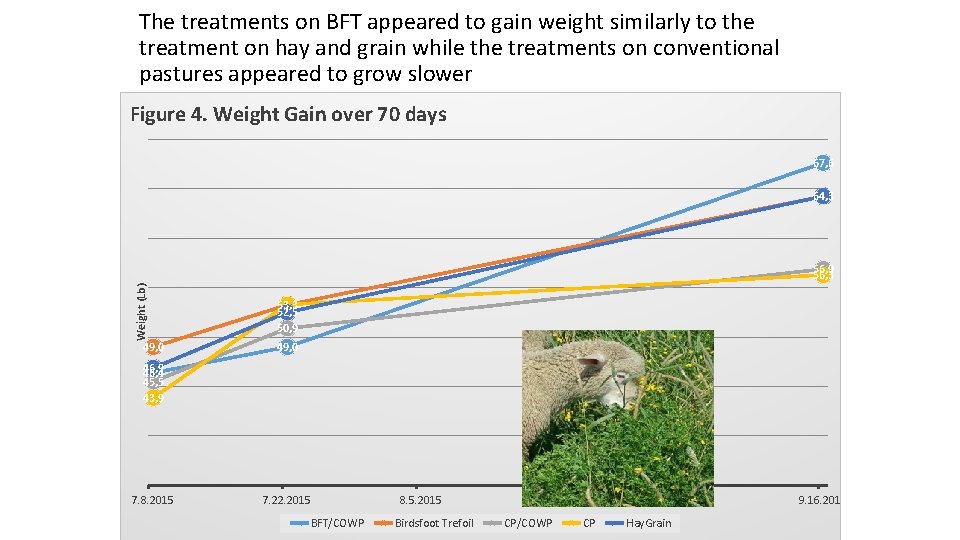
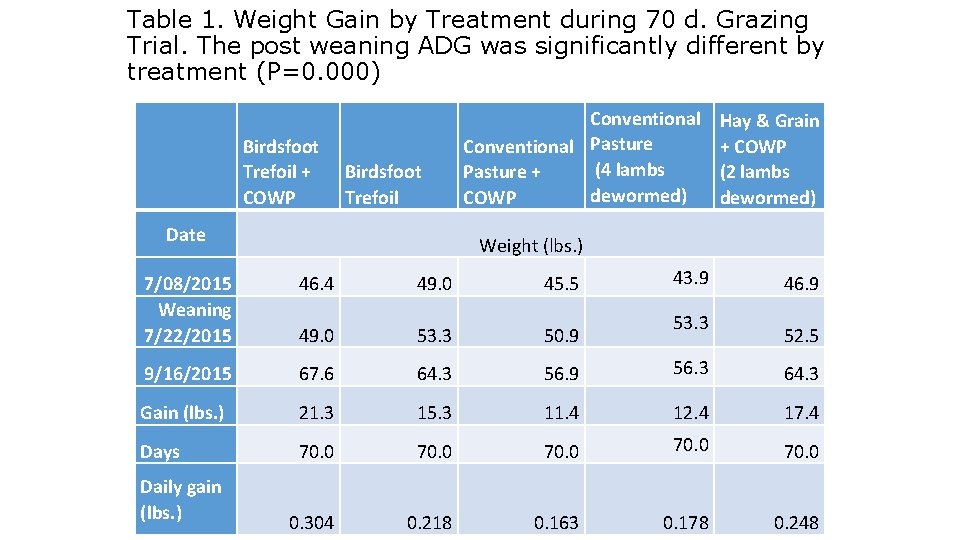
The treatments on BFT appeared to gain weight similarly to the treatment on hay and grain while the treatments on conventional pastures appeared to grow slower Figure 4. Weight Gain over 70 days 67, 6 64, 3 Weight (Lb) 56, 9 56, 3 49, 0 53, 3 52, 5 50, 9 49, 0 46, 9 46, 4 45, 5 43, 9 7. 8. 2015 7. 22. 2015 BFT/COWP 8. 5. 2015 Birdsfoot Trefoil 8. 19. 2015 CP/COWP 9. 2. 2015 CP Hay. Grain 9. 16. 2015
Table 1. Weight Gain by Treatment during 70 d. Grazing Trial. The post weaning ADG was significantly different by treatment (P=0. 000) Birdsfoot Trefoil + COWP Birdsfoot Trefoil Date Conventional Pasture (4 lambs Pasture + dewormed) COWP Hay & Grain + COWP (2 lambs dewormed) Weight (lbs. ) 43. 9 7/08/2015 Weaning 7/22/2015 46. 4 49. 0 45. 5 49. 0 53. 3 50. 9 9/16/2015 67. 6 64. 3 56. 9 56. 3 64. 3 Gain (lbs. ) 21. 3 15. 3 11. 4 12. 4 17. 4 Days 70. 0 0. 304 0. 218 0. 163 0. 178 0. 248 Daily gain (lbs. ) 53. 3 46. 9 52. 5
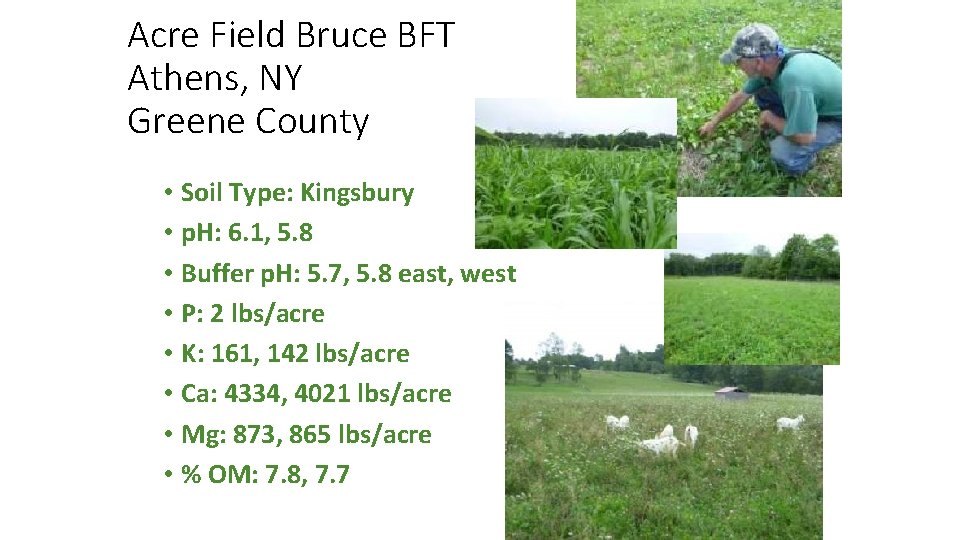
Acre Field Bruce BFT Athens, NY Greene County • Soil Type: Kingsbury • p. H: 6. 1, 5. 8 • Buffer p. H: 5. 7, 5. 8 east, west • P: 2 lbs/acre • K: 161, 142 lbs/acre • Ca: 4334, 4021 lbs/acre • Mg: 873, 865 lbs/acre • % OM: 7. 8, 7. 7
Soil Preparation and Planting • 2012 - Cover cropped with cereal rye. • 2013 – planted peas, oats, vetch, crimson clover in spring, hayed summer, grazed fall, and disked. • 2014 – planted soybeans in spring, turnips in summer, cereal rye cover crop in fall. • Fertilizer – composted manure 2012, composted wood chips and Sulfur 90% 2 days before planting in May 2015, foliar application of Neptune’s Harvest (Hydrolyzed Cold Processed Fish) and Sea 90 Minerals in May, July, Sept 2015 and soluble Boron 20% July 2015 • Planted May 8, 2015 – 17. 5 lb. Bruce BFT /acre and 50 lb oats/acre • Grazed oats July 12 th – 20 th and clipped ungrazed portion July 25 th. Baled for hay Sept 16 th. • Frost seeded 5 lb. Bruce BFT/acre March 4, 2016 (spinner spreader)
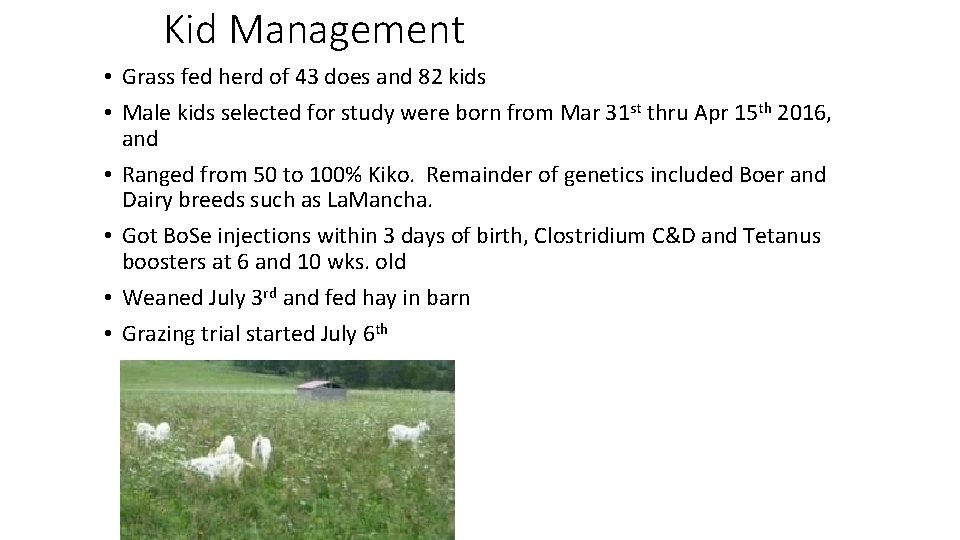
Kid Management • Grass fed herd of 43 does and 82 kids • Male kids selected for study were born from Mar 31 st thru Apr 15 th 2016, and • Ranged from 50 to 100% Kiko. Remainder of genetics included Boer and Dairy breeds such as La. Mancha. • Got Bo. Se injections within 3 days of birth, Clostridium C&D and Tetanus boosters at 6 and 10 wks. old • Weaned July 3 rd and fed hay in barn • Grazing trial started July 6 th
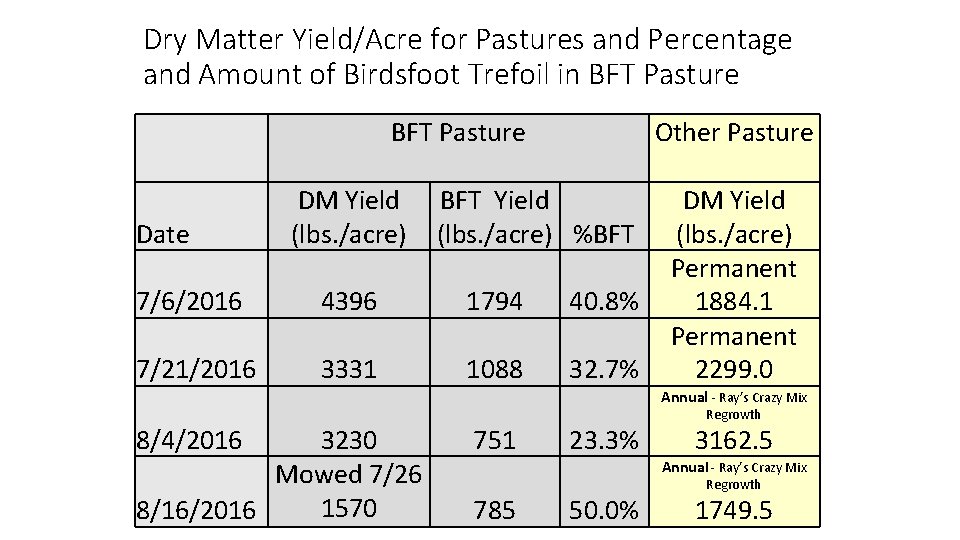
Dry Matter Yield/Acre for Pastures and Percentage and Amount of Birdsfoot Trefoil in BFT Pasture Date DM Yield (lbs. /acre) Other Pasture BFT Yield (lbs. /acre) %BFT 7/6/2016 4396 1794 40. 8% 7/21/2016 3331 1088 32. 7% DM Yield (lbs. /acre) Permanent 1884. 1 Permanent 2299. 0 Annual - Ray’s Crazy Mix 8/4/2016 3230 Mowed 7/26 1570 8/16/2016 751 23. 3% Regrowth 3162. 5 Annual - Ray’s Crazy Mix 785 50. 0% Regrowth 1749. 5
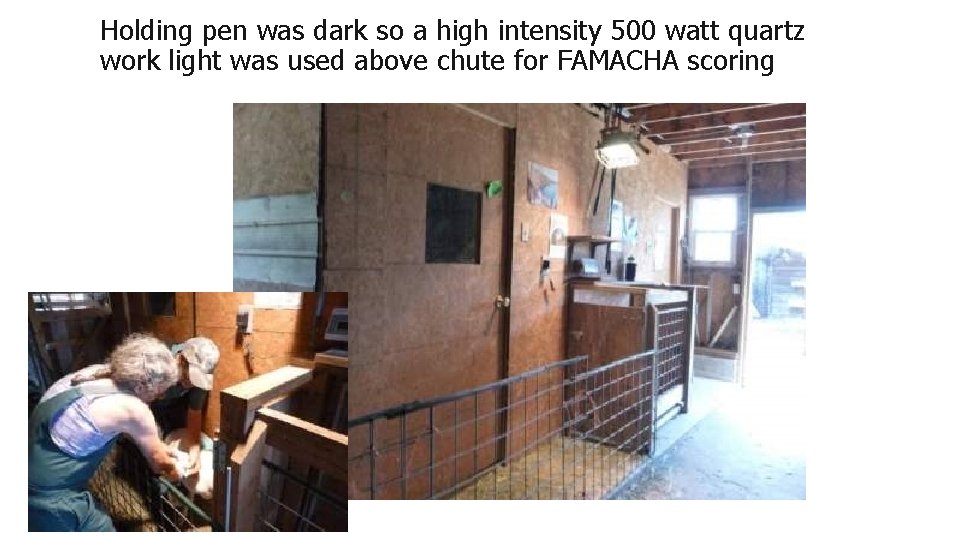
Holding pen was dark so a high intensity 500 watt quartz work light was used above chute for FAMACHA scoring
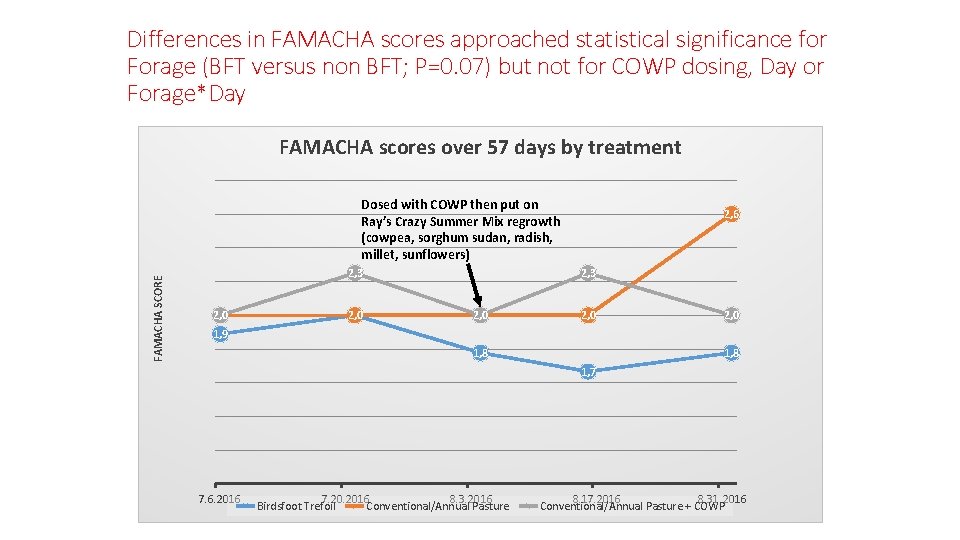
Differences in FAMACHA scores approached statistical significance for Forage (BFT versus non BFT; P=0. 07) but not for COWP dosing, Day or Forage*Day FAMACHA scores over 57 days by treatment FAMACHA SCORE Dosed with COWP then put on Ray’s Crazy Summer Mix regrowth (cowpea, sorghum sudan, radish, millet, sunflowers) 2, 3 2, 0 2, 6 2, 3 2, 0 1, 9 1, 8 1, 7 7. 6. 2016 7. 2016 8. 3. 2016 Birdsfoot Trefoil Conventional/Annual Pasture 8. 17. 2016 8. 31. 2016 Conventional/Annual Pasture + COWP
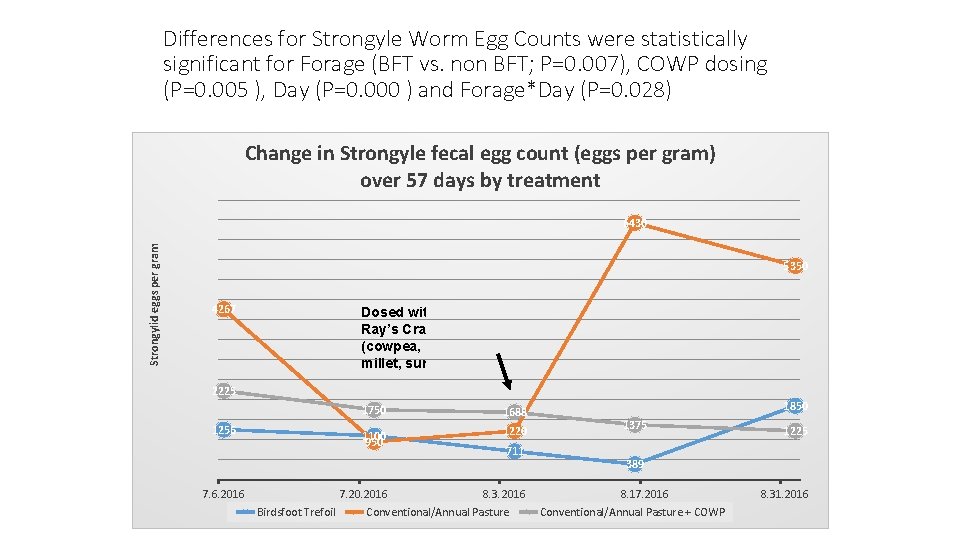
Differences for Strongyle Worm Egg Counts were statistically significant for Forage (BFT vs. non BFT; P=0. 007), COWP dosing (P=0. 005 ), Day (P=0. 000 ) and Forage*Day (P=0. 028) Change in Strongyle fecal egg count (eggs per gram) over 57 days by treatment Strongylid eggs per gram 6430 5350 4267 Dosed with COWP then put on Ray’s Crazy Summer Mix regrowth (cowpea, sorghum sudan, radish, millet, sunflowers) 2225 1256 7. 6. 2016 1750 1688 1100 950 1220 711 7. 2016 8. 3. 2016 Birdsfoot Trefoil Conventional/Annual Pasture 1850 1375 1225 389 8. 17. 2016 Conventional/Annual Pasture + COWP 8. 31. 2016
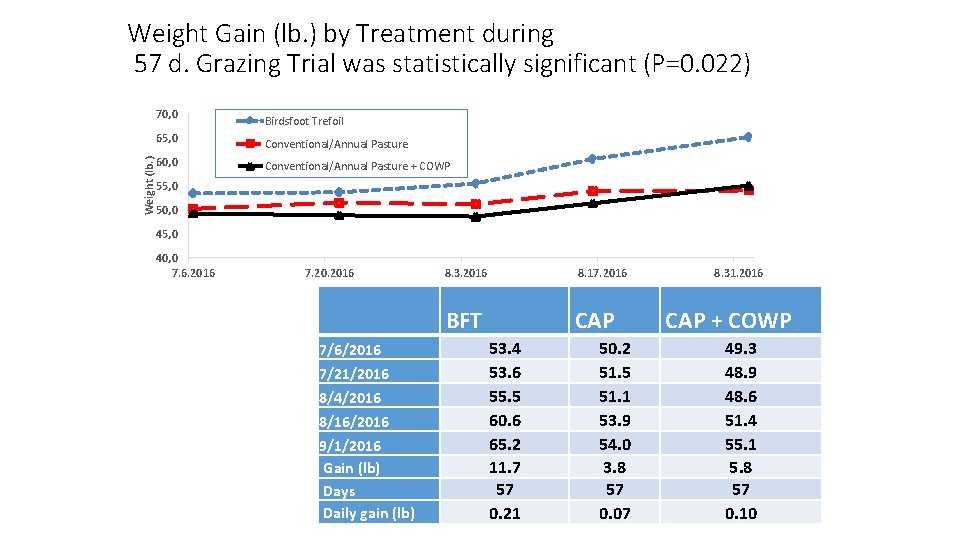
Weight Gain (lb. ) by Treatment during 57 d. Grazing Trial was statistically significant (P=0. 022) Weight (lb. ) 70, 0 Birdsfoot Trefoil 65, 0 Conventional/Annual Pasture 60, 0 Conventional/Annual Pasture + COWP 55, 0 50, 0 45, 0 40, 0 7. 6. 2016 7/6/2016 7/21/2016 8/4/2016 8/16/2016 9/1/2016 Gain (lb) Days Daily gain (lb) 8. 3. 2016 8. 17. 2016 BFT CAP 53. 4 53. 6 55. 5 60. 6 65. 2 11. 7 57 0. 21 50. 2 51. 5 51. 1 53. 9 54. 0 3. 8 57 0. 07 8. 31. 2016 CAP + COWP 49. 3 48. 9 48. 6 51. 4 55. 1 5. 8 57 0. 10
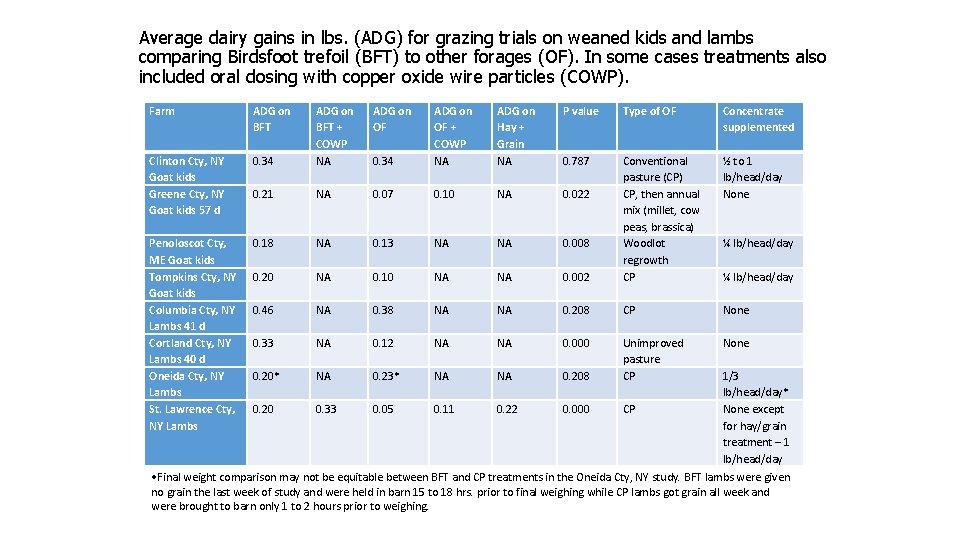
Average dairy gains in lbs. (ADG) for grazing trials on weaned kids and lambs comparing Birdsfoot trefoil (BFT) to other forages (OF). In some cases treatments also included oral dosing with copper oxide wire particles (COWP). Farm ADG on BFT ADG on OF 0. 34 ADG on BFT + COWP NA ADG on Hay + Grain NA P value Type of OF Concentrate supplemented 0. 34 ADG on OF + COWP NA Clinton Cty, NY Goat kids Greene Cty, NY Goat kids 57 d 0. 787 NA 0. 07 0. 10 NA 0. 022 ½ to 1 lb/head/day None 0. 18 NA 0. 13 NA NA 0. 008 0. 20 NA 0. 10 NA NA 0. 002 Conventional pasture (CP) CP, then annual mix (millet, cow peas, brassica) Woodlot regrowth CP 0. 21 Penoloscot Cty, ME Goat kids Tompkins Cty, NY Goat kids Columbia Cty, NY Lambs 41 d Cortland Cty, NY Lambs 40 d Oneida Cty, NY Lambs St. Lawrence Cty, NY Lambs 0. 46 NA 0. 38 NA NA 0. 208 CP None 0. 33 NA 0. 12 NA NA 0. 000 None 0. 20* NA 0. 23* NA NA 0. 208 Unimproved pasture CP 0. 20 0. 33 0. 05 0. 11 0. 22 0. 000 CP ¼ lb/head/day 1/3 lb/head/day* None except for hay/grain treatment – 1 lb/head/day • Final weight comparison may not be equitable between BFT and CP treatments in the Oneida Cty, NY study. BFT lambs were given no grain the last week of study and were held in barn 15 to 18 hrs. prior to final weighing while CP lambs got grain all week and were brought to barn only 1 to 2 hours prior to weighing.
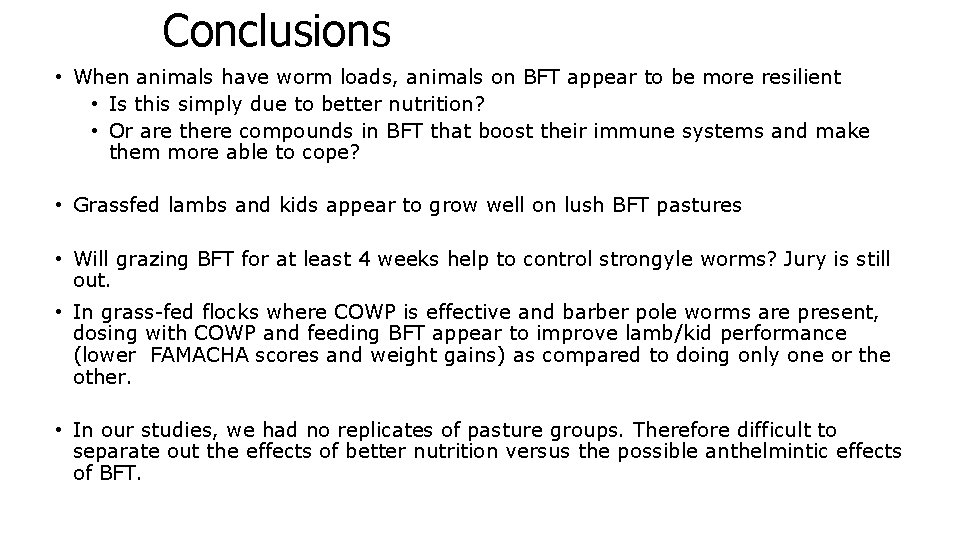
Conclusions • When animals have worm loads, animals on BFT appear to be more resilient • Is this simply due to better nutrition? • Or are there compounds in BFT that boost their immune systems and make them more able to cope? • Grassfed lambs and kids appear to grow well on lush BFT pastures • Will grazing BFT for at least 4 weeks help to control strongyle worms? Jury is still out. • In grass-fed flocks where COWP is effective and barber pole worms are present, dosing with COWP and feeding BFT appear to improve lamb/kid performance (lower FAMACHA scores and weight gains) as compared to doing only one or the other. • In our studies, we had no replicates of pasture groups. Therefore difficult to separate out the effects of better nutrition versus the possible anthelmintic effects of BFT.
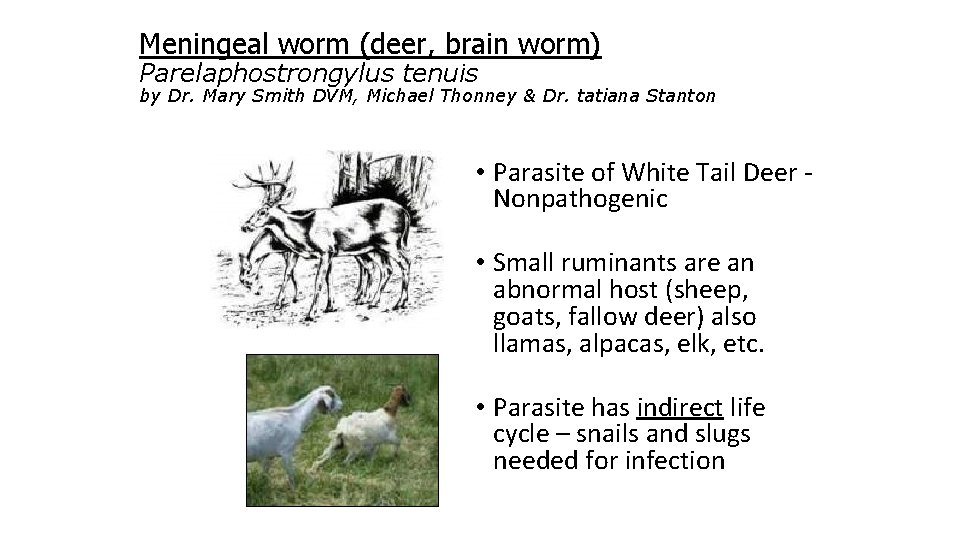
Meningeal worm (deer, brain worm) Parelaphostrongylus tenuis by Dr. Mary Smith DVM, Michael Thonney & Dr. tatiana Stanton • Parasite of White Tail Deer Nonpathogenic • Small ruminants are an abnormal host (sheep, goats, fallow deer) also llamas, alpacas, elk, etc. • Parasite has indirect life cycle – snails and slugs needed for infection
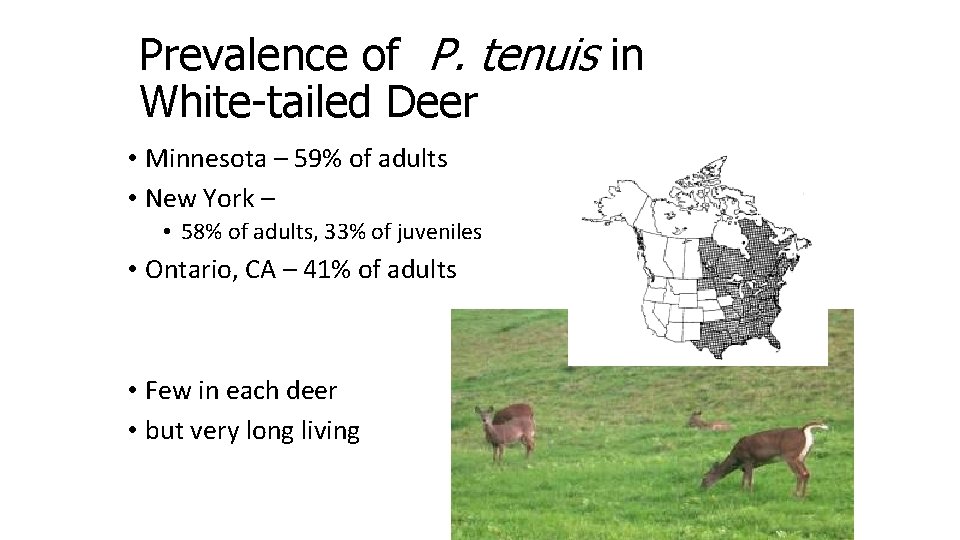
Prevalence of P. tenuis in White-tailed Deer • Minnesota – 59% of adults • New York – • 58% of adults, 33% of juveniles • Ontario, CA – 41% of adults • Few in each deer • but very long living
Life cycle in deer • Deer eats forage that contains a slime trail, slug or snail that is infected with the 3 rd stage larvae • Larvae migrate through the stomach wall to the peritoneal cavity • enter lumbar spinal nerves • reach spinal cord in 10 days • develop in an orderly manner in the grey matter of the spinal cord • return to surface of spinal cord at 40 days • mature and migrate to cranium to live and reproduce -> eggs laid into blood vessels • Eggs hatch into first-stage larvae in the lungs • 1 st stage larvae enter bronchial tree, coughed up, swallowed and passed in feces
Larvae of P. tenuis Ø 1 st stage larvae excreted in the mucous coat of fecal pellets 90+ days after deer infected Økilled by drying, solar radiation but resist freezing Øland snails and slugs crawl over deer feces Ølarvae penetrate gastropod’s foot Ødevelop to infective (3 rd stage) in 2 to 3 mo. (depends on temperature) Øpersist for life of snail or slug or excreted in slime trail onto vegetation Ømean of 3 larvae for each infected snail
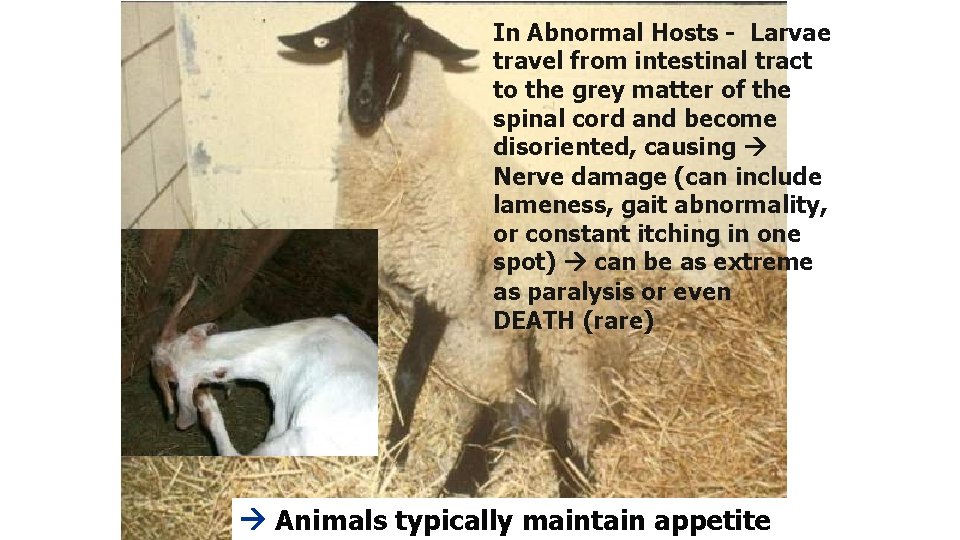
In Abnormal Hosts - Larvae travel from intestinal tract to the grey matter of the spinal cord and become disoriented, causing Nerve damage (can include lameness, gait abnormality, or constant itching in one spot) can be as extreme as paralysis or even DEATH (rare) Animals typically maintain appetite
• Current research – takes a little over 2 to 3 months to develop to L 3 in snail -> possibly less chance of infection for about 3 months after winter is over • Sheep or goat does not have to eat the snail or slug. The L 3 emerge from snail/slug in slime trail and can survive on vegetation • After about 10 days of infection much harder to kill worm in sheep or goat. May take up to 60 days for signs to develop.
Treatment of P. tenuis in aberrant hosts • no controlled studies in sheep and goats • Cornell has completed a 3 year study comparing two treatment protocols on naturally infected sheep and goats on 14 farms in Ithaca, NY region • Infected animals scored on a “neurologic score card” and video taped within the first day or two of treatment and post treatment
Research Study • Goal- Determine if Ivermectin is needed in the treatment P. tenuis in sheep and goats. Theoretically, Ivermectin cannot pass through the blood brain barrier should not aid in treatment • Treatment Protocol: • Dexamethasone: 0. 2 mg/kg IM for 3 days, 0. 1 mg/kg for 2 days (if instead Banamine, 50 mg flunixin per cc at 1 cc/100 lb. lw, 60 d withdrawal sheep) • Fenbendazole (Safeguard): 25 mg/kg PO for 5 days (10 d withdrawal goats, 54 d sheep) • Ivermectin or Placebo: 0. 5 mg/kg SQ for 5 days (96 d withdrawal for goats & sheep)
Study Design • Producer recognizes an animal with signs of P. tenuis and begins treating with either Treatment A or B • A veterinarian or researcher does an initial neurologic exam on the animal when treatment is started • A second neuro exam is done after treatment is completed • Improvement based on the neuro exam and final outcome of the animal were compared to determine ivermectin’s role in improving the outcome
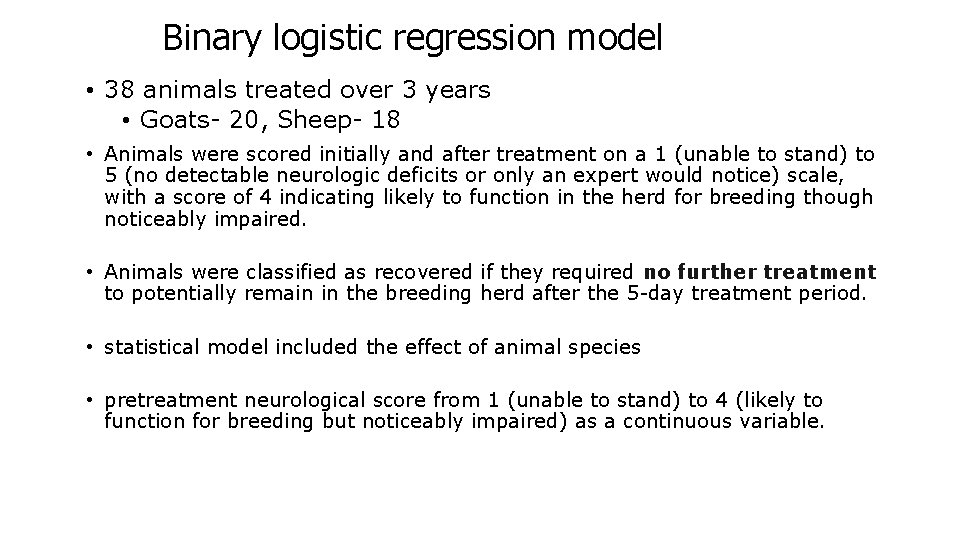
Binary logistic regression model • 38 animals treated over 3 years • Goats- 20, Sheep- 18 • Animals were scored initially and after treatment on a 1 (unable to stand) to 5 (no detectable neurologic deficits or only an expert would notice) scale, with a score of 4 indicating likely to function in the herd for breeding though noticeably impaired. • Animals were classified as recovered if they required no further treatment to potentially remain in the breeding herd after the 5 -day treatment period. • statistical model included the effect of animal species • pretreatment neurological score from 1 (unable to stand) to 4 (likely to function for breeding but noticeably impaired) as a continuous variable.
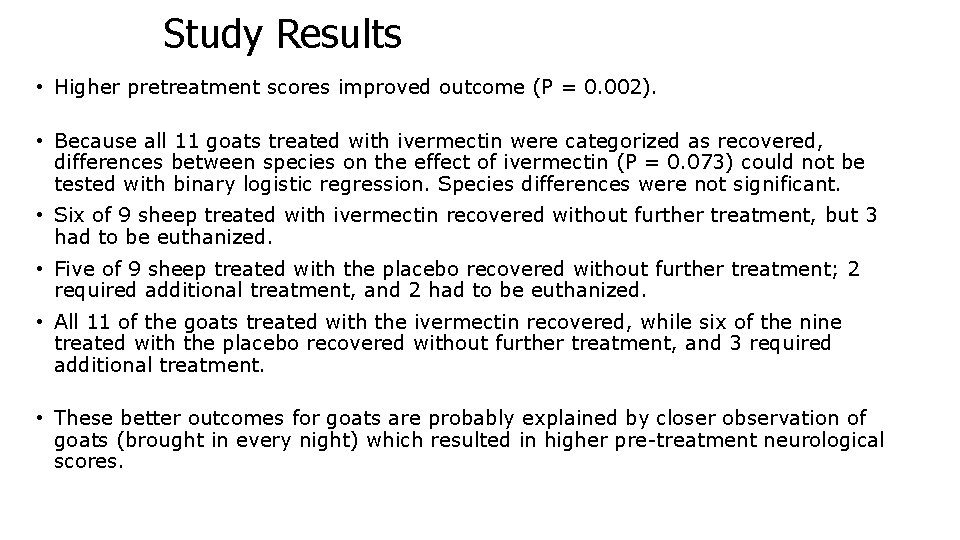
Study Results • Higher pretreatment scores improved outcome (P = 0. 002). • Because all 11 goats treated with ivermectin were categorized as recovered, differences between species on the effect of ivermectin (P = 0. 073) could not be tested with binary logistic regression. Species differences were not significant. • Six of 9 sheep treated with ivermectin recovered without further treatment, but 3 had to be euthanized. • Five of 9 sheep treated with the placebo recovered without further treatment; 2 required additional treatment, and 2 had to be euthanized. • All 11 of the goats treated with the ivermectin recovered, while six of the nine treated with the placebo recovered without further treatment, and 3 required additional treatment. • These better outcomes for goats are probably explained by closer observation of goats (brought in every night) which resulted in higher pre-treatment neurological scores.
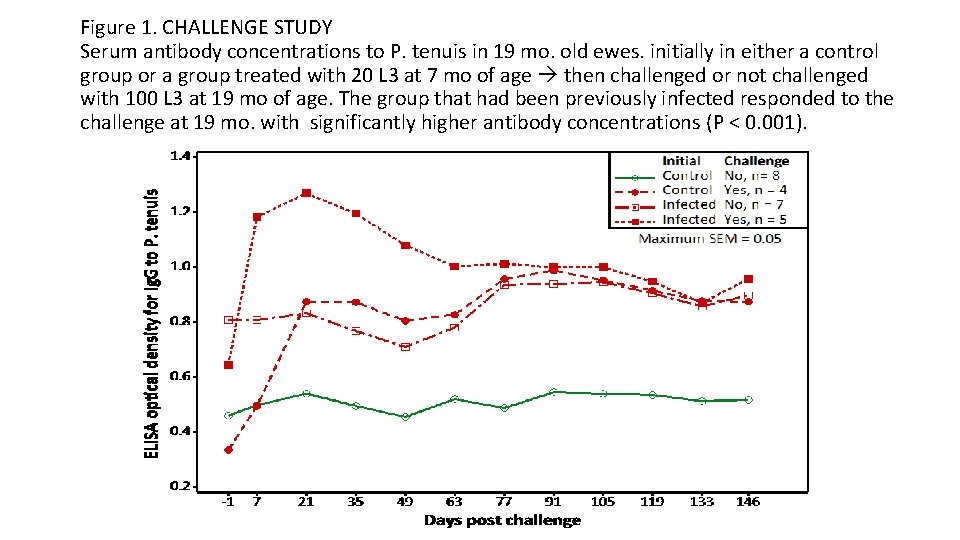
Figure 1. CHALLENGE STUDY Serum antibody concentrations to P. tenuis in 19 mo. old ewes. initially in either a control group or a group treated with 20 L 3 at 7 mo of age then challenged or not challenged with 100 L 3 at 19 mo of age. The group that had been previously infected responded to the challenge at 19 mo. with significantly higher antibody concentrations (P < 0. 001).
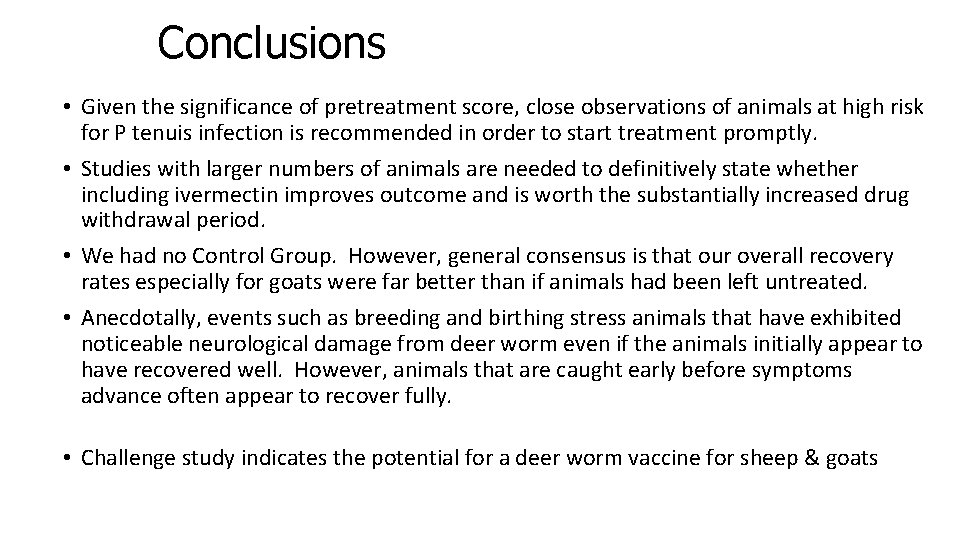
Conclusions • Given the significance of pretreatment score, close observations of animals at high risk for P tenuis infection is recommended in order to start treatment promptly. • Studies with larger numbers of animals are needed to definitively state whether including ivermectin improves outcome and is worth the substantially increased drug withdrawal period. • We had no Control Group. However, general consensus is that our overall recovery rates especially for goats were far better than if animals had been left untreated. • Anecdotally, events such as breeding and birthing stress animals that have exhibited noticeable neurological damage from deer worm even if the animals initially appear to have recovered well. However, animals that are caught early before symptoms advance often appear to recover fully. • Challenge study indicates the potential for a deer worm vaccine for sheep & goats
QUESTIONS?