
Part 3 UNDERSTANDING CUSTOMER REQUIREMENTS 6 1 Provider

- Slides: 19
Part 3 UNDERSTANDING CUSTOMER REQUIREMENTS 6 -1
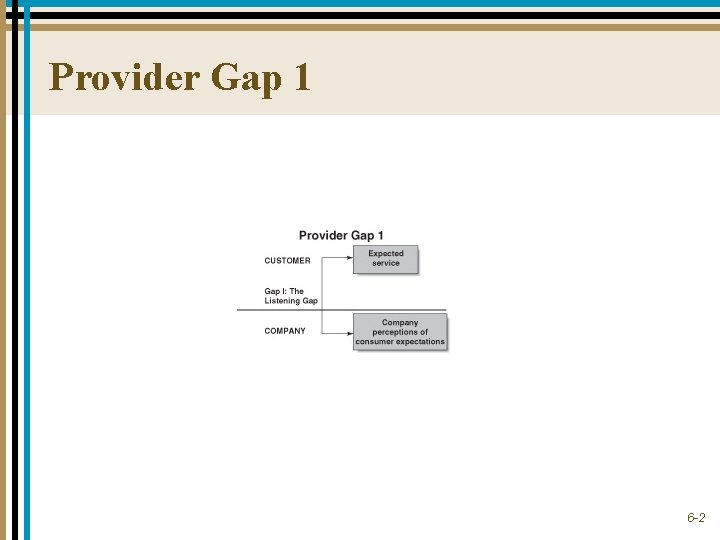
Provider Gap 1 6 -2
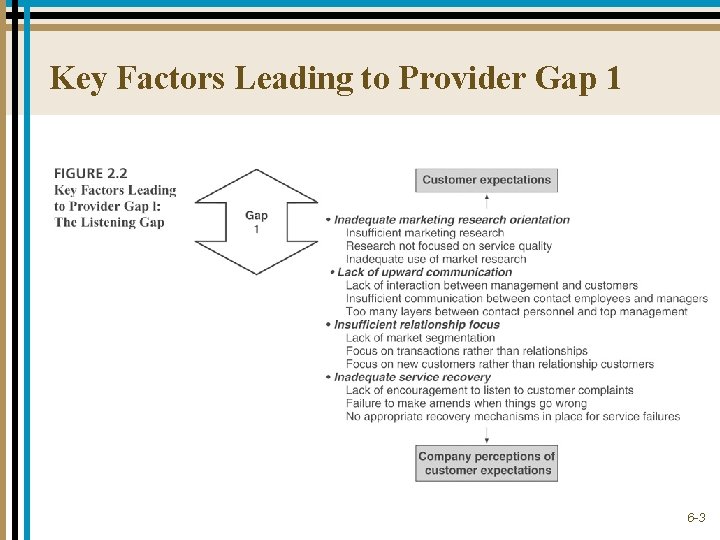
Key Factors Leading to Provider Gap 1 6 -3
Listening to Customers through Research Chapter 6 § Using Marketing Research to Understand Customer Expectations § Elements in an Effective Services Marketing Research Program § Analyzing and Interpreting Marketing Research Findings § Model Services Marketing Research Programs § Using Marketing Research Information § Upward Communication Mc. Graw-Hill/Irwin 6 -4 Copyright © 2009 by The Mc. Graw-Hill Companies, Inc. All rights reserved.
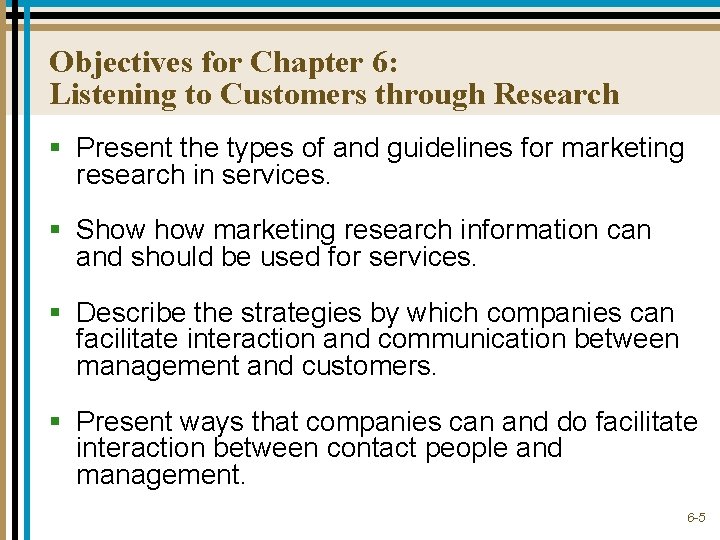
Objectives for Chapter 6: Listening to Customers through Research § Present the types of and guidelines for marketing research in services. § Show marketing research information can and should be used for services. § Describe the strategies by which companies can facilitate interaction and communication between management and customers. § Present ways that companies can and do facilitate interaction between contact people and management. 6 -5
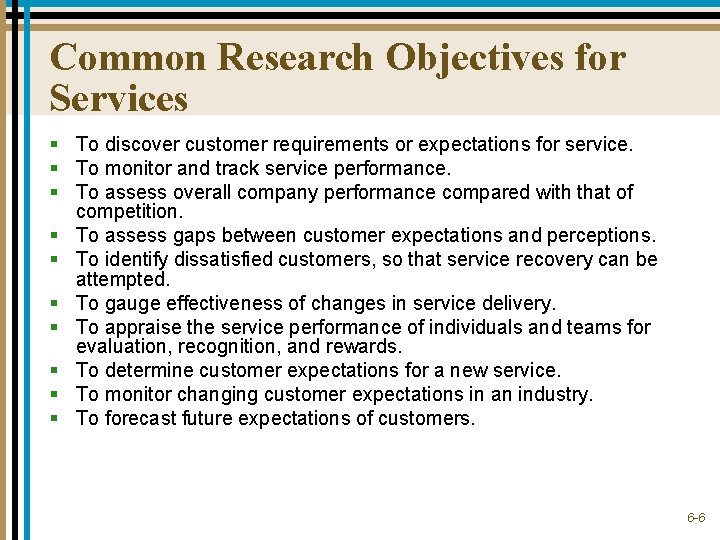
Common Research Objectives for Services § To discover customer requirements or expectations for service. § To monitor and track service performance. § To assess overall company performance compared with that of competition. § To assess gaps between customer expectations and perceptions. § To identify dissatisfied customers, so that service recovery can be attempted. § To gauge effectiveness of changes in service delivery. § To appraise the service performance of individuals and teams for evaluation, recognition, and rewards. § To determine customer expectations for a new service. § To monitor changing customer expectations in an industry. § To forecast future expectations of customers. 6 -6
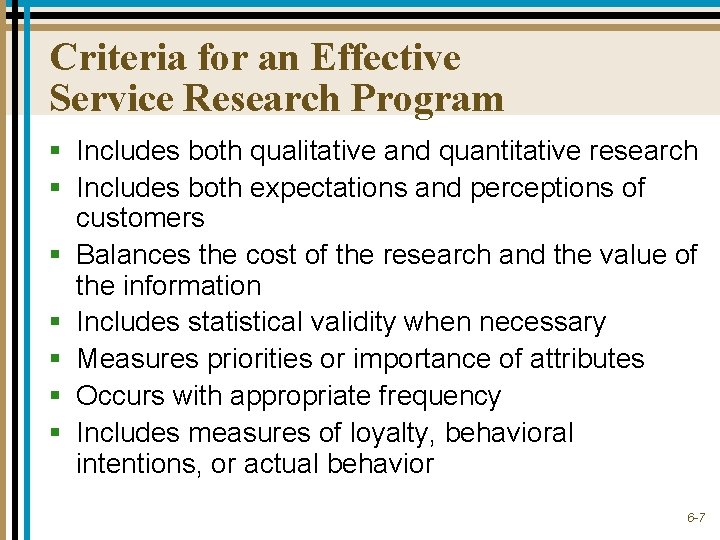
Criteria for an Effective Service Research Program § Includes both qualitative and quantitative research § Includes both expectations and perceptions of customers § Balances the cost of the research and the value of the information § Includes statistical validity when necessary § Measures priorities or importance of attributes § Occurs with appropriate frequency § Includes measures of loyalty, behavioral intentions, or actual behavior 6 -7
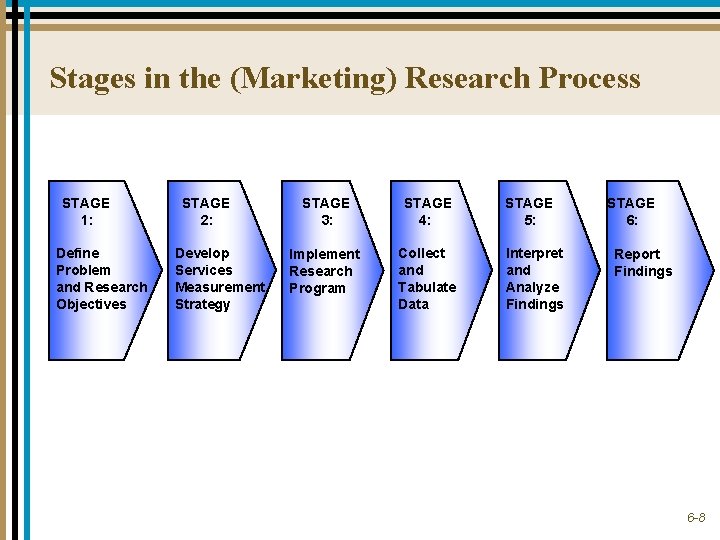
Stages in the (Marketing) Research Process STAGE 1: Define Problem and Research Objectives STAGE 2: Develop Services Measurement Strategy STAGE 3: STAGE 4: Implement Research Program Collect and Tabulate Data STAGE 5: Interpret and Analyze Findings STAGE 6: Report Findings 6 -8
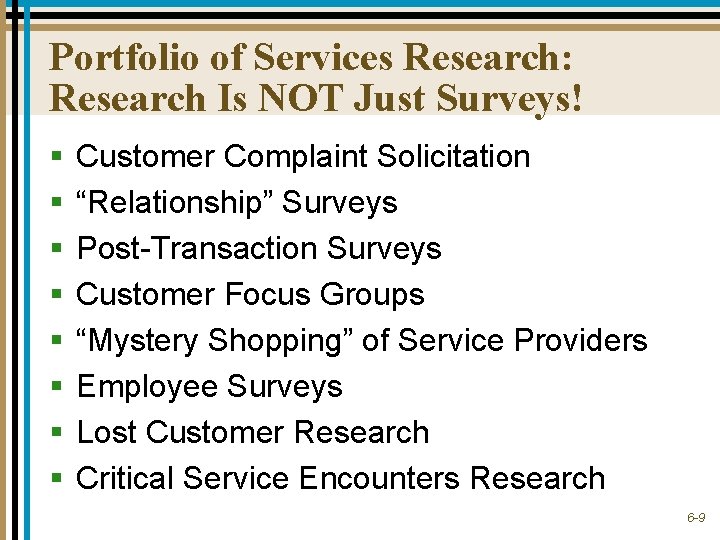
Portfolio of Services Research: Research Is NOT Just Surveys! § § § § Customer Complaint Solicitation “Relationship” Surveys Post-Transaction Surveys Customer Focus Groups “Mystery Shopping” of Service Providers Employee Surveys Lost Customer Research Critical Service Encounters Research 6 -9
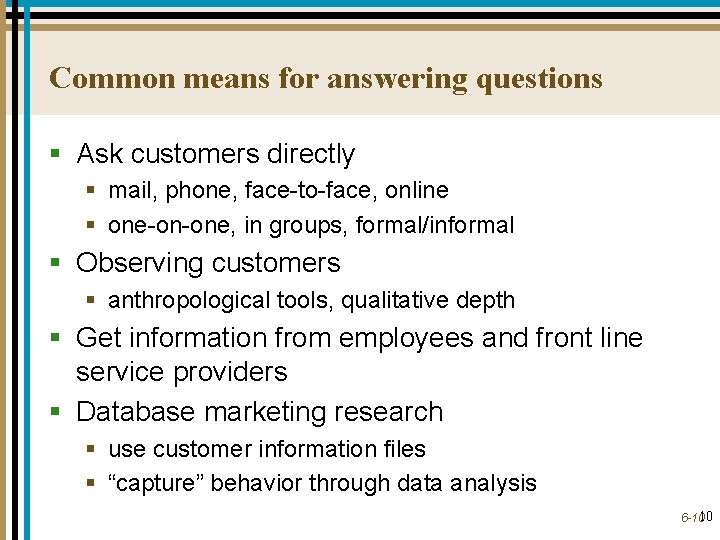
Common means for answering questions § Ask customers directly § mail, phone, face-to-face, online § one-on-one, in groups, formal/informal § Observing customers § anthropological tools, qualitative depth § Get information from employees and front line service providers § Database marketing research § use customer information files § “capture” behavior through data analysis 6 -1010
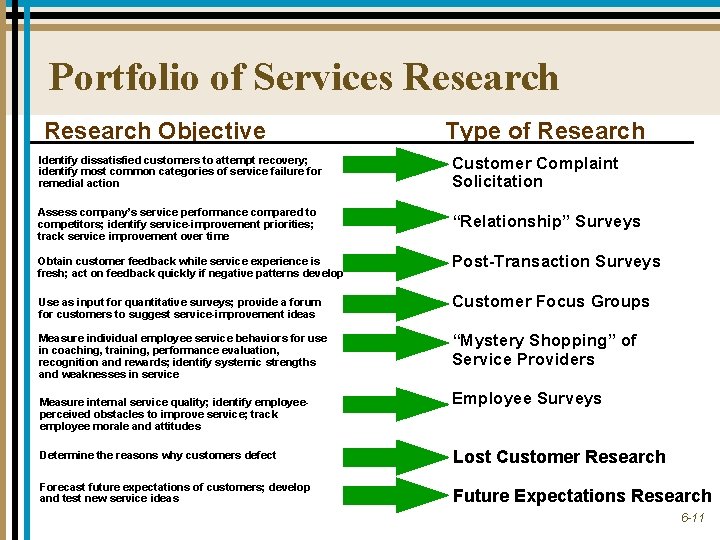
Portfolio of Services Research Objective Type of Research Identify dissatisfied customers to attempt recovery; identify most common categories of service failure for remedial action Customer Complaint Solicitation Assess company’s service performance compared to competitors; identify service-improvement priorities; track service improvement over time “Relationship” Surveys Obtain customer feedback while service experience is fresh; act on feedback quickly if negative patterns develop Post-Transaction Surveys Use as input for quantitative surveys; provide a forum for customers to suggest service-improvement ideas Customer Focus Groups Measure individual employee service behaviors for use in coaching, training, performance evaluation, recognition and rewards; identify systemic strengths and weaknesses in service “Mystery Shopping” of Service Providers Measure internal service quality; identify employeeperceived obstacles to improve service; track employee morale and attitudes Employee Surveys Determine the reasons why customers defect Lost Customer Research Forecast future expectations of customers; develop and test new service ideas Future Expectations Research 6 -11
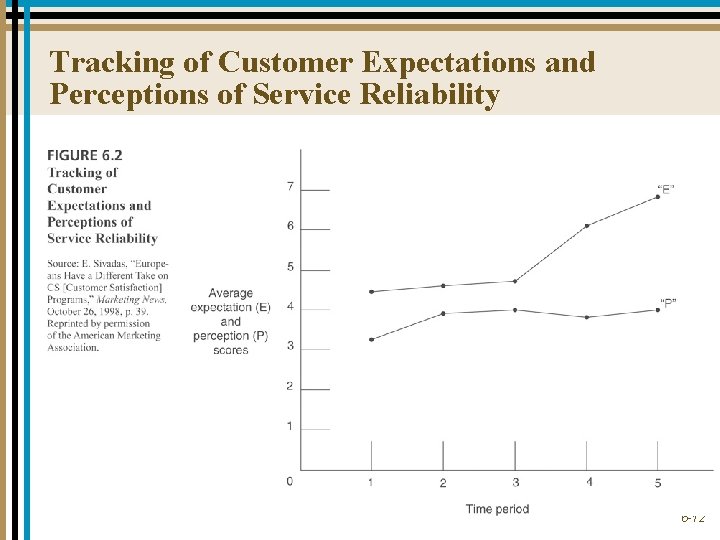
Tracking of Customer Expectations and Perceptions of Service Reliability 6 -12
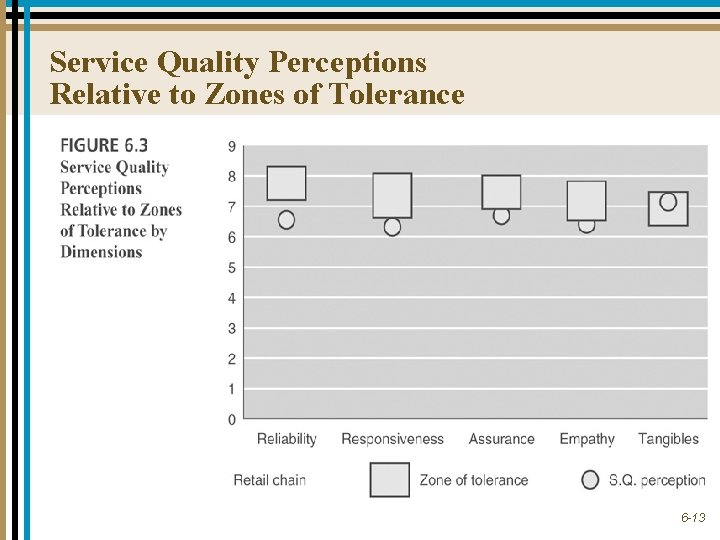
Service Quality Perceptions Relative to Zones of Tolerance 6 -13
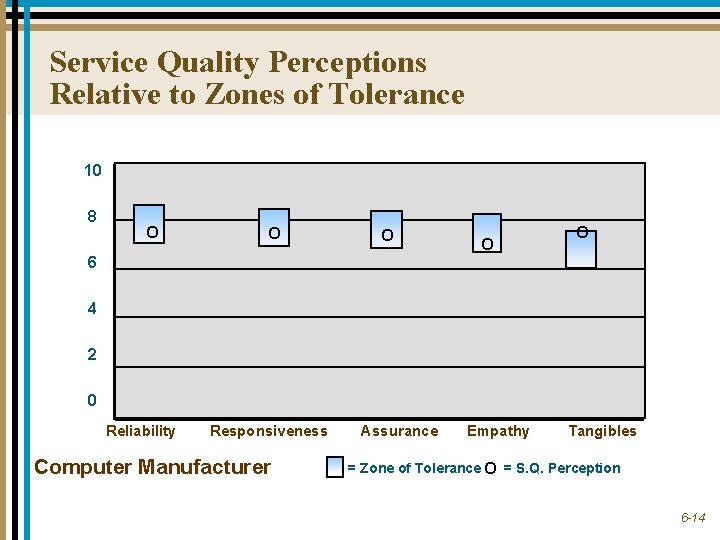
Service Quality Perceptions Relative to Zones of Tolerance 10 8 O O O 6 O O 4 2 0 Reliability Responsiveness Computer Manufacturer Assurance Empathy Tangibles = Zone of Tolerance O = S. Q. Perception 6 -14
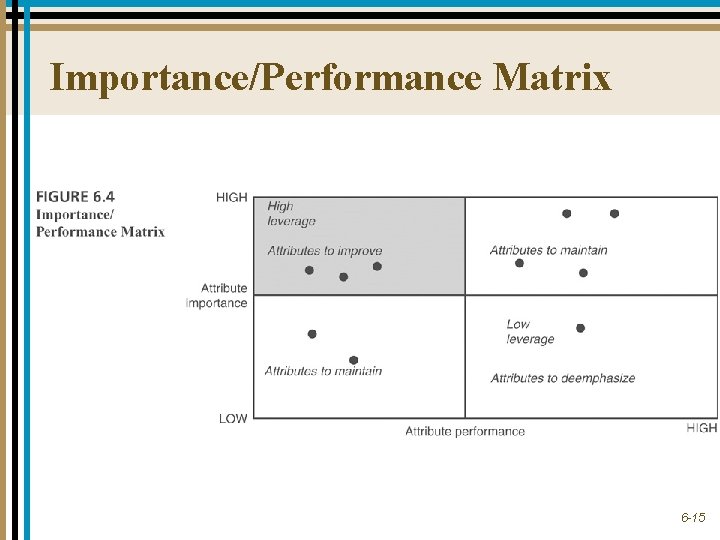
Importance/Performance Matrix 6 -15
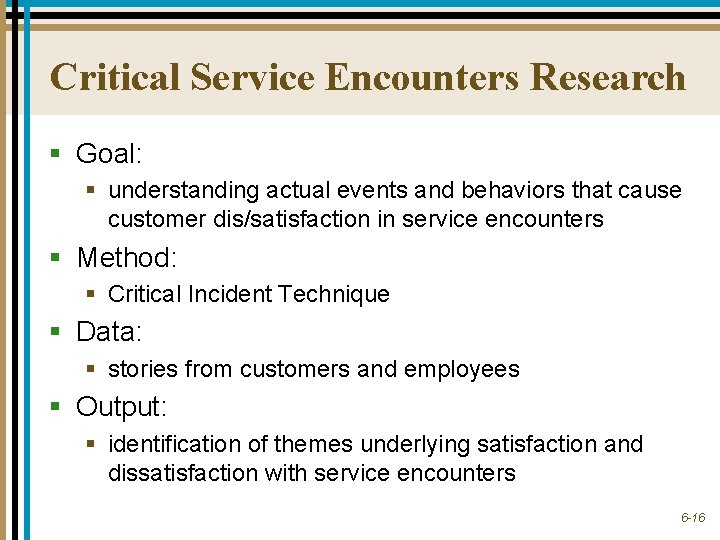
Critical Service Encounters Research § Goal: § understanding actual events and behaviors that cause customer dis/satisfaction in service encounters § Method: § Critical Incident Technique § Data: § stories from customers and employees § Output: § identification of themes underlying satisfaction and dissatisfaction with service encounters 6 -16
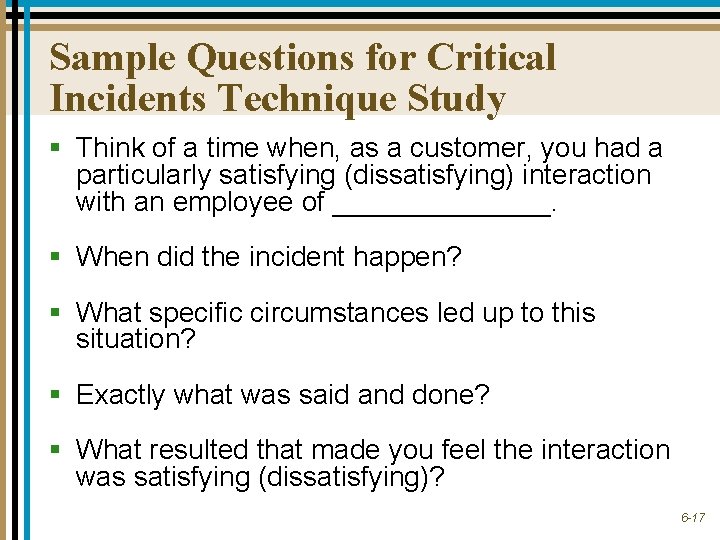
Sample Questions for Critical Incidents Technique Study § Think of a time when, as a customer, you had a particularly satisfying (dissatisfying) interaction with an employee of _______. § When did the incident happen? § What specific circumstances led up to this situation? § Exactly what was said and done? § What resulted that made you feel the interaction was satisfying (dissatisfying)? 6 -17
Mc. Donald’s Creates Health-Conscious Panel to Do Research and Pass it On § Mom's Quality Consultants at Mc. Donalds § Women, especially moms, tend to get information and form opinions by talking with others § Selected 6 moms to bring “fully inside the company”—to visit restaurants, processing plants, orchards, and test kitchens § Will keep an online journal for 3 months 6 -18
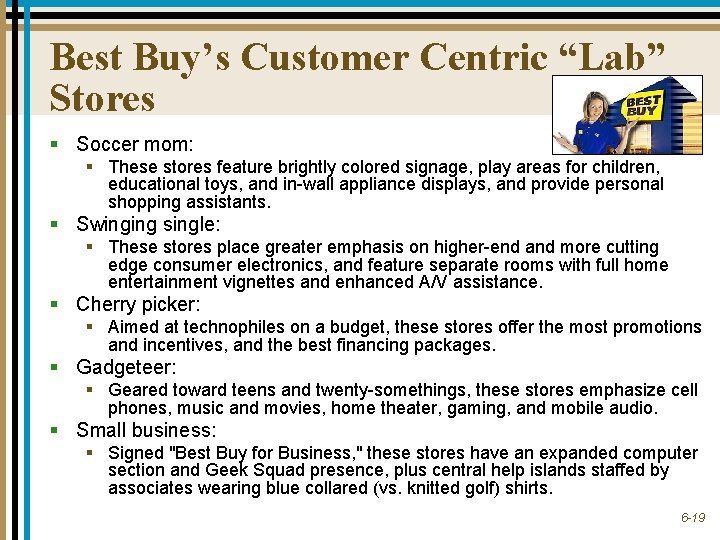
Best Buy’s Customer Centric “Lab” Stores § Soccer mom: § These stores feature brightly colored signage, play areas for children, educational toys, and in-wall appliance displays, and provide personal shopping assistants. § Swinging single: § These stores place greater emphasis on higher-end and more cutting edge consumer electronics, and feature separate rooms with full home entertainment vignettes and enhanced A/V assistance. § Cherry picker: § Aimed at technophiles on a budget, these stores offer the most promotions and incentives, and the best financing packages. § Gadgeteer: § Geared toward teens and twenty-somethings, these stores emphasize cell phones, music and movies, home theater, gaming, and mobile audio. § Small business: § Signed "Best Buy for Business, " these stores have an expanded computer section and Geek Squad presence, plus central help islands staffed by associates wearing blue collared (vs. knitted golf) shirts. 6 -19