
Part 3 The Period of the English Bourgeois
Part 3 The Period of the English Bourgeois Revolution (the 17 th Century Literature ) English and American Literature & Selected Readings :魏晓红 : weixiaohonghd@163. com : 13931098970

Part 3 The Period of the English Bourgeois Revolution (the 17 th Century Literature ) Who are they?
3 T h Eng e l is h 17 th B o u C e rg e nt o i ur s Re y L i vo te l u r a ti o tu re n Part 3 The Period of the English Bourgeois Revolution (the 17 th Century Literature ) Restoration J. Dryden Pa rt Prose-writers Paper Writing
Part 3 The Period of the English Bourgeois Revolution (the 17 th Century Literature ) Chapter 6 Restoration Literature 复辟文学 1660— 1688
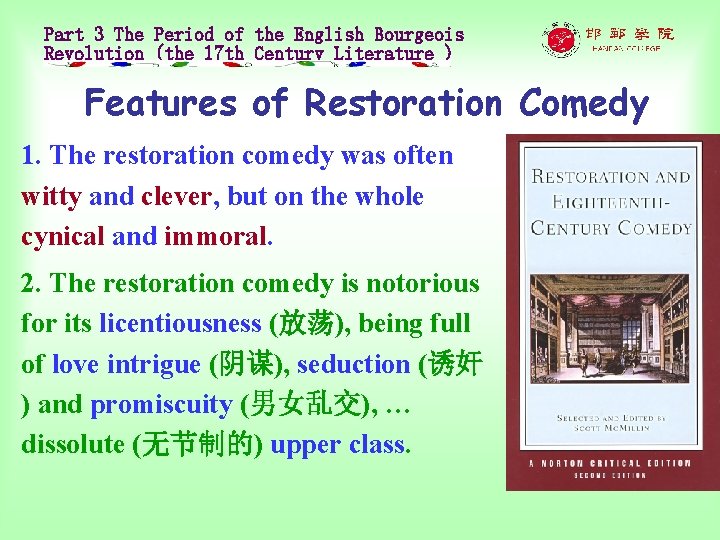
Part 3 The Period of the English Bourgeois Revolution (the 17 th Century Literature ) Features of Restoration Comedy 1. The restoration comedy was often witty and clever, but on the whole cynical and immoral. 2. The restoration comedy is notorious for its licentiousness (放荡), being full of love intrigue (阴谋), seduction (诱奸 ) and promiscuity (男女乱交), … dissolute (无节制的) upper class.

Part 3 The Period of the English Bourgeois Revolution (the 17 th Century Literature ) The Features When England’s theatres reopened 18 years after being closed by an act of Parliament in 1642, audiences embraced (看到,领会)the witty and satirical dialogue from “plain folks”(忠厚老实的人,质朴的人) characters that defined a new era in drama. of the Restoration Literature (1660— 1688 )
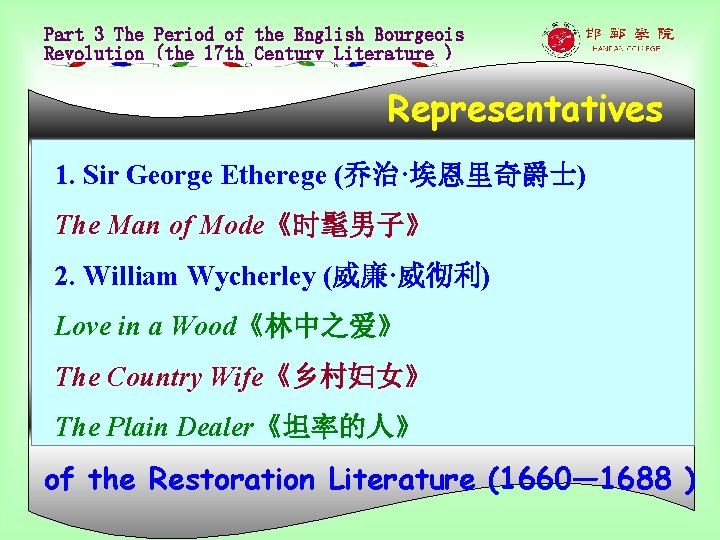
Part 3 The Period of the English Bourgeois Revolution (the 17 th Century Literature ) Representatives 1. Sir George Etherege (乔治·埃恩里奇爵士) The Man of Mode《时髦男子》 2. William Wycherley (威廉·威彻利) Love in a Wood《林中之爱》 The Country Wife《乡村妇女》 The Plain Dealer《坦率的人》 of the Restoration Literature (1660— 1688 )
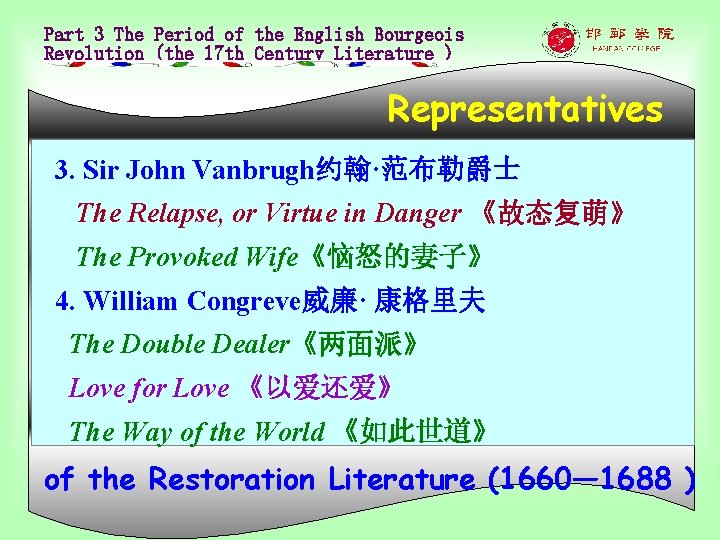
Part 3 The Period of the English Bourgeois Revolution (the 17 th Century Literature ) Representatives 3. Sir John Vanbrugh约翰·范布勒爵士 The Relapse, or Virtue in Danger 《故态复萌》 The Provoked Wife《恼怒的妻子》 4. William Congreve威廉· 康格里夫 The Double Dealer《两面派》 Love for Love 《以爱还爱》 The Way of the World 《如此世道》 of the Restoration Literature (1660— 1688 )
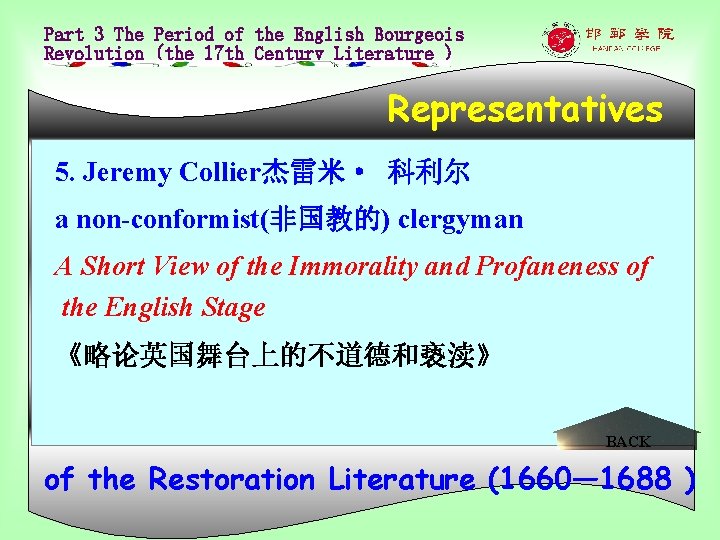
Part 3 The Period of the English Bourgeois Revolution (the 17 th Century Literature ) Representatives 5. Jeremy Collier杰雷米· 科利尔 a non-conformist(非国教的) clergyman A Short View of the Immorality and Profaneness of the English Stage 《略论英国舞台上的不道德和亵渎》 BACK of the Restoration Literature (1660— 1688 )
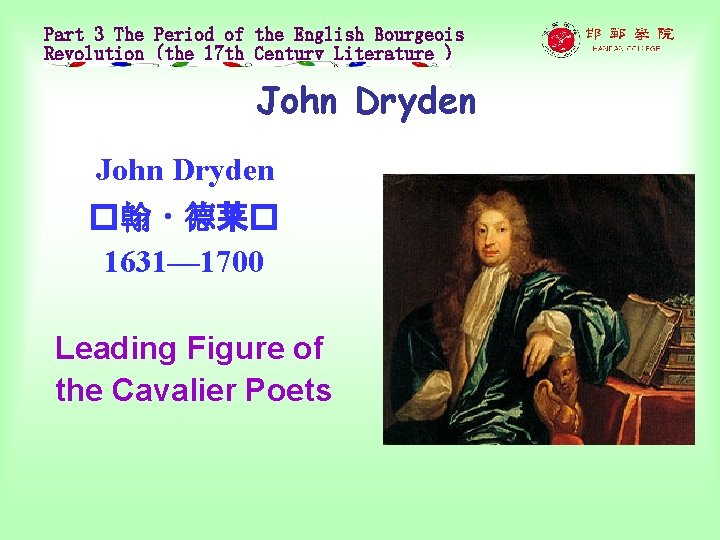
Part 3 The Period of the English Bourgeois Revolution (the 17 th Century Literature ) John Dryden �翰·德莱� 1631— 1700 Leading Figure of the Cavalier Poets
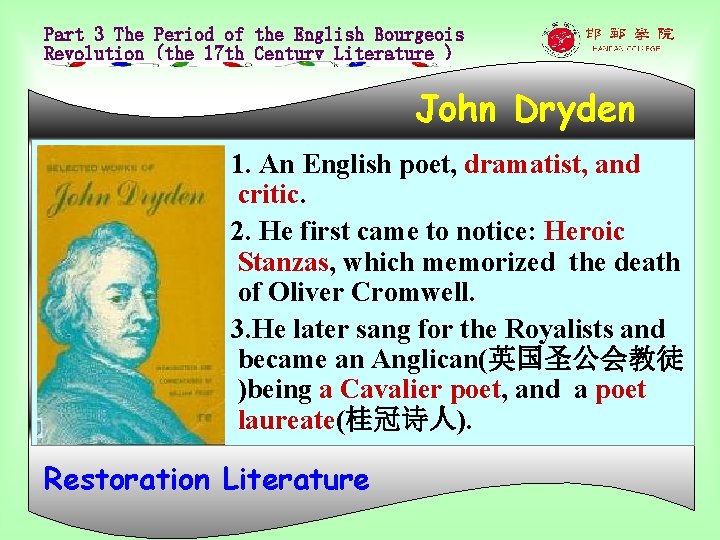
Part 3 The Period of the English Bourgeois Revolution (the 17 th Century Literature ) John Dryden 1. An English poet, dramatist, and critic. 2. He first came to notice: Heroic Stanzas, which memorized the death of Oliver Cromwell. 3. He later sang for the Royalists and became an Anglican(英国圣公会教徒 )being a Cavalier poet, and a poet laureate(桂冠诗人). Restoration Literature
Part 3 The Period of the English Bourgeois Revolution (the 17 th Century Literature ) John Dryden’s Works Changeable, a time-server (随波逐流的人): 1. an elegy on Cromwell’s death: “Herioick Stanza” ”英雄诗辩” 2. An Ode on Charles II: “Astraea Redux””伸张正义” a didactic poem in James II’s reign “The Hind and the Panther” “牝鹿与豹” Restoration Literature
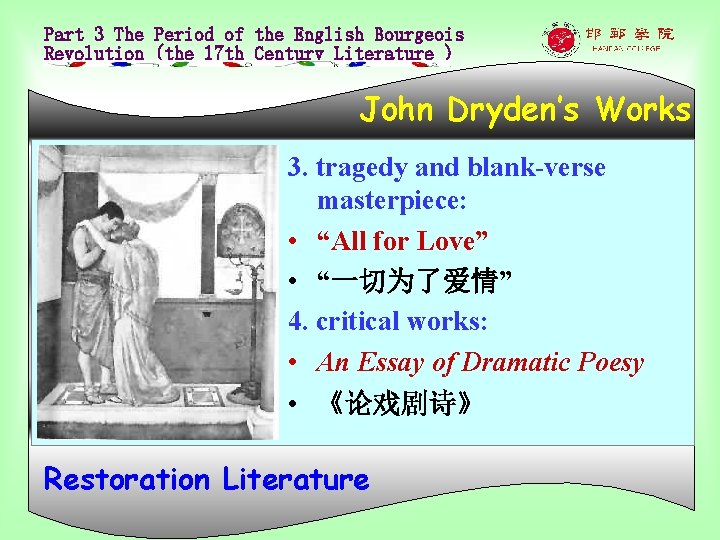
Part 3 The Period of the English Bourgeois Revolution (the 17 th Century Literature ) John Dryden’s Works 3. tragedy and blank-verse masterpiece: • “All for Love” • “一切为了爱情” 4. critical works: • An Essay of Dramatic Poesy • 《论戏剧诗》 Restoration Literature
Part 3 The Period of the English Bourgeois Revolution (the 17 th Century Literature ) John Dryden’s Works 5. political satires: 1) “Absolom and Achitophel” “押沙龙与阿托奈拖菲尔” –Its subject is politics and written in heroic couplet. 6. a comedy Marriage à la Mode 《时尚婚姻》《现代婚姻》 Restoration Literature
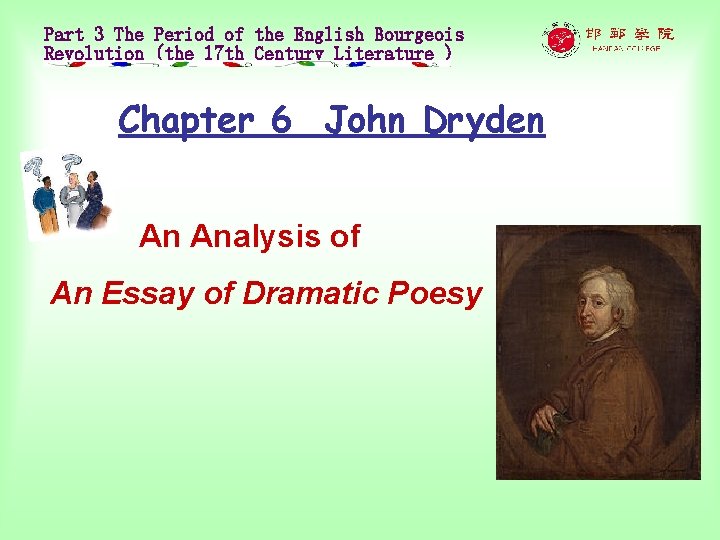
Part 3 The Period of the English Bourgeois Revolution (the 17 th Century Literature ) Chapter 6 John Dryden An Analysis of An Essay of Dramatic Poesy
Part 3 The Period of the English Bourgeois Revolution (the 17 th Century Literature ) An Essay of Dramatic Poesy Dryden is a neoclassic critic, and as such he deals in his Dramatic Poesy with issues of form and morality(形式与道德) in drama.
Part 3 The Period of the English Bourgeois Revolution (the 17 th Century Literature ) An Essay of Dramatic Poesy 1. Form: dialogue among four gentlemen on the river Thames 2. Four Characters: 《实践》p. 86 Eugenius (whose name may mean “well born”) Crites Lisideius Neander
Part 3 The Period of the English Bourgeois Revolution (the 17 th Century Literature ) They are all pseudonyms for actual Restoration critics, Sir William Davenant, Sir Robert Howard, the earl of Orrery and the last for Dryden himself.
Part 3 The Period of the English Bourgeois Revolution (the 17 th Century Literature ) Eugenius favours modern English dramatists by attacking the classical playwrights, who did not themselves always observe the unity of place.
Part 3 The Period of the English Bourgeois Revolution (the 17 th Century Literature ) Crites defends the ancients and points out that they invited the principles of dramatic art paved by Aristotle. Crites opposes rhyme in plays and argues that though the moderns excel in sciences, the ancient age was the true age of poetry.
Part 3 The Period of the English Bourgeois Revolution (the 17 th Century Literature ) Lisideius holds the French drama is superior to English drama for the reason that the French writers follow the rules of the classical separation of comedy and tragedy and English writers, such as Ben Jonson.
Part 3 The Period of the English Bourgeois Revolution (the 17 th Century Literature ) Neander speaks in favour of the Moderns and respects the Ancients. He also favors English drama and has a critical eye on French drama which he believes that they are indeed the beauties of a statue , but not of a man.
Part 3 The Period of the English Bourgeois Revolution (the 17 th Century Literature ) An Essay of Dramatic Poesy Five issues: 1) Ancients vs. Moderns 2) Unities: unity of action, time and place 3) French vs. English Drama 4) Separation of Tragedy and Comedy vs. Tragicomedy 5) Appropriateness of Rhyme in Drama
Part 3 The Period of the English Bourgeois Revolution (the 17 th Century Literature ) The essay is written in the dialogue from which shows truthfulness , vividness and liveliness and discusses the controversial topics in an easy, colloquial and friendly tone.
Part 3 The Period of the English Bourgeois Revolution (the 17 th Century Literature ) An Essay of Dramatic Poesy Dryden uses easy, proper, concise, direct and significant words and expressions.
Part 3 The Period of the English Bourgeois Revolution (the 17 th Century Literature ) Comments John Dryden 1. Dryden made his prose precise, concise and flexible, and raised English literary criticism to a new level. 2. Following the standards of classicism, he established the heroic couplet. John Dryden was the forerunner of the English classical school of literature in the 18 th century. Restoration Literature
Part 3 The Period of the English Bourgeois Revolution (the 17 th Century Literature ) BACK
Part 3 The Period of the English Bourgeois Revolution (the 17 th Century Literature ) Chapter 5 Some Prose-Writers in the 17 th Century
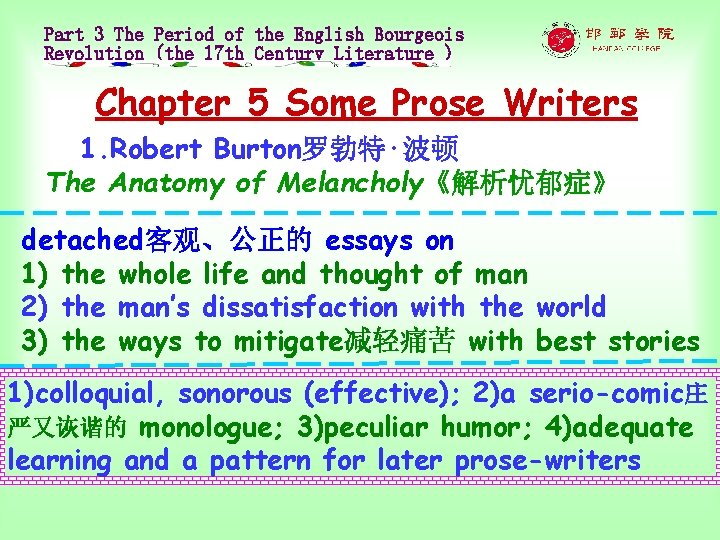
Part 3 The Period of the English Bourgeois Revolution (the 17 th Century Literature ) Chapter 5 Some Prose Writers 1. Robert Burton罗勃特·波顿 The Anatomy of Melancholy《解析忧郁症》 detached客观、公正的 essays on 1) the whole life and thought of man 2) the man’s dissatisfaction with the world 3) the ways to mitigate减轻痛苦 with best stories 1)colloquial, sonorous (effective); 2)a serio-comic庄 严又诙谐的 monologue; 3)peculiar humor; 4)adequate learning and a pattern for later prose-writers
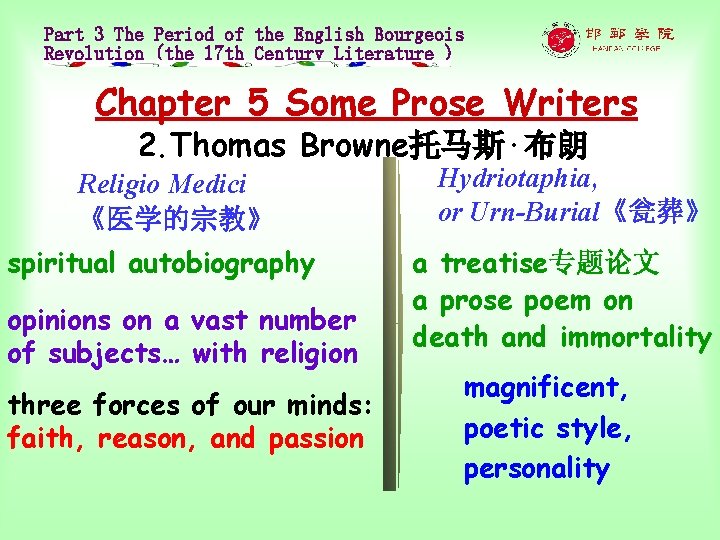
Part 3 The Period of the English Bourgeois Revolution (the 17 th Century Literature ) Chapter 5 Some Prose Writers 2. Thomas Browne托马斯·布朗 Religio Medici 《医学的宗教》 spiritual autobiography opinions on a vast number of subjects… with religion three forces of our minds: faith, reason, and passion Hydriotaphia, or Urn-Burial《瓮葬》 a treatise专题论文 a prose poem on death and immortality magnificent, poetic style, personality
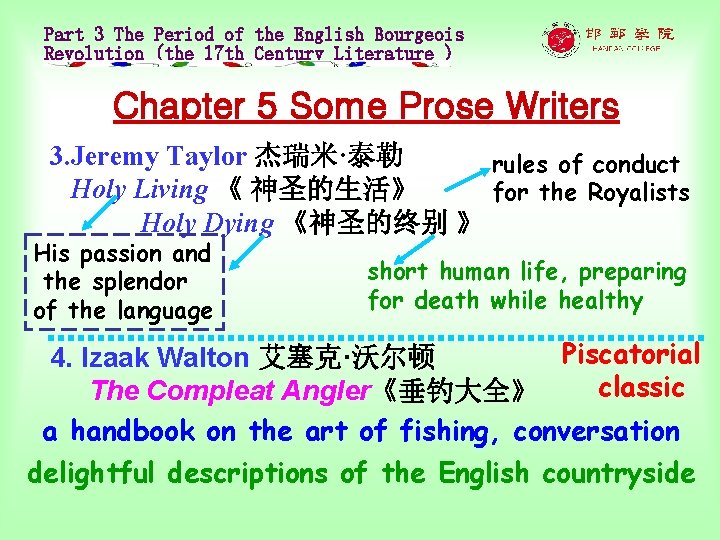
Part 3 The Period of the English Bourgeois Revolution (the 17 th Century Literature ) Chapter 5 Some Prose Writers 3. Jeremy Taylor 杰瑞米·泰勒 rules of conduct Holy Living 《 神圣的生活》 for the Royalists Holy Dying 《神圣的终别 》 His passion and the splendor of the language short human life, preparing for death while healthy Piscatorial 4. Izaak Walton 艾塞克·沃尔顿 classic The Compleat Angler《垂钓大全》 a handbook on the art of fishing, conversation delightful descriptions of the English countryside
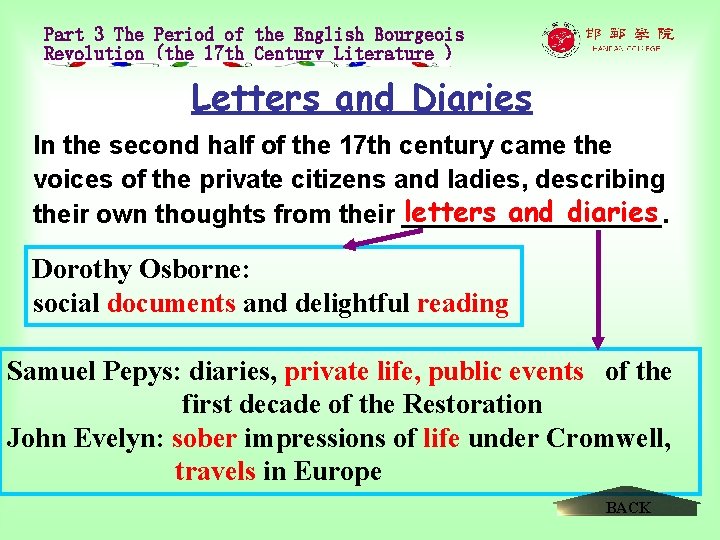
Part 3 The Period of the English Bourgeois Revolution (the 17 th Century Literature ) Letters and Diaries In the second half of the 17 th century came the voices of the private citizens and ladies, describing letters and diaries their own thoughts from their _________. Dorothy Osborne: social documents and delightful reading Samuel Pepys: diaries, private life, public events of the first decade of the Restoration John Evelyn: sober impressions of life under Cromwell, travels in Europe BACK
Part 3 The Period of the English Bourgeois Revolution (the 17 th Century Literature ) Assignment (6) 1. Remember Dryden’s works? 2. Comment on John Dryden. 3. Essay writing: BACK

Part 3 The Period of the English Bourgeois Revolution (the 17 th Century Literature ) 主要内容 1 结构 2 题目 3 摘要 4 正文 5 注释 6 文献 7 建议 8 打印
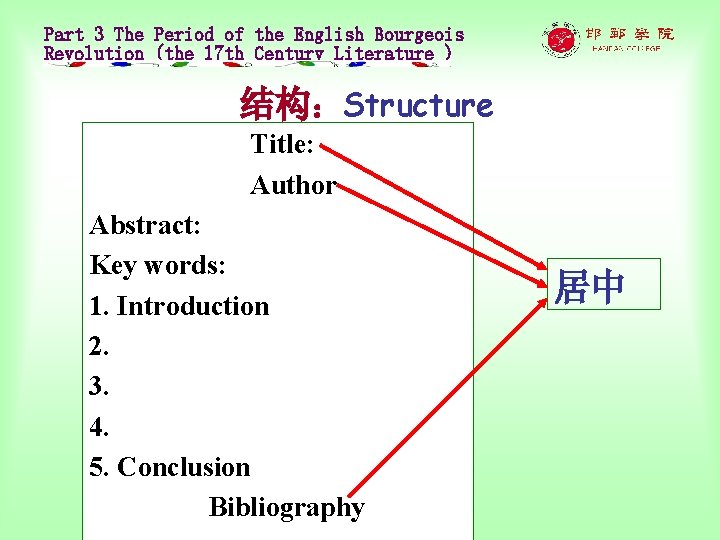
Part 3 The Period of the English Bourgeois Revolution (the 17 th Century Literature ) 结构:Structure Title: Author Abstract: Key words: 1. Introduction 2. 3. 4. 5. Conclusion Bibliography 居中
Part 3 The Period of the English Bourgeois Revolution (the 17 th Century Literature ) Paper Writing • • Title: 名词短语式 作者 班级;学号 Abstract: purpose and importance, main idea, conclusion • Key Words: names characters colors • (3— 5, 空 2格) Back
Part 3 The Period of the English Bourgeois Revolution (the 17 th Century Literature ) 题目:Title 1. The title, as an embodiment of the content of the paper, tells a lot about what the author is going to say. 2. The title should be concise and short, and wordiness should be avoided. e. g. • The Spirit of the American People Represented in Leaves of Grass • →American Spirit in Leaves of Grass
Part 3 The Period of the English Bourgeois Revolution (the 17 th Century Literature ) 题目:Title 3. Noun phrases are often used. 4. Capitalization of certain words and the italicized words should be noted. e. g. An Analysis of Hamlet in Shakespeare’s Hamlet On Symbolism in Heart of Darkness Back
Part 3 The Period of the English Bourgeois Revolution (the 17 th Century Literature ) 摘要:Abstract • An abstract is a very brief summary of the paper’s content, a presentation of its central ideas or focal points in a few sentences in about 100 words.
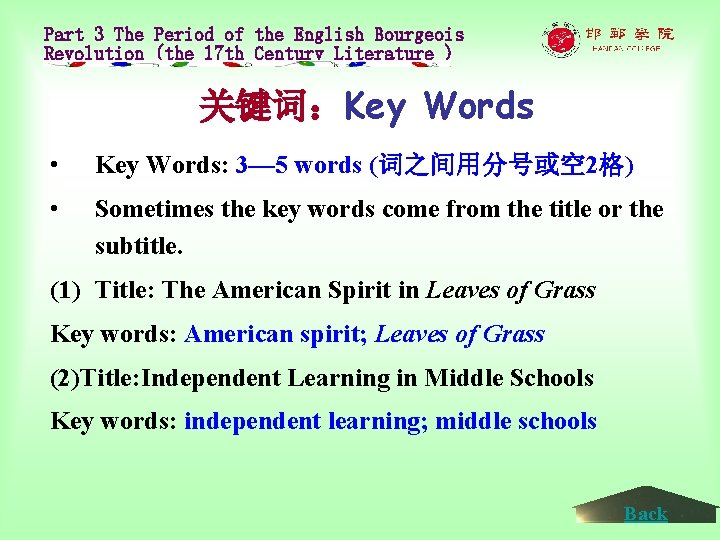
Part 3 The Period of the English Bourgeois Revolution (the 17 th Century Literature ) 关键词:Key Words • Key Words: 3— 5 words (词之间用分号或空 2格) • Sometimes the key words come from the title or the subtitle. (1) Title: The American Spirit in Leaves of Grass Key words: American spirit; Leaves of Grass (2)Title: Independent Learning in Middle Schools Key words: independent learning; middle schools Back
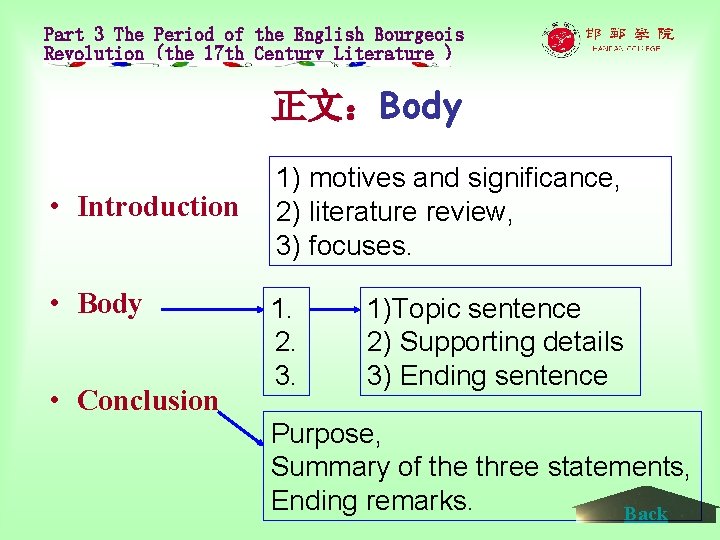
Part 3 The Period of the English Bourgeois Revolution (the 17 th Century Literature ) 正文:Body • Introduction • Body • Conclusion 1) motives and significance, 2) literature review, 3) focuses. 1. 2. 3. 1)Topic sentence 2) Supporting details 3) Ending sentence Purpose, Summary of the three statements, Ending remarks. Back
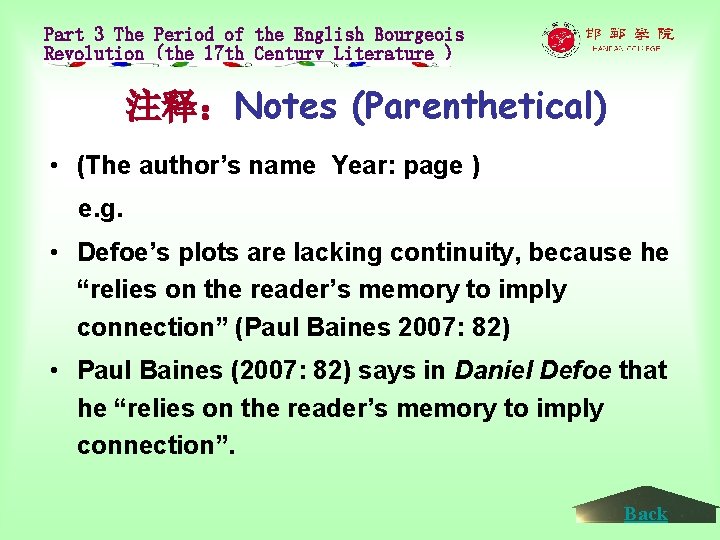
Part 3 The Period of the English Bourgeois Revolution (the 17 th Century Literature ) 注释:Notes (Parenthetical) • (The author’s name Year: page ) e. g. • Defoe’s plots are lacking continuity, because he “relies on the reader’s memory to imply connection” (Paul Baines 2007: 82) • Paul Baines (2007: 82) says in Daniel Defoe that he “relies on the reader’s memory to imply connection”. Back
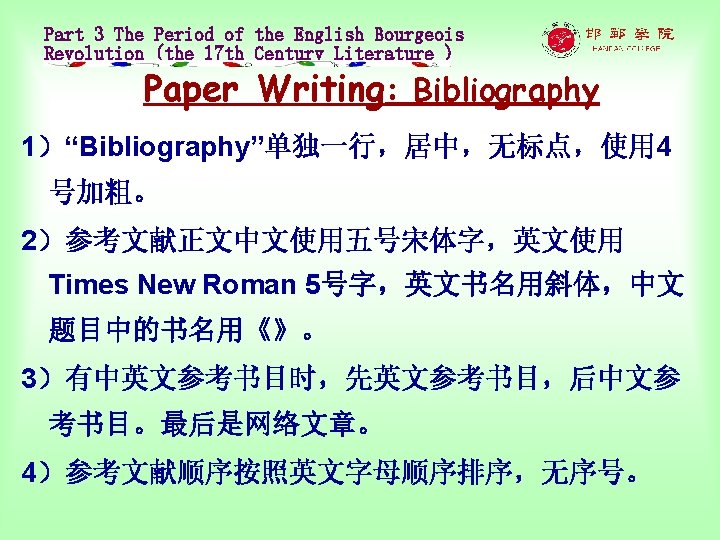
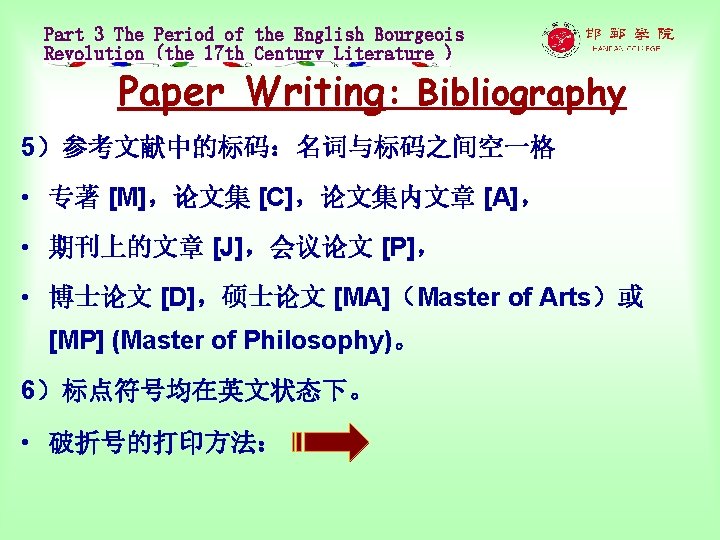
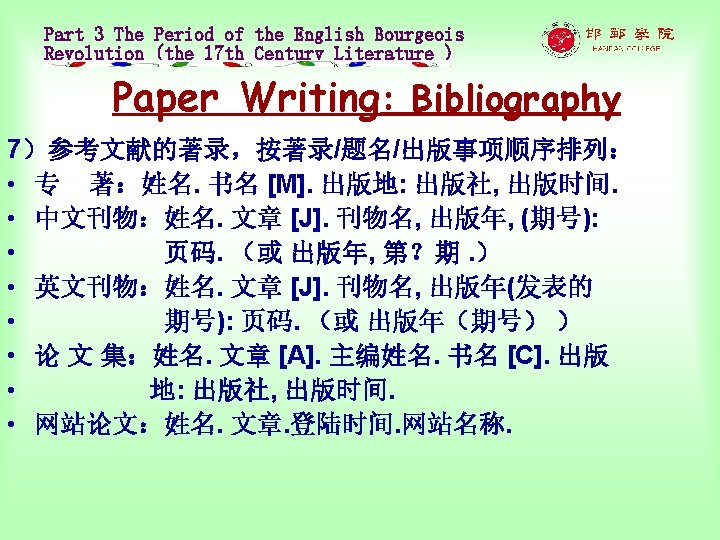
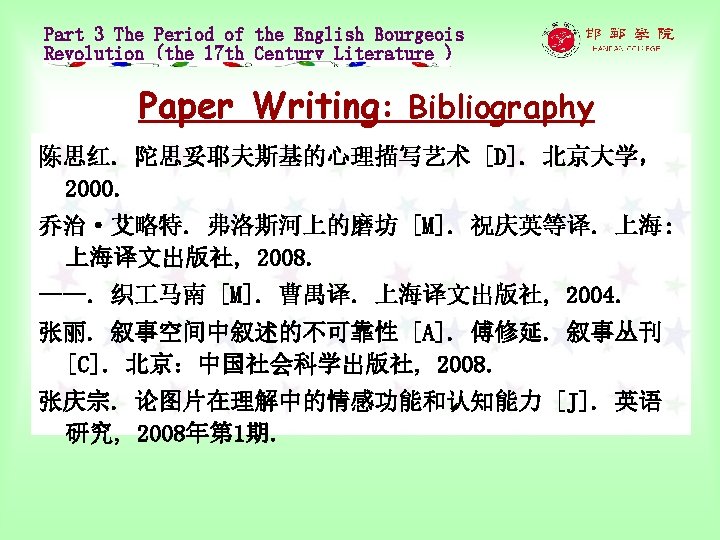
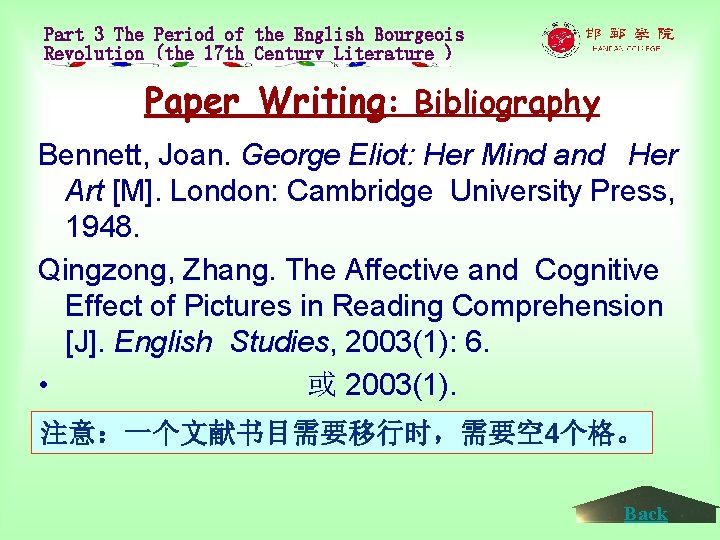
Part 3 The Period of the English Bourgeois Revolution (the 17 th Century Literature ) Paper Writing: Bibliography Bennett, Joan. George Eliot: Her Mind and Her Art [M]. London: Cambridge University Press, 1948. Qingzong, Zhang. The Affective and Cognitive Effect of Pictures in Reading Comprehension [J]. English Studies, 2003(1): 6. • 或 2003(1). 注意:一个文献书目需要移行时,需要空 4个格。 Back
Part 3 The Period of the English Bourgeois Revolution (the 17 th Century Literature ) Suggestions 1. Be serious, not humorous, casual, conversational. 2. Avoid first-person pronouns. I think, as I know, I believe, in my opinion, which imply uncertainty.
Part 3 The Period of the English Bourgeois Revolution (the 17 th Century Literature ) Suggestions 3. Pay attention to the language Concise, fluent, academic. 4. No plagiarism. You may quote, paraphrase, translate and summarize others’ ideas, but tell clearly in your paper where you take it. Back
Part 3 The Period of the English Bourgeois Revolution (the 17 th Century Literature ) 论文的字体与字号 1. 英文题目:Times New Roman,三号粗体 2. 中文姓名:宋体,四号 3. 小标题:Times New Roman,小四号粗体 4. 内容:Times New Roman, 5号字体 5. Sample Back
Part 3 The Period of the English Bourgeois Revolution (the 17 th Century Literature ) Assignments 1. Write a paper within 2000 words. 2. Pre-read Chapter 1 -3, Part Four.
Part 3 The Period of the English Bourgeois Revolution (the 17 th Century Literature ) Goodbye.
- Slides: 53