
PART 3 HISTORY AND CONTEXT Chapter 3 6
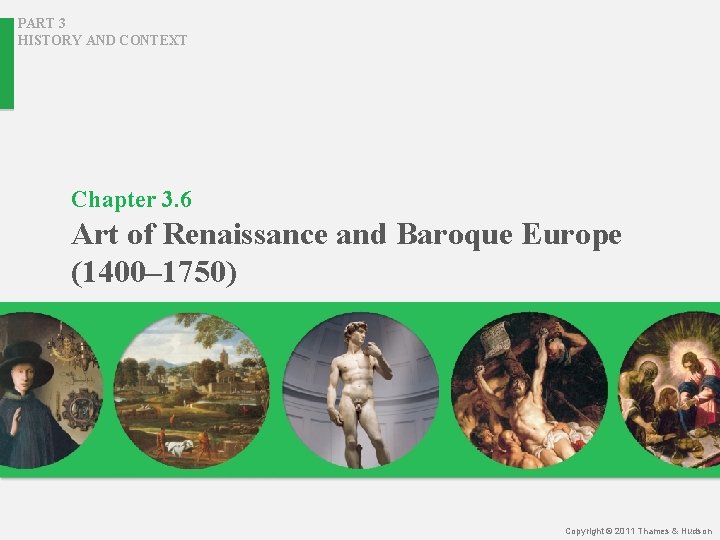
- Slides: 79
PART 3 HISTORY AND CONTEXT Chapter 3. 6 Art of Renaissance and Baroque Europe (1400– 1750) Copyright © 2011 Thames & Hudson
Chapter 3. 6 Art of Renaissance and Baroque Europe PART 3 HISTORY AND CONTEXT Introduction § Renaissance (1400– 1600) u Means “rebirth” u Refers to the time period and the style of art u A renewed interest in Classical thinking, mythology, and art § Humanism u Philosophical approach that stressed the intellectual and physical potential of human beings § Religion u Reformation and Counter-Reformation • Catholic and Protestant beliefs were reflected in the art of the Italian Renaissance and the northern Renaissance Gateways to Art: Understanding the Visual Arts, Debra J. De. Witte, Ralph M. Larmann, M. Kathryn Shields
Chapter 3. 6 Art of Renaissance and Baroque Europe PART 3 HISTORY AND CONTEXT Introduction § Baroque (1600– 1750) u Refers to the time period and the style of art u Increase in trade, advancements in science u Permanent split between Roman Catholics and Protestants u Baroque art tends to be full of motion and emotion Gateways to Art: Understanding the Visual Arts, Debra J. De. Witte, Ralph M. Larmann, M. Kathryn Shields
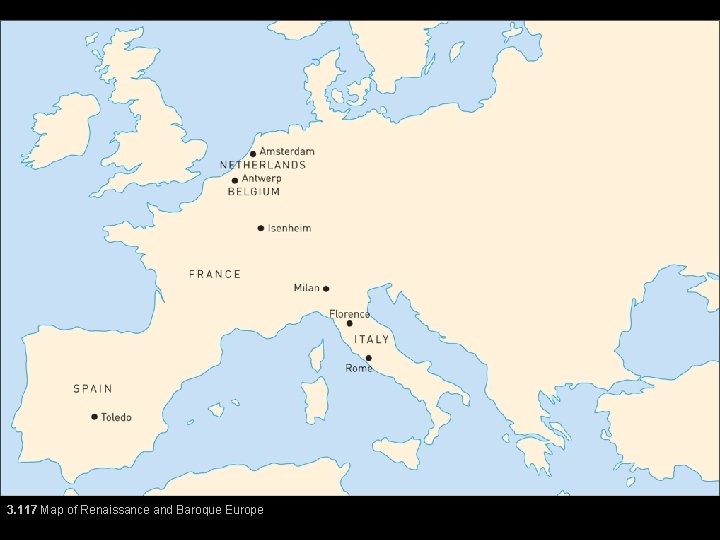
3. 117 Map of Renaissance and Baroque Europe
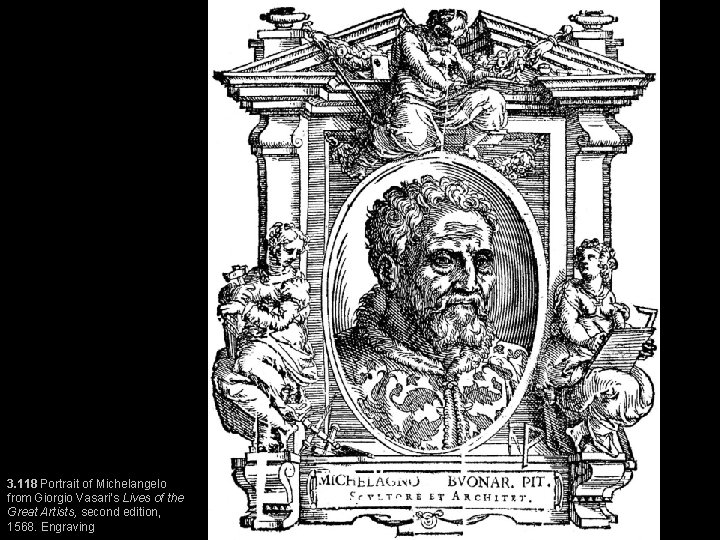
3. 118 Portrait of Michelangelo from Giorgio Vasari’s Lives of the Great Artists, second edition, 1568. Engraving
Chapter 3. 6 Art of Renaissance and Baroque Europe PART 3 HISTORY AND CONTEXT Portrait of Michelangelo from Lives of the Great Artists § The Lives of the Most Excellent Painters, Sculptors, and Architects u Written by Italian artist and historian Giorgio Vasari u Published in 1550 u Known as the first art history book u Emphasized the intellectual ability required to make art u Encouraged the view of artists as creative geniuses Gateways to Art: Understanding the Visual Arts, Debra J. De. Witte, Ralph M. Larmann, M. Kathryn Shields
Chapter 3. 6 Art of Renaissance and Baroque Europe PART 3 HISTORY AND CONTEXT The Early Renaissance in Italy § Renewed interest in the Classical past u Study of mathematics and science encouraged the systematic understanding of the world § Art was a balance of the real and ideal u u Realistic depictions of three-dimensional space and perspective Idealistic portrayal of mythological or religious subjects, and the nude figure § The artist Giotto represents the transition between the art of the Middle Ages and the early Renaissance (see chapter 3. 2) Gateways to Art: Understanding the Visual Arts, Debra J. De. Witte, Ralph M. Larmann, M. Kathryn Shields
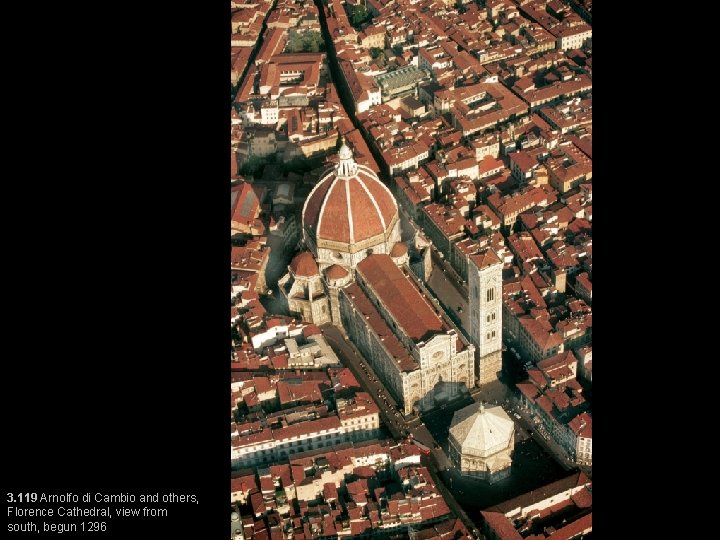
3. 119 Arnolfo di Cambio and others, Florence Cathedral, view from south, begun 1296
Chapter 3. 6 Art of Renaissance and Baroque Europe PART 3 HISTORY AND CONTEXT Florence Cathedral § Building the cathedral began in 1296, but it was still incomplete more than 100 years later u No one had figured out how to build its enormous dome § In 1419 a competition to design the dome was held u Italian sculptor and architect Filippo Brunelleschi won • He designed the dome, devised the machinery used to build it, and oversaw the construction Gateways to Art: Understanding the Visual Arts, Debra J. De. Witte, Ralph M. Larmann, M. Kathryn Shields
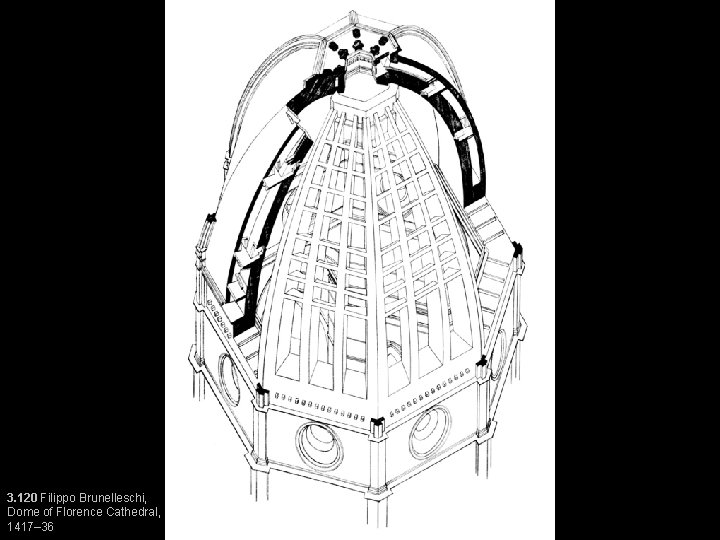
3. 120 Filippo Brunelleschi, Dome of Florence Cathedral, 1417– 36
Chapter 3. 6 Art of Renaissance and Baroque Europe PART 3 HISTORY AND CONTEXT Dome of Florence Cathedral § The construction of Brunelleschi’s dome began in 1420 u It took 16 years to complete § Dome was a great technological challenge u u u 140 feet in diameter, and 170 feet above ground at its top Brunelleschi designed the system and equipment for building it The dome structure was built layer by layer Gateways to Art: Understanding the Visual Arts, Debra J. De. Witte, Ralph M. Larmann, M. Kathryn Shields
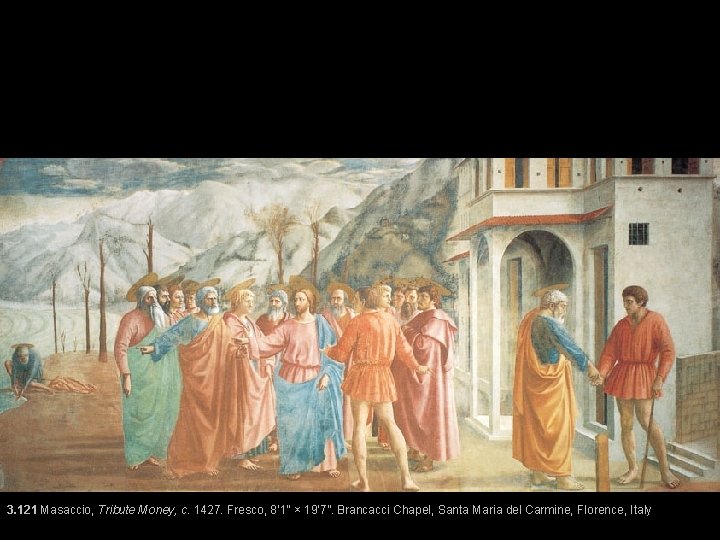
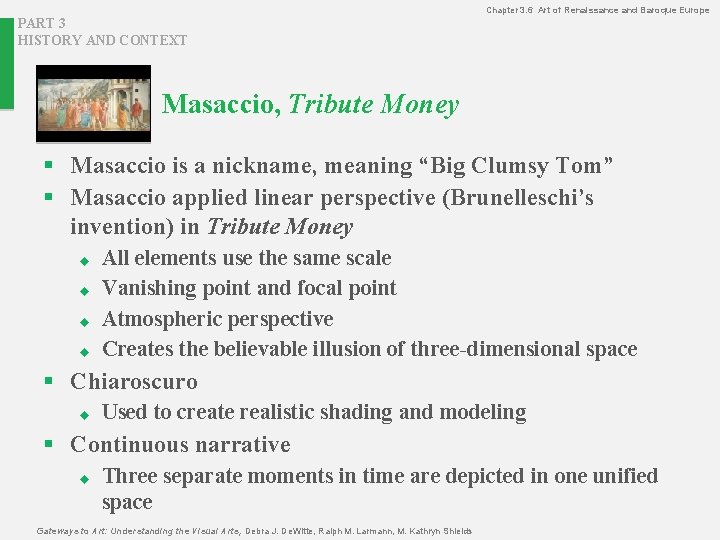
3. 121 Masaccio, Tribute Money, c. 1427. Fresco, 8’ 1” × 19’ 7”. Brancacci Chapel, Santa Maria del Carmine, Florence, Italy
Chapter 3. 6 Art of Renaissance and Baroque Europe PART 3 HISTORY AND CONTEXT Masaccio, Tribute Money § Masaccio is a nickname, meaning “Big Clumsy Tom” § Masaccio applied linear perspective (Brunelleschi’s invention) in Tribute Money u u All elements use the same scale Vanishing point and focal point Atmospheric perspective Creates the believable illusion of three-dimensional space § Chiaroscuro u Used to create realistic shading and modeling § Continuous narrative u Three separate moments in time are depicted in one unified space Gateways to Art: Understanding the Visual Arts, Debra J. De. Witte, Ralph M. Larmann, M. Kathryn Shields
Chapter 3. 6 Art of Renaissance and Baroque Europe PART 3 HISTORY AND CONTEXT The High Renaissance in Italy § Beginning of the 16 th century § Continued development of making art look “believable” u Rules of perspective u Ideal and real u Religious and mythological subject matter § Three great Italian artists dominated this period: u Leonardo da Vinci u Michelangelo u Raphael Gateways to Art: Understanding the Visual Arts, Debra J. De. Witte, Ralph M. Larmann, M. Kathryn Shields
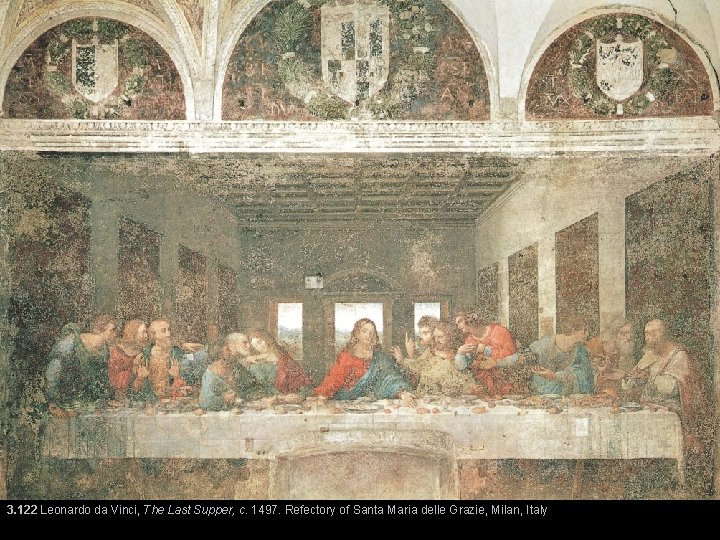
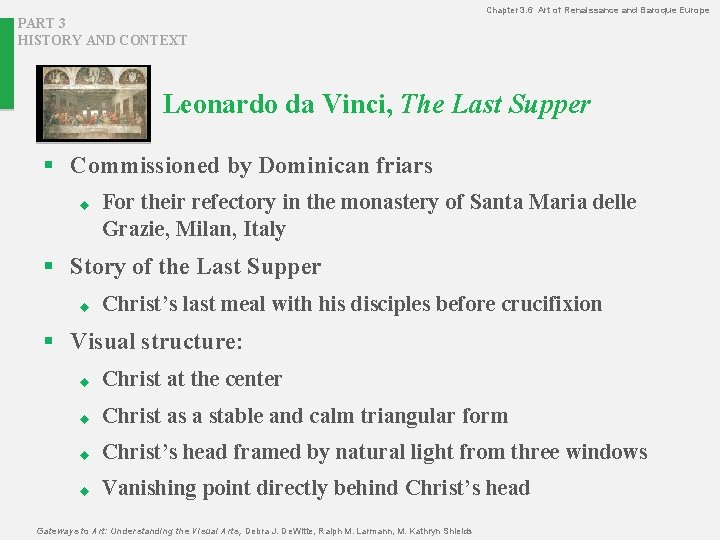
3. 122 Leonardo da Vinci, The Last Supper, c. 1497. Refectory of Santa Maria delle Grazie, Milan, Italy
Chapter 3. 6 Art of Renaissance and Baroque Europe PART 3 HISTORY AND CONTEXT Leonardo da Vinci, The Last Supper § Commissioned by Dominican friars u For their refectory in the monastery of Santa Maria delle Grazie, Milan, Italy § Story of the Last Supper u Christ’s last meal with his disciples before crucifixion § Visual structure: u Christ at the center u Christ as a stable and calm triangular form u Christ’s head framed by natural light from three windows u Vanishing point directly behind Christ’s head Gateways to Art: Understanding the Visual Arts, Debra J. De. Witte, Ralph M. Larmann, M. Kathryn Shields
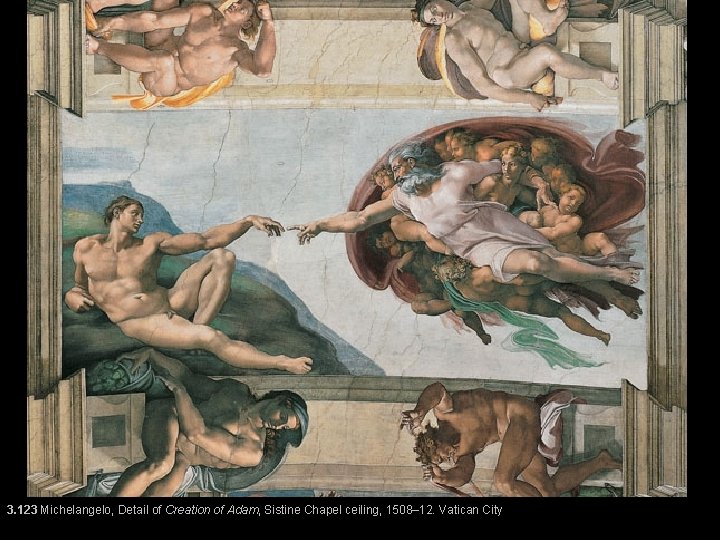
3. 123 Michelangelo, Detail of Creation of Adam, Sistine Chapel ceiling, 1508– 12. Vatican City
Chapter 3. 6 Art of Renaissance and Baroque Europe PART 3 HISTORY AND CONTEXT Michelangelo, Creation of Adam § Michelangelo was commissioned by Pope Julius II to paint the ceiling of the Sistine Chapel, Vatican City, Italy § Michelangelo preferred sculpting to painting u Three-dimensionality of his painted figures u Painted architectural and sculptural elements § Nine central panels depict the Old Testament story of Genesis § More on Michelangelo in chapters 2. 1, 2. 2, 2. 9, and 4. 4 Gateways to Art: Understanding the Visual Arts, Debra J. De. Witte, Ralph M. Larmann, M. Kathryn Shields
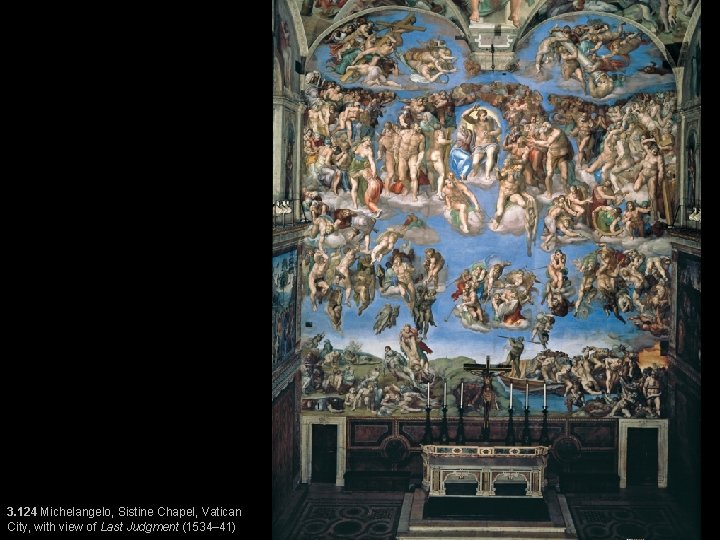
3. 124 Michelangelo, Sistine Chapel, Vatican City, with view of Last Judgment (1534– 41)
Chapter 3. 6 Art of Renaissance and Baroque Europe PART 3 HISTORY AND CONTEXT Michelangelo, Last Judgment, Sistine Chapel § Around 20 years after completing the ceiling, Michelangelo was commissioned to return to the Sistine Chapel and paint the altar wall § Last Judgment u Souls called up on the left u Blessed remain in heaven u Damned cast down into hell on the right § Energetic, chaotic effect of the scene u Reflects uncertainty of the late Renaissance Gateways to Art: Understanding the Visual Arts, Debra J. De. Witte, Ralph M. Larmann, M. Kathryn Shields
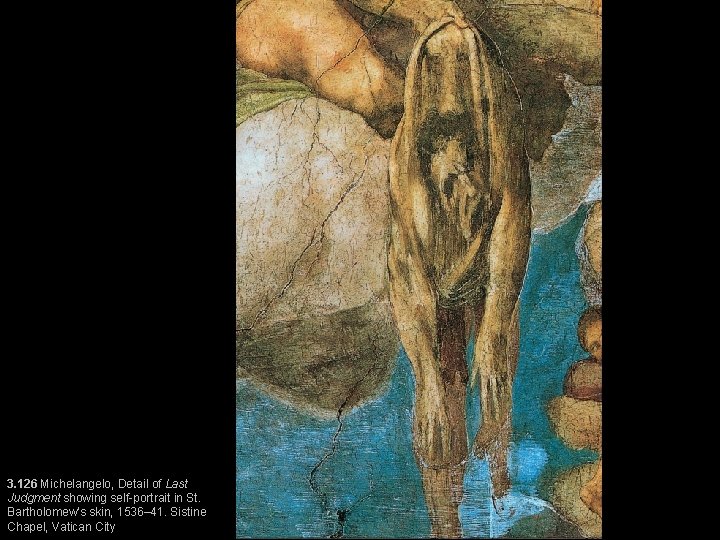
3. 126 Michelangelo, Detail of Last Judgment showing self-portrait in St. Bartholomew’s skin, 1536– 41. Sistine Chapel, Vatican City
Chapter 3. 6 Art of Renaissance and Baroque Europe PART 3 HISTORY AND CONTEXT Detail of Last Judgment showing selfportrait in St. Bartholomew’s skin § Flayed skin of St. Bartholomew u Located at the center-right of the composition § Face is a self-portrait by Michelangelo § Possible meanings: u u u Michelangelo was a tortured artist Indication of his dissatisfaction with painting commissions (his favored process was sculpting) May refer to the artist’s homosexuality Gateways to Art: Understanding the Visual Arts, Debra J. De. Witte, Ralph M. Larmann, M. Kathryn Shields
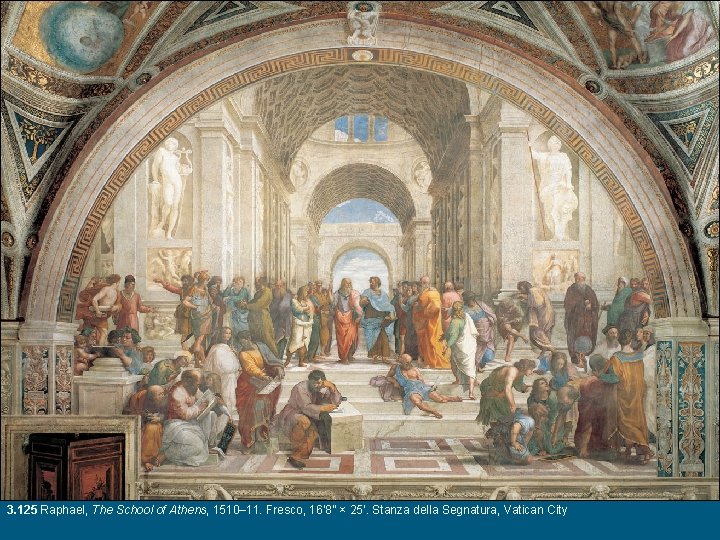
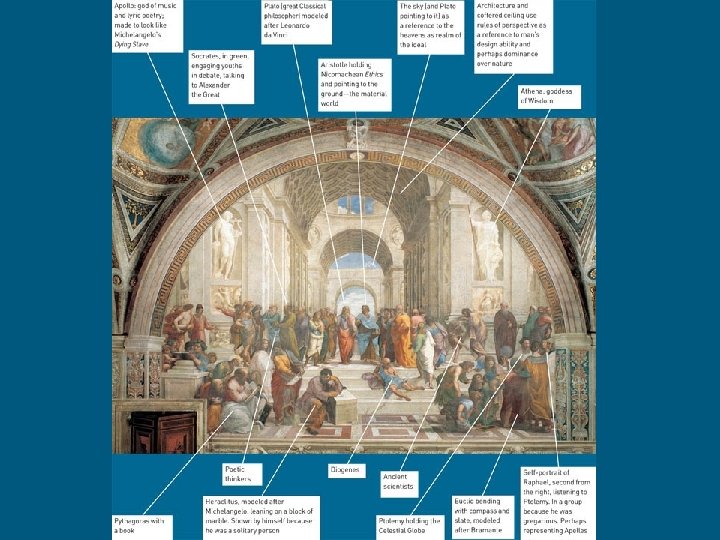
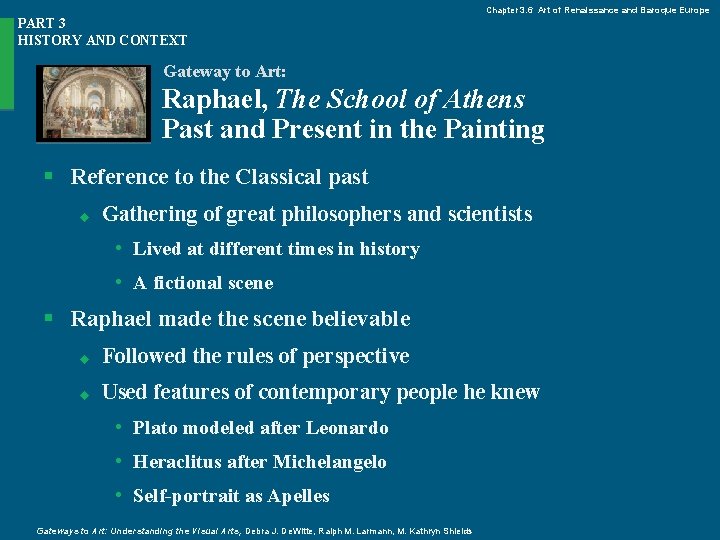
3. 125 Raphael, The School of Athens, 1510– 11. Fresco, 16’ 8” × 25’. Stanza della Segnatura, Vatican City
Chapter 3. 6 Art of Renaissance and Baroque Europe PART 3 HISTORY AND CONTEXT Gateway to Art: Raphael, The School of Athens Past and Present in the Painting § Reference to the Classical past u Gathering of great philosophers and scientists • Lived at different times in history • A fictional scene § Raphael made the scene believable u Followed the rules of perspective u Used features of contemporary people he knew • Plato modeled after Leonardo • Heraclitus after Michelangelo • Self-portrait as Apelles Gateways to Art: Understanding the Visual Arts, Debra J. De. Witte, Ralph M. Larmann, M. Kathryn Shields
Chapter 3. 6 Art of Renaissance and Baroque Europe PART 3 HISTORY AND CONTEXT The Renaissance in Northern Europe § Northern European countries we now know as the Netherlands, Germany, France, and Belgium § During the fifteenth century, artists in northern Europe: u Continued using methods established in the Middle Ages • Those used for illuminated manuscripts (see chapter 3. 2) u Paid careful attention to texture and fine detail u Developed oil painting techniques u Depicted everyday objects with religious symbolism u Were considered the finest artists in Europe at the time Gateways to Art: Understanding the Visual Arts, Debra J. De. Witte, Ralph M. Larmann, M. Kathryn Shields
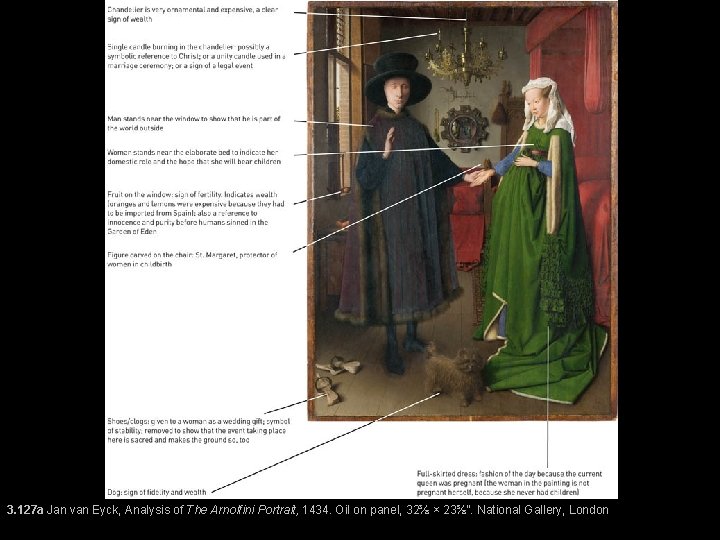
3. 127 a Jan van Eyck, Analysis of The Arnolfini Portrait, 1434. Oil on panel, 32⅜ × 23⅝”. National Gallery, London
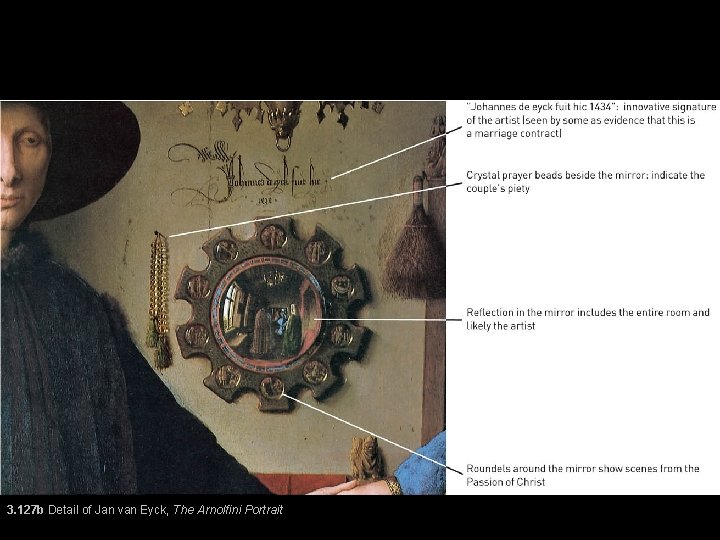
3. 127 b Detail of Jan van Eyck, The Arnolfini Portrait
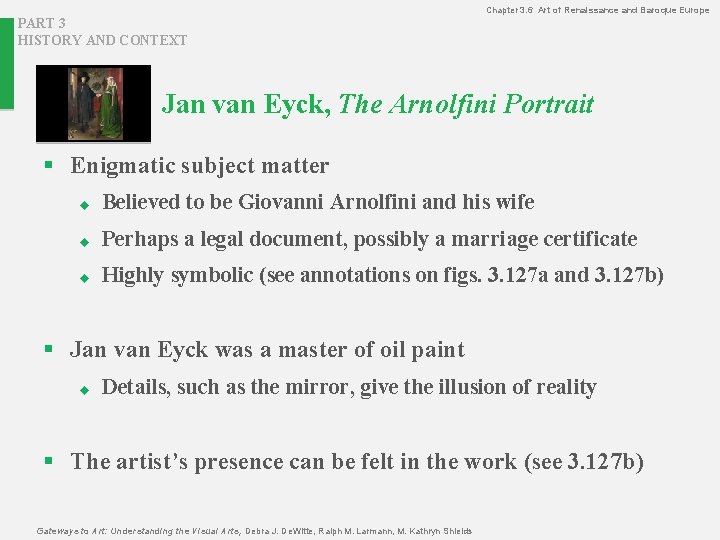
Chapter 3. 6 Art of Renaissance and Baroque Europe PART 3 HISTORY AND CONTEXT Jan van Eyck, The Arnolfini Portrait § Enigmatic subject matter u Believed to be Giovanni Arnolfini and his wife u Perhaps a legal document, possibly a marriage certificate u Highly symbolic (see annotations on figs. 3. 127 a and 3. 127 b) § Jan van Eyck was a master of oil paint u Details, such as the mirror, give the illusion of reality § The artist’s presence can be felt in the work (see 3. 127 b) Gateways to Art: Understanding the Visual Arts, Debra J. De. Witte, Ralph M. Larmann, M. Kathryn Shields
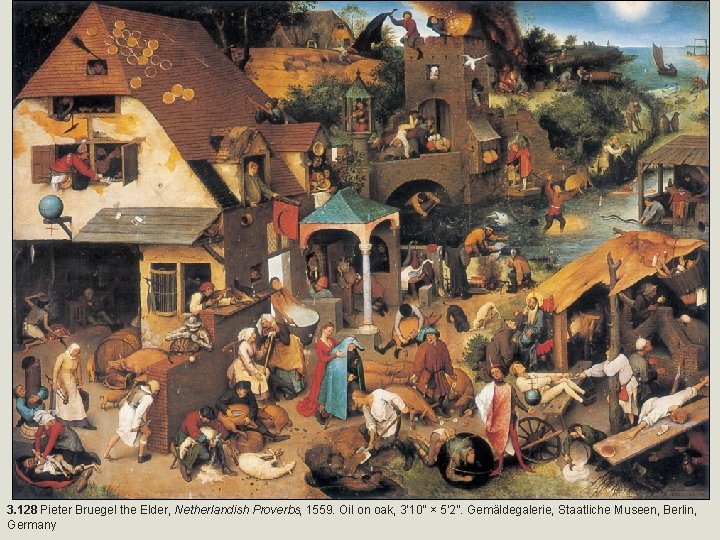
3. 128 Pieter Bruegel the Elder, Netherlandish Proverbs, 1559. Oil on oak, 3’ 10” × 5’ 2”. Gemäldegalerie, Staatliche Museen, Berlin, Germany
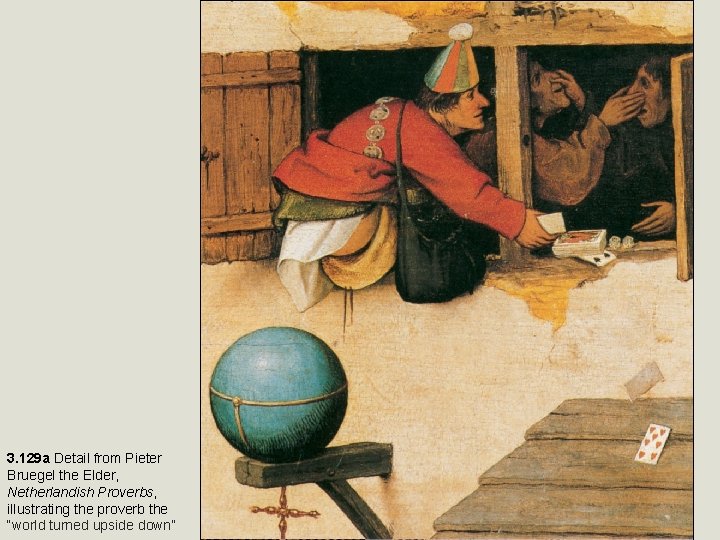
3. 129 a Detail from Pieter Bruegel the Elder, Netherlandish Proverbs, illustrating the proverb the “world turned upside down”
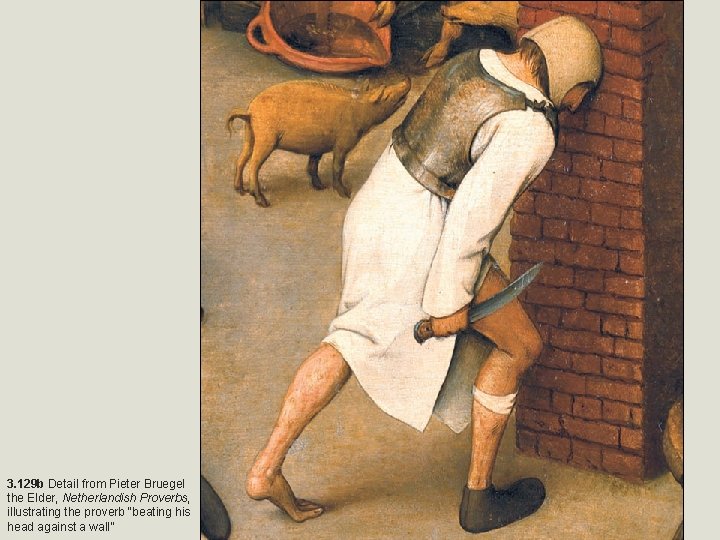
3. 129 b Detail from Pieter Bruegel the Elder, Netherlandish Proverbs, illustrating the proverb “beating his head against a wall”
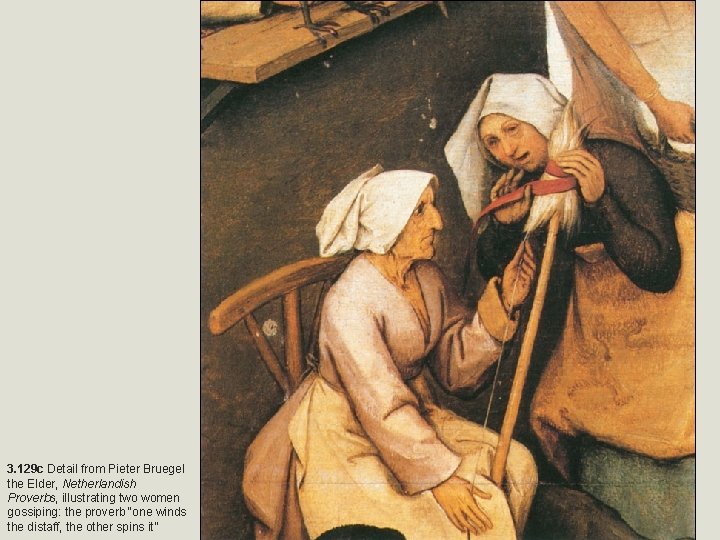
3. 129 c Detail from Pieter Bruegel the Elder, Netherlandish Proverbs, illustrating two women gossiping: the proverb “one winds the distaff, the other spins it”
Chapter 3. 6 Art of Renaissance and Baroque Europe PART 3 HISTORY AND CONTEXT Pieter Bruegel: A Sampling of Proverbs § Bruegel was interested in “types” u Such as farmers and townspeople § The people are general and universal figures u Not idealized individuals § Over 100 proverbs are illustrated in this painting u Some are now obscure u Some are still in use Gateways to Art: Understanding the Visual Arts, Debra J. De. Witte, Ralph M. Larmann, M. Kathryn Shields
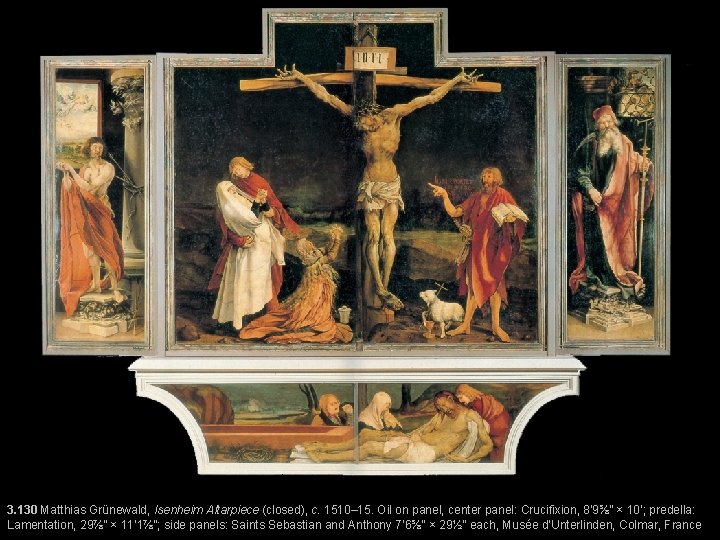
3. 130 Matthias Grünewald, Isenheim Altarpiece (closed), c. 1510– 15. Oil on panel, center panel: Crucifixion, 8’ 9⅝” × 10’; predella: Lamentation, 29⅞” × 11’ 1⅞”; side panels: Saints Sebastian and Anthony 7’ 6⅝” × 29½” each, Musée d’Unterlinden, Colmar, France
Chapter 3. 6 Art of Renaissance and Baroque Europe PART 3 HISTORY AND CONTEXT Matthias Grünewald, Isenheim Altarpiece § Made for the chapel of the Abbey of St. Anthony in Isenheim (northeastern France) u Hospital for patients with skin diseases § Very graphic depiction of Christ’s crucifixion u Patients could relate to his suffering • Green pallor of his skin • Thorns piercing his flesh • Deformed bones from hanging u Opening the altarpiece makes Christ’s limbs appear amputated Gateways to Art: Understanding the Visual Arts, Debra J. De. Witte, Ralph M. Larmann, M. Kathryn Shields
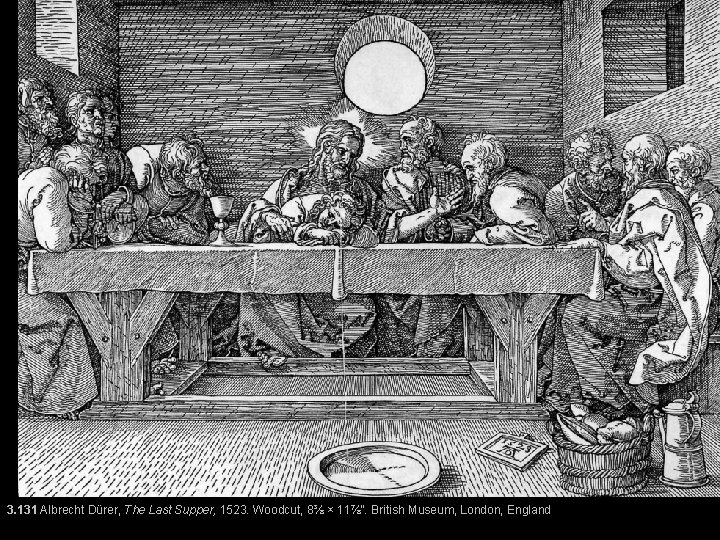
3. 131 Albrecht Dürer, The Last Supper, 1523. Woodcut, 8⅜ × 11⅞”. British Museum, London, England
Chapter 3. 6 Art of Renaissance and Baroque Europe PART 3 HISTORY AND CONTEXT Albrecht Dürer, The Last Supper § Dürer traveled to Italy twice u He was influenced by Classical subject matter u And Italian Renaissance rules of perspective and composition u This woodcut was made 25 years after Leonardo’s painting The Last Supper § Reflects the ideas of the Protestant Reformation u The doctrine of the Lutheran Church emphasizes that communion is only a re-enactment, not the literal receiving of Christ’s body and blood Gateways to Art: Understanding the Visual Arts, Debra J. De. Witte, Ralph M. Larmann, M. Kathryn Shields
Chapter 3. 6 Art of Renaissance and Baroque Europe PART 3 HISTORY AND CONTEXT Late Renaissance and Mannerism § c. 1530– 1600 § A time of historical upheaval u u 1527 Sack of Rome 1530 Charles V crowned Holy Roman Emperor § Late Renaissance art u u u A reaction to the high Renaissance Dissonance instead of harmony Distortion rather than precision § Mannerism u u From the Italian “di maniera, ” which means charm, grace Exaggeration for emotional effect Gateways to Art: Understanding the Visual Arts, Debra J. De. Witte, Ralph M. Larmann, M. Kathryn Shields
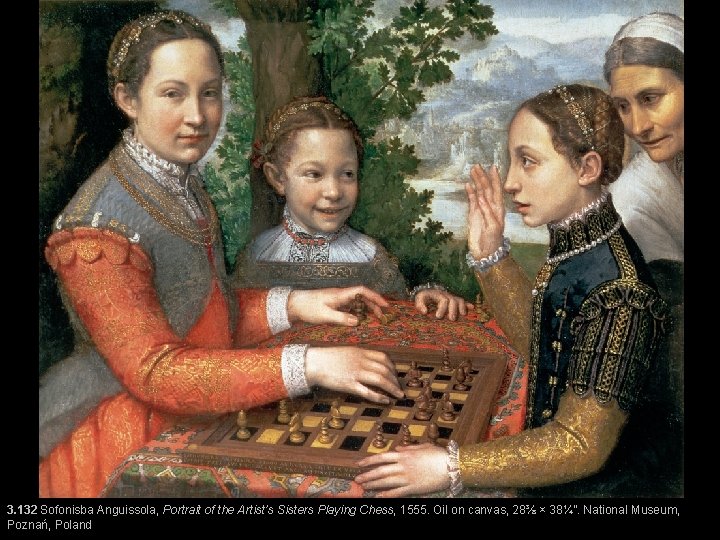
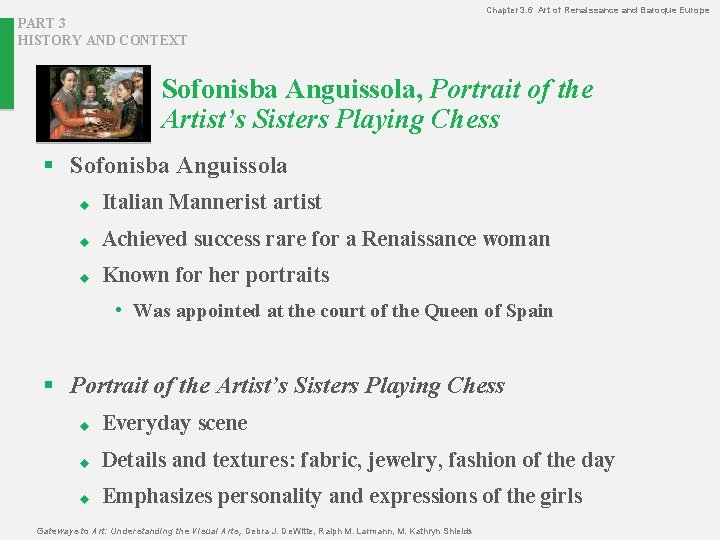
3. 132 Sofonisba Anguissola, Portrait of the Artist’s Sisters Playing Chess, 1555. Oil on canvas, 28⅜ × 38¼”. National Museum, Poznań, Poland
Chapter 3. 6 Art of Renaissance and Baroque Europe PART 3 HISTORY AND CONTEXT Sofonisba Anguissola, Portrait of the Artist’s Sisters Playing Chess § Sofonisba Anguissola u Italian Mannerist artist u Achieved success rare for a Renaissance woman u Known for her portraits • Was appointed at the court of the Queen of Spain § Portrait of the Artist’s Sisters Playing Chess u Everyday scene u Details and textures: fabric, jewelry, fashion of the day u Emphasizes personality and expressions of the girls Gateways to Art: Understanding the Visual Arts, Debra J. De. Witte, Ralph M. Larmann, M. Kathryn Shields
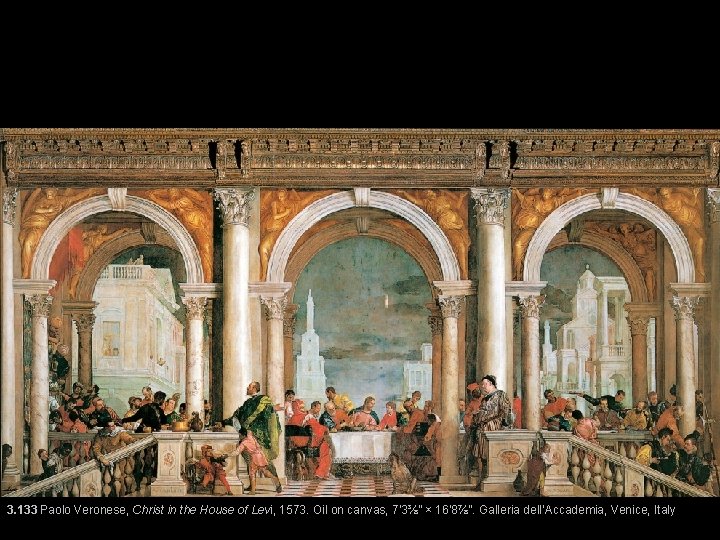
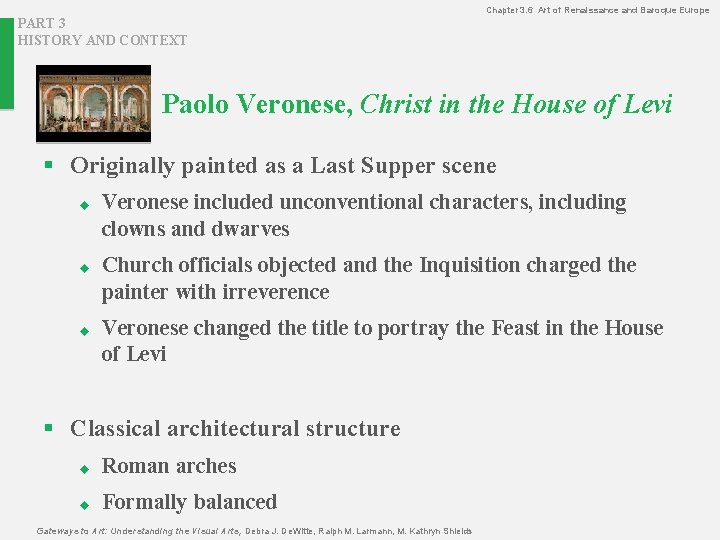
3. 133 Paolo Veronese, Christ in the House of Levi, 1573. Oil on canvas, 7’ 3⅜” × 16’ 8⅞”. Galleria dell’Accademia, Venice, Italy
Chapter 3. 6 Art of Renaissance and Baroque Europe PART 3 HISTORY AND CONTEXT Paolo Veronese, Christ in the House of Levi § Originally painted as a Last Supper scene u u u Veronese included unconventional characters, including clowns and dwarves Church officials objected and the Inquisition charged the painter with irreverence Veronese changed the title to portray the Feast in the House of Levi § Classical architectural structure u Roman arches u Formally balanced Gateways to Art: Understanding the Visual Arts, Debra J. De. Witte, Ralph M. Larmann, M. Kathryn Shields
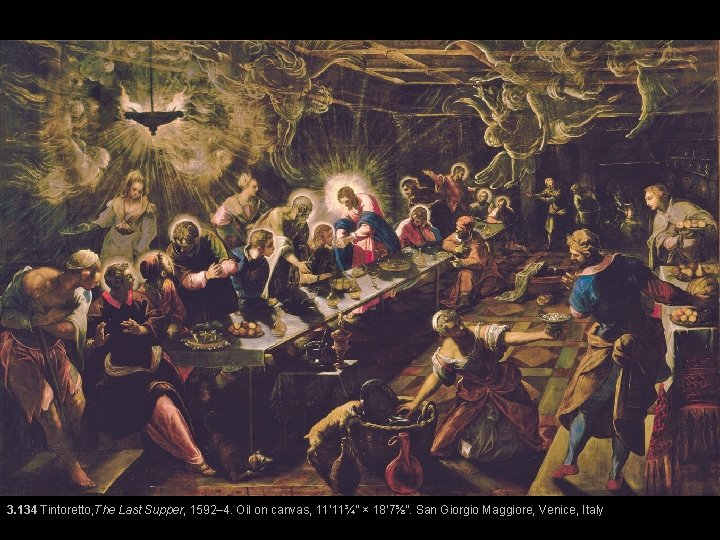
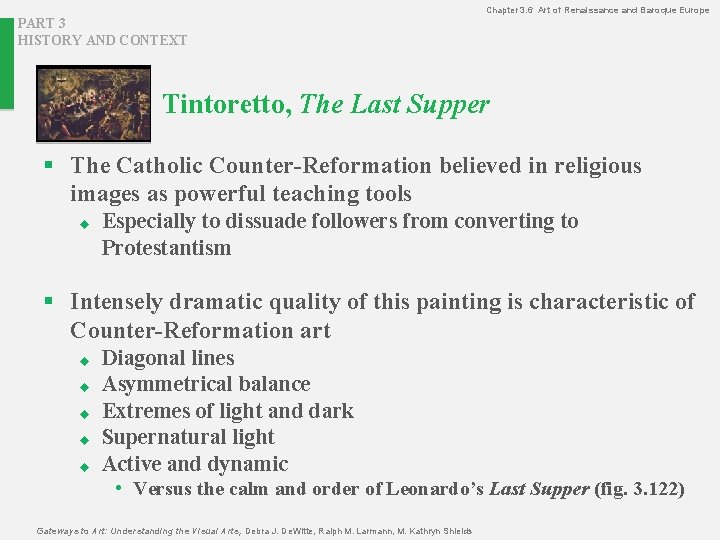
3. 134 Tintoretto, The Last Supper, 1592– 4. Oil on canvas, 11’ 11¾” × 18’ 7⅝”. San Giorgio Maggiore, Venice, Italy
Chapter 3. 6 Art of Renaissance and Baroque Europe PART 3 HISTORY AND CONTEXT Tintoretto, The Last Supper § The Catholic Counter-Reformation believed in religious images as powerful teaching tools u Especially to dissuade followers from converting to Protestantism § Intensely dramatic quality of this painting is characteristic of Counter-Reformation art u u u Diagonal lines Asymmetrical balance Extremes of light and dark Supernatural light Active and dynamic • Versus the calm and order of Leonardo’s Last Supper (fig. 3. 122) Gateways to Art: Understanding the Visual Arts, Debra J. De. Witte, Ralph M. Larmann, M. Kathryn Shields
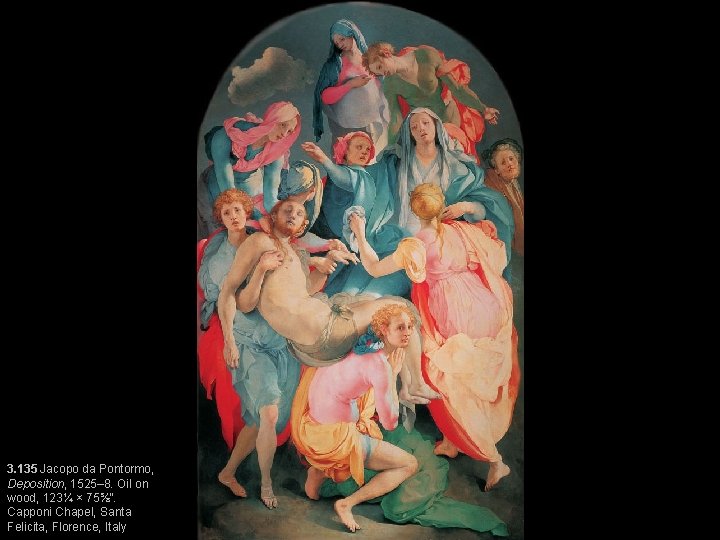
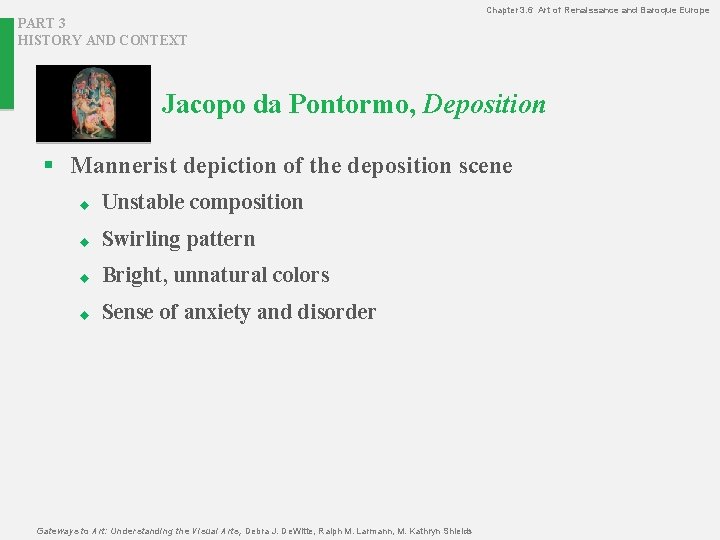
3. 135 Jacopo da Pontormo, Deposition, 1525– 8. Oil on wood, 123¼ × 75⅝”. Capponi Chapel, Santa Felicita, Florence, Italy
Chapter 3. 6 Art of Renaissance and Baroque Europe PART 3 HISTORY AND CONTEXT Jacopo da Pontormo, Deposition § Mannerist depiction of the deposition scene u Unstable composition u Swirling pattern u Bright, unnatural colors u Sense of anxiety and disorder Gateways to Art: Understanding the Visual Arts, Debra J. De. Witte, Ralph M. Larmann, M. Kathryn Shields
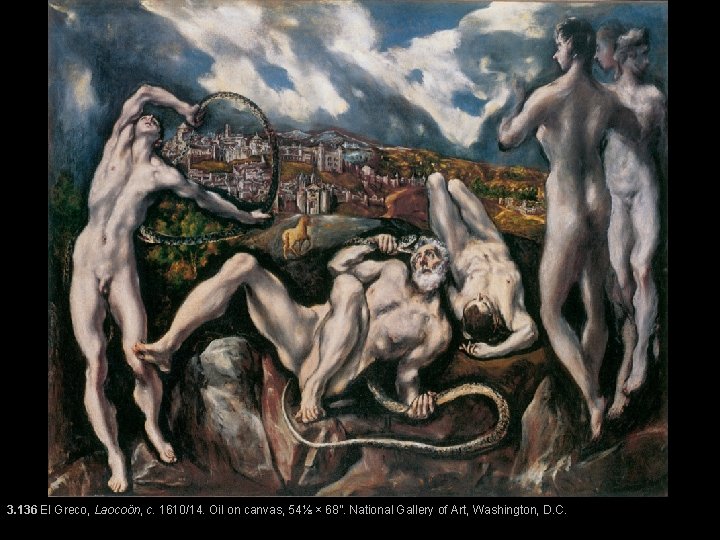
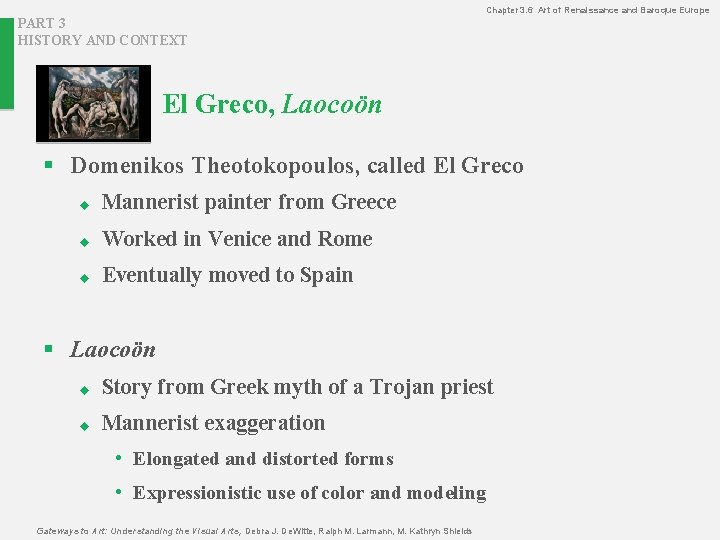
3. 136 El Greco, Laocoön, c. 1610/14. Oil on canvas, 54⅛ × 68”. National Gallery of Art, Washington, D. C.
Chapter 3. 6 Art of Renaissance and Baroque Europe PART 3 HISTORY AND CONTEXT El Greco, Laocoön § Domenikos Theotokopoulos, called El Greco u Mannerist painter from Greece u Worked in Venice and Rome u Eventually moved to Spain § Laocoön u Story from Greek myth of a Trojan priest u Mannerist exaggeration • Elongated and distorted forms • Expressionistic use of color and modeling Gateways to Art: Understanding the Visual Arts, Debra J. De. Witte, Ralph M. Larmann, M. Kathryn Shields
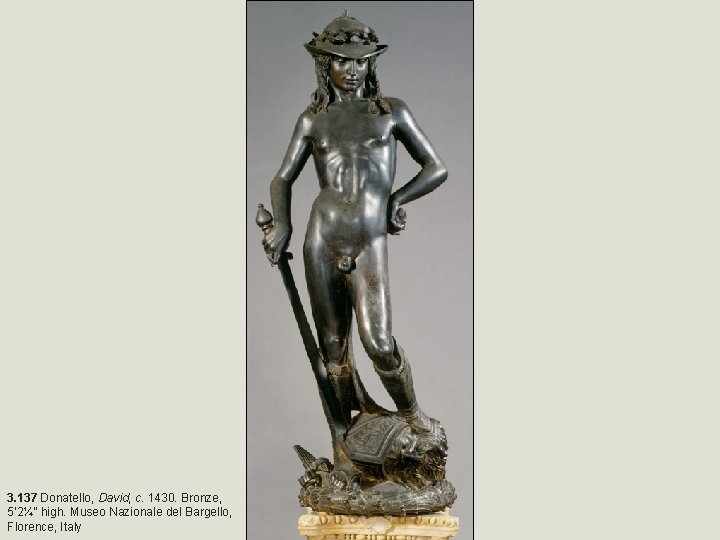
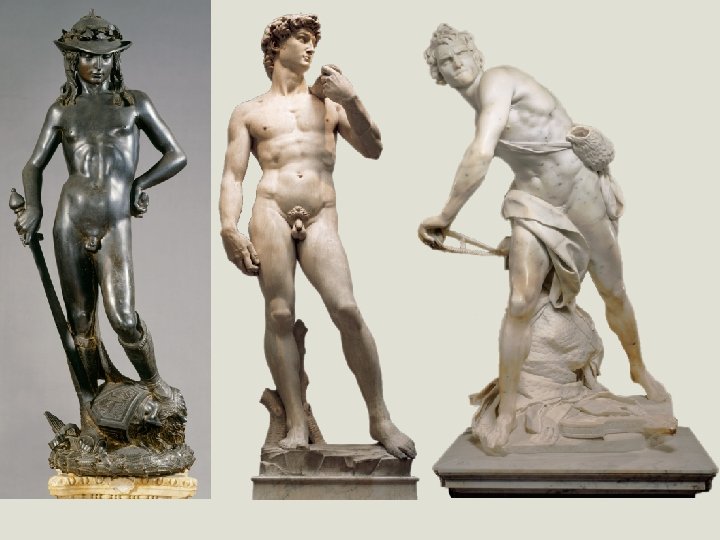
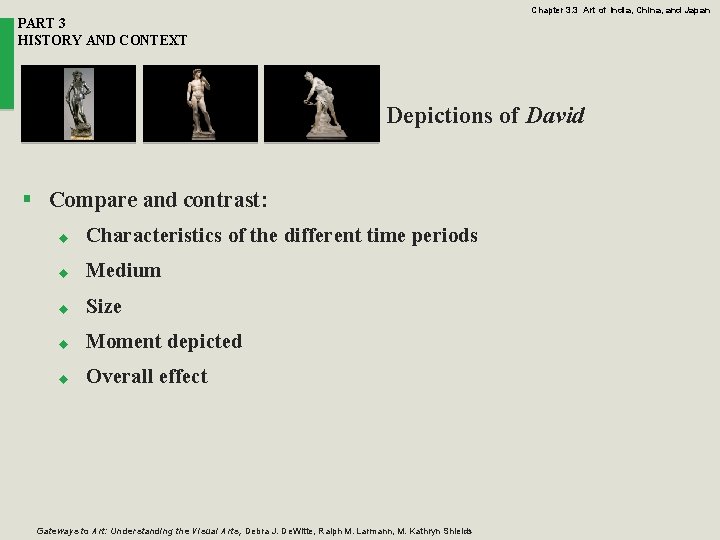
3. 137 Donatello, David, c. 1430. Bronze, 5’ 2¼” high. Museo Nazionale del Bargello, Florence, Italy
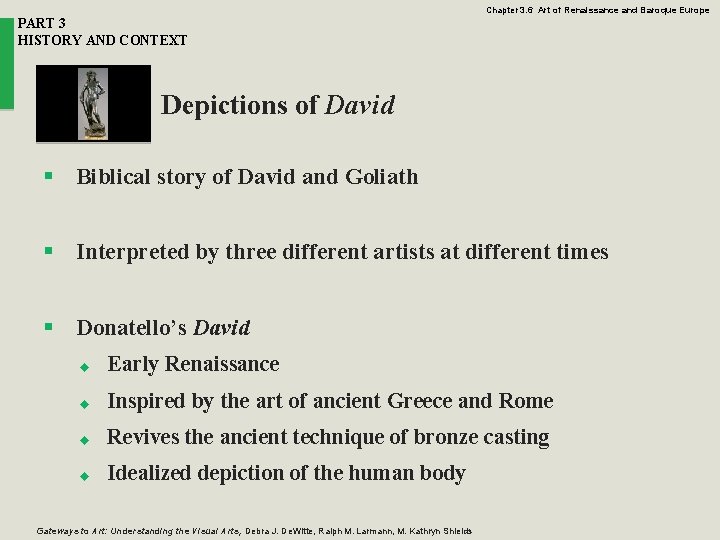
Chapter 3. 6 Art of Renaissance and Baroque Europe PART 3 HISTORY AND CONTEXT Depictions of David § Biblical story of David and Goliath § Interpreted by three different artists at different times § Donatello’s David u Early Renaissance u Inspired by the art of ancient Greece and Rome u Revives the ancient technique of bronze casting u Idealized depiction of the human body Gateways to Art: Understanding the Visual Arts, Debra J. De. Witte, Ralph M. Larmann, M. Kathryn Shields
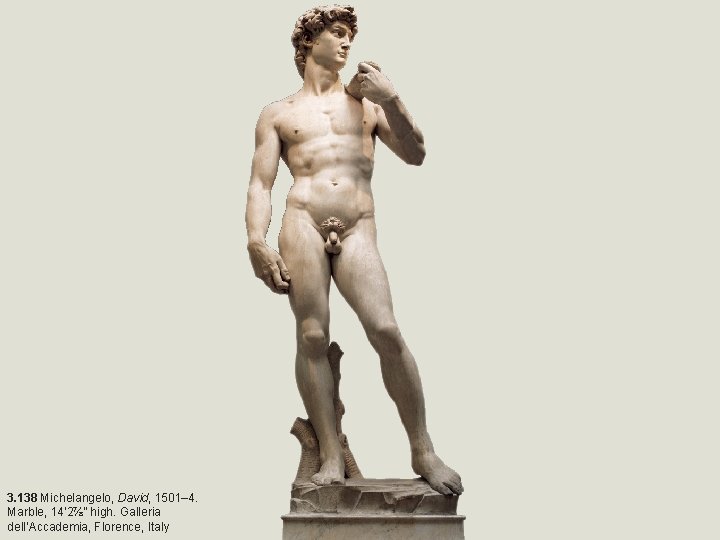
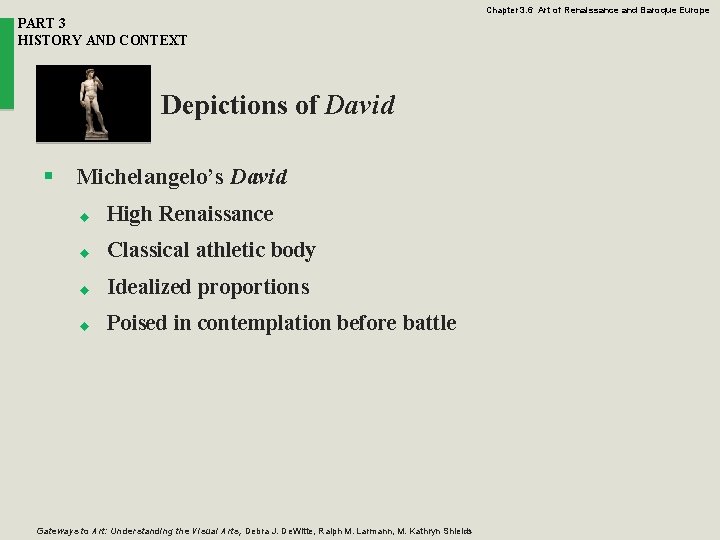
3. 138 Michelangelo, David, 1501– 4. Marble, 14’ 2⅞” high. Galleria dell’Accademia, Florence, Italy
Chapter 3. 6 Art of Renaissance and Baroque Europe PART 3 HISTORY AND CONTEXT Depictions of David § Michelangelo’s David u High Renaissance u Classical athletic body u Idealized proportions u Poised in contemplation before battle Gateways to Art: Understanding the Visual Arts, Debra J. De. Witte, Ralph M. Larmann, M. Kathryn Shields
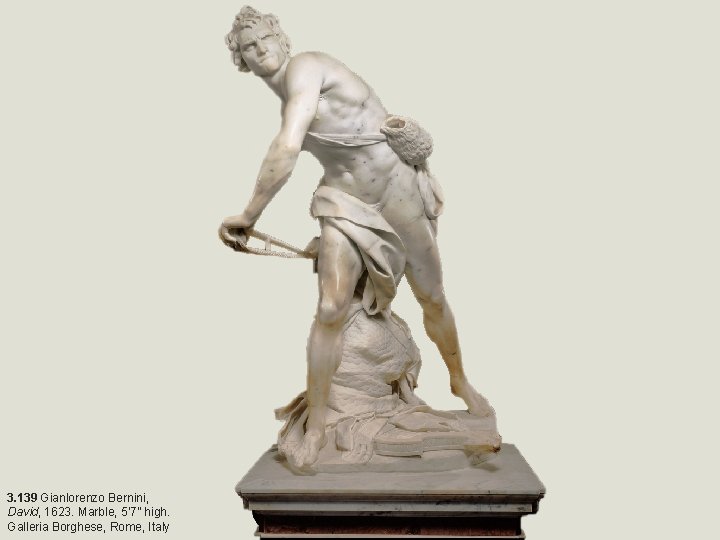
3. 139 Gianlorenzo Bernini, David, 1623. Marble, 5’ 7” high. Galleria Borghese, Rome, Italy
Chapter 3. 6 Art of Renaissance and Baroque Europe PART 3 HISTORY AND CONTEXT Depictions of David § Bernini’s David u Baroque u Designed to be viewed in the round u Dynamic energy of pose u Even the muscles in his face are tensed Gateways to Art: Understanding the Visual Arts, Debra J. De. Witte, Ralph M. Larmann, M. Kathryn Shields
Chapter 3. 3 Art of India, China, and Japan PART 3 HISTORY AND CONTEXT Depictions of David § Compare and contrast: u Characteristics of the different time periods u Medium u Size u Moment depicted u Overall effect Gateways to Art: Understanding the Visual Arts, Debra J. De. Witte, Ralph M. Larmann, M. Kathryn Shields
Chapter 3. 6 Art of Renaissance and Baroque Europe PART 3 HISTORY AND CONTEXT The Baroque § Time of exploration and discovery u Theory that the sun was the center of the universe now accepted § Religion u Post-Reformation § Warfare u Battles throughout Europe § Artwork characteristics: u Emphasis on light u Diversity of approaches u Dramatic movement and theatrical compositions Gateways to Art: Understanding the Visual Arts, Debra J. De. Witte, Ralph M. Larmann, M. Kathryn Shields
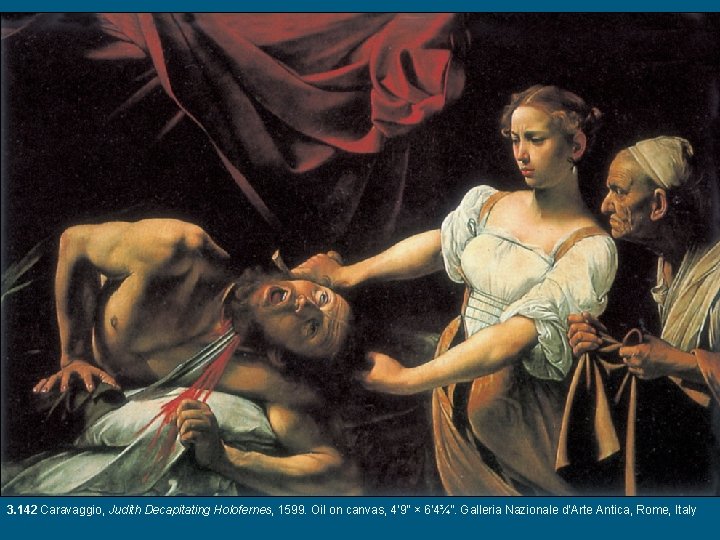
3. 142 Caravaggio, Judith Decapitating Holofernes, 1599. Oil on canvas, 4’ 9” × 6’ 4¾”. Galleria Nazionale d’Arte Antica, Rome, Italy
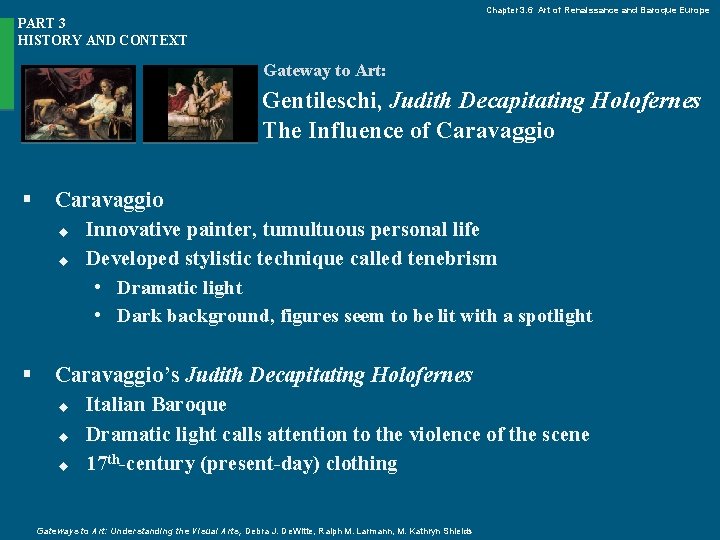
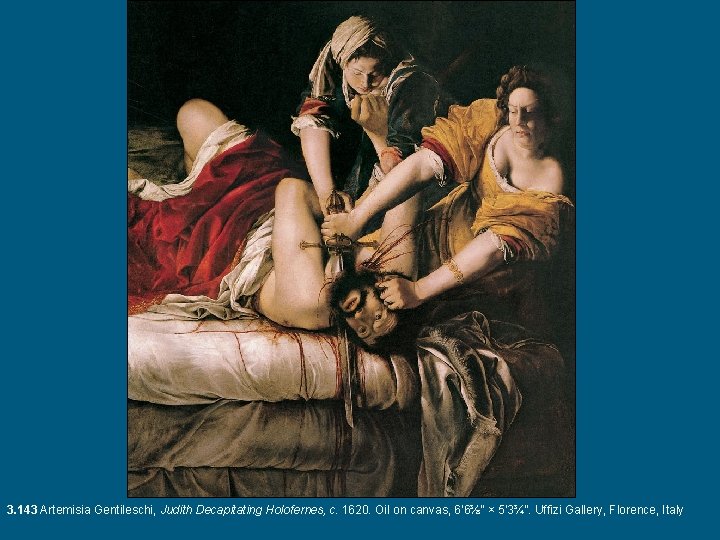
Chapter 3. 6 Art of Renaissance and Baroque Europe PART 3 HISTORY AND CONTEXT Gateway to Art: Gentileschi, Judith Decapitating Holofernes The Influence of Caravaggio § Caravaggio u u Innovative painter, tumultuous personal life Developed stylistic technique called tenebrism • Dramatic light • Dark background, figures seem to be lit with a spotlight § Caravaggio’s Judith Decapitating Holofernes u u u Italian Baroque Dramatic light calls attention to the violence of the scene 17 th-century (present-day) clothing Gateways to Art: Understanding the Visual Arts, Debra J. De. Witte, Ralph M. Larmann, M. Kathryn Shields
3. 143 Artemisia Gentileschi, Judith Decapitating Holofernes, c. 1620. Oil on canvas, 6’ 6⅜” × 5’ 3¾”. Uffizi Gallery, Florence, Italy
Chapter 3. 6 Art of Renaissance and Baroque Europe PART 3 HISTORY AND CONTEXT Gateway to Art: Gentileschi, Judith Decapitating Holofernes The Influence of Caravaggio § Gentileschi’s Judith Decapitating Holofernes u Influenced by Caravaggio’s use of realism and tenebrism u Both scenes emphasize violence u Gentileschi’s Judith appears physically stronger and more active in the murder Gateways to Art: Understanding the Visual Arts, Debra J. De. Witte, Ralph M. Larmann, M. Kathryn Shields
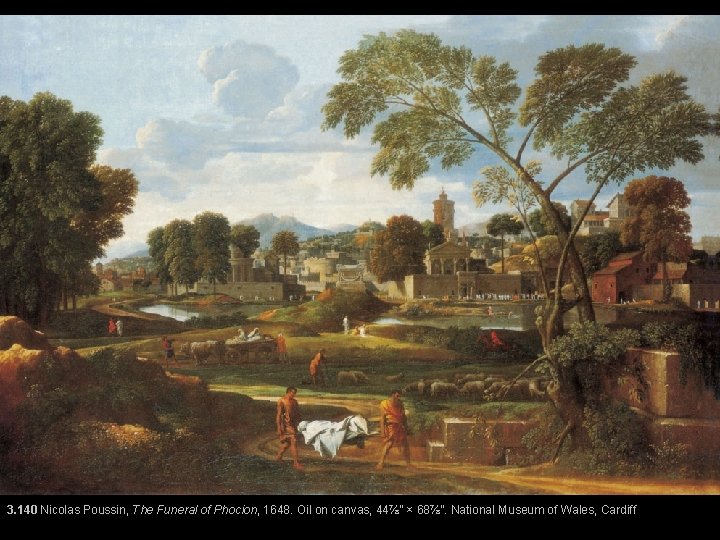
3. 140 Nicolas Poussin, The Funeral of Phocion, 1648. Oil on canvas, 44⅞” × 68⅞”. National Museum of Wales, Cardiff
Chapter 3. 6 Art of Renaissance and Baroque Europe PART 3 HISTORY AND CONTEXT Nicholas Poussin, The Funeral of Phocion § French Baroque § Nicholas Poussin u Carefully planned his compositions u Specialized in subjects from Classical antiquity § The Funeral of Phocion u Story of an Athenian general falsely executed for treason u Space organized to guide the viewer through the landscape u Balance and order Gateways to Art: Understanding the Visual Arts, Debra J. De. Witte, Ralph M. Larmann, M. Kathryn Shields
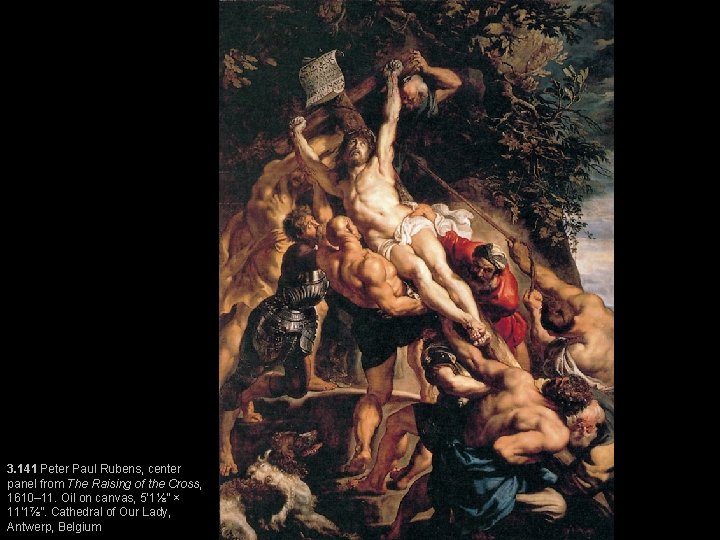
3. 141 Peter Paul Rubens, center panel from The Raising of the Cross, 1610– 11. Oil on canvas, 5’ 1⅛” × 11’ 1⅞”. Cathedral of Our Lady, Antwerp, Belgium
Chapter 3. 6 Art of Renaissance and Baroque Europe PART 3 HISTORY AND CONTEXT Peter Paul Rubens, The Raising of the Cross § Flemish Baroque § Peter Paul Rubens u u u Very prolific artist Operated a large workshop with assistants Received many commissions from wealthy merchants § The Raising of the Cross u u Center panel of an altarpiece for a church Focus on Christ’s body • Strong diagonal lines • Bright light • Muscular body, immaculate flesh Gateways to Art: Understanding the Visual Arts, Debra J. De. Witte, Ralph M. Larmann, M. Kathryn Shields
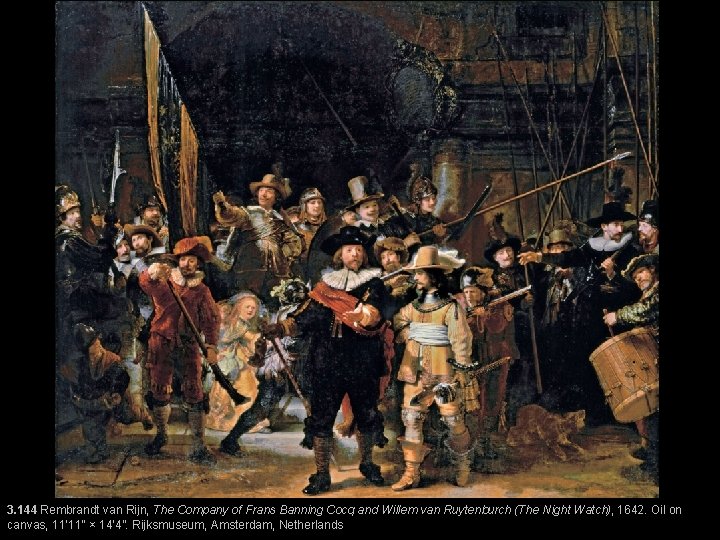
3. 144 Rembrandt van Rijn, The Company of Frans Banning Cocq and Willem van Ruytenburch (The Night Watch), 1642. Oil on canvas, 11’ 11” × 14’ 4”. Rijksmuseum, Amsterdam, Netherlands
Chapter 3. 6 Art of Renaissance and Baroque Europe PART 3 HISTORY AND CONTEXT Rembrandt van Rijn, The Night Watch § Dutch Baroque § Rembrandt u Impressive reputation as an artist § The Night Watch u Commissioned by the Dutch civic militia • Depicts a gathering of officers and guardsmen u Skillful use of lighting techniques • Chiaroscuro, tenebrism u Believed to be a night scene • Until it was cleaned after WWII, when it was revealed that the dark atmosphere was a result of years of accumulated dirt and layers of varnish Gateways to Art: Understanding the Visual Arts, Debra J. De. Witte, Ralph M. Larmann, M. Kathryn Shields
Chapter 3. 6 Art of Renaissance and Baroque Europe PART 3 HISTORY AND CONTEXT The following videos will show you more about the art and architecture of the Renaissance and the Baroque: St. Peter’s Basilica and the Sistine Chapel Click the image above to launch the video Gateways to Art: Understanding the Visual Arts, Debra J. De. Witte, Ralph M. Larmann, M. Kathryn Shields
Chapter 3. 6 Art of Renaissance and Baroque Europe PART 3 HISTORY AND CONTEXT Gianlorenzo Bernini: The Ecstasy of St. Teresa Click the image above to launch the video Gateways to Art: Understanding the Visual Arts, Debra J. De. Witte, Ralph M. Larmann, M. Kathryn Shields
Chapter 3. 6 Art of Renaissance and Baroque Europe PART 3 HISTORY AND CONTEXT Sandro Botticelli: The Birth of Venus Click the image above to launch the video Gateways to Art: Understanding the Visual Arts, Debra J. De. Witte, Ralph M. Larmann, M. Kathryn Shields
Chapter 3. 6 Art of Renaissance and Baroque Europe PART 3 HISTORY AND CONTEXT Diego Velázquez: Las Meninas Click the image above to launch the video Gateways to Art: Understanding the Visual Arts, Debra J. De. Witte, Ralph M. Larmann, M. Kathryn Shields
Chapter 3. 6 Art of Renaissance and Baroque Europe PART 3 HISTORY AND CONTEXT Discussion Question 1. Find two examples of artwork in this chapter in which linear perspective plays an important part. Point out the parts of the composition that use linear perspective to create the desired illusion. Discuss what the artist wants to communicate by using linear perspective. Gateways to Art: Understanding the Visual Arts, Debra J. De. Witte, Ralph M. Larmann, M. Kathryn Shields Copyright © 2011 Thames & Hudson
Chapter 3. 6 Art of Renaissance and Baroque Europe PART 3 HISTORY AND CONTEXT Discussion Question 2. From this chapter choose a northern Renaissance artwork and an Italian Renaissance work. List the prominent characteristics of each. Include information about both the form and the content of the artworks in your lists. Gateways to Art: Understanding the Visual Arts, Debra J. De. Witte, Ralph M. Larmann, M. Kathryn Shields Copyright © 2011 Thames & Hudson
Chapter 3. 6 Art of Renaissance and Baroque Europe PART 3 HISTORY AND CONTEXT Discussion Question 3. Select three artworks that deal with subject matter from the Bible. Consider how they portray their biblical themes: examine style, medium and technique, content, and any other aspects that the artist emphasizes. You might choose works from this chapter, or elsewhere in the textbook. For example: 1. 70, 2. 148, 4. 163. Gateways to Art: Understanding the Visual Arts, Debra J. De. Witte, Ralph M. Larmann, M. Kathryn Shields Copyright © 2011 Thames & Hudson
Chapter 3. 6 Art of Renaissance and Baroque Europe PART 3 HISTORY AND CONTEXT Discussion Question 4. Select a Renaissance work and a Baroque work from this chapter. List their similarities and differences. Consider their subject matter, style, content, and emotional impact. Gateways to Art: Understanding the Visual Arts, Debra J. De. Witte, Ralph M. Larmann, M. Kathryn Shields Copyright © 2011 Thames & Hudson
Chapter 3. 6 Art of Renaissance and Baroque Europe PART 3 HISTORY AND CONTEXT Discussion Question 5. Select three Renaissance artworks that draw on the artistic and intellectual heritage of Classical Greece and Rome. Make a list of the ways in which they use the Classical past. Make another list of any Renaissance innovations, either in terms of form or content. You might choose one work from another chapter in the textbook, for example: 4. 133, 4. 136. Gateways to Art: Understanding the Visual Arts, Debra J. De. Witte, Ralph M. Larmann, M. Kathryn Shields Copyright © 2011 Thames & Hudson
Chapter 3. 6 Art of Renaissance and Baroque Europe PART 3 HISTORY AND CONTEXT This concludes the Power. Point slide set for Chapter 3. 6 Gateways to Art: Understanding the Visual Arts By Debra J. De. Witte, Ralph M. Larmann, M. Kathryn Shields Copyright © 2011 Thames & Hudson Power. Points developed by Creative. Myndz Multimedia Studios
Chapter 3. 6 Art of Renaissance and Baroque Europe PART 3 HISTORY AND CONTEXT Picture Credits for Chapter 3. 6 3. 117 Drazen Tomic 3. 118 From Vasari, G. , Lives of the Great Artists, 1568 3. 119 © Michael S. Yamashita/Corbis 3. 120 Libreria dello Stato, Rome 3. 121 Brancacci Chapel, Church of Santa Maria del Carmine, Florence 3. 122 Refectory of Sta Maria delle Grazie, Milan 3. 123, 3. 124 Vatican Museums, Rome 3. 125 Stanza della Segnatura, Vatican Museums, Rome 3. 126 Vatican Museums, Rome 3. 127 a, 3. 127 b National Gallery, London/Scala, Florence 3. 128, 3. 129 a, 3. 129 b, 3. 129 c Gemäldegalerie, Staatliche Museen, Berlin 3. 130 Musée d’Unterlinden, Colmar 3. 131 British Museum, London 3. 132 Museum Narodowe, Poznan´/Bridgeman Art Library 3. 133 Galleria dell’Accademia, Venice 3. 134 Cameraphoto/Scala, Florence 3. 135 Capponi Chapel, Church of Santa Felicità, Florence 3. 136 National Gallery of Art, Washington, D. C. , Samuel H. Kress Collection, 1946. 18. 1 3. 137 Photo Scala, Florence, courtesy Ministero Beni e Att. Culturali 3. 138 © nagelestock. com/Alamy 3. 139 Photo Scala, Florence, courtesy Ministero Beni e Att. Culturali 3. 140 The Earl of Plymouth. On loan to the National Museum of Wales, Cardiff 3. 141 Royal Institute for the Study and Conservation of Belgium’s Artistic Heritage 3. 142 Galleria Nazionale d’Arte Antica, Rome 3. 143 Galleria degli Uffizi, Florence 3. 144 Rijksmuseum, Amsterdam Power. Points developed by Creative. Myndz Multimedia Studios