
Part 3 Earthquake Information Seismic Waves Review Body
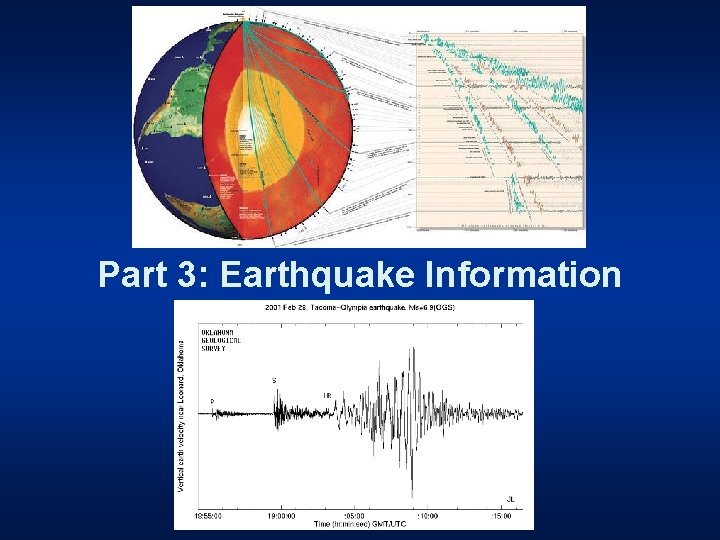
Part 3: Earthquake Information
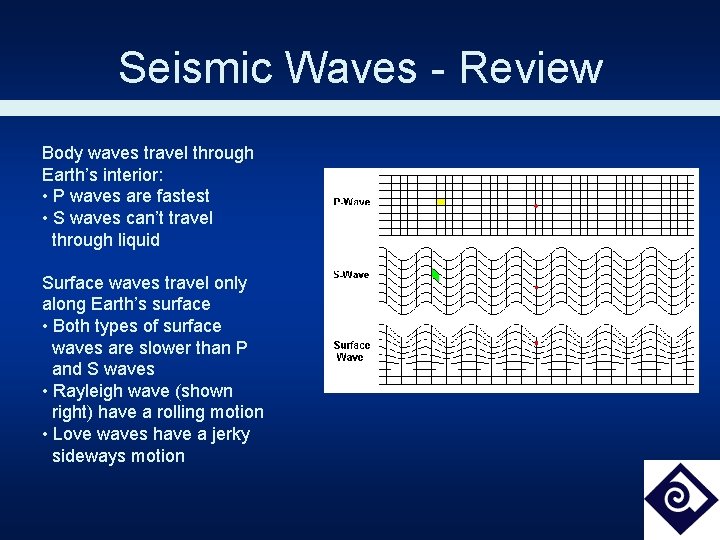
Seismic Waves - Review Body waves travel through Earth’s interior: • P waves are fastest • S waves can’t travel through liquid Surface waves travel only along Earth’s surface • Both types of surface waves are slower than P and S waves • Rayleigh wave (shown right) have a rolling motion • Love waves have a jerky sideways motion
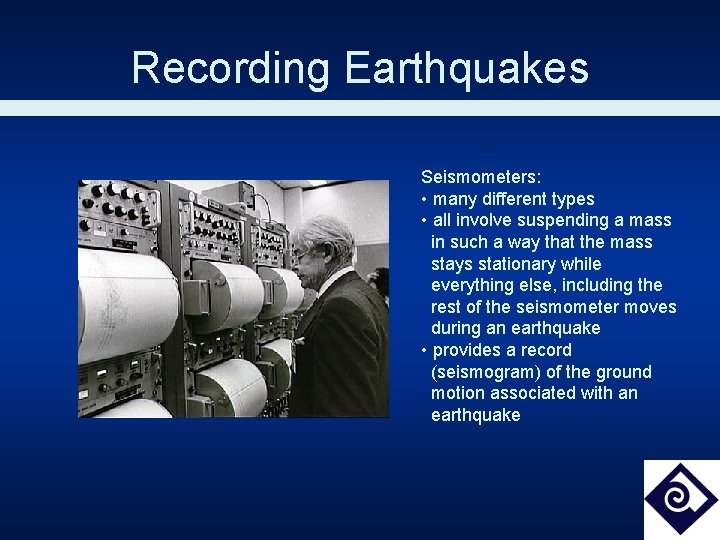
Recording Earthquakes Seismometers: • many different types • all involve suspending a mass in such a way that the mass stays stationary while everything else, including the rest of the seismometer moves during an earthquake • provides a record (seismogram) of the ground motion associated with an earthquake
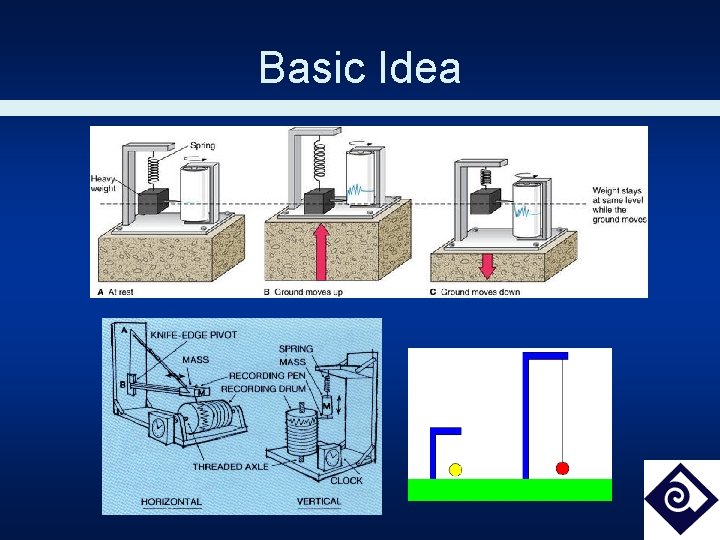
Basic Idea
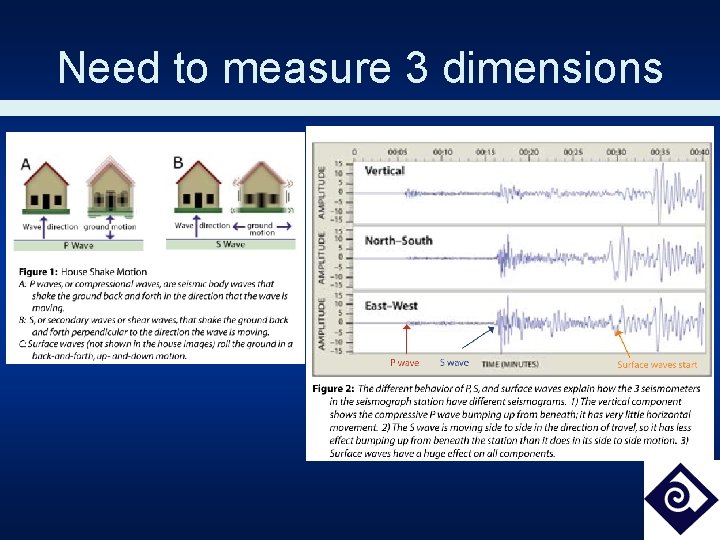
Need to measure 3 dimensions
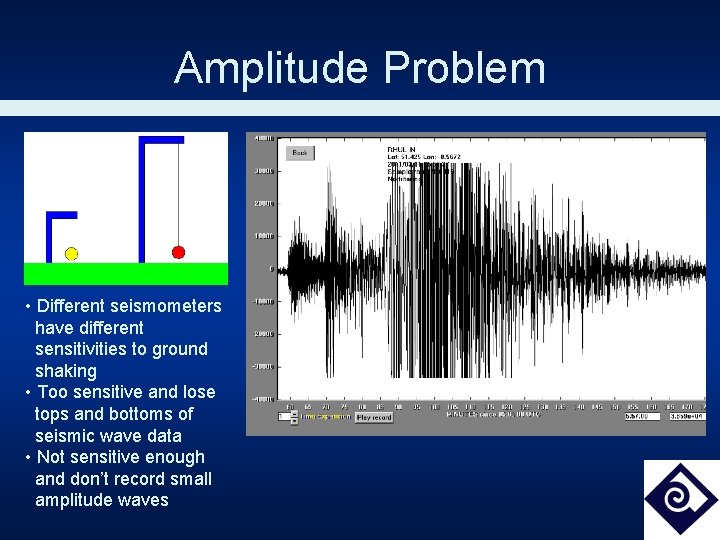
Amplitude Problem • Different seismometers have different sensitivities to ground shaking • Too sensitive and lose tops and bottoms of seismic wave data • Not sensitive enough and don’t record small amplitude waves
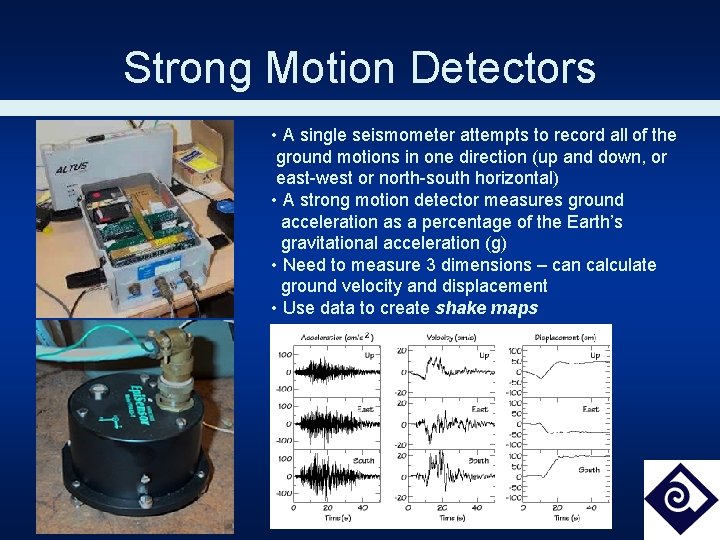
Strong Motion Detectors • A single seismometer attempts to record all of the ground motions in one direction (up and down, or east-west or north-south horizontal) • A strong motion detector measures ground acceleration as a percentage of the Earth’s gravitational acceleration (g) • Need to measure 3 dimensions – can calculate ground velocity and displacement • Use data to create shake maps
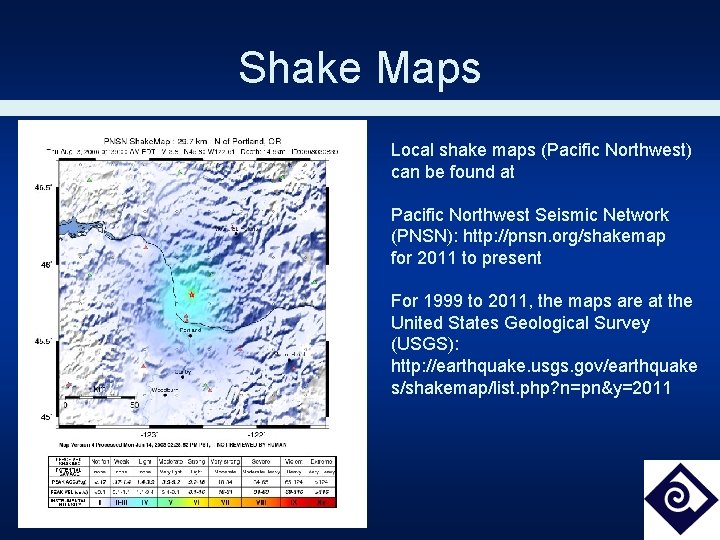
Shake Maps Local shake maps (Pacific Northwest) can be found at Pacific Northwest Seismic Network (PNSN): http: //pnsn. org/shakemap for 2011 to present For 1999 to 2011, the maps are at the United States Geological Survey (USGS): http: //earthquake. usgs. gov/earthquake s/shakemap/list. php? n=pn&y=2011
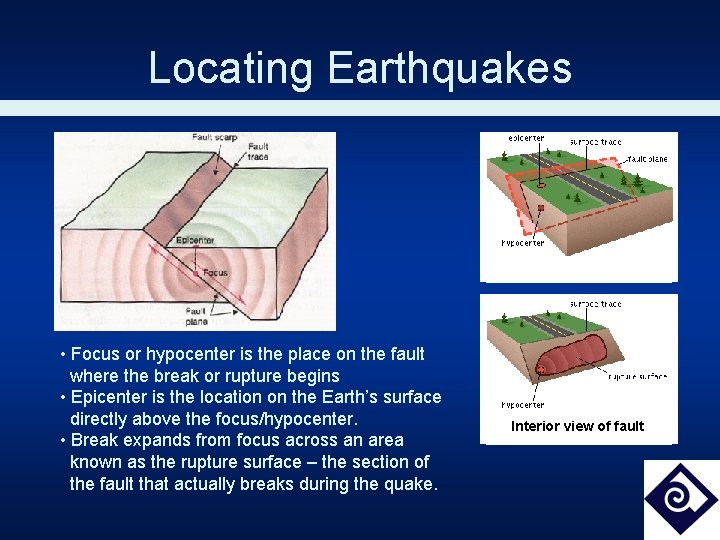
Locating Earthquakes • Focus or hypocenter is the place on the fault where the break or rupture begins • Epicenter is the location on the Earth’s surface directly above the focus/hypocenter. • Break expands from focus across an area known as the rupture surface – the section of the fault that actually breaks during the quake. Interior view of fault
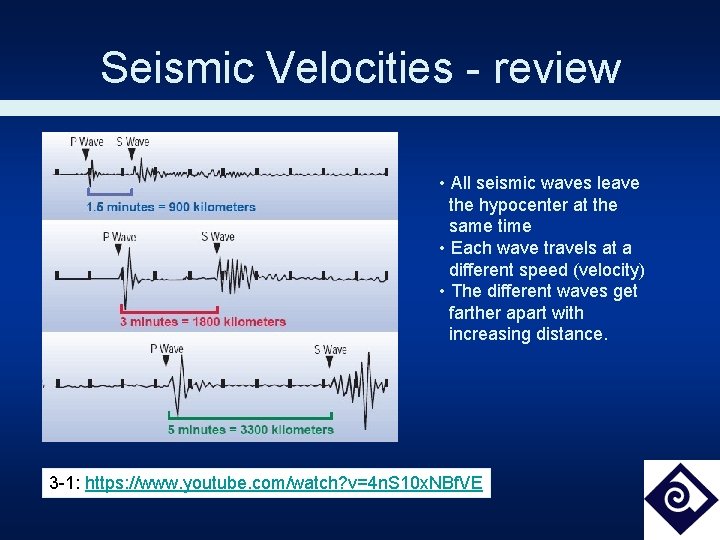
Seismic Velocities - review • All seismic waves leave the hypocenter at the same time • Each wave travels at a different speed (velocity) • The different waves get farther apart with increasing distance. 3 -1: https: //www. youtube. com/watch? v=4 n. S 10 x. NBf. VE
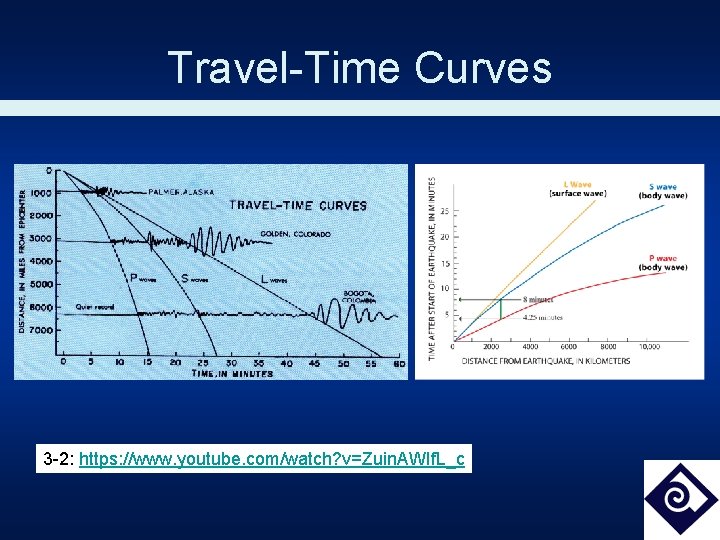
Travel-Time Curves 3 -2: https: //www. youtube. com/watch? v=Zuin. AWIf. L_c
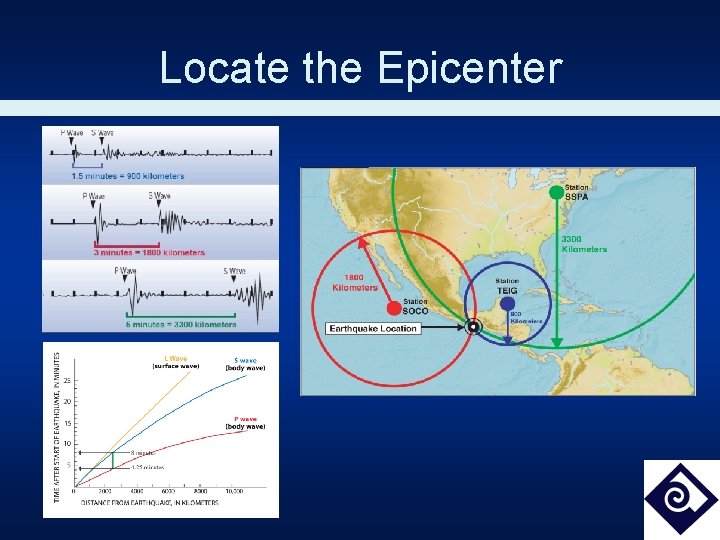
Locate the Epicenter
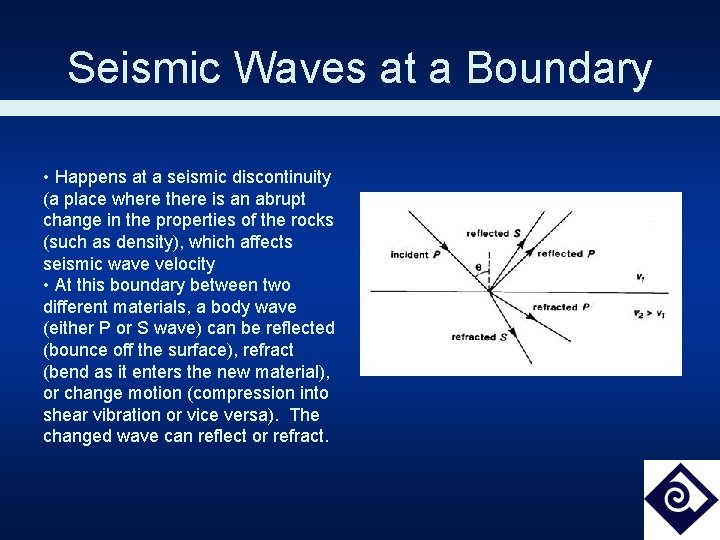
Seismic Waves at a Boundary • Happens at a seismic discontinuity (a place where there is an abrupt change in the properties of the rocks (such as density), which affects seismic wave velocity • At this boundary between two different materials, a body wave (either P or S wave) can be reflected (bounce off the surface), refract (bend as it enters the new material), or change motion (compression into shear vibration or vice versa). The changed wave can reflect or refract.
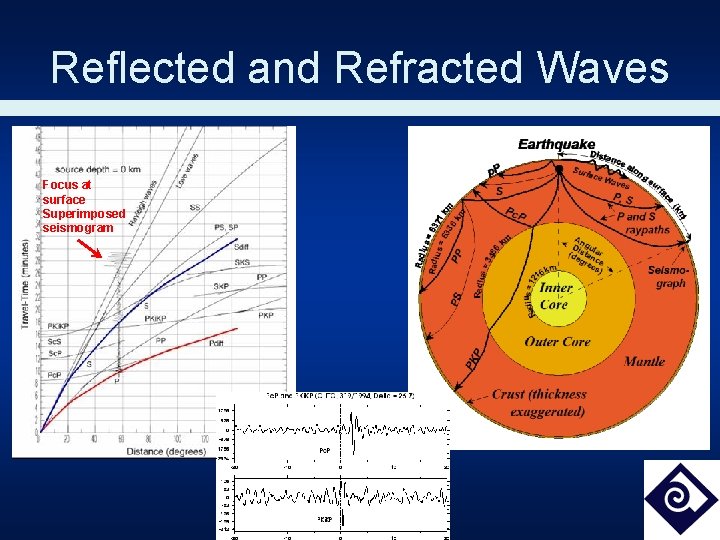
Reflected and Refracted Waves Focus at surface Superimposed seismogram
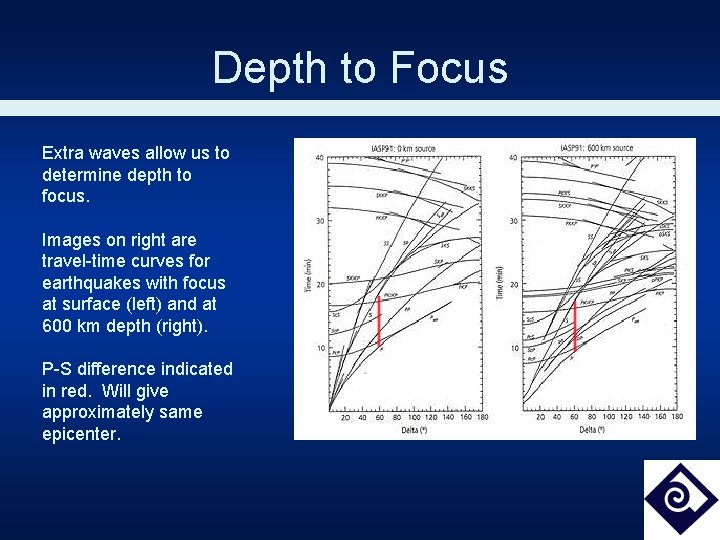
Depth to Focus Extra waves allow us to determine depth to focus. Images on right are travel-time curves for earthquakes with focus at surface (left) and at 600 km depth (right). P-S difference indicated in red. Will give approximately same epicenter.
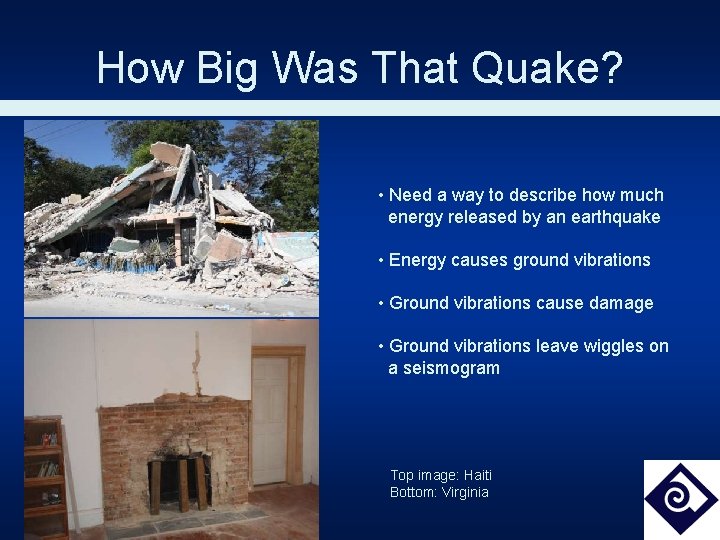
How Big Was That Quake? • Need a way to describe how much energy released by an earthquake • Energy causes ground vibrations • Ground vibrations cause damage • Ground vibrations leave wiggles on a seismogram Top image: Haiti Bottom: Virginia
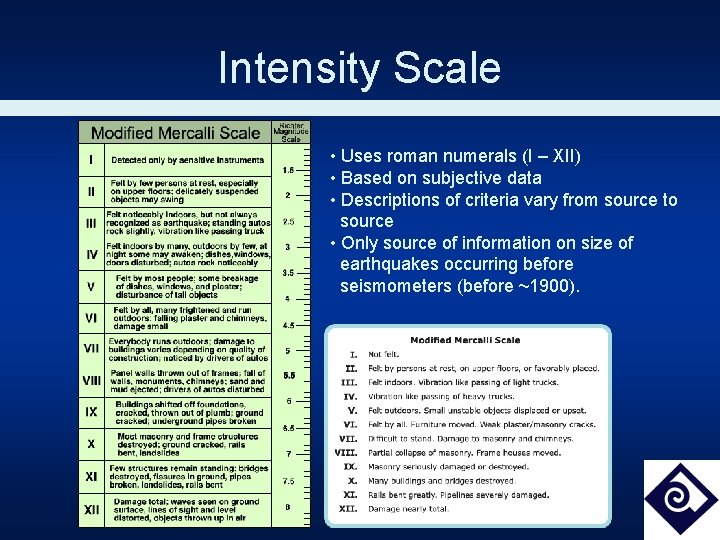
Intensity Scale • Uses roman numerals (I – XII) • Based on subjective data • Descriptions of criteria vary from source to source • Only source of information on size of earthquakes occurring before seismometers (before ~1900).
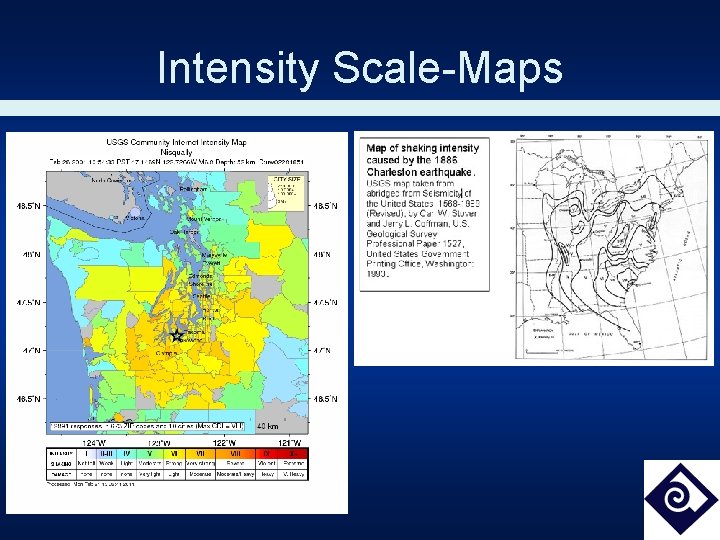
Intensity Scale-Maps
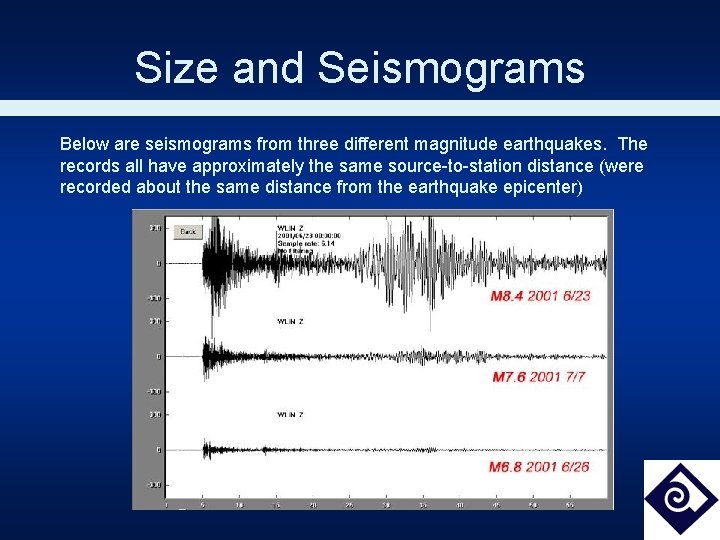
Size and Seismograms Below are seismograms from three different magnitude earthquakes. The records all have approximately the same source-to-station distance (were recorded about the same distance from the earthquake epicenter)
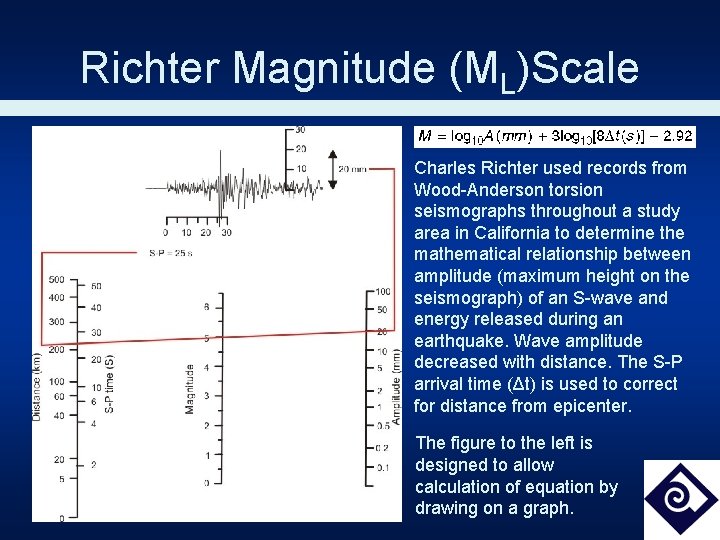
Richter Magnitude (ML)Scale Charles Richter used records from Wood-Anderson torsion seismographs throughout a study area in California to determine the mathematical relationship between amplitude (maximum height on the seismograph) of an S-wave and energy released during an earthquake. Wave amplitude decreased with distance. The S-P arrival time (Δt) is used to correct for distance from epicenter. The figure to the left is designed to allow calculation of equation by drawing on a graph.
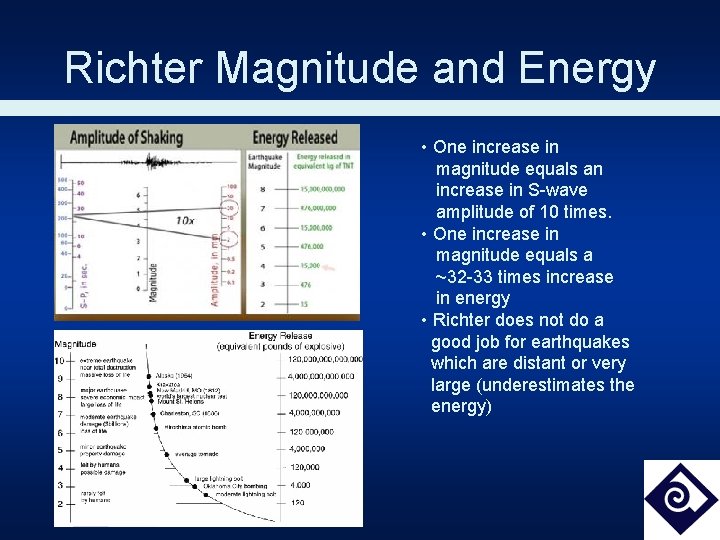
Richter Magnitude and Energy • One increase in magnitude equals an increase in S-wave amplitude of 10 times. • One increase in magnitude equals a ~32 -33 times increase in energy • Richter does not do a good job for earthquakes which are distant or very large (underestimates the energy)
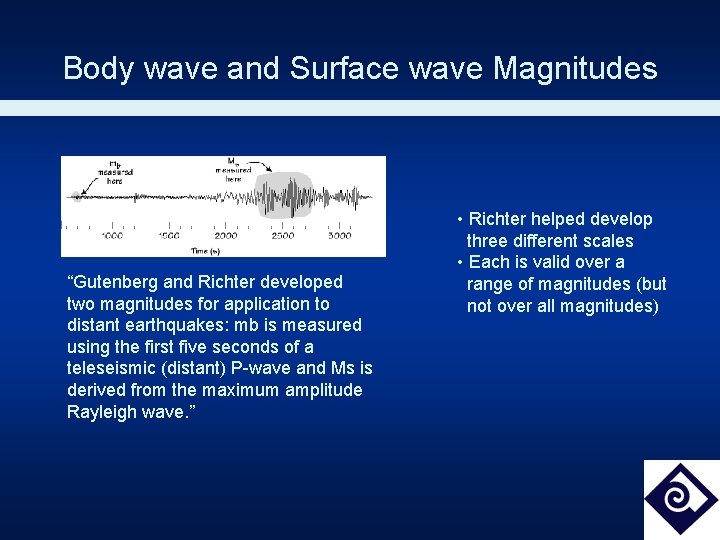
Body wave and Surface wave Magnitudes “Gutenberg and Richter developed two magnitudes for application to distant earthquakes: mb is measured using the first five seconds of a teleseismic (distant) P-wave and Ms is derived from the maximum amplitude Rayleigh wave. ” • Richter helped develop three different scales • Each is valid over a range of magnitudes (but not over all magnitudes)
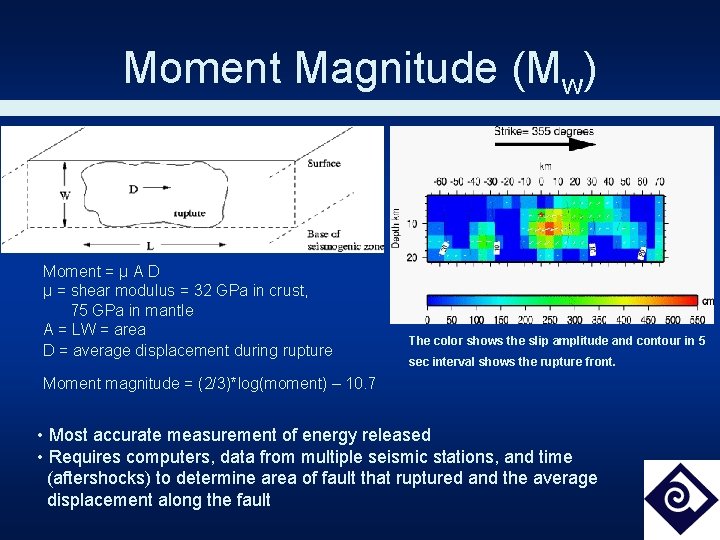
Moment Magnitude (Mw) Moment = µ A D µ = shear modulus = 32 GPa in crust, 75 GPa in mantle A = LW = area D = average displacement during rupture The color shows the slip amplitude and contour in 5 sec interval shows the rupture front. Moment magnitude = (2/3)*log(moment) – 10. 7 • Most accurate measurement of energy released • Requires computers, data from multiple seismic stations, and time (aftershocks) to determine area of fault that ruptured and the average displacement along the fault
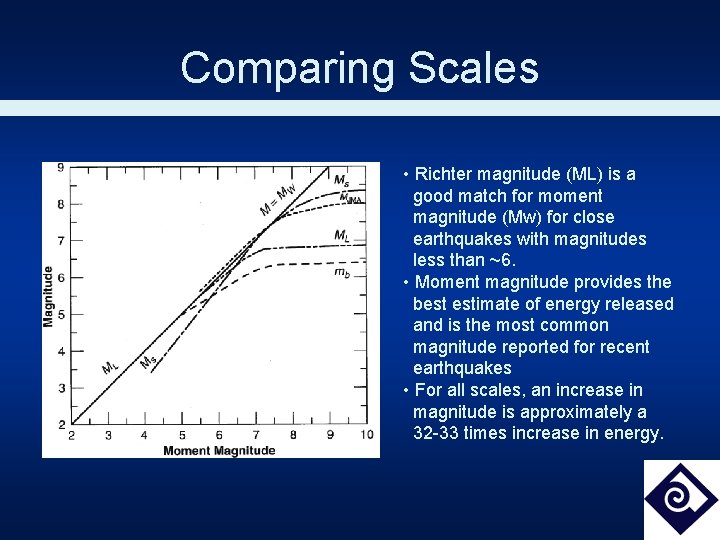
Comparing Scales • Richter magnitude (ML) is a good match for moment magnitude (Mw) for close earthquakes with magnitudes less than ~6. • Moment magnitude provides the best estimate of energy released and is the most common magnitude reported for recent earthquakes • For all scales, an increase in magnitude is approximately a 32 -33 times increase in energy.
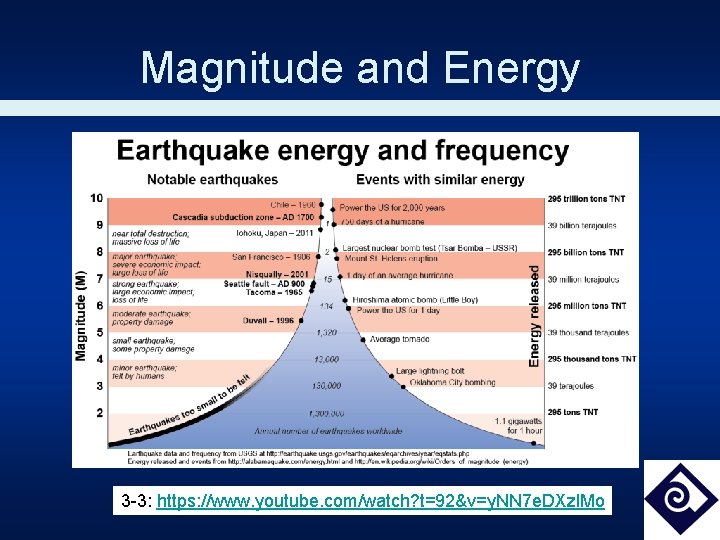
Magnitude and Energy 3 -3: https: //www. youtube. com/watch? t=92&v=y. NN 7 e. DXzl. Mo
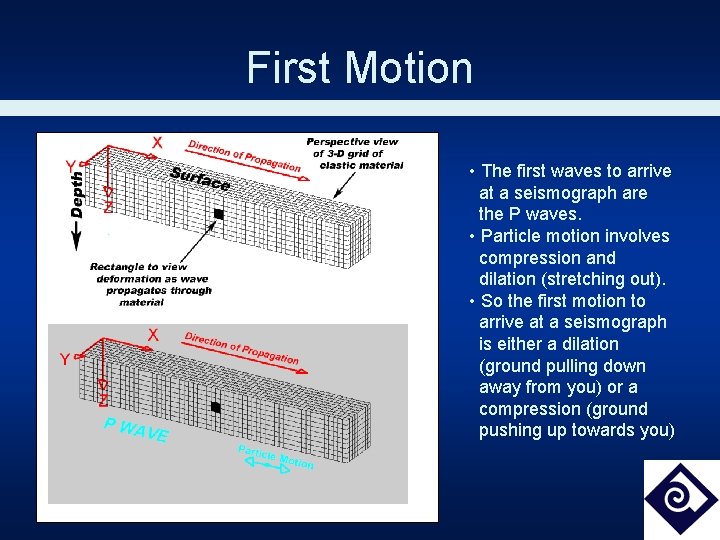
First Motion • The first waves to arrive at a seismograph are the P waves. • Particle motion involves compression and dilation (stretching out). • So the first motion to arrive at a seismograph is either a dilation (ground pulling down away from you) or a compression (ground pushing up towards you)
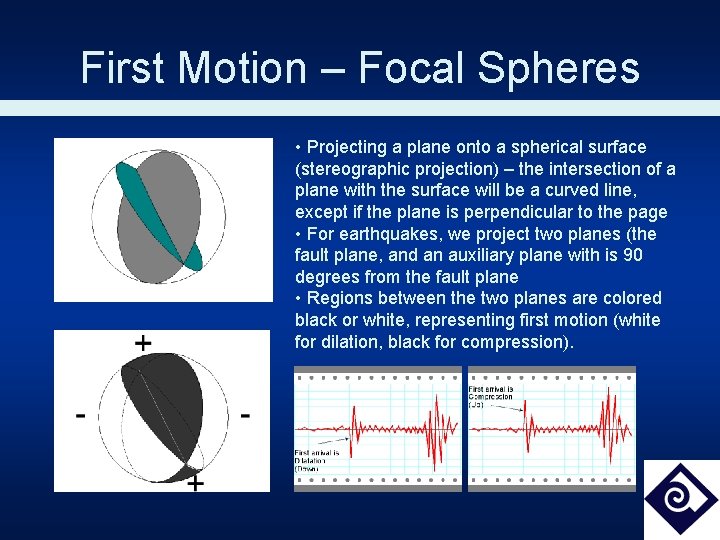
First Motion – Focal Spheres • Projecting a plane onto a spherical surface (stereographic projection) – the intersection of a plane with the surface will be a curved line, except if the plane is perpendicular to the page • For earthquakes, we project two planes (the fault plane, and an auxiliary plane with is 90 degrees from the fault plane • Regions between the two planes are colored black or white, representing first motion (white for dilation, black for compression).
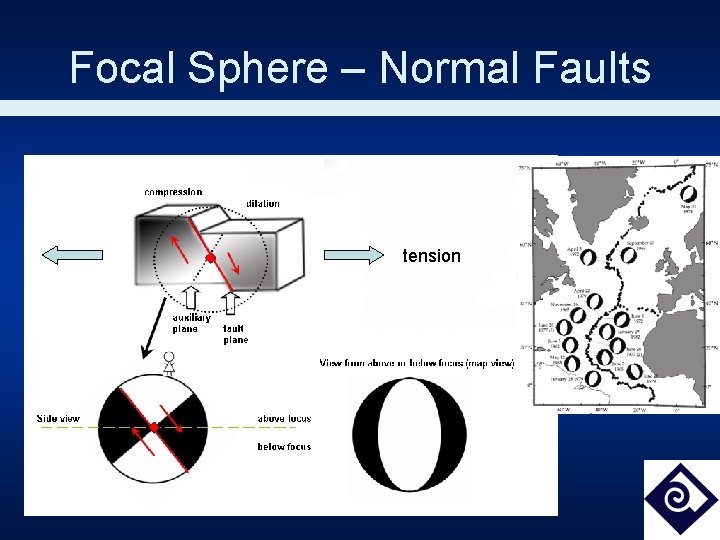
Focal Sphere – Normal Faults tension
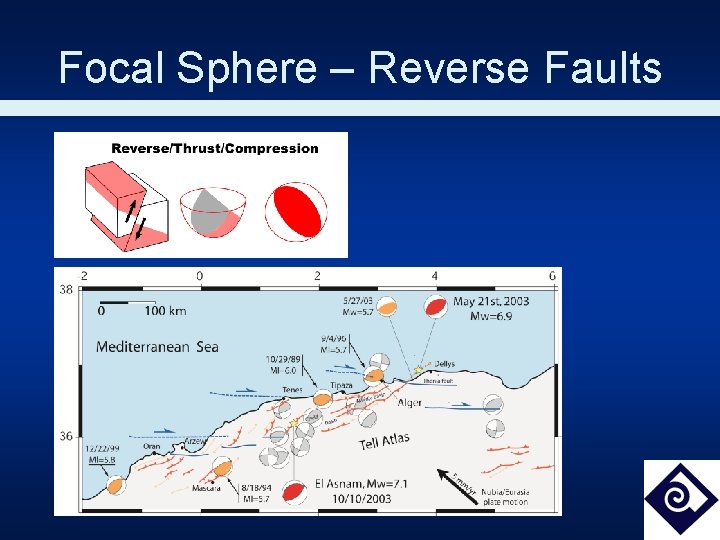
Focal Sphere – Reverse Faults
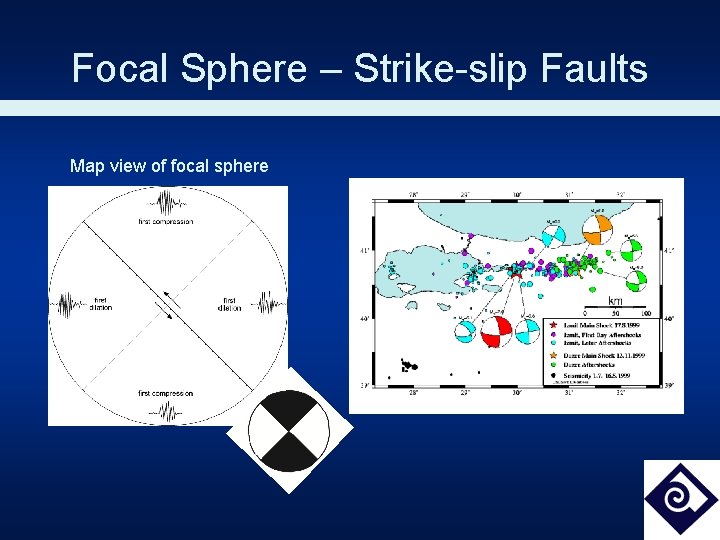
Focal Sphere – Strike-slip Faults Map view of focal sphere
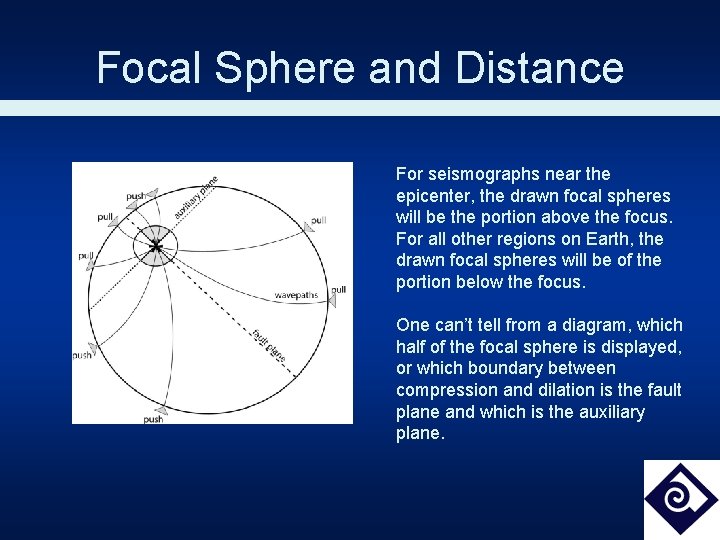
Focal Sphere and Distance For seismographs near the epicenter, the drawn focal spheres will be the portion above the focus. For all other regions on Earth, the drawn focal spheres will be of the portion below the focus. One can’t tell from a diagram, which half of the focal sphere is displayed, or which boundary between compression and dilation is the fault plane and which is the auxiliary plane.
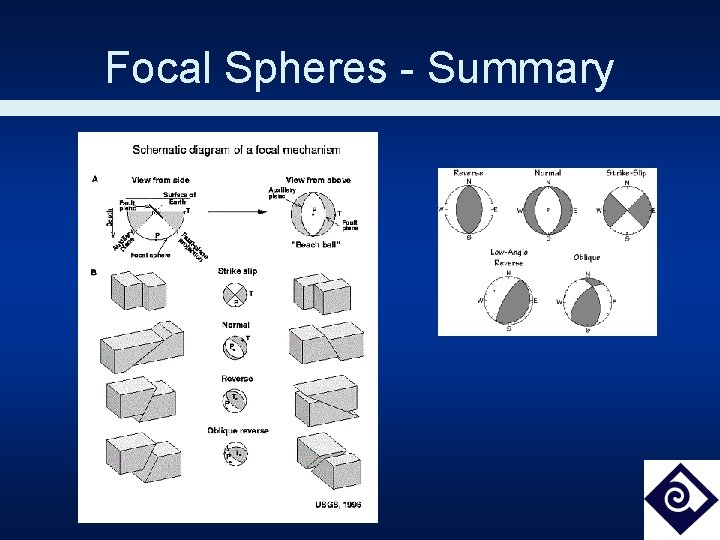
Focal Spheres - Summary
References • • • Title page: Top diagram from IRIS at https: //www. iris. edu/gallery 3/general/posters/ exploring_earth/Wave. Propagation. Bottom diagram from IRIS at http: //www. iris. edu/gallery 3/var/albums/eqs_seismo/record_sections/seismic%20 grap h 2. gif? m=1400095886 Seismic Waves – Review: animated image from Steve Dutch at http: //www. uwgb. edu/dutchs/earthsc 202 notes/quakes. htm. He has no clear copyright guidelines, but has provided images to other sites (such as IRIS/USGS), indicating his willingness to share to educators. Recording Earthquakes: Image from http: //history. msfc. nasa. gov/saturn_apollo/photos/pages/10075947_jpg. htm Basic Idea: Blue image from http: //earthquake. usgs. gov/learn/topics/ seismology/keeping_track. php. Other image from http: //lpsa. swarthmore. edu/ Systems/Mech. Translating/Trans. Mech. Sys. Model. html. Animation from Steve Dutch at http: //www. uwgb. edu/dutchs/earthsc 202 notes/quakes. htm Need to measure 3 dimensions: Images from http: //www. iris. edu/hq/files/ programs/education_and_outreach/aotm/9/3 -Component. Seismograph. pdf
References • • • Amplitude Problem: Animation from Steve Dutch at http: //www. uwgb. edu/ dutchs/earthsc 202 notes/quakes. htm. Image from British Geological Society’s school seismology project at http: //davidwaltham. com/schoolseismology/ Strong motion detectors: Left two images from http: //www. pnsn. org/EDHOME/ SENSORS/sensors. html. Accelerogram data from http: //earthquake. usgs. gov/learn/glossary/? term=accelerogram Shake Maps: Image from http: //earthquake. usgs. gov/earthquakes/ shakemap/pn/shake/0608030839/download/intensity. jpg Locating Earthquakes: Left image from USGS at http: //earthquake. usgs. gov/ learn/glossary/? term=fault%20 plane. Right two images from SCEDC education module at http: //scedc. caltech. edu/Module/sec 1 pg 06. html Seismic velocities – review: Image from http: //www. iris. edu/hq/inclass/factsheet/how_are_earthquakes_located Travel-Time Curves: Blue image from http: //earthquake. usgs. gov/learn/topics/ seismology/keeping_track. php. The other image is from IRIS, but have lost the URL.
References • • • Locate the Epicenter: All images from IRIS, with two from https: //www. iris. edu/ hq/files/programs/education_and_outreach/aotm/interactive/One. Pager 6. pdf, and the other URL misplaced. Seismic Waves at a Boundary: Image from http: //www. ucl. ac. uk/Earth. Sci/ people/lidunka/GEOL 2014/Geophysics 4%20 -%20 Seismic%20 waves/ SEISMOLOGY%20. htm Reflected and Refracted Waves: Earth image and travel-time curves from http: //web. ics. purdue. edu/~braile/edumod/as 1 lessons/Interp. Seis. htm. Seismogram from https: //seismo. berkeley. edu/annual_report/ar 02_03/img 235. gif Depth to focus: Image adapted from http: //web. ics. purdue. edu/~nowack/ geos 557/lecture 14 c-dir/lecture 14 c. htm Haiti 2010 from USGS image gallery at http: //gallery. usgs. gov/images/ 02_24_2010/c 28 Ja 44 Yyt_02_24_2010/medium/Haiti_Jan_2010_3_104. jpg. Virginia quake 2011 from USGS at http: //gallery. usgs. gov/images/08_14_2012/ rvm 8 PDb 55 J_08_14_2012/medium/06_library_26 Aug 2011. JPG
References • • • Intensity Scale: Green scale from http: //dnr. mo. gov/geology/images/ mercallirichter. gif. White scale from http: //ema. alabama. gov/earthquakebook/images/ mercalli_scale. png. Intensity Scale – Maps: Nisqually map from USGS – didn’t find original URL, but located at http: //static. ddmcdn. com/gif/blogs/6 a 00 d 8341 bf 67 c 53 ef 0147 e 2 e 6 c 97 d 970 b-800 wi. jpg. Charleston map from http: //scearthquakes. cofc. edu/img/SC% 20 Earthquakes/aboutsceqs/scequakes_1886 shaking. jpg Size and Seismograms: Image from http: //web. ics. purdue. edu/~braile/edumod/as 1 lessons/Interp. Seis. htm Richter Magnitude Scale: Image from http: //www. earthquakes. bgs. ac. uk/education/ eq_guide/dia_richter_scale. jpg. Equation image from http: //crack. seismo. unr. edu/ ftp/pub/louie/class/100/magnitude. html Richter Magnitude and Energy: Top image from http: //www. iris. edu/hq/inclass/ uploads/A_004 A_Moment. Mag_Thumbnail_thumbnail. jpg. Bottom image from https: //pnsn. org/outreach/about-earthquakes/magnitude-intensity
References • • • Body wave and Surface wave Magnitudes: Image and quote from http: //eqseis. geosc. psu. edu/~cammon/HTML/Classes/Intro. Quakes/Notes/earthquake _size. html Moment Magnitude: Sketch from http: //earthquake. usgs. gov/learn/ glossary/images/seismogenic. gif. Image of fault rupture and figure caption from http: //earthquake. usgs. gov/earthquakes/eqarchives/year/2004/ 2004_02_07_ff. php Comparing Scales: Image from http: //www. intechopen. com/source/ html/43883/media/image 9. png Magnitude and Energy: Image from http: //wa-dnr. s 3. amazonaws. com/ pictures/ger_hazards_eq_mag_freq_1140. png. Youtube video found at https: //pnsn. org/outreach/about-earthquakes/magnitude-intensity. First Motion: Image and animations from http: //web. ics. purdue. edu/~braile/ edumod/waves/Wave. Demo. htm First Motion – Focal Spheres: All images from an old powerpoint by Melinda Hutson. Original source misplaced.
References • • • Focal Sphere – Normal Faults: Large image drawn by Melinda Hutson, Portland Community College. Mid-Atlantic ridge from http: //www. geosci. usyd. edu. au/users/prey/Teaching/Geos 2111 GIS/FMS/Sld 031 c. html Focal Sphere – Reverse Faults: Focal sphere image from http: //www. iris. edu/hq/retm – powerpoint on July 27, 2015 New Guinea earthquake. Algeria map from http: //web. ics. purdue. edu/~ecalais/projects/algeria/ Focal Sphere – Strike-slip Faults: Map view of single focal sphere from http: //myweb. cwpost. liu. edu/vdivener/notes/earthquakes. htm. Turkey map attributed to USGS and taken from http: //www. orfeus-eu. org/organization/Organization/ Newsletter/vol 2 no 1/rmti-eth. html. Small beach ball drawn by Melinda Hutson. Focal Sphere and Distance: Image from http: //www. geology. cwu. edu/facstaff/ charlier/courses/g 415/focalsolution. pdf. Focal Spheres – Summary: Schematic diagram from https: //pnsn. org/outreach/ about -earthquakes/seismic_beachball. JPG. Other diagram from http: //earthquake. usgs. gov/learn/glossary/images/focal_mechanism. gif
- Slides: 38