
PART 3 Advance Land Navigation Module 17 Additional













- Slides: 57
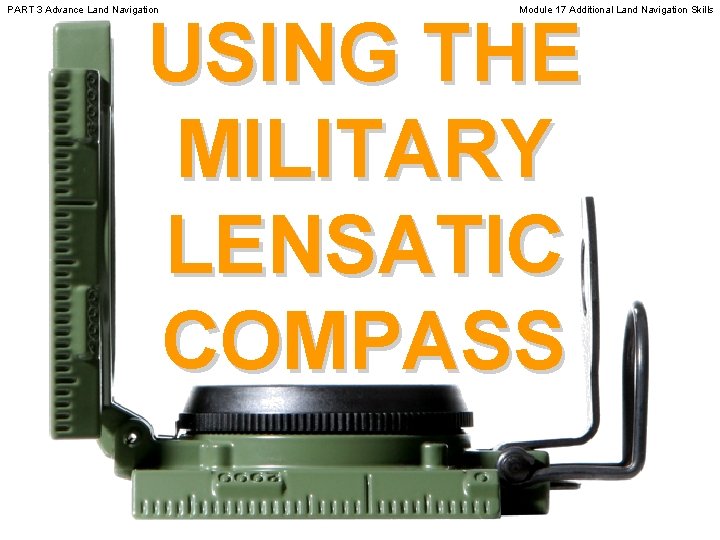
PART 3 Advance Land Navigation Module 17 Additional Land Navigation Skills USING THE MILITARY LENSATIC COMPASS
PART 3 Advance Land Navigation Module 17 Additional Land Navigation Skills WARNING This presentation is intended as a quick summary, and not a comprehensive resource. If you want to learn Land Navigation in detail, either buy a book; or get someone, who has the knowledge and skills, to teach you in person.
PART 3 Advance Land Navigation Module 17 Additional Land Navigation Skills NOTE To get the ideas across presented on these slides, many figures, pictures, and calculations may not be to scale and may be exaggerated for clarity.
PART 3 Advance Land Navigation Module 17 Additional Land Navigation Skills Note: Prior to being issued any training *equipment, you will be required to sign a “statement of liability” agreeing to pay for anything you damage or lose. All items will be inspected and inventoried prior to your signature and at the end of the training day too. If you do not intend to sign this statement, then you may be denied training. * You may use your own equipment.
PART 3 Advance Land Navigation Module 17 Additional Land Navigation Skills Any Questions?
PART 3 Advance Land Navigation Module 17 Additional Land Navigation Skills LAND NAVIGATION PRESENTATION PART 3 Module 17 Additional Skills
PART 3 Advance Land Navigation Module 17 Additional Land Navigation Skills . . . and now on with the. . . PRESENTATION
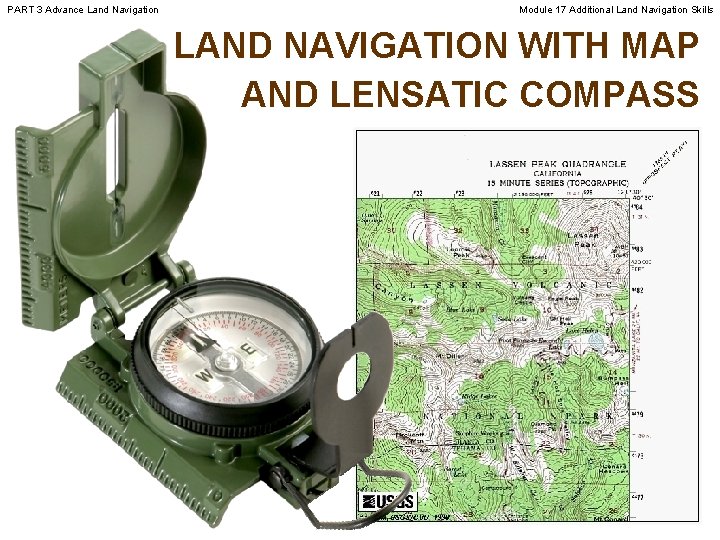
PART 3 Advance Land Navigation Module 17 Additional Land Navigation Skills LAND NAVIGATION WITH MAP AND LENSATIC COMPASS
PART 3 Advance Land Navigation Module 17 Additional Land Navigation Skills LAND NAVIGATION Why Learn Land Navigation? Training and practicing land navigation on foot provides the following everyday navigation (how not to get lost) benefits; - Tracking present location (Where am I ? ) - Determining Distance (How far is it and am I there yet ? ) - Sense of direction (Where do I want to go and where am I actually going ? ) - How to read a topographic map (Do I understand the map ? ) -Terrain and map association (What hill or river am I looking at ? ) - Spatial skills (Can I mentally visualize the landscape in 3 D ? ) - Planning safe, practical routes (Take a long safe route or a short risky route ? ) - And more Navigational skills The best way to learn LAND NAVIGATION is to get "dirt time", that is, get out there with a map and compass! Navigation is not about finding yourself after you are lost (although that’s what happens sometimes); it’s about keeping track of your position as you move away from a known point. As you move you have to remain cognizant of the terrain you are leaving, of the terrain you are passing, and of the terrain that is ahead. Navigation in the wilderness means knowing your starting point, your destination, and your route to get there. These skills will allow you to venture farther off the beaten path than you ever thought before.
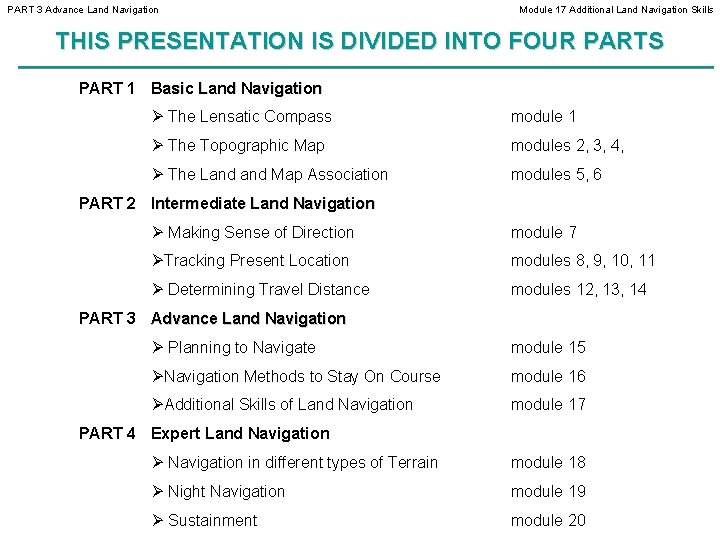
PART 3 Advance Land Navigation Module 17 Additional Land Navigation Skills THIS PRESENTATION IS DIVIDED INTO FOUR PARTS ____________________________________________________________________________ PART 1 Basic Land Navigation Ø The Lensatic Compass module 1 Ø The Topographic Map modules 2, 3, 4, Ø The Land Map Association modules 5, 6 PART 2 Intermediate Land Navigation Ø Making Sense of Direction module 7 ØTracking Present Location modules 8, 9, 10, 11 Ø Determining Travel Distance modules 12, 13, 14 PART 3 Advance Land Navigation Ø Planning to Navigate module 15 ØNavigation Methods to Stay On Course module 16 ØAdditional Skills of Land Navigation module 17 PART 4 Expert Land Navigation Ø Navigation in different types of Terrain module 18 Ø Night Navigation module 19 Ø Sustainment module 20
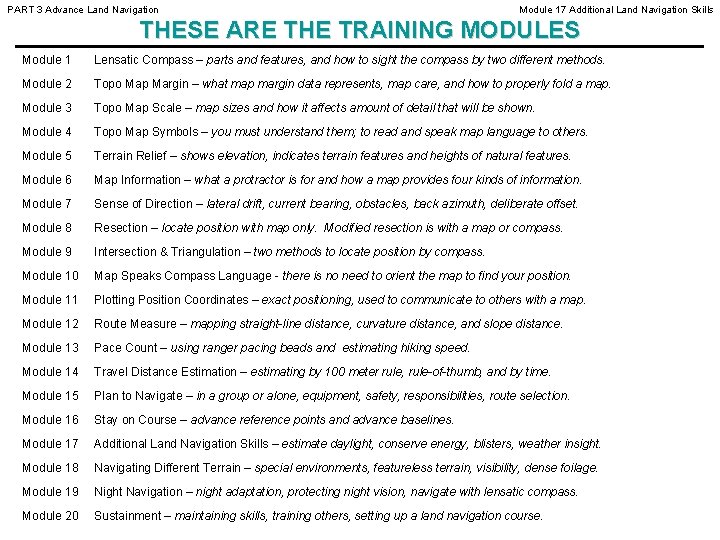
PART 3 Advance Land Navigation Module 17 Additional Land Navigation Skills THESE ARE THE TRAINING MODULES Module 1 Lensatic Compass – parts and features, and how to sight the compass by two different methods. Module 2 Topo Map Margin – what map margin data represents, map care, and how to properly fold a map. Module 3 Topo Map Scale – map sizes and how it affects amount of detail that will be shown. Module 4 Topo Map Symbols – you must understand them; to read and speak map language to others. Module 5 Terrain Relief – shows elevation, indicates terrain features and heights of natural features. Module 6 Map Information – what a protractor is for and how a map provides four kinds of information. Module 7 Sense of Direction – lateral drift, current bearing, obstacles, back azimuth, deliberate offset. Module 8 Resection – locate position with map only. Modified resection is with a map or compass. Module 9 Intersection & Triangulation – two methods to locate position by compass. Module 10 Map Speaks Compass Language - there is no need to orient the map to find your position. Module 11 Plotting Position Coordinates – exact positioning, used to communicate to others with a map. Module 12 Route Measure – mapping straight-line distance, curvature distance, and slope distance. Module 13 Pace Count – using ranger pacing beads and estimating hiking speed. Module 14 Travel Distance Estimation – estimating by 100 meter rule, rule-of-thumb, and by time. Module 15 Plan to Navigate – in a group or alone, equipment, safety, responsibilities, route selection. Module 16 Stay on Course – advance reference points and advance baselines. Module 17 Additional Land Navigation Skills – estimate daylight, conserve energy, blisters, weather insight. Module 18 Navigating Different Terrain – special environments, featureless terrain, visibility, dense foilage. Module 19 Night Navigation – night adaptation, protecting night vision, navigate with lensatic compass. Module 20 Sustainment – maintaining skills, training others, setting up a land navigation course.
PART 3 Advance Land Navigation Module 17 Additional Land Navigation Skills Any Questions?
PART 3 Advance Land Navigation Module 17 Additional Land Navigation Skills PART 3 ADVANCE LAND NAVIGATION MODULE 17 • Additional Navigation Skills – – Description Additional Skills
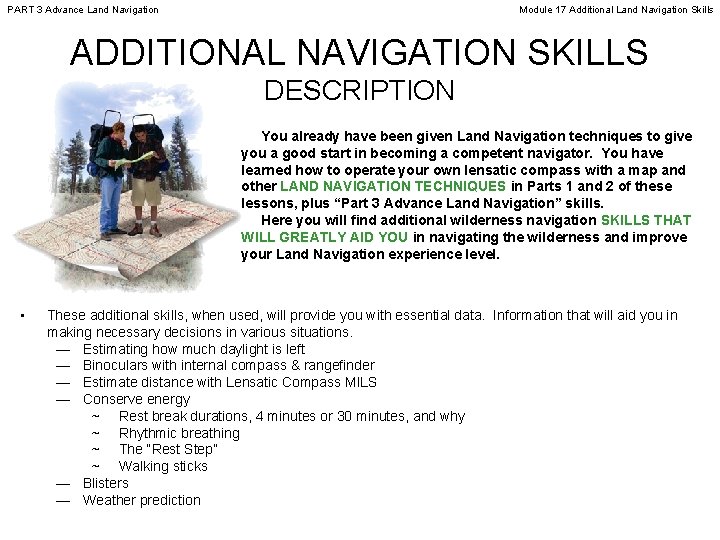
PART 3 Advance Land Navigation Module 17 Additional Land Navigation Skills ADDITIONAL NAVIGATION SKILLS DESCRIPTION You already have been given Land Navigation techniques to give you a good start in becoming a competent navigator. You have learned how to operate your own lensatic compass with a map and other LAND NAVIGATION TECHNIQUES in Parts 1 and 2 of these lessons, plus “Part 3 Advance Land Navigation” skills. Here you will find additional wilderness navigation SKILLS THAT WILL GREATLY AID YOU in navigating the wilderness and improve your Land Navigation experience level. • These additional skills, when used, will provide you with essential data. Information that will aid you in making necessary decisions in various situations. — Estimating how much daylight is left — Binoculars with internal compass & rangefinder — Estimate distance with Lensatic Compass MILS — Conserve energy ~ Rest break durations, 4 minutes or 30 minutes, and why ~ Rhythmic breathing ~ The “Rest Step” ~ Walking sticks — Blisters — Weather prediction
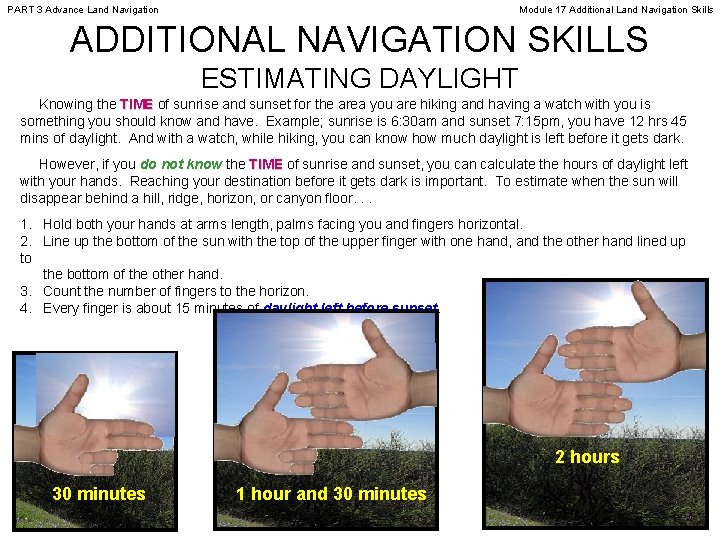
PART 3 Advance Land Navigation Module 17 Additional Land Navigation Skills ADDITIONAL NAVIGATION SKILLS ESTIMATING DAYLIGHT Knowing the TIME of sunrise and sunset for the area you are hiking and having a watch with you is something you should know and have. Example; sunrise is 6: 30 am and sunset 7: 15 pm, you have 12 hrs 45 mins of daylight. And with a watch, while hiking, you can know how much daylight is left before it gets dark. However, if you do not know the TIME of sunrise and sunset, you can calculate the hours of daylight left with your hands. Reaching your destination before it gets dark is important. To estimate when the sun will disappear behind a hill, ridge, horizon, or canyon floor. . . 1. Hold both your hands at arms length, palms facing you and fingers horizontal. 2. Line up the bottom of the sun with the top of the upper finger with one hand, and the other hand lined up to the bottom of the other hand. 3. Count the number of fingers to the horizon. 4. Every finger is about 15 minutes of daylight left before sunset. 2 hours 30 minutes 1 hour and 30 minutes
PART 3 Advance Land Navigation Module 17 Additional Land Navigation Skills Any Questions?
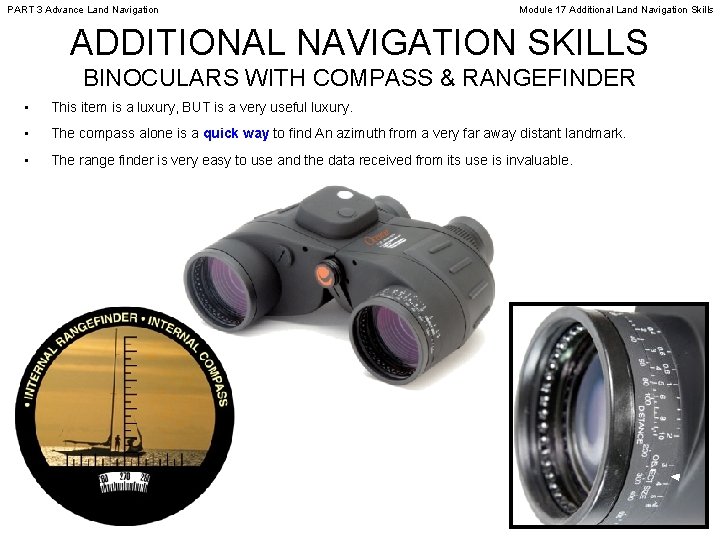
PART 3 Advance Land Navigation Module 17 Additional Land Navigation Skills ADDITIONAL NAVIGATION SKILLS BINOCULARS WITH COMPASS & RANGEFINDER • This item is a luxury, BUT is a very useful luxury. • The compass alone is a quick way to find An azimuth from a very far away distant landmark. • The range finder is very easy to use and the data received from its use is invaluable.
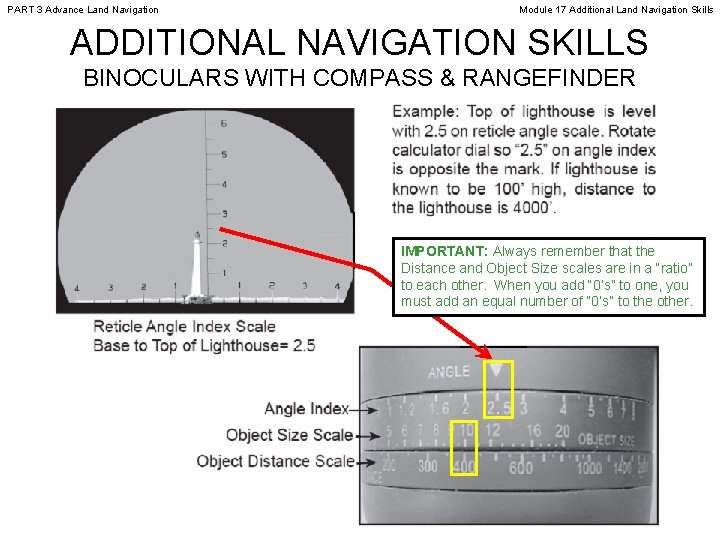
PART 3 Advance Land Navigation Module 17 Additional Land Navigation Skills ADDITIONAL NAVIGATION SKILLS BINOCULARS WITH COMPASS & RANGEFINDER IMPORTANT: Always remember that the Distance and Object Size scales are in a “ratio” to each other. When you add “ 0’s” to one, you must add an equal number of “ 0’s” to the other. .
PART 3 Advance Land Navigation Module 17 Additional Land Navigation Skills ADDITIONAL NAVIGATION SKILLS BINOCULARS WITH COMPASS & RANGEFINDER When the object size is known, its distance is determined as follows: 1. Look through your binocular and place the horizontal reticle line at the base of the object. 2. Count the number of reticle divisions from the base to the top of the object. (In the example on the previous slide, the top of the lighthouse comes to 2. 5 on the Reticle Scale) 3. Rotate the Calculator Dial and place this number (2. 5) at the Angle Index Mark 4. Assuming you know that the height of the lighthouse is 100 ft. , look to the right of the Angle Index Mark and find the object size on the scale labeled “Object Size”. In this example, use “ 10”. NOTE The object size divisions are from 1 to 20. In dealing with an object that is 100 feet, mentally add a zero to the 10 indicator on the object size scale. 5. Now read the distance scale directly beneath the object size. It is 400 but remember, because you added a “ 0” to the “ 10” in Step 4, you must add a zero to the 400. Thus, the distance from you to the lighthouse is 4000 feet. When distance to the object is known, its size is determined as follows: 1. Count the reticle divisions occupied by the object 2. Rotate the Calculator Dial, so that the Angle Index Mark points to the number from the reticle scale. 3. Look at the Distance Scale, and find your known distance to the object (for example, 4000 feet, or 400 on the scale). The number on the Object Size scale that is opposite this distance indicates the size of the object (for example, 100 feet).
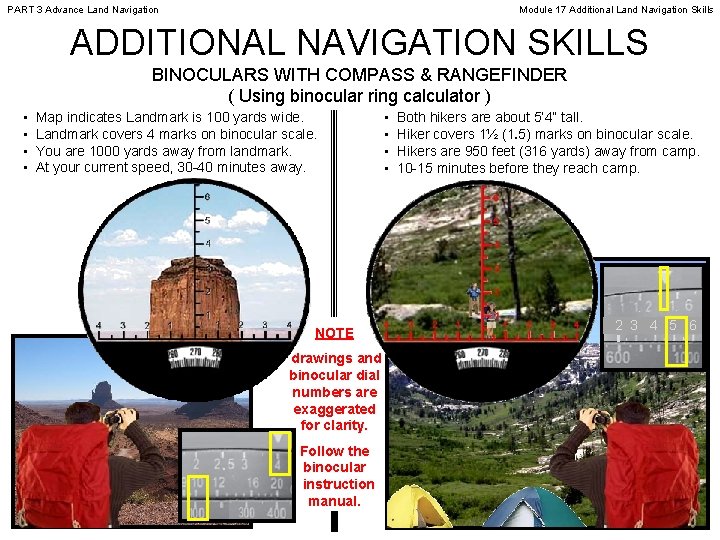
PART 3 Advance Land Navigation Module 17 Additional Land Navigation Skills ADDITIONAL NAVIGATION SKILLS BINOCULARS WITH COMPASS & RANGEFINDER ( Using binocular ring calculator ) • • Map indicates Landmark is 100 yards wide. Landmark covers 4 marks on binocular scale. You are 1000 yards away from landmark. At your current speed, 30 -40 minutes away. • • Both hikers are about 5’ 4” tall. Hiker covers 1½ (1. 5) marks on binocular scale. Hikers are 950 feet (316 yards) away from camp. 10 -15 minutes before they reach camp. . . 2 3 4 5 6 . . NOTE drawings and binocular dial numbers are exaggerated for clarity. . Follow the binocular dinstruction manual.
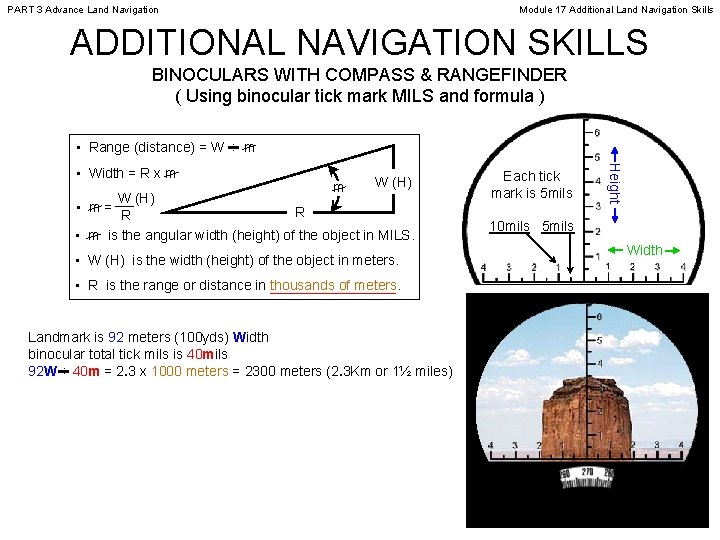
PART 3 Advance Land Navigation Module 17 Additional Land Navigation Skills ADDITIONAL NAVIGATION SKILLS BINOCULARS WITH COMPASS & RANGEFINDER ( Using binocular tick mark MILS and formula ) • Range (distance) = W. . m m W (H) R R • m is the angular width (height) of the object in MILS. • m= • W (H) is the width (height) of the object in meters. • R is the range or distance in thousands of meters. Landmark is 92 meters (100 yds) Width binocular total tick mils is 40 mils 92 W. . 40 m = 2. 3 x 1000 meters = 2300 meters (2. 3 Km or 1½ miles) Each tick mark is 5 mils Height • Width = R x m 10 mils 5 mils Width
PART 3 Advance Land Navigation Module 17 Additional Land Navigation Skills Any Questions?
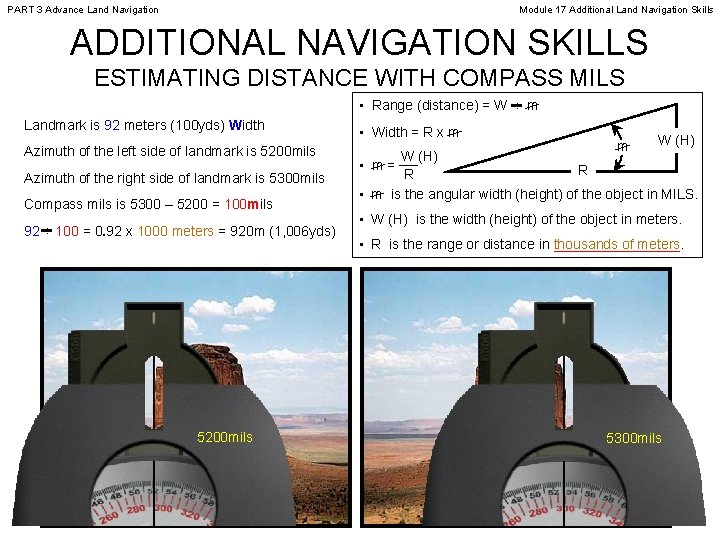
PART 3 Advance Land Navigation Module 17 Additional Land Navigation Skills ADDITIONAL NAVIGATION SKILLS ESTIMATING DISTANCE WITH COMPASS MILS • Range (distance) = W. . m Landmark is 92 meters (100 yds) Width Azimuth of the left side of landmark is 5200 mils Azimuth of the right side of landmark is 5300 mils Compass mils is 5300 – 5200 = 100 mils 92. . 100 = 0. 92 x 1000 meters = 920 m (1, 006 yds) 5200 mils • Width = R x m m W (H) R R • m is the angular width (height) of the object in MILS. • m= • W (H) is the width (height) of the object in meters. • R is the range or distance in thousands of meters. 5300 mils
PART 3 Advance Land Navigation Module 17 Additional Land Navigation Skills Any Questions?
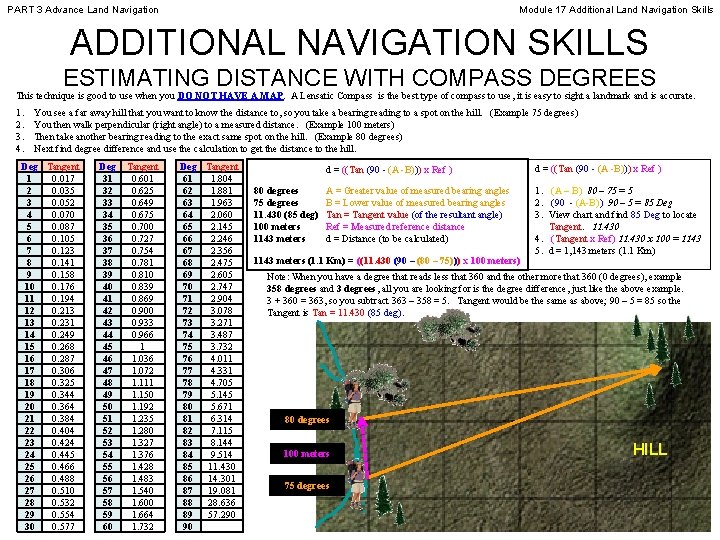
PART 3 Advance Land Navigation Module 17 Additional Land Navigation Skills ADDITIONAL NAVIGATION SKILLS ESTIMATING DISTANCE WITH COMPASS DEGREES This technique is good to use when you DO NOT HAVE A MAP. A Lensatic Compass is the best type of compass to use, it is easy to sight a landmark and is accurate. 1. 2. 3. 4. You see a far away hill that you want to know the distance to, so you take a bearing reading to a spot on the hill. (Example 75 degrees) You then walk perpendicular (right angle) to a measured distance. (Example 100 meters) Then take another bearing reading to the exact same spot on the hill. (Example 80 degrees) Next find degree difference and use the calculation to get the distance to the hill. Deg Tangent 1 0. 017 2 0. 035 3 0. 052 4 0. 070 5 0. 087 6 0. 105 7 0. 123 8 0. 141 9 0. 158 10 0. 176 11 0. 194 12 0. 213 13 0. 231 14 0. 249 15 0. 268 16 0. 287 17 0. 306 18 0. 325 19 0. 344 20 0. 364 21 0. 384 22 0. 404 23 0. 424 24 0. 445 25 0. 466 26 0. 488 27 0. 510 28 0. 532 29 0. 554 30 0. 577 Deg 31 32 33 34 35 36 37 38 39 40 41 42 43 44 45 46 47 48 49 50 51 52 53 54 55 56 57 58 59 60 Tangent 0. 601 0. 625 0. 649 0. 675 0. 700 0. 727 0. 754 0. 781 0. 810 0. 839 0. 869 0. 900 0. 933 0. 966 1 1. 036 1. 072 1. 111 1. 150 1. 192 1. 235 1. 280 1. 327 1. 376 1. 428 1. 483 1. 540 1. 600 1. 664 1. 732 Deg Tangent 61 1. 804 62 1. 881 63 1. 963 64 2. 060 65 2. 145 66 2. 246 67 2. 356 68 2. 475 69 2. 605 70 2. 747 71 2. 904 72 3. 078 73 3. 271 74 3. 487 75 3. 732 76 4. 011 77 4. 331 78 4. 705 79 5. 145 80 5. 671 81 6. 314 82 7. 115 83 8. 144 84 9. 514 85 11. 430 86 14. 301 87 19. 081 88 28. 636 89 57. 290 90 80 degrees 75 degrees 11. 430 (85 deg) 100 meters 1143 meters d = ((Tan (90 - (A -B))) x Ref ) A = Greater value of measured bearing angles B = Lower value of measured bearing angles Tan = Tangent value (of the resultant angle) Ref = Measured reference distance d = Distance (to be calculated) 1. (A – B) 80 – 75 = 5 2. (90 - (A-B)) 90 – 5 = 85 Deg 3. View chart and find 85 Deg to locate Tangent. 11. 430 4. (Tangent x Ref) 11. 430 x 100 = 1143 5. d = 1, 143 meters (1. 1 Km) 1143 meters (1. 1 Km) = ((11. 430 (90 – (80 – 75))) x 100 meters) Note: When you have a degree that reads less that 360 and the other more that 360 (0 degrees), example 358 degrees and 3 degrees, all you are looking for is the degree difference, just like the above example. 3 + 360 = 363, so you subtract 363 – 358 = 5. Tangent would be the same as above; 90 – 5 = 85 so the Tangent is Tan = 11. 430 (85 deg). 80 degrees 100 meters 75 degrees HILL
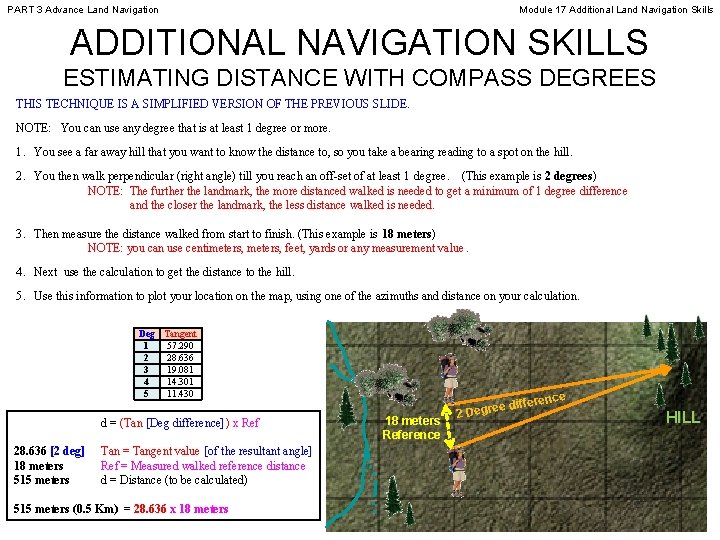
PART 3 Advance Land Navigation Module 17 Additional Land Navigation Skills ADDITIONAL NAVIGATION SKILLS ESTIMATING DISTANCE WITH COMPASS DEGREES THIS TECHNIQUE IS A SIMPLIFIED VERSION OF THE PREVIOUS SLIDE. NOTE: You can use any degree that is at least 1 degree or more. 1. You see a far away hill that you want to know the distance to, so you take a bearing reading to a spot on the hill. 2. You then walk perpendicular (right angle) till you reach an off-set of at least 1 degree. (This example is 2 degrees) NOTE: The further the landmark, the more distanced walked is needed to get a minimum of 1 degree difference and the closer the landmark, the less distance walked is needed. 3. Then measure the distance walked from start to finish. (This example is 18 meters) NOTE: you can use centimeters, feet, yards or any measurement value. 4. Next use the calculation to get the distance to the hill. 5. Use this information to plot your location on the map, using one of the azimuths and distance on your calculation. Deg Tangent 1 57. 290 2 28. 636 3 19. 081 4 14. 301 5 11. 430 d = (Tan [Deg difference]) x Ref 28. 636 [2 deg] 18 meters 515 meters Tan = Tangent value [of the resultant angle] Ref = Measured walked reference distance d = Distance (to be calculated) 515 meters (0. 5 Km) = 28. 636 x 18 meters Reference r ee diffe 2 Degr ence HILL
PART 3 Advance Land Navigation Module 17 Additional Land Navigation Skills Any Questions?
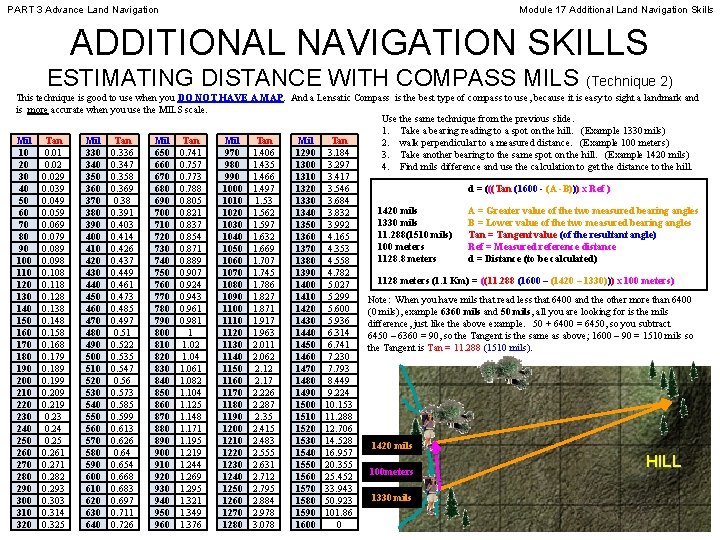
PART 3 Advance Land Navigation Module 17 Additional Land Navigation Skills ADDITIONAL NAVIGATION SKILLS ESTIMATING DISTANCE WITH COMPASS MILS (Technique 2) This technique is good to use when you DO NOT HAVE A MAP. And a Lensatic Compass is the best type of compass to use, because it is easy to sight a landmark and is more accurate when you use the MILS scale. Use the same technique from the previous slide. 1. Take a bearing reading to a spot on the hill. (Example 1330 mils) Mil Tan Mil Tan 2. walk perpendicular to a measured distance. (Example 100 meters) 10 0. 01 330 0. 336 650 0. 741 970 1. 406 1290 3. 184 3. Take another bearing to the same spot on the hill. (Example 1420 mils) 20 0. 02 340 0. 347 660 0. 757 980 1. 435 1300 3. 297 4. Find mils difference and use the calculation to get the distance to the hill. 30 0. 029 350 0. 358 670 0. 773 990 1. 466 1310 3. 417 40 0. 039 360 0. 369 680 0. 788 1000 1. 497 1320 3. 546 d = (((Tan (1600 - (A -B))) x Ref ) 50 0. 049 370 0. 38 690 0. 805 1010 1. 53 1330 3. 684 1420 mils A = Greater value of the two measured bearing angles 60 0. 059 380 0. 391 700 0. 821 1020 1. 562 1340 3. 832 1330 mils B = Lower value of the two measured bearing angles 70 0. 069 390 0. 403 710 0. 837 1030 1. 597 1350 3. 992 11. 288(1510 mils) Tan = Tangent value (of the resultant angle) 80 0. 079 400 0. 414 720 0. 854 1040 1. 632 1360 4. 165 100 meters Ref = Measured reference distance 90 0. 089 410 0. 426 730 0. 871 1050 1. 669 1370 4. 353 1128. 8 meters d = Distance (to be calculated) 100 0. 098 420 0. 437 740 0. 889 1060 1. 707 1380 4. 558 110 0. 108 430 0. 449 750 0. 907 1070 1. 745 1390 4. 782 1128 meters (1. 1 Km) = ((11. 288 (1600 – (1420 – 1330))) x 100 meters) 120 0. 118 440 0. 461 760 0. 924 1080 1. 786 1400 5. 027 130 0. 128 450 0. 473 770 0. 943 1090 1. 827 1410 5. 299 Note: When you have mils that read less that 6400 and the other more than 6400 140 0. 138 460 0. 485 780 0. 961 1100 1. 871 1420 5. 600 (0 mils), example 6360 mils and 50 mils, all you are looking for is the mils 150 0. 148 470 0. 497 790 0. 981 1110 1. 917 1430 5. 936 difference, just like the above example. 50 + 6400 = 6450, so you subtract 160 0. 158 480 0. 51 800 1 1120 1. 963 1440 6. 314 6450 – 6360 = 90, so the Tangent is the same as above; 1600 – 90 = 1510 mils so 170 0. 168 490 0. 522 810 1. 02 1130 2. 011 1450 6. 741 the Tangent is Tan = 11. 288 (1510 mils). 180 0. 179 500 0. 535 820 1. 04 1140 2. 062 1460 7. 230 190 0. 189 510 0. 547 830 1. 061 1150 2. 12 1470 7. 793 200 0. 199 520 0. 56 840 1. 082 1160 2. 17 1480 8. 449 210 0. 209 530 0. 573 850 1. 104 1170 2. 226 1490 9. 224 220 0. 219 540 0. 585 860 1. 125 1180 2. 287 1500 10. 153 230 0. 23 550 0. 599 870 1. 148 1190 2. 35 1510 11. 288 240 0. 24 560 0. 613 880 1. 171 1200 2. 415 1520 12. 706 250 0. 25 570 0. 626 890 1. 195 1210 2. 483 1530 14. 528 1420 mils 260 0. 261 580 0. 64 900 1. 219 1220 2. 555 1540 16. 957 270 0. 271 590 0. 654 910 1. 244 1230 2. 631 1550 20. 355 100 meters 280 0. 282 600 0. 668 920 1. 269 1240 2. 712 1560 25. 452 290 0. 293 610 0. 683 930 1. 295 1250 2. 795 1570 33. 943 1330 mils 300 0. 303 620 0. 697 940 1. 321 1260 2. 884 1580 50. 923 310 0. 314 630 0. 711 950 1. 349 1270 2. 978 1590 101. 86 320 0. 325 640 0. 726 960 1. 376 1280 3. 078 1600 0 HILL
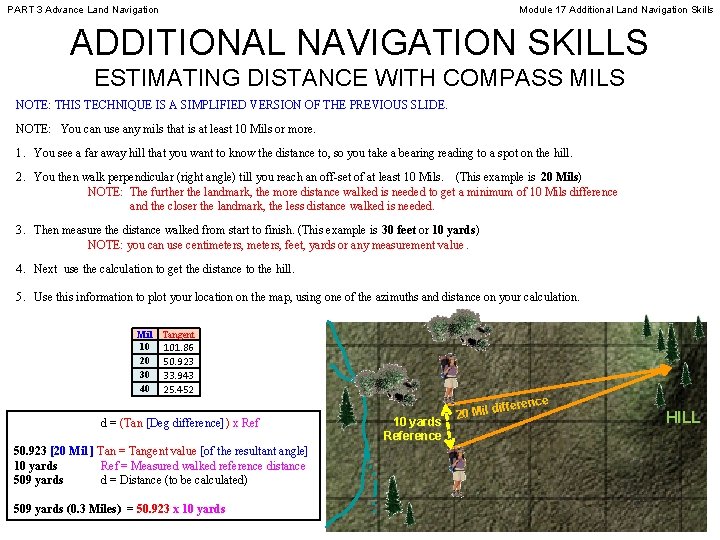
PART 3 Advance Land Navigation Module 17 Additional Land Navigation Skills ADDITIONAL NAVIGATION SKILLS ESTIMATING DISTANCE WITH COMPASS MILS NOTE: THIS TECHNIQUE IS A SIMPLIFIED VERSION OF THE PREVIOUS SLIDE. NOTE: You can use any mils that is at least 10 Mils or more. 1. You see a far away hill that you want to know the distance to, so you take a bearing reading to a spot on the hill. 2. You then walk perpendicular (right angle) till you reach an off-set of at least 10 Mils. (This example is 20 Mils) NOTE: The further the landmark, the more distance walked is needed to get a minimum of 10 Mils difference and the closer the landmark, the less distance walked is needed. 3. Then measure the distance walked from start to finish. (This example is 30 feet or 10 yards) NOTE: you can use centimeters, feet, yards or any measurement value. 4. Next use the calculation to get the distance to the hill. 5. Use this information to plot your location on the map, using one of the azimuths and distance on your calculation. Mil Tangent 10 101. 86 20 50. 923 30 33. 943 40 25. 452 d = (Tan [Deg difference]) x Ref 50. 923 [20 Mil ] Tan = Tangent value [of the resultant angle] 10 yards Ref = Measured walked reference distance 509 yards d = Distance (to be calculated) 509 yards (0. 3 Miles) = 50. 923 x 10 yards Reference 20 Mil d e ifferenc HILL
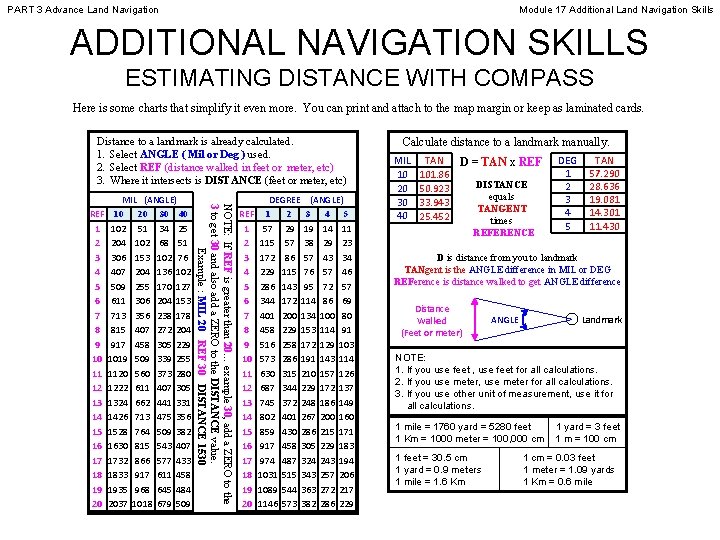
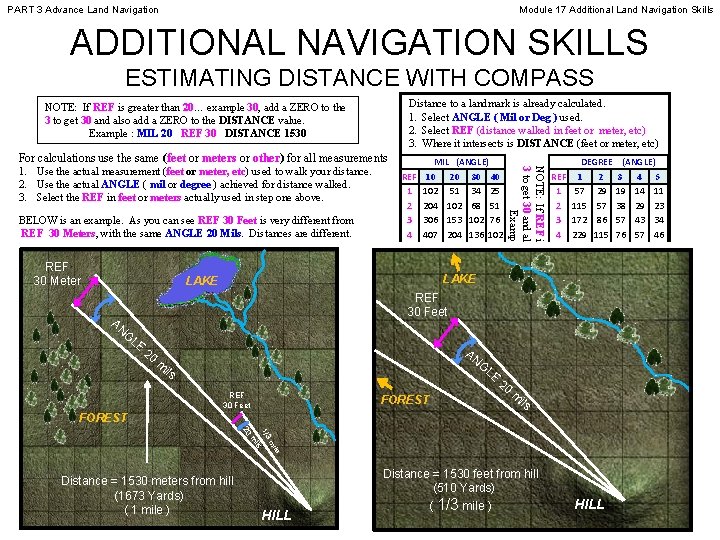
PART 3 Advance Land Navigation Module 17 Additional Land Navigation Skills ADDITIONAL NAVIGATION SKILLS ESTIMATING DISTANCE WITH COMPASS Here is some charts that simplify it even more. You can print and attach to the map margin or keep as laminated cards. Distance to a landmark is already calculated. 1. Select ANGLE ( Mil or Deg ) used. 2. Select REF (distance walked in feet or meter, etc) 3. Where it intersects is DISTANCE (feet or meter, etc) REF 1 2 3 4 5 6 7 8 9 10 11 12 13 14 15 16 17 18 19 20 10 20 30 40 102 204 306 407 509 611 713 815 917 1019 1120 1222 1324 1426 1528 1630 1732 1833 1935 2037 51 102 153 204 255 306 356 407 458 509 560 611 662 713 764 815 866 917 968 1018 34 68 102 136 170 204 238 272 305 339 373 407 441 475 509 543 577 611 645 679 25 51 76 102 127 153 178 204 229 255 280 305 331 356 382 407 433 458 484 509 NOTE: If REF is greater than 20… example 30, add a ZERO to the 3 to get 30 and also add a ZERO to the DISTANCE value. Example : MIL 20 REF 30 DISTANCE 1530 MIL (ANGLE) DEGREE (ANGLE) REF 1 2 3 4 5 6 7 8 9 10 11 12 13 14 15 16 17 18 19 20 1 2 3 4 5 57 115 172 229 286 344 401 458 516 573 630 687 745 802 859 917 974 1031 1089 1146 29 57 86 115 143 172 200 229 258 286 315 344 372 401 430 458 487 515 544 573 19 38 57 76 95 114 134 153 172 191 210 229 248 267 286 305 324 343 363 382 14 29 43 57 72 86 100 114 129 143 157 172 186 200 215 229 243 257 272 286 11 23 34 46 57 69 80 91 103 114 126 137 149 160 171 183 194 206 217 229 Calculate distance to a landmark manually. MIL 10 20 30 40 TAN D = TAN x REF 101. 86 DISTANCE 50. 923 equals 33. 943 TANGENT 25. 452 times REFERENCE DEG 1 2 3 4 5 TAN 57. 290 28. 636 19. 081 14. 301 11. 430 D is distance from you to landmark TANgent is the ANGLE difference in MIL or DEG REFerence is distance walked to get ANGLE difference Distance Walked (Feet or meter) ANGLE Landmark NOTE: 1. If you use feet , use feet for all calculations. 2. If you use meter, use meter for all calculations. 3. If you use other unit of measurement, use it for all calculations. 1 mile = 1760 yard = 5280 feet 1 Km = 1000 meter = 100, 000 cm 1 feet = 30. 5 cm 1 yard = 0. 9 meters 1 mile = 1. 6 Km 1 yard = 3 feet 1 m = 100 cm 1 cm = 0. 03 feet 1 meter = 1. 09 yards 1 Km = 0. 6 mile
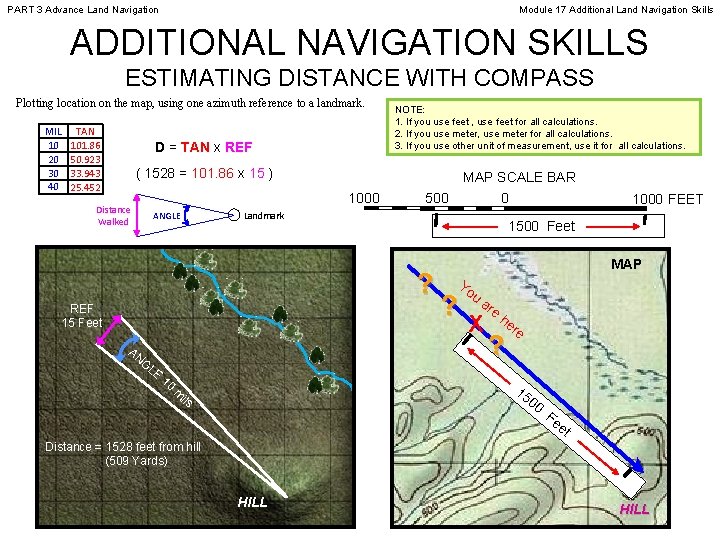
PART 3 Advance Land Navigation Module 17 Additional Land Navigation Skills ADDITIONAL NAVIGATION SKILLS ESTIMATING DISTANCE WITH COMPASS Plotting location on the map, using one azimuth reference to a landmark. MIL 10 20 30 40 TAN 101. 86 50. 923 33. 943 25. 452 D = TAN x REF NOTE: 1. If you use feet , use feet for all calculations. 2. If you use meter, use meter for all calculations. 3. If you use other unit of measurement, use it for all calculations. ( 1528 = 101. 86 x 15 ) MAP SCALE BAR 1000 Distance Walked ANGLE Landmark REF 15 Feet AN G 10 1000 FEET 1500 Feet ? LE 0 500 MAP Yo ? u ar X e he ? re 15 00 m ils Fe et Distance = 1528 feet from hill (509 Yards) HILL
PART 3 Advance Land Navigation Module 17 Additional Land Navigation Skills ADDITIONAL NAVIGATION SKILLS ESTIMATING DISTANCE WITH COMPASS Distance to a landmark is already calculated. 1. Select ANGLE ( Mil or Deg ) used. 2. Select REF (distance walked in feet or meter, etc) 3. Where it intersects is DISTANCE (feet or meter, etc) NOTE: If REF is greater than 20… example 30, add a ZERO to the 3 to get 30 and also add a ZERO to the DISTANCE value. Example : MIL 20 REF 30 DISTANCE 1530 BELOW is an example. As you can see REF 30 Feet is very different from REF 30 Meters, with the same ANGLE 20 Mils. Distances are different. REF 30 Meter MIL (ANGLE) REF 1 2 3 4 10 20 30 40 102 51 34 25 204 102 68 51 306 153 102 76 407 204 136 102 NOTE: If REF i 3 to get 30 and al Examp For calculations use the same (feet or meters or other) for all measurements 1. Use the actual measurement (feet or meter, etc) used to walk your distance. 2. Use the actual ANGLE ( mil or degree ) achieved for distance walked. 3. Select the REF in feet or meters actually used in step one above. DEGREE (ANGLE) REF 1 2 3 4 5 57 115 172 229 29 57 86 115 19 38 57 76 14 29 43 57 11 23 34 46 LAKE REF 30 Feet AN G LE 20 AN m ils REF 30 Feet G LE FOREST 20 m ils FOREST le mi 1/3 ils m 20 Distance = 1530 meters from hill (1673 Yards) ( 1 mile ) Distance = 1530 feet from hill (510 Yards) HILL ( 1/3 mile ) HILL
PART 3 Advance Land Navigation Module 17 Additional Land Navigation Skills Any Questions?
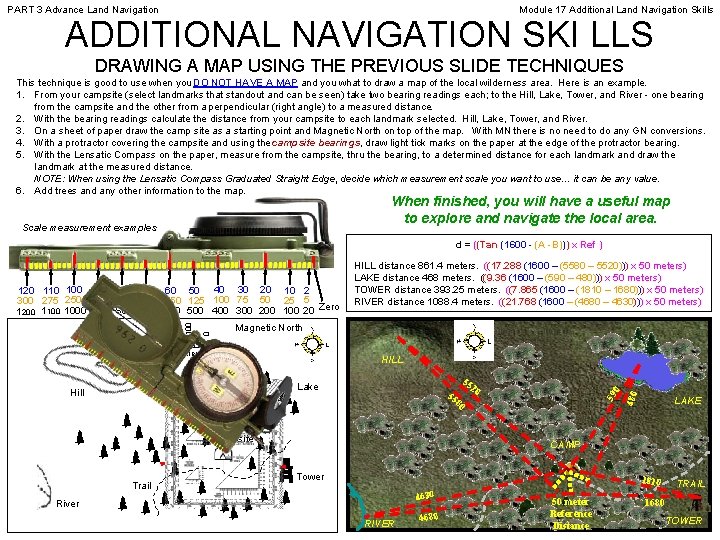
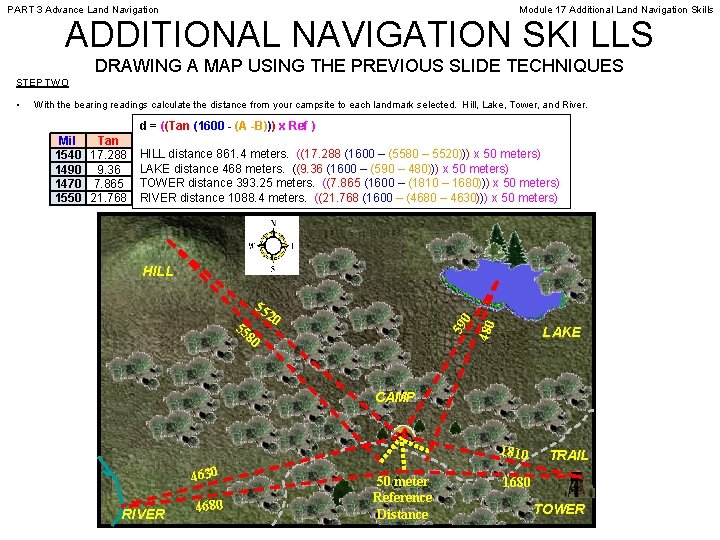
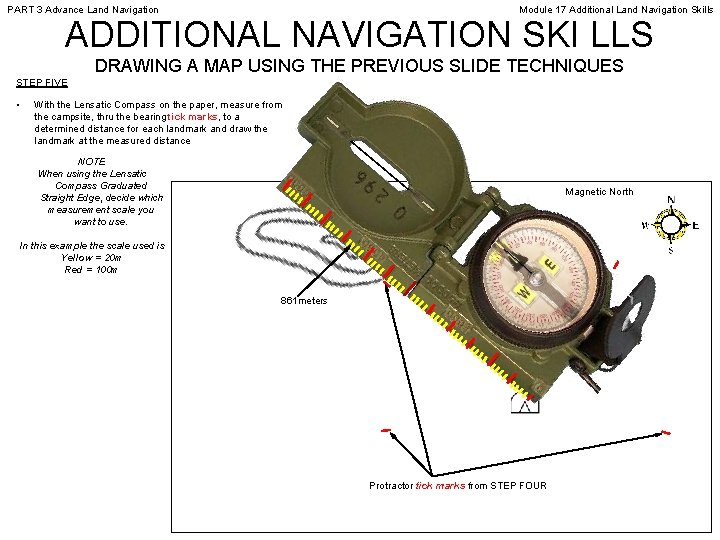
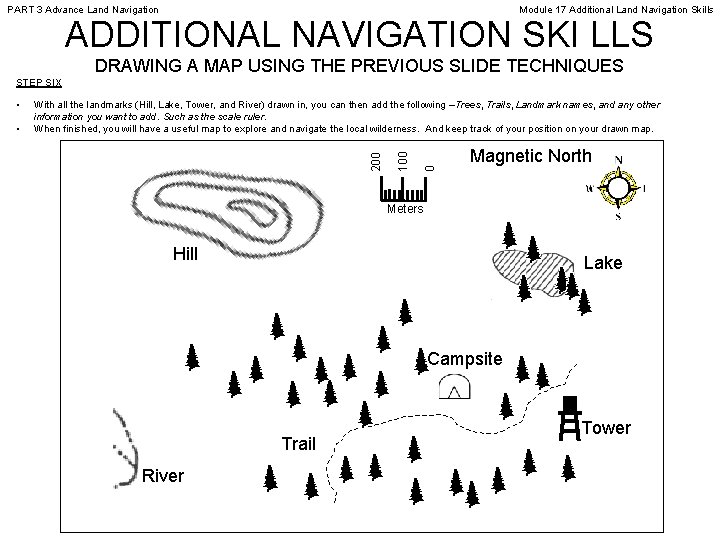
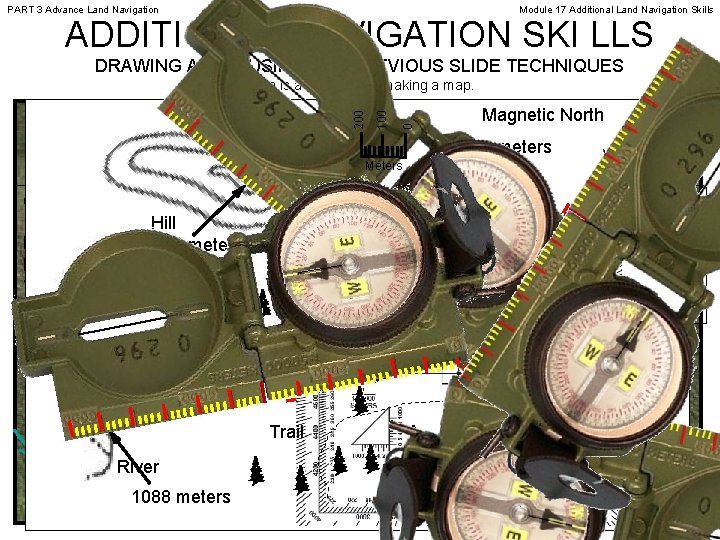
PART 3 Advance Land Navigation Module 17 Additional Land Navigation Skills ADDITIONAL NAVIGATION SKI LLS DRAWING A MAP USING THE PREVIOUS SLIDE TECHNIQUES This technique is good to use when you DO NOT HAVE A MAP and you what to draw a map of the local wilderness area. Here is an example. 1. From your campsite (select landmarks that standout and can be seen) take two bearing readings each; to the Hill, Lake, Tower, and River - one bearing from the campsite and the other from a perpendicular (right angle) to a measured distance. 2. With the bearing readings calculate the distance from your campsite to each landmark selected. Hill, Lake, Tower, and River. 3. On a sheet of paper draw the camp site as a starting point and Magnetic North on top of the map. With MN there is no need to do any GN conversions. 4. With a protractor covering the campsite and using the campsite bearings, draw light tick marks on the paper at the edge of the protractor bearing. 5. With the Lensatic Compass on the paper, measure from the campsite, thru the bearing, to a determined distance for each landmark and draw the landmark at the measured distance. NOTE: When using the Lensatic Compass Graduated Straight Edge, decide which measurement scale you want to use… it can be any value. 6. Add trees and any other information to the map. When finished, you will have a useful map to explore and navigate the local area. Scale measurement examples d = ((Tan (1600 - (A -B))) x Ref ) Magnetic North Meters HILL 55 20 55 0 480 Lake Hill 59 0 100 200 120 110 100 90 80 70 60 50 40 30 20 10 2 300 275 250 225 200 175 150 125 100 75 50 25 5 1200 1100 1000 900 800 700 600 500 400 300 200 100 20 Zero HILL distance 861. 4 meters. ((17. 288 (1600 – (5580 – 5520))) x 50 meters) LAKE distance 468 meters. ((9. 36 (1600 – (590 – 480))) x 50 meters) TOWER distance 393. 25 meters. ((7. 865 (1600 – (1810 – 1680))) x 50 meters) RIVER distance 1088. 4 meters. ((21. 768 (1600 – (4680 – 4630))) x 50 meters) 80 Campsite Trail LAKE CAMP Tower 1810 4630 River RIVER 4680 50 meter Reference Distance TRAIL 1680 TOWER
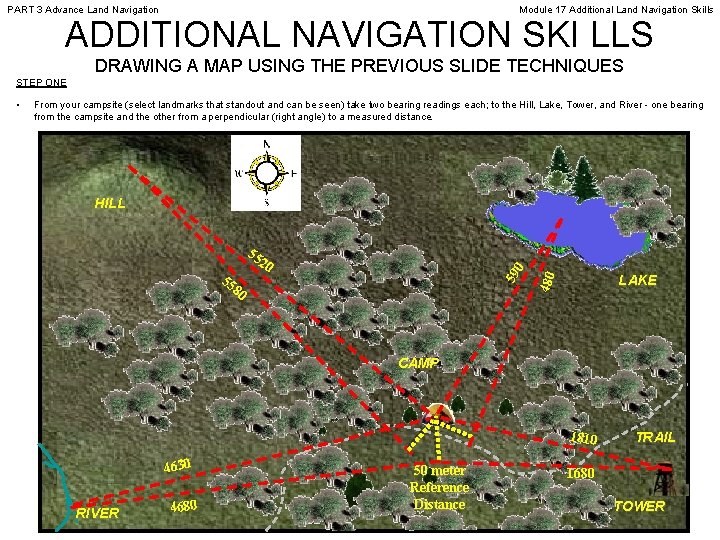
PART 3 Advance Land Navigation Module 17 Additional Land Navigation Skills ADDITIONAL NAVIGATION SKI LLS DRAWING A MAP USING THE PREVIOUS SLIDE TECHNIQUES STEP ONE From your campsite (select landmarks that standout and can be seen) take two bearing readings each; to the Hill, Lake, Tower, and River - one bearing from the campsite and the other from a perpendicular (right angle) to a measured distance. HILL 55 80 0 LAKE 480 55 2 59 0 • CAMP 1810 4630 RIVER 4680 50 meter Reference Distance TRAIL 1680 TOWER
PART 3 Advance Land Navigation Module 17 Additional Land Navigation Skills ADDITIONAL NAVIGATION SKI LLS DRAWING A MAP USING THE PREVIOUS SLIDE TECHNIQUES STEP TWO With the bearing readings calculate the distance from your campsite to each landmark selected. Hill, Lake, Tower, and River. d = ((Tan (1600 - (A -B))) x Ref ) Mil Tan 1540 17. 288 1490 9. 36 1470 7. 865 1550 21. 768 HILL distance 861. 4 meters. ((17. 288 (1600 – (5580 – 5520))) x 50 meters) LAKE distance 468 meters. ((9. 36 (1600 – (590 – 480))) x 50 meters) TOWER distance 393. 25 meters. ((7. 865 (1600 – (1810 – 1680))) x 50 meters) RIVER distance 1088. 4 meters. ((21. 768 (1600 – (4680 – 4630))) x 50 meters) 55 80 20 0 55 480 HILL 59 • LAKE CAMP 1810 4630 RIVER 4680 50 meter Reference Distance TRAIL 1680 TOWER
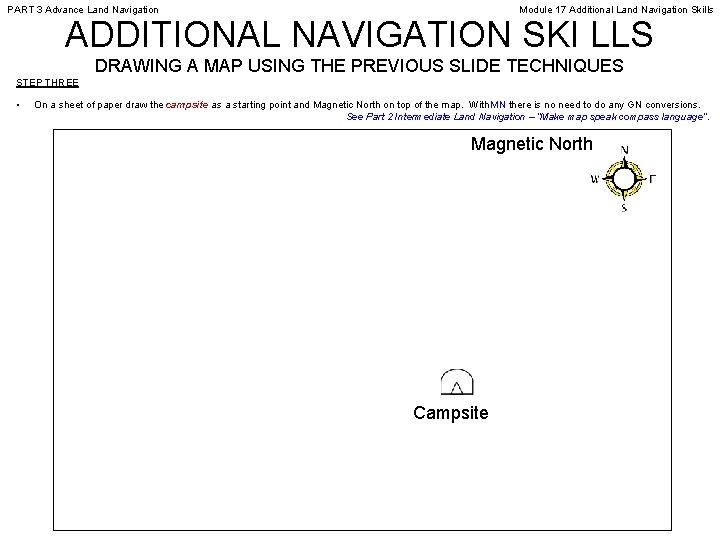
PART 3 Advance Land Navigation Module 17 Additional Land Navigation Skills ADDITIONAL NAVIGATION SKI LLS DRAWING A MAP USING THE PREVIOUS SLIDE TECHNIQUES STEP THREE • On a sheet of paper draw the campsite as a starting point and Magnetic North on top of the map. With MN there is no need to do any GN conversions. See Part 2 Intermediate Land Navigation – “Make map speak compass language”. Magnetic North Campsite
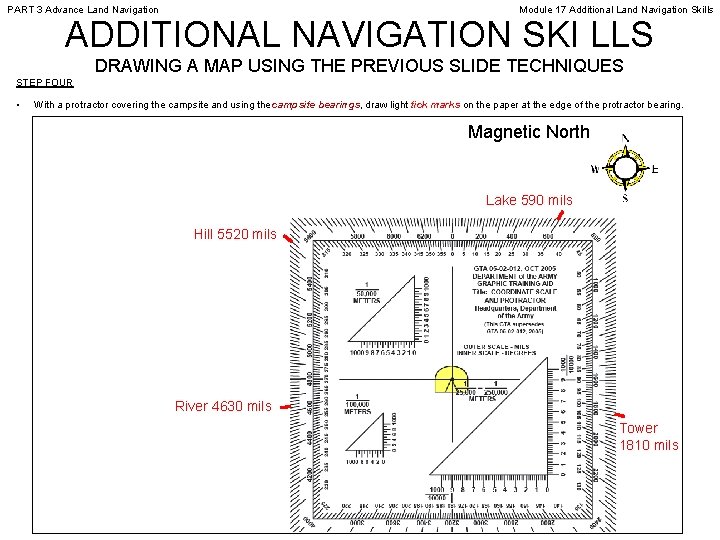
PART 3 Advance Land Navigation Module 17 Additional Land Navigation Skills ADDITIONAL NAVIGATION SKI LLS DRAWING A MAP USING THE PREVIOUS SLIDE TECHNIQUES STEP FOUR • With a protractor covering the campsite and using the campsite bearings, draw light tick marks on the paper at the edge of the protractor bearing. Magnetic North Lake 590 mils Hill 5520 mils River 4630 mils Tower 1810 mils
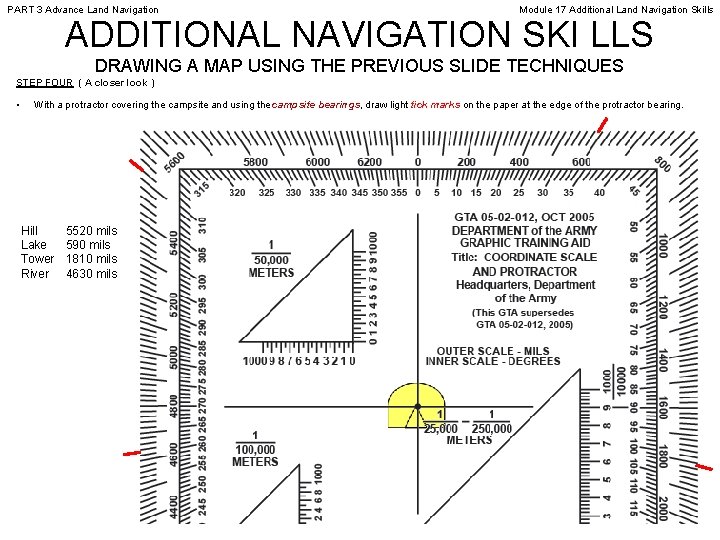
PART 3 Advance Land Navigation Module 17 Additional Land Navigation Skills ADDITIONAL NAVIGATION SKI LLS DRAWING A MAP USING THE PREVIOUS SLIDE TECHNIQUES STEP FOUR ( A closer look ) • With a protractor covering the campsite and using the campsite bearings, draw light tick marks on the paper at the edge of the protractor bearing. Hill Lake Tower River 5520 mils 590 mils 1810 mils 4630 mils
PART 3 Advance Land Navigation Module 17 Additional Land Navigation Skills ADDITIONAL NAVIGATION SKI LLS DRAWING A MAP USING THE PREVIOUS SLIDE TECHNIQUES STEP FIVE • With the Lensatic Compass on the paper, measure from the campsite, thru the bearing tick marks, to a determined distance for each landmark and draw the landmark at the measured distance NOTE When using the Lensatic Compass Graduated Straight Edge, decide which measurement scale you want to use. Magnetic North In this example the scale used is Yellow = 20 m Red = 100 m 861 meters Protractor tick marks from STEP FOUR
PART 3 Advance Land Navigation Module 17 Additional Land Navigation Skills ADDITIONAL NAVIGATION SKI LLS DRAWING A MAP USING THE PREVIOUS SLIDE TECHNIQUES STEP SIX Magnetic North 0 100 • With all the landmarks (Hill, Lake, Tower, and River) drawn in, you can then add the following – Trees, Trails, Landmark names, and any other information you want to add. Such as the scale ruler. When finished, you will have a useful map to explore and navigate the local wilderness. And keep track of your position on your drawn map. 200 • Meters Hill Lake Campsite Trail River Tower
PART 3 Advance Land Navigation Module 17 Additional Land Navigation Skills Any Questions?
PART 3 Advance Land Navigation Module 17 Additional Land Navigation Skills ADDITIONAL NAVIGATION SKI LLS DRAWING A MAP USING THE PREVIOUS SLIDE TECHNIQUES Magnetic North 0 100 200 Here is a summary of making a map. 468 meters Meters HILL CAMPCampsite River RIVER 4680 meters 1088 393 meters 1810 Tower TRAIL Trail 4630 480 59 0 d = ((Tan (1600 - (A -B))) x Ref ) Hill 55 Lake 2 HILL distance 861. 4 meters. 0((17. 228 (1600 – (5580 – 5520))) x 50 meters) 861 meters 55 LAKE 80 LAKE distance 468 meters. ((9. 36 (1600 – (590 – 480))) x 50 meters) TOWER distance 393. 25 meters. ((7. 865 (1600 – (1810 – 1680))) x 50 meters) RIVER distance 1088. 4 meters. ((21. 768 (1600 – (4680 – 4630))) x 50 meters) 50 meter Reference Distance 1680 TOWER
PART 3 Advance Land Navigation Module 17 Additional Land Navigation Skills Any Questions?
PART 3 Advance Land Navigation Module 17 Additional Land Navigation Skills ADDITIONAL NAVIGATION SKILLS CONSERVE ENERGY – REST BREAKS All groups need to take regular rest breaks in order to hike effectively throughout the day. • A good schedule is about 5 minutes of rest for every hour of hiking, which will minimize lactic acid buildup in the body. • Lactic acid is the by-product created when your muscles burn glucose while you exercise, it’s what causes your muscles to feel sore. • When you stop, lactic acid continues to be produced and remains in the system. • If you stop for less than 5 minutes, this buildup is not a problem. • If you stop for more than 5 minutes, you may begin to feel muscle soreness and tightening. • In that case it is best to extend the stop to 25 minutes to allow the excess lactic acid to be cleared out of your system. Lactic Acid during REST BREAK Less than 5 minutes – no problem More than 5 minutes – muscle soreness and tightening 25 minutes or more – body clears the lactic acid • Encourage everyone to re-hydrate at every break.
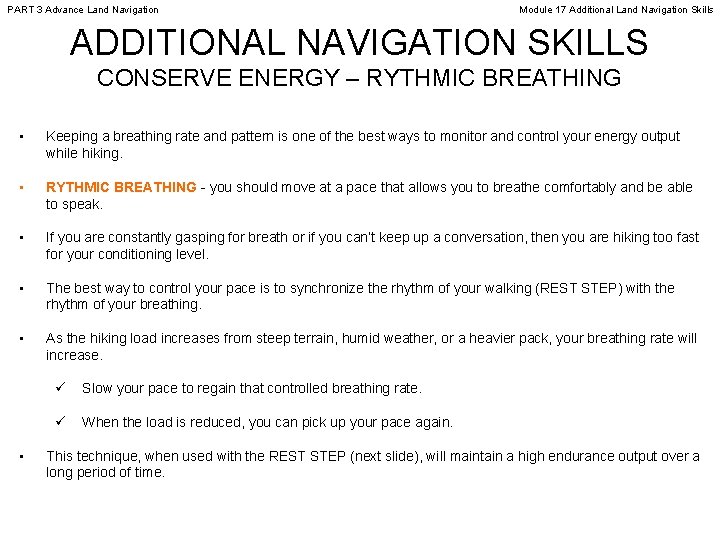
PART 3 Advance Land Navigation Module 17 Additional Land Navigation Skills ADDITIONAL NAVIGATION SKILLS CONSERVE ENERGY – RYTHMIC BREATHING • Keeping a breathing rate and pattern is one of the best ways to monitor and control your energy output while hiking. • RYTHMIC BREATHING - you should move at a pace that allows you to breathe comfortably and be able to speak. • If you are constantly gasping for breath or if you can’t keep up a conversation, then you are hiking too fast for your conditioning level. • The best way to control your pace is to synchronize the rhythm of your walking (REST STEP) with the rhythm of your breathing. • As the hiking load increases from steep terrain, humid weather, or a heavier pack, your breathing rate will increase. • ü Slow your pace to regain that controlled breathing rate. ü When the load is reduced, you can pick up your pace again. This technique, when used with the REST STEP (next slide), will maintain a high endurance output over a long period of time.
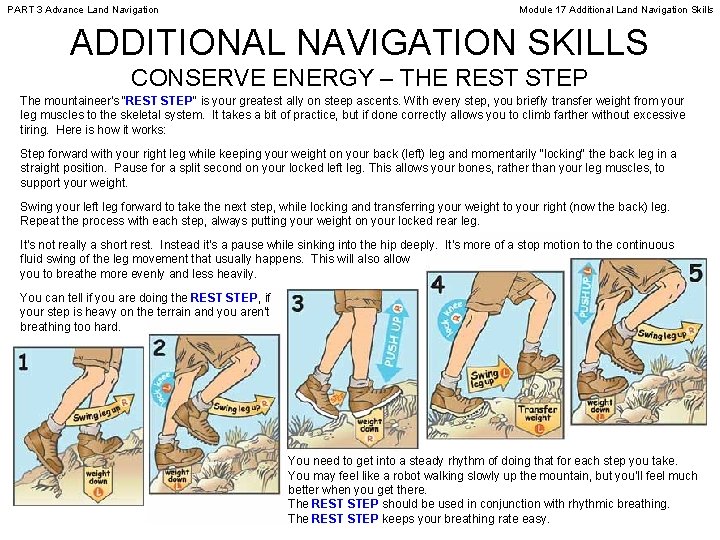
PART 3 Advance Land Navigation Module 17 Additional Land Navigation Skills ADDITIONAL NAVIGATION SKILLS CONSERVE ENERGY – THE REST STEP The mountaineer's “REST STEP" is your greatest ally on steep ascents. With every step, you briefly transfer weight from your leg muscles to the skeletal system. It takes a bit of practice, but if done correctly allows you to climb farther without excessive tiring. Here is how it works: Step forward with your right leg while keeping your weight on your back (left) leg and momentarily "locking" the back leg in a straight position. Pause for a split second on your locked left leg. This allows your bones, rather than your leg muscles, to support your weight. Swing your left leg forward to take the next step, while locking and transferring your weight to your right (now the back) leg. Repeat the process with each step, always putting your weight on your locked rear leg. It's not really a short rest. Instead it's a pause while sinking into the hip deeply. It's more of a stop motion to the continuous fluid swing of the leg movement that usually happens. This will also allow you to breathe more evenly and less heavily. You can tell if you are doing the REST STEP, if your step is heavy on the terrain and you aren't breathing too hard. You need to get into a steady rhythm of doing that for each step you take. You may feel like a robot walking slowly up the mountain, but you'll feel much better when you get there. The REST STEP should be used in conjunction with rhythmic breathing. The REST STEP keeps your breathing rate easy.
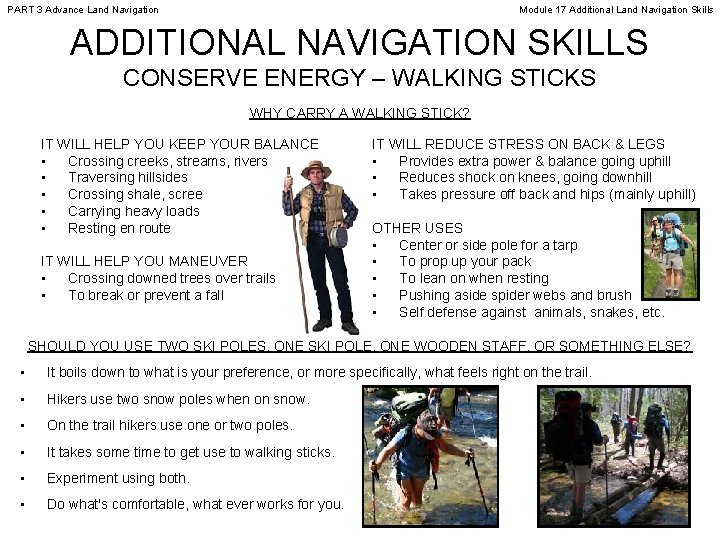
PART 3 Advance Land Navigation Module 17 Additional Land Navigation Skills ADDITIONAL NAVIGATION SKILLS CONSERVE ENERGY – WALKING STICKS WHY CARRY A WALKING STICK? IT WILL HELP YOU KEEP YOUR BALANCE • Crossing creeks, streams, rivers • Traversing hillsides • Crossing shale, scree • Carrying heavy loads • Resting en route IT WILL HELP YOU MANEUVER • Crossing downed trees over trails • To break or prevent a fall IT WILL REDUCE STRESS ON BACK & LEGS • Provides extra power & balance going uphill • Reduces shock on knees, going downhill • Takes pressure off back and hips (mainly uphill) OTHER USES • Center or side pole for a tarp • To prop up your pack • To lean on when resting • Pushing aside spider webs and brush • Self defense against animals, snakes, etc. SHOULD YOU USE TWO SKI POLES, ONE SKI POLE, ONE WOODEN STAFF, OR SOMETHING ELSE? • It boils down to what is your preference, or more specifically, what feels right on the trail. • Hikers use two snow poles when on snow. • On the trail hikers use one or two poles. • It takes some time to get use to walking sticks. • Experiment using both. • Do what's comfortable, what ever works for you.
PART 3 Advance Land Navigation Module 17 Additional Land Navigation Skills Any Questions?
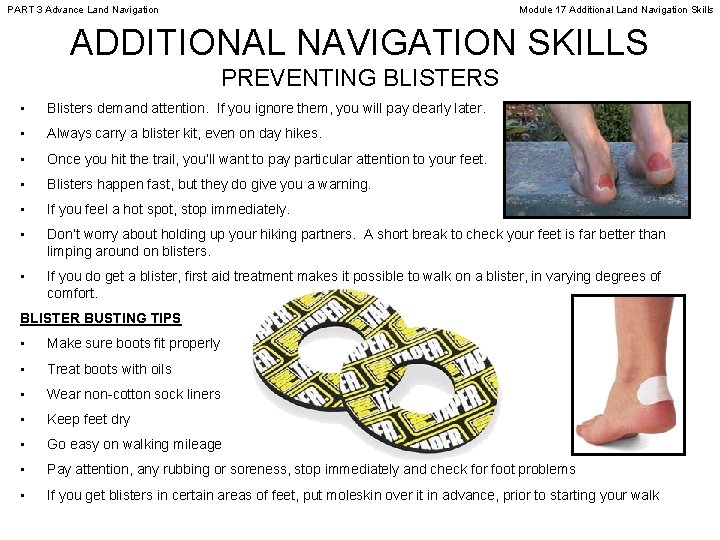
PART 3 Advance Land Navigation Module 17 Additional Land Navigation Skills ADDITIONAL NAVIGATION SKILLS PREVENTING BLISTERS • Blisters demand attention. If you ignore them, you will pay dearly later. • Always carry a blister kit, even on day hikes. • Once you hit the trail, you’ll want to pay particular attention to your feet. • Blisters happen fast, but they do give you a warning. • If you feel a hot spot, stop immediately. • Don’t worry about holding up your hiking partners. A short break to check your feet is far better than limping around on blisters. • If you do get a blister, first aid treatment makes it possible to walk on a blister, in varying degrees of comfort. BLISTER BUSTING TIPS • Make sure boots fit properly • Treat boots with oils • Wear non-cotton sock liners • Keep feet dry • Go easy on walking mileage • Pay attention, any rubbing or soreness, stop immediately and check for foot problems • If you get blisters in certain areas of feet, put moleskin over it in advance, prior to starting your walk
PART 3 Advance Land Navigation Module 17 Additional Land Navigation Skills Any Questions?
PART 3 Advance Land Navigation Module 17 Additional Land Navigation Skills ADDITIONAL NAVIGATION SKILLS Not all of these sayings hold true every time under every circumstance, but you might be surprised at just how accurate they tend to be. THE MOON • If you can see the dark part of the crescent moon, it means 24 to 48 hours of good weather. • A ring around the moon brings rain. By counting the number of stars contained within the ring, you can fairly accurately predict how long away the rain will be. Each star represents 24 hours, faint star 12 hours. • If the moon's face is red, of water she speaks. The red color is due to the presence of dust being pushed ahead of a low pressure front bringing in moisture. THE SUN • rainbow or white band around the sun, look for a drastic change in the weather within 12 -24 hours. If the weather is clear, plan on stormy weather; if the weather is dreary, plan on fair weather to arrive. • Red Sun: A red sun at dusk or dawn indicates dry weather (fair). Don't confuse a red sky in the morning with a red sun in the morning. If the sun itself is red and the sky is a normal blue color, the day will be fair. • Red Sky: A red sky at night, hikers delight, Red sky at morning, hikers take warning. RAINBOWS • Rainbows in the morning to the west indicate approaching rain. • A rainbow at sunset indicates that the rain is leaving and fair weather is on the way.
PART 3 Advance Land Navigation Module 17 Additional Land Navigation Skills ADDITIONAL NAVIGATION SKILLS ATMOSPHERIC LOW PRESSURE (rain) • If you find yourself out in a marsh or swamp and the air really seems to stink more than normal, expect rainy weather. • Birds and bats have a tendency to fly much lower to the ground right before a rain due to the “thinning” of the air. • Smoke hanging low means rain is on the way. ATMOSPHERIC HIGH PRESSURE (fair) • Things won't smell quite so strong, fair weather. • The atmosphere becomes more dense and birds can easily fly at higher altitudes, dry air. • Smoke rising straight into the air means fair weather. CLOUDS • An ability to accurately read cloud formations is invaluable in predicting the weather. For a more detailed look into this, consult a good book on the weather. Each type of cloud is caused by specific actions in nature building up to fair weather or rainy weather. PLANTS • Pine cones - One of the most reliable of all natural weather indicators are pine cones. In dry weather, pine cones open out as the scales shrivel up and stand out stiffly. When it is damp, they absorb moisture and as the scales become flexible again, the cone returns to its normal shape. • Flowers - flowers bloom in fair weather and close when rain is approaching. • Grass – dew on the grass, rain will never come to pass. When grass is dry at morning light, look for rain before the night.
PART 3 Advance Land Navigation Module 17 Additional Land Navigation Skills Any Questions?
PART 3 Advance Land Navigation Module 17 Additional Land Navigation Skills Note: Prior to being issued any training *equipment, you will be required to sign a “statement of liability” agreeing to pay for anything you damage or lose. All items will be inspected and inventoried prior to your signature and at the end of the training day too. If you do not intend to sign this statement, then you may be denied training. * You may use your own equipment.
PART 3 Advance Land Navigation Module 17 Additional Land Navigation Skills TESTING Now it is time for the following. . . • Written exam • Hands-on / Outdoors exam
PART 3 Advance Land Navigation Module 17 Additional Land Navigation Skills THE END OF LAND NAVIGATION PRESENTATION PART 3 Module 17 Additional Skills