
Part 2The Power of Vision Mc GrawHillIrwin Copyright
- Slides: 62
Part 2—The Power of Vision Mc. Graw-Hill/Irwin Copyright © 2012 by The Mc. Graw-Hill Companies, Inc. All rights reser
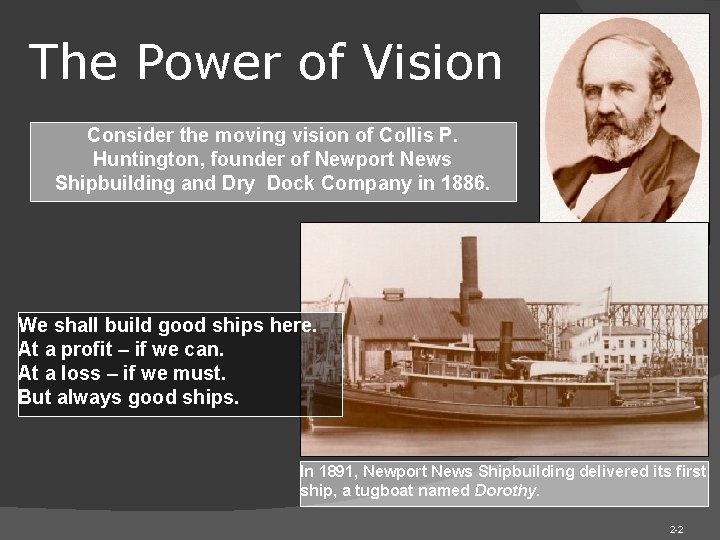
The Power of Vision Consider the moving vision of Collis P. Huntington, founder of Newport News Shipbuilding and Dry Dock Company in 1886. We shall build good ships here. At a profit – if we can. At a loss – if we must. But always good ships. In 1891, Newport News Shipbuilding delivered its first ship, a tugboat named Dorothy. 2 -2
Vision is a three-step process Recognize the need for change - Create a clear and positive vision of the future state - Institute empowering structures - 3
Three Leadership Qualities Needed For Steering Organizations Through Periods of Change 1. Taking personal responsibility for initiating change. 2. Creating a vision and strategy for the organization. 3. Trusting and supporting others. 2 -4
Taking personal responsibility A leader must manage attention - Must be personally involved - Committed to making a difference - Identity with the cause is rule 1 - 5
Creating a strategy - Strategy must be - Leader-initiated - Shared - Supported by followers - Worth doing 6
Trusting and supporting others - Leader must - Treat people with respect and dignity - Expect and demand the best effort - Show sincere appreciation 7
7 Key Leadership Findings • Without leadership, organizations falter in times of change. • Leadership is important from the boardroom to the shop floor. • Positions and titles have little or no relationship to leadership performance. • Organizational leadership involves interdependence more than individualism. • Leaders inspire others to take on the tasks of leadership. • Management skills are an essential component of organizational success. • Leadership is contextual. 2 -5
Visioning Process Principles • Initiation and constant vigilance by leaders. • Be challenging, yet realistic. • Significant early involvement by other members of the organization. • Widespread review and comment. • Keep communications flowing. • Allow time for the process to work. • Commitment, follow-through, and concurrent action by leaders. • Maintain harmony of sub-units. 2 -6
Visioning Content Principles 1. Central purpose or mission (reason for existence). 2. Broad goals 3. Core values to measure the rightness and wrongness of behavior 4. The human element 5. Analysis of organizational strengths and weaknesses, as well as environmental opportunities and threats. 6. Strategic initiatives 7. Tactical plans and specific assignments to support strategic initiatives, broad goals, and the attainment of the mission. 2 -7
The first four provide general direction - 5 and 6 involve strategic planning, giving definition - 7 is tactical planning - - The SWOT analysis can help put meaningful information behind these elements 11
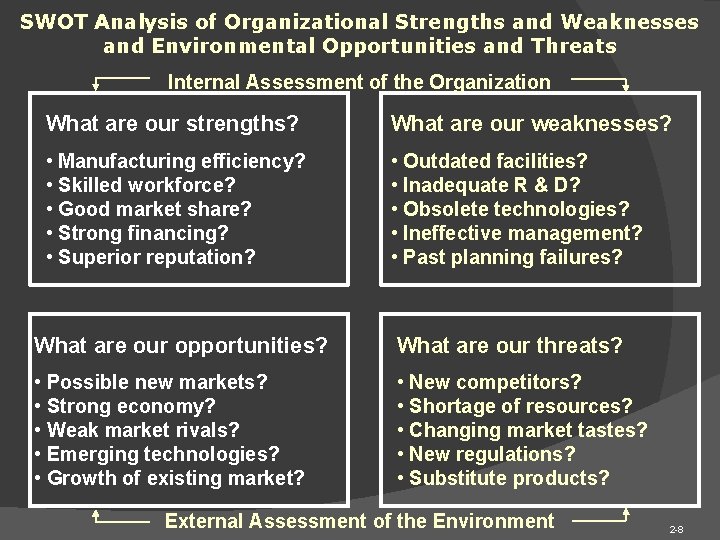
SWOT Analysis of Organizational Strengths and Weaknesses and Environmental Opportunities and Threats Internal Assessment of the Organization What are our strengths? What are our weaknesses? • Manufacturing efficiency? • Skilled workforce? • Good market share? • Strong financing? • Superior reputation? • Outdated facilities? • Inadequate R & D? • Obsolete technologies? • Ineffective management? • Past planning failures? What are our opportunities? What are our threats? • Possible new markets? • Strong economy? • Weak market rivals? • Emerging technologies? • Growth of existing market? • New competitors? • Shortage of resources? • Changing market tastes? • New regulations? • Substitute products? External Assessment of the Environment 2 -8
Visioning Application Principles • Honor and live the vision as the organization’s constitution. • Encourage new member understanding and commitment through early introduction. • Make it constantly visible. • Create integrity through alignment and congruency. • Review the vision periodically, revising as appropriate to reflect changing conditions. 2 -9
Requirements for an Effective Vision 1. Vision must be developed by leaders, those individuals with strength and influence to establish direction and mobilize the organization. - Leaders must create clear and worthy visions that motivate - An environment for success must be created - The vision should be for the common good and believed in passionately 2 -10
- 2. The vision must be communicated to followers and must be supported by them - The vision must be aligned with the needs and capabilities of the followers - An unshared vision is an unfulfilled one 15
- 3. The vision must be comprehensive and detailed - Everyone must understand their role - What is expected and the rewards must be clear - There should be a clear line of sight from personal effort to personal reward 16
4. The vision must be uplifting and inspiring - It must be worth the effort - It must be big enough to inspire - 17
What motivates individuals? The need for power - The need for personal achievement - The need for affiliation and acceptance - - How do these align with the noble goals we just saw? 18
Do we really need vision? Peter Drucker: In an economy of narrowly focused specialists, there must be vision to provide direction - Collins/Porras: In business, ‘visionary’ companies significantly outperform non visionary ones - Frederick Polak: Is a nation’s positive image of its future the result of its success, or the other way around? - 19
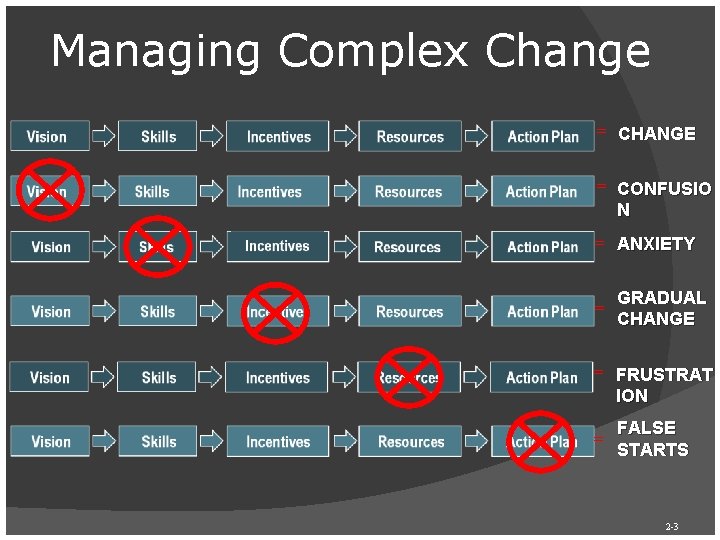
Managing Complex Change = CHANGE = CONFUSIO N = ANXIETY = GRADUAL CHANGE = FRUSTRAT ION = FALSE STARTS 2 -3
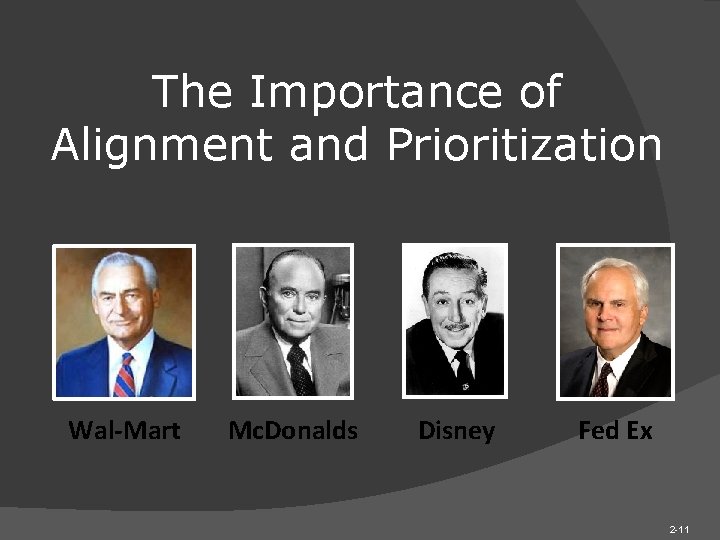
The Importance of Alignment and Prioritization Wal-Mart Mc. Donalds Disney Fed Ex 2 -11
Sam Walton: Every resource supported the store - Ray Croc: Every process supported the delivery of quality, service, cleanliness, and value - Walt Disney: Every practice brought wholesome entertainment - Fred Smith: Every system aligned to deliver the package on time - 22
Prioritization Constant prioritization of work helps do the important things first - Ivy Lee’s method expanded on by David Allen, became Getting Things Done - There are many macro and micro methodologies for task alignment and prioritization - Don’t get stuck on the tools! - 23
Why are we stressed? • • Perception of having too much to handle and not the time to get it all done - Take on too many commitments - Having too many ideas - Too much involvement - Information overflow Too many distractions – no appropriate focus Too high values – focus on primary outcomes and values does not ease our lives Ineffective personal organizational systems creating huge subconscious resistance – loose ends 24
A Goal: Mind Like Water - Imagine throwing a pebble into a still pond. How does the water respond? The answer is, totally appropriately to the force and mass of the input; then it returns to calm. It doesn’t overreact or underreact. Anything that causes you to overreact or underreact can control you, and often does. Responding inappropriately to your e-mail, your staff, your projects, your unread magazines, your thoughts about what you need to do, your children, or your boss will lead to less effective results than you’d like. Most people give either more or less attention to things than they deserve, simply because they don’t operate with a "mind like water. " (David Allen) 25
Another famous leader said… - Empty your mind, be formless. Shapeless, like water. If you put water into a cup, it becomes the cup. You put water into a bottle and it becomes the bottle. You put it in a teapot it becomes the teapot. Now, water can flow or it can crash. Be water. (Bruce Lee) 26
However… - You shouldn’t be trying to do more in each day, trying to fill every second with a work fidget of some type. … [T]he person who…develops an elaborate system of folder rules … is efficient on some perverse level. … Doing something well does not make it important … What you do is infinitely more important than how you do it. -Timothy Ferriss 27
Still, from a leadership perspective we need clarity • We need to deal effectively with internal commitments: How many incomplete tasks (open loops) are pulling your attention? There are much more than you think - • Basic requirements in Managing Commitments: ● First: Clear your mind by emptying it! Anything you consider unfinished in any way must be captured in a trusted system outside your mind where you come back to regularly and sort through! ● Second: Clarify exactly what your commitment is and decide what you have to do, if anything, to make progress toward fulfilling it. - you Third: Once you‘ve decided on all the actions you need to take, must keep reminders of them organized in a system you review regularly 28
The brain and the consequences of ‘loose ends’ • • Why is our mind not so smart? ○ Do you have a flashlight somewhere with dead batteries in it? When does your mind tend to remind you that you need new batteries? When you notice the dead ones! That‘s not very smart. If your mind had any innate intelligence, it would remind you about those dead batteries only when you passed live ones in a store! Why do you think of stuff you can‘t make progress on? ○ Between the time you woke up today and now, did you think of anything you needed to do that you still haven‘t done? ○ It‘s a waste of time and energy to keep thinking about something that you make no progress on. Stuff are open loops – Anything you have allowed into your psychological or physical world that doesn‘t belong where it is and for which no outcome and next action has been defined! Stuff has to be transformed in actionable items in a wider system. 29
Managing Action • The key to manage your “stuff” is managing your actions • Horizontal and Vertical Action Management – Horizontal control maintains coherence across all the activities in which you are in involved. – Vertical control, in contrast, manages thinking up and down the track of individual topics and projects. • The major change: Getting it all out of your head! – The short-term-memory part of your mind – the part that tends to hold all of the incomplete, undecided, and unorganized “stuff” - is overloaded with Stuff works like myriads of little monitors popping up arbitrarily and distracting your focus. Furthermore, if you have loaded much stuff there will always be conflict as you only can fulfill one task at a time. • This produces ongoing stress – stress that is ubiquitous like gravity 30
The Axiom Humans have a problem with stuff - Stuff is anything we want or need to do - Taxes, groceries, marriage proposal, retirement plan, mowing the yard – it’s ALL stuff - 31
The Goal ⦿ To have nothing on your mind Why? ⦿ Because you’re most creative (can solve problems best) when you’re relaxed and having nothing on your mind 32
The System To simplify a complex event, you NEED a complex system - Technology-enabled forgetfulness - Planner, computer, sticky notes, or magnets on the fridge are all technology - 33
The TRUSTED system The key to making any productivity methodology work is that you MUST TRUST IT - If you get something out of your head and then completely forget about it, your stress level will go up, not down. - The trusted system can be paper, a program, a set of programs…whatever works and that you trust - 34
The Rules Collect and describe all the stuff - All stuff must be handled in a precise way - Items on lists should be described as concretely as possible - 35
The Process - Capture all your stuff – make a list Don’t worry about order or coherence The list is meant to be exhaustive – get it all off your mind Capture physical stuff…make a big pile on your desk All of this is your INBOX 36
Now that you have a pile Go through every item one at a time - Apply the GTD workflow (coming up) - The goal is to get the in-box empty - 37
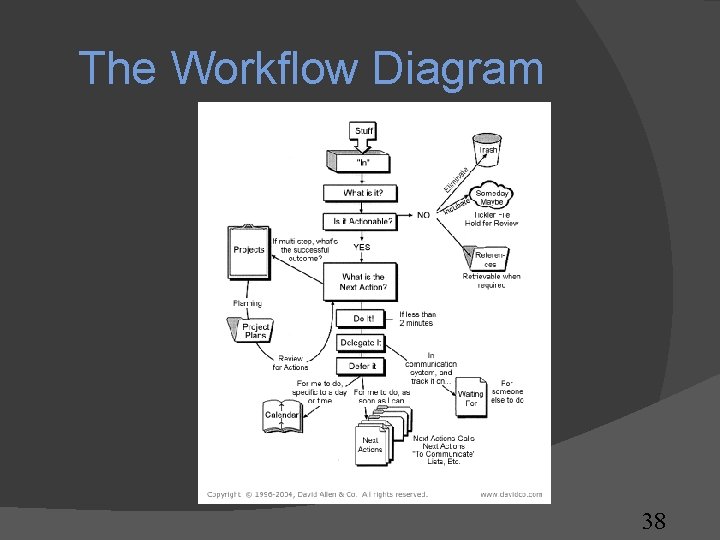
The Workflow Diagram 38
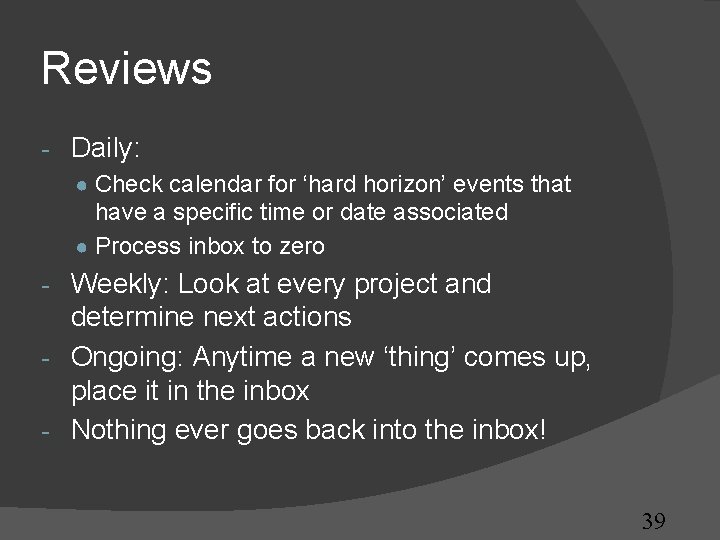
Reviews - Daily: ● Check calendar for ‘hard horizon’ events that have a specific time or date associated ● Process inbox to zero Weekly: Look at every project and determine next actions - Ongoing: Anytime a new ‘thing’ comes up, place it in the inbox - Nothing ever goes back into the inbox! - 39
Alternatives to GTD • There are lots of alternative systems to GTD – Zen to Done is a simplified implementation to GTD: ztd – Get everything done: GED – More productive now (a GTD plagiate): moreproductivenow – Franklin Covey – Hundreds of apps for mobile devices – Web-based tools like RTM, Toodledo, etc • But remember, to have a mind like water there is more to do than just get organized! 40
The Goal ⦿ To have nothing on your mind Why? ⦿ Because you’re most creative (can solve problems best) when you’re relaxed and having nothing on your mind 41
What are common leadership styles? Exploitive - Impoverished - Supportive - Enlightened - 42
Exploitive Leadership ⦿ Autocratic and Hierarchical ⦿ No participation by members ⦿ Leaders show little trust in others ⦿ Often have a lack of loyalty by employees ⦿ Organizations don’t often survive 2 -12
Impoverished Leadership ⦿ Power remains at top ⦿ Rare opportunities for members to participate ⦿ Autocracies are good examples ⦿ These can actually be beneficial if leaders truly care about their people 2 -13
Supportive Leadership ⦿ Great deal of interest and confidence in members ⦿ Power resides in leaders ⦿ Widespread commitment to achieve goals ⦿ Broad participation in decision-making activities 2 -14
Enlightened Leadership ⦿ Delegates power to a concern for a problem ⦿ All levels of an organization can initiate and execute plans ⦿ Open and uncensored communication ⦿ Leaders ask for ideas and try to use others’ suggestions 2 -15
Four Principles of Enlightened Organizations 1. View human resources as the organization’s greatest asset; 2. Treat every individual with understanding, dignity, warmth, and support; 3. Tap the constructive power of groups through visioning and team building; 4. Set high performance goals at every level of the organization. 2 -16
Importance of community Thomas Carlyle: Though we want to be unique and valuable, we also crave to be something more than one alone - Marvin Weisbord: We hunger for community and are more productive when we find it - 48
Ten Elements of a True Community 1. Shared vision 2. Wholeness incorporating diversity 3. Shared culture 4. Internal communications 5. Consideration and trust 6. Maintenance and government 7. Participation and shared leadership 8. Development of younger members 9. Affirmation 10. Links with outside groups 2 -17
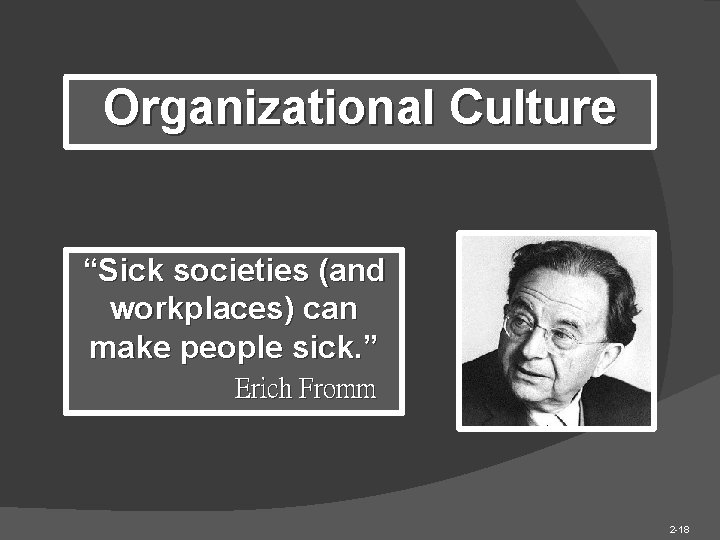
Organizational Culture “Sick societies (and workplaces) can make people sick. ” Erich Fromm 2 -18
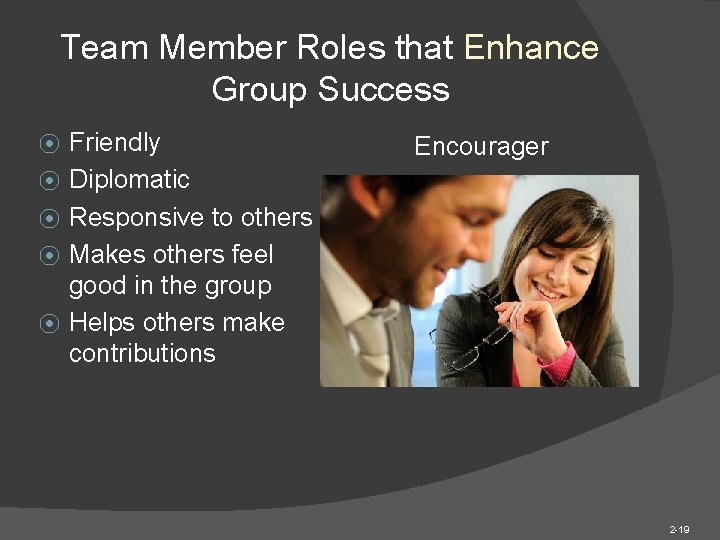
Team Member Roles that Enhance Group Success ⦿ ⦿ ⦿ Friendly Diplomatic Responsive to others Makes others feel good in the group Helps others make contributions Encourager 2 -19
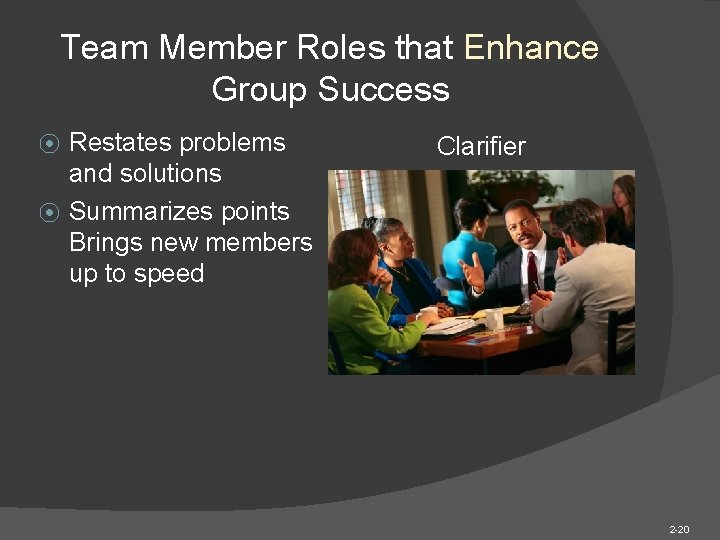
Team Member Roles that Enhance Group Success Restates problems and solutions ⦿ Summarizes points Brings new members up to speed ⦿ Clarifier 2 -20
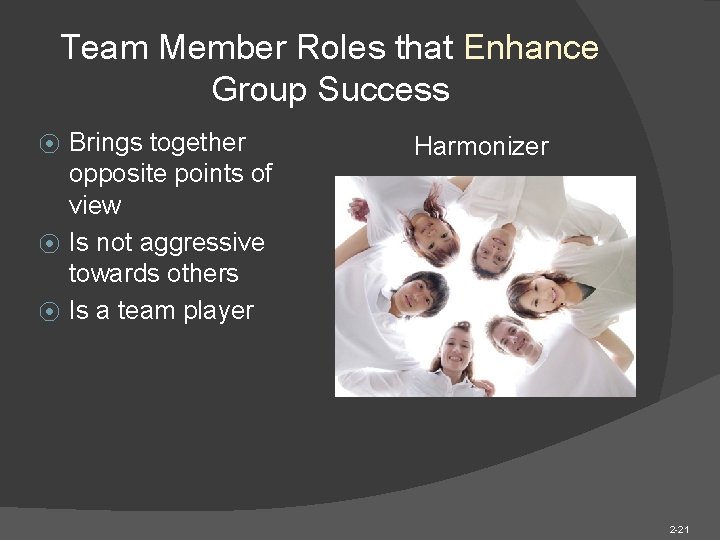
Team Member Roles that Enhance Group Success Brings together opposite points of view ⦿ Is not aggressive towards others ⦿ Is a team player ⦿ Harmonizer 2 -21
Team Member Roles that Enhance Group Success Spontaneous and creative ⦿ Unafraid of change ⦿ Suggests new ideas ⦿ Idea Generator 2 -22
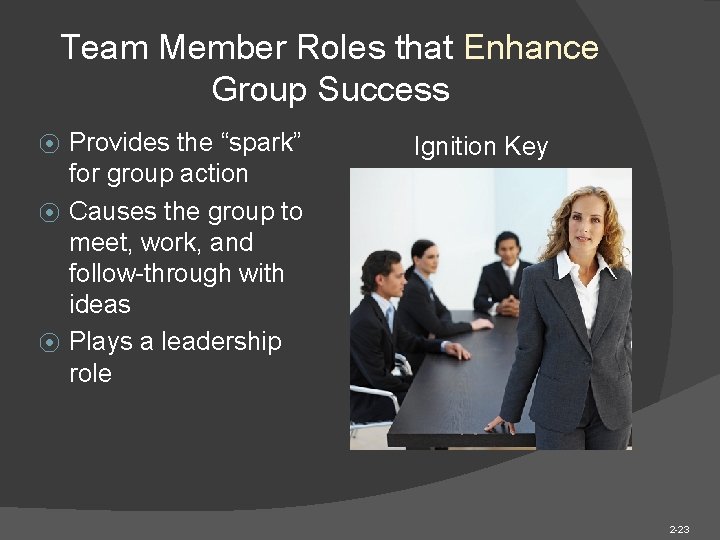
Team Member Roles that Enhance Group Success Provides the “spark” for group action ⦿ Causes the group to meet, work, and follow-through with ideas ⦿ Plays a leadership role ⦿ Ignition Key 2 -23
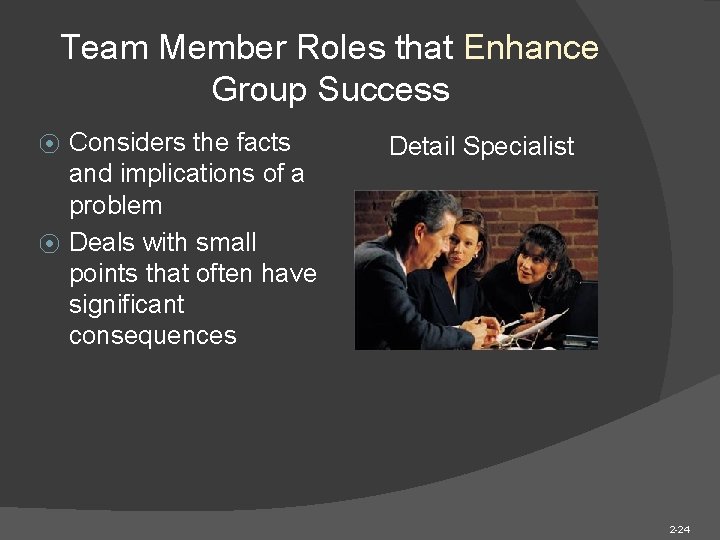
Team Member Roles that Enhance Group Success Considers the facts and implications of a problem ⦿ Deals with small points that often have significant consequences ⦿ Detail Specialist 2 -24
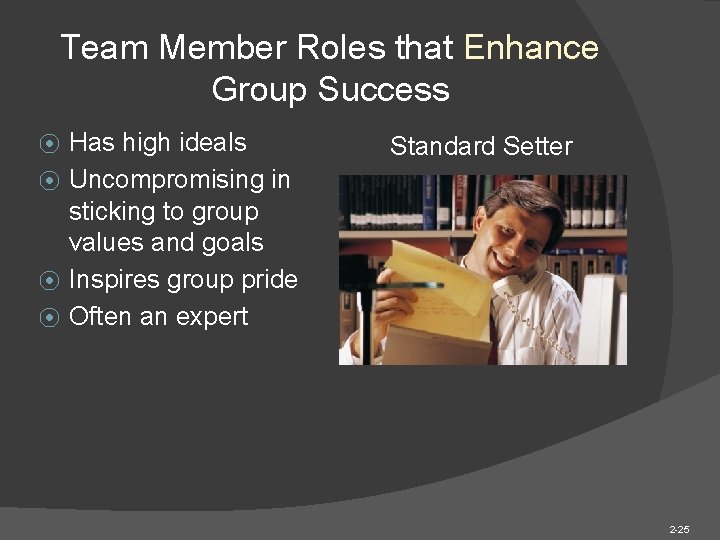
Team Member Roles that Enhance Group Success Has high ideals ⦿ Uncompromising in sticking to group values and goals ⦿ Inspires group pride ⦿ Often an expert ⦿ Standard Setter 2 -25
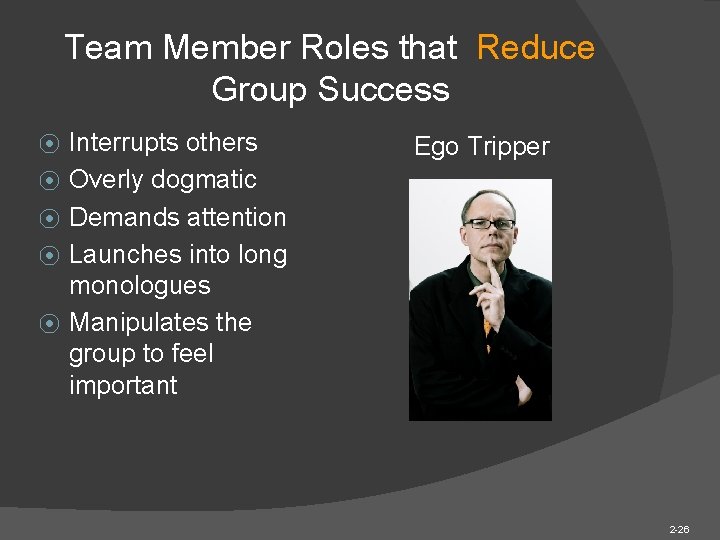
Team Member Roles that Reduce Group Success ⦿ ⦿ ⦿ Interrupts others Overly dogmatic Demands attention Launches into long monologues Manipulates the group to feel important Ego Tripper 2 -26
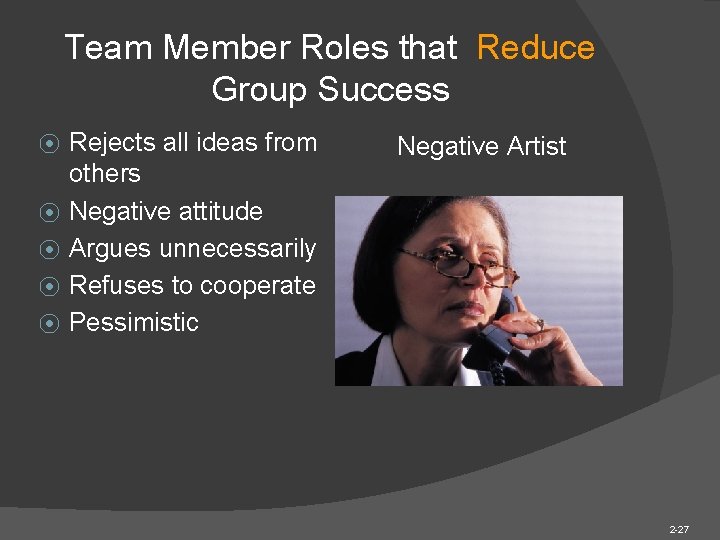
Team Member Roles that Reduce Group Success ⦿ ⦿ ⦿ Rejects all ideas from others Negative attitude Argues unnecessarily Refuses to cooperate Pessimistic Negative Artist 2 -27
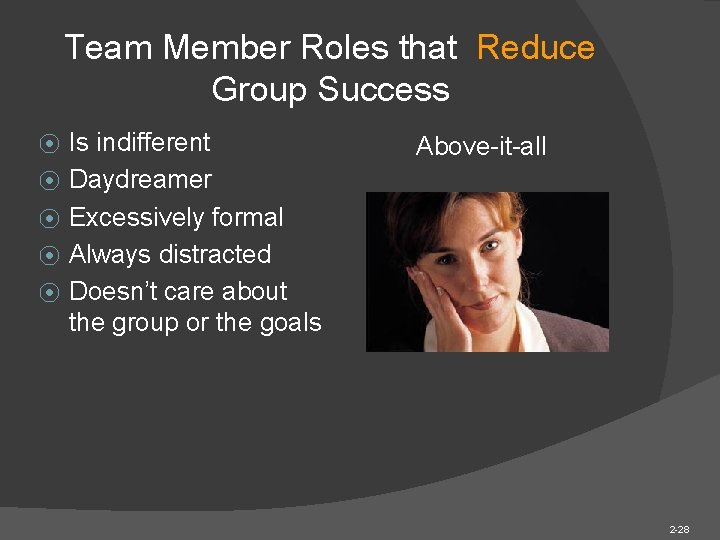
Team Member Roles that Reduce Group Success ⦿ ⦿ ⦿ Is indifferent Daydreamer Excessively formal Always distracted Doesn’t care about the group or the goals Above-it-all 2 -28
Profile of a Dream Team ⦿ Works towards a common goal ⦿ Is committed to continuous improvement ⦿ Maintains a positive attitude toward everyone’s ideas ⦿ Stays on task ⦿ Shares pride in its accomplishments ⦿ Celebrates success 2 -29
Bottom line Those in leadership roles set the tone for the organization - Scott Peck: The leader of a group is a potential obstacle to creating community (and thereby harmony) - 62