
Part 2 What is a SWPPP Preventing Stormwater
- Slides: 20
Part 2 - What is a SWPPP? Preventing Stormwater Pollution at Your Public Works Facility: A 5 -Part Workshop Series
Training Modules 1. Why Stormwater Matters 2. What is a SWPPP? 3. Spill Prevention & Response 4. Materials Management 5. Good Housekeeping
What is a SWPPP? • Relation to Clean Water Act & RIPDES • Contents of site-specific SWPPP • Exercise: What do we do outdoors?
Storm Water Pollution Prevention Plan • Site (Facility) Specific • Facility Staff all have a role in implementation
National Stormwater Discharge Program • Phased approach by EPA – Phase I – 1990 – large cities – Phase II – 1999 – smaller municipalities & “public bodies”
GENERAL PERMITS under Rhode Island Pollutant Discharge Elimination System • Storm Water Discharge Associated with Industrial Activity (Multi-Sector) • Storm Water Discharge from Small Municipal Separate Storm Sewer Systems (MS 4)
General Permit Requirement • Implement a site-specific Storm Water Pollution Prevention Plan (SWPPP) developed for each facility with “industrial” activity
SWPPP requirements • Facility Associated with a MS 4 – Section IV. B. 6. b. 5. of MS 4 General Permit (Good Housekeeping) • Multi-Sector – Section IV of Multi. Sector General Permit
SWPPP Contents • Site-specific • Describe BMPs (Best Management Practices) • Structural and non-structural controls for reducing or eliminating discharge of pollutants from operations and facilities • Storm water-related: Outdoors
SWPPP must describe COORDINATOR • Individual responsible for coordinating and implementing practices, inspections, evaluations and updates
SWPPP must describe FACILITY o Address o Number of acres o Size of impervious areas o Number of buildings & what used for o Number & types of vehicles o Number & location of outfalls o Number & location of catch basins
SWPPP must describe “EXPOSED” ACTIVITIES o Past spills/chronic leaks o Handling materials & wastes o Fueling, washing, maintaining equipment o Underground & above ground storage o “Allowable non-storm water discharges”
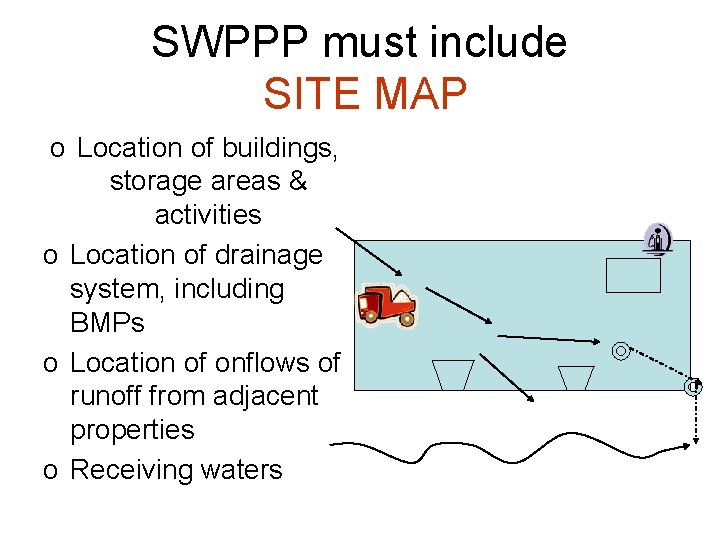
SWPPP must include SITE MAP o Location of buildings, storage areas & activities o Location of drainage system, including BMPs o Location of onflows of runoff from adjacent properties o Receiving waters
SWPPP must describe MATERIALS & ACTIVITIES o Assessment of potential of each to contribute pollutants to storm water discharges
SWPPP must describe PRACTICES TO CONTROL POLLUTANTS o Good housekeeping practices o Preventive maintenance o Existing/planned BMPs for activities o How salt/sand piles are stored o Operating procedures re. fuels o Vehicle maintenance operations o Erosion controls o Other runoff management practices o Spill prevention & response procedures o Employee training
SWPPP must describe PROCEDURES FOR EVALUATION OF COMPLIANCE o Visual monitoring o Annual site inspections o Record keeping & reporting
SWPPP must be AMENDED • as operations/materials/practices change
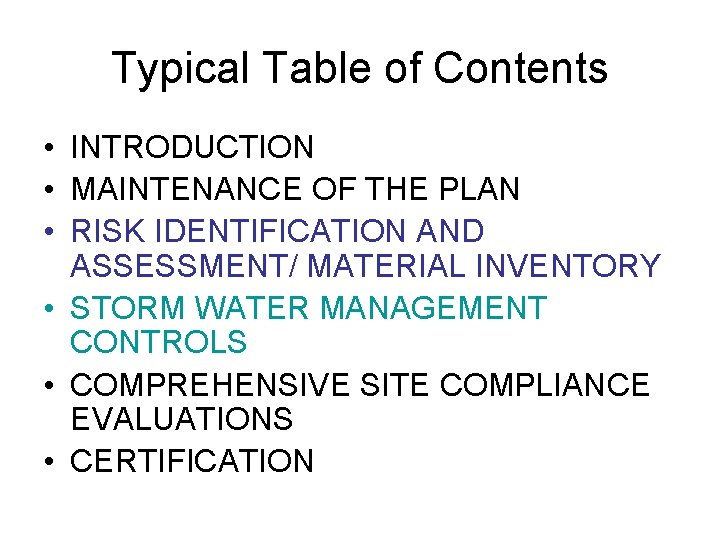
Typical Table of Contents • INTRODUCTION • MAINTENANCE OF THE PLAN • RISK IDENTIFICATION AND ASSESSMENT/ MATERIAL INVENTORY • STORM WATER MANAGEMENT CONTROLS • COMPREHENSIVE SITE COMPLIANCE EVALUATIONS • CERTIFICATION
Public Works Facility Operations & Maintenance for Stormwater Management: Employee Training Brought to you by: This program was developed by the Southern Rhode Island Conservation District in partnership with the URI Cooperative Extension RI NEMO Program and the Rhode Island T 2 Center. Funding was provided by the RI Department of Environmental Management and the RI Department of Transportation under the Phase II Stormwater Education and Outreach Program.
Exercise! n What activities are performed outdoors? n Locate on map