
Part 2 The Second Hadith On Riya Riya
- Slides: 39
Part 2 The Second Hadith: On Riya’
• "Riya’ in any of its forms amounts to shirk, • • (polytheism); verily, one who works for the people, his reward lies with them, and one who works for God his reward lies with God. ” –Imam Jaafar al. Sadiq (as)It is a game of pretend; it means to put on a show for others to see and make oneself appear pious, virtuous, good natured, and a true believer in God. By doing so, the hypocrite (person committing Riya’) wishes to earn respect and admiration, and wishes to build a reputation amongst the people; without any intention of acquiring these positive traits for the
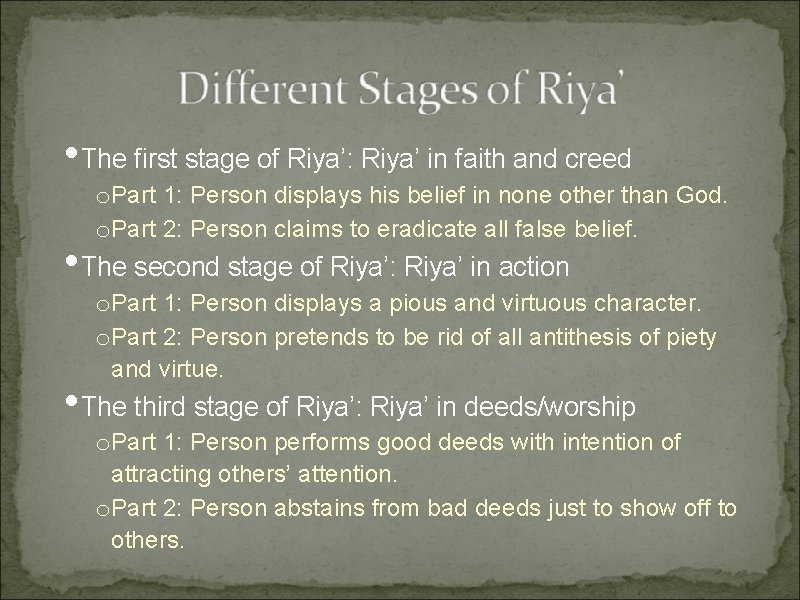
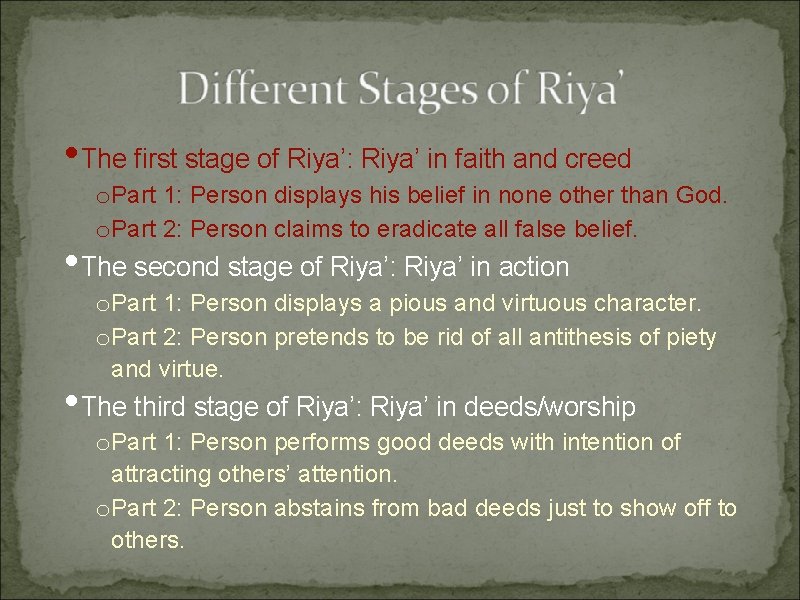
• The first stage of Riya’: Riya’ in faith and creed o Part 1: Person displays his belief in none other than God. o Part 2: Person claims to eradicate all false belief. • The second stage of Riya’: Riya’ in action o Part 1: Person displays a pious and virtuous character. o Part 2: Person pretends to be rid of all antithesis of piety and virtue. • The third stage of Riya’: Riya’ in deeds/worship o Part 1: Person performs good deeds with intention of attracting others’ attention. o Part 2: Person abstains from bad deeds just to show off to others.
• Hypocrisy in faith is the worst kind of hypocrisy, and will result in the severest of punishments. A person who boasts in believing, but does not genuinely believe , will be considered one of the munafiqun (hypocrites) and sentenced to the Fire. • However, if a person does believe in what he claims to believe, but he believes for the sake of winning peoples’ hearts and worldly honor, then he’s not considered a munafiq, but he is considered a mushrik (polytheist). o He is guilty of confessing faith for the sake of others and therefore makes them partners in what should solely belong to Allah (swt).
• Genuine faith emerges from the depths of the heart, and one who brings partners onto God allows others (such as shaytan) to occupy his heart. o This is hidden cruelty onto one’s own self, as the individual nullifies his good deeds and allows the surrender of his heart to those other than God. o He dies the death of a non-believer. His profession in faith is similar to a body without a soul; empty and senseless. • God Almighty said, "I am the best of friends; one who makes others My partners in any matter, his deeds are not acceptable to Me. I accept only those acts that are purely done for My sake. “ –Tradition stated from Imam Jafar al-Sadiq (as)-
• Any spiritual act performed without sincerety of the heart will not be regarded by Allah (swt), and will be credited in the account of that partner-the person, for whose sake they were performed. o This surpasses shirk and amounts to kufr (infidelity), and the individual might even be considered a munafiq (hypocrite). • Just as his polytheism was hidden, his hypocrisy is also hidden to him. He believes himself a believer, but he is condemned to the fate of munafiqun and his good deeds will be of no avail.
• Difference between knowledge and faith: Being a believer and having faith are quite different from possessing knowledge of God, His Unity, His Attributes, the angels, the Scriptures, the Last Day, etc. o Shaytan has more knowledge on these matter than people like us, yet he is still a non-believer. o Faith comes from the inner depths of the heart, and anyone who comes to believe through reason and logic should submit whole-heartedly, beyond doubt, without conditions. Faith is complete surrender to God. o “When the light of faith is stabilized, it brings with it
• Difference between knowledge and faith (contd. ): o When reason and logic accept something as true, but the heart does not, that knowledge becomes useless. § Ex: Our logic may tell us that the dead are powerless, and that after death, the body of the deceased has no power as the physical and the spiritual powers no longer reside in that body. However, if our heart does not accept that fact, we will not spend a dark night alone with that dead body. However, if our heart and mind come to an agreement on this issue, then our fear of the dead body will be no more. o Faith is for the gratification of the heart, and knowledge is for the gratification of the mind, and until “the words: (there is no god except God) are inscribed
• Difference between knowledge and faith (contd. ): o When the mind and heart agree, only then does a person come towards God. At that point, a person does not care for rank, riches, fame, favor, reputation, etc. with the people; his sole contentment is with God. o So if you find yourself poisoned by Riya’, and find your heart is still lacking the illumination of true faith; “for you consider others to be your God and see them as efficient agents in the world, and you do not trust Him, the only God; it means that you have joined the company of hypocrites, polytheists and idolaters”.
• Dangerous effects of Riya’: o The pleasures of the hereafter are lost, and the person is deprived of the sight of the Most High. o The light of faith which illuminates the heart and lifts the spirit is exchanged for dreadful darkness of eternal misfortunes. This darkness is not followed by even a single ray of light, it is disease without a cure, a fire that will engulf the heart. § (It is) the fire of Allah, kindled, which leapeth up over the hearts (of men). (104: 6 -7) o “My friend, do not make yourself an object of the Divine wrath for the sake of an illusion, an insignificant and trivial popularity in the eyes of weak creatures of
• An advice for getting rid of the curse of Riya’: o Understand that nothing is outside of Allah’s (swt) dominion, and that he has control over all things, even the hearts of man. He it is who puts love in man’s heart for whomsoever He chooses. o Because Allah (swt) has control over all things, it is possible that in your attempts to please people, you inadvertently produce negative results (because that is what God has planned); like the hypocrites with their impure hearts, who were ultimately condemned to be disgraced despite what they intended.
• Jarrah al-Mada'ini, asked Imam Jaafar al-Sadiq (as) about the words of the Almighty that `whosoever is desirous of meeting his Creator, he should perform virtuous deeds and should not ascribe any partner to God in his worship. ’ The Imam (as) said, `A person who performs good deeds but not for the sake of being blessed with the vision of his God, his acts are aimed at being considered as pious by the people, and he wishes that people should know about his deeds; such a person is counted among polytheists, who have ascribed partners to God. There is none in the world, who has concealed his good deeds and after passage of time God has not revealed them. And there is none
• An advice for getting rid of the curse of Riya’ (contd. ): o Try to make yourself worthy in front of God, and instead of wasting time trying to impress people, invest your time in impressing the One who has ownership of peoples’ hearts. o “Work for the sake of God. As a consequence God Almighty, besides showering His favors and excellences upon you in the Hereafter, will bestow His honors and favors on you in this world as well, and will befriend you. He will raise your status in the eyes of people and will exalt you in both the worlds. ”
• An advice for getting rid of the curse of Riya’ (contd. ): o Beware, your love for this world may turn you into a mushrik, munafiq, a non-believer. You do not want your end to be in disgrace, nor do you want to be a sijjini (inhabitant of the lowest dungeon of hell). o Sijjin is a place of unimaginable horror, a point of no return, for at that moment the doors of repentance will be shut on us. o The Prophet (saww) said: `Indeed when the angel of God joyously takes to the higher heaven the good deeds of a man, as he carries the good deeds heavenward, God Almighty orders him to place those
• An advice for getting rid of the curse of Riya’ (contd. ): o Wake up before it is too late and put an end to your negligence; do not allow polytheism, hypocrisy, and infidelity to plague your heart. “Do not be a traitor to yourself and do not destroy what God has entrusted to you, calling it: ‘. . . the nature (framed) of Allah in which He hath created man. . . ’ (30: 30)”. o Let your heart be the mirror in which the Light of the Divine is reflected. Attach yourself to the One, such that His remembrance is of greatest pleasure to you and the pleasures of this world are no longer deemed
• Sincerity in action: o His kingdom is boundless, and “. . . Lo! Allah is independent of (all) creatures. (3: 97)”, yet we constantly transgress with our polytheism and deny our complete dependence upon him. o Allah (swt) has bestowed countless blessings upon us, and in exchange for this He asks that we liberate ourselves from the narrow confines of this material world and keep our hearts pure for Him to occupy (this is for our own benefit). o Thus, we should turn to Him, worshipping and supplicating with humility, because this is a favor that we do onto ourselves, not onto others (i. e Prophets,
• Sincerity in action (contd. ): o These chosen servants of Allah (swt) have taken great responsibilities upon themselves to deliver us from darkness into the light, a light that our narrow and worldly eyes cannot imagine. o The magnificence of this light has been described to us, through words of the prophets and the revelations to the Seal of the prophets, but we continue to disobey the mandates and disregard the favors of Allah (swt) and through Him the favors of the Prophet (saww) and his ahlul-bayt (as). o We do not realize that we are indebted to these chosen ones for delivering us the means of our
• Sincerity in action (contd. ): o “. . . Say: Deem not your surrender a favor unto me; nay, but Allah does confer a favor on you, inasmuch as He hath led you to the faith, if ye are earnest. Lo. Allah knows the Unseen of the heavens and the earth. And Allah is Seer of what you do. ” (49: 17 -18) o Thus, our sincerity in faith is God’s favor upon us, not the other way around. And Allah (swt), knows the hidden realities of all our actions. § We acquire knowledge from the faqih (jurisprudent) and think we are doing him a favor. We pray behind an alim and think we have graced that congregation with our presence, when in fact, that congregation was a favor upon our soul.
• The first stage of Riya’: Riya’ in faith and creed o Part 1: Person displays his belief in none other than God. o Part 2: Person claims to eradicate all false belief. • The second stage of Riya’: Riya’ in action o Part 1: Person displays a pious and virtuous character. o Part 2: Person pretends to be rid of all antithesis of piety and virtue. • The third stage of Riya’: Riya’ in deeds/worship o Part 1: Person performs good deeds with intention of attracting others’ attention. o Part 2: Person abstains from bad deeds just to show off to others.
• Though the second stage of riya’ is lesser in intensity then the previous stage, if not corrected, this stage can lead a person to the first stage- the riya’ in faith. • In Alam al-malakut (the celestial world), man may not be in his human form depending on the merits of his actions in this world. o “Ayatullah Shahabadi used to say that the measure of the false and invalid spiritual practice and true religious spiritual struggle is as to what extent
• On the upward heavenly journey, if the person is driven by selfish motives, his suluk (progress on mystic path) will lead to torments in the hereafter. o For such a person, the operating force is satanic and the inner self is not of human form. o For such people, it is impossible to learn the essence of tawhid unless the heart is purged of its impurities. • If, however, the person is genuinely devoted to the right path and searched for God, Allah’s (swt) help will be delivered to him. o “As for those who strive for Us, We surely guide them to Our paths. . . ” (29: 69)
• In hadith qudsi, Allah (swt) has said: o There is no clearer sign in the earth and in the heavens of the elegance of the Beloved than the heart of a true believer (mu'min). o The heart of the true believer (mu'min) lies between two fingers of God, that He may turn it whatever way He pleases. • Thus, in order to become a mu’min, one must stop worshipping oneself and the devil, and prevent ignorance from governing the heart. Because as long as bad habits prevail, and selfishness and egotism dominate, the person will be a munafiq (hypocrite) even if he believes himself as believer.
• The value of human existence as a trustee of divine honor: o Understand why you were created; you were not created for yourself, but for His sake, and your heart is where Divine Honor resides. § “O progeny of Adam, We have made everything for you and you for Our service. ” (Hadith qudsi) o Those moral attributes that brought the awliya (saints) closest to God are often the attributes that we surrender to this material realm instead of to God, thus committing shirk. o We must be careful of this transgression, because although Allah (swt) is Sattar (concealer of sins), He
• The value of human existence as a trustee of divine honor (contd. ): o We should wake up before we cross the point of no return, and sincerely repent for our negligence and sins before it is too late. And as Allah (swt) is Forgiving and Merciful, He will no doubt forgive us. o Surrender yourself to the will of Allah (swt), and He will in turn give you power over realms under his control. § It is narrated in a hadith that when the people are placed in the Paradise, a message from the Almighty will be given to them and its purport will be as follows: `From the One who is Eternal and Immortal to him who is also eternal and immortal: Whatever I desire to bring into existence I command it to be and it comes into being; from this hour it
• The first stage of Riya’: Riya’ in faith and creed o Part 1: Person displays his belief in none other than God. o Part 2: Person claims to eradicate all false belief. • The second stage of Riya’: Riya’ in action o Part 1: Person displays a pious and virtuous character. o Part 2: Person pretends to be rid of all antithesis of piety and virtue. • The third stage of Riya’: Riya’ in deeds/worship o Part 1: Person performs good deeds with intention of attracting others’ attention. o Part 2: Person abstains from bad deeds just to show off to others.
• This is the most common kind of riya’ because majority of the worship is through prayer, so the devil interferes in this stage most frequently. He transforms the very act that is supposed to bring felicity into an act that brings destruction. o “The deeds which would have led one to `Illiyyin (the highest heaven), are so distorted that their performer is thrown into Sijjin by angels at the command of God. ” • We must heed our actions and be conscious of our worship, so that our acts for blessings are not transformed into acts which bring about God’s wrath.
• How to combat riya’: o Most often we do not know that our actions have lead us on a path of hypocrisy because these temptations are subtle and their results unobservable. Our egotism also prevents us from discovering these flaws within us. o Before moving on to preach to others, we must selfreflect and question our motives for preaching. § Are we preaching so that we can be in the spotlight? § If this is the case, our words are for glory seeking; we are most likely amongst those who do not practice what they preach, and we will end up in Sijjin. § Are we preaching because intellectual discourse is a form of worship?
• Riya’ in congregational prayers: o Shaytan is always busy trying to intrude most in this worship. § He tries to infiltrate the ranks through the Imam by means of riya’ and ‘ujb (self-admiration), especially because the Imam of the congregation holds a distinctive position. § He tries to grip average people like ourselves by leading us to question the merits of the jama’ah (congregation), as we shun this worship and prefer worship in seclusion over it. What we don’t realize is our bitterness at not having access to the leadership of the congregation; for if we had that power, we would likely be more power-hungry and greedy than others.
• How does Riya’ infiltrate the ranks of congregation: o Because the first row is more esteemed over others, and its right wing over its left, Shaytan allures the pious people to those esteemed sections and entices them to put on a display of piety. o This display of piety becomes the object of attention for others in the congregation, and slowly the ranks in the congregation are stolen by Shaytan. o Sometimes a scholar of high distinction will sit in the last row to show that he does not care for this selfesteem and honors in this world.
• Sometimes Shaytan infiltrates the heart of a believer by directing the person to the masjid during a congregation, but making the person question the Imam and his adal. o Such a person may think no Imam is adil and will not pray behind anyone. o Such a person is also plagued by riya’, as his ultimate motives are to display his piety and superiority to others.
• Constantly evaluate yourself; your actions and the motives governing them. o If you perform virtuous deeds for God, and wish others to imitate you because you know that “who shows the path of virtue is as worthy as the doer of it”, then consider yourself blessed. § BE CAREFUL: Often, in moments of self-reflection, Shaytan can lead us to believe that are actions are sacred and selfless, when they are actually drenched in riya’. You do not want to be guilty of sum’ah as well. • Sum’ah: Advertisement of false virtue o It is a branch of riya’ and its perpetrators will be in Sijjin.
• Imam Khomeini (ra) says: “In the words of my respected teacher, the Devil is the watchdog of the Almighty's court; he does not bark at the person who is near to God, and does not bother him. As the watchdog does not drive the friends of the master away from the house, in the same way, the Satan also recognizes God's friends, and does not allow any stranger to get access to Him. ”
• It is narrated in hadith that whoever is a faithful servant of Allah (swt) forty days, his heart will pour out wisdom. o If we are true servant, why is this not the case for us especially since we have been worshipping for years? o This in itself is a sign for us regarding out lack of sincerity. • What a pity that our acts meant as worship for God should be the fuel for the hellfire. o On account of our insincerity, we will be resurrected in a form beyond hideous, and we will be branded a mushrik- unpardonable.
• Let us find a cure to this spiritual sickness: 1. Realize that all efforts to please people are ultimately futile. 2. Realize the absolute power of the Almighty and reach itminan (tranquility); people cannot do you good, nor can they harm you without God. 3. Inscribe on your heart with the pen of reason: There is no God, but Allah! 4. Plead to Allah (swt), particularly when alone, to illuminate your heart with light of tawhid (Oneness). 5. Keep yourself under strict scrutiny and always question the sincerity of your intentions, and actions that follow.
The Prophet (saww) once said: “One who does some act liked by God in order to show off to people, and in secret manifests such qualities as are abominations to God, he shall encounter God’s anger and wrath (on the Day of Resurrection)”.
• Imam Ali (as) once said: “There are three distinguishing features of one accustomed to riya’: he expresses joy and cheerfulness when he is greeted by people; he becomes cheerless and sullen when alone; and he wishes to be praised for everything he does”. o This person’s greatest misfortune is that he does not know of his own illness, instead imagines himself to be spiritually sound and in need of no cure. • If a person truly perform his deeds for sake of Allah (swt), and his actions are done in want of heaven and in fear of hell, then such a person will have no
• Those who give up vices and adopt only virtues are considered the ‘urafa’ (saints and friends of God). • Other degrees and stages are based on the spiritual station to which the individual belongs. o For a person belonging to a higher spiritual station, the things that are considered vices might actually be considered virtues for a person belonging to the lower spiritual station. § Riya’ is one of these relative vices, the degree of which changes based on a person’s spiritual status. • For our Imams (as), worship was strictly for Allah, and not for heaven or in fear of hell. Their worship
• Imam al-Baqir (as) once said in reference to a person who becomes happy if others do happen to see his good deeds: “There is no harm in it; there is no one who does not like that his good deeds be made known to the people, in case he does not perform them (solely) for the sake of attracting their admiration”. o To perform good deeds for people’s admiration is one thing (and this amounts to riya’), but to gain joy if people by chance become aware of these good deeds is another (this is not riya’ since this was not done with