
Part 2 Surface Characterization Methods Dr T Dobbins
Part 2: Surface Characterization Methods Dr. T. Dobbins MSE 505 Surface and Surface Analysis Lecture Series March 31, 2004 Reference Materials: 1. Metals Handbook Volume 10: Materials Characterization ASM Intl. Publishing Group (1986). 2. Sibilia J. P. , Materials Characterization and Chemical Analysis VCH Publishers (1996). 3. Venables J. , Introduction to Surface and Thin Film Processes Cambridge University Press (UK) 2000. 4. Website sponsored by the UK Surface Analysis Forum (USAF) http: //www. siu. edu/~cafs/surface (written by D. T. Marx at Southern Illinois University) Assumed understanding of Quantum Mechanics and Crystallography.
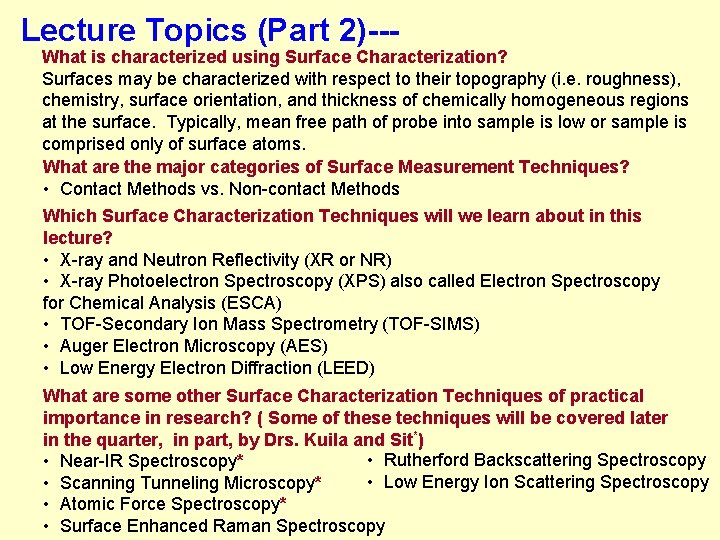
Lecture Topics (Part 2)--- What is characterized using Surface Characterization? Surfaces may be characterized with respect to their topography (i. e. roughness), chemistry, surface orientation, and thickness of chemically homogeneous regions at the surface. Typically, mean free path of probe into sample is low or sample is comprised only of surface atoms. What are the major categories of Surface Measurement Techniques? • Contact Methods vs. Non-contact Methods Which Surface Characterization Techniques will we learn about in this lecture? • X-ray and Neutron Reflectivity (XR or NR) • X-ray Photoelectron Spectroscopy (XPS) also called Electron Spectroscopy for Chemical Analysis (ESCA) • TOF-Secondary Ion Mass Spectrometry (TOF-SIMS) • Auger Electron Microscopy (AES) • Low Energy Electron Diffraction (LEED) What are some other Surface Characterization Techniques of practical importance in research? ( Some of these techniques will be covered later in the quarter, in part, by Drs. Kuila and Sit*) • Rutherford Backscattering Spectroscopy • Near-IR Spectroscopy* • Low Energy Ion Scattering Spectroscopy • Scanning Tunneling Microscopy* • Atomic Force Spectroscopy* • Surface Enhanced Raman Spectroscopy
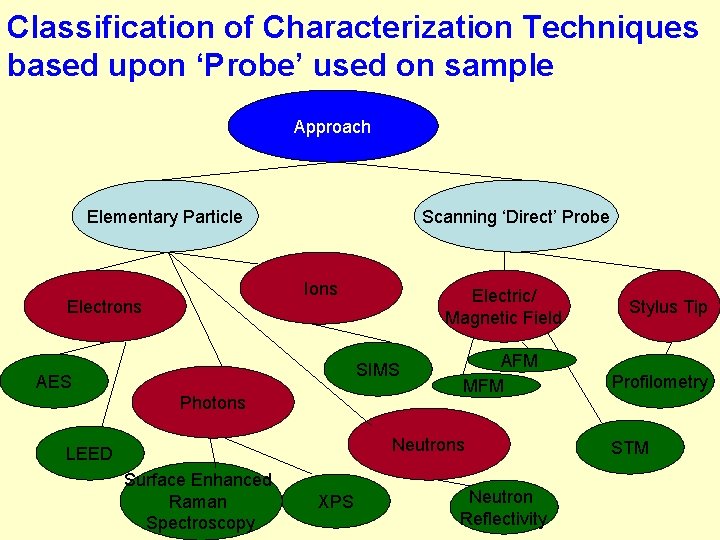
Classification of Characterization Techniques based upon ‘Probe’ used on sample Approach Elementary Particle Scanning ‘Direct’ Probe Ions Electric/ Magnetic Field SIMS AES Photons AFM MFM Neutrons LEED Surface Enhanced Raman Spectroscopy XPS Neutron Reflectivity Stylus Tip Profilometry STM

Classification of Characterization Techniques based upon ‘Probe’ used on sample Approach Elementary Particle ‘Direct’ Probe Ions Electric/ Magnetic Field SIMS AES Photons AFM MFM Neutrons LEED Surface Enhanced Raman Spectroscopy XPS Neutron Reflectivity Stylus Tip Profilometry STM
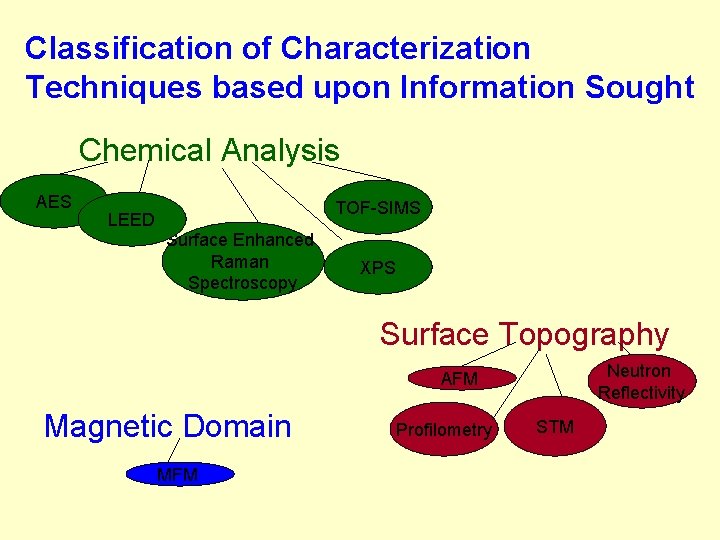
Classification of Characterization Techniques based upon Information Sought Chemical Analysis AES TOF-SIMS LEED Surface Enhanced Raman Spectroscopy XPS Surface Topography Neutron Reflectivity AFM Magnetic Domain MFM Profilometry STM
Elementary Particles are Good Probes at the Nanoscale? • Neutrons - an uncharged elementary particle that has a mass nearly equal to that of the proton and is present in all known atomic nuclei except the hydrogen nucleus • X-rays - any of the electromagnetic radiations of the same nature as visible radiation but having an extremely short wavelength of less than 100 angstroms (or 10 nm). X-rays are produced by bombarding a metallic target with fast electrons in vacuum or by transition of atoms to lower energy states and that has the properties of ionizing a gas upon passage through it, of penetrating various thicknesses of all solids, of producing secondary radiations by impinging on material bodies, of acting on photographic films and plates as light does, and of causing fluorescent screens to emit light • Electrons - A charged elementary particle that has a mass much less than that of the proton and is present in all known elements • Ions – A charged particle that has a mass much greater than that of protons, electrons, and neutrons.
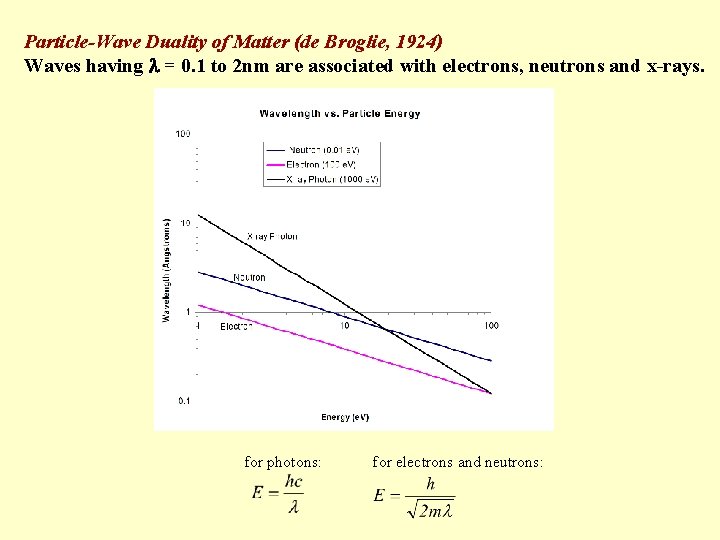
Particle-Wave Duality of Matter (de Broglie, 1924) Waves having l = 0. 1 to 2 nm are associated with electrons, neutrons and x-rays. for photons: for electrons and neutrons:
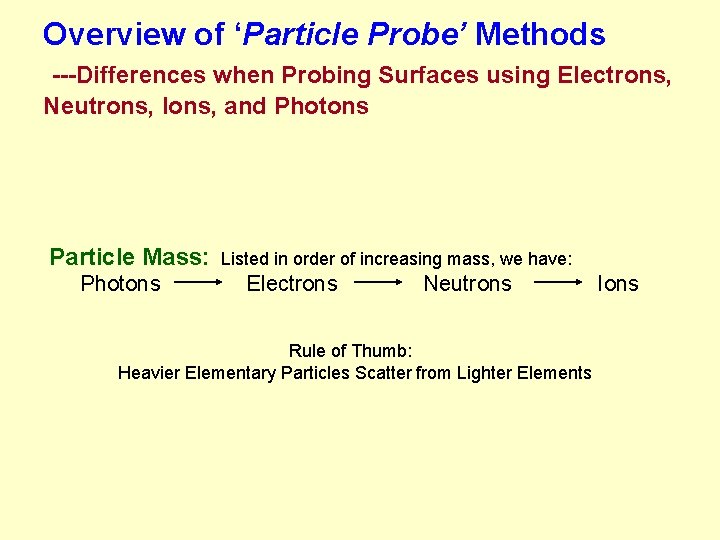
Overview of ‘Particle Probe’ Methods ---Differences when Probing Surfaces using Electrons, Neutrons, Ions, and Photons Particle Mass: Photons Listed in order of increasing mass, we have: Electrons Neutrons Rule of Thumb: Heavier Elementary Particles Scatter from Lighter Elements Ions
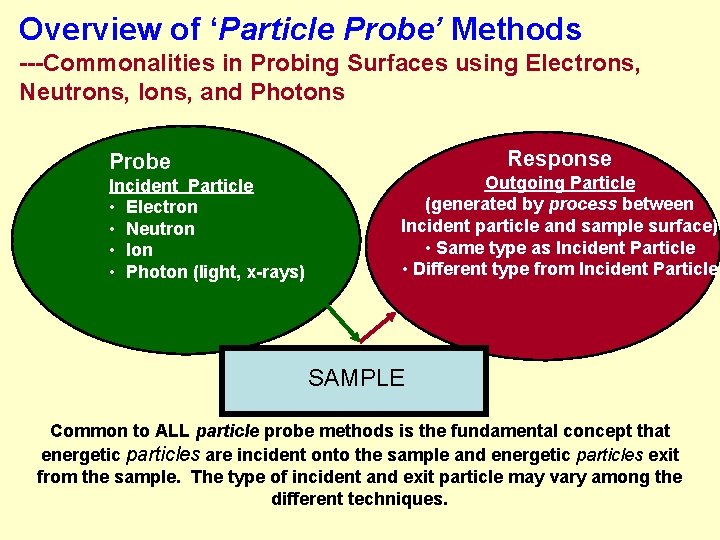
Overview of ‘Particle Probe’ Methods ---Commonalities in Probing Surfaces using Electrons, Neutrons, Ions, and Photons Probe Incident Particle • Electron • Neutron • Ion • Photon (light, x-rays) Response Outgoing Particle (generated by process between Incident particle and sample surface) • Same type as Incident Particle • Different type from Incident Particle SAMPLE Common to ALL particle probe methods is the fundamental concept that energetic particles are incident onto the sample and energetic particles exit from the sample. The type of incident and exit particle may vary among the different techniques.
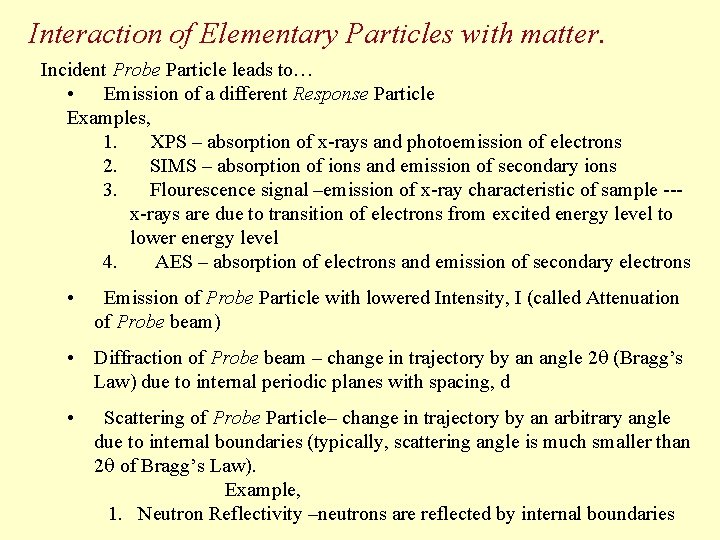
Interaction of Elementary Particles with matter. Incident Probe Particle leads to… • Emission of a different Response Particle Examples, 1. XPS – absorption of x-rays and photoemission of electrons 2. SIMS – absorption of ions and emission of secondary ions 3. Flourescence signal –emission of x-ray characteristic of sample --x-rays are due to transition of electrons from excited energy level to lower energy level 4. AES – absorption of electrons and emission of secondary electrons • Emission of Probe Particle with lowered Intensity, I (called Attenuation of Probe beam) • Diffraction of Probe beam – change in trajectory by an angle 2 q (Bragg’s Law) due to internal periodic planes with spacing, d • Scattering of Probe Particle– change in trajectory by an arbitrary angle due to internal boundaries (typically, scattering angle is much smaller than 2 q of Bragg’s Law). Example, 1. Neutron Reflectivity –neutrons are reflected by internal boundaries
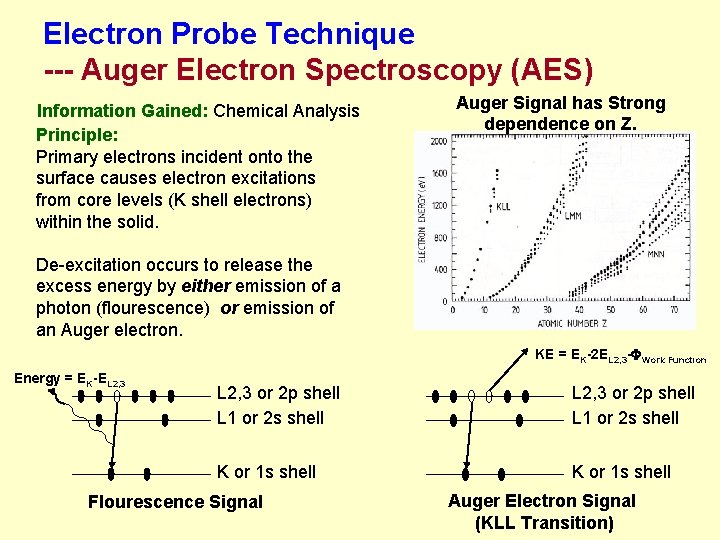
Electron Probe Technique --- Auger Electron Spectroscopy (AES) Information Gained: Chemical Analysis Principle: Primary electrons incident onto the surface causes electron excitations from core levels (K shell electrons) within the solid. Auger Signal has Strong dependence on Z. De-excitation occurs to release the excess energy by either emission of a photon (flourescence) or emission of an Auger electron. KE = EK-2 EL 2, 3 -FWork Function Energy = EK-EL 2, 3 or 2 p shell L 1 or 2 s shell K or 1 s shell Flourescence Signal Auger Electron Signal (KLL Transition)
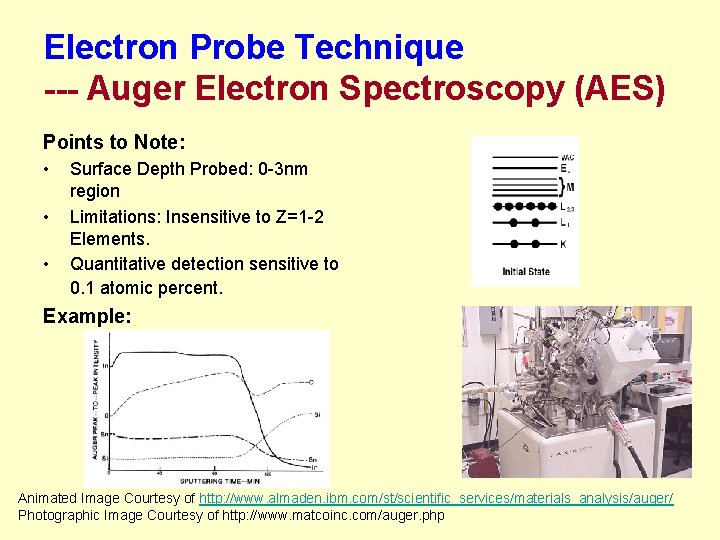
Electron Probe Technique --- Auger Electron Spectroscopy (AES) Points to Note: • • • Surface Depth Probed: 0 -3 nm region Limitations: Insensitive to Z=1 -2 Elements. Quantitative detection sensitive to 0. 1 atomic percent. Example: Animated Image Courtesy of http: //www. almaden. ibm. com/st/scientific_services/materials_analysis/auger/ Photographic Image Courtesy of http: //www. matcoinc. com/auger. php
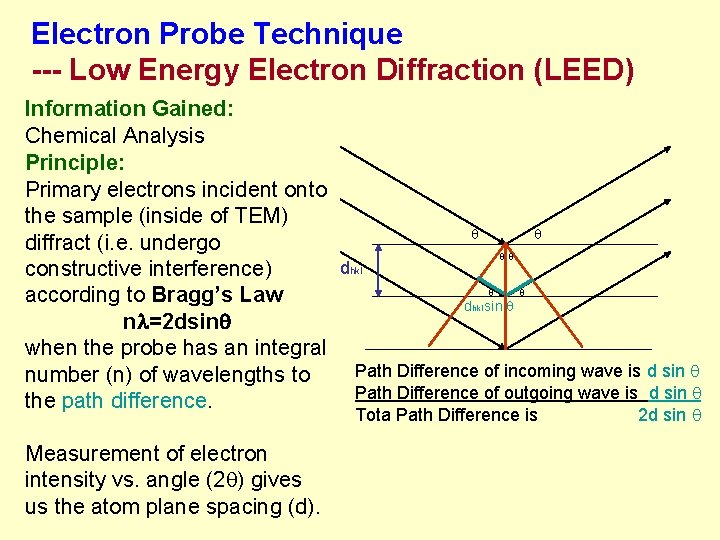
Electron Probe Technique --- Low Energy Electron Diffraction (LEED) Information Gained: Chemical Analysis Principle: Primary electrons incident onto the sample (inside of TEM) q q diffract (i. e. undergo q q dhkl constructive interference) q q according to Bragg’s Law d sin q nl=2 dsinq when the probe has an integral Path Difference of incoming wave is d sin q number (n) of wavelengths to Path Difference of outgoing wave is d sin q the path difference. hkl Tota Path Difference is Measurement of electron intensity vs. angle (2 q) gives us the atom plane spacing (d). 2 d sin q
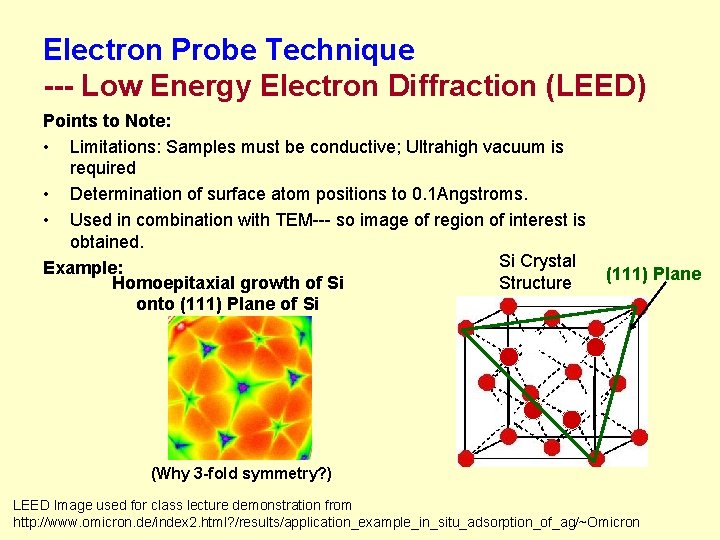
Electron Probe Technique --- Low Energy Electron Diffraction (LEED) Points to Note: • Limitations: Samples must be conductive; Ultrahigh vacuum is required • Determination of surface atom positions to 0. 1 Angstroms. • Used in combination with TEM--- so image of region of interest is obtained. Si Crystal Example: Homoepitaxial growth of Si Structure onto (111) Plane of Si (111) Plane (Why 3 -fold symmetry? ) LEED Image used for class lecture demonstration from http: //www. omicron. de/index 2. html? /results/application_example_in_situ_adsorption_of_ag/~Omicron
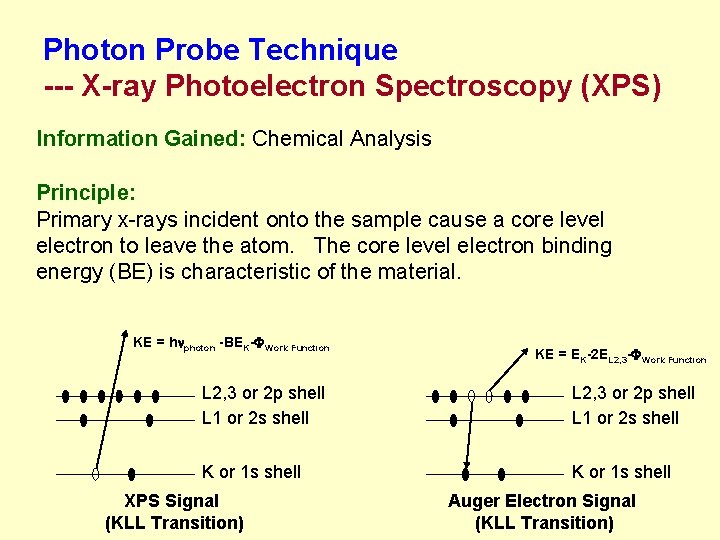
Photon Probe Technique --- X-ray Photoelectron Spectroscopy (XPS) Information Gained: Chemical Analysis Principle: Primary x-rays incident onto the sample cause a core level electron to leave the atom. The core level electron binding energy (BE) is characteristic of the material. KE = hnphoton -BEK-FWork Function KE = EK-2 EL 2, 3 -FWork Function L 2, 3 or 2 p shell L 1 or 2 s shell K or 1 s shell XPS Signal (KLL Transition) Auger Electron Signal (KLL Transition)
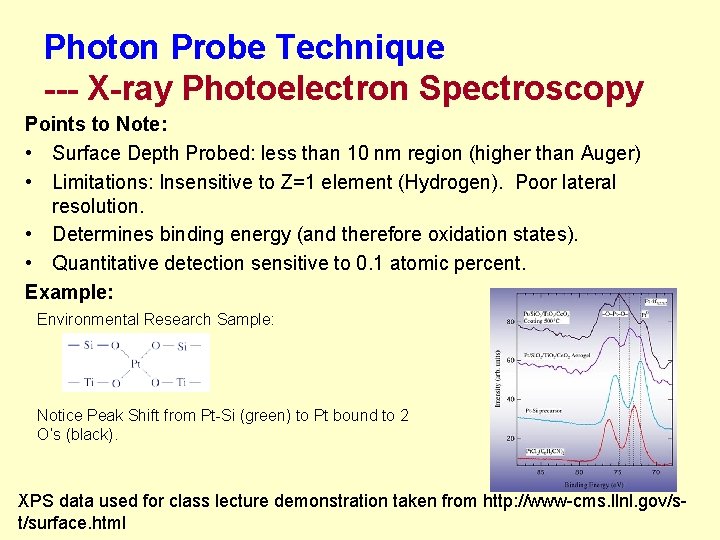
Photon Probe Technique --- X-ray Photoelectron Spectroscopy Points to Note: • Surface Depth Probed: less than 10 nm region (higher than Auger) • Limitations: Insensitive to Z=1 element (Hydrogen). Poor lateral resolution. • Determines binding energy (and therefore oxidation states). • Quantitative detection sensitive to 0. 1 atomic percent. Example: Environmental Research Sample: Notice Peak Shift from Pt-Si (green) to Pt bound to 2 O’s (black). XPS data used for class lecture demonstration taken from http: //www-cms. llnl. gov/st/surface. html
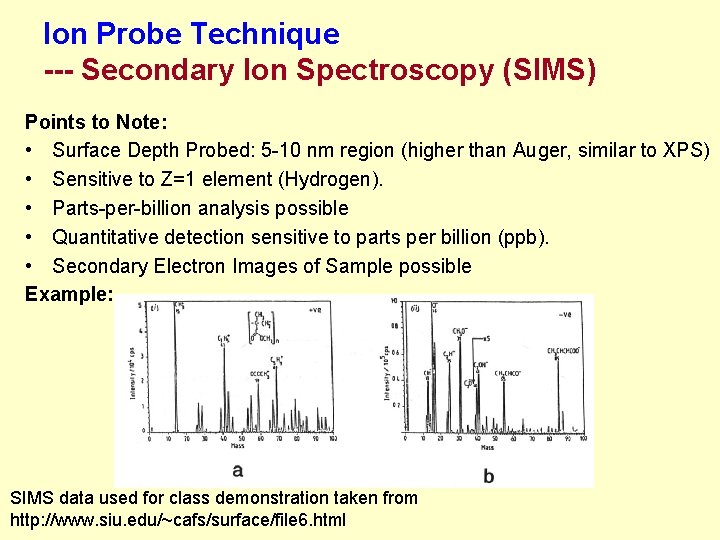
Ion Probe Technique --- Secondary Ion Spectroscopy (SIMS) Points to Note: • Surface Depth Probed: 5 -10 nm region (higher than Auger, similar to XPS) • Sensitive to Z=1 element (Hydrogen). • Parts-per-billion analysis possible • Quantitative detection sensitive to parts per billion (ppb). • Secondary Electron Images of Sample possible Example: SIMS data used for class demonstration taken from http: //www. siu. edu/~cafs/surface/file 6. html
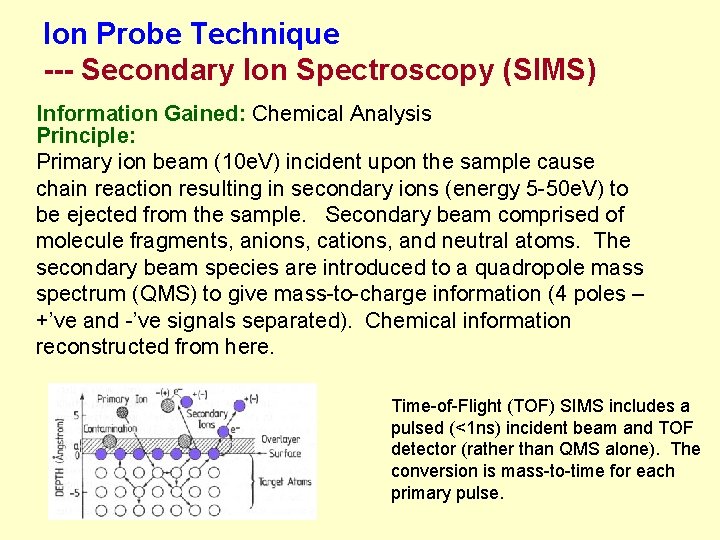
Ion Probe Technique --- Secondary Ion Spectroscopy (SIMS) Information Gained: Chemical Analysis Principle: Primary ion beam (10 e. V) incident upon the sample cause chain reaction resulting in secondary ions (energy 5 -50 e. V) to be ejected from the sample. Secondary beam comprised of molecule fragments, anions, cations, and neutral atoms. The secondary beam species are introduced to a quadropole mass spectrum (QMS) to give mass-to-charge information (4 poles – +’ve and -’ve signals separated). Chemical information reconstructed from here. Time-of-Flight (TOF) SIMS includes a pulsed (<1 ns) incident beam and TOF detector (rather than QMS alone). The conversion is mass-to-time for each primary pulse.
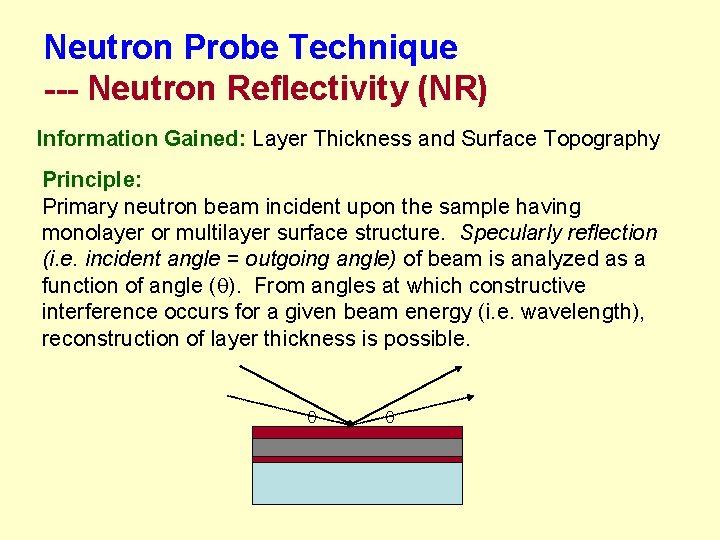
Neutron Probe Technique --- Neutron Reflectivity (NR) Information Gained: Layer Thickness and Surface Topography Principle: Primary neutron beam incident upon the sample having monolayer or multilayer surface structure. Specularly reflection (i. e. incident angle = outgoing angle) of beam is analyzed as a function of angle (q). From angles at which constructive interference occurs for a given beam energy (i. e. wavelength), reconstruction of layer thickness is possible. q q
Neutron Probe Technique --- Neutron Reflectivity (NR) Points to Note: • Sensitive to Layers between several Angstrom up to 5 micrometers • Use of neutrons makes the technique sensitive to Z=1 element (Hydrogen). X-ray reflectivity is not sensitive to low Z elements. • Compatible with may in-situ growth experiments (e. g. molecular beam epitaxial growth).
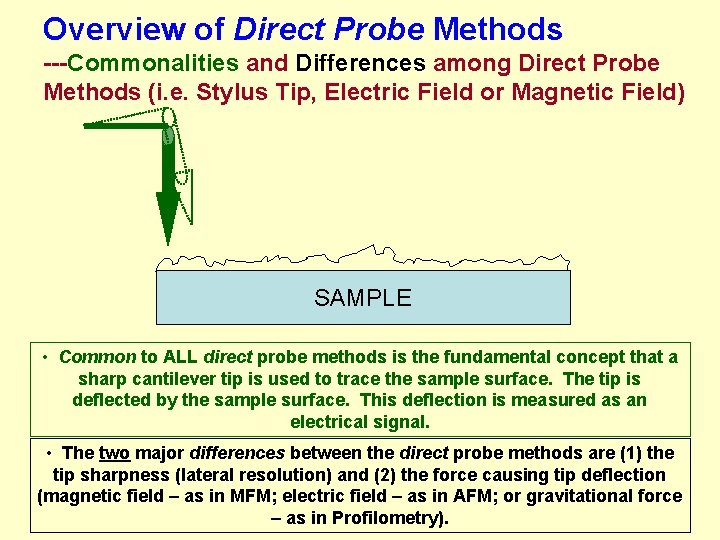
Overview of Direct Probe Methods ---Commonalities and Differences among Direct Probe Methods (i. e. Stylus Tip, Electric Field or Magnetic Field) SAMPLE • Common to ALL direct probe methods is the fundamental concept that a sharp cantilever tip is used to trace the sample surface. The tip is deflected by the sample surface. This deflection is measured as an electrical signal. • The two major differences between the direct probe methods are (1) the tip sharpness (lateral resolution) and (2) the force causing tip deflection (magnetic field – as in MFM; electric field – as in AFM; or gravitational force – as in Profilometry).
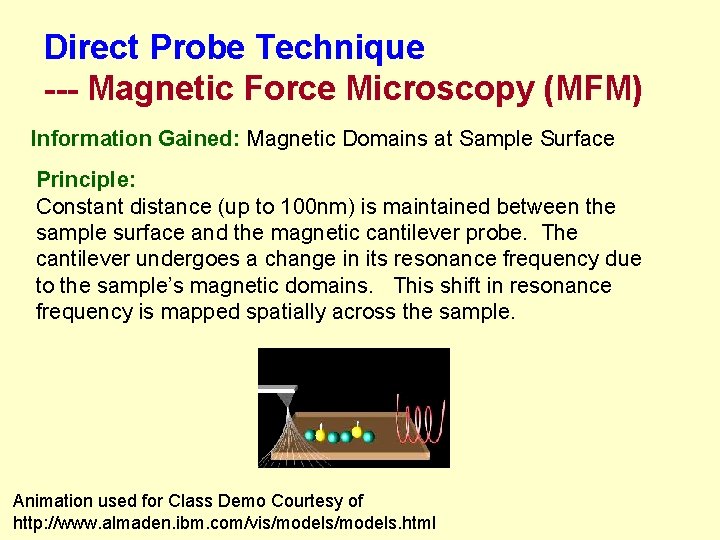
Direct Probe Technique --- Magnetic Force Microscopy (MFM) Information Gained: Magnetic Domains at Sample Surface Principle: Constant distance (up to 100 nm) is maintained between the sample surface and the magnetic cantilever probe. The cantilever undergoes a change in its resonance frequency due to the sample’s magnetic domains. This shift in resonance frequency is mapped spatially across the sample. Animation used for Class Demo Courtesy of http: //www. almaden. ibm. com/vis/models. html
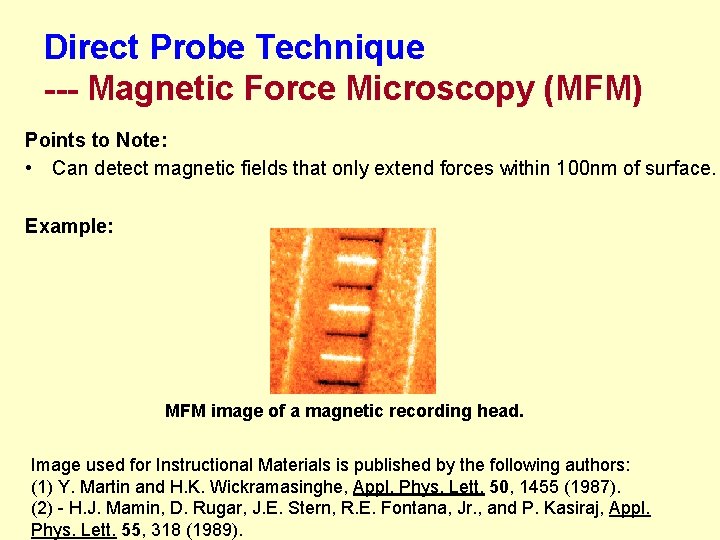
Direct Probe Technique --- Magnetic Force Microscopy (MFM) Points to Note: • Can detect magnetic fields that only extend forces within 100 nm of surface. Example: MFM image of a magnetic recording head. Image used for Instructional Materials is published by the following authors: (1) Y. Martin and H. K. Wickramasinghe, Appl. Phys. Lett. 50, 1455 (1987). (2) - H. J. Mamin, D. Rugar, J. E. Stern, R. E. Fontana, Jr. , and P. Kasiraj, Appl. Phys. Lett. 55, 318 (1989).
- Slides: 23