
PART 2 MICROECONOMICS THE MARKET SYSTEM For use





- Slides: 19
PART 2 MICROECONOMICS – THE MARKET SYSTEM For use with Business Economics 1 e By N. Gregory Mankiw, Mark P. Taylor, and Andrew Ashwin ISBN: 978 -1 -4080 -6981 -3 © Cengage Learning 1 of 38
4 SUPPLY & DEMAND: How Markets Work For use with Business Economics 1 e By N. Gregory Mankiw, Mark P. Taylor, and Andrew Ashwin ISBN: 978 -1 -4080 -6981 -3 © Cengage Learning 2 Chapter of 38 4 2 of 19
1. Market Forces For use with Business Economics 1 e By N. Gregory Mankiw, Mark P. Taylor, and Andrew Ashwin ISBN: 978 -1 -4080 -6981 -3 © Cengage Learning 3 Chapter of 38 4 3 of 19
Market forces of Supply & Demand § Supply and demand are the forces that make market economies work. § Supply and demand determine the quantity of each good produced and the price at which it is sold. § Price is different from cost For use with Business Economics 1 e By N. Gregory Mankiw, Mark P. Taylor, and Andrew Ashwin ISBN: 978 -1 -4080 -6981 -3 © Cengage Learning 4 Chapter of 38 4 4 of 19
Markets and Competition § Markets exist in many forms § Market have buyers and sellers § Buyers and sellers don’t have to meet to make a deal § A competitive market has many buyers and sellers, none has a significant impact on determining the market price For use with Business Economics 1 e By N. Gregory Mankiw, Mark P. Taylor, and Andrew Ashwin ISBN: 978 -1 -4080 -6981 -3 © Cengage Learning 5 Chapter of 38 4 5 of 19
Competition: Perfect & Otherwise Characteristics of a perfectly competitive market: 1. Homogenous goods meaning buyers have no preference 2. Price takers: Numerous buyers and sellers each unable to influence prices Other market structures: § Oligopoly: A few sellers not always aggressively competing with each other § Imperfect or monopolistic market: Many sellers each offering a slightly different product (Monopoly – One supplier or buyer. Will be tackled in a later chapter) For use with Business Economics 1 e By N. Gregory Mankiw, Mark P. Taylor, and Andrew Ashwin ISBN: 978 -1 -4080 -6981 -3 © Cengage Learning 6 Chapter of 38 4 6 of 19
2. Supply For use with Business Economics 1 e By N. Gregory Mankiw, Mark P. Taylor, and Andrew Ashwin ISBN: 978 -1 -4080 -6981 -3 © Cengage Learning 7 Chapter of 38 4 7 of 19
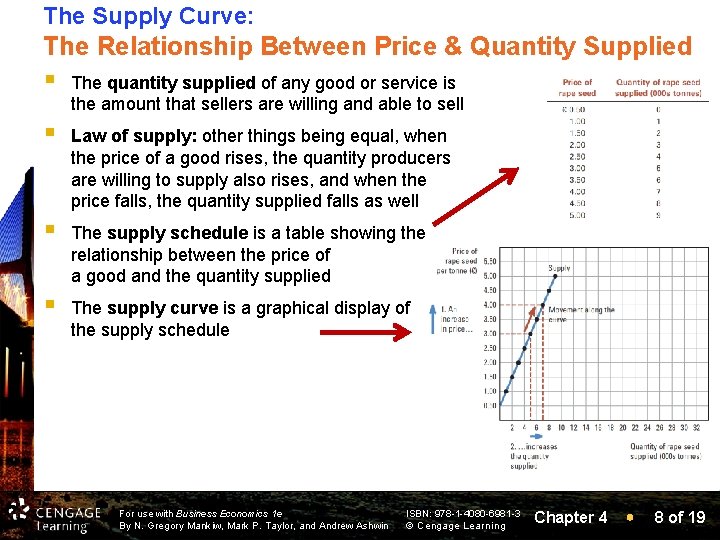
The Supply Curve: The Relationship Between Price & Quantity Supplied § The quantity supplied of any good or service is the amount that sellers are willing and able to sell § Law of supply: other things being equal, when the price of a good rises, the quantity producers are willing to supply also rises, and when the price falls, the quantity supplied falls as well § The supply schedule is a table showing the relationship between the price of a good and the quantity supplied § The supply curve is a graphical display of the supply schedule For use with Business Economics 1 e By N. Gregory Mankiw, Mark P. Taylor, and Andrew Ashwin ISBN: 978 -1 -4080 -6981 -3 © Cengage Learning 8 Chapter of 38 4 8 of 19
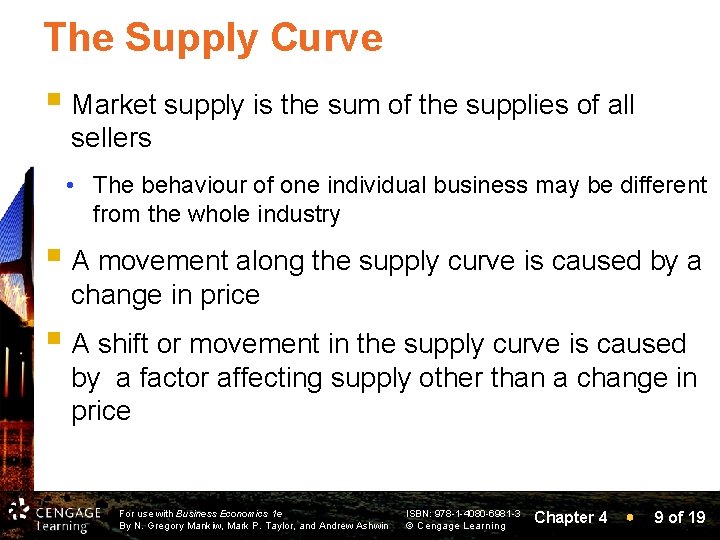
The Supply Curve § Market supply is the sum of the supplies of all sellers • The behaviour of one individual business may be different from the whole industry § A movement along the supply curve is caused by a change in price § A shift or movement in the supply curve is caused by a factor affecting supply other than a change in price For use with Business Economics 1 e By N. Gregory Mankiw, Mark P. Taylor, and Andrew Ashwin ISBN: 978 -1 -4080 -6981 -3 © Cengage Learning 9 Chapter of 38 4 9 of 19
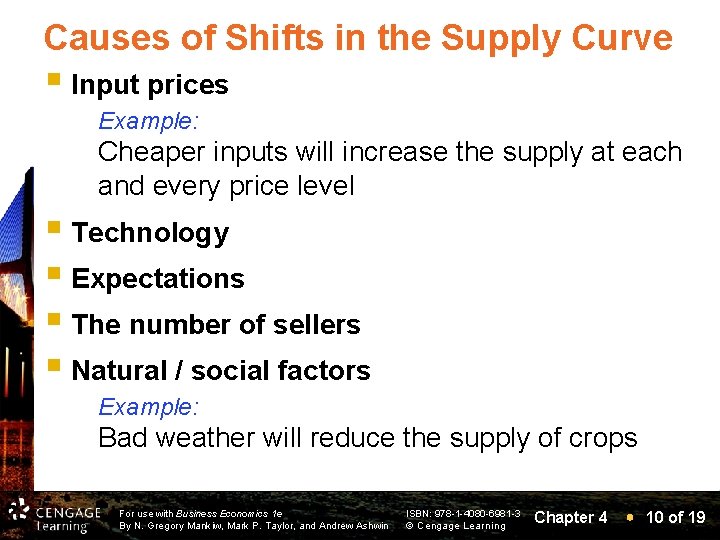
Causes of Shifts in the Supply Curve § Input prices Example: Cheaper inputs will increase the supply at each and every price level § Technology § Expectations § The number of sellers § Natural / social factors Example: Bad weather will reduce the supply of crops For use with Business Economics 1 e By N. Gregory Mankiw, Mark P. Taylor, and Andrew Ashwin ISBN: 978 -1 -4080 -6981 -3 © Cengage Learning 10 Chapter of 38 4 10 of 19
3. Demand For use with Business Economics 1 e By N. Gregory Mankiw, Mark P. Taylor, and Andrew Ashwin ISBN: 978 -1 -4080 -6981 -3 © Cengage Learning 11 Chapter of 38 4 11 of 19
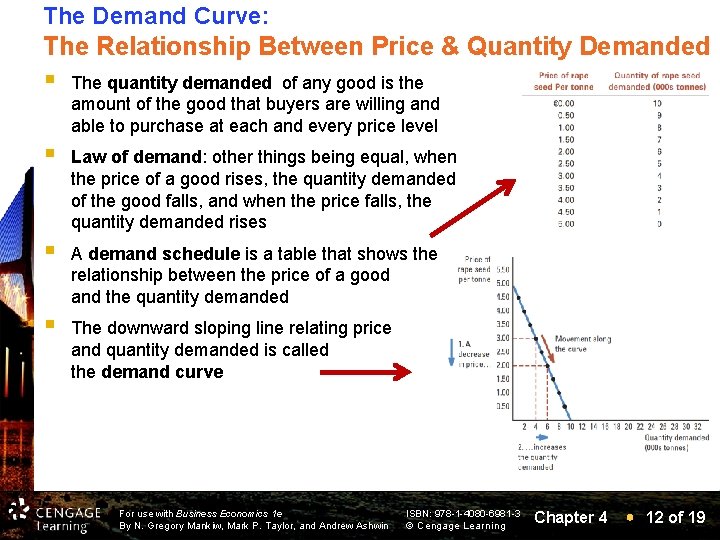
The Demand Curve: The Relationship Between Price & Quantity Demanded § The quantity demanded of any good is the amount of the good that buyers are willing and able to purchase at each and every price level § Law of demand: other things being equal, when the price of a good rises, the quantity demanded of the good falls, and when the price falls, the quantity demanded rises § A demand schedule is a table that shows the relationship between the price of a good and the quantity demanded § The downward sloping line relating price and quantity demanded is called the demand curve For use with Business Economics 1 e By N. Gregory Mankiw, Mark P. Taylor, and Andrew Ashwin ISBN: 978 -1 -4080 -6981 -3 © Cengage Learning 12 Chapter of 38 4 12 of 19
The Demand Curve § The market demand, which is the sum of all the individual demands for a particular good or service § A movement along the demand curve occurs when there is a change in price § A shift or movement in the demand curve is caused by a factor affecting demand other than a change in price For use with Business Economics 1 e By N. Gregory Mankiw, Mark P. Taylor, and Andrew Ashwin ISBN: 978 -1 -4080 -6981 -3 © Cengage Learning 13 Chapter of 38 4 13 of 19
Causes of Shifts in the Demand Curve § Income • Normal goods • Inferior goods § Prices of related goods • Substitutes • Complements § Tastes § Expectations § Size and structure of the population For use with Business Economics 1 e By N. Gregory Mankiw, Mark P. Taylor, and Andrew Ashwin ISBN: 978 -1 -4080 -6981 -3 © Cengage Learning 14 Chapter of 38 4 14 of 19
4. Demand & Supply Together For use with Business Economics 1 e By N. Gregory Mankiw, Mark P. Taylor, and Andrew Ashwin ISBN: 978 -1 -4080 -6981 -3 © Cengage Learning 15 Chapter of 38 4 15 of 19
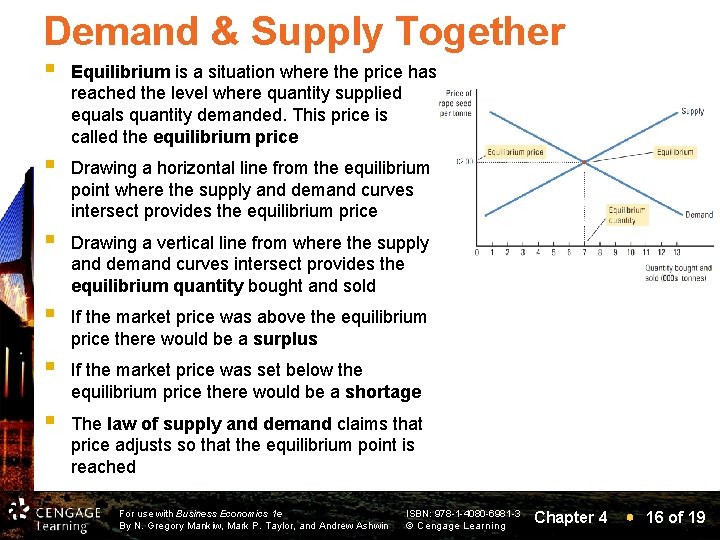
Demand & Supply Together § Equilibrium is a situation where the price has reached the level where quantity supplied equals quantity demanded. This price is called the equilibrium price § Drawing a horizontal line from the equilibrium point where the supply and demand curves intersect provides the equilibrium price § Drawing a vertical line from where the supply and demand curves intersect provides the equilibrium quantity bought and sold § If the market price was above the equilibrium price there would be a surplus § If the market price was set below the equilibrium price there would be a shortage § The law of supply and demand claims that price adjusts so that the equilibrium point is reached For use with Business Economics 1 e By N. Gregory Mankiw, Mark P. Taylor, and Andrew Ashwin ISBN: 978 -1 -4080 -6981 -3 © Cengage Learning 16 Chapter of 38 4 16 of 19
5. How Prices Allocate Resources For use with Business Economics 1 e By N. Gregory Mankiw, Mark P. Taylor, and Andrew Ashwin ISBN: 978 -1 -4080 -6981 -3 © Cengage Learning 17 Chapter of 38 4 17 of 19
How Prices Allocate Resources § Markets are dynamic and changing all the time § For many markets, the equilibrium point is continually changing • Look at the market for currency or commodities § Prices allocate resources: • Whenever you go to a shop to buy something, you are contributing to the demand for that item. Scarce resources have to be allocated among competing uses • Supply and demand together determine the prices of the economy’s many different goods and services; prices in turn are the signals that guide the allocation of resources For use with Business Economics 1 e By N. Gregory Mankiw, Mark P. Taylor, and Andrew Ashwin ISBN: 978 -1 -4080 -6981 -3 © Cengage Learning 18 Chapter of 38 4 18 of 19
End of Chapter 4 For use with Business Economics 1 e By N. Gregory Mankiw, Mark P. Taylor, and Andrew Ashwin ISBN: 978 -1 -4080 -6981 -3 © Cengage Learning 19 Chapter of 38 4 19 of 19