
PART 2 CURRENT ELECTRICITY CIRCUITS APPLIANCES POSSIBLE PROBLEMS
PART 2: CURRENT ELECTRICITY CIRCUITS, APPLIANCES, POSSIBLE PROBLEMS SERIES and PARALLEL
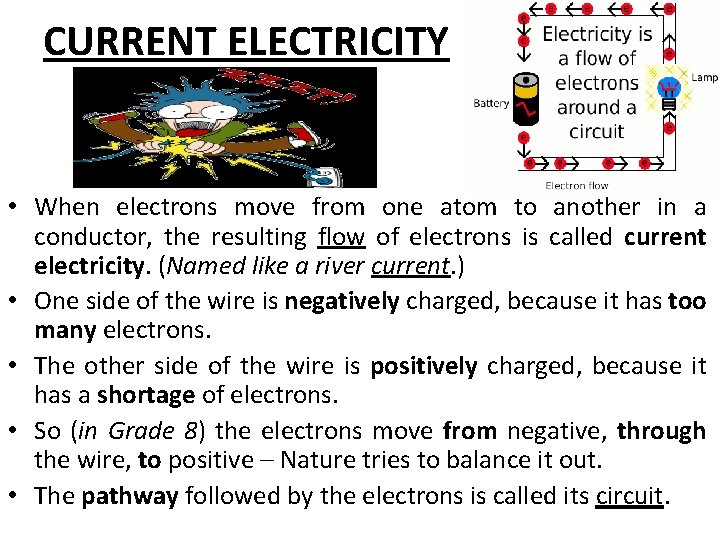
CURRENT ELECTRICITY • When electrons move from one atom to another in a conductor, the resulting flow of electrons is called current electricity. (Named like a river current. ) • One side of the wire is negatively charged, because it has too many electrons. • The other side of the wire is positively charged, because it has a shortage of electrons. • So (in Grade 8) the electrons move from negative, through the wire, to positive – Nature tries to balance it out. • The pathway followed by the electrons is called its circuit.
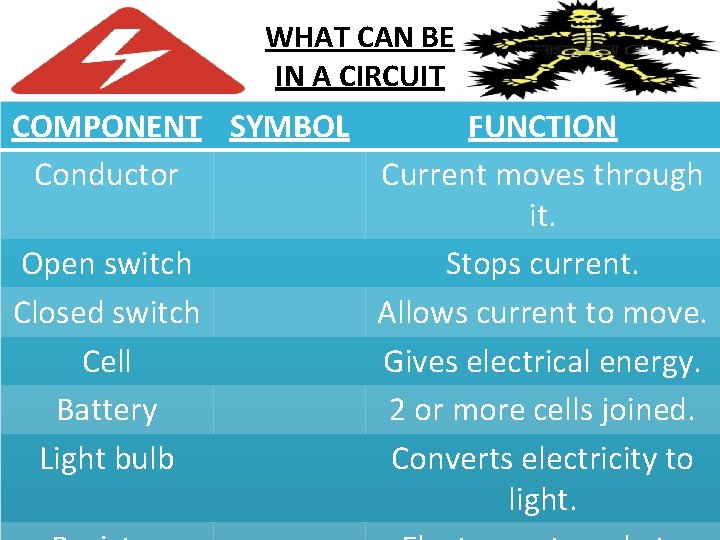
WHAT CAN BE IN A CIRCUIT COMPONENT SYMBOL FUNCTION Conductor Current moves through it. Open switch Stops current. Closed switch Allows current to move. Cell Gives electrical energy. Battery 2 or more cells joined. Light bulb Converts electricity to light.
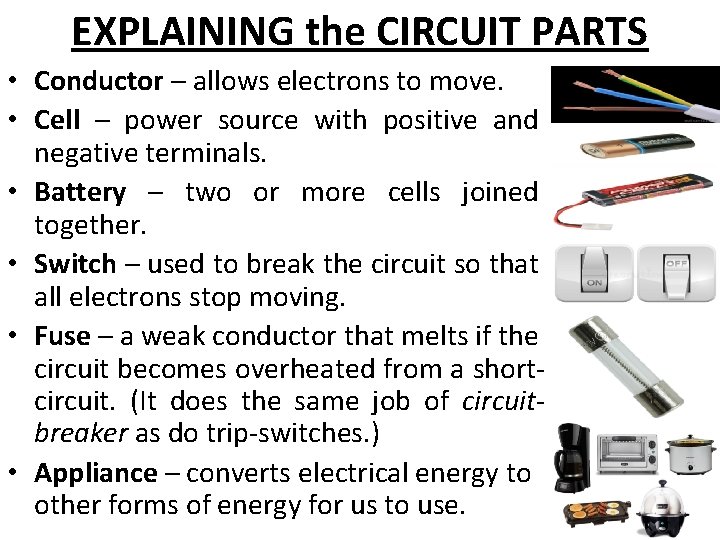
EXPLAINING the CIRCUIT PARTS • Conductor – allows electrons to move. • Cell – power source with positive and negative terminals. • Battery – two or more cells joined together. • Switch – used to break the circuit so that all electrons stop moving. • Fuse – a weak conductor that melts if the circuit becomes overheated from a shortcircuit. (It does the same job of circuitbreaker as do trip-switches. ) • Appliance – converts electrical energy to other forms of energy for us to use.
- Slides: 4