
Part 2 Assessing the Unconscious Neo FreudiansPsychodynamic Getting



- Slides: 30
Part 2: Assessing the Unconscious & Neo. Freudians/Psychodynamic
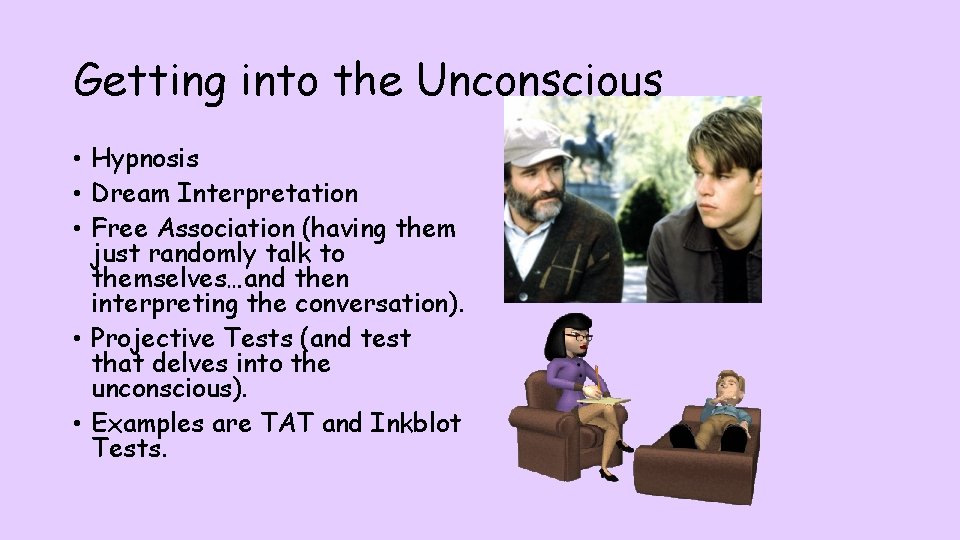
Getting into the Unconscious • Hypnosis • Dream Interpretation • Free Association (having them just randomly talk to themselves…and then interpreting the conversation). • Projective Tests (and test that delves into the unconscious). • Examples are TAT and Inkblot Tests.
Assessing the Unconscious… 1. Tests that provide subjects with ambiguous stimuli for interpretation are called projective tests 2. Henry Murray introduced the personality assessment technique called the Thematic Apperception Test 3. The most widely used projective test is the Rorschach’s, in which subjects are shown a series of inkblots. Generally, these tests appear to have little validity and reliability Validity – a test/research that measures what it is supposed to measure (validity = accuracy) Reliability- a test/research that has consistent results A social interaction
Assessing the Unconscious… • Projective tests: ask people to describe or tell a story about an ambiguous stimulus that has no inherent meaning. In doing so, people presumably project their own interest and conflicts and provide a sort of psychological “x-ray” of their personalities. Despite their widespread use, projective tests are considered by most researchers to be lacking in validity and reliability • • Thematic Apperception Test, TAT Rorschach’s Inkblot Test Sentence-Completion Tests Drawing Tests
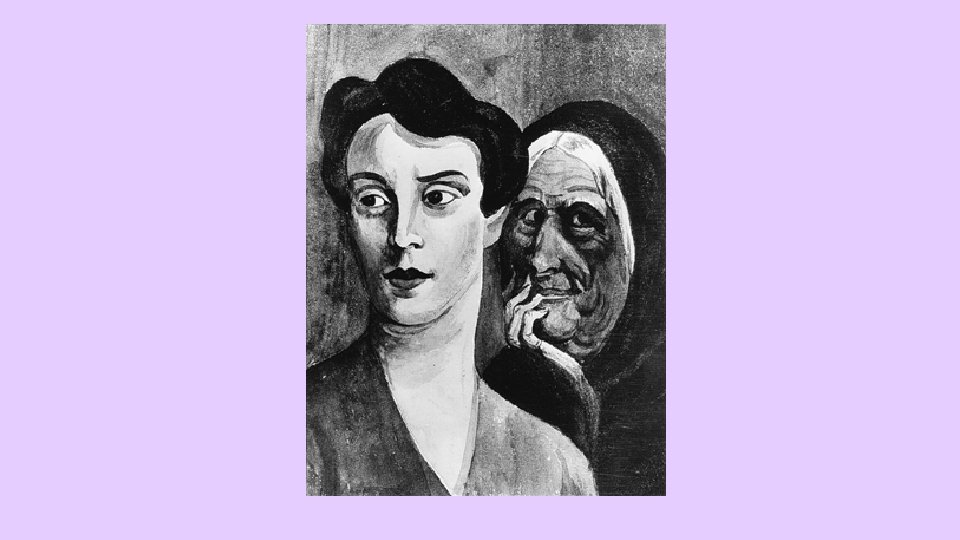
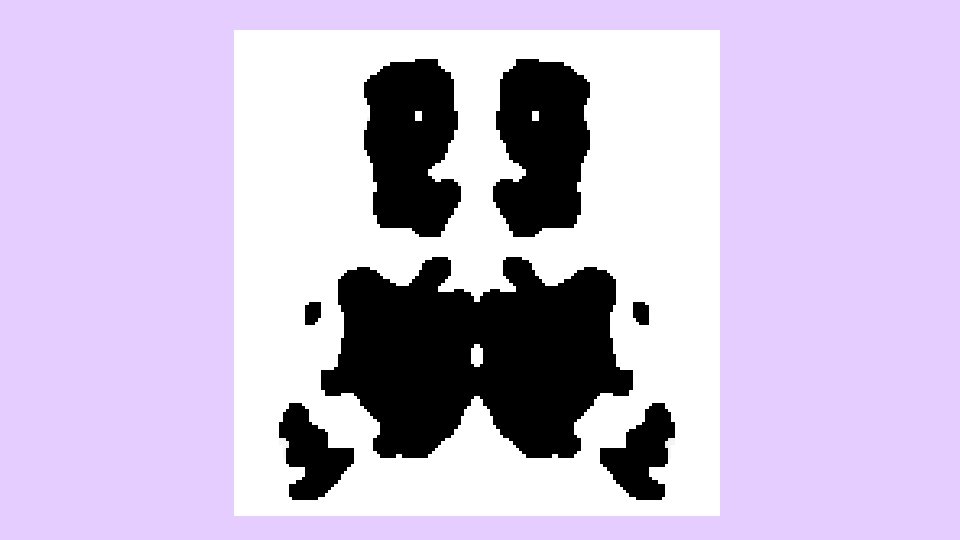
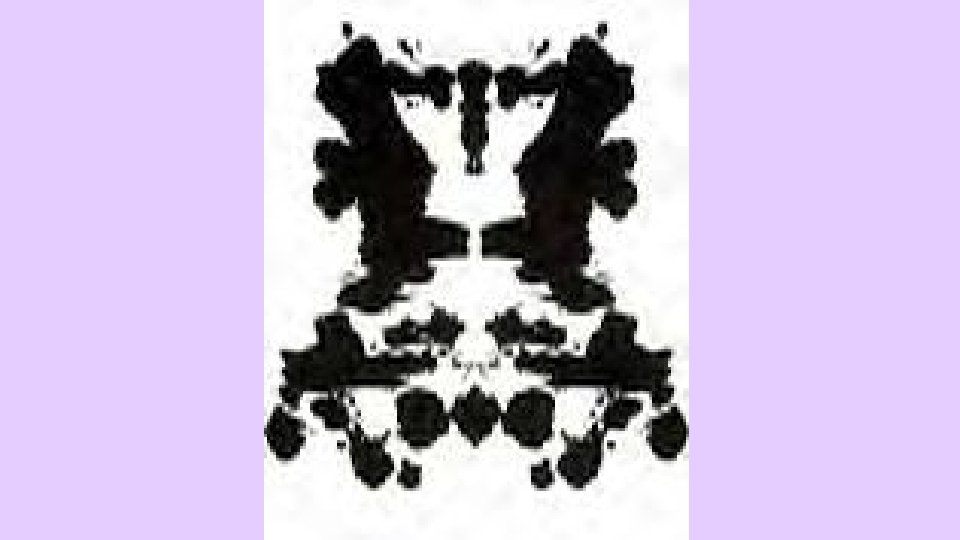
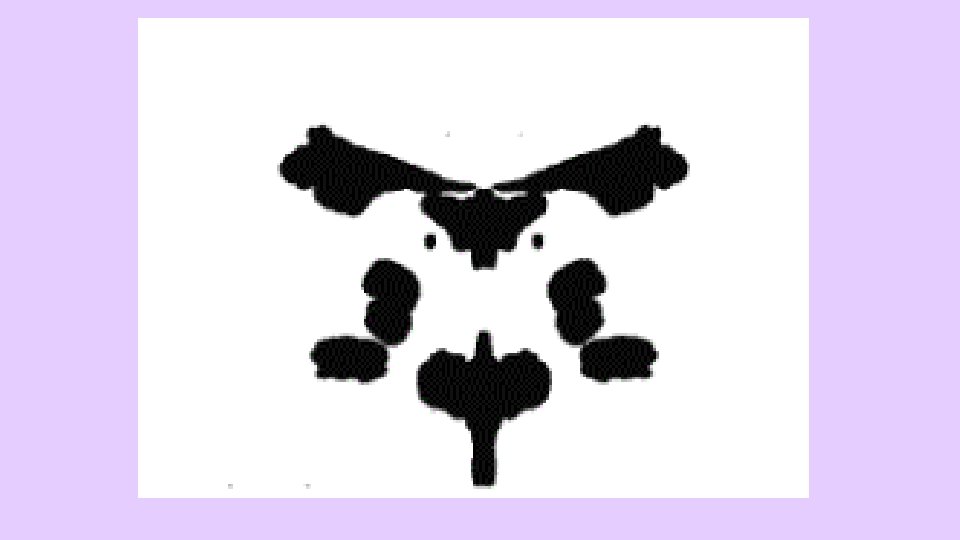
Projective Tests… 1. Thematic Apperception Test, TAT- “tell me a tory”- a projective test in which people express their inner feelings and interests through the stories they make up about ambiguous scenes 2. Rorschach’s Inkblot test- the most widely used projective test, a set of 10 inkblots, designed by Hermann Rorschach; seeks to identify people’s inner feelings by analyzing their interpretations of the blots ØNo single accepted scoring system for interpreting the Rorschach, so two raters may not interpret a person’s responses similarly (although a new computeraided scoring and interpretation tool is improving agreement among raters and enhancing validity ØTest is not very successful at predicting future behavior or discriminating between groups.
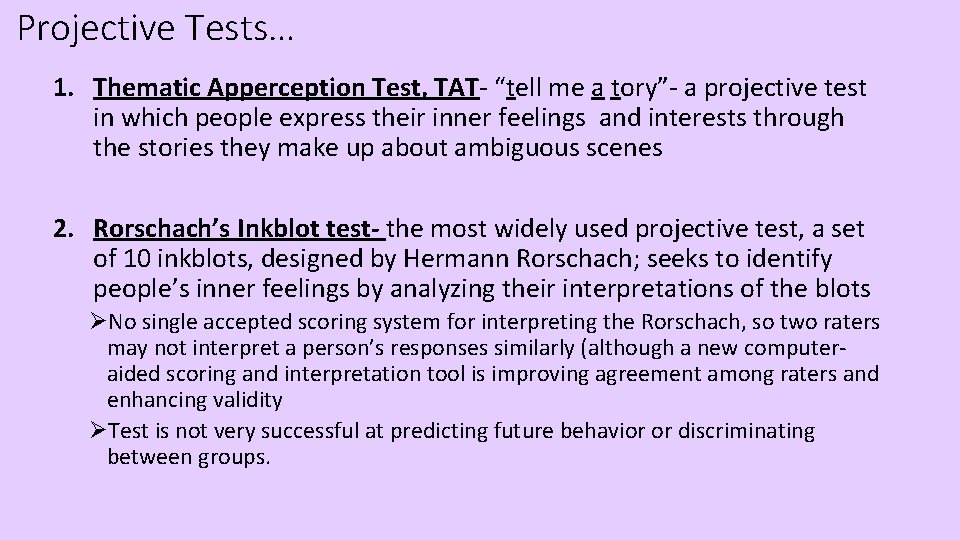
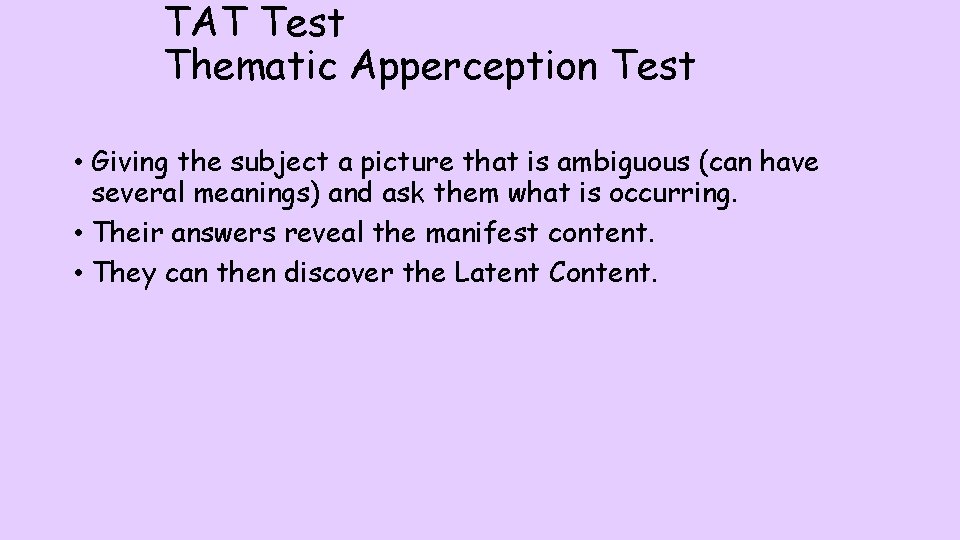
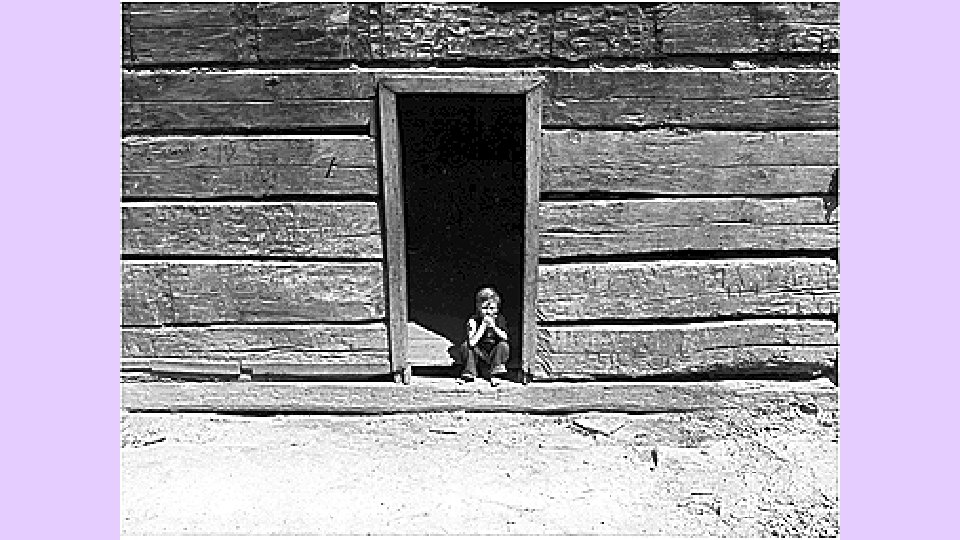
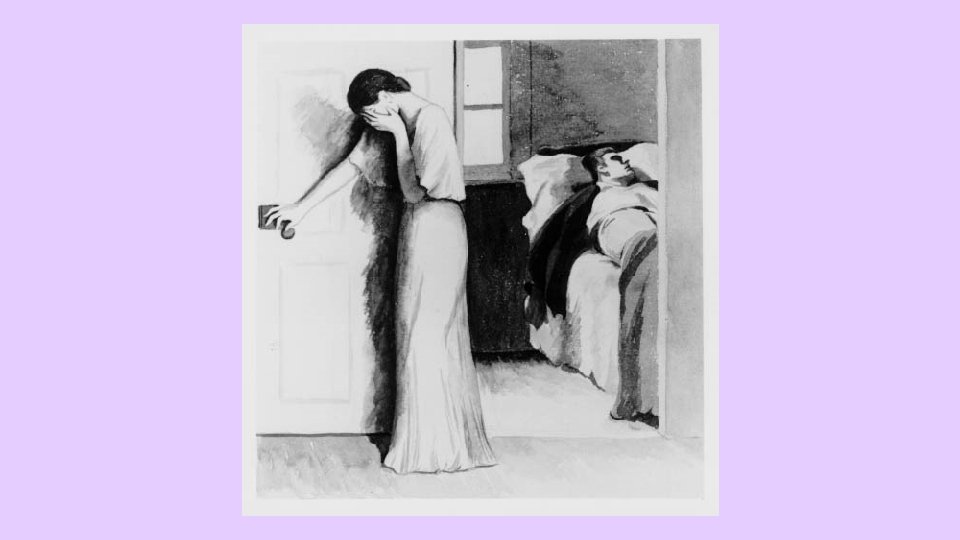
TAT Test Thematic Apperception Test • Giving the subject a picture that is ambiguous (can have several meanings) and ask them what is occurring. • Their answers reveal the manifest content. • They can then discover the Latent Content.
Rorschach Inkblot Test • The most widely used projective test • A set of ten inkblots designed to identify people’s feelings when they are asked to interpret what they see in the inkblots.
Neo-Freudians & Psychodynamic Theorists
Neo-Freudian & Psychodynamic Theorists… • Psychodynamic- modern day approaches that view personality w/ a focus on the unconscious & importance of childhood experiences • Neo-Freudians- est. their own modified version of psychoanalytic theory • Typically placed more emphasis on the conscious mind than Freud did • Less emphasis on sex & aggression 1. 2. 3. 4. Alfred Adler- Karen Horney- Carl Jung- Erikson-
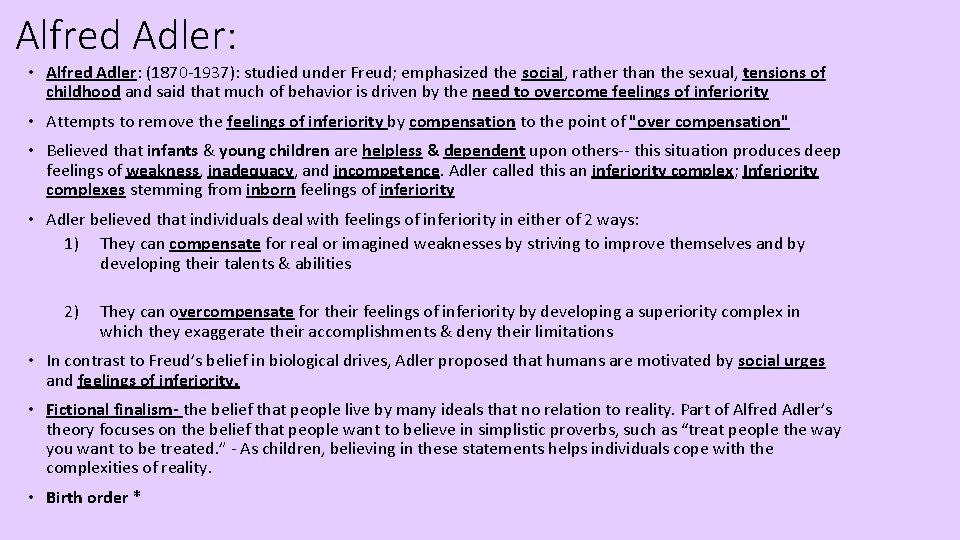
Alfred Adler: • Alfred Adler: (1870 -1937): studied under Freud; emphasized the social, rather than the sexual, tensions of childhood and said that much of behavior is driven by the need to overcome feelings of inferiority • Attempts to remove the feelings of inferiority by compensation to the point of "over compensation" • Believed that infants & young children are helpless & dependent upon others-- this situation produces deep feelings of weakness, inadequacy, and incompetence. Adler called this an inferiority complex; Inferiority complexes stemming from inborn feelings of inferiority • Adler believed that individuals deal with feelings of inferiority in either of 2 ways: 1) They can compensate for real or imagined weaknesses by striving to improve themselves and by developing their talents & abilities 2) They can overcompensate for their feelings of inferiority by developing a superiority complex in which they exaggerate their accomplishments & deny their limitations • In contrast to Freud’s belief in biological drives, Adler proposed that humans are motivated by social urges and feelings of inferiority. • Fictional finalism- the belief that people live by many ideals that no relation to reality. Part of Alfred Adler’s theory focuses on the belief that people want to believe in simplistic proverbs, such as “treat people the way you want to be treated. ” - As children, believing in these statements helps individuals cope with the complexities of reality. • Birth order *
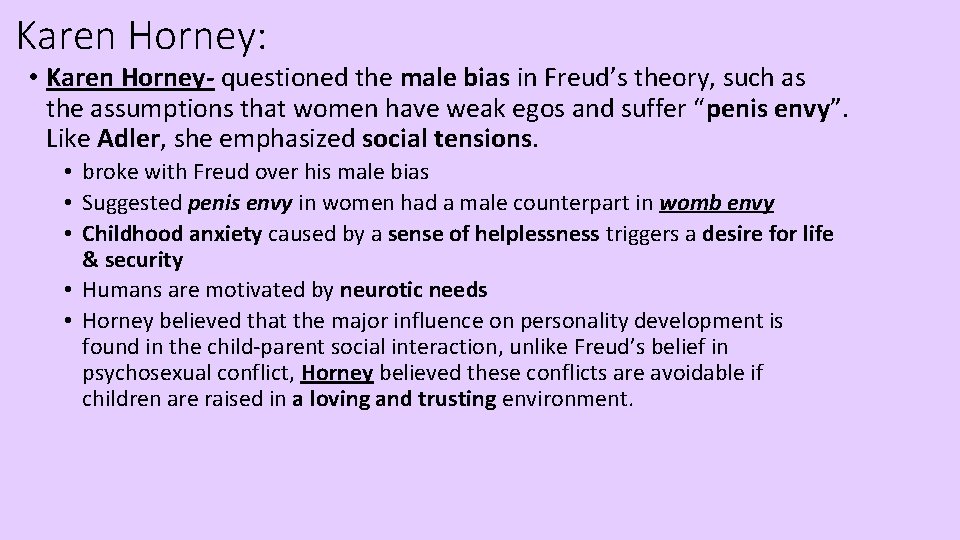
Karen Horney: • Karen Horney- questioned the male bias in Freud’s theory, such as the assumptions that women have weak egos and suffer “penis envy”. Like Adler, she emphasized social tensions. • broke with Freud over his male bias • Suggested penis envy in women had a male counterpart in womb envy • Childhood anxiety caused by a sense of helplessness triggers a desire for life & security • Humans are motivated by neurotic needs • Horney believed that the major influence on personality development is found in the child-parent social interaction, unlike Freud’s belief in psychosexual conflict, Horney believed these conflicts are avoidable if children are raised in a loving and trusting environment.
Carl Jung: • Carl Jung- (1875 -1961): contemporary/modern-day Freud who revised the psychosexual account of personality emphasized an inherited collective unconscious • Concepts of introversion and extroversion • Like Freud, Jung stressed the importance of unconscious processes. However, Jung distinguished b/w the personal unconscious & the collective unconscious; 2 separate unconscious regions of the mind. Personal unconscious: consists of experiences that are unique to each individual; Personal unconscious including material outside the individual's current awareness which holds complexes, groups of feelings, thoughts or memories that may exert influence over one's behavior (i. e. , mother complex, power complex)
Carl Jung: • Collective Unconscious: In contrast, the collective unconscious refers to that part of a person’s unconscious that is common to all human beings; based on human genetic heritage common to all people; the collective unconscious includes shared human experiences embodied in myths and cultural archetypes such as the wise grandfather, the innocent child, and the rebellious son • Archetypes- according to Carl Jung, are universal themes that are part of the collective unconscious. These universal themes are terms or ideas shared by all cultures; ancient memories & symbols that are passed down from birth and shared by all people in all cultures; Universal thought forms called archetypes (i. e. , God, self, anima-male's female archetypes, animus-female's male archetype) • Anima- feminine traits; • Animus- masculine traits • Persona- the part of your personality you publicly share; universally sheared understanding that people try to bring the best part of their personality to the forefront when in public view, they tend to hid the parts of their personality that they are not comfortable with. Ex: “George allows the public (his classmates) to see his confidence while hiding his insecurities. • Shadow- the part of your personality you do not publicly share
Erikson: • modified and extended Freud's critical stages of development • Lifespan approach to development • Referred to stages as psychosocial rather than psychosexual stages of development
5. Today’s psychologists reject the idea that people inherit a common reservoir of experiences, which Jung called a collective unconscious. 6. More recently, some of Freud’s ideas have been incorporated into psychodynamic theory. Unlike Freud, theorists advocating this perspective do not believe in that sex is the basis of personality. They do agree, however, that much of mental life is unconscious, that childhood shapes personality, and that we often struggle with inner conflicts. 7. Recent research also disputes Freud’s belief that dreams disguise wishes, and that defense mechanisms disguise sexual and aggressive impulses. Another Freudian idea that is no longer widely accepted is that psychological disorders are caused by sexual suppression.
Neo-Freudians Psychodynamic Theories • Erickson • Carl Jung and his concept of the “personal” and “collective” unconscious. • Alfred Adler and his ideas of superiority and inferiority. • Adler also talked about birth order and how it played a part in personality.
Neo-Freudians § Alfred Adler § importance of childhood social tension § Karen Horney § sought to balance Freud’s masculine biases § Carl Jung § emphasized the collective unconscious § concept of a shared, inherited reservoir of memory traces from our species’ history
Neo- Freudians agree w/Freud on: • Importance of the unconscious • The division of the mind • The use of defense mechanisms • The protection of the ego
Neo- Freudians disagree w/Freud on: • One major criticism Neo-Freudians had regarding Freud was the emphasis he placed on sexual drives & conflicts in determining our behavior. • Neo-Freudians believed much more strongly in our free will to make our own choices
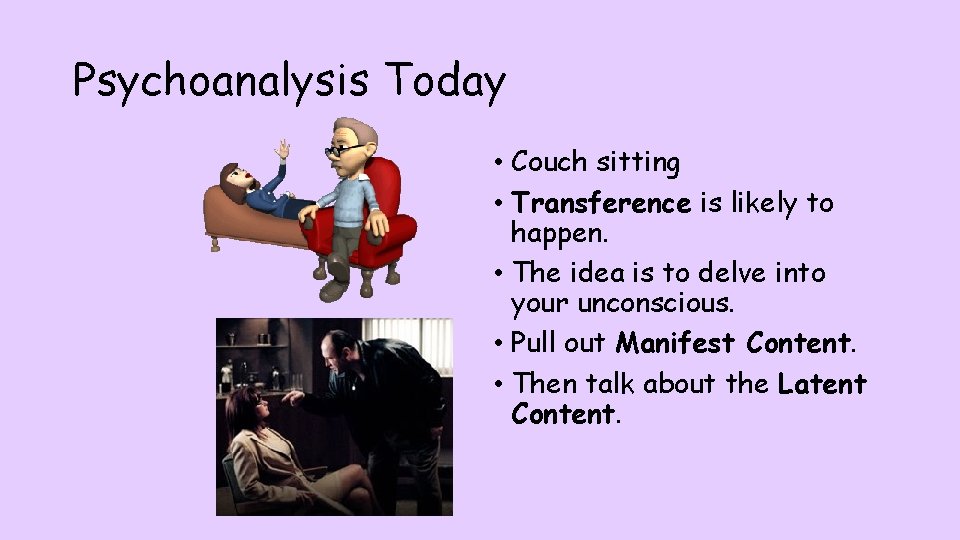
Psychoanalysis Today • Couch sitting • Transference is likely to happen. • The idea is to delve into your unconscious. • Pull out Manifest Content. • Then talk about the Latent Content.
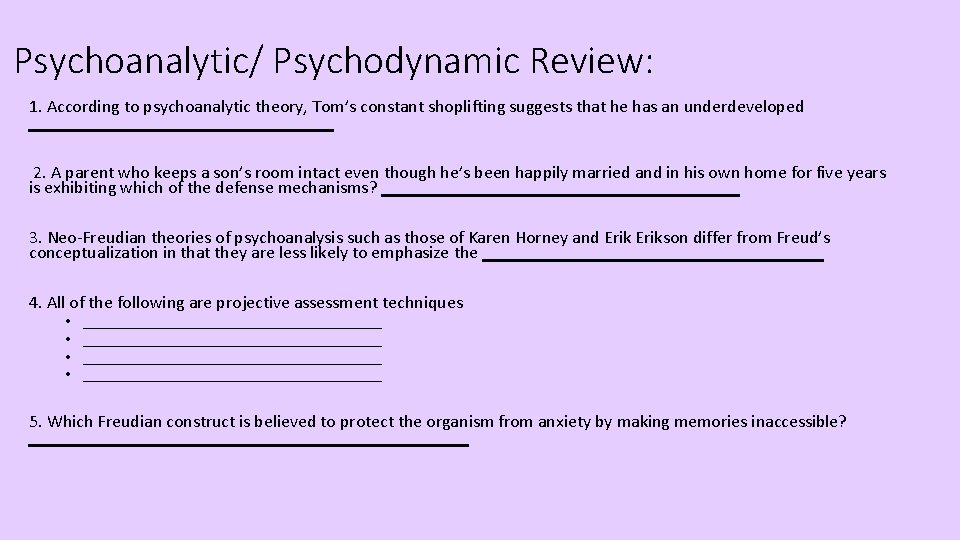
Psychoanalytic/ Psychodynamic Review: 1. According to psychoanalytic theory, Tom’s constant shoplifting suggests that he has an underdeveloped _________________ 2. A parent who keeps a son’s room intact even though he’s been happily married and in his own home for five years is exhibiting which of the defense mechanisms? ____________________ 3. Neo-Freudian theories of psychoanalysis such as those of Karen Horney and Erikson differ from Freud’s conceptualization in that they are less likely to emphasize the ___________________ 4. All of the following are projective assessment techniques • • ________________________________________ 5. Which Freudian construct is believed to protect the organism from anxiety by making memories inaccessible? _________________________
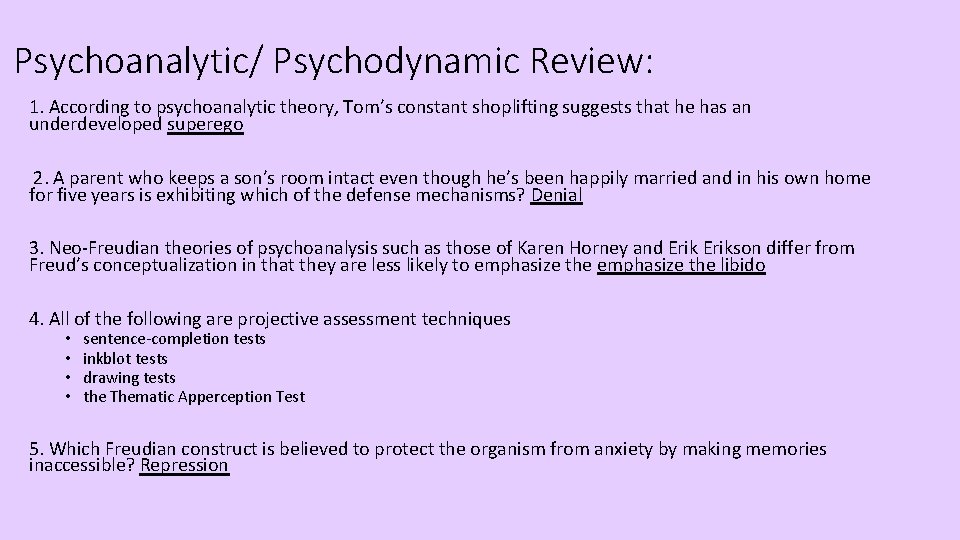
Psychoanalytic/ Psychodynamic Review: 1. According to psychoanalytic theory, Tom’s constant shoplifting suggests that he has an underdeveloped superego 2. A parent who keeps a son’s room intact even though he’s been happily married and in his own home for five years is exhibiting which of the defense mechanisms? Denial 3. Neo-Freudian theories of psychoanalysis such as those of Karen Horney and Erikson differ from Freud’s conceptualization in that they are less likely to emphasize the libido 4. All of the following are projective assessment techniques • • sentence-completion tests inkblot tests drawing tests the Thematic Apperception Test 5. Which Freudian construct is believed to protect the organism from anxiety by making memories inaccessible? Repression