
Part 2 3 Dipole Moments and Optical Activity
- Slides: 51
Part 2. 3: Dipole Moments and Optical Activity 1
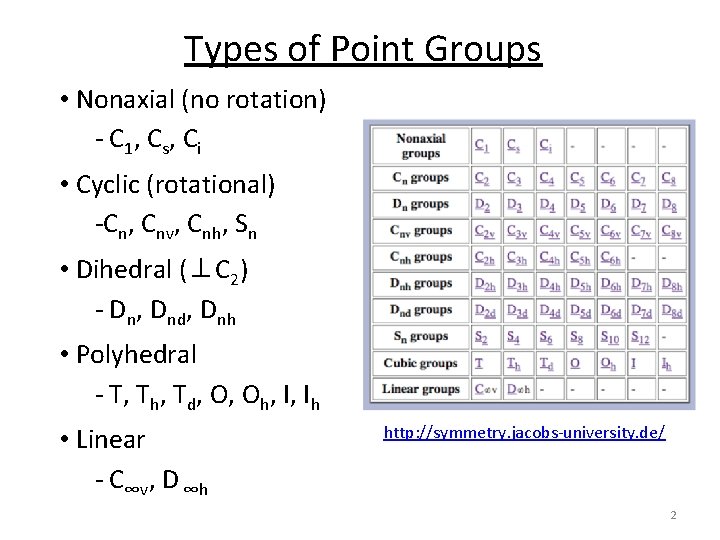
Types of Point Groups • Nonaxial (no rotation) - C 1, Cs, Ci • Cyclic (rotational) -Cn, Cnv, Cnh, Sn • Dihedral (⊥C 2) - Dn, Dnd, Dnh • Polyhedral - T, Th, Td, O, Oh, I, Ih • Linear - C∞v, D ∞h http: //symmetry. jacobs-university. de/ 2
Outline • • Dipole Moment/Polarity Dipole and Symmetry Dipole and Crystals Chirality Circular Dichroism Optical Activity and Symmetry Dynamic Molecules Applications of CD 3
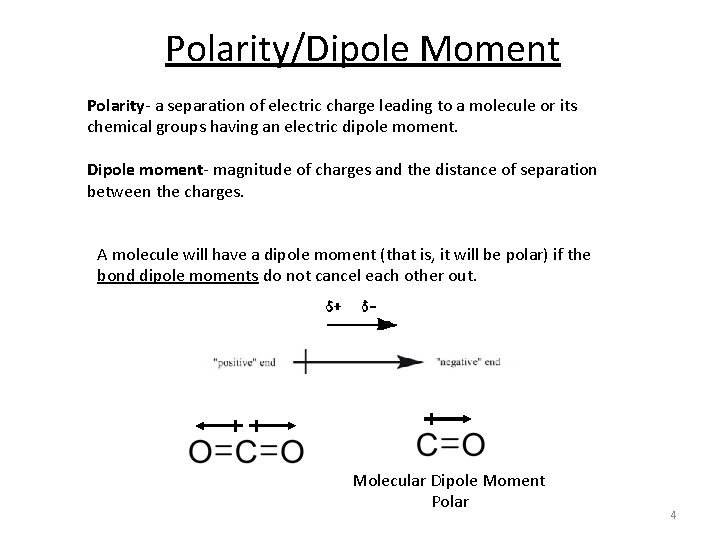
Polarity/Dipole Moment Polarity- a separation of electric charge leading to a molecule or its chemical groups having an electric dipole moment. Dipole moment- magnitude of charges and the distance of separation between the charges. A molecule will have a dipole moment (that is, it will be polar) if the bond dipole moments do not cancel each other out. Molecular Dipole Moment Polar 4
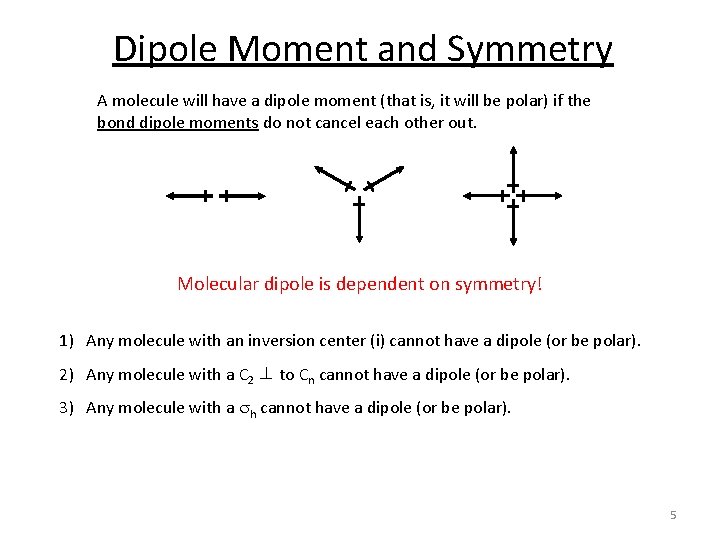
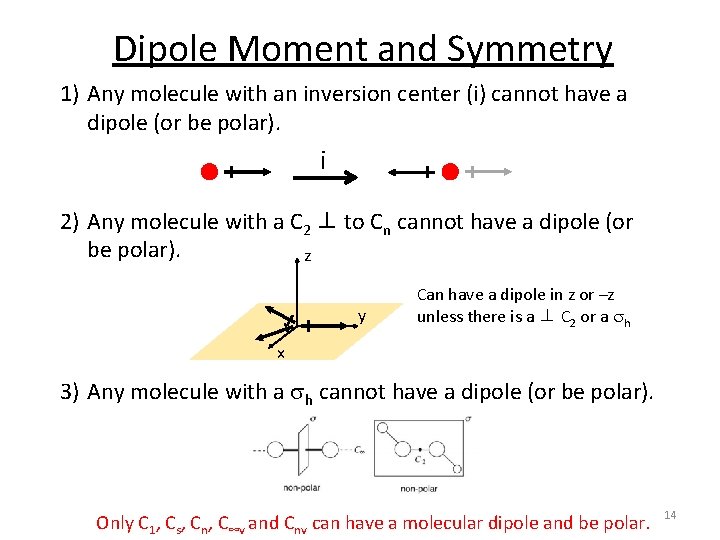
Dipole Moment and Symmetry A molecule will have a dipole moment (that is, it will be polar) if the bond dipole moments do not cancel each other out. Molecular dipole is dependent on symmetry! 1) Any molecule with an inversion center (i) cannot have a dipole (or be polar). 2) Any molecule with a C 2 ⊥ to Cn cannot have a dipole (or be polar). 3) Any molecule with a sh cannot have a dipole (or be polar). 5
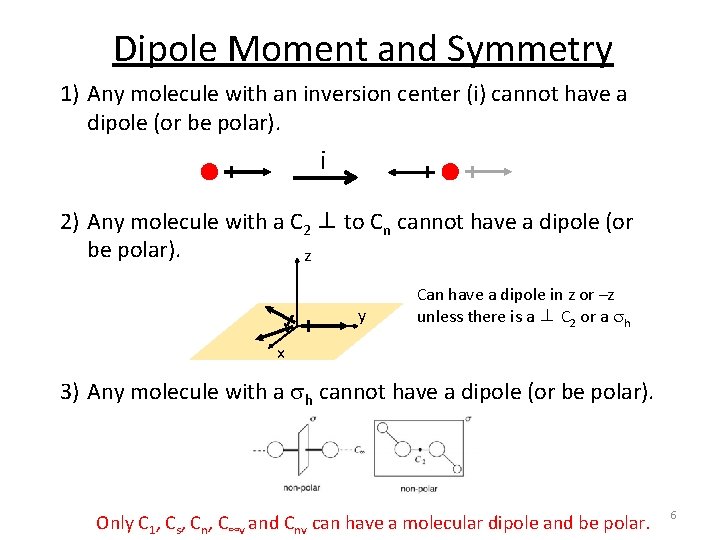
Dipole Moment and Symmetry 1) Any molecule with an inversion center (i) cannot have a dipole (or be polar). i 2) Any molecule with a C 2 ⊥ to Cn cannot have a dipole (or be polar). z y Can have a dipole in z or –z unless there is a ⊥ C 2 or a sh x 3) Any molecule with a sh cannot have a dipole (or be polar). Only C 1, Cs, Cn, C∞v and Cnv can have a molecular dipole and be polar. 6
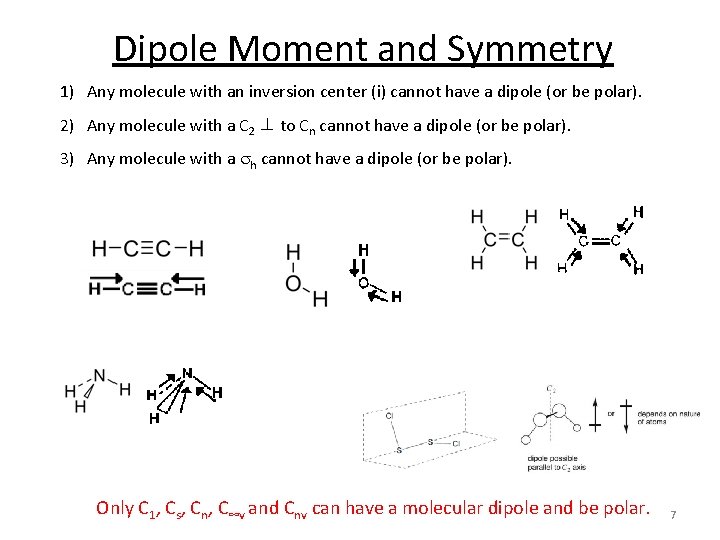
Dipole Moment and Symmetry 1) Any molecule with an inversion center (i) cannot have a dipole (or be polar). 2) Any molecule with a C 2 ⊥ to Cn cannot have a dipole (or be polar). 3) Any molecule with a sh cannot have a dipole (or be polar). Only C 1, Cs, Cn, C∞v and Cnv can have a molecular dipole and be polar. 7
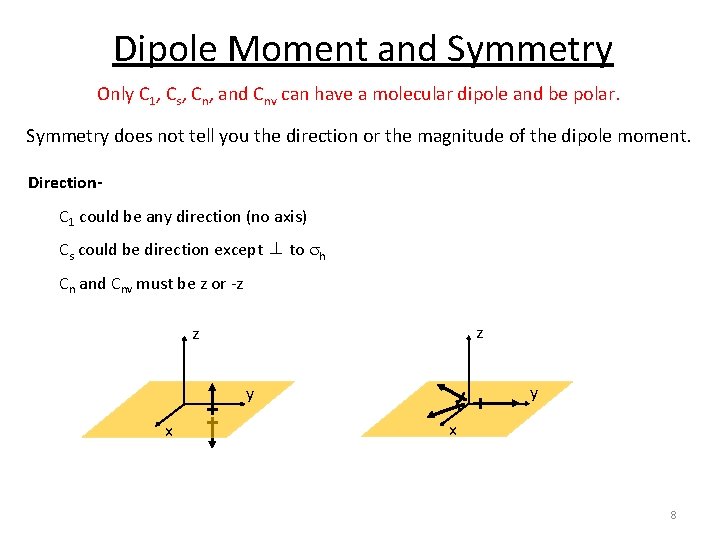
Dipole Moment and Symmetry Only C 1, Cs, Cn, and Cnv can have a molecular dipole and be polar. Symmetry does not tell you the direction or the magnitude of the dipole moment. Direction. C 1 could be any direction (no axis) Cs could be direction except ⊥ to sh Cn and Cnv must be z or -z z z y y x x 8
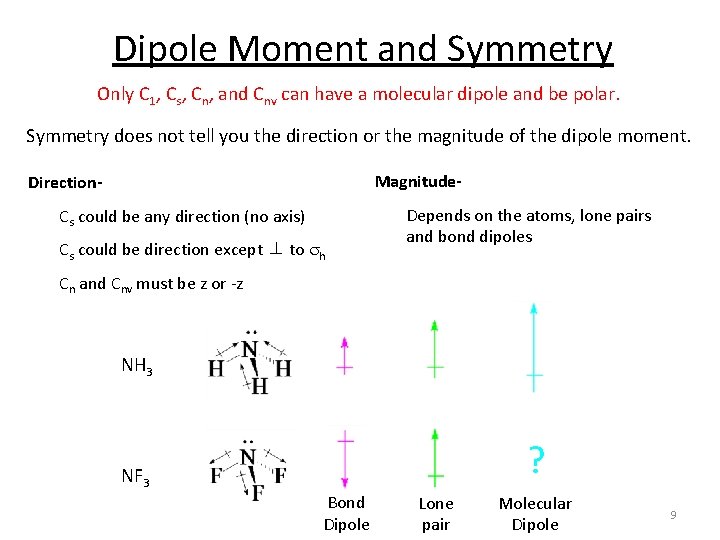
Dipole Moment and Symmetry Only C 1, Cs, Cn, and Cnv can have a molecular dipole and be polar. Symmetry does not tell you the direction or the magnitude of the dipole moment. Magnitude- Direction. Cs could be any direction (no axis) Cs could be direction except ⊥ to sh Depends on the atoms, lone pairs and bond dipoles Cn and Cnv must be z or -z NH 3 ? NF 3 Bond Dipole Lone pair Molecular Dipole 9
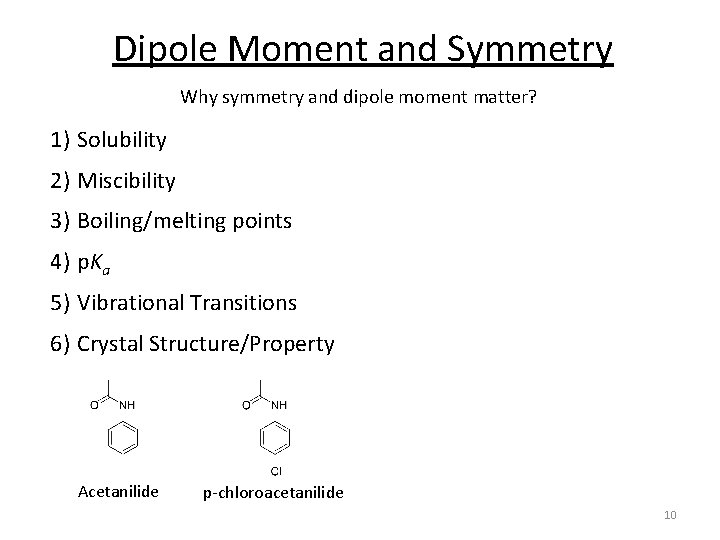
Dipole Moment and Symmetry Why symmetry and dipole moment matter? 1) Solubility 2) Miscibility 3) Boiling/melting points 4) p. Ka 5) Vibrational Transitions 6) Crystal Structure/Property Acetanilide p-chloroacetanilide 10
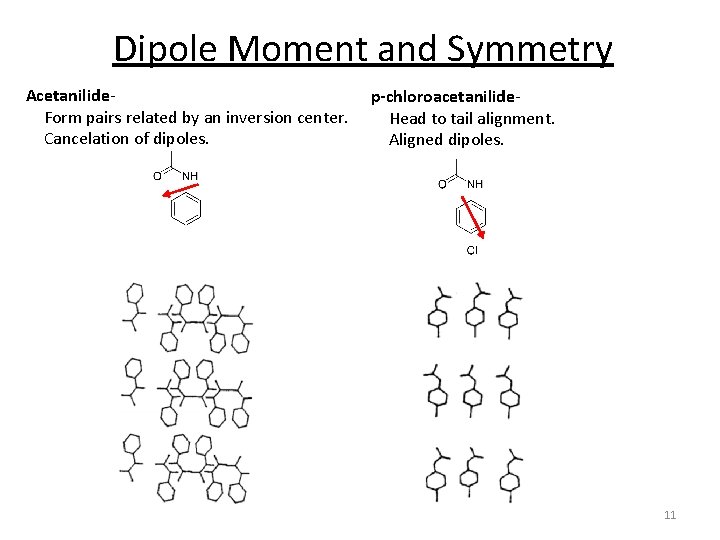
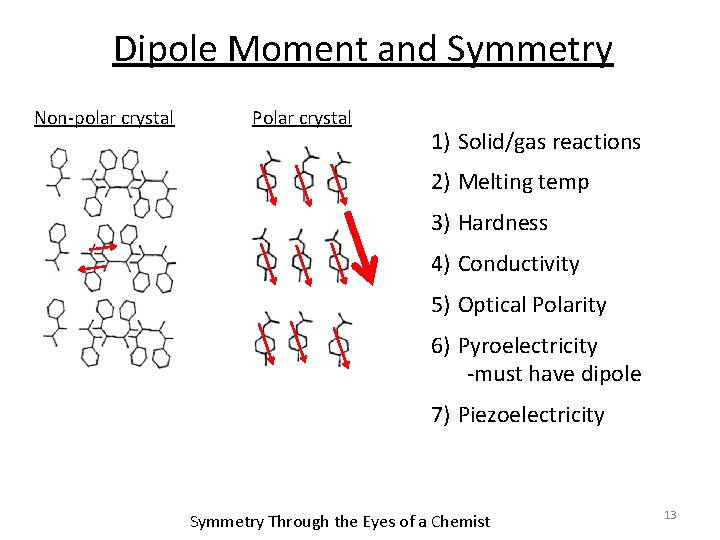
Dipole Moment and Symmetry Acetanilide- Form pairs related by an inversion center. Cancelation of dipoles. p-chloroacetanilide- Head to tail alignment. Aligned dipoles. 11
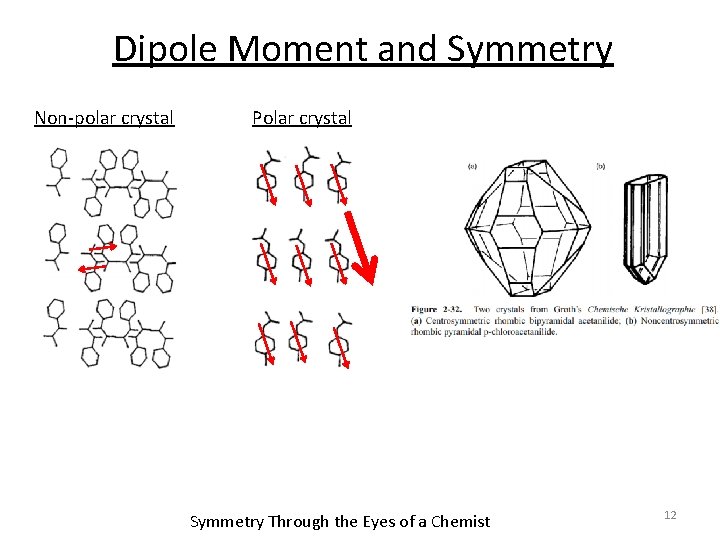
Dipole Moment and Symmetry Non-polar crystal Polar crystal Symmetry Through the Eyes of a Chemist 12
Dipole Moment and Symmetry Non-polar crystal Polar crystal 1) Solid/gas reactions 2) Melting temp 3) Hardness 4) Conductivity 5) Optical Polarity 6) Pyroelectricity -must have dipole 7) Piezoelectricity Symmetry Through the Eyes of a Chemist 13
Dipole Moment and Symmetry 1) Any molecule with an inversion center (i) cannot have a dipole (or be polar). i 2) Any molecule with a C 2 ⊥ to Cn cannot have a dipole (or be polar). z y Can have a dipole in z or –z unless there is a ⊥ C 2 or a sh x 3) Any molecule with a sh cannot have a dipole (or be polar). Only C 1, Cs, Cn, C∞v and Cnv can have a molecular dipole and be polar. 14
Optical Activity and Symmetry • Chirality • Circular Dichroism • Optical Activity and Symmetry • Dynamic Molecules • Applications of CD 15
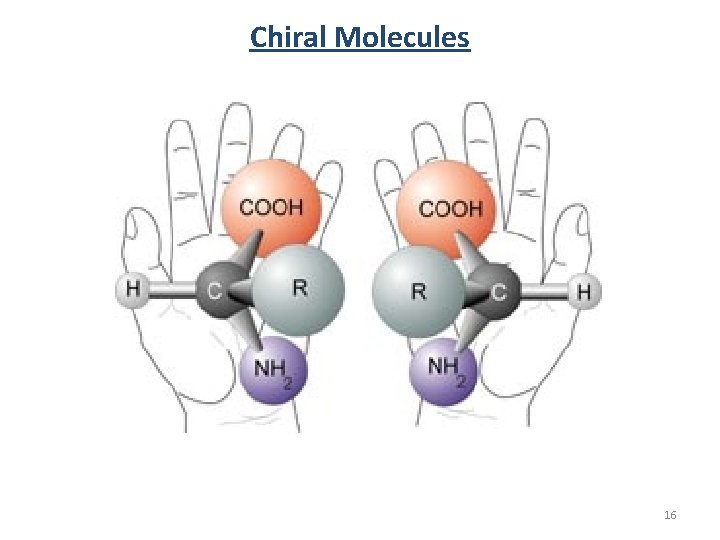
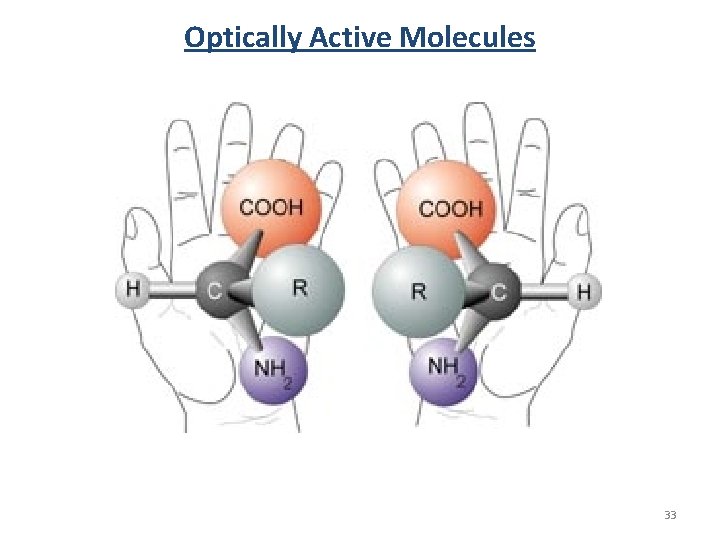
Chiral Molecules 16
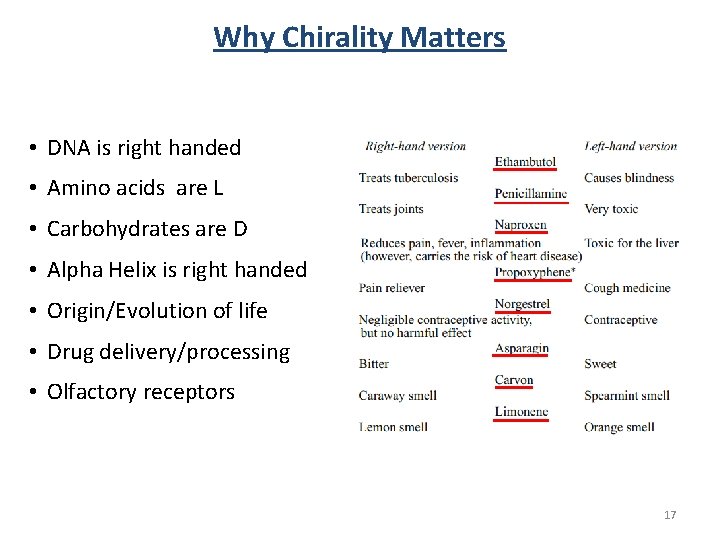
Why Chirality Matters • DNA is right handed • Amino acids are L • Carbohydrates are D • Alpha Helix is right handed • Origin/Evolution of life • Drug delivery/processing • Olfactory receptors 17
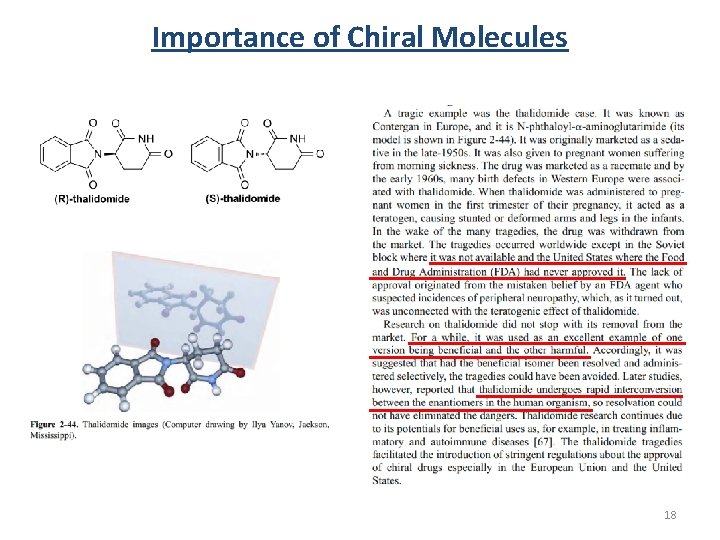
Importance of Chiral Molecules 18
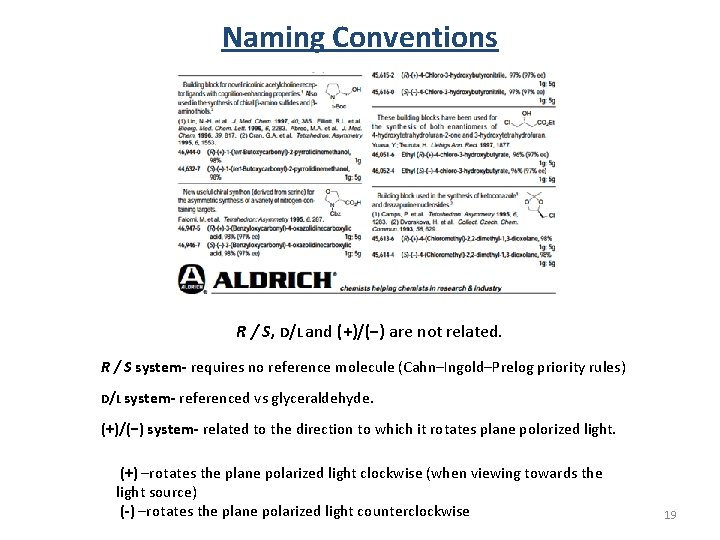
Naming Conventions R / S, D/L and (+)/(−) are not related. R / S system- requires no reference molecule (Cahn–Ingold–Prelog priority rules) D/L system- referenced vs glyceraldehyde. (+)/(−) system- related to the direction to which it rotates plane polorized light. (+) –rotates the plane polarized light clockwise (when viewing towards the light source) (-) –rotates the plane polarized light counterclockwise 19
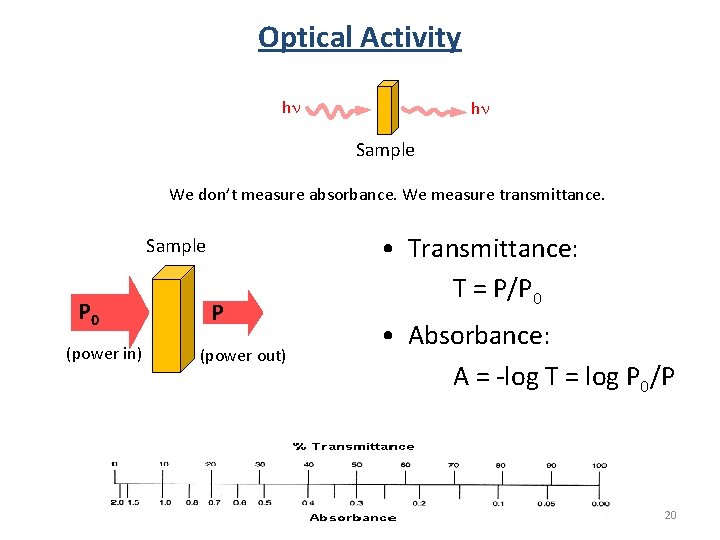
Optical Activity hn hn Sample We don’t measure absorbance. We measure transmittance. Sample P 0 (power in) P (power out) • Transmittance: T = P/P 0 • Absorbance: A = -log T = log P 0/P 20
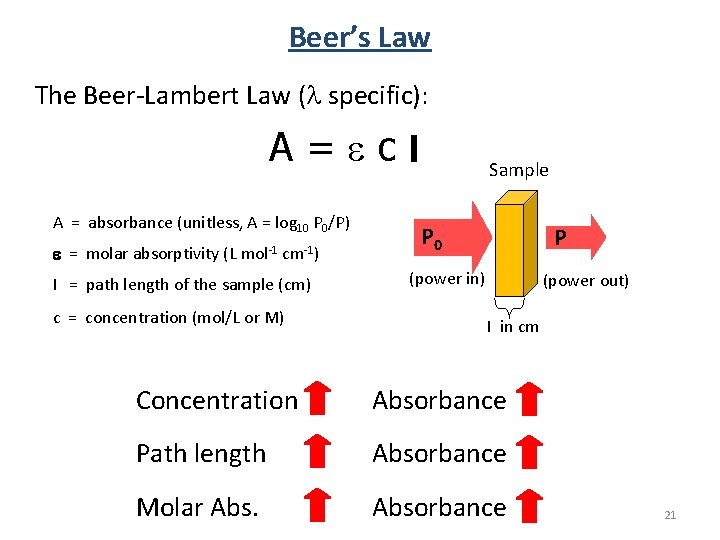
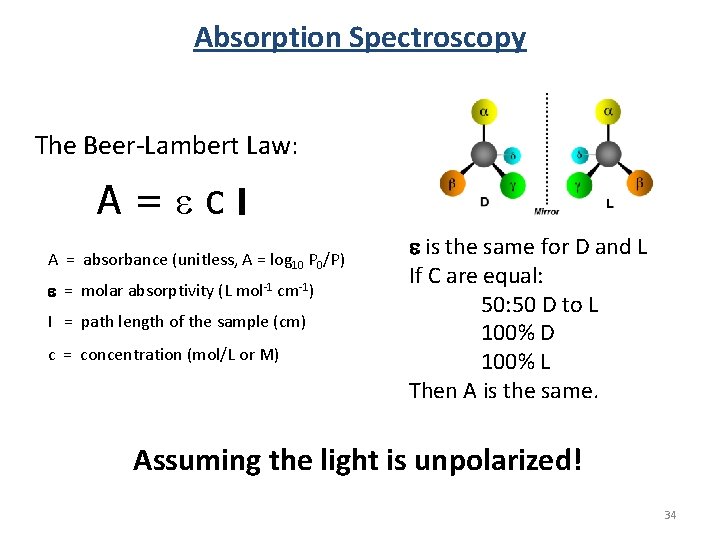
Beer’s Law The Beer-Lambert Law (l specific): A=ecl A = absorbance (unitless, A = log 10 P 0/P) e = molar absorptivity (L mol-1 cm-1) l = path length of the sample (cm) c = concentration (mol/L or M) Sample P 0 P (power in) (power out) l in cm Concentration Absorbance Path length Absorbance Molar Absorbance 21
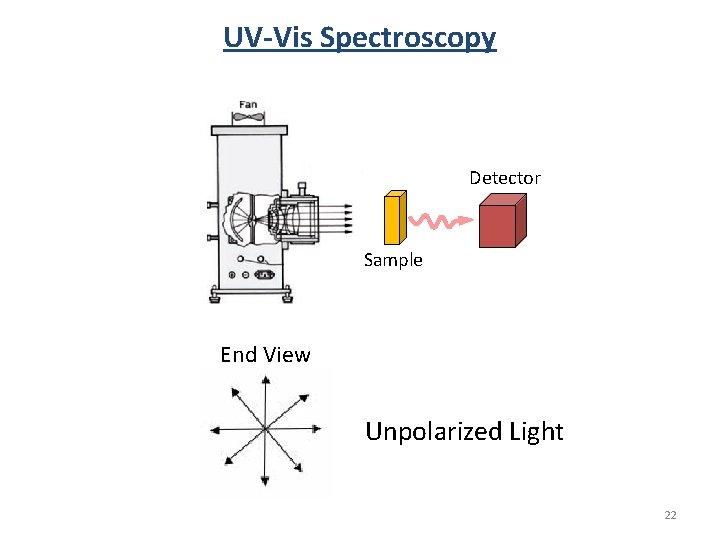
UV-Vis Spectroscopy Detector Sample End View Unpolarized Light 22
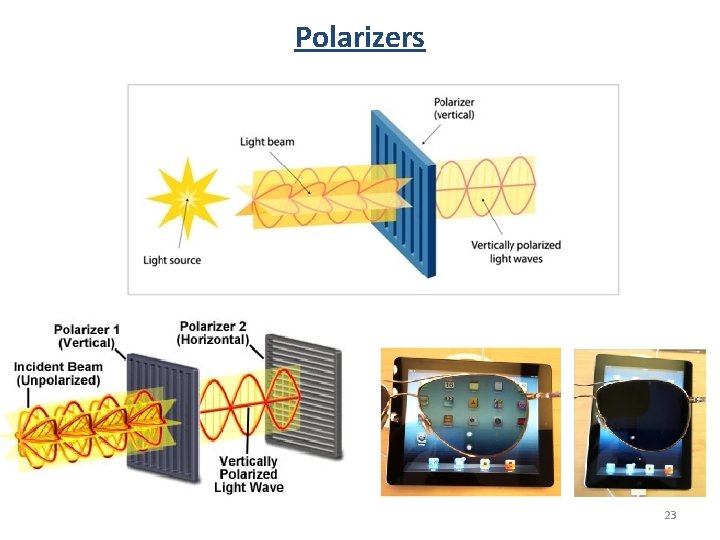
Polarizers 23
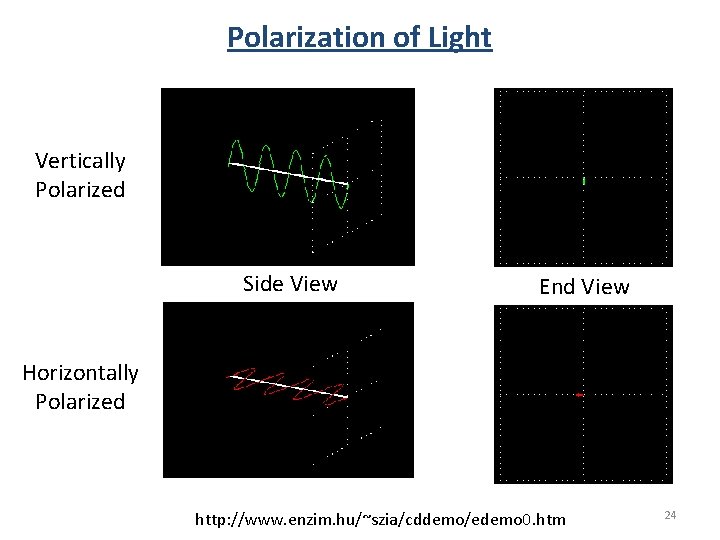
Polarization of Light Vertically Polarized Side View End View Horizontally Polarized http: //www. enzim. hu/~szia/cddemo/edemo 0. htm 24
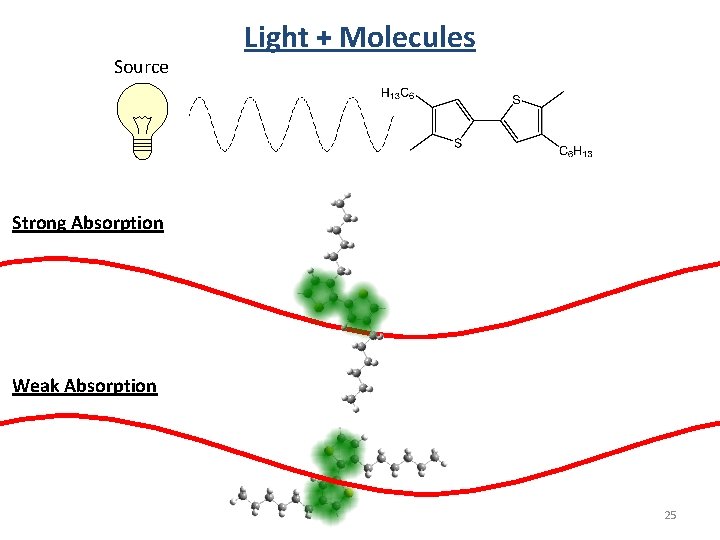
Source Light + Molecules Strong Absorption Weak Absorption 25
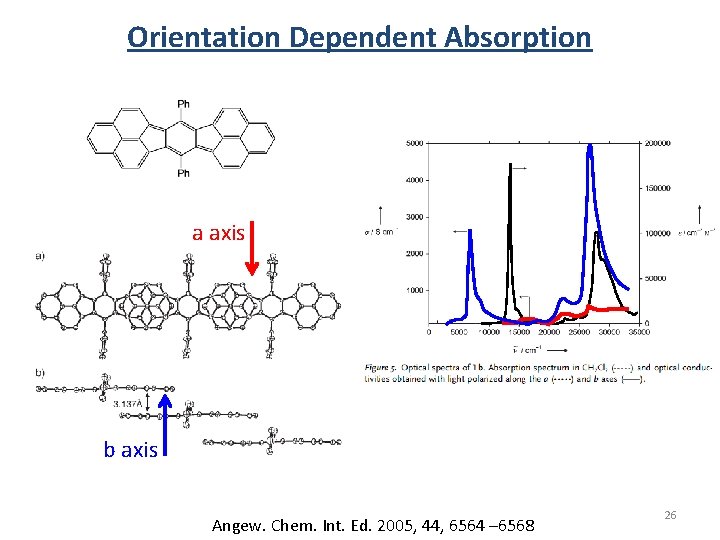
Orientation Dependent Absorption a axis b axis Angew. Chem. Int. Ed. 2005, 44, 6564 – 6568 26
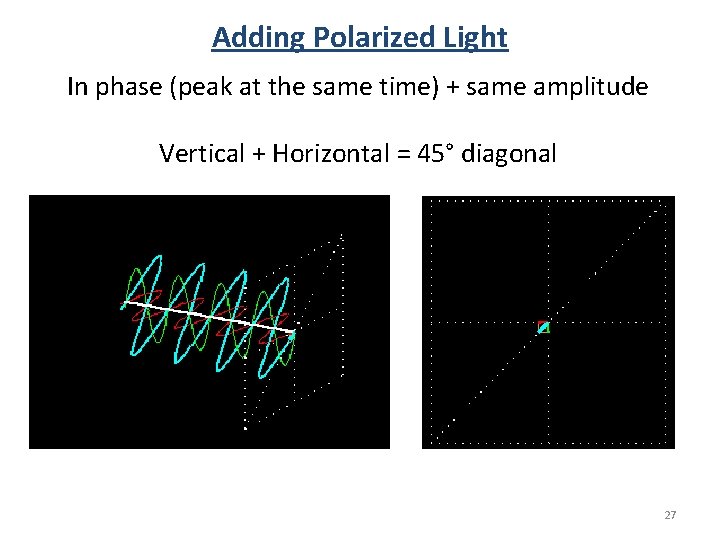
Adding Polarized Light In phase (peak at the same time) + same amplitude Vertical + Horizontal = 45° diagonal 27
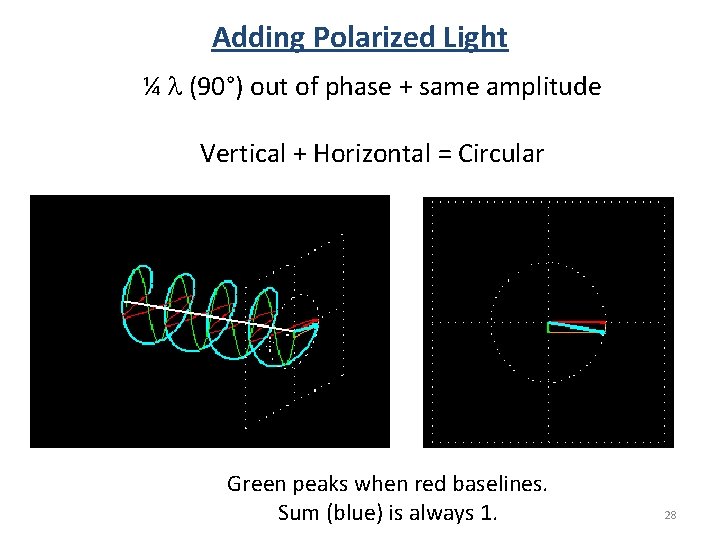
Adding Polarized Light ¼ l (90°) out of phase + same amplitude Vertical + Horizontal = Circular Green peaks when red baselines. Sum (blue) is always 1. 28
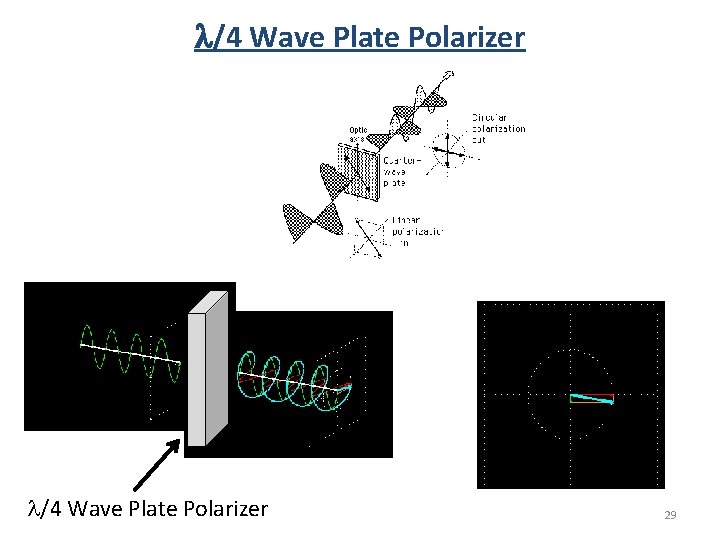
l/4 Wave Plate Polarizer 29
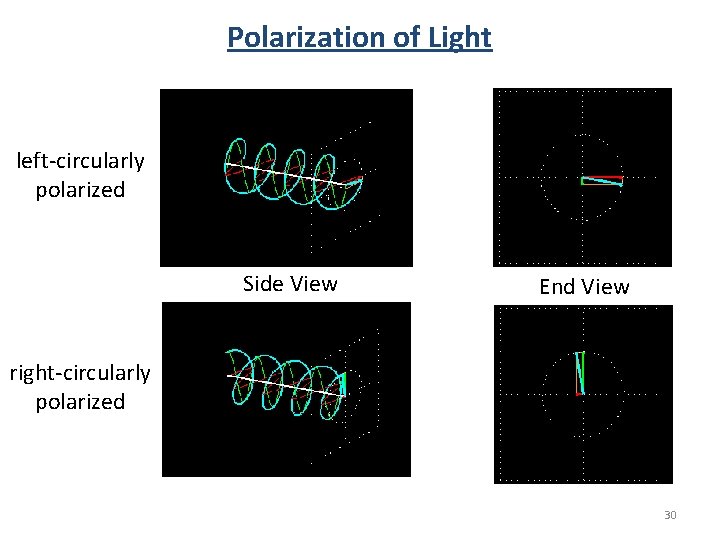
Polarization of Light left-circularly polarized Side View End View right-circularly polarized 30
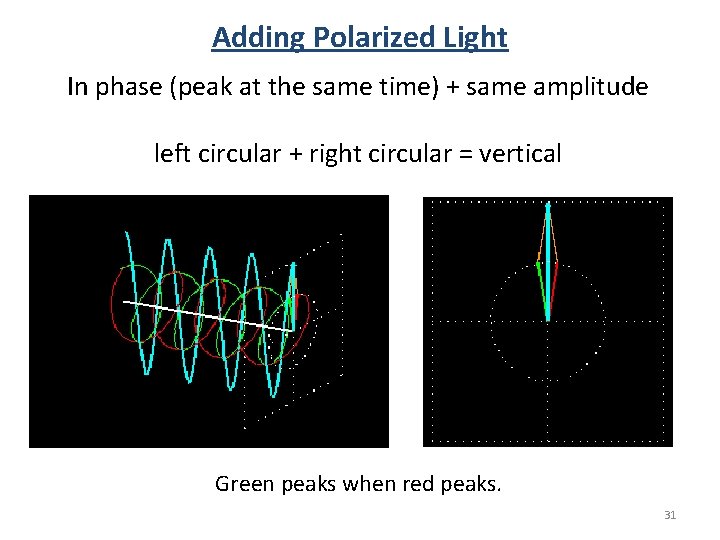
Adding Polarized Light In phase (peak at the same time) + same amplitude left circular + right circular = vertical Green peaks when red peaks. 31
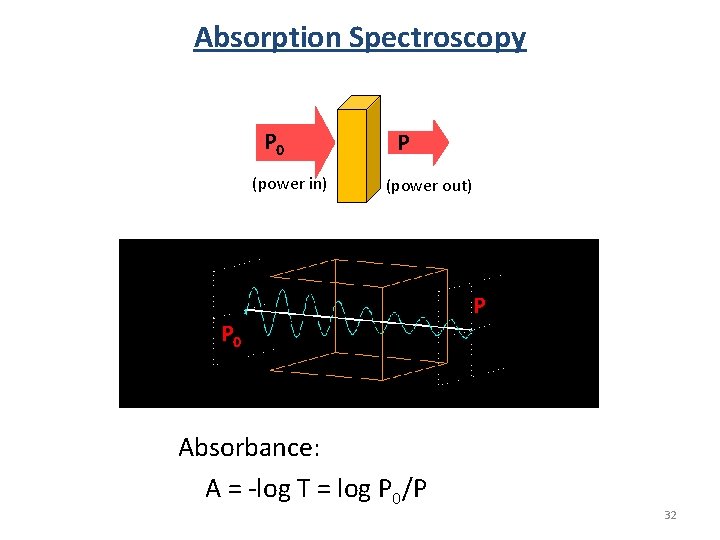
Absorption Spectroscopy P 0 (power in) P (power out) P 0 Absorbance: A = -log T = log P 0/P P 32
Optically Active Molecules 33
Absorption Spectroscopy The Beer-Lambert Law: A=ecl A = absorbance (unitless, A = log 10 P 0/P) e = molar absorptivity (L mol-1 cm-1) l = path length of the sample (cm) c = concentration (mol/L or M) e is the same for D and L If C are equal: 50 D to L 100% D 100% L Then A is the same. Assuming the light is unpolarized! 34
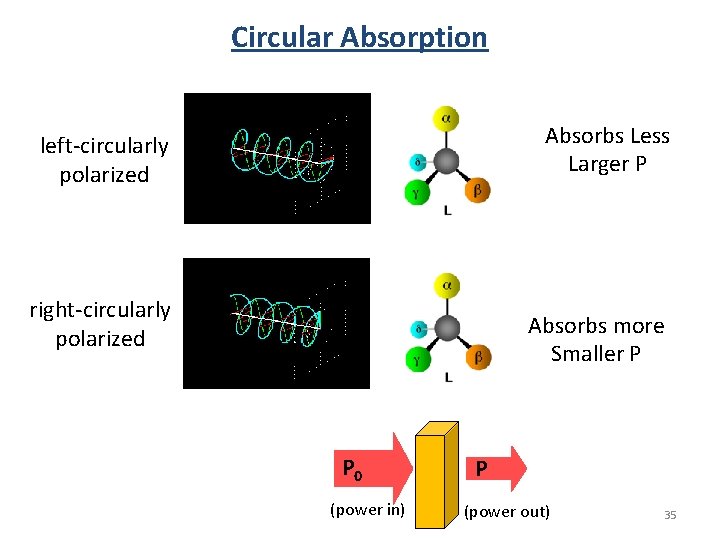
Circular Absorption Absorbs Less Larger P left-circularly polarized right-circularly polarized Absorbs more Smaller P P 0 (power in) P (power out) 35
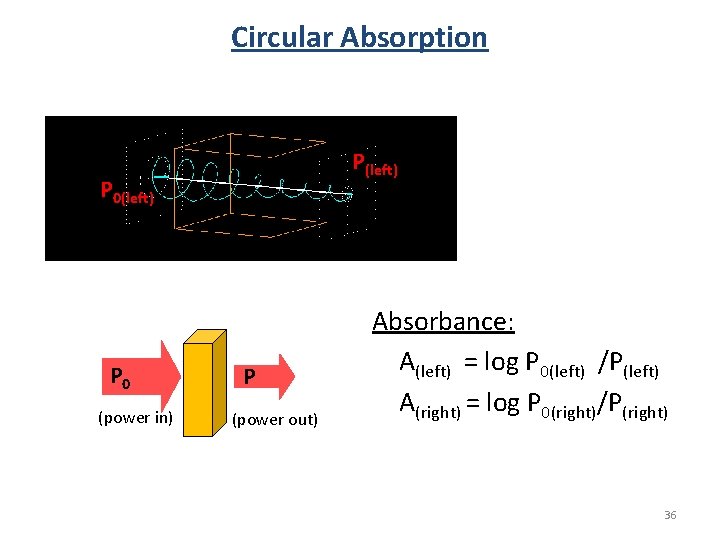
Circular Absorption P(left) P 0 (power in) P (power out) Absorbance: A(left) = log P 0(left) /P(left) A(right) = log P 0(right)/P(right) 36
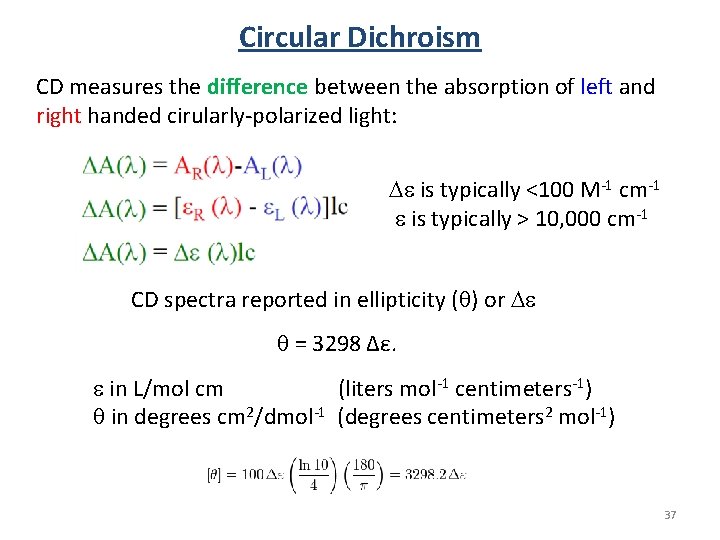
Circular Dichroism CD measures the difference between the absorption of left and right handed cirularly-polarized light: De is typically <100 M-1 cm-1 e is typically > 10, 000 cm-1 CD spectra reported in ellipticity ( ) or De = 3298 Δε. e in L/mol cm (liters mol-1 centimeters-1) in degrees cm 2/dmol-1 (degrees centimeters 2 mol-1) 37
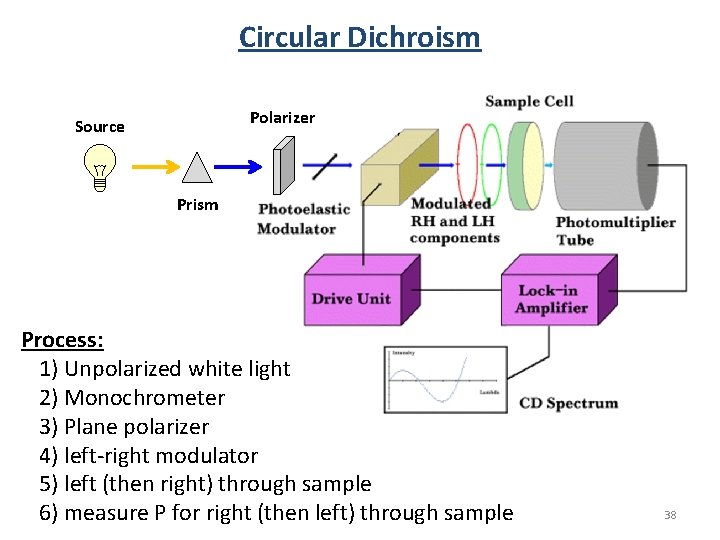
Circular Dichroism Polarizer Source Prism Process: 1) Unpolarized white light 2) Monochrometer 3) Plane polarizer 4) left-right modulator 5) left (then right) through sample 6) measure P for right (then left) through sample 38
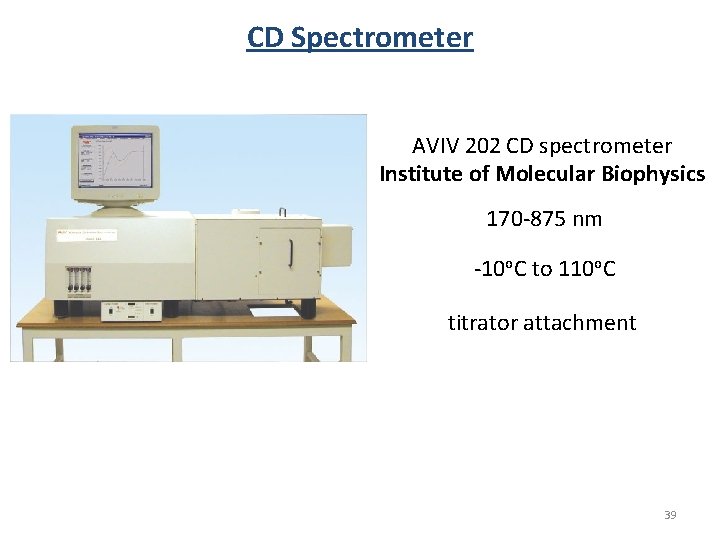
CD Spectrometer AVIV 202 CD spectrometer Institute of Molecular Biophysics 170 -875 nm -10 o. C to 110 o. C titrator attachment 39
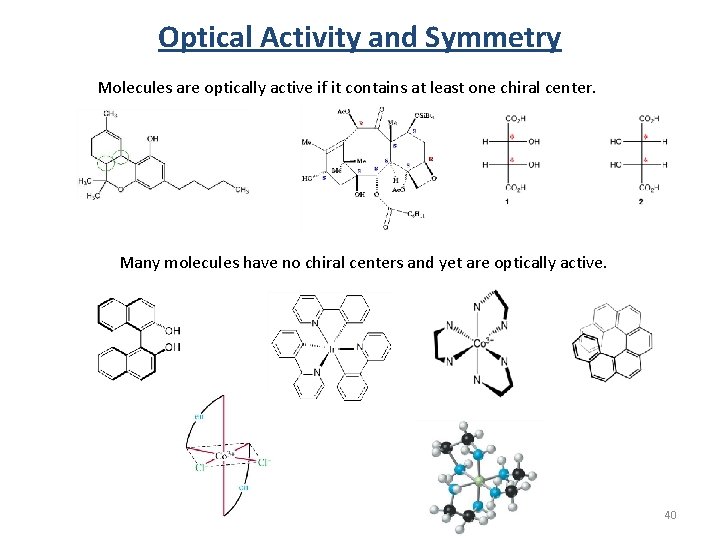
Optical Activity and Symmetry Molecules are optically active if it contains at least one chiral center. Many molecules have no chiral centers and yet are optically active. 40
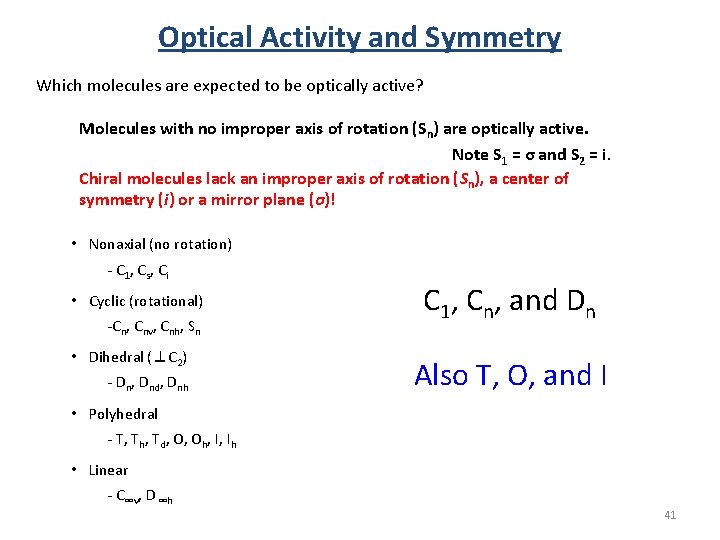
Optical Activity and Symmetry Which molecules are expected to be optically active? Molecules with no improper axis of rotation (Sn) are optically active. Note S 1 = σ and S 2 = i. Chiral molecules lack an improper axis of rotation (Sn), a center of symmetry (i) or a mirror plane (σ)! • Nonaxial (no rotation) - C 1, Cs, Ci • Cyclic (rotational) -Cn, Cnv, Cnh, Sn • Dihedral (⊥C 2) - Dn, Dnd, Dnh C 1, Cn, and Dn Also T, O, and I • Polyhedral - T, Th, Td, O, Oh, I, Ih • Linear - C∞v, D ∞h 41
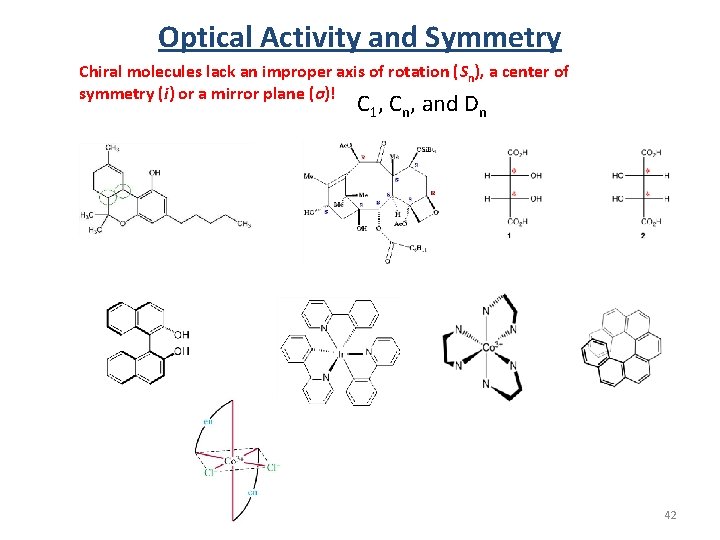
Optical Activity and Symmetry Chiral molecules lack an improper axis of rotation (Sn), a center of symmetry (i) or a mirror plane (σ)! C 1, Cn, and Dn 42
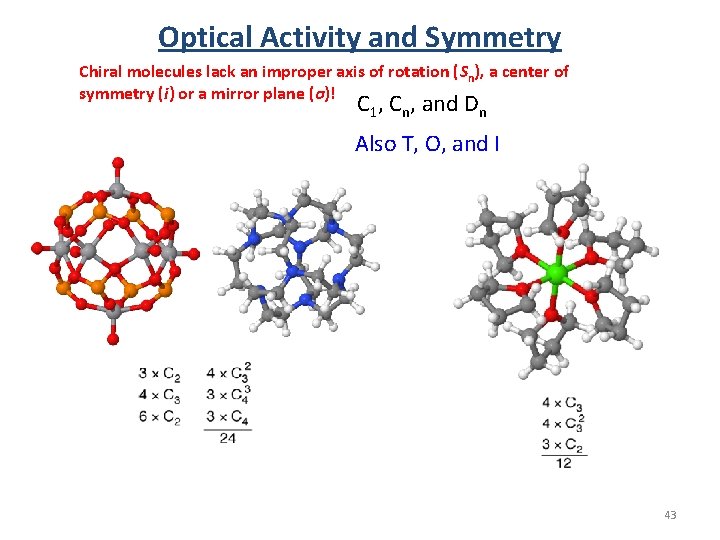
Optical Activity and Symmetry Chiral molecules lack an improper axis of rotation (Sn), a center of symmetry (i) or a mirror plane (σ)! C 1, Cn, and Dn Also T, O, and I 43
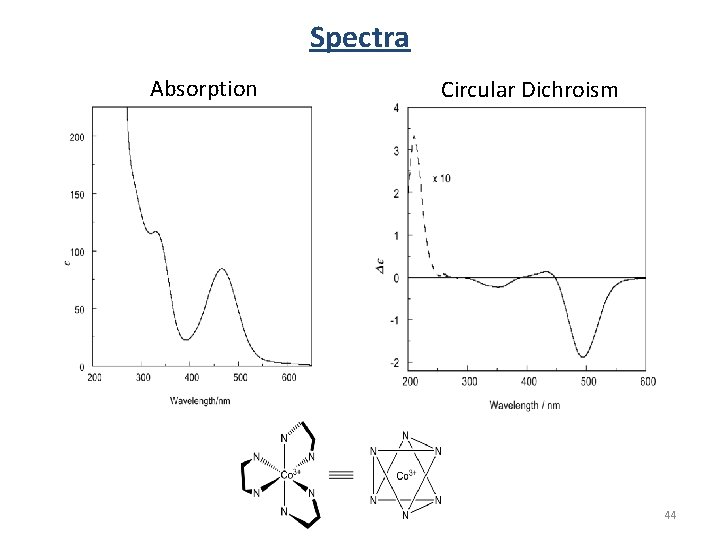
Spectra Absorption Circular Dichroism 44
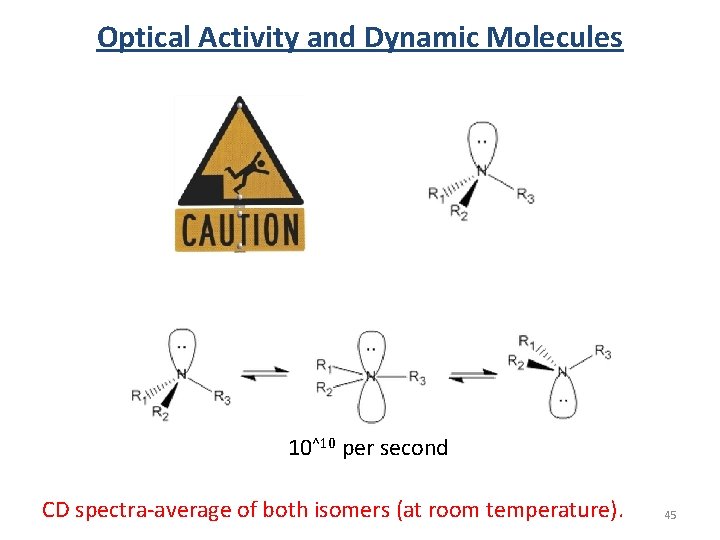
Optical Activity and Dynamic Molecules 10^10 per second CD spectra-average of both isomers (at room temperature). 45
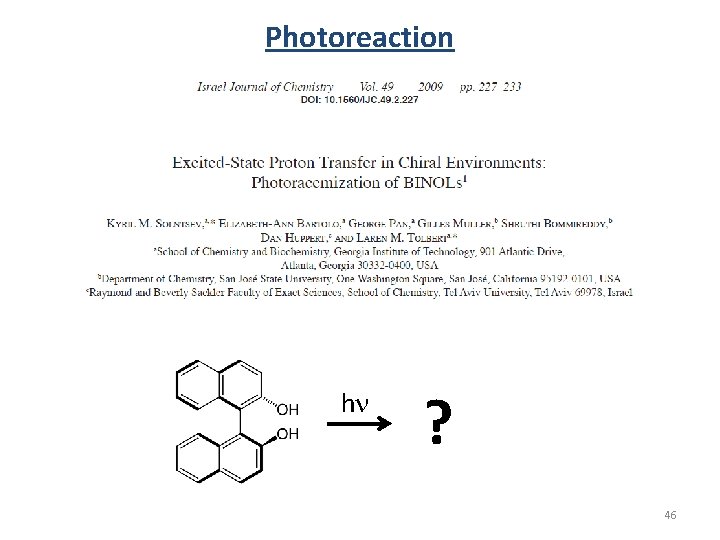
Photoreaction hn ? 46
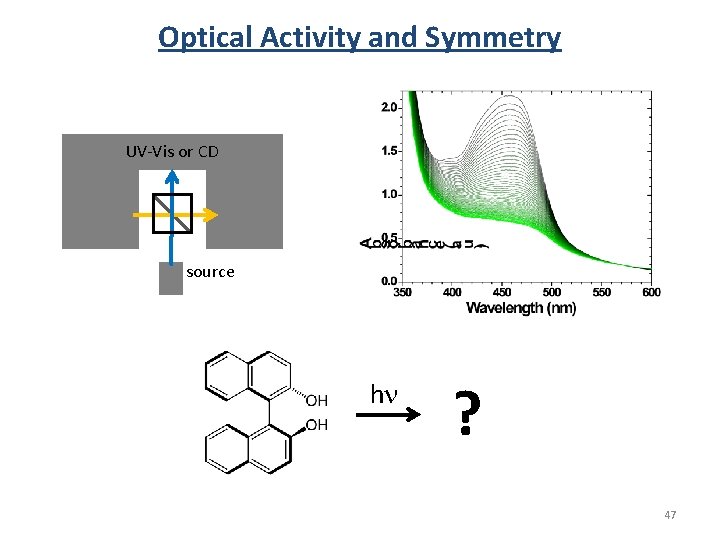
Optical Activity and Symmetry UV-Vis or CD source hn ? 47
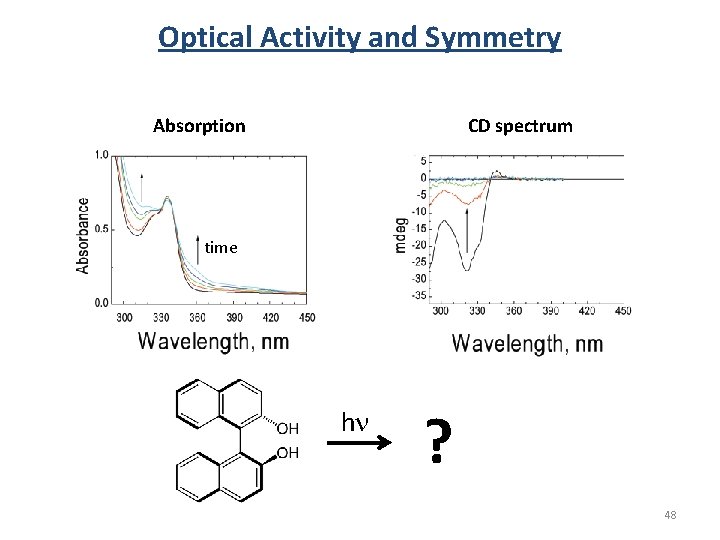
Optical Activity and Symmetry Absorption CD spectrum time hn ? 48
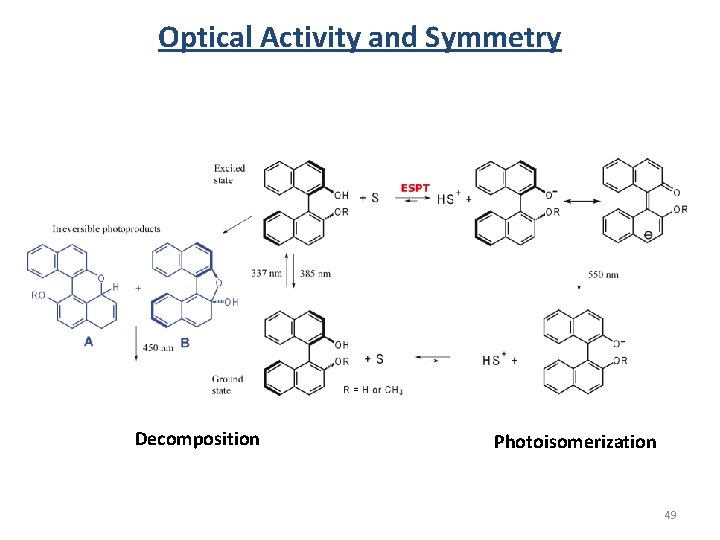
Optical Activity and Symmetry Decomposition Photoisomerization 49
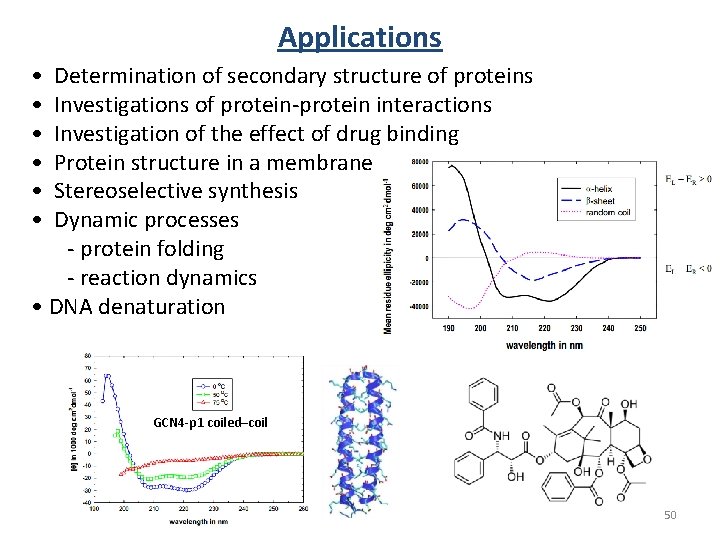
Applications • Determination of secondary structure of proteins • Investigations of protein-protein interactions • Investigation of the effect of drug binding • Protein structure in a membrane • Stereoselective synthesis • Dynamic processes - protein folding - reaction dynamics • DNA denaturation GCN 4 -p 1 coiled–coil 50
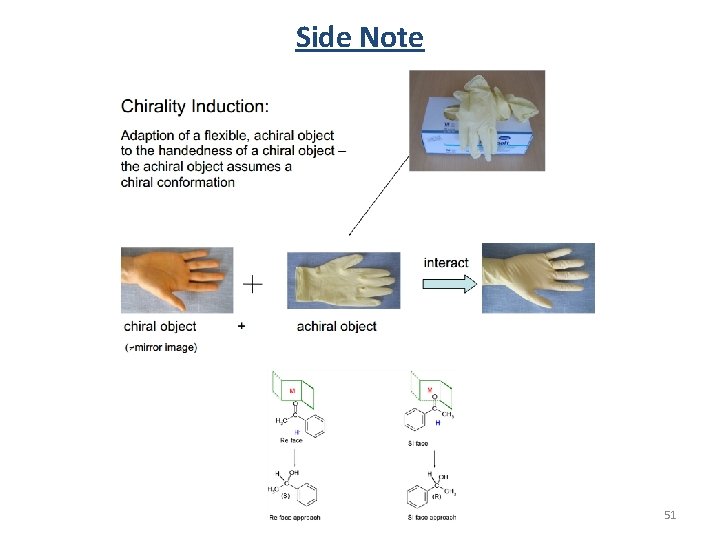
Side Note 51