
Part 121 Operating Requirements Domestic Flag and Supplemental
- Slides: 59
Part 121 Operating Requirements Domestic, Flag, and Supplemental Operations Subpart N Training Program
121. 400 Terms • Group I – Propeller driven including • Reciprocating powered • Turbopropeller powered • Group II – Turbojet powered • Initial Training – Have not qualified/served in same capacity of another airplane • Transition Training – Qualified/served in same capacity of another airplane
121. 400 Terms • Upgrade Training – Qualified/served as SIC or flight engineer • Differences Training – Qualified/served in particular type airplane and training on a particular variation of that airplane • Programmed hours – Hours of training prescribed – May be reduced by Administrator • Requalification Training – Previously qualified/trained
121. 401 Training Program • Establish for – – Crewmembers Aircraft dispatchers Flight instructors Check airmen • Whenever a crewmember takes a competence check in the calendar month before or after the calendar month in which that training or check is required, he is considered to have taken or completed it in the calendar month in which it was required 121. 404 CRM • All flight crewmembers and flight attendants must complete crew resource management before certificate holder can use them
121. 402 Special Rules • Part 142 certificated flight training center eligible to provide training – Holds applicable training specifications – Has facilities, training equipment, courseware – Approved curriculums, curriculum segments, and portions of curriculum segments – Has sufficient instructor and check airmen qualified to provide training, testing, and checks
121. 403 Curriculum • Training Program – Curriculum • List of principal ground training subjects – Including emergency training subjects • List of all training devices – System trainers – Procedures trainers – Other training aids • Detailed descriptions of approved normal, abnormal, and emergency procedures • List of airplane simulators • Programmed hours of training • Administrator grants final approval of training programs/revisions
121. 415 Crewmember/Dispatcher Training • Training program – Basic indoctrination ground training • • 40 hours programmed instruction Duties and responsibilities Appropriate provisions of FAR Contents of – Operating certificate – Operations specifications – Operating manual (Appropriate portions) • Roles/responsibilities in passenger recovery plan – Differences – Upgrade – Recurrent
121. 417 Emergency Training • Training includes – Instruction in emergency assignments – Instruction in location, function, operation of emergency equipment • • • Equipment used in ditching/evacuation Portable fire extinguishers Emergency exits Handing of emergency situations Review previous accidents
121. 417 Emergency Training • Each crewmember must accomplish: – During initial training and – Once each 24 calendar months during recurrent training • • • Each type of emergency exit Each type of installed hand fire extinguisher Each type of emergency oxygen system Donning, use, and inflation of individual flotation Ditching
121. 433 Training Required • Recurrent Training – Flight Crewmembers • No person may serve as a required crewmember unless, within the preceding 12 calendar months, satisfactorily complete recurrent and flight training for that airplane and a flight check as applicable – Pilot in Command • No person may serve as a pilot in command unless, within the preceding 6 calendar months, satisfactorily complete recurrent flight training in addition to the training required above
121. 440 Line Checks • Pilot in Command (Domestic/Flag) – Within preceding 12 calendar months, pass a line check – Over typical part of route, airway, direct route • Pilot in Command (Supplemental) – Within preceding 12 calendar months, pass a line check – Part or airway or advisory route
121. 441 Proficiency checks • Pilot in Command – With preceding 12 calendar months – Within preceding 6 calendar months either • Proficiency • Approved simulator course of training • Other pilots – Within the preceding 24 calendar months, pass a proficiency check or line-oriented simulator training course – Within the preceding 12 calendar months, pass a proficiency check or any simulator training course
Part 121 Operating Requirements Domestic, Flag, and Supplemental Operations Subpart P Aircraft Dispatcher Qualifications and Duty Time I love flying I’ve been to almost as many places as my luggage Bob Hope
121. 463 Domestic/Flag Operations • Completed initial dispatcher training • Operations familiarization – Within preceding 12 calendar months – 5 hours observing operations • Flight deck • Forward passenger seat with headset or speaker – Waived for 90 days after initial introduction • Reduced to 2 ½ hours based on – Substituting 1 additional takeoff and landing for an hour of flight • Satisfactorily completed differences training • Familiar with essential operating procedures
121. 465 Dispatcher Duty Time • Schedule – No more than 10 consecutive hours of duty – More than 10 hours in 24 consecutive hours • Provide rest period of at least 8 hours • At or before end of 10 hours of duty – Worked 7 consecutive days • Relieved for duty for at least 24 hours
Part 121 Operating Requirements Domestic, Flag, and Supplemental Operations Subpart Q Flight Time Limitations: Domestic Operations Flight is the only true sensation that men have achieved in modern history James Dickey
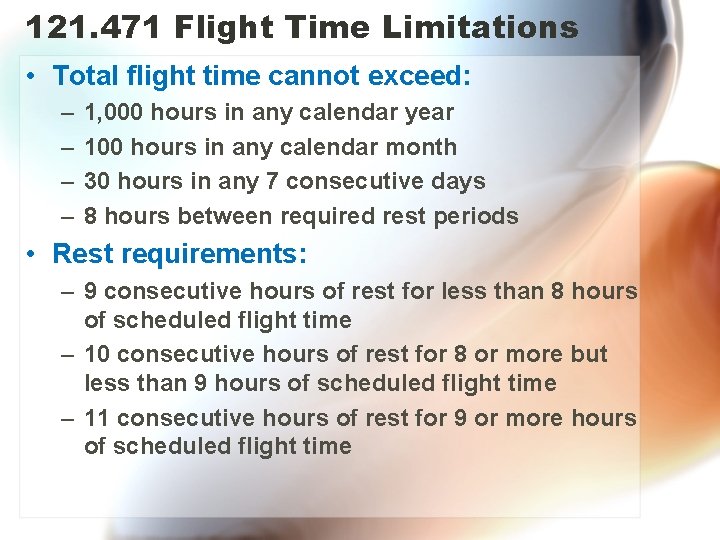
121. 471 Flight Time Limitations • Total flight time cannot exceed: – – 1, 000 hours in any calendar year 100 hours in any calendar month 30 hours in any 7 consecutive days 8 hours between required rest periods • Rest requirements: – 9 consecutive hours of rest for less than 8 hours of scheduled flight time – 10 consecutive hours of rest for 8 or more but less than 9 hours of scheduled flight time – 11 consecutive hours of rest for 9 or more hours of scheduled flight time
Part 121 Operating Requirements Domestic, Flag, and Supplemental Operations Subpart R Flight Time Limitations: Flag Operations
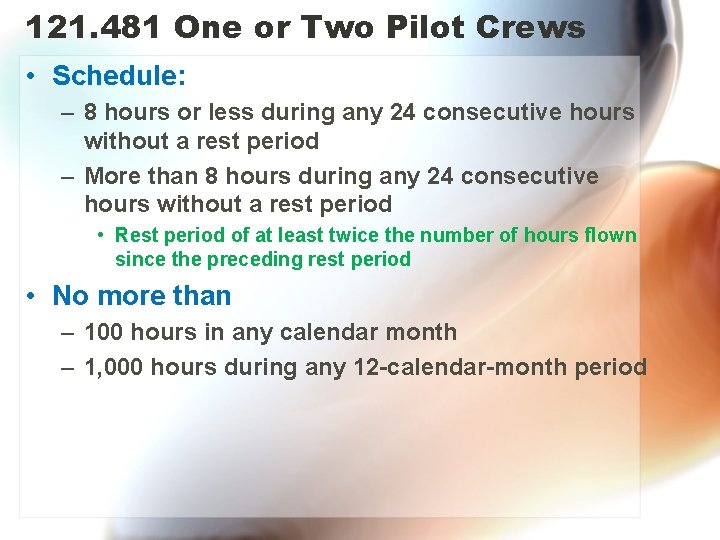
121. 481 One or Two Pilot Crews • Schedule: – 8 hours or less during any 24 consecutive hours without a rest period – More than 8 hours during any 24 consecutive hours without a rest period • Rest period of at least twice the number of hours flown since the preceding rest period • No more than – 100 hours in any calendar month – 1, 000 hours during any 12 -calendar-month period
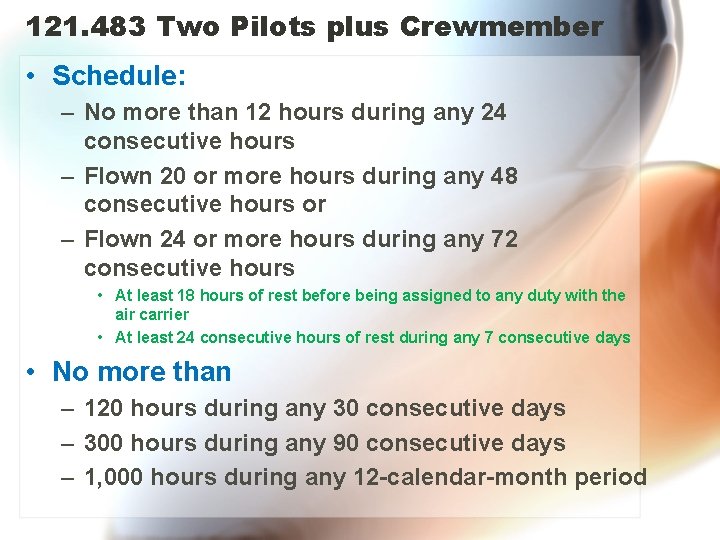
121. 483 Two Pilots plus Crewmember • Schedule: – No more than 12 hours during any 24 consecutive hours – Flown 20 or more hours during any 48 consecutive hours or – Flown 24 or more hours during any 72 consecutive hours • At least 18 hours of rest before being assigned to any duty with the air carrier • At least 24 consecutive hours of rest during any 7 consecutive days • No more than – 120 hours during any 30 consecutive days – 300 hours during any 90 consecutive days – 1, 000 hours during any 12 -calendar-month period
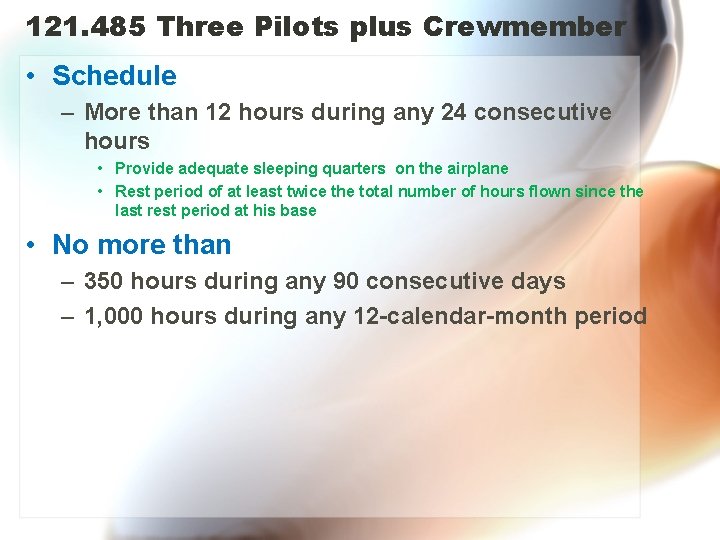
121. 485 Three Pilots plus Crewmember • Schedule – More than 12 hours during any 24 consecutive hours • Provide adequate sleeping quarters on the airplane • Rest period of at least twice the total number of hours flown since the last rest period at his base • No more than – 350 hours during any 90 consecutive days – 1, 000 hours during any 12 -calendar-month period
Part 121 Operating Requirements Domestic, Flag, and Supplemental Operations Subpart S Flight Time Limitations: Supplemental Operations
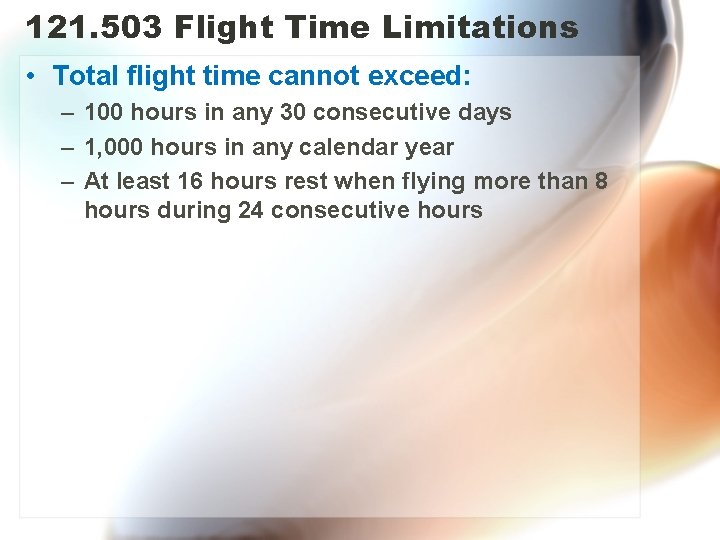
121. 503 Flight Time Limitations • Total flight time cannot exceed: – 100 hours in any 30 consecutive days – 1, 000 hours in any calendar year – At least 16 hours rest when flying more than 8 hours during 24 consecutive hours
Part 121 Operating Requirements Domestic, Flag, and Supplemental Operations Subpart T Flight Operations Any landing you can walk away from is a good one Anonymous
121. 533/535 Domestic/Flag Operations • Responsibility for operational control – Pilot/Dispatcher • Jointly responsible – Preflight planning – Delay – Dispatch release – Aircraft Dispatcher responsible • Monitoring progress of each flight • Issuing necessary information for safety of flight • Canceling or redispatching flight
121. 537 Supplemental Operations • Responsibility for operational control – Pilot/Director of operations • Jointly responsible for flight – – Initiation Continuation Diversion Termination – Director of operations responsible • Canceling, diverting, delaying flight
121. 565 Engine Inoperative • 2 engines – Engine fails/shutdown • Land at nearest suitable airport where safe landing can be made • 3 engines – Engine fails/shutdown • Pilot determines whether to proceed
Part 121 Operating Requirements Domestic, Flag, and Supplemental Operations Subpart U Dispatching and Flight Release Rules Aviation is proof that, given the will, We have the capacity to achieve the impossible Edward Rickenbacker
121. 593 Domestic Operations • Aircraft dispatcher must authorize flights – Except for • Intermediate stop for not more than one hour and designated in original release
121. 595 Flag Operations • Aircraft dispatcher must authorize flights – Except for • Intermediate stop for not more than six hours • > 6 hours - redispatch
121. 597 Supplemental Operations • Person authorized by operations to exercise operational control over flight – Execute flight release • Setting conditions under which flights will be conducted – Intermediate stop • Cannot continue without a new flight release if aircraft has been on ground more than 6 hours
121. 601 Information to PIC • Domestic/Flag – Aircraft Dispatcher provide available current reports • • Airport conditions Irregularities of navigation facilities All available weather reports/forecasts During flight – additional information that affects safety of flight
121. 603 Information to PIC • Supplemental – PIC obtains available current reports • • Airport conditions Irregularities of navigation facilities All available weather reports/forecasts During flight – additional information that affects safety of flight
121. 611/3 VFR/IFR Dispatch/flight release • VFR – Ceiling and visibility forecasts • Remain at or above VFR minimums • Airplane arrives at destination • IFR/Over-the-Top – Weather conditions • At or above authorized minimums • At estimated time of arrival • Airport or airports dispatched
121. 617 Departure Alternate Airport • Weather conditions at departure airport – Below landing minimums • Specify alternate airport – Aircraft having 2 engines • Airport not more than 1 hour from departure airport – Aircraft having 3 or more engines • Airport not more than 2 hour from departure airport – Weather minimums must meet requirements of certificate holder’s ops specs
121. 619 Destination Alternate Airport • Domestic operations – No alternate required if • ETA + 1 hour • Weather reports – Ceiling at least 2, 000 feet above airport elevation – Visibility at least 3 miles – Marginal conditions • Destination and first alternate • At least one additional alternate must be designated
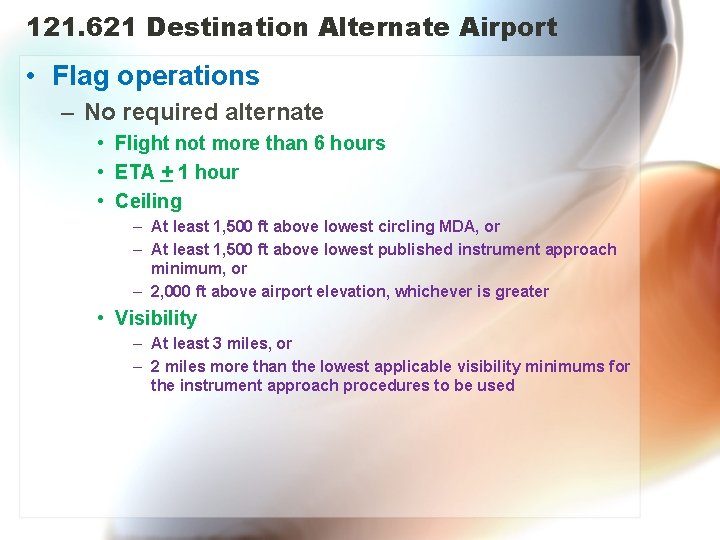
121. 621 Destination Alternate Airport • Flag operations – No required alternate • Flight not more than 6 hours • ETA + 1 hour • Ceiling – At least 1, 500 ft above lowest circling MDA, or – At least 1, 500 ft above lowest published instrument approach minimum, or – 2, 000 ft above airport elevation, whichever is greater • Visibility – At least 3 miles, or – 2 miles more than the lowest applicable visibility minimums for the instrument approach procedures to be used
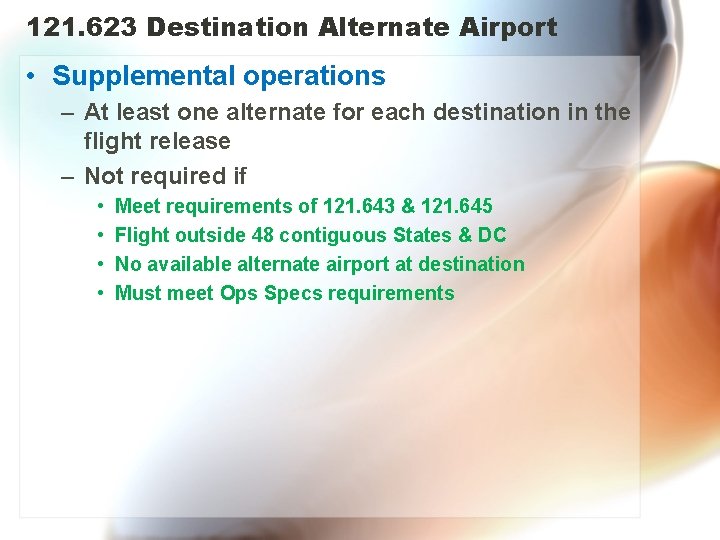
121. 623 Destination Alternate Airport • Supplemental operations – At least one alternate for each destination in the flight release – Not required if • • Meet requirements of 121. 643 & 121. 645 Flight outside 48 contiguous States & DC No available alternate airport at destination Must meet Ops Specs requirements
121. 625 Alternate Airport Weather Minima • Alternate – Weather reports at or above • Alternate weather minima specified in Ops Specs for that airport
121. 627 Flight in Unsafe Conditions • PIC – Cannot allow toward airport where flight cannot be completed safely • Opinion of PIC or dispatcher
121. 628 Inoperable Instruments/Equipment • Cannot takeoff unless – Approved MEL exists for that airplane • FSDO has approved MEL – MEL provides • Operation of airplane with certain instruments and equipment in inoperable condition • Instruments/Equipment excluded from MEL – Required by airworthiness requirements – Essential for safe operations – Required by airworthiness directive
121. 629 Operating in Icing Conditions • Cannot dispatch/release airplane – Opinion of PIC or dispatcher • Icing conditions expected to adversely affect safety of flight • Cannot takeoff/dispatch/release when – Frost, ice, snow adheres (or expected to adhere) to • Wings, control surfaces, propellers, engine inlets • Other critical surfaces of aircraft – Ground/anti-icing program • Approved by FSDO • Dispatch/release/takeoff comply with program
121. 631 Dispatch Release • Original dispatch or release – Any regular, provision, refueling airport • Authorized for type of aircraft
121. 639 Fuel Supply • All Domestic – Fly to airport to which dispatched – Fly and land at the most distant alternate airport – Fly for 45 minutes at normal cruise fuel consumption
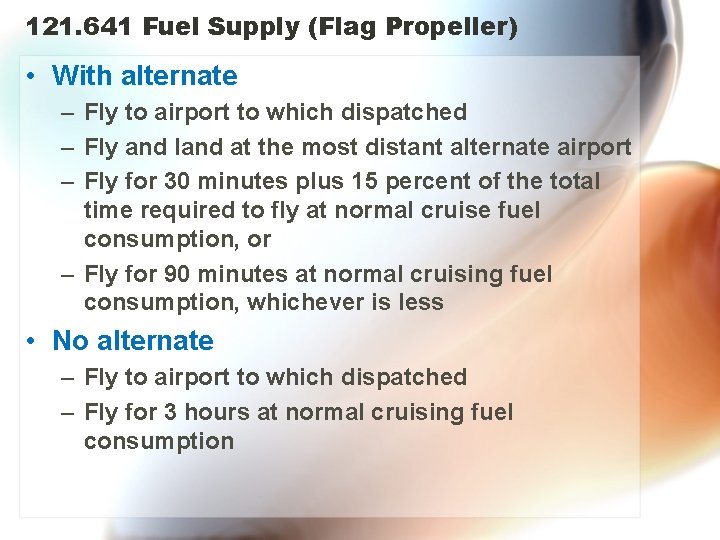
121. 641 Fuel Supply (Flag Propeller) • With alternate – Fly to airport to which dispatched – Fly and land at the most distant alternate airport – Fly for 30 minutes plus 15 percent of the total time required to fly at normal cruise fuel consumption, or – Fly for 90 minutes at normal cruising fuel consumption, whichever is less • No alternate – Fly to airport to which dispatched – Fly for 3 hours at normal cruising fuel consumption
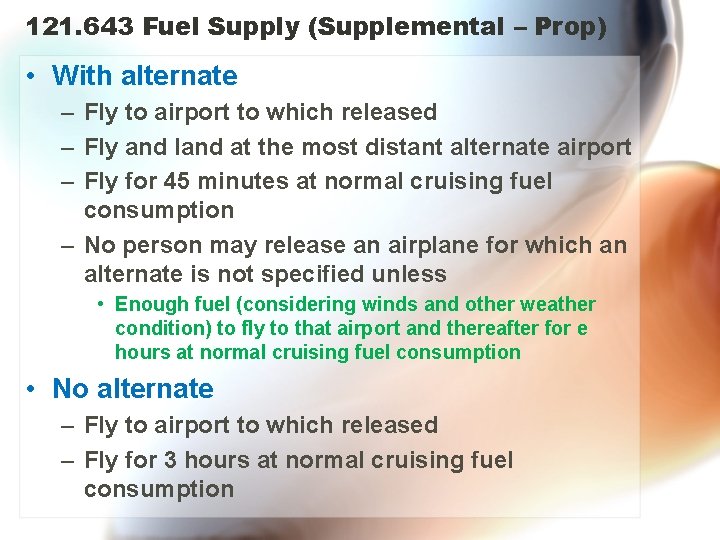
121. 643 Fuel Supply (Supplemental – Prop) • With alternate – Fly to airport to which released – Fly and land at the most distant alternate airport – Fly for 45 minutes at normal cruising fuel consumption – No person may release an airplane for which an alternate is not specified unless • Enough fuel (considering winds and other weather condition) to fly to that airport and thereafter for e hours at normal cruising fuel consumption • No alternate – Fly to airport to which released – Fly for 3 hours at normal cruising fuel consumption
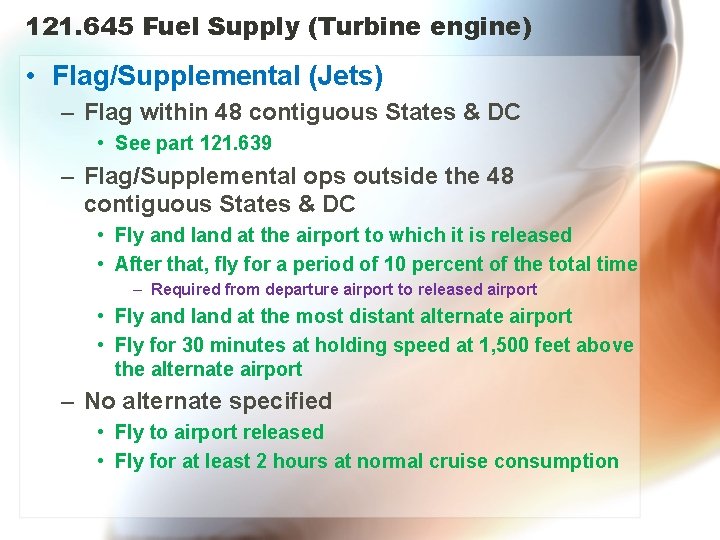
121. 645 Fuel Supply (Turbine engine) • Flag/Supplemental (Jets) – Flag within 48 contiguous States & DC • See part 121. 639 – Flag/Supplemental ops outside the 48 contiguous States & DC • Fly and land at the airport to which it is released • After that, fly for a period of 10 percent of the total time – Required from departure airport to released airport • Fly and land at the most distant alternate airport • Fly for 30 minutes at holding speed at 1, 500 feet above the alternate airport – No alternate specified • Fly to airport released • Fly for at least 2 hours at normal cruise consumption
121. 645 Fuel Supply (Turbine engine) • Flag/Supplemental (Jets) – Supplemental ops with 48 contiguous States/DC • Part 121. 643 apply
121. 647 Factors for computing fuel required • Factors – Wind/other conditions forecast – Anticipated traffic delays – One instrument approach and possible missed approach at destination – Other conditions that may delay landing
121. 649 Takeoff/Landing Minimums/VFR • Domestic – Cannot takeoff or land under VFR unless • Day operations – 1, 000 foot ceiling and 1 -mile visibility • Night operations – 1, 000 foot ceiling and 2 -mile visibility
121. 651 Takeoff/Landing Minimums/IFR • All certificate holders – Takeoff • Weather conditions reports must be equal to or above those specified in Ops Specs, or • Nothing in Ops Specs – Follow Parts 91 and 97 – No pilot may continue an approach past the final approach fix • An approved weather source issues weather report for that airport • Within United States, territories, military airports – Visibility - Equal to or greater than visibility minimums prescribed for that procedure
121. 652 Landing Weather Minimums/IFR • All certificate holders – PIC (High mins Captain) • Not served 100 as PIC in type aircraft • MDA/DH increased by 100 feet and visibility increased by ½ mile • Never lower than 300 -1 – Credit flight hours • Up to 50 percent – Operations under part 135 as PIC • PIC with at least 100 hours of another type aircraft – Substitute 1 landing in operations under this part for 1 hour required PIC experience (up to 50 percent)
121. 655 Applicability of reported wx mins • Ceiling and visibility values – Latest weather report • VFR or IFR takeoffs/landing and instrument approach procedures • All runways of an airport – Visibility value • Runway visibility or RVR for particular runway – This value controls VFR or IFR takeoffs/landings and straight-in instrument approaches for that runway over latest weather report
121. 663 Dispatch Release • Flag/Domestic – Dispatch release • PIC/dispatcher sign if they both believe flight can be made with safety – Dispatcher • Delegate authority to sign release • Cannot delegate authority to dispatch
121. 687 Dispatch Release • Flag/Domestic – Dispatch release contains • ID number of aircraft • Trip number • Departure airport, intermediate stops, destination airports, and alternate airports • Statement of type of operation (VFR/IFR) • Minimum fuel supply • ETOPS diversion time • Weather reports
121. 689 Flight Release • Supplemental – Flight release contains • • Company/organization name Flight/trip number Date of flight Name of each: – Flight crewmember – Flight attendant – Pilot designated as PIC • Departure airport, destination airports, and alternate airports, and route • Statement of type of operation (VFR/IFR) • Minimum fuel supply • ETOPS diversion time • Weather reports
121. 693 Load manifest • Load at takeoff time – Weight of • • Aircraft Fuel and oil Cargo and baggage Passengers and crewmembers – Maximum allowable weight for • Runway of intended use • Enroute performance limits • Maximum landing weight at destination and alternate – Total weight – Proof aircraft s loaded in accordance with an approved schedule – Names of passengers unless maintained by other means
121. 695 Disposition (Domestic/Flag) • PIC shall carry in plane: – Load manifest – Dispatch release – Flight plan • Certificate holder – Maintain copies for at least 3 months
121. 697 Disposition (Supplemental) • PIC shall carry in plane: – – – Load manifest Flight release Airworthiness release Pilot route certification Flight plan • Certificate holder – Maintain copies for at least 3 months