
Part 1 What is a Work Experience Placement
- Slides: 21
Part 1 What is a Work Experience Placement? �Takes place at a worksite �Without the direct supervision of a teacher �You are in Year 10 �A limited length of time (1 Week) �Formal arrangement between parents/caregivers, you, the school and the work placement provider �You receive no payment
Essential Learnings before Work Placement Legislation and Guidelines i. iii. iv. Work Health and Safety Act 2012 Equal Opportunity Act 1984 Children’s Protection Act 1993 Prohibited Work Placements But what do these Acts and Guidelines actually say?
Work Health and Safety Act 2012 �The Act defines students on work placement as workers �The work placement provider has the same responsibility for you as they do for all their workers �You must take every reasonable care to: i. Avoid adversely affecting the health or safety of yourself ii. Avoid adversely affecting the health or safety of any other person This could be by doing something or not doing something
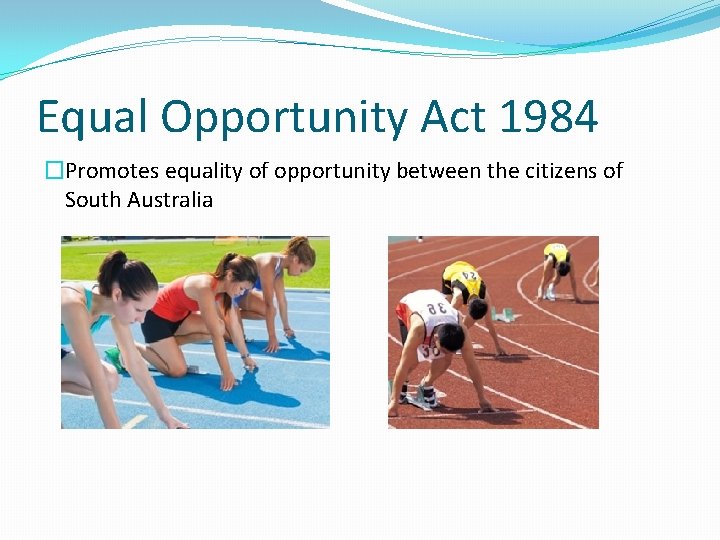
Equal Opportunity Act 1984 �Promotes equality of opportunity between the citizens of South Australia
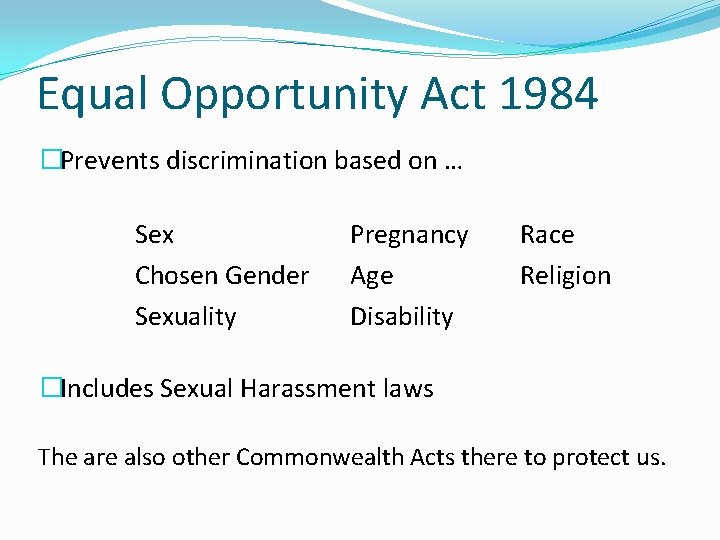
Equal Opportunity Act 1984 �Prevents discrimination based on … Sex Chosen Gender Sexuality Pregnancy Age Disability Race Religion �Includes Sexual Harassment laws The are also other Commonwealth Acts there to protect us.
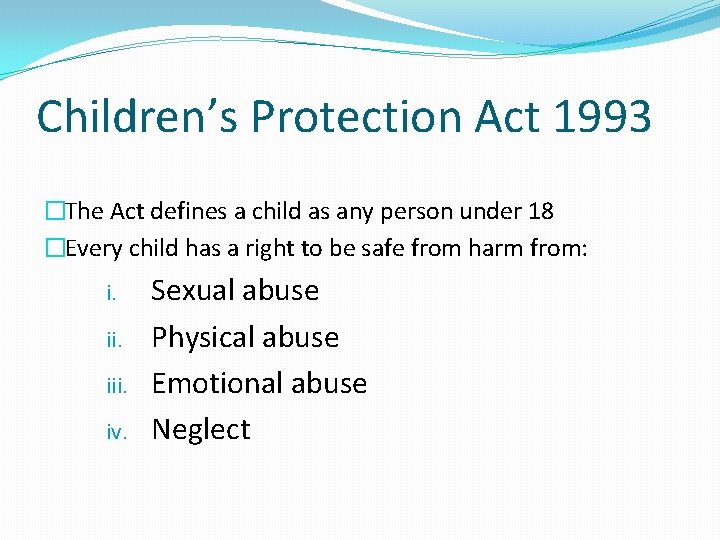
Children’s Protection Act 1993 �The Act defines a child as any person under 18 �Every child has a right to be safe from harm from: i. iii. iv. Sexual abuse Physical abuse Emotional abuse Neglect
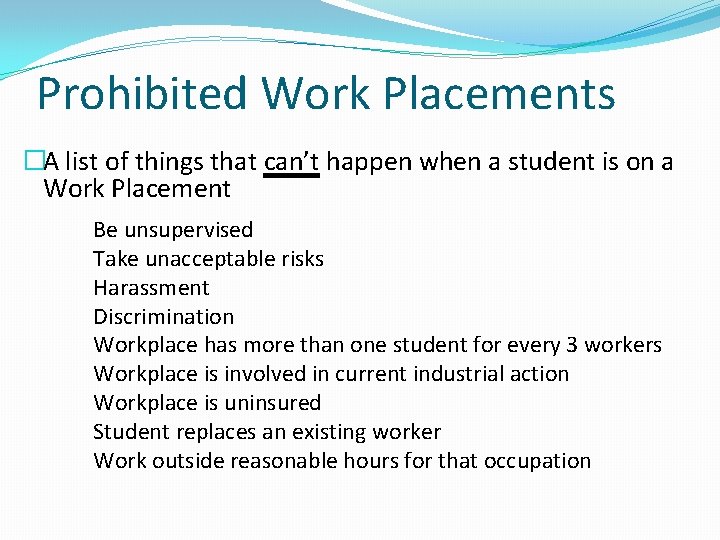
Prohibited Work Placements �A list of things that can’t happen when a student is on a Work Placement Be unsupervised Take unacceptable risks Harassment Discrimination Workplace has more than one student for every 3 workers Workplace is involved in current industrial action Workplace is uninsured Student replaces an existing worker Work outside reasonable hours for that occupation
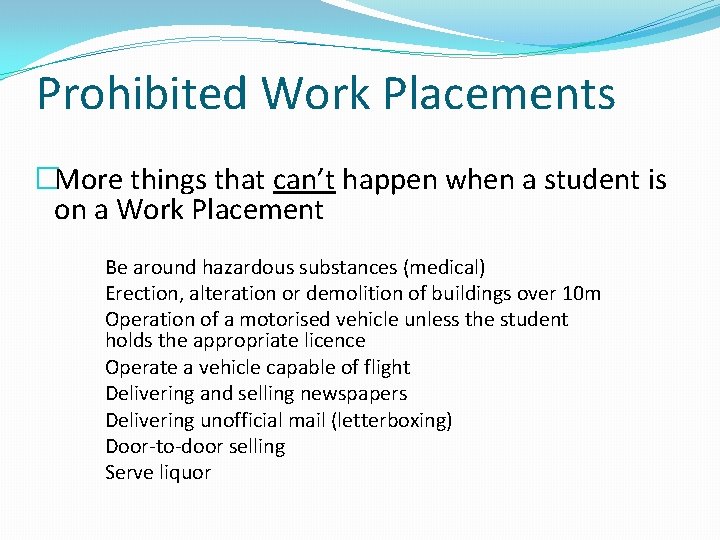
Prohibited Work Placements �More things that can’t happen when a student is on a Work Placement Be around hazardous substances (medical) Erection, alteration or demolition of buildings over 10 m Operation of a motorised vehicle unless the student holds the appropriate licence Operate a vehicle capable of flight Delivering and selling newspapers Delivering unofficial mail (letterboxing) Door-to-door selling Serve liquor
Essential Learnings before Work Placement �Duty of Care �Legislation and Guidelines i. Work Health and Safety Act 2012 ii. Equal Opportunity Act 1984 iii. Children’s Protection Act 1993 iv. Prohibited Work Placements But how can we try to ensure that your work placement complies with these essential learnings?
Is your workplace safe for you? �Ensure the workplace provider is aware of their obligations under all the Acts and Guidelines �Ensure the workplace provider understands that they must provide a child safe environment and what that looks like in their particular business �Ensure the workplace provider signs the Workplace Learning Agreement form to show that they comply �Ensure parents/caregivers understand roles and responsibilities
Is your workplace safe for you? �Ensure that you understand your rights and responsibilities and your school’s commitment to a child safe environment �Ensure that you have been prepared for work placement (these lessons, for example) �Ensure that you know what to do if you feel unsafe or something goes wrong (phone number and who to contact)
ACTIVITIES Let’s look at some activities to help explain Work Health and Safety (WHS), Equal Opportunities and Worker’s Rights
Part 2 Essential Learnings before Work Placement �Legislation and Guidelines i. Work Health and Safety Act 2012 ii. Equal Opportunity Act 1984 iii. Children’s Protection Act 1993 iv. Prohibited Work Placements But how do we know that you understand these Essential Learnings?
Case Study Scenarios Let’s practice … You will have a few different scenarios to read and then you need to answer the same 4 questions for each scenario.
Workplace Learning Useful Information �Use the cheat sheet to jog your memory �Add your own notes to build up a bank of ideas �Be thinking about things that could happen �Before the incident – preventative �At the time of the incident – immediate �After the incident – support or other actions
Case Study Scenario Questions 1. Identify the act, law or guideline that may have been breached and explain in what ways it may have been breached. 2. Explain the employer/workplace provider/PCBU rights and responsibilities in the situation. 3. Explain the employee/worker’s rights and responsibilities in the situation. 4. Suggest strategies - explain what action the individual should or could take. What should they do? Who could they talk to? Who should they inform? Consider : (a) preventative strategies, (b) immediate strategies, (c) any further actions or support strategies
Practice Case Study Scenario 1 JASON Jason was participating in work experience at a printing press operating one of the machines. His supervisor vaguely mentioned that whenever the machine started rolling Jason needed to “adjust it back and feel the rollers”. As he attempted to operate the machine and “feel the rollers” his hand became trapped, crushing his fingers and thumb and damaging his wrist. He required micro-surgery to extract a portion of hip to replace the damaged bone. Acknowledgement to Safe. Work SA for this scenario.
Practice Case Study Scenario 2 MICHELLE Michelle organised work experience in a hotel kitchen. She was carrying a box of potato peelings across a floor that had just been mopped. As she was walking past a fat fryer she slipped and as she reached out to steady herself she plunged her arm into the hot oil. She sustained full thickness burns to her hand arm and further burns to her face due to splashing oil. Acknowledgement to Safe. Work SA for this scenario.
Practice Case Study Scenario 5 ALEXIS Alexis is 16 years old and on work placement at a local radio station. Her supervisor there, Mark, asks her questions like “do you have a boyfriend? ” and “have you ever been out with an older guy? ” He insists that Alexis gives him her mobile number “for WHS reasons” and sends her messages at work and after work. The messages include personal comments like “you are looking gorgeous today” and “what are you doing after work tonight? ” Acknowledgement to Safe. Work SA for this scenario.
Practice Case Study Scenario 6 DREW Drew is 17 and lives with his Mum who is disabled. During his work placement he receives a text message from his Mum so he calls her to reassure her that he will be home soon. Another worker finds out and tells the supervisor who calls a meeting for the whole team. In front of the group, Drew’s work placement supervisor tells him off for making a call during work time and then says he needs to “toughen up” and not be such a “Mummy’s boy” because “no one likes a baby”.
Summative Case Study Scenarios Now time for the real thing … �You need to complete 4 Case Study Scenarios – At least one must be for a Work Experience Student �Complete the Scenario Work Sheets �Make sure that you put YOUR name on each answer sheet �Put the number and name of each scenario you are given on the answer sheet �Give as much information as possible to show that you understand the scenario