
Part 1 Water Cycle and Ground Water Add




- Slides: 54
Part 1: Water Cycle and Ground Water Add the Yellow words to your note packet.
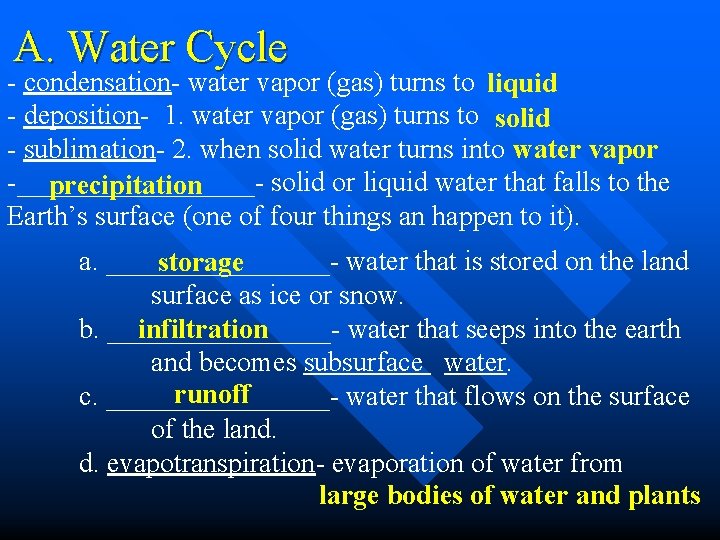
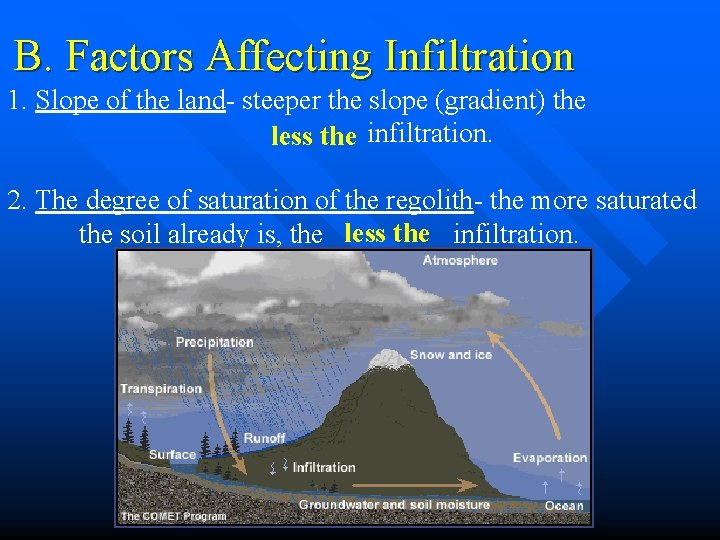
A. Water Cycle - condensation- water vapor (gas) turns to liquid - deposition- 1. water vapor (gas) turns to solid - sublimation- 2. when solid water turns into water vapor -_________- solid or liquid water that falls to the precipitation Earth’s surface (one of four things an happen to it). a. ________- water that is stored on the land storage surface as ice or snow. b. ________- water that seeps into the earth infiltration and becomes subsurface water. runoff c. ________- water that flows on the surface of the land. d. evapotranspiration- evaporation of water from large bodies of water and plants
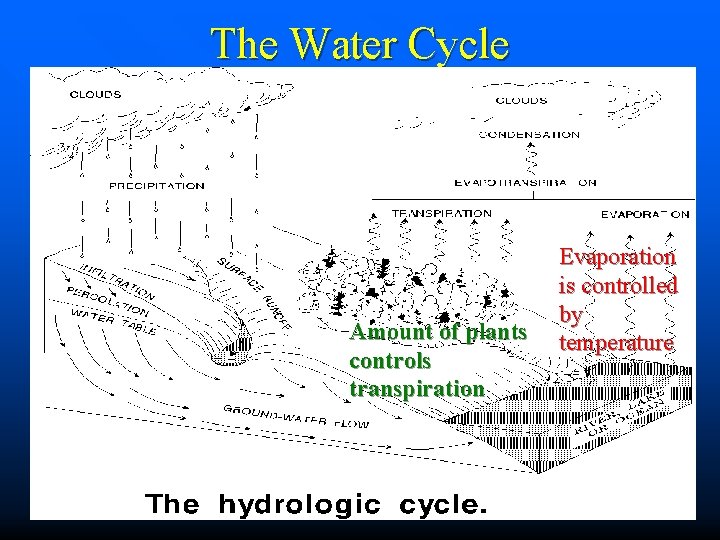
The Water Cycle Amount of plants controls transpiration Evaporation is controlled by temperature
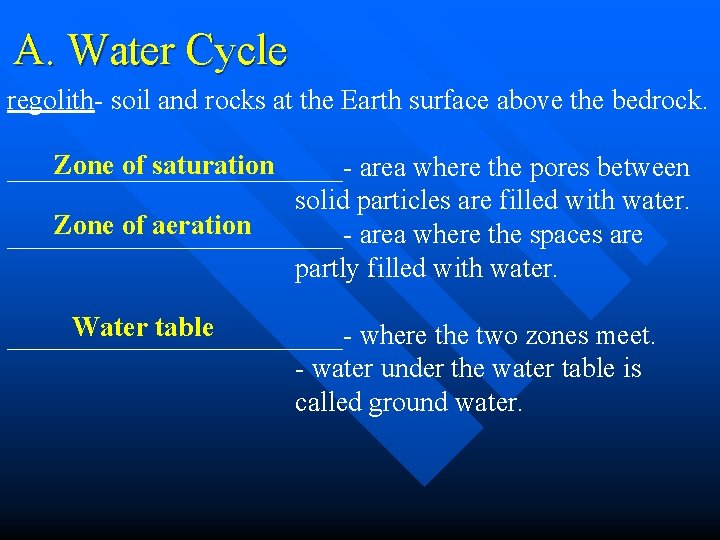
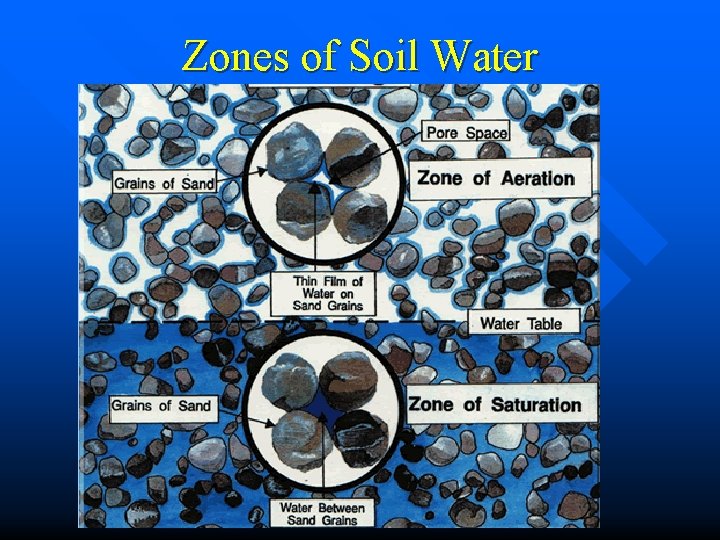
A. Water Cycle regolith- soil and rocks at the Earth surface above the bedrock. Zone of saturation ____________- area where the pores between solid particles are filled with water. Zone of aeration ____________- area where the spaces are partly filled with water. Water table ____________- where the two zones meet. - water under the water table is called ground water.
Zones of Soil Water
B. Factors Affecting Infiltration 1. Slope of the land- steeper the slope (gradient) the less the infiltration. 2. The degree of saturation of the regolith- the more saturated the soil already is, the less the infiltration.
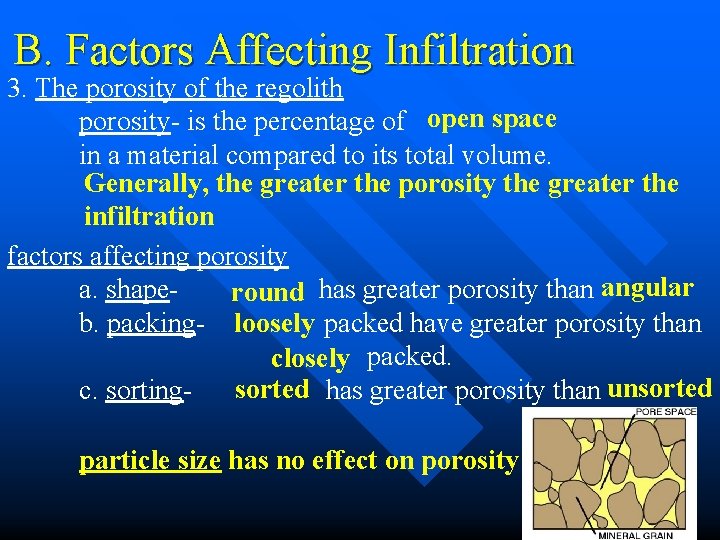
B. Factors Affecting Infiltration 3. The porosity of the regolith open space porosity- is the percentage of in a material compared to its total volume. Generally, the greater the porosity the greater the infiltration factors affecting porosity angular a. shape- has greater porosity than round loosely b. packing- packed have greater porosity than closely packed. unsorted c. sorting- has greater porosity than particle size has no effect on porosity
B. Factors Affecting Infiltration permeability 4. _________- the ability of a material to allow fluids, such as water, to pass through it. - permeability rate- the speed at which fluids will flow through a material. - a material can be porous but impermeable (not permeable), if the spaces aren’t connected due to tight packing or cemented particles - If soil is loosely packed the the size of the larger soil particles the faster the permeability rate.
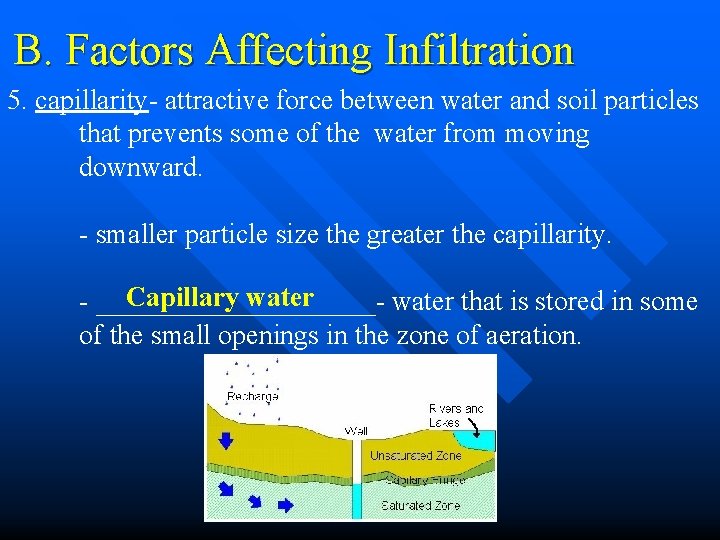
B. Factors Affecting Infiltration 5. capillarity- attractive force between water and soil particles that prevents some of the water from moving downward. - smaller particle size the greater the capillarity. Capillary water - __________- water that is stored in some of the small openings in the zone of aeration.
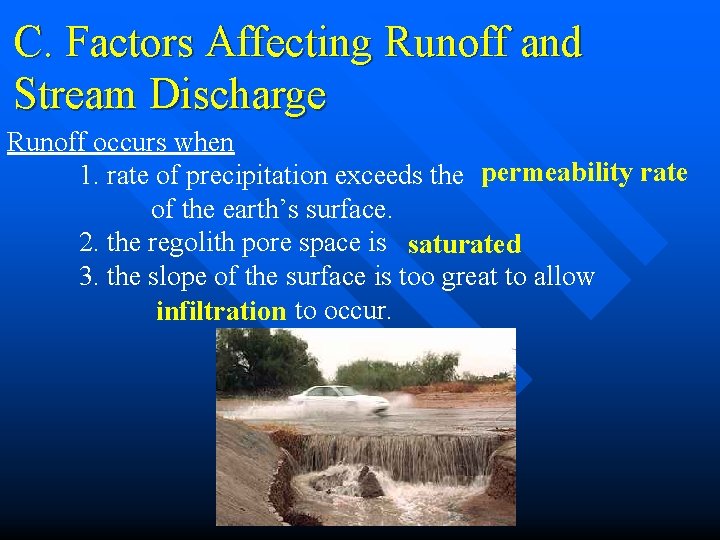
C. Factors Affecting Runoff and Stream Discharge Runoff occurs when 1. rate of precipitation exceeds the permeability rate of the earth’s surface. 2. the regolith pore space is saturated 3. the slope of the surface is too great to allow infiltration to occur.
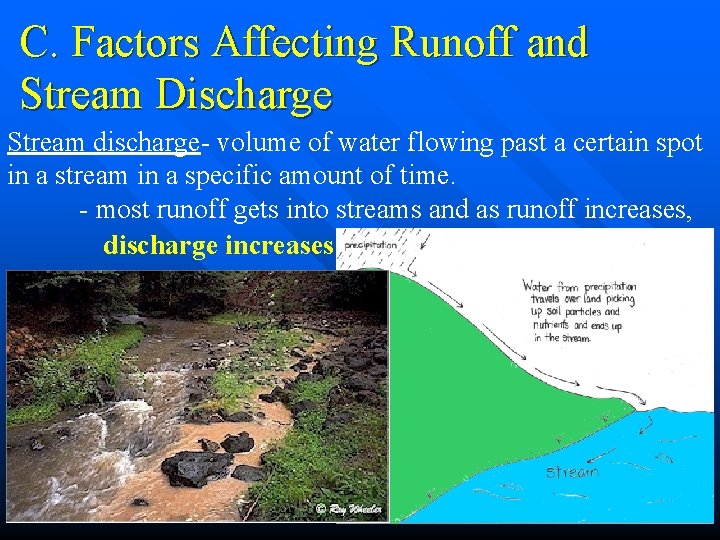
C. Factors Affecting Runoff and Stream Discharge Stream discharge- volume of water flowing past a certain spot in a stream in a specific amount of time. - most runoff gets into streams and as runoff increases, discharge increases
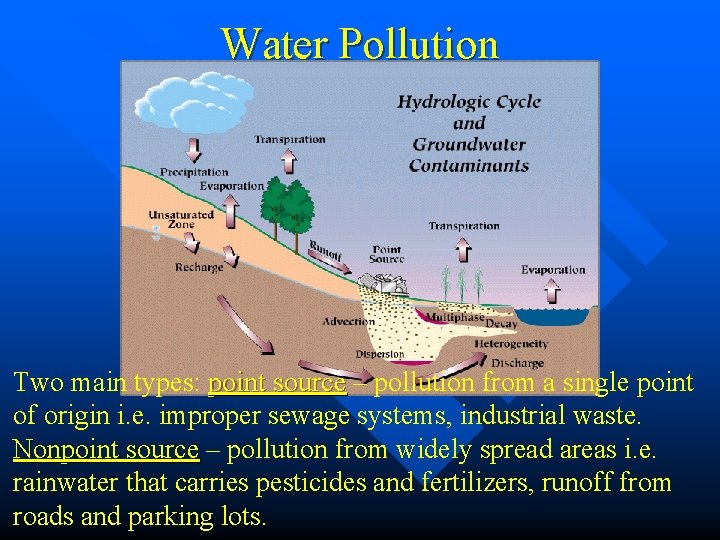
Water Pollution Two main types: point source – pollution from a single point source of origin i. e. improper sewage systems, industrial waste. Nonpoint source – pollution from widely spread areas i. e. rainwater that carries pesticides and fertilizers, runoff from roads and parking lots.
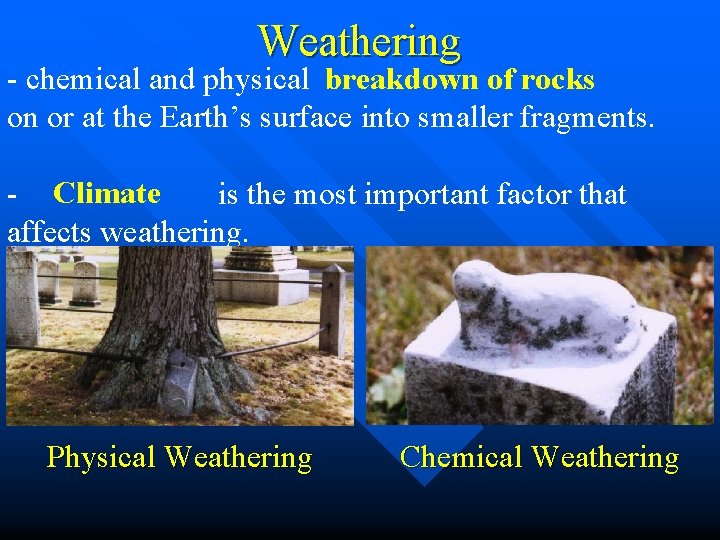
Weathering - chemical and physical breakdown of rocks on or at the Earth’s surface into smaller fragments. Climate - is the most important factor that affects weathering. Physical Weathering Chemical Weathering
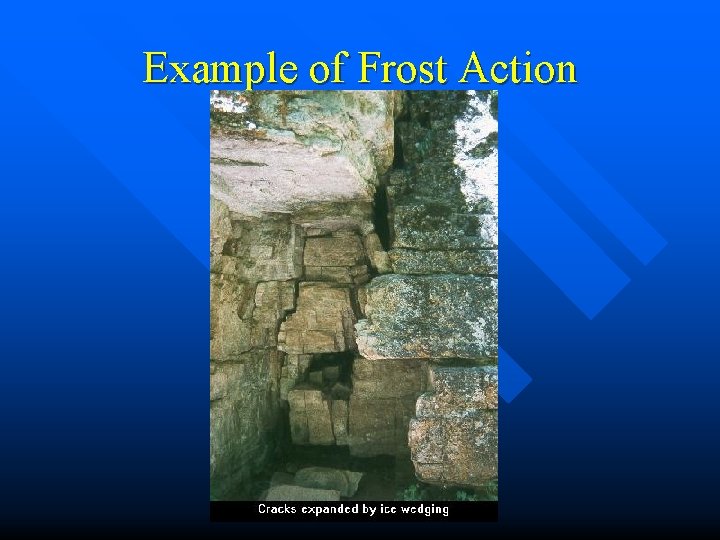
A. Physical Weathering - occurs when rock is cracked, split, or broken into smaller pieces called ________. sediments - sediments are classified by size. (boulders, cobbles, pebbles, sand, silt, clay, colloids, and dissolved particles) 1. _________- breakup of rocks by freezing Frost Action and thawing of water. - water molecule expands by 20% as it freezes
Example of Frost Action
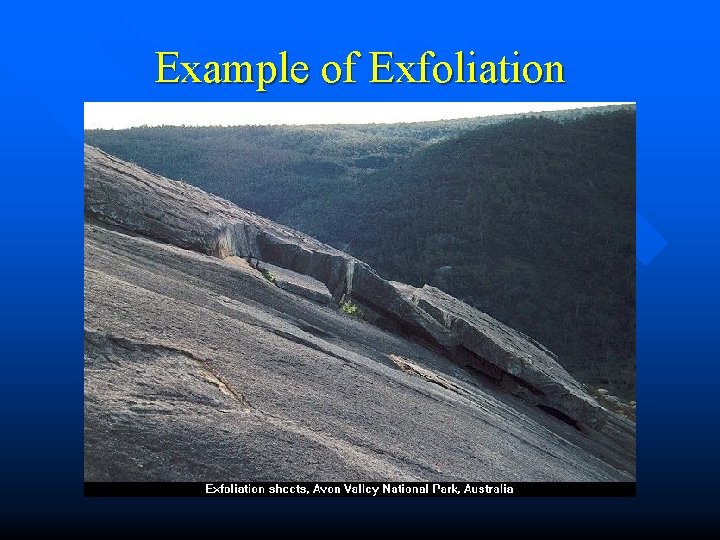
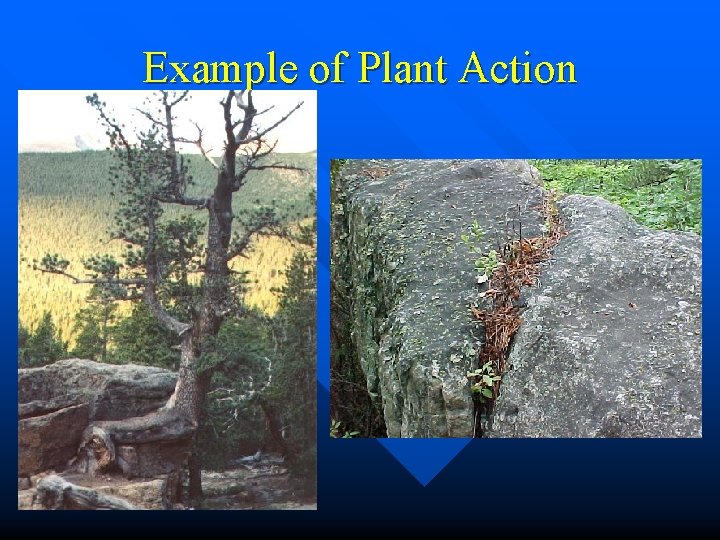
A. Physical Weathering abrasion 2. _________- physical wearing down of rocks as they rub or bounce against each other. -dry windy areas, under glaciers, stream channels. 3. _________- peeling away of large sheets exfoliation of loosened material at the surface of a rock. 4. plant roots rocks. split the Called plant action
Example of Exfoliation
Example of Plant Action
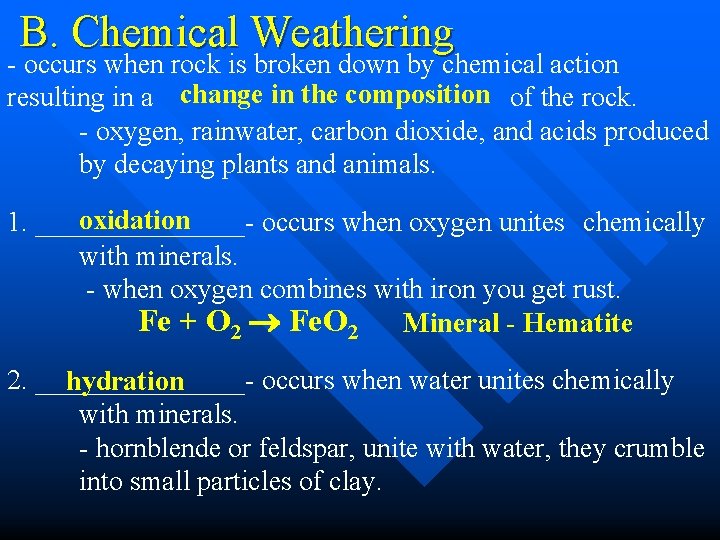
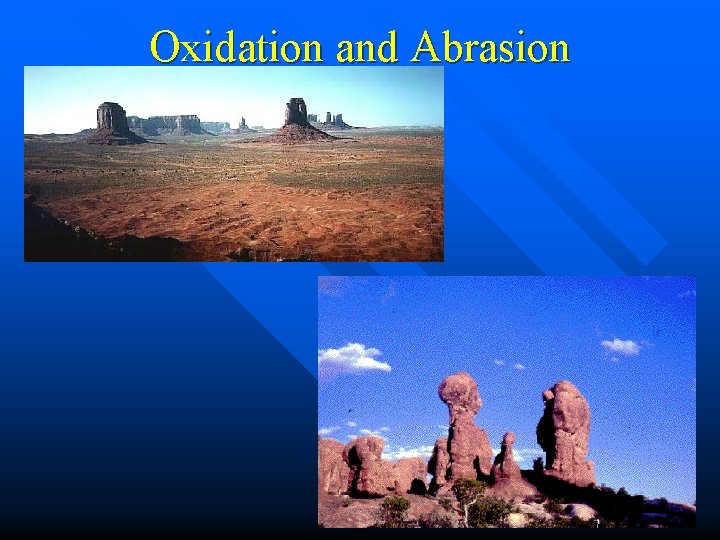
B. Chemical Weathering - occurs when rock is broken down by chemical action change in the composition resulting in a of the rock. - oxygen, rainwater, carbon dioxide, and acids produced by decaying plants and animals. oxidation 1. ________- occurs when oxygen unites chemically with minerals. - when oxygen combines with iron you get rust. Fe + O 2 Fe. O 2 Mineral - Hematite 2. ________- occurs when water unites chemically hydration with minerals. - hornblende or feldspar, unite with water, they crumble into small particles of clay.
Oxidation and Abrasion
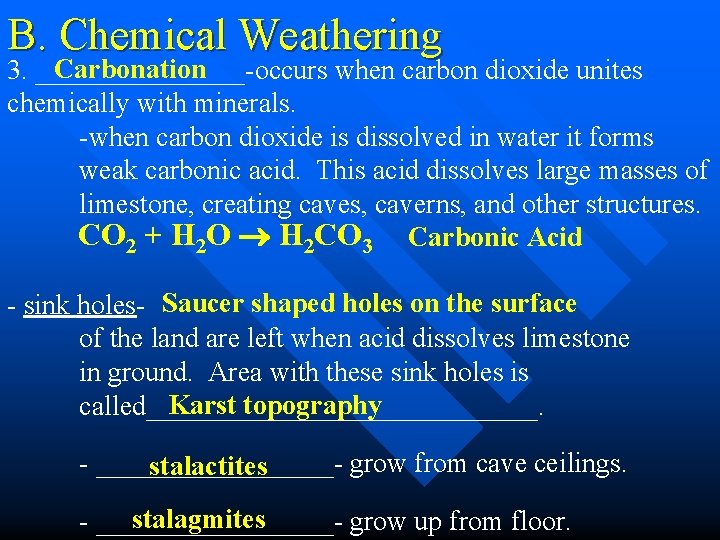
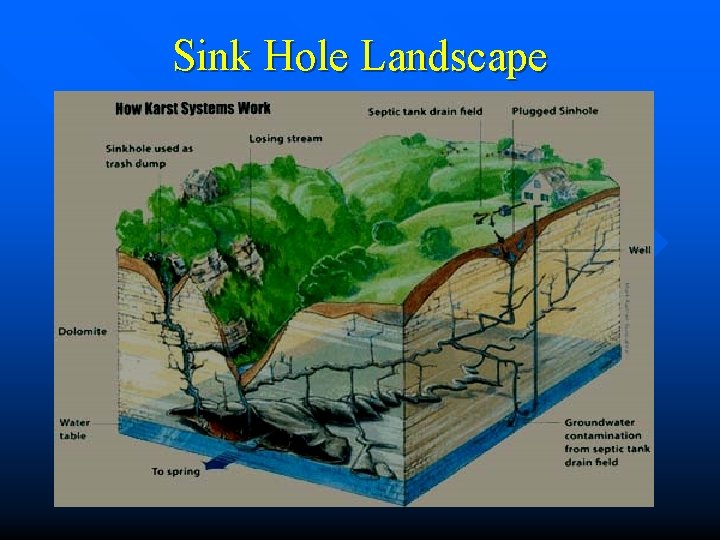
B. Chemical Weathering Carbonation 3. ________-occurs when carbon dioxide unites chemically with minerals. -when carbon dioxide is dissolved in water it forms weak carbonic acid. This acid dissolves large masses of limestone, creating caves, caverns, and other structures. CO 2 + H 2 O H 2 CO 3 Carbonic Acid - sink holes- Saucer shaped holes on the surface of the land are left when acid dissolves limestone in ground. Area with these sink holes is Karst topography called______________. - _________- grow from cave ceilings. stalactites stalagmites - _________- grow up from floor.
Sink Hole Landscape
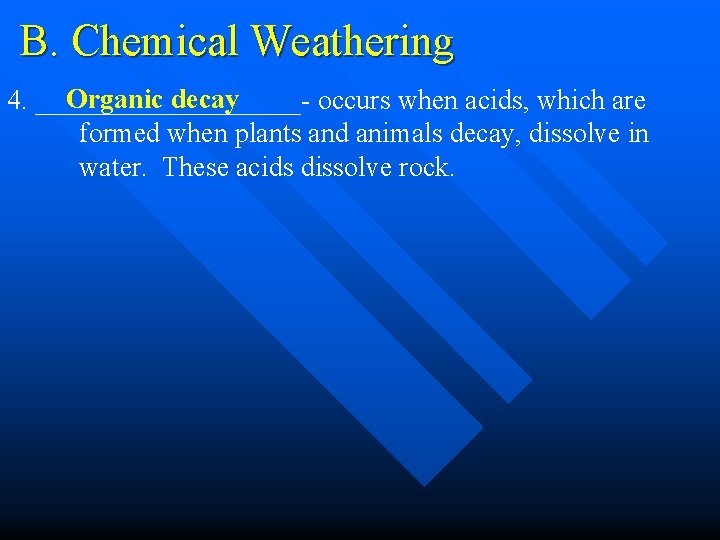
B. Chemical Weathering Organic decay 4. __________- occurs when acids, which are formed when plants and animals decay, dissolve in water. These acids dissolve rock.
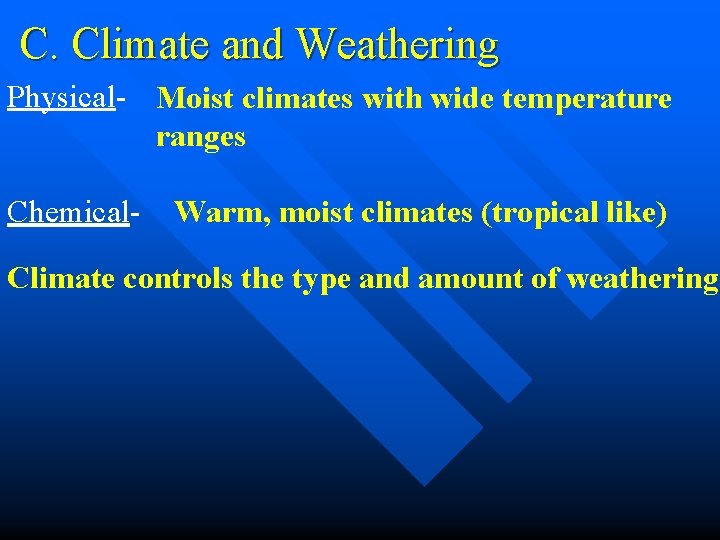
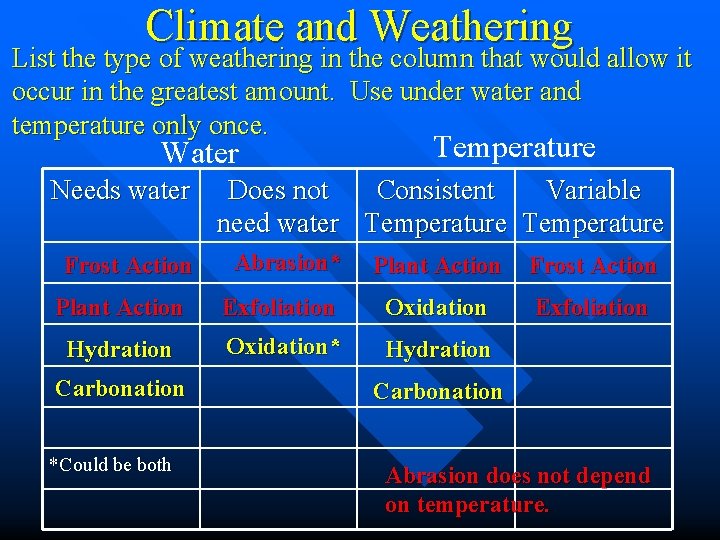
C. Climate and Weathering Physical- Moist climates with wide temperature ranges Chemical- Warm, moist climates (tropical like) Climate controls the type and amount of weathering
Climate and Weathering List the type of weathering in the column that would allow it occur in the greatest amount. Use under water and temperature only once. Water Needs water Frost Action Temperature Does not Consistent Variable need water Temperature Abrasion* Plant Action Frost Action Exfoliation Plant Action Exfoliation Oxidation Hydration Oxidation* Hydration Carbonation *Could be both Carbonation Abrasion does not depend on temperature.
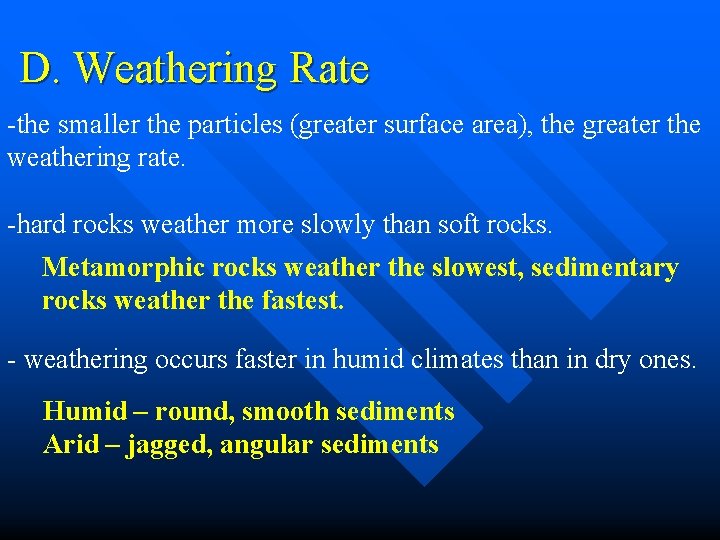
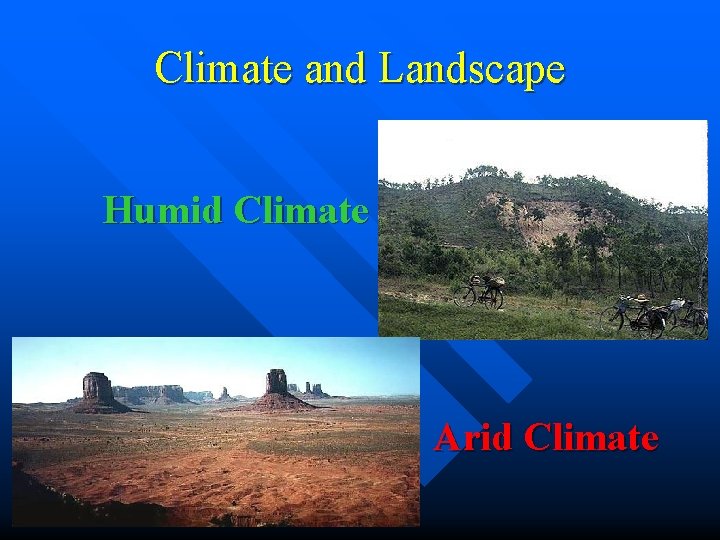
D. Weathering Rate -the smaller the particles (greater surface area), the greater the weathering rate. -hard rocks weather more slowly than soft rocks. Metamorphic rocks weather the slowest, sedimentary rocks weather the fastest. - weathering occurs faster in humid climates than in dry ones. Humid – round, smooth sediments Arid – jagged, angular sediments
Climate and Landscape Humid Climate Arid Climate
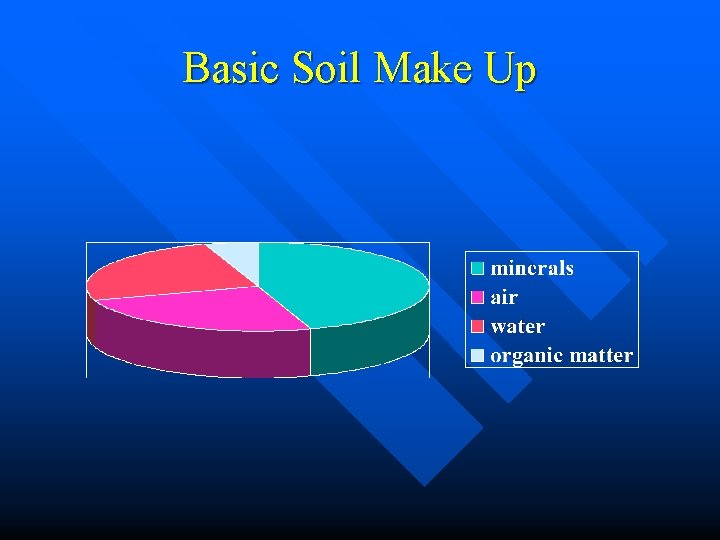
II Soils -part of the weathered regolith in which rooted plants will grow. - made of pieces of , and rocks minerals organic matter residual soil- soil formed by weathering of the bedrock found beneath it Soil minerals same as bedrock minerals. transported soil- soil formed from rocks that were moved to their present locations Soil minerals (different from bedrock).
Basic Soil Make Up
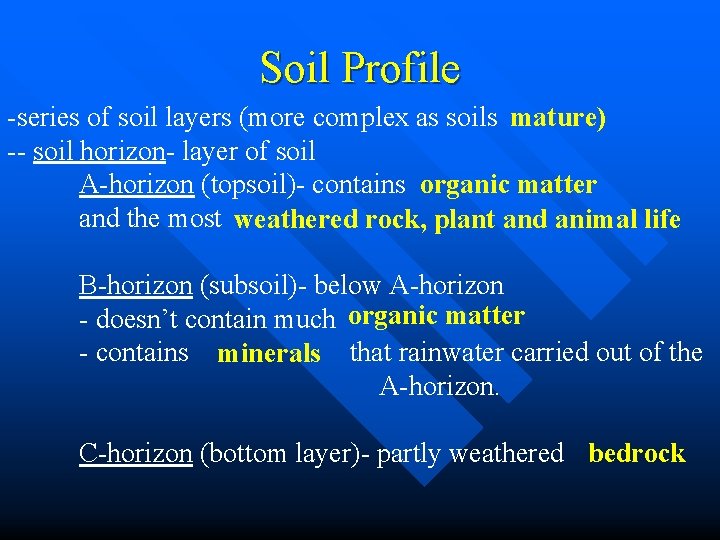
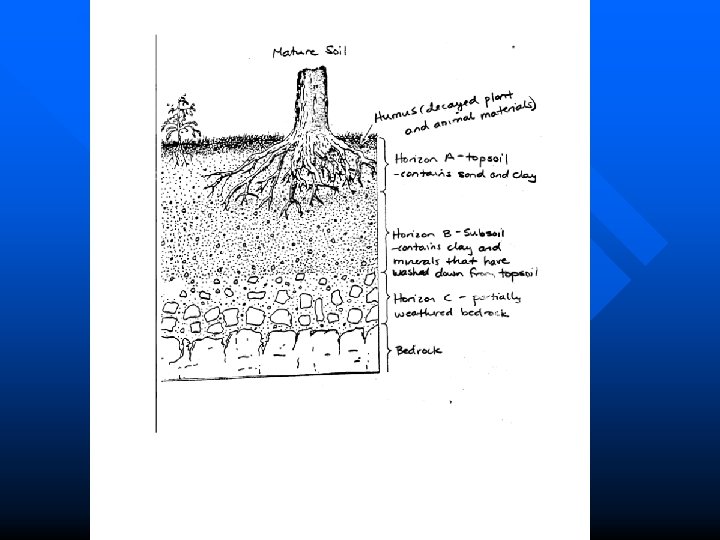
Soil Profile -series of soil layers (more complex as soils mature) -- soil horizon- layer of soil organic matter A-horizon (topsoil)- contains and the most weathered rock, plant and animal life B-horizon (subsoil)- below A-horizon - doesn’t contain much organic matter - contains that rainwater carried out of the minerals A-horizon. C-horizon (bottom layer)- partly weathered bedrock
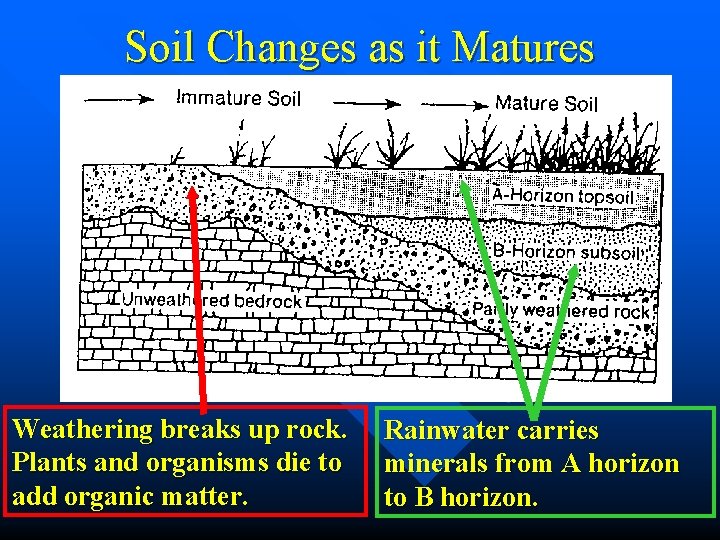
Soil Changes as it Matures Weathering breaks up rock. Plants and organisms die to add organic matter. Rainwater carries minerals from A horizon to B horizon.
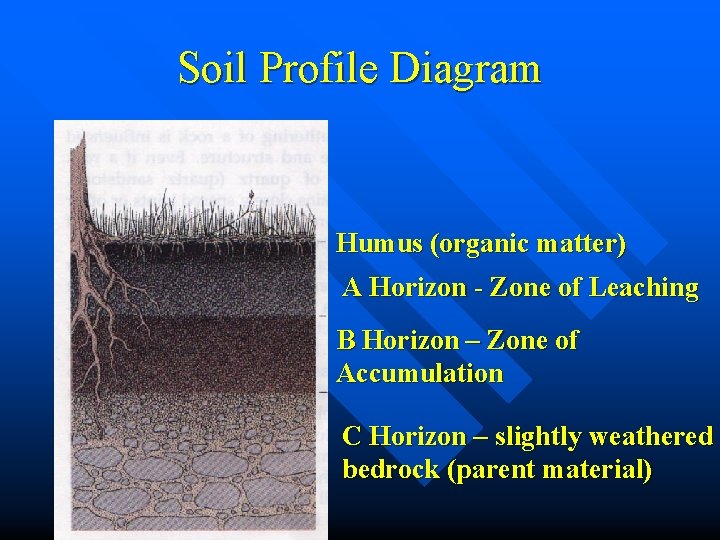
Soil Profile Diagram Humus (organic matter) A Horizon - Zone of Leaching B Horizon – Zone of Accumulation C Horizon – slightly weathered bedrock (parent material)
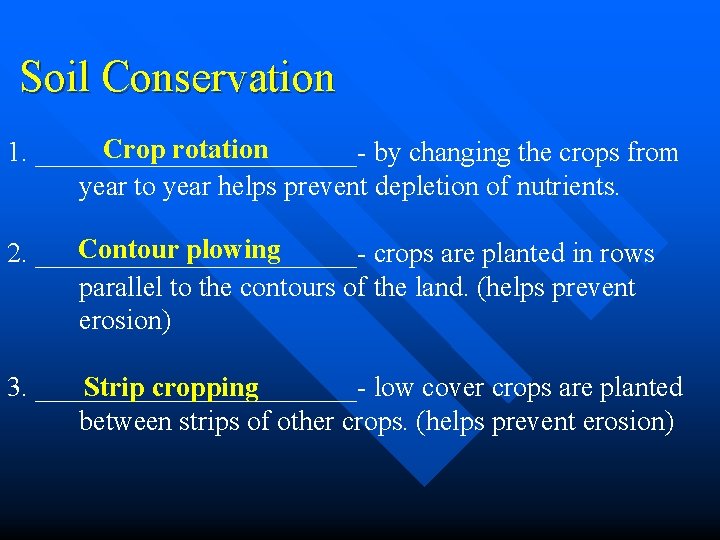
Soil Conservation Crop rotation 1. ____________- by changing the crops from year to year helps prevent depletion of nutrients. Contour plowing 2. ____________- crops are planted in rows parallel to the contours of the land. (helps prevent erosion) Strip cropping 3. ____________- low cover crops are planted between strips of other crops. (helps prevent erosion)
Soil Conservation Terracing 4. __________- series of steps cut into a hill. (helps prevent erosion) Windbreaks 5. ____________- belts of trees along the edge of farming areas. (helps prevent erosion by wind)
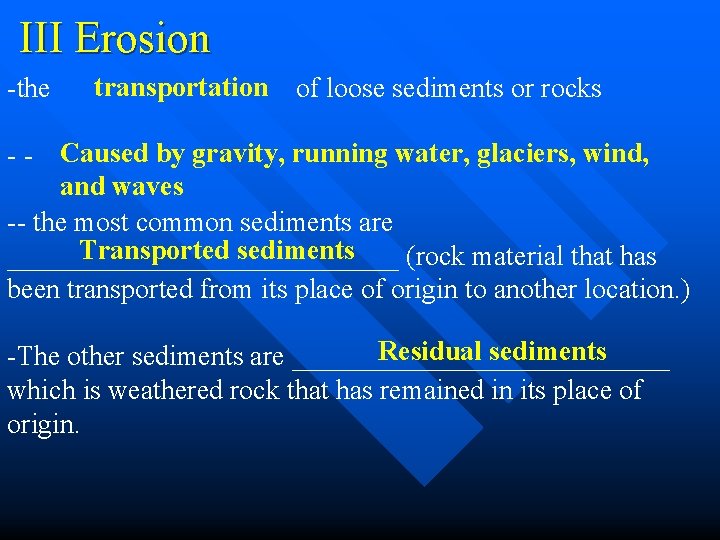
III Erosion transportation -the of loose sediments or rocks - - Caused by gravity, running water, glaciers, wind, and waves -- the most common sediments are Transported sediments ______________ (rock material that has been transported from its place of origin to another location. ) Residual sediments -The other sediments are ______________ which is weathered rock that has remained in its place of origin.
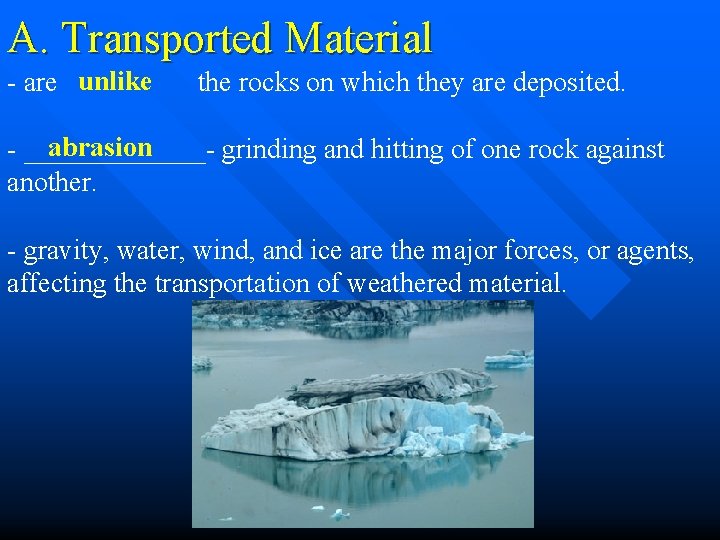
A. Transported Material unlike - are the rocks on which they are deposited. abrasion - _______- grinding and hitting of one rock against another. - gravity, water, wind, and ice are the major forces, or agents, affecting the transportation of weathered material.
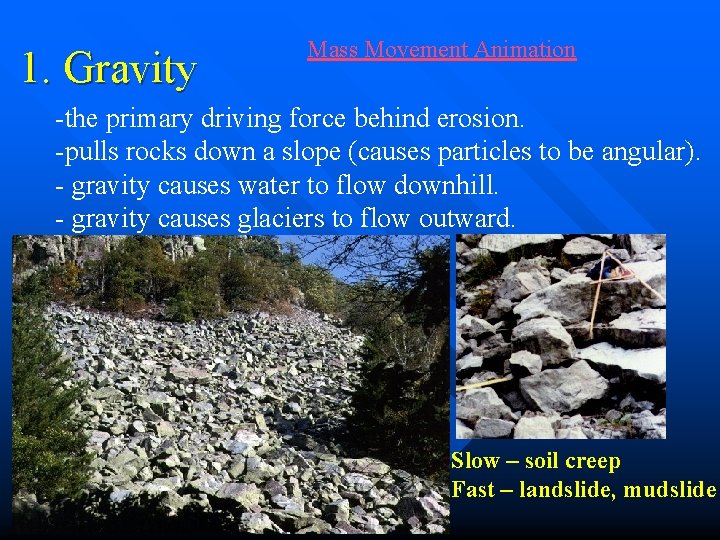
1. Gravity Mass Movement Animation -the primary driving force behind erosion. -pulls rocks down a slope (causes particles to be angular). - gravity causes water to flow downhill. - gravity causes glaciers to flow outward. Slow – soil creep Fast – landslide, mudslide
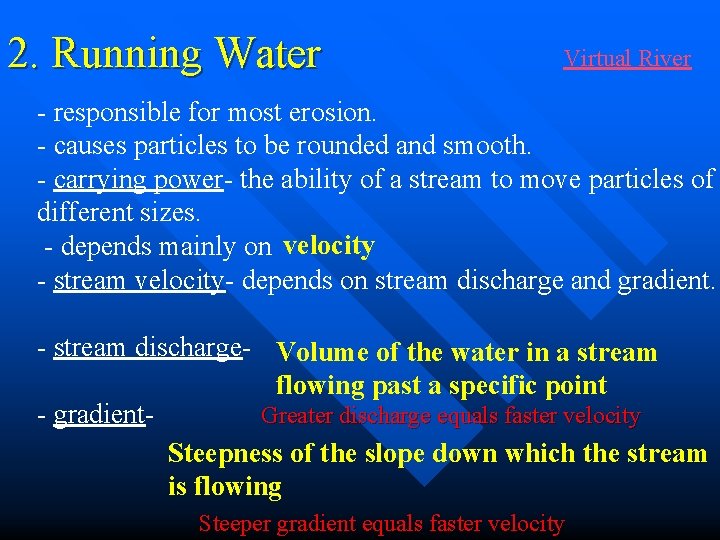
2. Running Water Virtual River - responsible for most erosion. - causes particles to be rounded and smooth. - carrying power- the ability of a stream to move particles of different sizes. - depends mainly on velocity - stream velocity- depends on stream discharge and gradient. - stream discharge- Volume of the water in a stream flowing past a specific point Greater discharge equals faster velocity - gradient. Steepness of the slope down which the stream is flowing Steeper gradient equals faster velocity
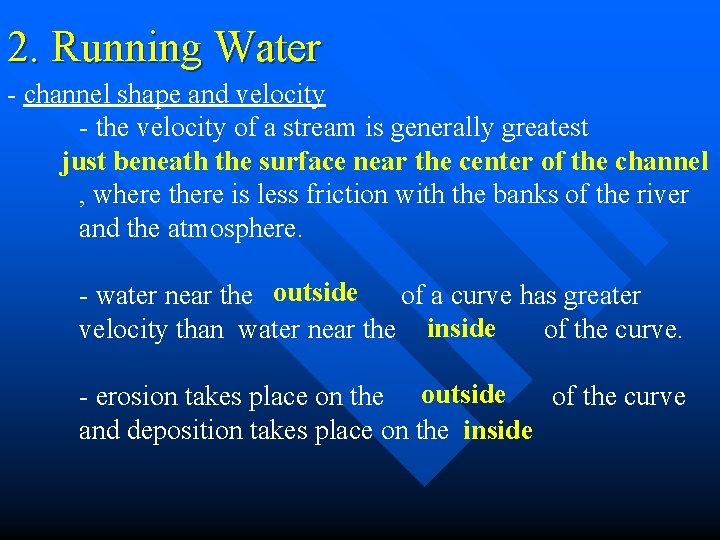
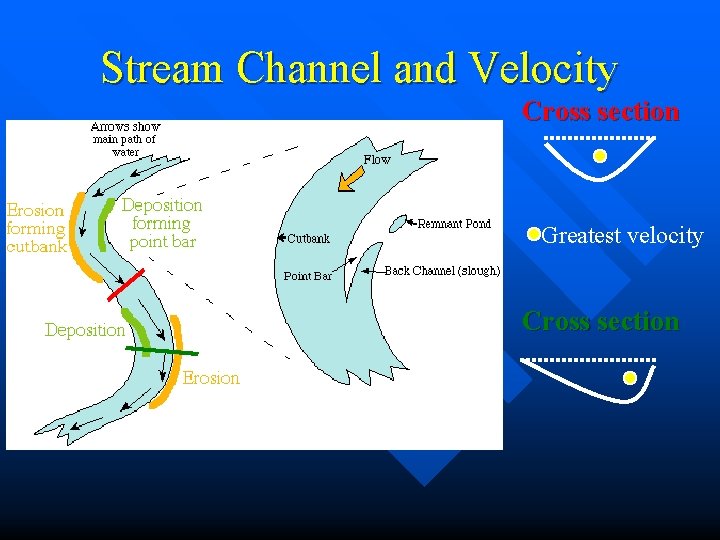
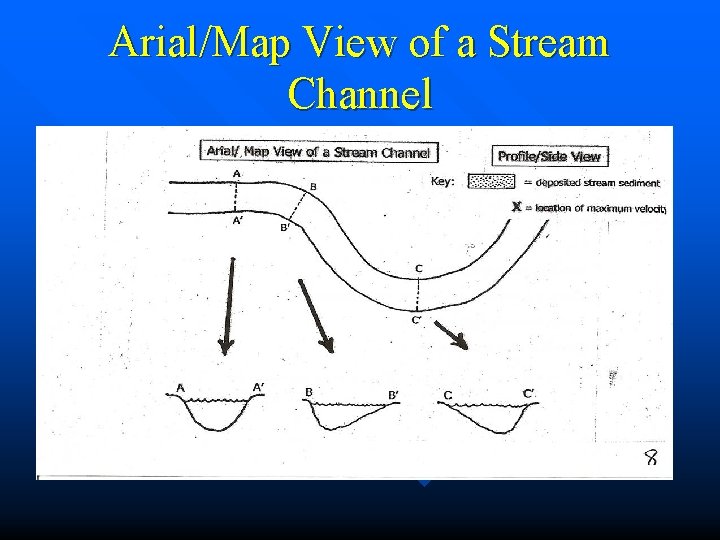
2. Running Water - channel shape and velocity - the velocity of a stream is generally greatest just beneath the surface near the center of the channel , where there is less friction with the banks of the river and the atmosphere. outside - water near the of a curve has greater inside velocity than water near the of the curve. outside - erosion takes place on the of the curve and deposition takes place on the inside
Stream Channel and Velocity Cross section Greatest velocity Cross section
Arial/Map View of a Stream Channel
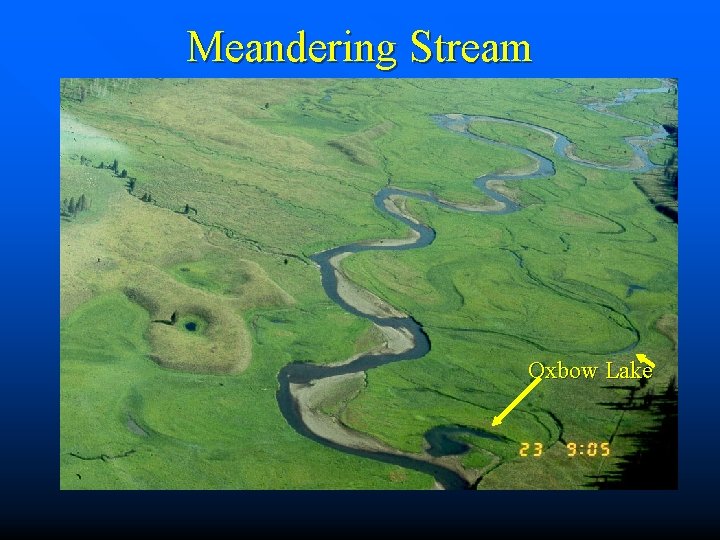
Meandering Stream Oxbow Lake
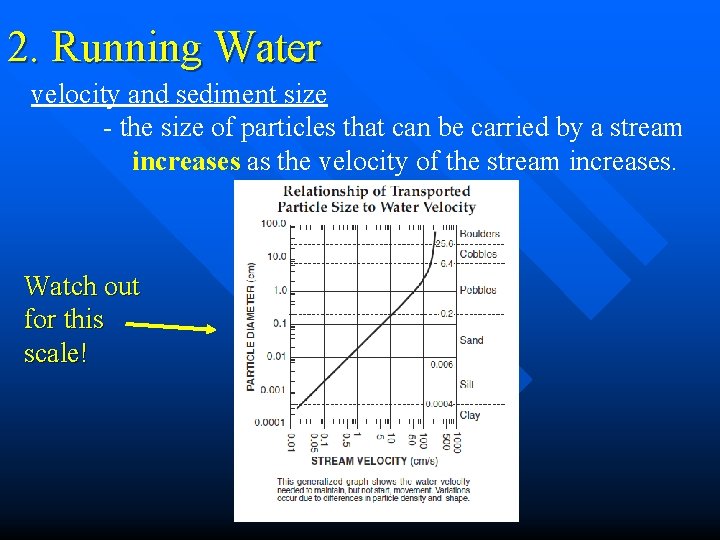
2. Running Water velocity and sediment size - the size of particles that can be carried by a stream increases as the velocity of the stream increases. Watch out for this scale!
2. Running Water stream load - material carried by a stream. 1. Dissolved particles in solution. 2. fine sediments of clay, silt, and colloids in suspension _________. 3. larger sand pebbles that are , bounced rolled pushed , or along the stream Called bed load bed.
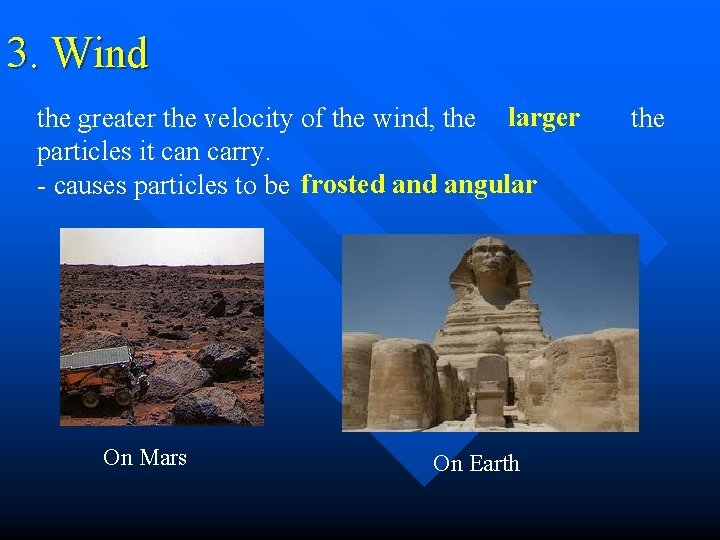
3. Wind larger the greater the velocity of the wind, the the particles it can carry. - causes particles to be frosted angular On Mars On Earth
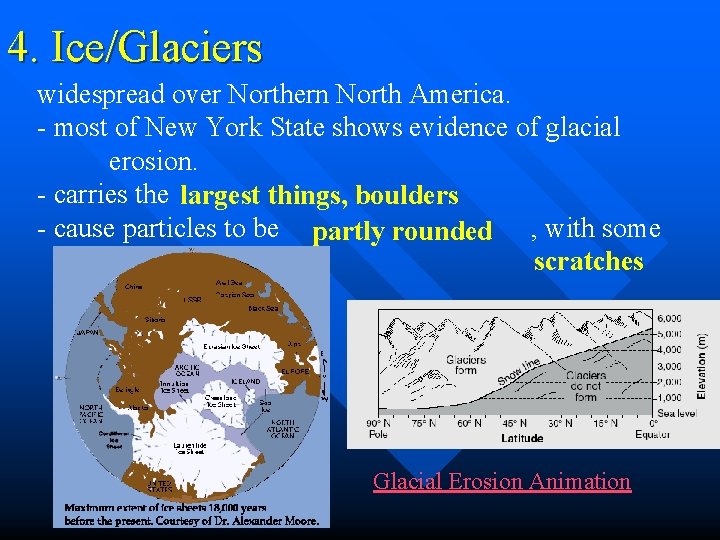
4. Ice/Glaciers widespread over Northern North America. - most of New York State shows evidence of glacial erosion. - carries the largest things, boulders - cause particles to be , with some partly rounded scratches Glacial Erosion Animation
Glacial Features
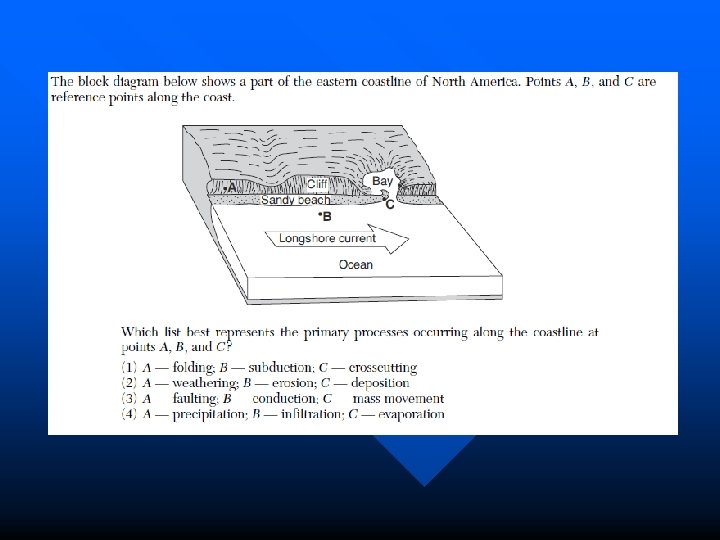
Wave Action -Erosion and deposition cause changes in shoreline features, including beaches, sandbars, , and barrier islands. Wave action rounds sediments as a result of abrasion. -Waves approaching a shoreline move sand parallel to the shore within the zone of breaking waves.
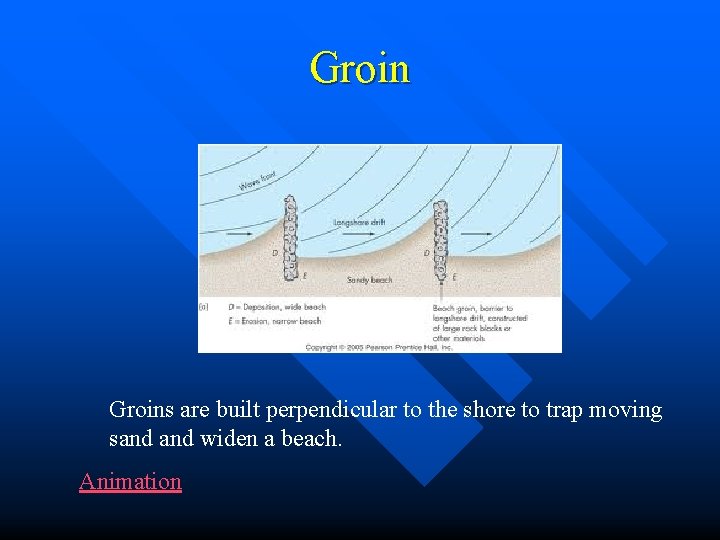
Longshore Drift Longshore drift is the movement of sediment parallel to the shore as waves strike the shoreline at an angle. Jetties- rock walls designed to protect the entrance of a harbor from sediment deposition and storm waves. Groins- walls built to protect beaches that are losing sand from longshore drifting.
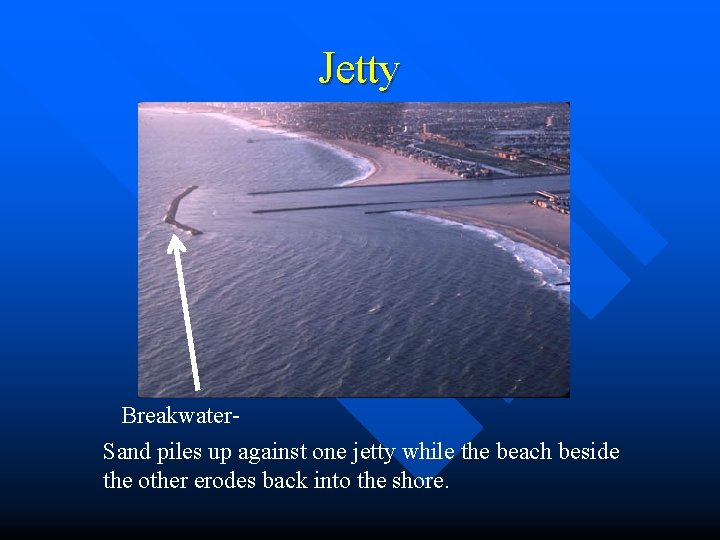
Jetty Breakwater- Sand piles up against one jetty while the beach beside the other erodes back into the shore.
Groins are built perpendicular to the shore to trap moving sand widen a beach. Animation
Beach Erosion Beautiful vacation home, or costly death trap?