
PART 1 They all day swimming and sunbathing


PART 1
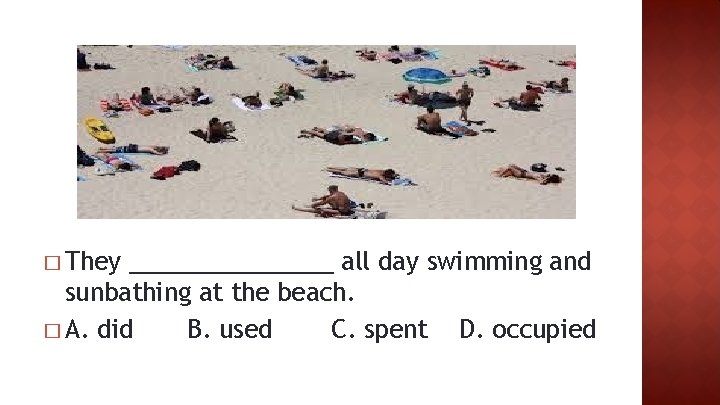
� They ________ all day swimming and sunbathing at the beach. � A. did B. used C. spent D. occupied
� What �a does it involve? 200 word article � 12 gaps in the article � multi-choice � 10 answers A, B, C or D for each gap minutes to do Part One
� 5 collocations (e. g. a brief glimpse) � 4 vocabulary questions, especially words with similar meaning but different uses (e. g. advantage, benefit, gain, profit) � 1 -2 phrasal verbs (e. g. bring about) � 0 -1 preposition combinations (e. g. keen on, interested in) � 0 -1 linking words (e. g. although, despite)
� Collocations are words which typically go together. For example we typically "admire a painting" as opposed to "watch". Learning to recognize and adopt the use of collocations helps people learning English as a foreign language to make their written English easier to read.
� http: //www. autoenglish. org/FCEUse/Colloca tions. List. pdf � http: //www. autoenglish. org/FCEUse/Colloca tions. Exercise. htm � http: //www. autoenglish. org/trickywords/Do and. Make. Exercise. htm

� https: //www. youtube. com/watch? v=mf. GSc. P Ka 1 GE

� http: //www. tinyteflteacher. co. uk/learning- english/FCE/practice-make-do. html
� These questions are about synonyms and words with a similar meaning but different use. � An example would be "recognise, recommend, remember and remind". � There are normally five questions like this. � Common questions include � job vs. work � remember vs. remind � travel vs. journey vs. trip
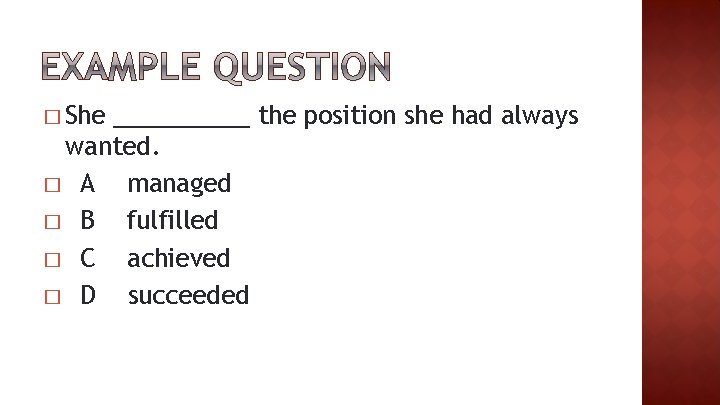
� She _____ the position she had always wanted. � A managed � B fulfilled � C achieved � D succeeded
� � � http: //www. autoenglish. org/FCEUse/Part 1 Vocabulary. Exer cise. htm Job Vs Work: http: //www. autoenglish. org/trickywords/Joband. Work. Exer cise. htm Remember vs. Remind http: //www. autoenglish. org/trickywords/Rememberand. Re mind. Exercise. htm Travel vs. Journey vs. Trip http: //www. autoenglish. org/trickywords/Traveland. Trip. Ex ercise. htm Extra Exercises http: //www. autoenglish. org/trickywords. htm
� Phrasal verbs are the combination of a verb with a preposition resulting in a big change in meaning e. g. "bring" means to take something with you whereas "bring about" means to make something happen. � They can be difficult to remember because their meanings are not clear from the words. � There are usually about 1 -2 phrasal verb questions
� The outbreak of disease was _____ by poor sanitary conditions. � A brought in � B brought out � C brought down � D brought about
� http: //www. autoenglish. org/phrasals/writin gphrasalverbs. htm � Specific Exercises: http: //www. autoenglish. org/picnic. htm
� Sometimes, we need to add prepositions on to the end of adjectives or verbs to make them connect in a sentence � There is usually at least 1 question like this on the test
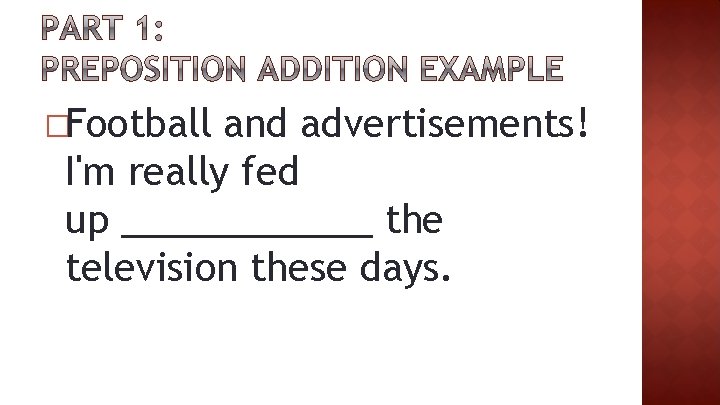
�Football and advertisements! I'm really fed up ______ the television these days.
�Adjectives http: //www. autoenglish. org/prepositions /Preposition. Adjective. Combinations. htm �Verbs http: //www. autoenglish. org/prepositions /Preposition. Verb. Combinations. htm
� When we worked with our writing, we did our best to add transition words/connectors. You may be asked to add these words to the passage as well. � This may or may not be on the test (usually about 1 question) � Common Linking Words �Although vs. Despite
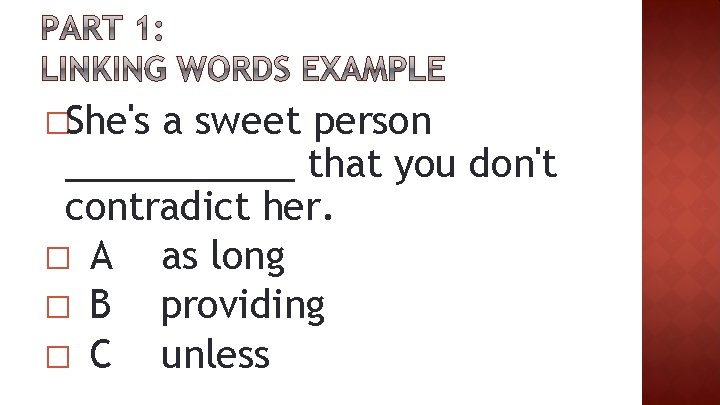
�She's a sweet person ______ that you don't contradict her. � A as long � B providing � C unless
� http: //www. autoenglish. org/generalgramma r/Connectors. Exercise. htm � http: //www. autoenglish. org/generalgramma r/Althoughand. Despite. Exercise. htm � http: //www. autoenglish. org/generalgramma r/Unless. Exercise. htm
�http: //www. autoenglish. org/FCEUse/Use of. English. Part 1. htm

PART 2
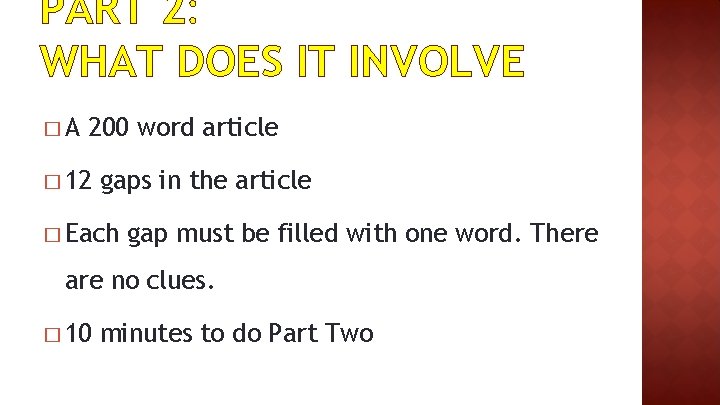
PART 2: WHAT DOES IT INVOLVE �A 200 word article � 12 gaps in the article � Each gap must be filled with one word. There are no clues. � 10 minutes to do Part Two

� https: //www. youtube. com/watch? v=0 Qx 0 GG ZA 2 t. Q
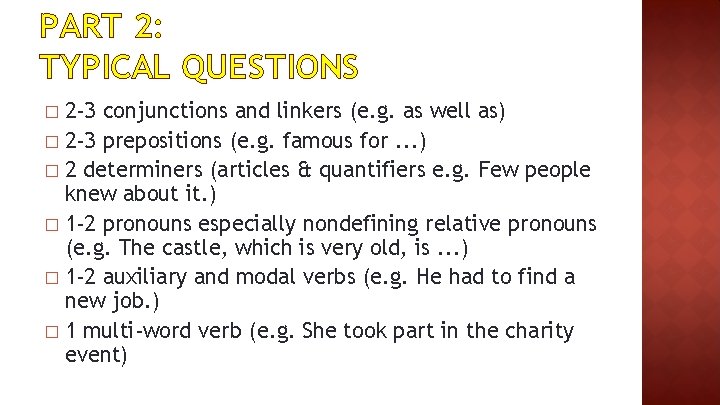
PART 2: TYPICAL QUESTIONS 2 -3 conjunctions and linkers (e. g. as well as) � 2 -3 prepositions (e. g. famous for. . . ) � 2 determiners (articles & quantifiers e. g. Few people knew about it. ) � 1 -2 pronouns especially nondefining relative pronouns (e. g. The castle, which is very old, is. . . ) � 1 -2 auxiliary and modal verbs (e. g. He had to find a new job. ) � 1 multi-word verb (e. g. She took part in the charity event) �
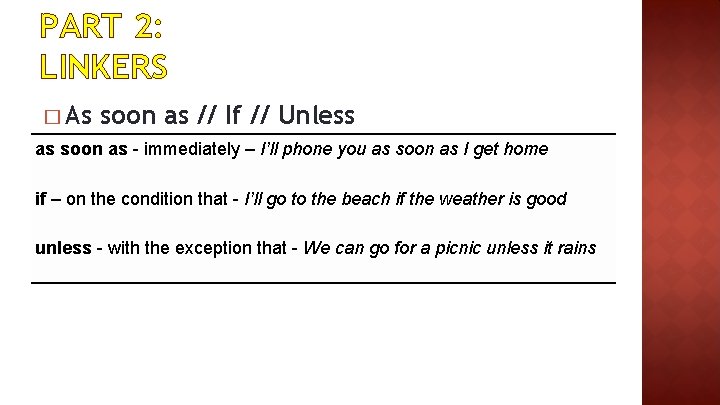
PART 2: LINKERS � As soon as // If // Unless as soon as - immediately – I’ll phone you as soon as I get home if – on the condition that - I’ll go to the beach if the weather is good unless - with the exception that - We can go for a picnic unless it rains
PART 2: LINKERS � http: //www. autoenglish. org/generalgramma r/Linkers. Exercise. htm � http: //www. autoenglish. org/generalgramma r/Assoonas. Exercise. htm � http: //www. autoenglish. org/generalgramma r/Purpose. Exercise. htm
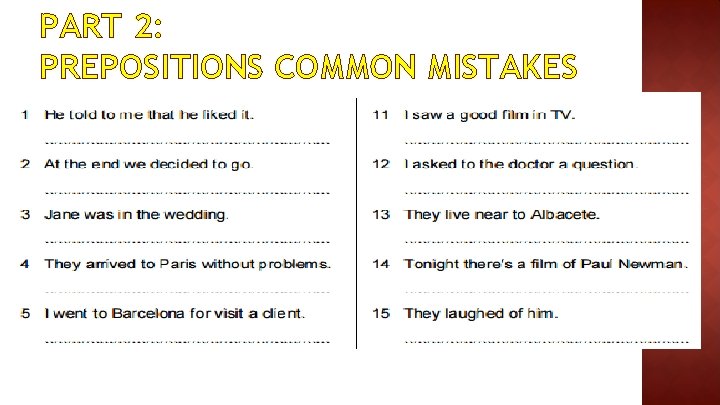
PART 2: PREPOSITIONS COMMON MISTAKES
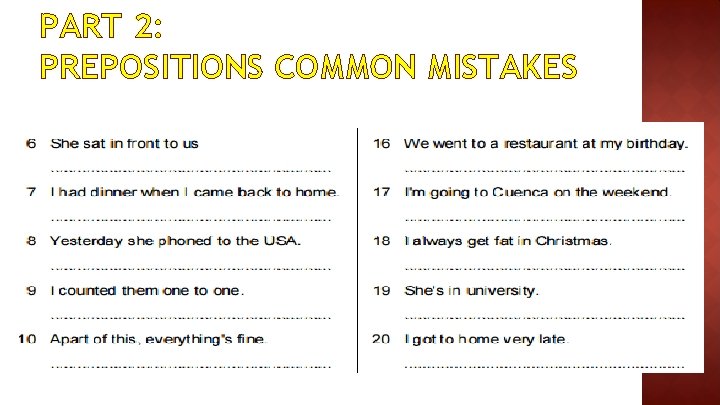
PART 2: PREPOSITIONS COMMON MISTAKES
PART 2: PREPOSITIONS � http: //www. autoenglish. org/prepositions/FC EPrepositions. htm � http: //www. autoenglish. org/prepositions. ht m
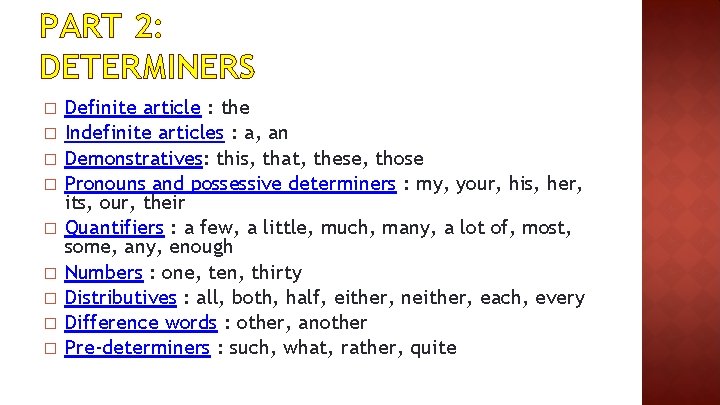
PART 2: DETERMINERS � � � � � Definite article : the Indefinite articles : a, an Demonstratives: this, that, these, those Pronouns and possessive determiners : my, your, his, her, its, our, their Quantifiers : a few, a little, much, many, a lot of, most, some, any, enough Numbers : one, ten, thirty Distributives : all, both, half, either, neither, each, every Difference words : other, another Pre-determiners : such, what, rather, quite
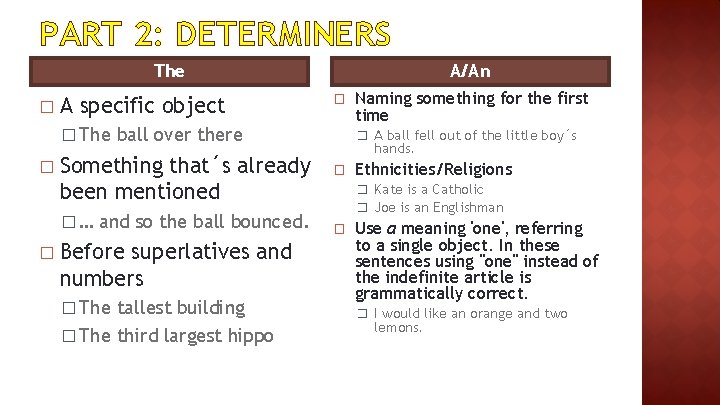
PART 2: DETERMINERS The � A specific object � The � � and so the ball bounced. Before superlatives and numbers � The � ball over there Something that´s already been mentioned �… A/An tallest building � The third largest hippo Naming something for the first time � A ball fell out of the little boy´s hands. � Ethnicities/Religions � Kate is a Catholic � Joe is an Englishman � Use a meaning 'one', referring to a single object. In these sentences using "one" instead of the indefinite article is grammatically correct. � I would like an orange and two lemons.
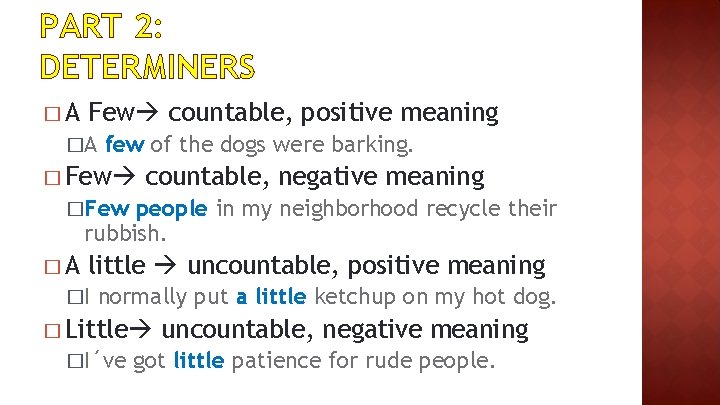
PART 2: DETERMINERS �A Few countable, positive meaning �A few of the dogs were barking. � Few countable, negative meaning �Few people in my neighborhood recycle their rubbish. �A little uncountable, positive meaning �I normally put a little ketchup on my hot dog. � Little �I´ve uncountable, negative meaning got little patience for rude people.
PART 2: DETERMINERS � http: //www. autoenglish. org/generalgramma r/Determiners. htm � http: //www. autoenglish. org/generalgramma r/Articles. Exercise. htm � http: //www. autoenglish. org/generalgramma r. htm
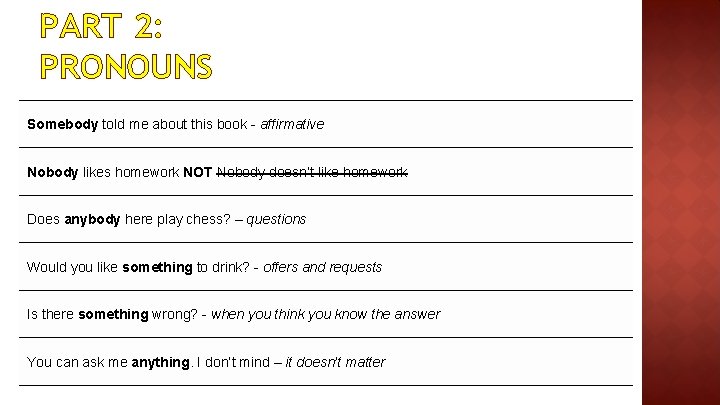
PART 2: PRONOUNS Somebody told me about this book - affirmative Nobody likes homework NOT Nobody doesn’t like homework Does anybody here play chess? – questions Would you like something to drink? - offers and requests Is there something wrong? - when you think you know the answer You can ask me anything. I don’t mind – it doesn’t matter
PART 2: PRONOUNS � http: //www. autoenglish. org/generalgramma r/FCEPronouns. htm � http: //www. autoenglish. org/generalgramma r/Indefinite. Pronouns. Exercise. htm
� The most frequently ocurring auxiliary and modal verbs to fill the gaps are WOULD and HAD (sometimes from the past perfect and sometimes from HAVE TO).
� http: //www. autoenglish. org/tenses/auxiliar ymodals. htm � http: //www. autoenglish. org/tenses/Past. Perf ect. htm � http: //www. autoenglish. org/tenses/con 2 pal. html � http: //www. autoenglish. org/modalverbs/Mo dals. Obligation. htm
� http: //www. flo- joe. com/fce/students/tests/oclts 2. htm � http: //www. autoenglish. org/listening/paella exercise. htm
- Slides: 40