
Part 1 Overview of SCube Part 2 Service
Part 1: Overview of S-Cube Part 2: Service engineering research in S-Cube and links with industrial use cases Part 3: Collaboration opportunities and wrap-up
Outline § Details on the S-Cube Integrated Research Framework § Research Areas – Service Engineering – Cross-layer Adaptation – End-to-end Quality Provision § Case studies: a methodological approach
Details on the IRF
S-Cube Integrated Research Framework § S-Cube focuses on long-term research § Main research focus: – Software service and systems – Adaptivity and evolution - of services - of agile service networks § S-Cube developed an Integrated Research Framework – 4 views on research issues § S-Cube evolved a methodology for case studies documentation
Integrated Research Framework Views § Conceptual Research Framework § Reference Life Cycle § Logical Run Time Architecture § Logical Design Environment
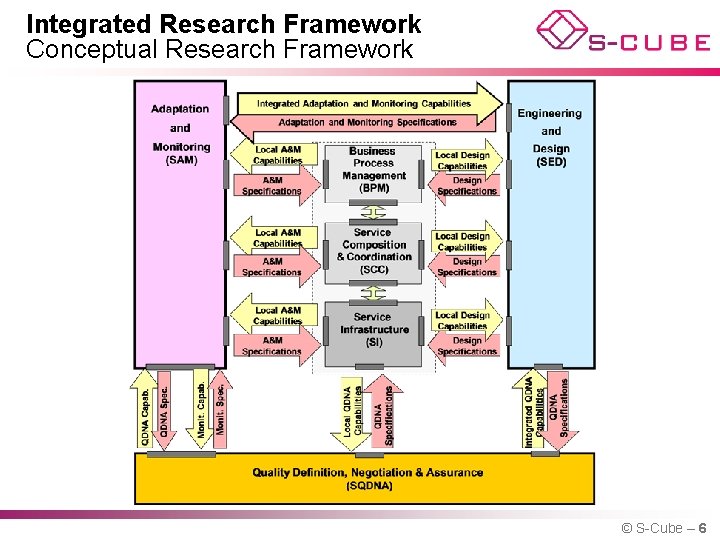
Integrated Research Framework Conceptual Research Framework © S-Cube – 6
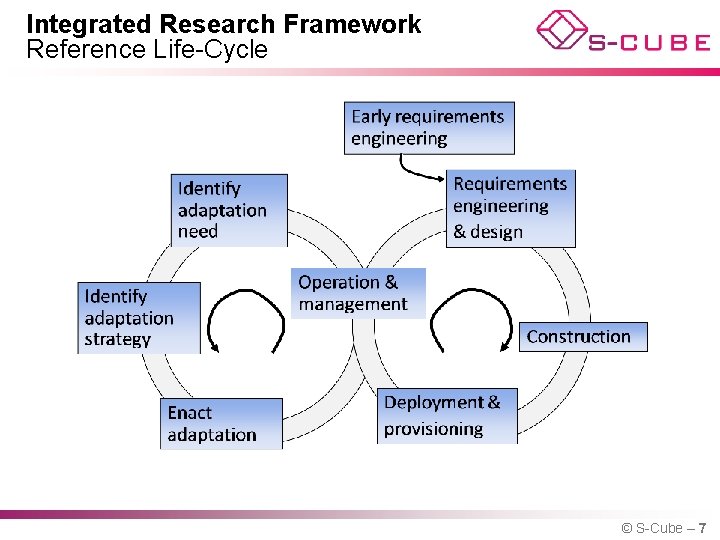
Integrated Research Framework Reference Life-Cycle © S-Cube – 7
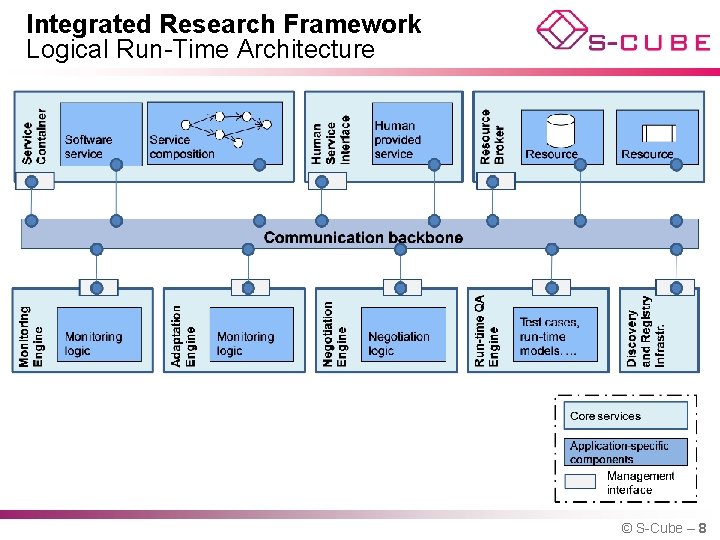
Integrated Research Framework Logical Run-Time Architecture © S-Cube – 8
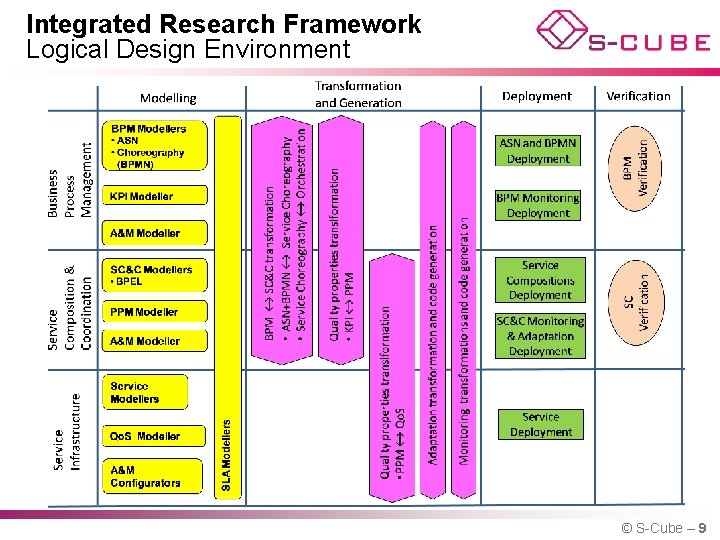
Integrated Research Framework Logical Design Environment © S-Cube – 9
Research Areas in Service Engineering
Service Engineering for Service-Based Applications (SBA) www. s-cube-network. eu
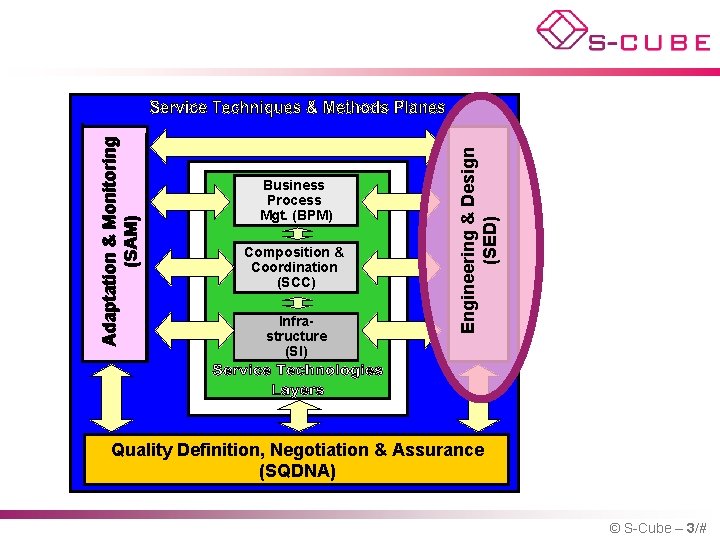
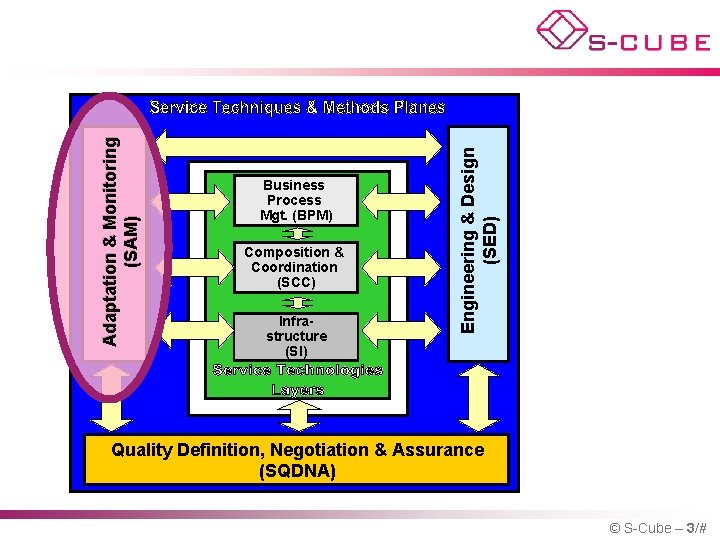
Composition & Coordination (SCC) Infrastructure (SI) Engineering & Design (SED) Adaptation & Monitoring (SAM) Business Process Mgt. (BPM) Quality Definition, Negotiation & Assurance (SQDNA) © S-Cube – 3/#
Adaptation design § Focus on activation of adaptation strategies § Instance-level adaptation § Context § Model-based
![Main Ingredients of an Adaptable SBA [6] Bucchiarone, C. Cappiello, E. di Nitto, R.](http://slidetodoc.com/presentation_image_h/af495f459244328cdfbc155aad5860c9/image-14.jpg "Main Ingredients of an Adaptable SBA [6] Bucchiarone, C. Cappiello, E. di Nitto, R.")
Main Ingredients of an Adaptable SBA [6] Bucchiarone, C. Cappiello, E. di Nitto, R. Kazhamiakin, V. Mazza, and M. Pistore, “Design for adaptation of Service-Based applications: Main issues and requirements, ” in WEOSA 2009
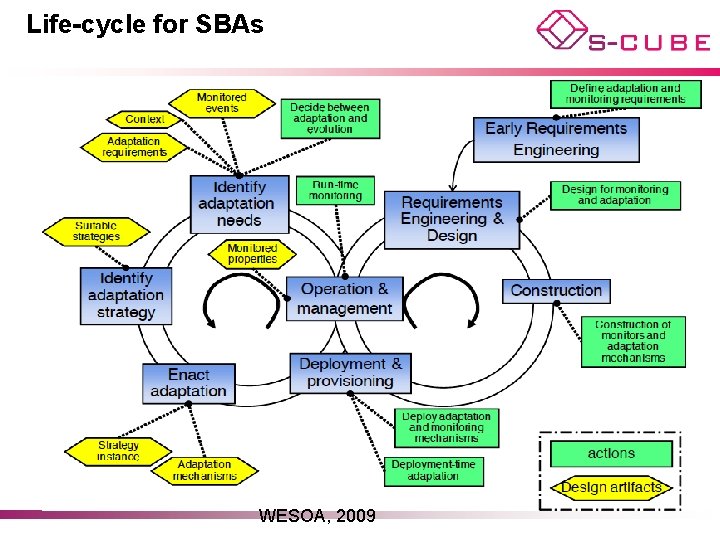
Life-cycle for SBAs WESOA, 2009
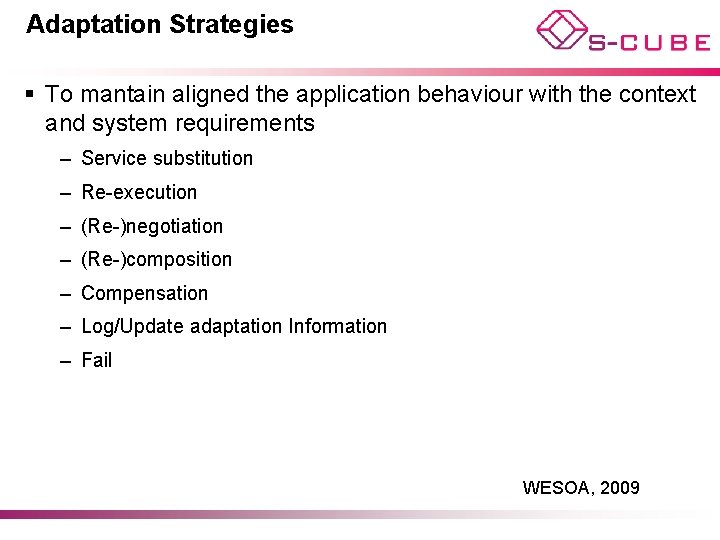
Adaptation Strategies § To mantain aligned the application behaviour with the context and system requirements – Service substitution – Re-execution – (Re-)negotiation – (Re-)composition – Compensation – Log/Update adaptation Information – Fail WESOA, 2009
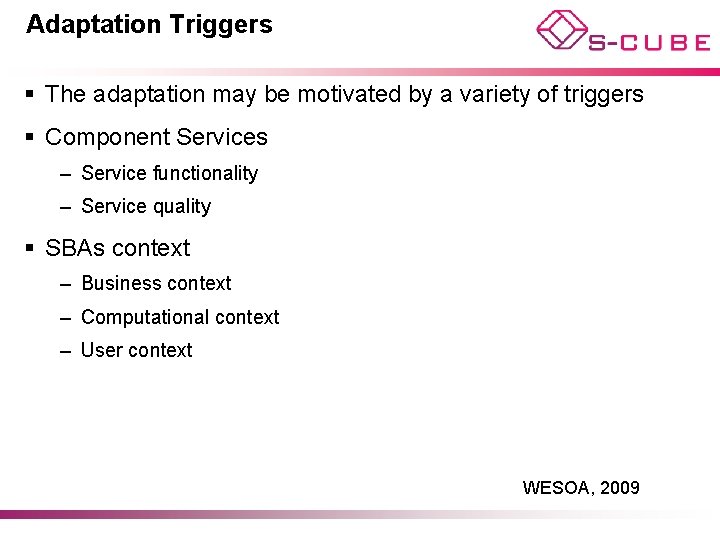
Adaptation Triggers § The adaptation may be motivated by a variety of triggers § Component Services – Service functionality – Service quality § SBAs context – Business context – Computational context – User context WESOA, 2009
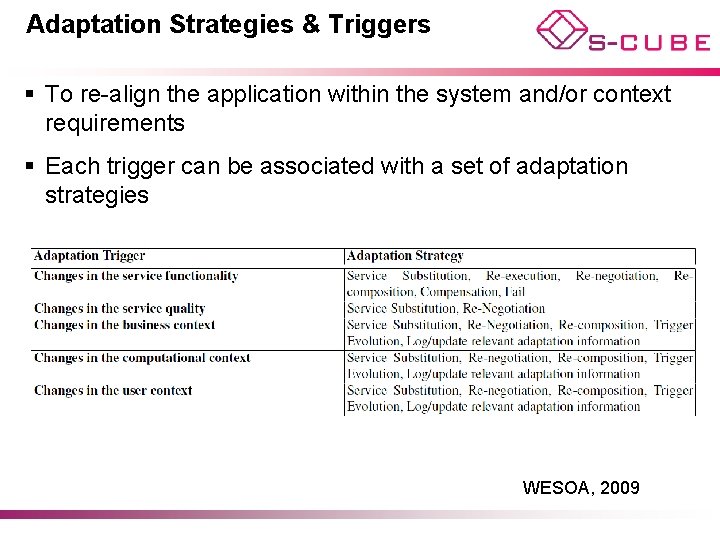
Adaptation Strategies & Triggers § To re-align the application within the system and/or context requirements § Each trigger can be associated with a set of adaptation strategies WESOA, 2009
Design Guidelines for triggers and adaptation strategies § Design adaptable SBAs implies relate adaptation triggers and adaptation strategies together – Modeling adaptation triggers – Realizing adaptation strategies – Associating adaptation strategies to triggers § Design approaches – Built-in adaptation - Adaptation needs and adaptation configuration known a priori – Abstraction-based adaptation - Adaptation need fixed, but adaptation configuration not known a priori – Dynamic adaptation - Adaptation needs not known at design time or cannot be enumerated WESOA, 2009
Designing reliable service compositions § Focus on service compositions § To design more reliable service-based processes – inserting monitors, adaptation strategies, changing process structure, … – Which is the best choice? § Context-awareness (user-dependent) § Based on quality evaluation Cappiello, C. ; Pernici, B. : QUADS: Quality-Aware Design of dependable Service-based processes. 2010
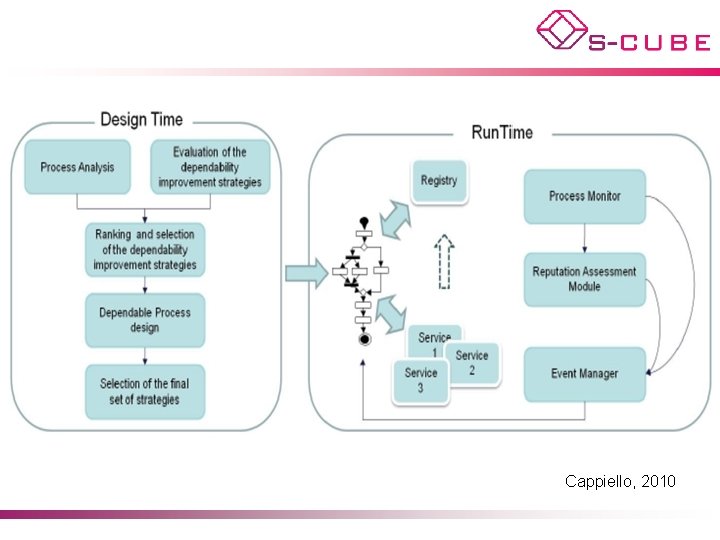
Cappiello, 2010
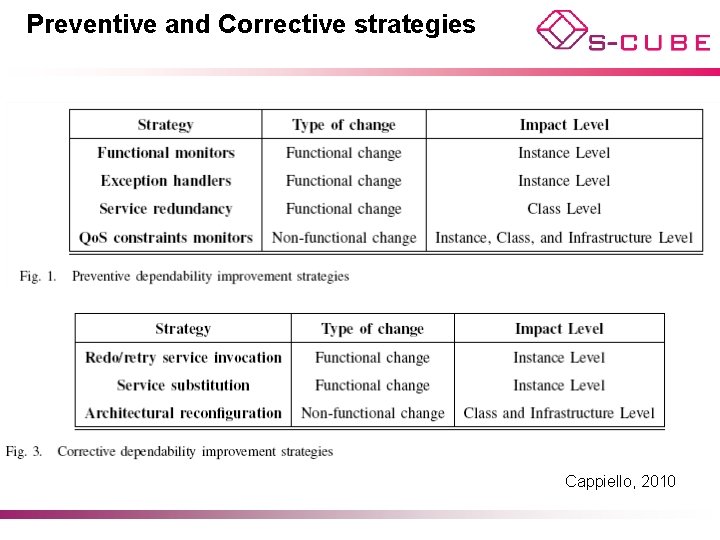
Preventive and Corrective strategies Cappiello, 2010
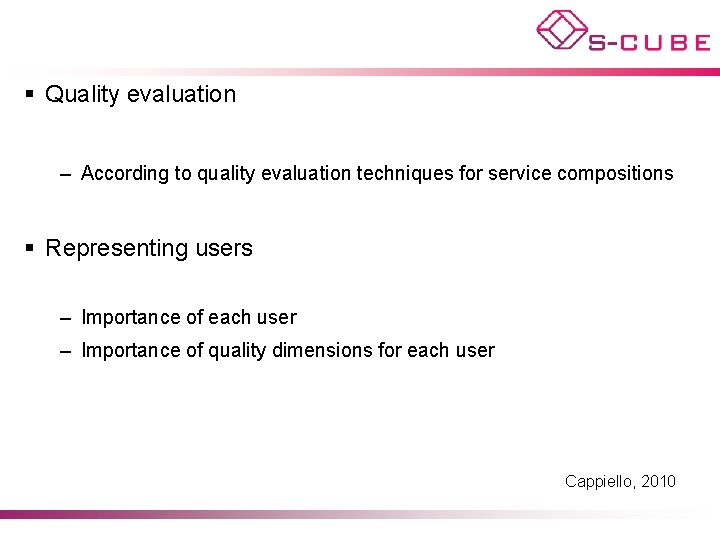
§ Quality evaluation – According to quality evaluation techniques for service compositions § Representing users – Importance of each user – Importance of quality dimensions for each user Cappiello, 2010
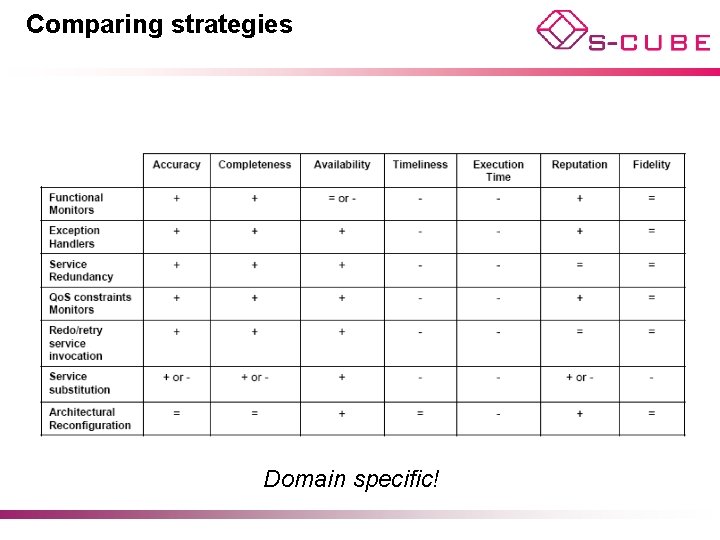
Comparing strategies Domain specific!
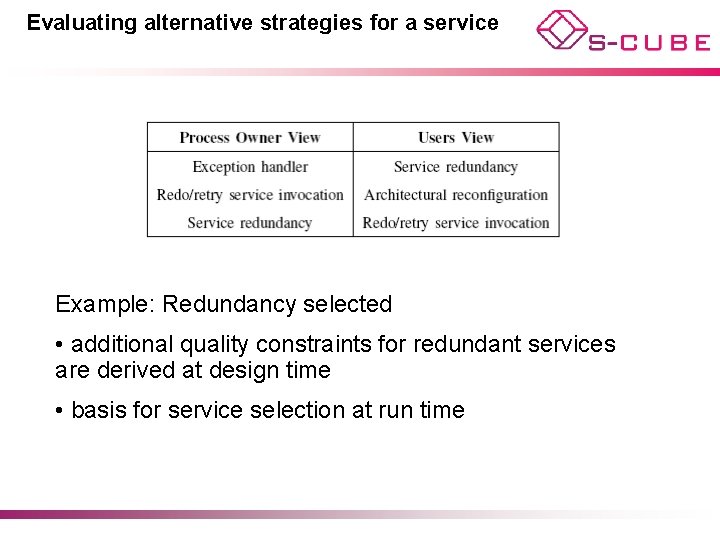
Evaluating alternative strategies for a service Example: Redundancy selected • additional quality constraints for redundant services are derived at design time • basis for service selection at run time
Cross-Layer Adaptation www. s-cube-network. eu
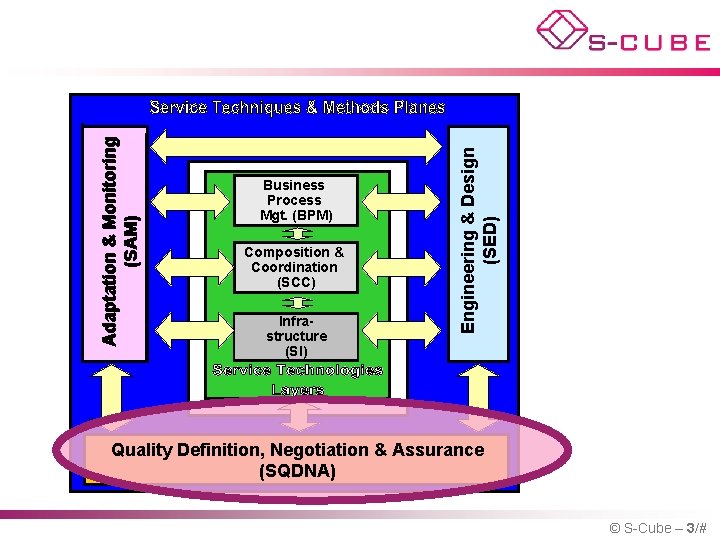
Composition & Coordination (SCC) Infrastructure (SI) Engineering & Design (SED) Adaptation & Monitoring (SAM) Business Process Mgt. (BPM) Quality Definition, Negotiation & Assurance (SQDNA) © S-Cube – 3/#
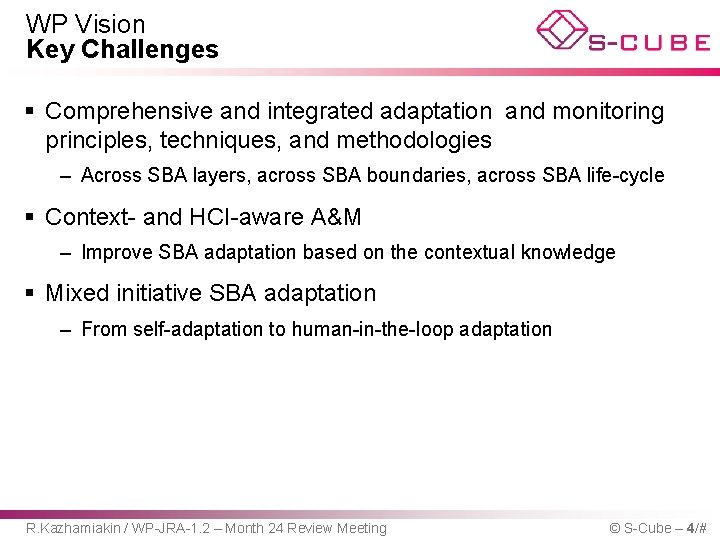
WP Vision Key Challenges § Comprehensive and integrated adaptation and monitoring principles, techniques, and methodologies – Across SBA layers, across SBA boundaries, across SBA life-cycle § Context- and HCI-aware A&M – Improve SBA adaptation based on the contextual knowledge § Mixed initiative SBA adaptation – From self-adaptation to human-in-the-loop adaptation R. Kazhamiakin / WP-JRA-1. 2 – Month 24 Review Meeting © S-Cube – 4/#
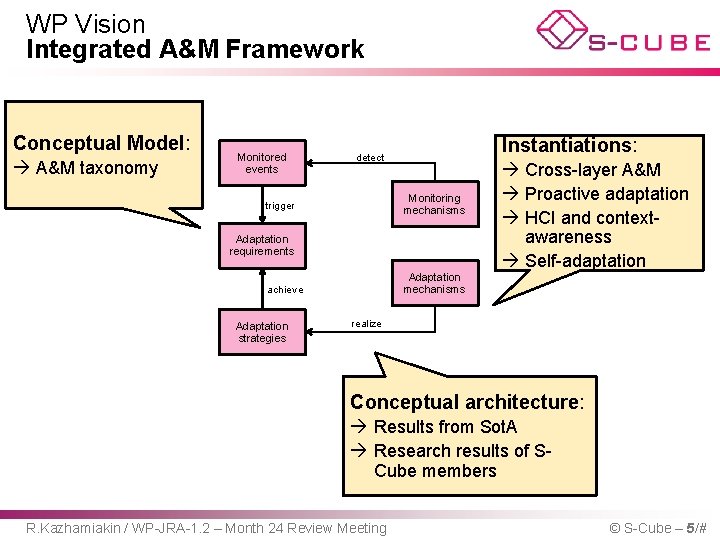
WP Vision Integrated A&M Framework Conceptual Model: A&M taxonomy Monitored events Instantiations: detect Monitoring mechanisms trigger Adaptation requirements Adaptation mechanisms achieve Adaptation strategies Cross-layer A&M Proactive adaptation HCI and contextawareness Self-adaptation realize Conceptual architecture: Results from Sot. A Research results of SCube members R. Kazhamiakin / WP-JRA-1. 2 – Month 24 Review Meeting © S-Cube – 5/#
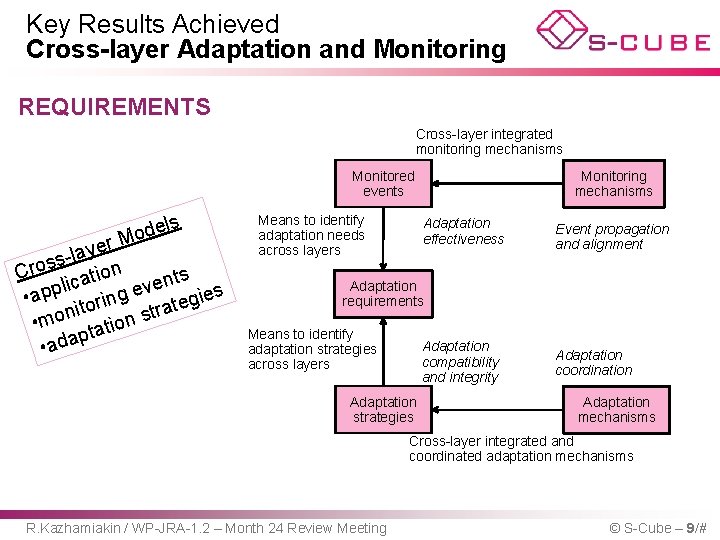
Key Results Achieved Cross-layer Adaptation and Monitoring REQUIREMENTS Cross-layer integrated monitoring mechanisms Monitored events els d o M er y a l s Cros cation ts n e i l v p • ap toring e tegies tra ni s o n m • tio a t p • ada Means to identify adaptation needs across layers Monitoring mechanisms Adaptation effectiveness Event propagation and alignment Adaptation requirements Means to identify adaptation strategies across layers Adaptation compatibility and integrity Adaptation strategies Adaptation coordination Adaptation mechanisms Cross-layer integrated and coordinated adaptation mechanisms R. Kazhamiakin / WP-JRA-1. 2 – Month 24 Review Meeting © S-Cube – 9/#
Cross-layer Adaptation and Monitoring Integrated Monitoring Mechanisms § Results – Unify monitoring of business properties and low-level service properties centered around service compositions at run-time [1] - Instance and class properties in the same model (ASTRO) - Rich notation for basic events and probes (Dynamo) – Integrate run-time and design-time events monitoring [2] - Monitoring of run-time properties and model changes (EMF events, from design environment) in the same framework (Wild. Cat model for monitored data) – Multifactor Monitoring [3] - Unified language for querying various factors: service behavior, service quality, service context, service structure - Formal model for the representation of queries: event calculus - Automated translation rules for different factors 1. Baresi, Guinea, Pistore, Trainotti. Dynamo+ASTRO: an Integrated Approach for BPEL Monitoring. In ICWS 2009 2. Morin, Ledoux, Ben Hassine, Chauvel, Barais, Jezequel. Unifying Runtime Adaptation and Design Evolution In CIT 2009 3. Zisman, Spanoudakis, Mahbub. A Monitoring Approach for Run-time Service Discovery. Under submission. R. Kazhamiakin / WP-JRA-1. 2 – Month 24 Review Meeting © S-Cube – 31/#
![Cross-layer Adaptation and Monitoring Identification of Adaptation Needs § Results – Domain assumptions [1]](http://slidetodoc.com/presentation_image_h/af495f459244328cdfbc155aad5860c9/image-32.jpg "Cross-layer Adaptation and Monitoring Identification of Adaptation Needs § Results – Domain assumptions [1]")
Cross-layer Adaptation and Monitoring Identification of Adaptation Needs § Results – Domain assumptions [1] • External services • User context Domain - Explicit encoding of domain assumptions - Associate them to requirements - Monitor assumption violations - verify requirements at run time to trigger adaptation Assumptions • Non-functional req’s • Functional req’s – Replacement policies [2] Requirements SBA • Composition (BPEL) • Service protocols • Qo. S models - Explicit encoding of rules for service substitution - Take into account the SBA execution point - Consider variety of aspects: Qo. S, structural, behavior, context, changing requirements - Take into account availability of new services 1. Gehlert, Bucchiarone, Kazhamiakin, Metzger, Pistore, Pohl: Exploiting Assumption-Based Verification for the Adaptation of Service-Based Applications. SOA@SAC Conference, 2010 2. Mahbub, Zisman. Replacement Policies for Service-Based Systems. MONA+ workshop, ICSOC/Service. Wave conference, 2009 R. Kazhamiakin / WP-JRA-1. 2 – Month 24 Review Meeting © S-Cube – 32/#
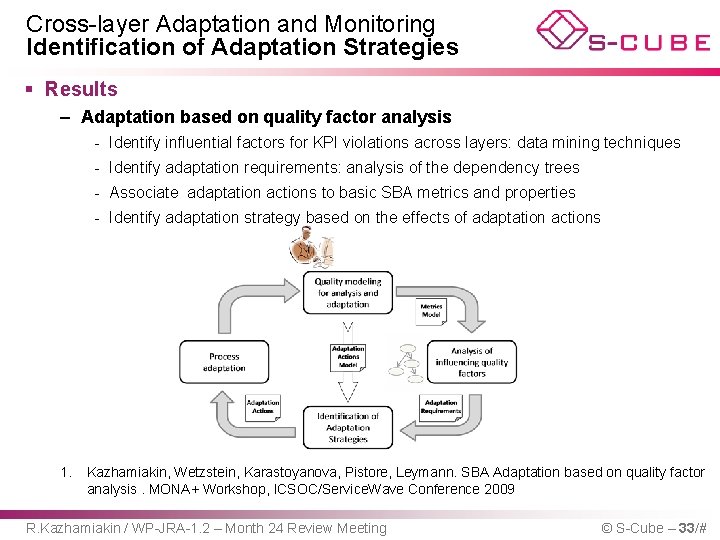
Cross-layer Adaptation and Monitoring Identification of Adaptation Strategies § Results – Adaptation based on quality factor analysis - Identify influential factors for KPI violations across layers: data mining techniques - Identify adaptation requirements: analysis of the dependency trees - Associate adaptation actions to basic SBA metrics and properties - Identify adaptation strategy based on the effects of adaptation actions 1. Kazhamiakin, Wetzstein, Karastoyanova, Pistore, Leymann. SBA Adaptation based on quality factor analysis. MONA+ Workshop, ICSOC/Service. Wave Conference 2009 R. Kazhamiakin / WP-JRA-1. 2 – Month 24 Review Meeting © S-Cube – 33/#
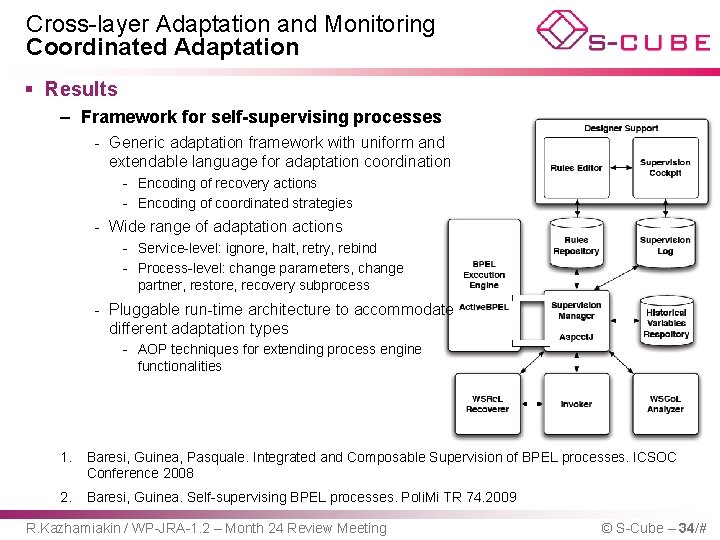
Cross-layer Adaptation and Monitoring Coordinated Adaptation § Results – Framework for self-supervising processes - Generic adaptation framework with uniform and extendable language for adaptation coordination - Encoding of recovery actions - Encoding of coordinated strategies - Wide range of adaptation actions - Service-level: ignore, halt, retry, rebind - Process-level: change parameters, change partner, restore, recovery subprocess - Pluggable run-time architecture to accommodate different adaptation types - AOP techniques for extending process engine functionalities 1. Baresi, Guinea, Pasquale. Integrated and Composable Supervision of BPEL processes. ICSOC Conference 2008 2. Baresi, Guinea. Self-supervising BPEL processes. Poli. Mi TR 74. 2009 R. Kazhamiakin / WP-JRA-1. 2 – Month 24 Review Meeting © S-Cube – 34/#
End-to-End Quality Provision www. s-cube-network. eu
Composition & Coordination (SCC) Infrastructure (SI) Engineering & Design (SED) Adaptation & Monitoring (SAM) Business Process Mgt. (BPM) Quality Definition, Negotiation & Assurance (SQDNA) © S-Cube – 3/#
Motivational „Scenario“ 1. Identify Vehicle = service invocation/activity = third-party service = internal service = alternative binding [not valid] e. Pay response time: 2 s cost: 1. 50 € Secure. Pay response time: 3 s cost: 1 € Yahoo response time: 1. 5 s GMail [valid] response time: 2 s 2. Pay Renewal Fee 3. Update Vehicle Record 4. a. E-Mail Confirmation Renewal. Handler response time: 1 s 4. b. Mail Validation Sticker response time: 2 s A. Metzger / WP-JRA-1. 3 – Global Meeting, Pisa, Mar. 2010 response time: 1 s
WP Vision Key Challenges Devise novel principles, techniques & methods for Quality. . . Definition [Mo 1 -45] D A • End-to-End Quality Reference Model (completed in Y 1) • Rich and Extensible Quality Definition Language • Run-time Quality Assurance Techniques • Quality Prediction Techniques to Support Proactive Adaptation . . . Assurance [Mo 18– 45] N • Exploiting HCI knowledge for automatic quality contract establishment • Proactive SLA negotiation and agreement (from Y 3) . . . Negotiation [Mo 10– 45]
Key Results Achieved Quality Reference Model § Problems – Understanding quality attributes across SOA layers § Solution – Quality Reference Model § S-Cube Publications 1. NNN A. Metzger / WP-JRA-1. 3 – Global Meeting, Pisa, Mar. 2010
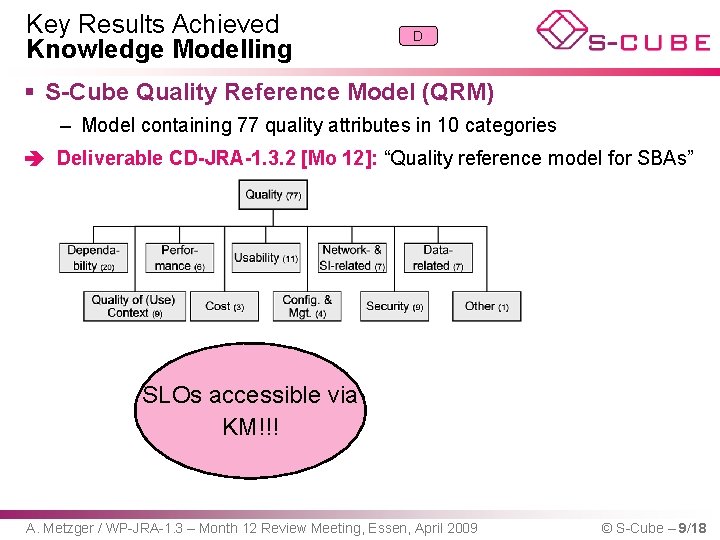
Key Results Achieved Knowledge Modelling D § S-Cube Quality Reference Model (QRM) – Model containing 77 quality attributes in 10 categories Deliverable CD-JRA-1. 3. 2 [Mo 12]: “Quality reference model for SBAs” SLOs accessible via KM!!! A. Metzger / WP-JRA-1. 3 – Month 12 Review Meeting, Essen, April 2009 © S-Cube – 9/18
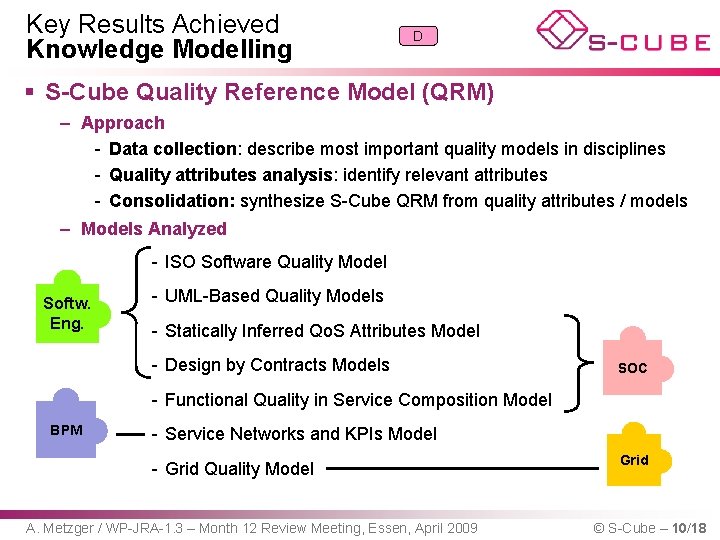
Key Results Achieved Knowledge Modelling D § S-Cube Quality Reference Model (QRM) – Approach - Data collection: describe most important quality models in disciplines - Quality attributes analysis: identify relevant attributes - Consolidation: synthesize S-Cube QRM from quality attributes / models – Models Analyzed - ISO Software Quality Model Softw. Eng. - UML-Based Quality Models - Statically Inferred Qo. S Attributes Model - Design by Contracts Models SOC - Functional Quality in Service Composition Model BPM - Service Networks and KPIs Model - Grid Quality Model A. Metzger / WP-JRA-1. 3 – Month 12 Review Meeting, Essen, April 2009 Grid © S-Cube – 10/18
Exploiting HCI knowledge for automatic quality contract establishment D N § Problems – Need for automated service contract negotiation (time can be critical factor) – User interaction and experience impacts on negotiation – Quality modelling languages offer limited capabilities to support automated negotiation - Lack of formalization (hinders automation) - Negotiation-related concepts missing; e. g. , negotiatable vs. non-negotiatable attributes - Missing shared terminology between provider and consumers § Solution – Quality meta-model (QMM) encompassing the concepts for a rich, extensible, and semantically enriched quality definition language – Automated negotiation techniques based on QMM concepts – Considering codified UI aspects in QMM and negotiation techniques § S-Cube Publications 1. Marco Comuzzi and Barbara Pernici. A Framework for Qo. S-Based Web service Contracting. In ACM Transactions on the Web, 3(3), 2009 2. Marco Comuzzi, Kyriakos Kritikos and Pierluigi Plebani. Semantic-aware Service Quality Negotiation. In Service. Wave 2008 3. Marco Comuzzi, Kyriakos Kritikos and Pierluigi Plebani. A semantic based framework for supporting negotiation in Service Oriented Architectures. In Proceedings IEEE CEC 2009 4. Kyriakos Kritikos and Dimitris Plexousakis. Mixed-Integer Programming for Qo. S-Based Web Service Matchmaking. In IEEE Transactions on Services Computing, 2(2), 2009 A. Metzger / WP-JRA-1. 3 – Global Meeting, Pisa, Mar. 2010
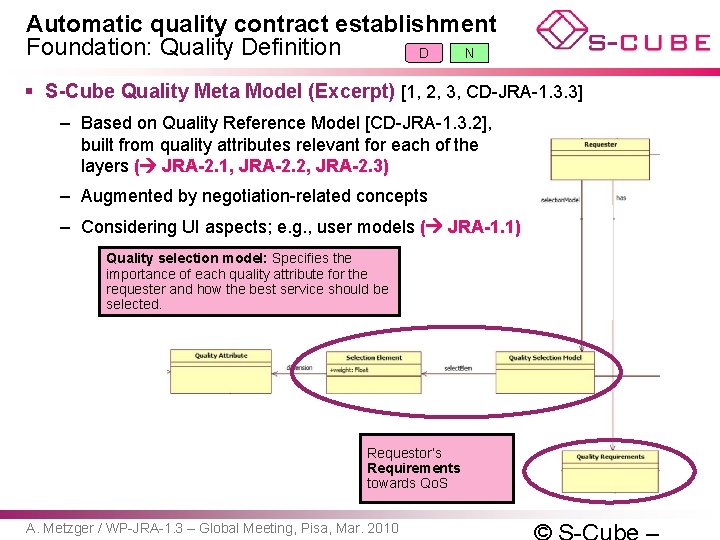
Automatic quality contract establishment Foundation: Quality Definition D N § S-Cube Quality Meta Model (Excerpt) [1, 2, 3, CD-JRA-1. 3. 3] – Based on Quality Reference Model [CD-JRA-1. 3. 2], built from quality attributes relevant for each of the layers ( JRA-2. 1, JRA-2. 2, JRA-2. 3) – Augmented by negotiation-related concepts – Considering UI aspects; e. g. , user models ( JRA-1. 1) Quality selection model: Specifies the importance of each quality attribute for the requester and how the best service should be selected. Requestor’s Requirements towards Qo. S A. Metzger / WP-JRA-1. 3 – Global Meeting, Pisa, Mar. 2010
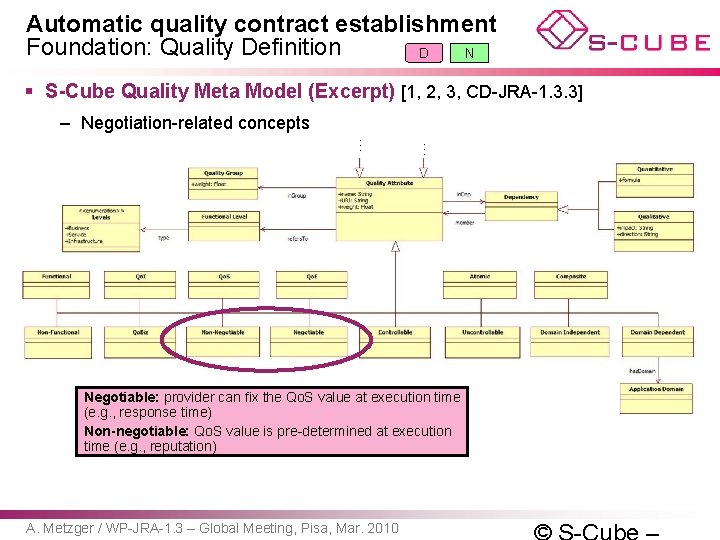
Automatic quality contract establishment Foundation: Quality Definition D N § S-Cube Quality Meta Model (Excerpt) [1, 2, 3, CD-JRA-1. 3. 3] – Negotiation-related concepts … … Negotiable: provider can fix the Qo. S value at execution time (e. g. , response time) Non-negotiable: Qo. S value is pre-determined at execution time (e. g. , reputation) A. Metzger / WP-JRA-1. 3 – Global Meeting, Pisa, Mar. 2010
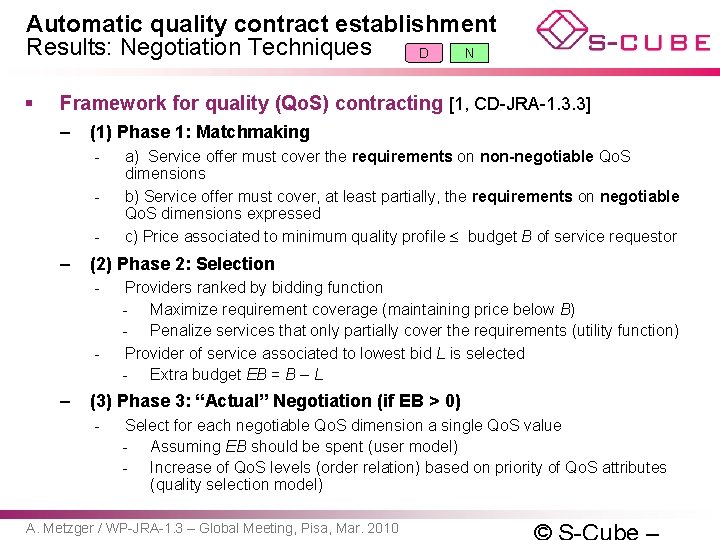
Automatic quality contract establishment Results: Negotiation Techniques D N § Framework for quality (Qo. S) contracting [1, CD-JRA-1. 3. 3] – (1) Phase 1: Matchmaking - – (2) Phase 2: Selection - - – a) Service offer must cover the requirements on non-negotiable Qo. S dimensions b) Service offer must cover, at least partially, the requirements on negotiable Qo. S dimensions expressed c) Price associated to minimum quality profile budget B of service requestor Providers ranked by bidding function - Maximize requirement coverage (maintaining price below B) - Penalize services that only partially cover the requirements (utility function) Provider of service associated to lowest bid L is selected - Extra budget EB = B – L (3) Phase 3: “Actual” Negotiation (if EB > 0) - Select for each negotiable Qo. S dimension a single Qo. S value - Assuming EB should be spent (user model) - Increase of Qo. S levels (order relation) based on priority of Qo. S attributes (quality selection model) A. Metzger / WP-JRA-1. 3 – Global Meeting, Pisa, Mar. 2010
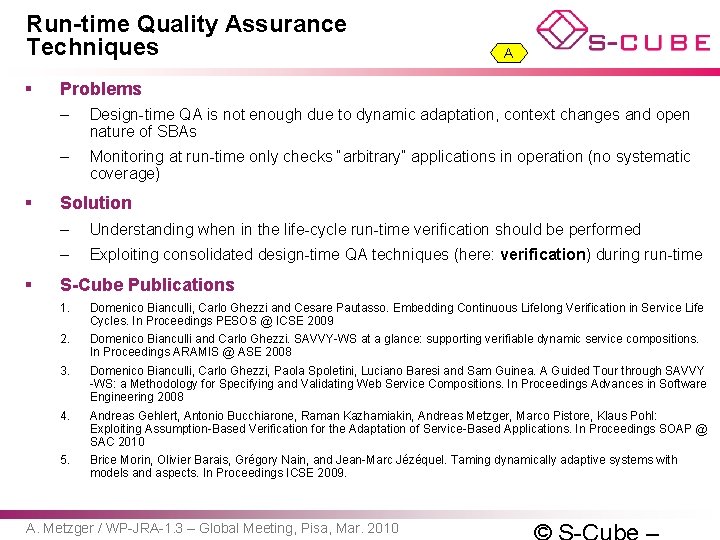
Run-time Quality Assurance Techniques § § § A Problems – Design-time QA is not enough due to dynamic adaptation, context changes and open nature of SBAs – Monitoring at run-time only checks “arbitrary” applications in operation (no systematic coverage) Solution – Understanding when in the life-cycle run-time verification should be performed – Exploiting consolidated design-time QA techniques (here: verification) during run-time S-Cube Publications 1. Domenico Bianculli, Carlo Ghezzi and Cesare Pautasso. Embedding Continuous Lifelong Verification in Service Life Cycles. In Proceedings PESOS @ ICSE 2009 2. Domenico Bianculli and Carlo Ghezzi. SAVVY-WS at a glance: supporting verifiable dynamic service compositions. In Proceedings ARAMIS @ ASE 2008 3. Domenico Bianculli, Carlo Ghezzi, Paola Spoletini, Luciano Baresi and Sam Guinea. A Guided Tour through SAVVY -WS: a Methodology for Specifying and Validating Web Service Compositions. In Proceedings Advances in Software Engineering 2008 4. Andreas Gehlert, Antonio Bucchiarone, Raman Kazhamiakin, Andreas Metzger, Marco Pistore, Klaus Pohl: Exploiting Assumption-Based Verification for the Adaptation of Service-Based Applications. In Proceedings SOAP @ SAC 2010 5. Brice Morin, Olivier Barais, Grégory Nain, and Jean-Marc Jézéquel. Taming dynamically adaptive systems with models and aspects. In Proceedings ICSE 2009. A. Metzger / WP-JRA-1. 3 – Global Meeting, Pisa, Mar. 2010
![Run-time Quality Assurance Techniques Results § Life-cycle Model [1, CD-JRA-1. 3. 4] – QA](http://slidetodoc.com/presentation_image_h/af495f459244328cdfbc155aad5860c9/image-47.jpg "Run-time Quality Assurance Techniques Results § Life-cycle Model [1, CD-JRA-1. 3. 4] – QA")
Run-time Quality Assurance Techniques Results § Life-cycle Model [1, CD-JRA-1. 3. 4] – QA oriented life cycle layered on existing iterative life cycle ( WP-JRA-1. 1) – Due to open nature, SBS need to "continuously" assert properties that have a “lifelong” validity - E. g. , there is no guarantee that a service implementation eventually fulfils the contract promised (e. g. , SLA) - E. g. , during design-time QA, it is not possible to model the behaviour of the underlying distributed infrastructure (e. g. , Internet) – Existing QA techniques applied at each stage of the service life cycle – Combining different techniques can improve the overall quality of QA A. Metzger / WP-JRA-1. 3 – Global Meeting, Pisa, Mar. 2010 A
![Run-time Quality Assurance Techniques Results A § Run-time Verification: Basic Approach [2, 3, 4]](http://slidetodoc.com/presentation_image_h/af495f459244328cdfbc155aad5860c9/image-48.jpg "Run-time Quality Assurance Techniques Results A § Run-time Verification: Basic Approach [2, 3, 4]")
Run-time Quality Assurance Techniques Results A § Run-time Verification: Basic Approach [2, 3, 4] – Activities during Design-Time: - Specify service composition (workflow): W ( JRA-1. 1, JRA-2. 2) - Assume properties of the outside world / context: A ( Negotiation) - e. g. , Qo. S of services as stipulated in SLAs - Formalize requirements towards workflow: R ( JRA-1. 1, JRA-2. 2) - Check (e. g. , using model checker) that workflow meets requirements - W, A |-- R ? W R X W, A |-- R ? A. Metzger / WP-JRA-1. 3 – Global Meeting, Pisa, Mar. 2010 A
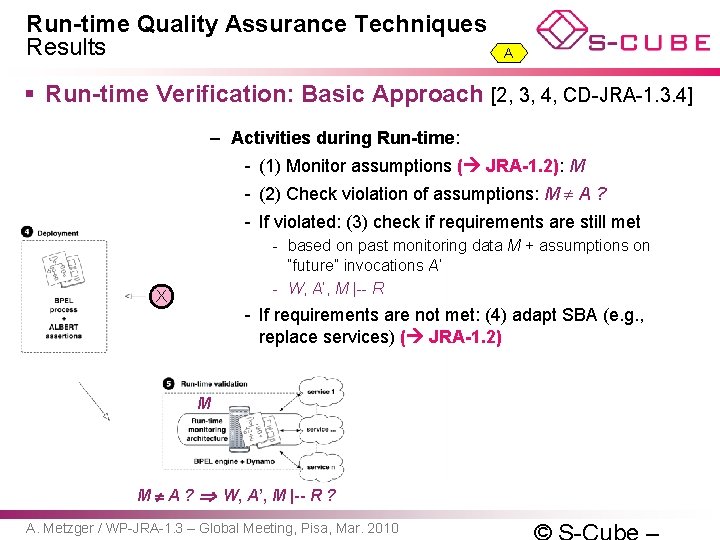
Run-time Quality Assurance Techniques Results A § Run-time Verification: Basic Approach [2, 3, 4, CD-JRA-1. 3. 4] – Activities during Run-time: - (1) Monitor assumptions ( JRA-1. 2): M - (2) Check violation of assumptions: M A ? - If violated: (3) check if requirements are still met - based on past monitoring data M + assumptions on “future” invocations A’ - W, A’, M |-- R X - If requirements are not met: (4) adapt SBA (e. g. , replace services) ( JRA-1. 2) M M A ? W, A’, M |-- R ? A. Metzger / WP-JRA-1. 3 – Global Meeting, Pisa, Mar. 2010
Quality Prediction Techniques to Support Proactive Adaptation § § § A Problems – Reactive adaptation has significant shortcomings – Quality prediction needed to enable pro-active adaptation ( JRA-1. 2) – Unnecessary pro-active adaptations need to be avoided (as they can be costly) Solution – Exploiting synergies between monitoring and online testing – Determining (and fostering) confidence of failure prediction S-Cube Publications 1. 2. 3. 4. 5. Julia Hielscher, Raman Kazhamiakin, Andreas Metzger and Marco Pistore. A Framework for Proactive Self. Adaptation of Service-based Applications Based on Online Testing. In Service. Wave 2008, Nr. (5377), Springer, 1013 December 2008. Andreas Gehlert, Julia Hielscher, Olha Danylevych and Dimka Karastoyanova. Online Testing, Requirements Engineering and Service Faults as Drivers for Adapting Service Compositions. In Dimka Karastoyanova, Raman Kazhamiakin, Andreas Metzger and Marco Pistore editors, Proceedings of the International Workshop on Service Monitoring, Adaptation and Beyond (MONA+ 2008), December 13, 2008, Madrid, Spain, Pages 39 --50, 2008. Andreas Gehlert, Andreas Metzger, Dimka Karastoyanova, Raman Kazhamiakin, Klaus Pohl, Frank Leymann, Marco Pistore. Adaptation of Service-Based Systems based on Requirements Engineering and Online Testing. Internet of Services Book (S. Dustdar, Ed. ) – to be published Andreas Metzger, Osama Sammodi, Klaus Pohl. Towards Pro-Active Adaptation with Confidence – Augmenting Monitoring with Online Testing. SEAMS Workshop @ ICSE 2010 Philipp Leitner, Branimir Wetzstein, Florian Rosenberg, Anton Michlmayr, Schahram Dustdar, and Frank Leymann. Runtime Prediction of Service Level Agreement Violations for Composite Services. In Proceedings Non-Functional Properties and SLA Management @ ICSOC 2009 A. Metzger / WP-JRA-1. 3 – Global Meeting, Pisa, Mar. 2010
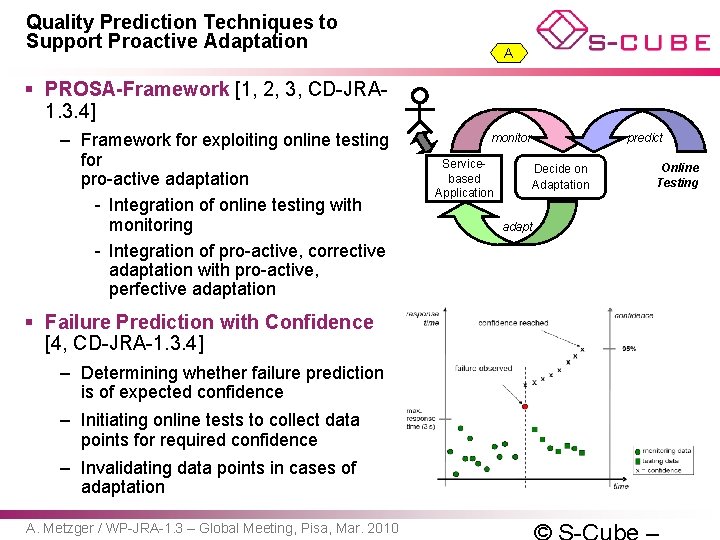
Quality Prediction Techniques to Support Proactive Adaptation A § PROSA-Framework [1, 2, 3, CD-JRA 1. 3. 4] – Framework for exploiting online testing for pro-active adaptation - Integration of online testing with monitoring - Integration of pro-active, corrective adaptation with pro-active, perfective adaptation § Failure Prediction with Confidence [4, CD-JRA-1. 3. 4] – Determining whether failure prediction is of expected confidence – Initiating online tests to collect data points for required confidence – Invalidating data points in cases of adaptation A. Metzger / WP-JRA-1. 3 – Global Meeting, Pisa, Mar. 2010 monitor Servicebased Application predict Decide on Adaptation adapt Online Testing
Case studies: a methodological approach
Towards validation: Case studies § Goals: – validate research results with realistic scenarios – develop research challenges derived from case studies § A methodology for case study documentation has been developed
Case studies § S-Cube proposal – An approach to describe case studies derived from NEXOF-RA and enriched with other elements from the RE literature – The identification of a set of case studies which the approach is applied on
Case studies § Directly from S-CUBE – Wine production (Donnafugata) – Automotive supply chain (360 Fresh and IBM) § Derived from NEXOF-RA – E-health diagnostic workflow (Siemens/Thales) – Traffic management (Siemens) – E-government (TIS and Engineering) § For a complete description of the case studies analyzed in S-Cube, please refer to the deliverable CD-IA-2. 2. 2 and for scenarios CD-IA-2. 2. 4 © S-Cube
The proposed case study description approach § Business goals: express the main purposes of some system in the terms of the business domain in which the system will live or currently lives § Domain assumptions and constraints: report properties of the domain or restrictions on the design of the system architecture § Domain description: phenomena occurring in the world together with the laws that regulate such a world § Abstract scenario description: a way to describe world phenomena P. Plebani - IE 4 SOC Opening - Stockholm 23/11/2009 © S-Cube
Business goals and domain assumptions/constraints § Business goals and domain assumption/constraints rely on the same elements: – Description – Rationale – Involved stakeholders – Conflicts – Supporting material – Priority P. Plebani - IE 4 SOC Opening - Stockholm 23/11/2009 © S-Cube
Domain description § Purpose – Study and describe phenomena in the world as well as shared phenomena § Content – Glossary – Relationships among the main terms - Through class diagrams, semantic networks, E/R diagrams, … – Boundaries between the world and the machine - Context diagrams P. Plebani - IE 4 SOC Opening - Stockholm 23/11/2009 © S-Cube
Scenarios description § Purpose: to describe possible situations and interactions between the world and the machine § Structure of description – Involved actors – Detailed operational description – Problems and challenges – Non-functional requirements and constraints – Accompanying material - sequence and activity diagrams - (sub)use case diagrams § From scenarios, abstract scenarios are derived (template) P. Plebani - IE 4 SOC Opening - Stockholm 23/11/2009 © S-Cube
Case study description life-cycle § The four elements NOT necessarily have to be defined sequentially – Goals assumptions domain scenario § They can be defined iteratively § Some rules: – All the terms used in the description have to be put in a glossary – All identified actors have to appear in the context diagram (and vice versa) – From each scenario there exist at least one related business goal and vice versa – Scenarios are not overlapping – Goals are not overlapping P. Plebani - IE 4 SOC Opening - Stockholm 23/11/2009 © S-Cube
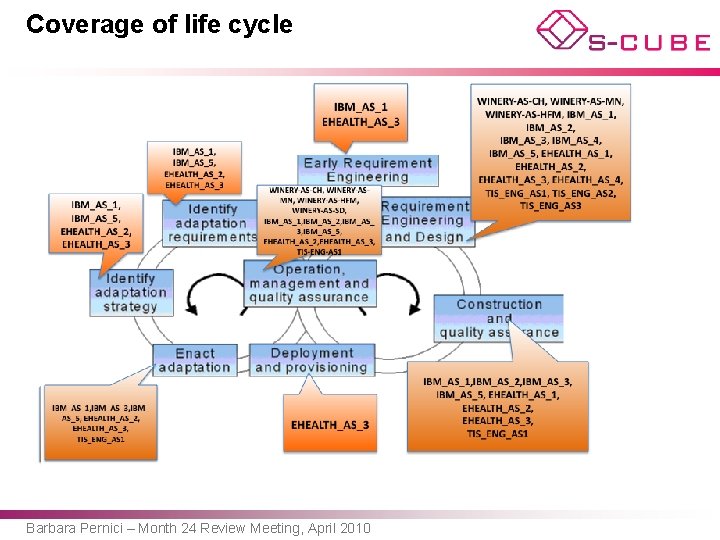
Coverage of life cycle Barbara Pernici – Month 24 Review Meeting, April 2010
Classifying & Comparing case studies P. Plebani - IE 4 SOC Opening - Stockholm 23/11/2009 www. s-cube-network. eu © S-Cube
Case study meta-data § Used to index case studies in the repository for facilitating search mechanisms § Meta-data: – Source – Real vs. Realistic – Abstract – Available solutions – Licensing – … P. Plebani - IE 4 SOC Opening - Stockholm 23/11/2009 © S-Cube
Comparison dimensions § S-Cube – Description of business situations and presence of agile service networks – Need for negotiating, establishing, monitoring, enforcing Qo. S – Need for service consumers with various different characteristics – Need for distributed infrastructures – Need for highly distributed service compositions – Highly changing requirements at various levels (from business to infrastructure) § Others – Security – Reliability – … P. Plebani - IE 4 SOC Opening - Stockholm 23/11/2009 © S-Cube
SEEKING NEW CASE STUDIES (OR SCENARIOS FOR EXISTING ONES)!
- Slides: 65