
Part 1 Our Learning Objective Take a minute
Part 1: Our Learning Objective
Take a minute or two to: Identify words and phrases that are not familiar Learning Objective G. 1: Explain how geographers use maps and data to contextualize spatial relationships and examine the human organization of space
Geography Spatial organization Human organization Contextualization
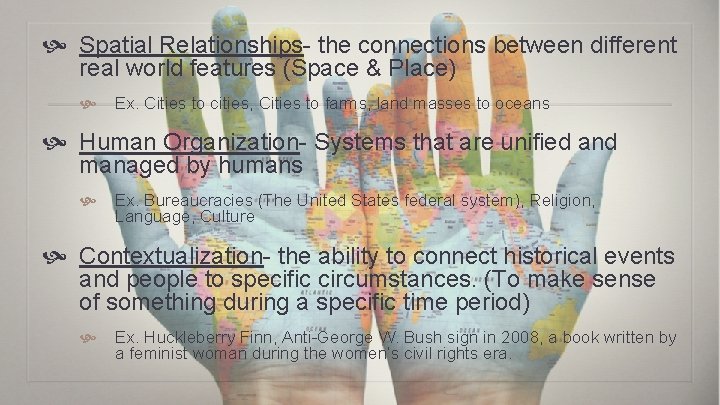
Spatial Relationships- the connections between different real world features (Space & Place) Ex. Cities to cities, Cities to farms, land masses to oceans Human Organization- Systems that are unified and managed by humans Ex. Bureaucracies (The United States federal system), Religion, Language, Culture Contextualization- the ability to connect historical events and people to specific circumstances. (To make sense of something during a specific time period) Ex. Huckleberry Finn, Anti-George W. Bush sign in 2008, a book written by a feminist woman during the women’s civil rights era.
Take a minute or two to: Identify words and phrases that are not familiar Write 1 -2 questions that will help you meet the learning objective Rephrase the learning objective as a question in your own words Learning Objective G. 1: Explain how geographers use maps and data to contextualize spatial relationships and examine the human organization of space
What questions did you come up with?
These may also help… How do geographers use maps and data to contextualize spatial relationships? What are spatial relationships? How do humans organize space?
Rephrase it into a question! You can also rephrase the learning objective into a question! Rephrasing the objective into a question can meet the needs of the learning objective! - How do geographers use tools to make sense of space and how people use space?
Questions, Comments Concerns? Easy, Hard, So-So?
- Slides: 9