
Part 1 Marketing Channel Systems Chapter 2 The

- Slides: 23
Part 1: Marketing Channel Systems Chapter 2 The Channel Participants © 2013 Cengage Learning. All Rights Reserved. May not be scanned, copied or duplicated, or posted to a publicly accessible website, in whole or in part.
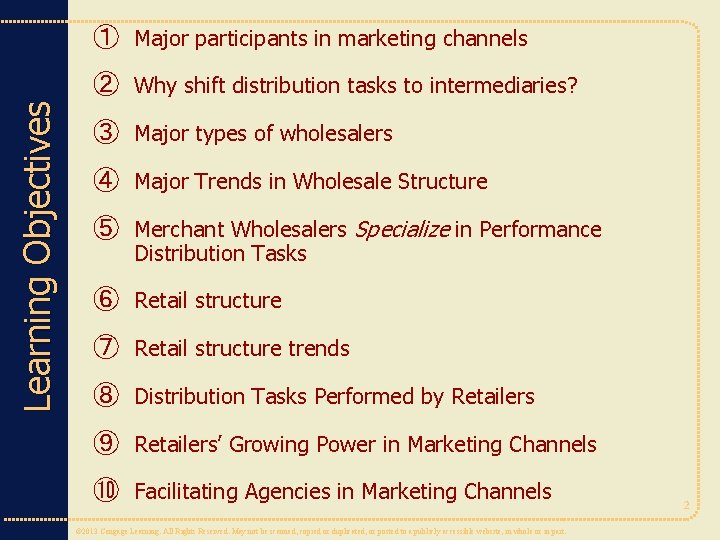
① Major participants in marketing channels Learning Objectives ② Why shift distribution tasks to intermediaries? ③ Major types of wholesalers ④ Major Trends in Wholesale Structure ⑤ Merchant Wholesalers Specialize in Performance Distribution Tasks ⑥ Retail structure ⑦ Retail structure trends ⑧ Distribution Tasks Performed by Retailers ⑨ Retailers’ Growing Power in Marketing Channels ⑩ Facilitating Agencies in Marketing Channels © 2013 Cengage Learning. All bebe scanned, copied or duplicated, or posted to a publicly accessible website, in whole orininwhole part. or in part. © 2013 All Rights Reserved. Maynot scanned, copied or duplicated, or posted to a publicly accessible website, 2
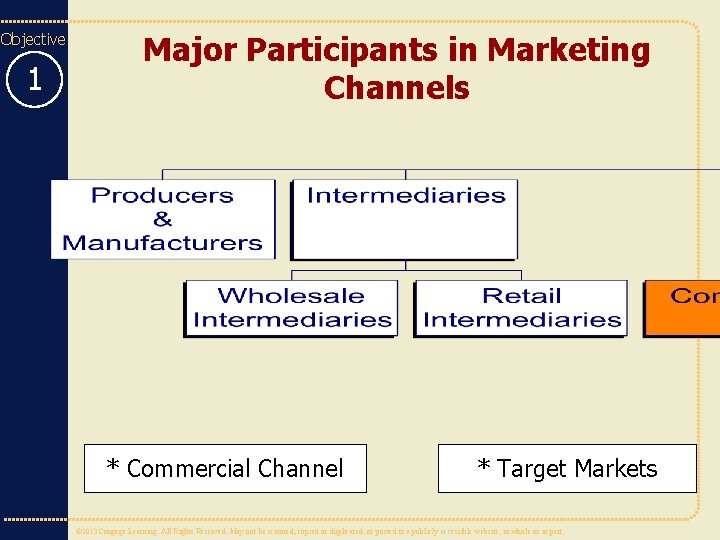
Objective 1 Major Participants in Marketing Channels * Commercial Channel * Target Markets © 2013 Cengage May notnot be be scanned, copied or duplicated, or posted to a publicly accessible website, inwebsite, whole orininwhole part. or in part. © 2013 Cengage Learning. All Rights. Reserved. May scanned, copied or duplicated, or posted to a publicly
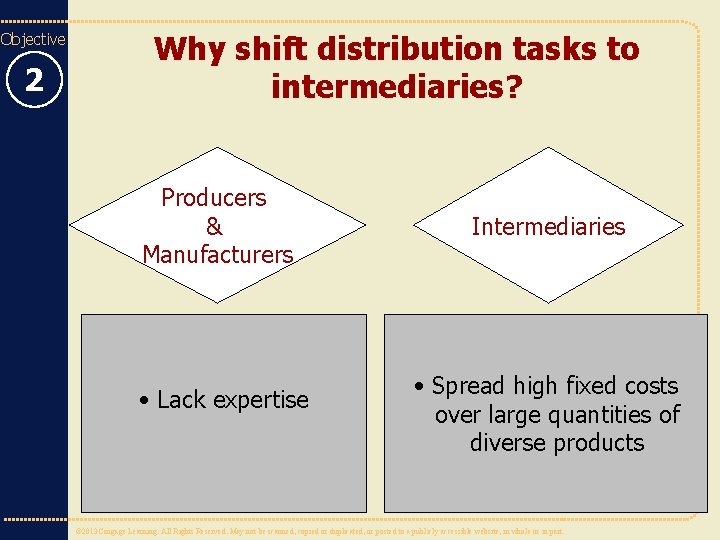
Objective 2 Why shift distribution tasks to intermediaries? Producers & Manufacturers • Lack expertise Intermediaries • Spread high fixed costs over large quantities of diverse products © 2013 Cengage May notnot be be scanned, copied or duplicated, or posted to a publicly accessible website, inwebsite, whole orininwhole part. or in part. © 2013 Cengage Learning. All Rights. Reserved. May scanned, copied or duplicated, or posted to a publicly
Objective 3 Major Types of Wholesalers © 2013 Cengage May notnot be be scanned, copied or duplicated, or posted to a publicly accessible website, inwebsite, whole orininwhole part. or in part. © 2013 Cengage Learning. All Rights. Reserved. May scanned, copied or duplicated, or posted to a publicly
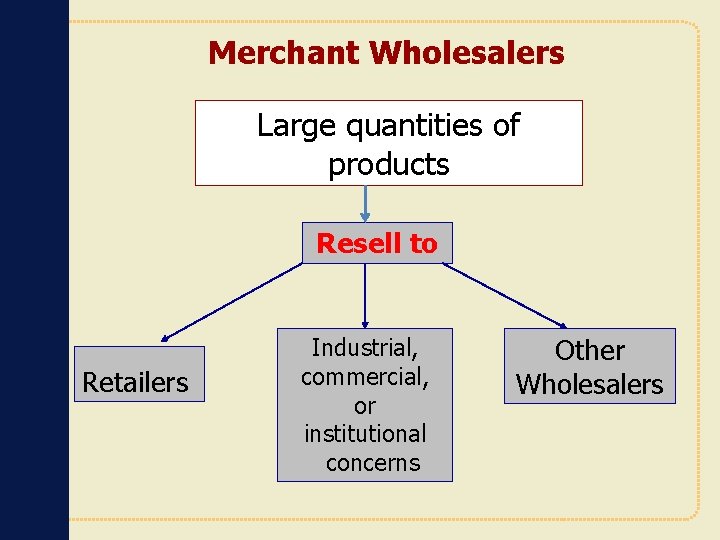
Merchant Wholesalers Large quantities of products Resell to Retailers Industrial, commercial, or institutional concerns Other Wholesalers © 2013 Cengage Learning. All Rights Reserved. May not be scanned, copied or duplicated, or posted to a publicly accessible website, in whole or in part.
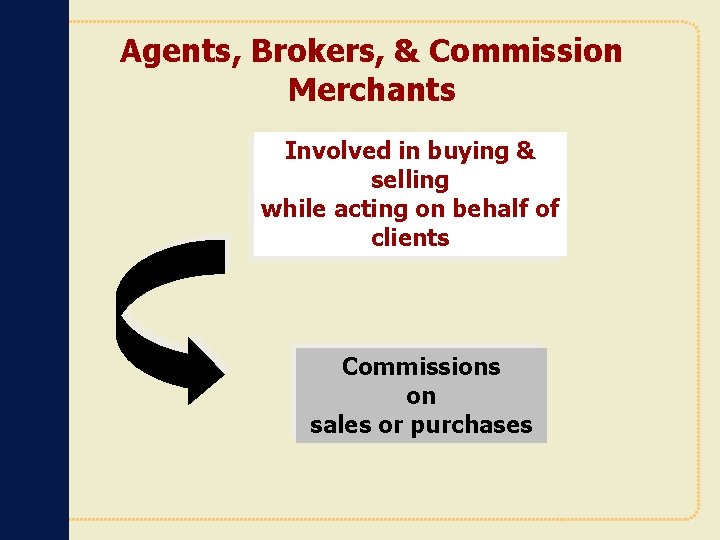
Agents, Brokers, & Commission Merchants Involved in buying & selling while acting on behalf of clients Commissions on sales or purchases © 2013 Cengage Learning. All Rights Reserved. May not be scanned, copied or duplicated, or posted to a publicly accessible website, in whole or in part.
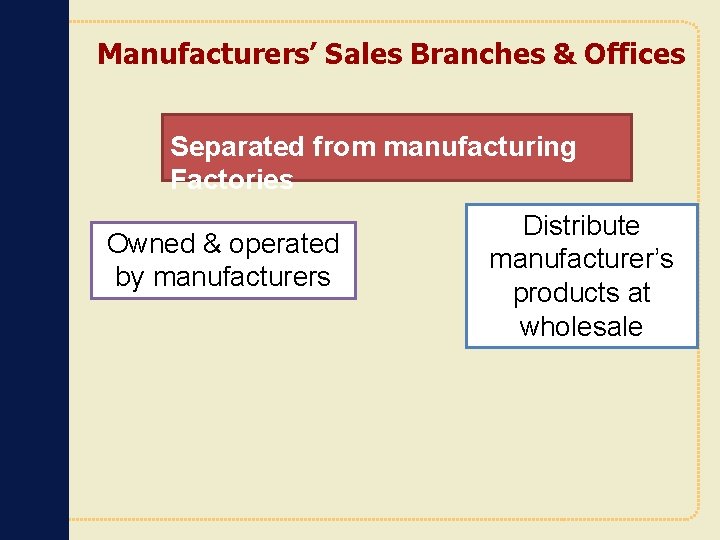
Manufacturers’ Sales Branches & Offices Separated from manufacturing Factories Owned & operated by manufacturers Distribute manufacturer’s products at wholesale © 2013 Cengage Learning. All Rights Reserved. May not be scanned, copied or duplicated, or posted to a publicly accessible website, in whole or in part.
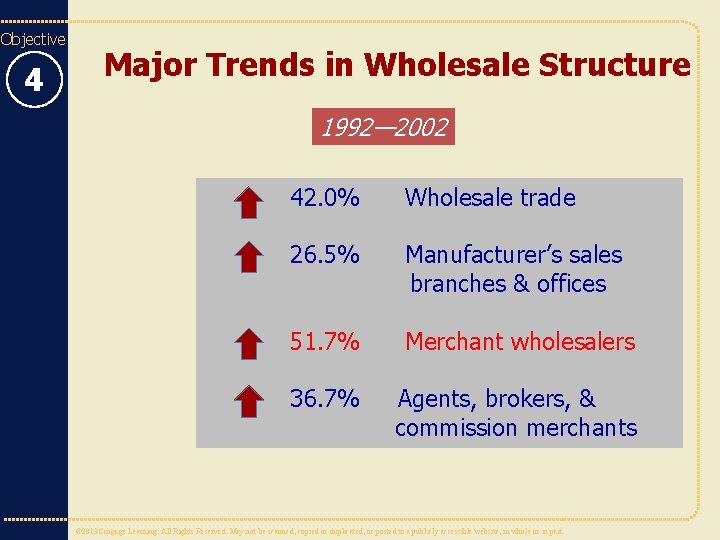
Objective 4 Major Trends in Wholesale Structure 1992— 2002 42. 0% Wholesale trade 26. 5% Manufacturer’s sales branches & offices 51. 7% Merchant wholesalers 36. 7% Agents, brokers, & commission merchants © 2013 Cengage May notnot be be scanned, copied or duplicated, or posted to a publicly accessible website, inwebsite, whole orininwhole part. or in part. © 2013 Cengage Learning. All Rights. Reserved. May scanned, copied or duplicated, or posted to a publicly
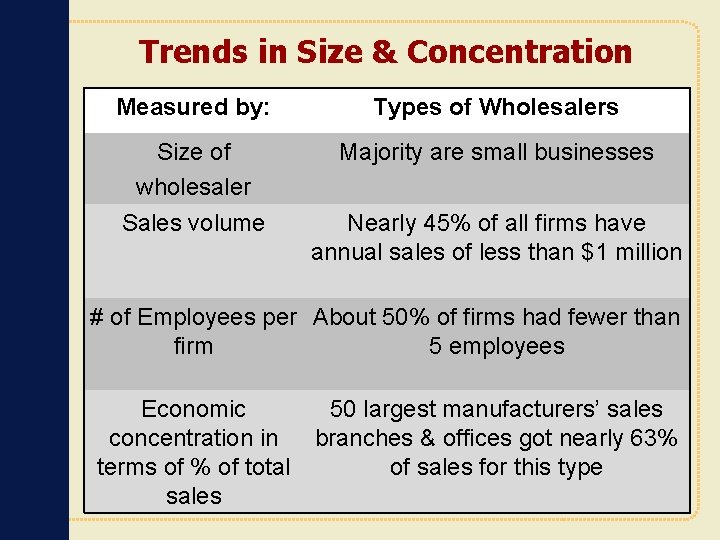
Trends in Size & Concentration Measured by: Types of Wholesalers Size of wholesaler Majority are small businesses Sales volume Nearly 45% of all firms have annual sales of less than $1 million # of Employees per About 50% of firms had fewer than firm 5 employees Economic concentration in terms of % of total sales 50 largest manufacturers’ sales branches & offices got nearly 63% of sales for this type © 2013 Cengage Learning. All Rights Reserved. May not be scanned, copied or duplicated, or posted to a publicly accessible website, in whole or in part.
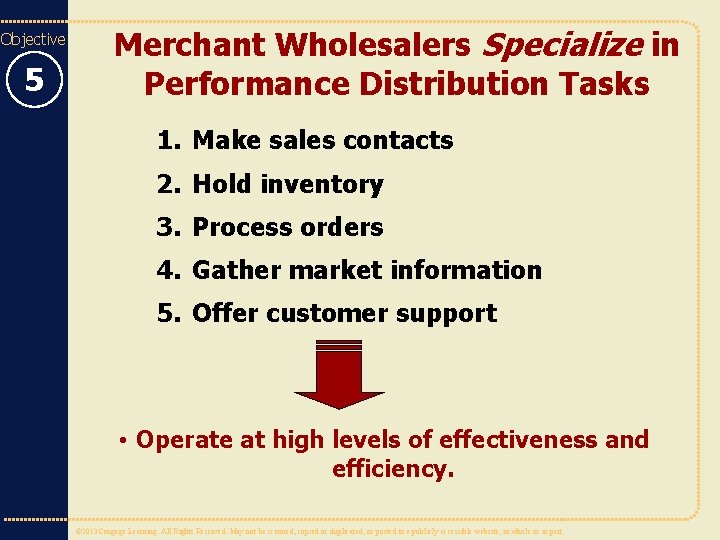
Objective 5 Merchant Wholesalers Specialize in Performance Distribution Tasks 1. Make sales contacts 2. Hold inventory 3. Process orders 4. Gather market information 5. Offer customer support • Operate at high levels of effectiveness and efficiency. © 2013 Cengage May notnot be be scanned, copied or duplicated, or posted to a publicly accessible website, inwebsite, whole orininwhole part. or in part. © 2013 Cengage Learning. All Rights. Reserved. May scanned, copied or duplicated, or posted to a publicly
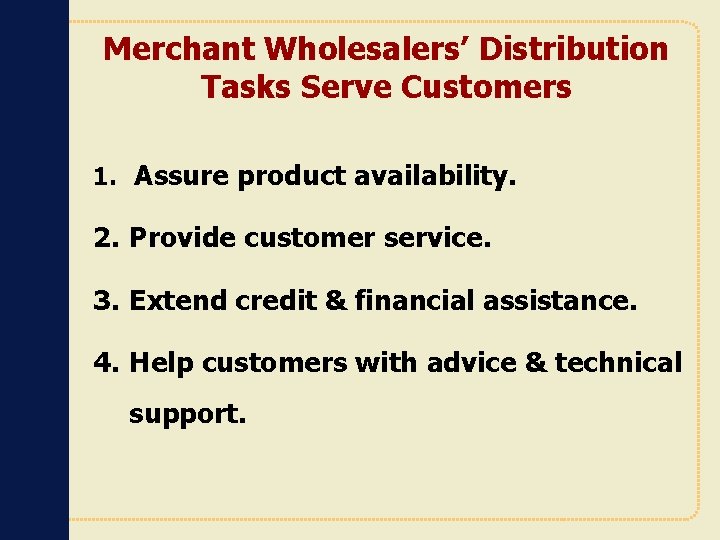
Merchant Wholesalers’ Distribution Tasks Serve Customers 1. Assure product availability. 2. Provide customer service. 3. Extend credit & financial assistance. 4. Help customers with advice & technical support. © 2013 Cengage Learning. All Rights Reserved. May not be scanned, copied or duplicated, or posted to a publicly accessible website, in whole or in part.
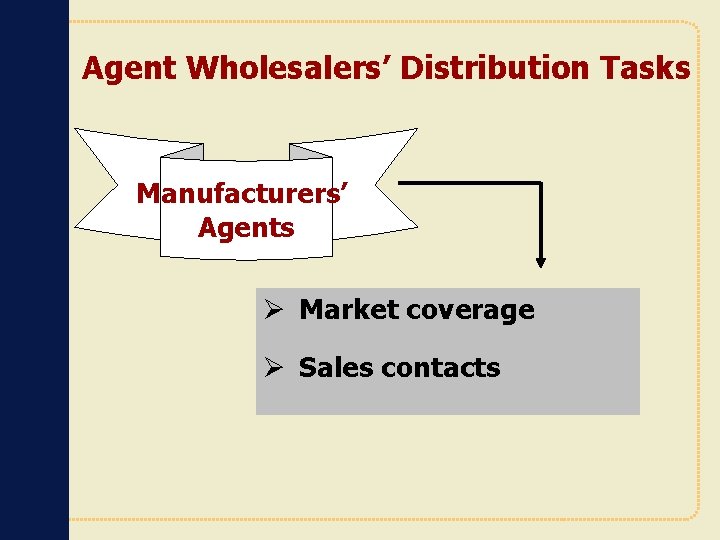
Agent Wholesalers’ Distribution Tasks Manufacturers’ Agents Ø Market coverage Ø Sales contacts © 2013 Cengage Learning. All Rights Reserved. May not be scanned, copied or duplicated, or posted to a publicly accessible website, in whole or in part.
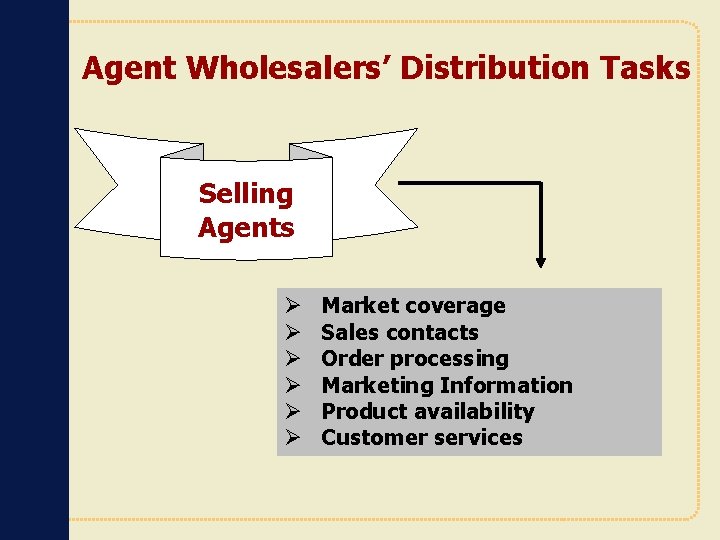
Agent Wholesalers’ Distribution Tasks Selling Agents Ø Ø Ø Market coverage Sales contacts Order processing Marketing Information Product availability Customer services © 2013 Cengage Learning. All Rights Reserved. May not be scanned, copied or duplicated, or posted to a publicly accessible website, in whole or in part.
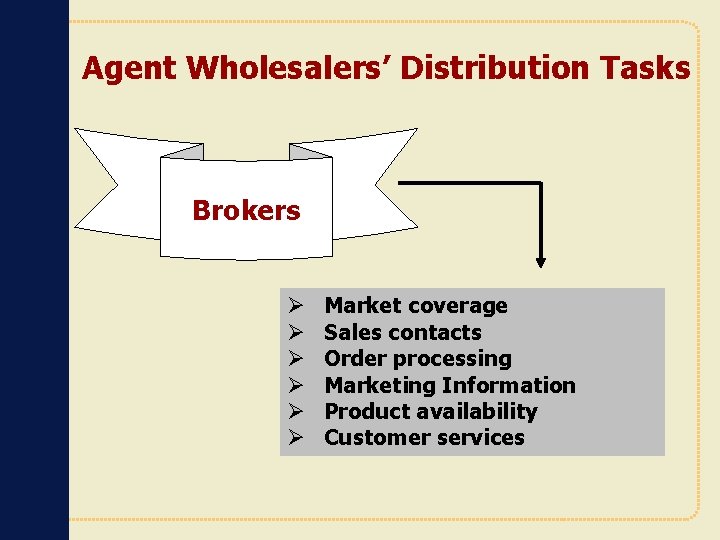
Agent Wholesalers’ Distribution Tasks Brokers Ø Ø Ø Market coverage Sales contacts Order processing Marketing Information Product availability Customer services © 2013 Cengage Learning. All Rights Reserved. May not be scanned, copied or duplicated, or posted to a publicly accessible website, in whole or in part.
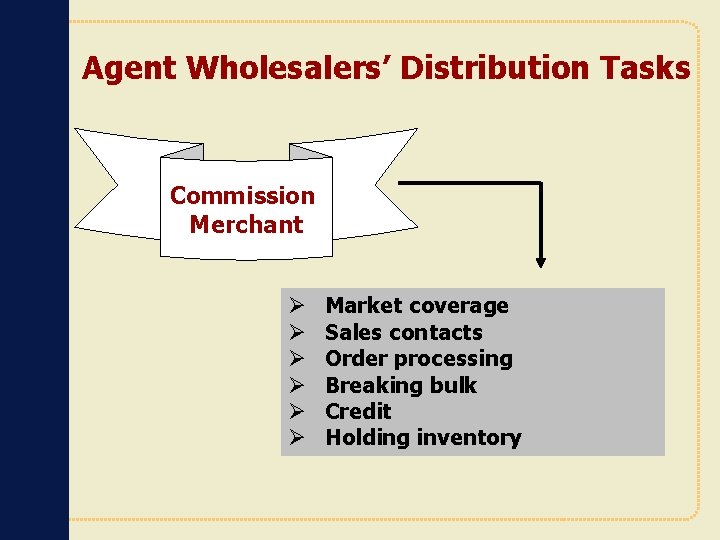
Agent Wholesalers’ Distribution Tasks Commission Merchant Ø Ø Ø Market coverage Sales contacts Order processing Breaking bulk Credit Holding inventory © 2013 Cengage Learning. All Rights Reserved. May not be scanned, copied or duplicated, or posted to a publicly accessible website, in whole or in part.
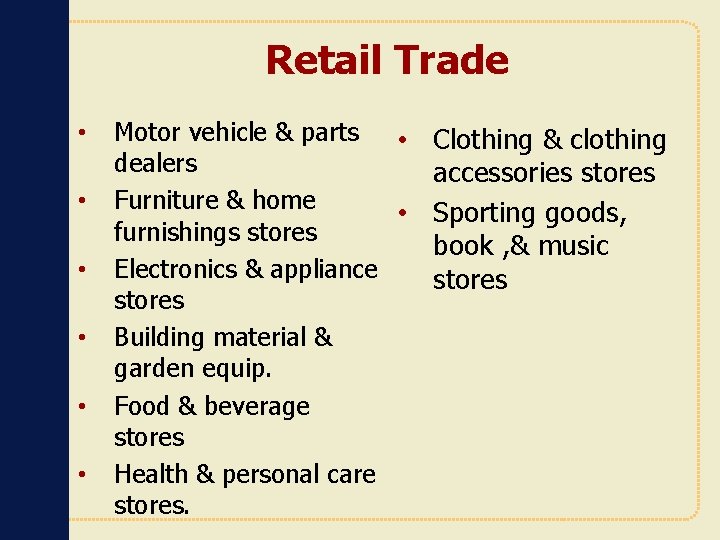
Retail Trade • • • Motor vehicle & parts • dealers Furniture & home • furnishings stores Electronics & appliance stores Building material & garden equip. Food & beverage stores Health & personal care stores. Clothing & clothing accessories stores Sporting goods, book , & music stores © 2013 Cengage Learning. All Rights Reserved. May not be scanned, copied or duplicated, or posted to a publicly accessible website, in whole or in part.
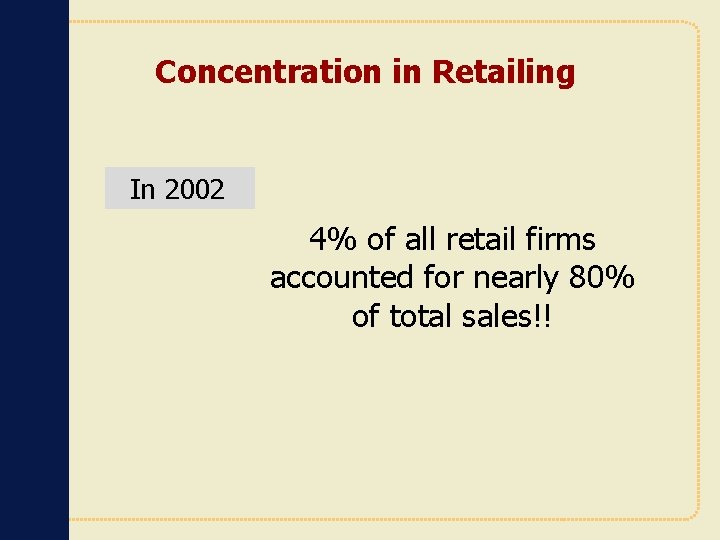
Concentration in Retailing In 2002 4% of all retail firms accounted for nearly 80% of total sales!! © 2013 Cengage Learning. All Rights Reserved. May not be scanned, copied or duplicated, or posted to a publicly accessible website, in whole or in part.
Objective 6 Distribution Tasks Performed by Retailers The role of the retailer in the distribution channel, regardless of his size or type, is to understand the demands of his customers and to find and stock the goods these customers want, when they want them, and in the way they want them. This adds up to having the right collections at the time customers are ready to buy. — Charles Y. Lazarus © 2013 Cengage May notnot be be scanned, copied or duplicated, or posted to a publicly accessible website, inwebsite, whole orininwhole part. or in part. © 2013 Cengage Learning. All Rights. Reserved. May scanned, copied or duplicated, or posted to a publicly
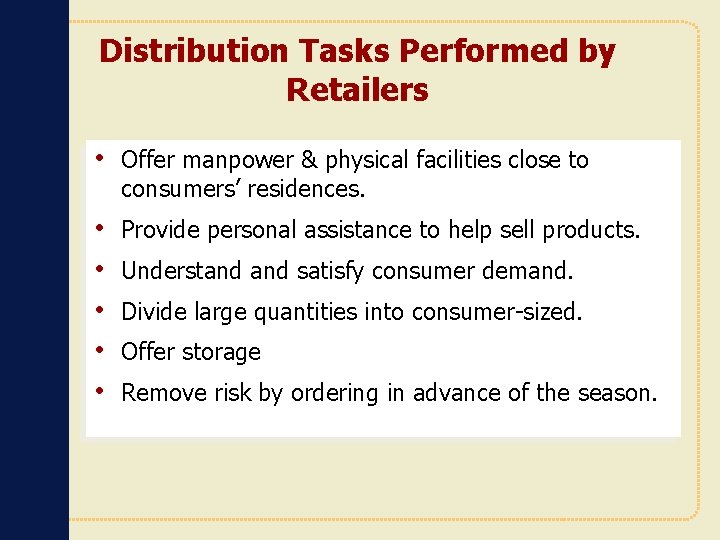
Distribution Tasks Performed by Retailers • Offer manpower & physical facilities close to consumers’ residences. • • • Provide personal assistance to help sell products. Understand satisfy consumer demand. Divide large quantities into consumer-sized. Offer storage Remove risk by ordering in advance of the season. © 2013 Cengage Learning. All Rights Reserved. May not be scanned, copied or duplicated, or posted to a publicly accessible website, in whole or in part.
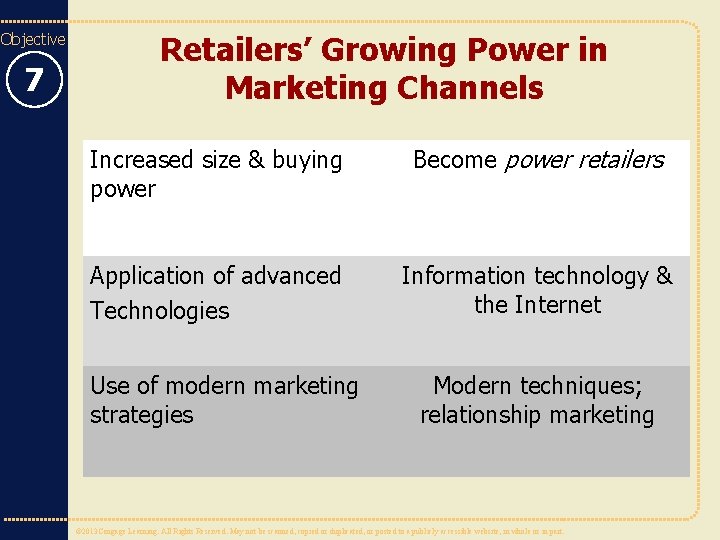
Objective 7 Retailers’ Growing Power in Marketing Channels Increased size & buying power Become power retailers Application of advanced Technologies Information technology & the Internet Use of modern marketing strategies Modern techniques; relationship marketing © 2013 Cengage May notnot be be scanned, copied or duplicated, or posted to a publicly accessible website, inwebsite, whole orininwhole part. or in part. © 2013 Cengage Learning. All Rights. Reserved. May scanned, copied or duplicated, or posted to a publicly
Objective 8 Facilitating Agencies in Marketing Channels • • • Transportation agencies Storage agencies Advertising agencies Financial agencies Insurance companies Marketing research firms © 2013 Cengage May notnot be be scanned, copied or duplicated, or posted to a publicly accessible website, inwebsite, whole orininwhole part. or in part. © 2013 Cengage Learning. All Rights. Reserved. May scanned, copied or duplicated, or posted to a publicly
Discussion Question #1 Orbit is the world’s leading manufacturer of gum, producing millions of packages of gum every day. It is a large, financially strong company whose manufacturing technology for producing gum is state-of-the-art. It sells its products to millions of gum-chewing consumers all over the United States and many other countries around the world. Still, Orbit has never attempted to sell its chewing gum directly to consumers, but instead uses a wide variety of intermediaries at the wholesale and retail levels. Q: Why do you suppose Orbit has chosen to use intermediaries rather than sell direct to consumers? Explain the underlying economics of the company’s policy. © 2013 Cengage Learning. All Rights Reserved. May not be scanned, copied or duplicated, or posted to a publicly accessible website, in whole or in part.