
Part 1 Learning Trajectory Approaches to Monitoring Student
- Slides: 22
Part 1: Learning Trajectory Approaches to Monitoring Student Learning Christina Schneider cschneider@nciea. org
Learning Progressions • Learning progressions are described increasingly in the literature as theoretical underpinnings for curriculum development, instruction, and assessment of learning. – description of the increasingly more sophisticated ways of reasoning in the content domain that follow one another as a student learns (Smith, Wiser, Anderson, and Krajcik, 2006) – are partly hypothetical Simon (1995) – provide the big picture of what is to be learned across a year, support instructional planning, and act as a touchstone formative assessment (Heritage, 2008).
Linking to Standards • The SLO Objective Statement, that depicts enduring understanding from the Common Core Standards, may be thought of as the learning goal • SLO Achievement Level Descriptors (ALDs) may be considered developmental learning progressions …descriptions of children's thinking and learning…and a related, conjectured route through a set of instructional tasks, " Clements and Sarama (2004) …based on related standards/indicators in lower & upper grades, and increased reasoning of standards/indicators within grade …based on research, using learning trajectory-based interpretations www. turnonccmath. net or trajectory-based curriculums such as “Building Blocks. ” The outcome of instructional tasks or assessment tasks should be the same: observable evidence of what students know and can do.
Step 1: Create the Objective Statement • Kindergarten students will apply grade-level phonics to decode and encode words.
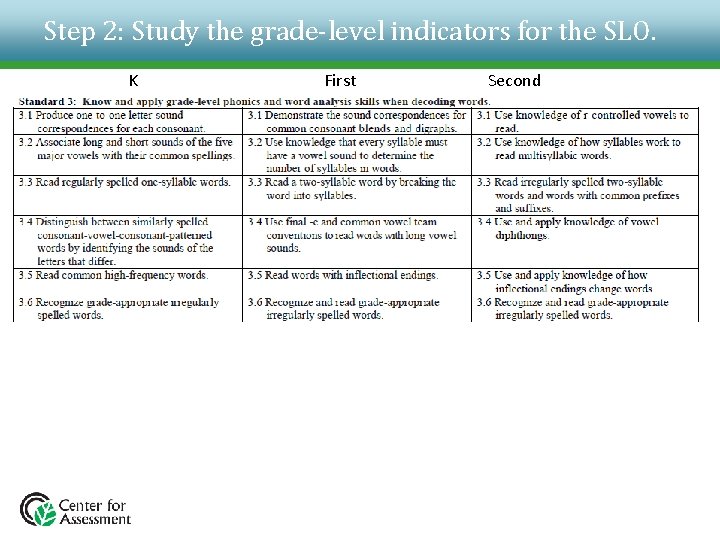
Step 2: Study the grade-level indicators for the SLO. K First Second
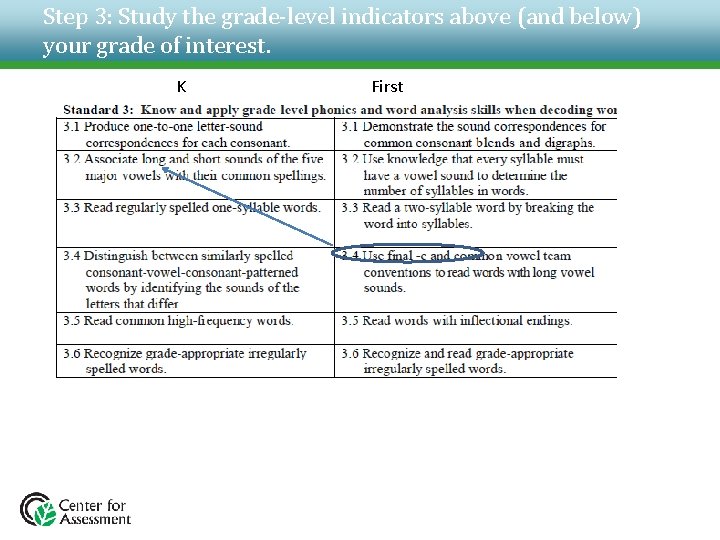
Step 3: Study the grade-level indicators above (and below) your grade of interest. K First
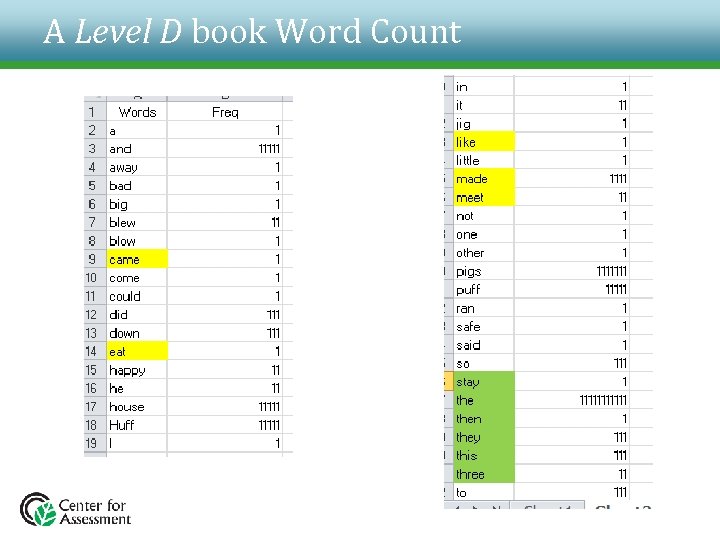
A Level D book Word Count
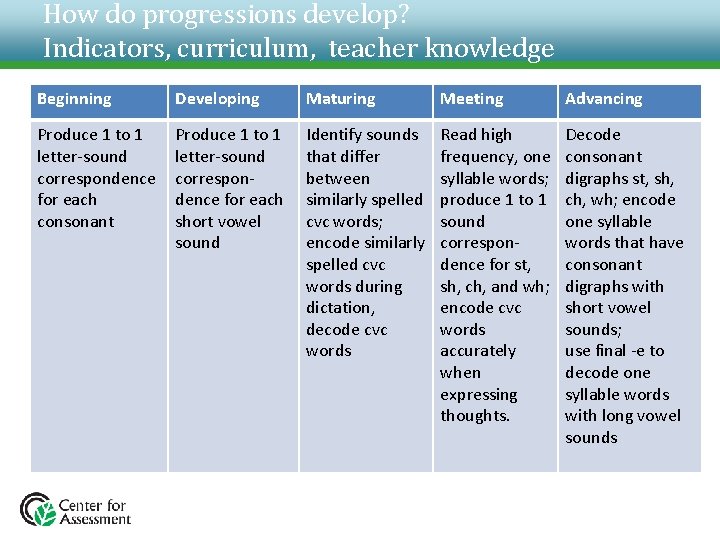
How do progressions develop? Indicators, curriculum, teacher knowledge Beginning Developing Maturing Meeting Advancing Produce 1 to 1 letter-sound correspondence for each consonant Produce 1 to 1 letter-sound correspondence for each short vowel sound Identify sounds that differ between similarly spelled cvc words; encode similarly spelled cvc words during dictation, decode cvc words Read high frequency, one syllable words; produce 1 to 1 sound correspondence for st, sh, ch, and wh; encode cvc words accurately when expressing thoughts. Decode consonant digraphs st, sh, ch, wh; encode one syllable words that have consonant digraphs with short vowel sounds; use final -e to decode one syllable words with long vowel sounds
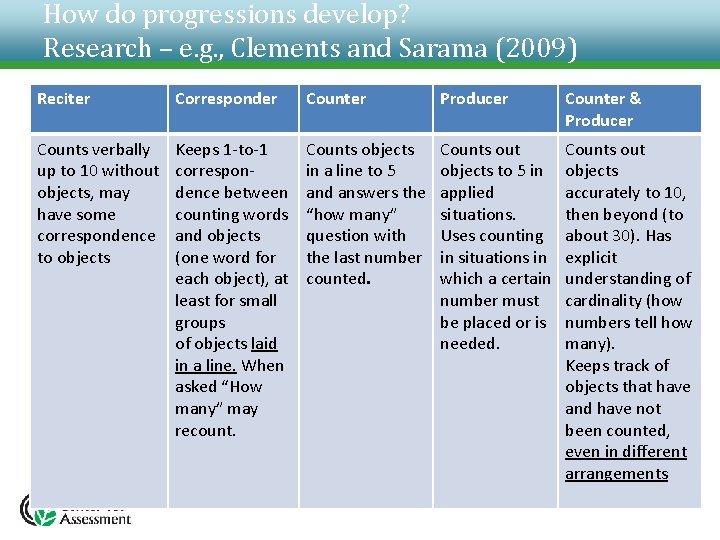
How do progressions develop? Research – e. g. , Clements and Sarama (2009) Reciter Corresponder Counter Producer Counter & Producer Counts verbally up to 10 without objects, may have some correspondence to objects Keeps 1 -to-1 correspondence between counting words and objects (one word for each object), at least for small groups of objects laid in a line. When asked “How many” may recount. Counts objects in a line to 5 and answers the “how many” question with the last number counted. Counts out objects to 5 in applied situations. Uses counting in situations in which a certain number must be placed or is needed. Counts out objects accurately to 10, then beyond (to about 30). Has explicit understanding of cardinality (how numbers tell how many). Keeps track of objects that have and have not been counted, even in different arrangements
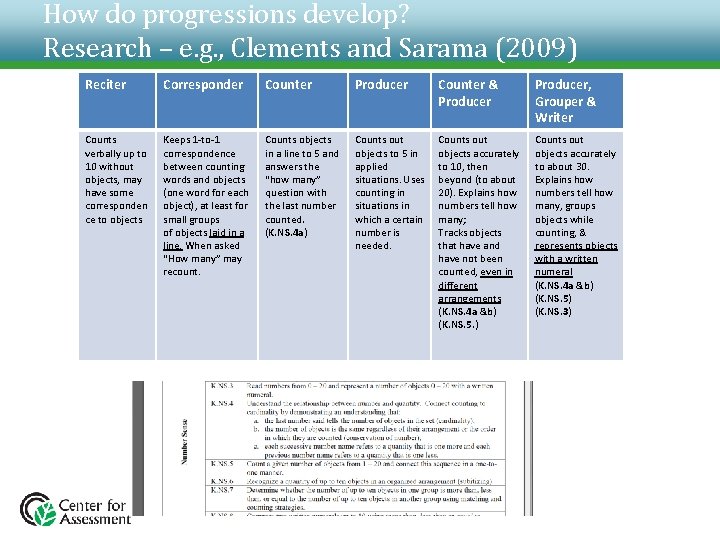
How do progressions develop? Research – e. g. , Clements and Sarama (2009) Reciter Corresponder Counter Producer Counter & Producer, Grouper & Writer Counts verbally up to 10 without objects, may have some corresponden ce to objects Keeps 1 -to-1 correspondence between counting words and objects (one word for each object), at least for small groups of objects laid in a line. When asked “How many” may recount. Counts objects in a line to 5 and answers the “how many” question with the last number counted. (K. NS. 4 a) Counts out objects to 5 in applied situations. Uses counting in situations in which a certain number is needed. Counts out objects accurately to 10, then beyond (to about 20). Explains how numbers tell how many; Tracks objects that have and have not been counted, even in different arrangements (K. NS. 4 a &b) (K. NS. 5. ) Counts out objects accurately to about 30. Explains how numbers tell how many, groups objects while counting, & represents objects with a written numeral (K. NS. 4 a &b) (K. NS. 5) (K. NS. 3)
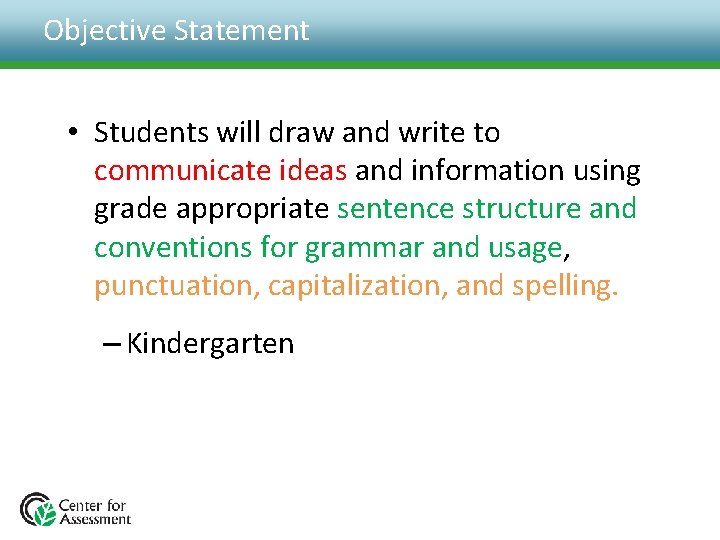
Objective Statement • Students will draw and write to communicate ideas and information using grade appropriate sentence structure and conventions for grammar and usage, punctuation, capitalization, and spelling. – Kindergarten
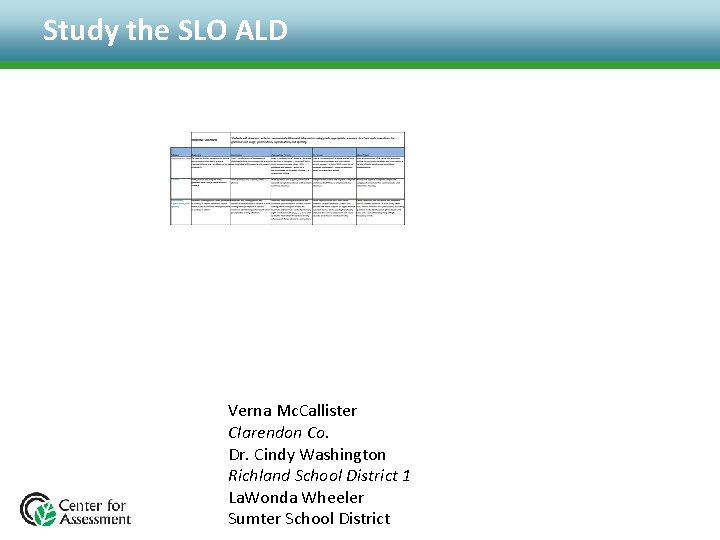
Study the SLO ALD Verna Mc. Callister Clarendon Co. Dr. Cindy Washington Richland School District 1 La. Wonda Wheeler Sumter School District
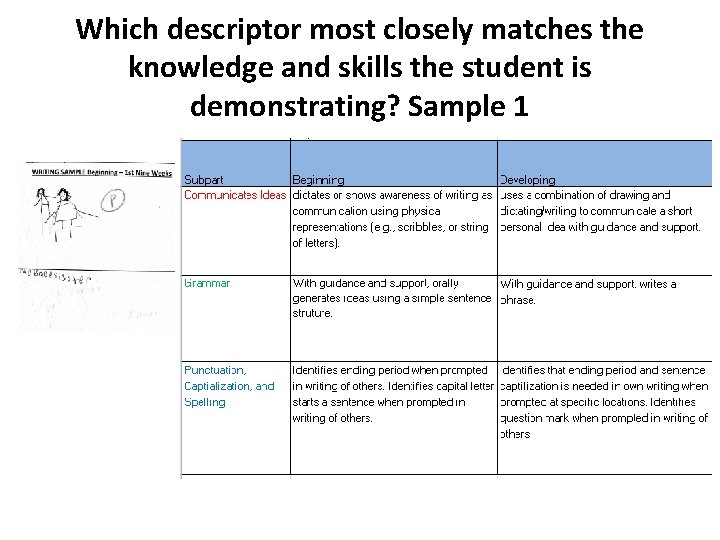
Which descriptor most closely matches the knowledge and skills the student is demonstrating? Sample 1
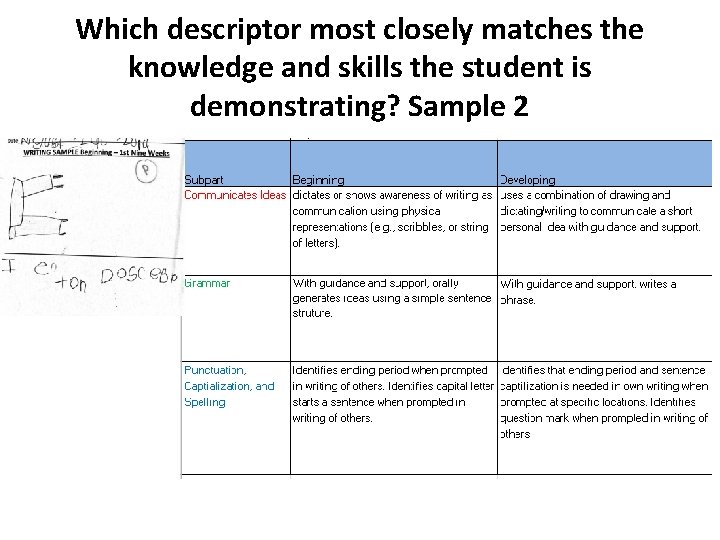
Which descriptor most closely matches the knowledge and skills the student is demonstrating? Sample 2
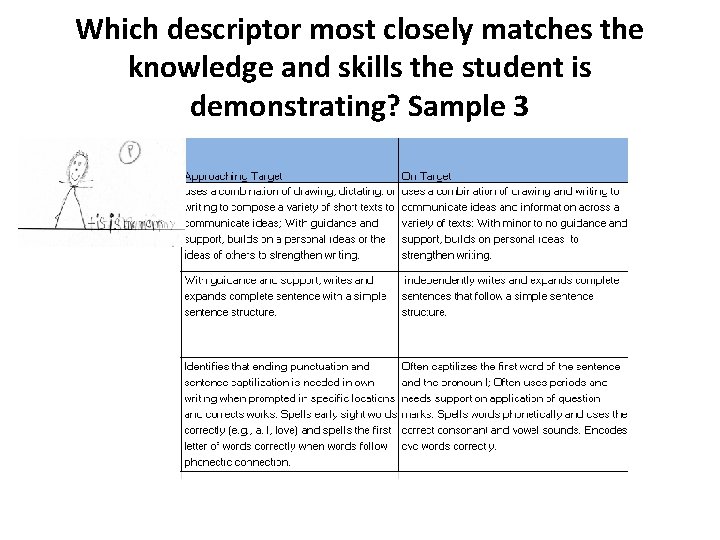
Which descriptor most closely matches the knowledge and skills the student is demonstrating? Sample 3
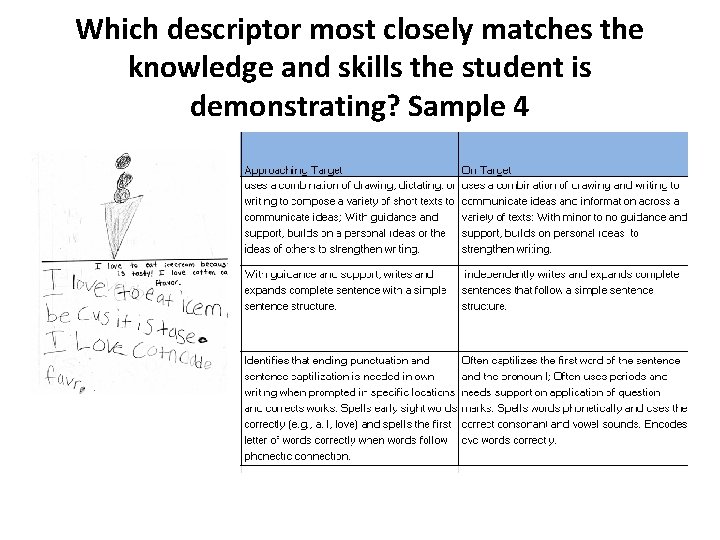
Which descriptor most closely matches the knowledge and skills the student is demonstrating? Sample 4
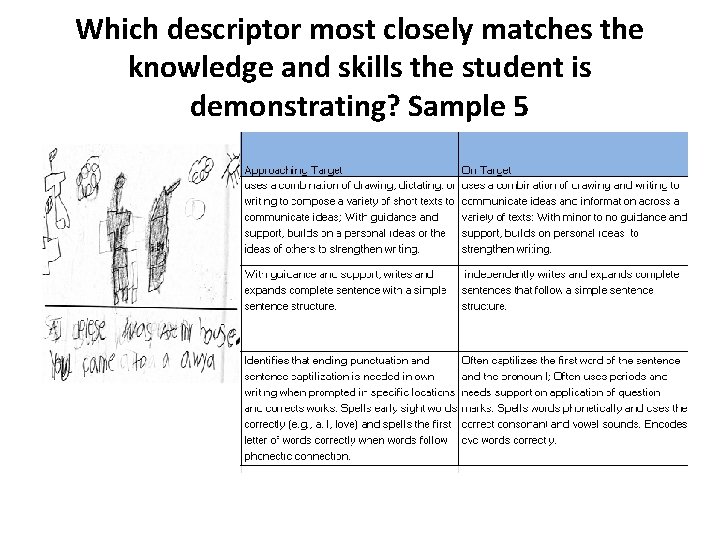
Which descriptor most closely matches the knowledge and skills the student is demonstrating? Sample 5
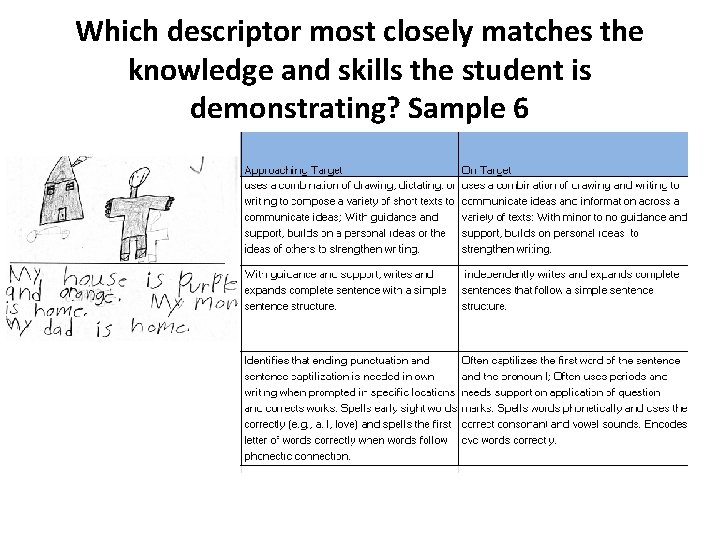
Which descriptor most closely matches the knowledge and skills the student is demonstrating? Sample 6
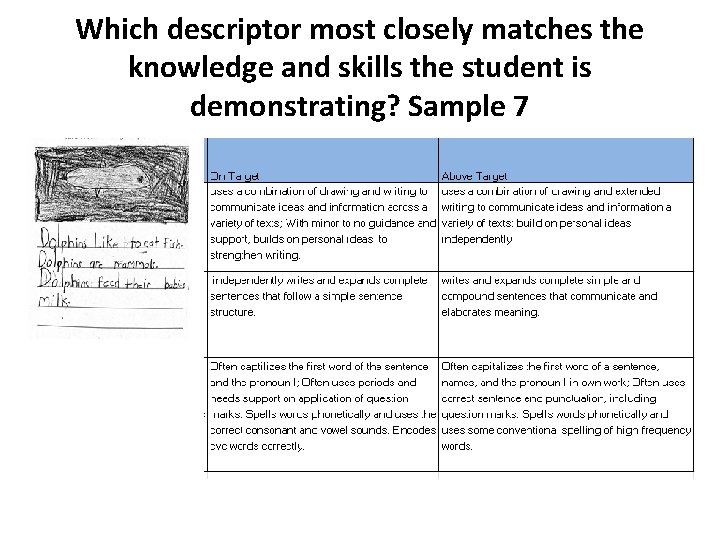
Which descriptor most closely matches the knowledge and skills the student is demonstrating? Sample 7
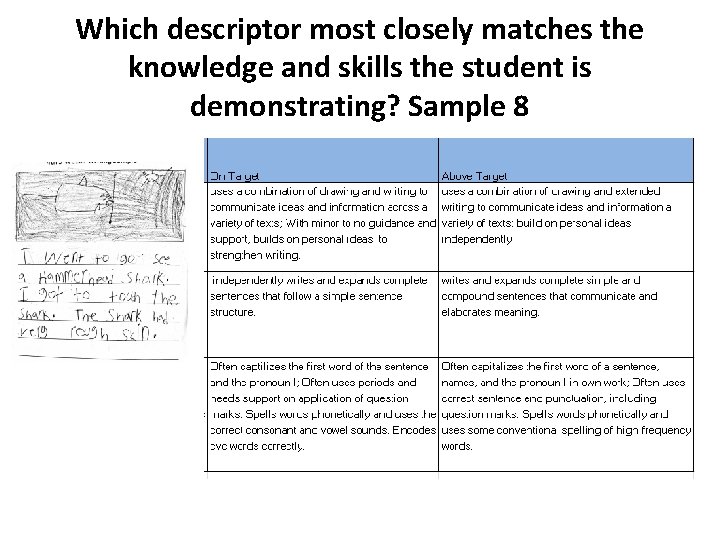
Which descriptor most closely matches the knowledge and skills the student is demonstrating? Sample 8
Additional supports – Examples from Utah • http: //www. utah. gov/pmn/files/102693. pdf – Smarter Balanced Assessment Consortium Range Achievement Level Descriptors • http: //www. smarterbalanced. org/wordpress/wpcontent/uploads/2012/11/Smarter-Balanced-ELA-Literacy. ALDs. pdf • http: //www. smarterbalanced. org/wordpress/wpcontent/uploads/2012/11/Smarter-Balanced-Math-ALDs. pdf
For more information: Center for Assessment www. nciea. org