
Part 1 Introduction Algorithms Recursion Sorting Data Structures
![Part 1 Introduction, Algorithms, Recursion, Sorting Searching/2, search 1 INPUT: A[1. . n] (un)sorted](https://slidetodoc.com/presentation_image_h2/86de51715052c87865039001cd7f0380/image-26.jpg "Part 1 Introduction, Algorithms, Recursion, Sorting Searching/2, search 1 INPUT: A[1. . n] (un)sorted")
![Part 1 Introduction, Algorithms, Recursion, Sorting Insertion Sort/2 INPUT: A[1. . n] – an](https://slidetodoc.com/presentation_image_h2/86de51715052c87865039001cd7f0380/image-68.jpg "Part 1 Introduction, Algorithms, Recursion, Sorting Insertion Sort/2 INPUT: A[1. . n] – an")
- Slides: 68
Part 1 Introduction, Algorithms, Recursion, Sorting Data Structures and Algorithms Part 1 Werner Nutt Master Informatique Data Structures and Algorithms 1
Part 1 Introduction, Algorithms, Recursion, Sorting Acknowledgments • The course follows the book “Introduction to Algorithms‘”, by Cormen, Leiserson, Rivest and Stein, MIT Press [CLRST]. Many examples displayed in these slides are taken from their book. • These slides are based on those developed by Michael Böhlen for this course. (See http: //www. inf. unibz. it/dis/teaching/DSA/) • The slides also include a number of additions made by Roberto Sebastiani and Kurt Ranalter when they taught later editions of this course (See http: //disi. unitn. it/~rseba/DIDATTICA/dsa 2011_BZ//) Master Informatique Data Structures and Algorithms 2
Part 1 Introduction, Algorithms, Recursion, Sorting DSA, Part 1: Overview • Introduction, syllabus, organisation • Algorithms • Recursion (principle, trace, factorial, Fibonacci) • Sorting (bubble, insertion, selection) Master Informatique Data Structures and Algorithms 3
Part 1 Introduction, Algorithms, Recursion, Sorting DSA, Part 1: • Introduction, syllabus, organisation • Algorithms • Recursion (principle, trace, factorial, Fibonacci) • Sorting (bubble, insertion, selection) Master Informatique Data Structures and Algorithms 4
Part 1 Introduction, Algorithms, Recursion, Sorting Learning Outcomes The main things we will learn in this course: • To think algorithmically and get the spirit of how algorithms are designed • To get to know a toolbox of classical algorithms • To learn a number of algorithm design techniques (such as divide and conquer) • To analyze (in a precise and formal way) the efficiency and the correctness of algorithms. Master Informatique Data Structures and Algorithms 5
Part 1 Introduction, Algorithms, Recursion, Sorting Syllabus (provisional) 1. Introduction, recursion (chap 1 in CLRS) 2. Correctness and complexity of algorithms (2, 3) 3. Divide and conquer, recurrences (4) 4. Heapsort, Quicksort (1) 5. Dynamic data structures, abstract data types (10) 6. Binary search trees, red black trees (12, 13) 7. Hash tables (11) 8. Dynamic programming (15) 9. Graphs: Principles and graph traversal (22) 10. Minimum spanning tree and shortest path (23, 24) Master Informatique Data Structures and Algorithms 6
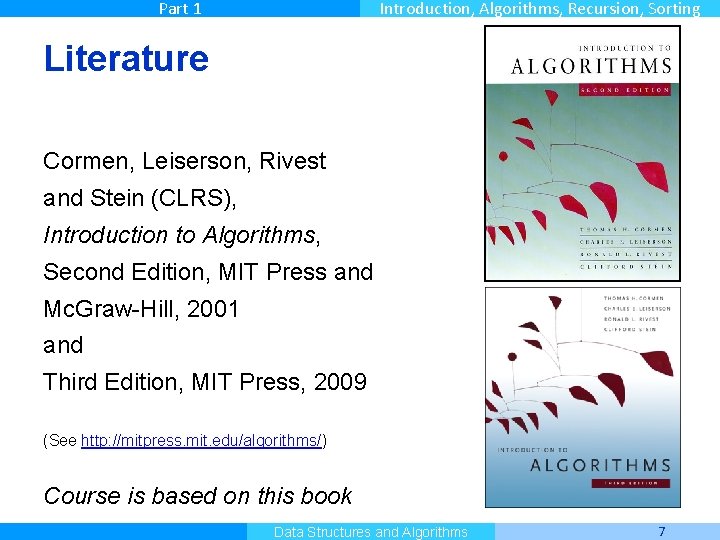
Part 1 Introduction, Algorithms, Recursion, Sorting Literature Cormen, Leiserson, Rivest and Stein (CLRS), Introduction to Algorithms, Second Edition, MIT Press and Mc. Graw Hill, 2001 and Third Edition, MIT Press, 2009 (See http: //mitpress. mit. edu/algorithms/) Course is based on this book Master Informatique Data Structures and Algorithms 7
Part 1 Introduction, Algorithms, Recursion, Sorting Other Literature Kurt Mehlhorn and Peter Sanders Algorithms and Data Structures The Basic Toolbox Offers alternate presentation of topics of the course Free download from http: //www. mpi inf. mpg. de/~mehlhorn/ftp/Mehlhorn Sanders Toolbox. pdf Master Informatique Data Structures and Algorithms 8
Part 1 Introduction, Algorithms, Recursion, Sorting Course Organization • Lectures: Mon 10: 30 12: 30, Wed 10: 30 12: 30 • Labs (provisional, starting next week) – English: Mouna Kacimi, Mouna. Kacimi@unibz. it Mon 14: 00 16: 00 – German: Simon Razniewski, razniewski@inf. unibz. it Wed 14: 00 16: 00 – Italian: Valeria Fionda, Valeria. Fionda@unibz. it Wed 14: 00 16: 00 • Home page: http: //www. inf. unibz. it/~nutt/DSA 1213/ Master Informatique Data Structures and Algorithms 9
Part 1 Introduction, Algorithms, Recursion, Sorting Assignments The assignments are a crucial part of the course • Each week an assignment has to be solved • The schedule for the publication and the handing in of the assignments will be announced at the next lecture. • A number of assignments include programming tasks. It is strongly recommended that you implement and run all programming exercises. • Assignments will be marked. The assignment mark will count towards the course mark. Master Informatique Data Structures and Algorithms 10
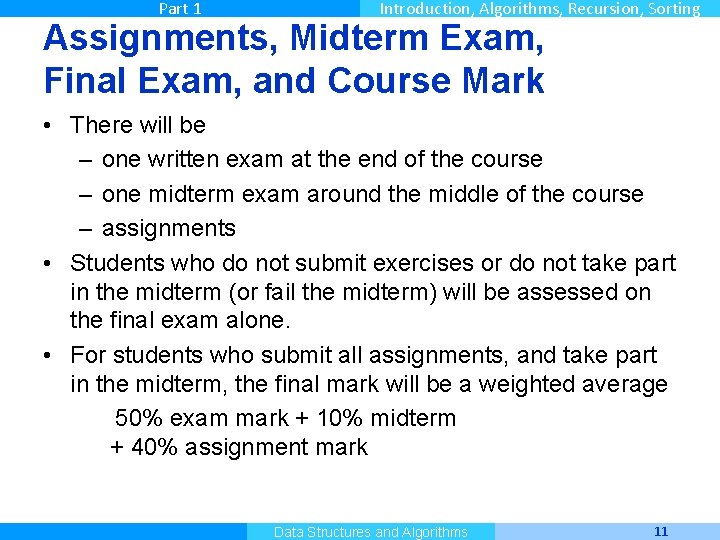
Part 1 Introduction, Algorithms, Recursion, Sorting Assignments, Midterm Exam, Final Exam, and Course Mark • There will be – one written exam at the end of the course – one midterm exam around the middle of the course – assignments • Students who do not submit exercises or do not take part in the midterm (or fail the midterm) will be assessed on the final exam alone. • For students who submit all assignments, and take part in the midterm, the final mark will be a weighted average 50% exam mark + 10% midterm + 40% assignment mark Master Informatique Data Structures and Algorithms 11
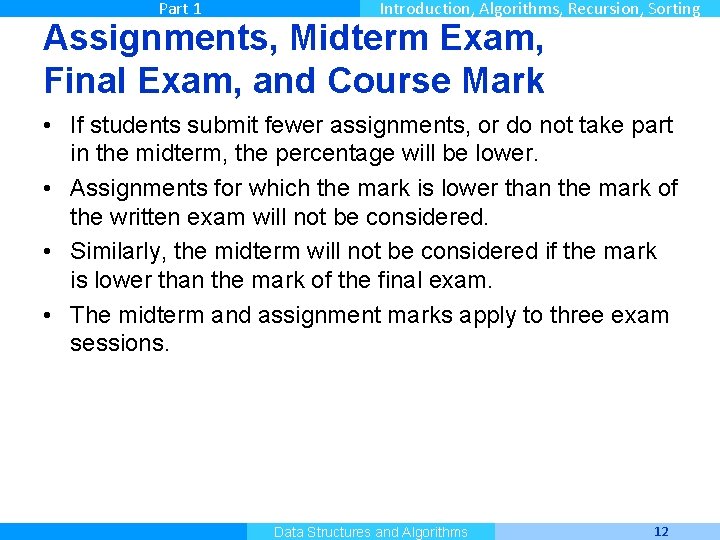
Part 1 Introduction, Algorithms, Recursion, Sorting Assignments, Midterm Exam, Final Exam, and Course Mark • If students submit fewer assignments, or do not take part in the midterm, the percentage will be lower. • Assignments for which the mark is lower than the mark of the written exam will not be considered. • Similarly, the midterm will not be considered if the mark is lower than the mark of the final exam. • The midterm and assignment marks apply to three exam sessions. Master Informatique Data Structures and Algorithms 12
Part 1 Introduction, Algorithms, Recursion, Sorting General Remarks • Algorithms are first designed on paper … and later keyed in on the computer. • The most important thing is to be simple and precise. • During lectures: – Interaction is welcome; ask questions (I will ask you anyway ) – Additional explanations and examples if desired – Speed up/slow down the progress Master Informatique Data Structures and Algorithms 13
Part 1 Introduction, Algorithms, Recursion, Sorting DSA, Part 1: • Introduction, syllabus, organisation • Algorithms • Recursion (principle, trace, factorial, Fibonacci) • Sorting (bubble, insertion, selection) Master Informatique Data Structures and Algorithms 14
Part 1 Introduction, Algorithms, Recursion, Sorting What are Algorithms About? Solving problems in everyday life • Travel from Bolzano to Munich • Cook Spaghetti alla Bolognese (I know, not in Italy, …) • Register for a Bachelor thesis at FUB For all these problems, there are • instructions • recipes • procedures, which describe a complex operation in terms of • elementary operations (“beat well …”) • control structures and conditions (“… until fluffy”) Master Informatique Data Structures and Algorithms 15
Part 1 Introduction, Algorithms, Recursion, Sorting Algorithms Problems involving numbers, strings, mathematical objects: • for two numbers, determine their sum, product, … • for two numbers, find their greatest common divisor • for a sequence of strings, find an alphabetically sorted permutation of the sequence • for two arithmetic expressions, find out if they are equivalent • for a program in Java, find an equivalent program in byte code • on a map, find for a given house the closest bus stop We call instructions, recipes, for such problems algorithms What have algorithms in common with recipes? How are they different? Master Informatique Data Structures and Algorithms 16
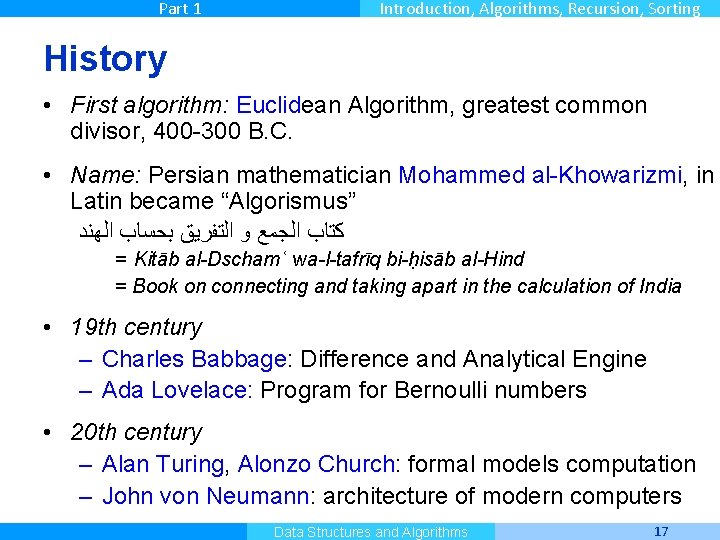
Part 1 Introduction, Algorithms, Recursion, Sorting History • First algorithm: Euclidean Algorithm, greatest common divisor, 400 300 B. C. • Name: Persian mathematician Mohammed al Khowarizmi, in Latin became “Algorismus” ﻛﺘﺎﺏ ﺍﻟﺠﻤﻊ ﻭ ﺍﻟﺘﻔﺮﻳﻖ ﺑﺤﺴﺎﺏ ﺍﻟﻬﻨﺪ = Kitāb al-Dschamʿ wa-l-tafrīq bi-ḥisāb al-Hind = Book on connecting and taking apart in the calculation of India • 19 th century – Charles Babbage: Difference and Analytical Engine – Ada Lovelace: Program for Bernoulli numbers • 20 th century – Alan Turing, Alonzo Church: formal models computation – John von Neumann: architecture of modern computers Master Informatique Data Structures and Algorithms 17
Part 1 Introduction, Algorithms, Recursion, Sorting Data Structures, Algorithms, and Programs • Data structure – Organization of data to solve the problem at hand • Algorithm – Outline, the essence of a computational procedure, step by step instructions • Program – implementation of an algorithm in some programming language Master Informatique Data Structures and Algorithms 18
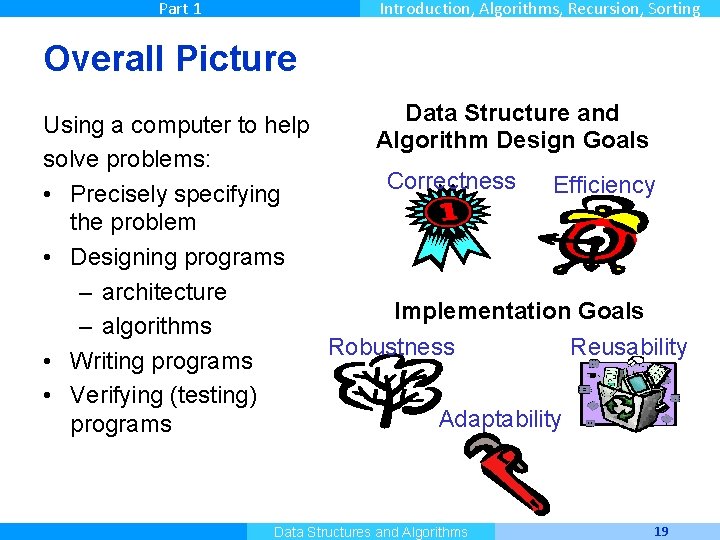
Part 1 Introduction, Algorithms, Recursion, Sorting Overall Picture Data Structure and Using a computer to help Algorithm Design Goals solve problems: Correctness Efficiency • Precisely specifying the problem • Designing programs – architecture Implementation Goals – algorithms Robustness Reusability • Writing programs • Verifying (testing) Adaptability programs Master Informatique Data Structures and Algorithms 19
Part 1 Introduction, Algorithms, Recursion, Sorting This course is not about: • Programming languages • Computer architecture • Software architecture • SW design and implementation principles We will only touch upon theory of complexity and computability. Master Informatique Data Structures and Algorithms 20
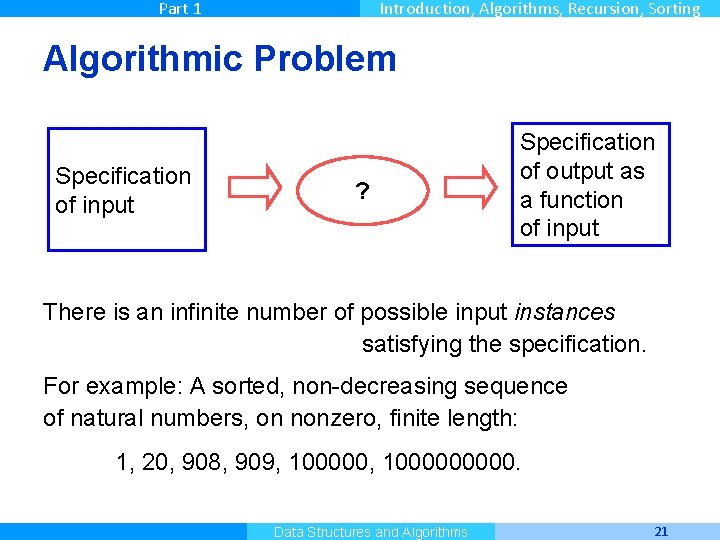
Part 1 Introduction, Algorithms, Recursion, Sorting Algorithmic Problem Specification of input ? Specification of output as a function of input There is an infinite number of possible input instances satisfying the specification. For example: A sorted, non decreasing sequence of natural numbers, on nonzero, finite length: 1, 20, 908, 909, 1000000000. Master Informatique Data Structures and Algorithms 21
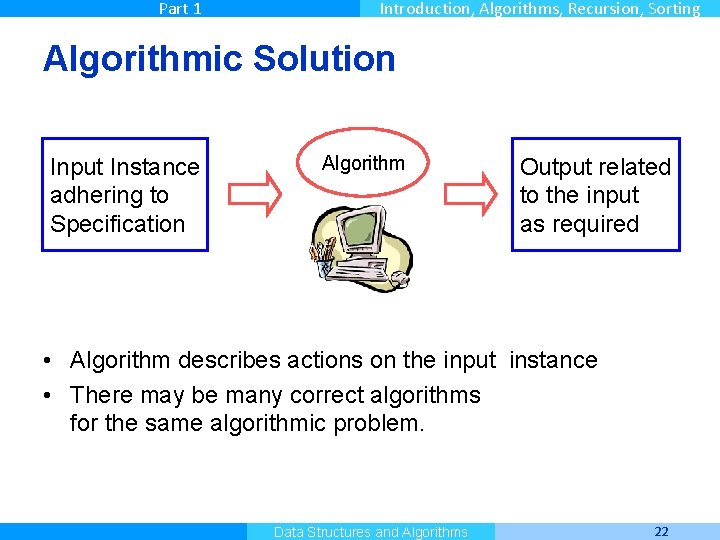
Part 1 Introduction, Algorithms, Recursion, Sorting Algorithmic Solution Input Instance adhering to Specification Algorithm Output related to the input as required • Algorithm describes actions on the input instance • There may be many correct algorithms for the same algorithmic problem. Master Informatique Data Structures and Algorithms 22
Part 1 Introduction, Algorithms, Recursion, Sorting Definition An algorithm is a sequence of unambiguous instructions for solving a problem, i. e. , • for obtaining a required output • for any legitimate input in a finite amount of time. è This presumes a mechanism to execute the algorithm Properties of algorithms: • Correctness, Termination, (Non )Determinism, Run Time, … Master Informatique Data Structures and Algorithms 23
Part 1 Introduction, Algorithms, Recursion, Sorting How to Develop an Algorithm • Precisely define the problem. Precisely specify the input and output. Consider all cases. • Come up with a simple plan to solve the problem at hand. – The plan is independent of a (programming) language – The precise problem specification influences the plan. • Turn the plan into an implementation – The problem representation (data structure) influences the implementation Master Informatique Data Structures and Algorithms 24
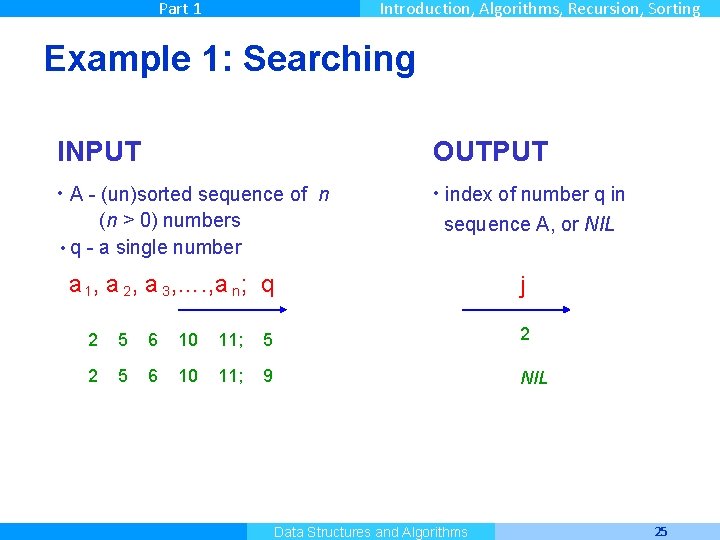
Part 1 Introduction, Algorithms, Recursion, Sorting Example 1: Searching INPUT OUTPUT • A (un)sorted sequence of n • index of number q in (n > 0) numbers • q a single number sequence A, or NIL a 1 , a 2 , a 3 , …. , a n ; q j 2 5 6 10 11; 5 2 2 5 6 10 11; 9 NIL Master Informatique Data Structures and Algorithms 25
Part 1 Introduction, Algorithms, Recursion, Sorting Searching/2, search 1 INPUT: A[1. . n] (un)sorted array of integers, q an integer. OUTPUT: index j such that A[j]=q or NIL if A[j] q for all j (1 j n) j : = 1 while j n and A[j] q do j++ if j n then return j else return NIL • The code is written in pseudo-code and INPUT and OUTPUT of the algorithm are specified. • The algorithm uses a brute-force technique, i. e. , scans the input sequentially. Master Informatique Data Structures and Algorithms 26
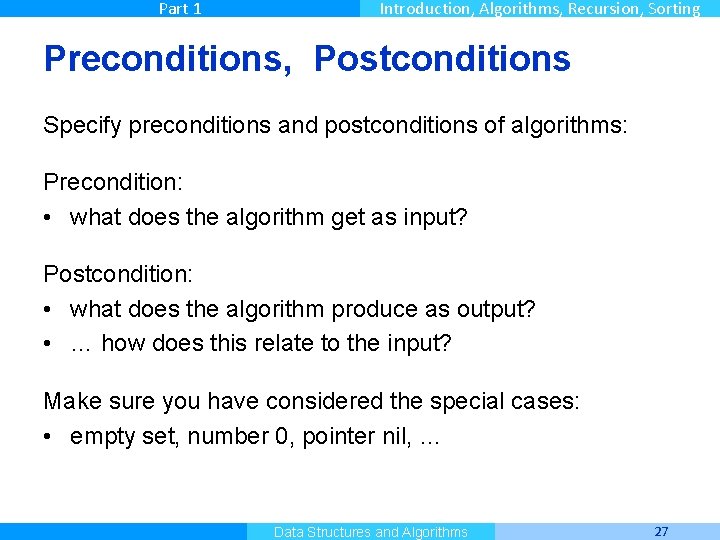
Part 1 Introduction, Algorithms, Recursion, Sorting Preconditions, Postconditions Specify preconditions and postconditions of algorithms: Precondition: • what does the algorithm get as input? Postcondition: • what does the algorithm produce as output? • … how does this relate to the input? Make sure you have considered the special cases: • empty set, number 0, pointer nil, … Master Informatique Data Structures and Algorithms 27
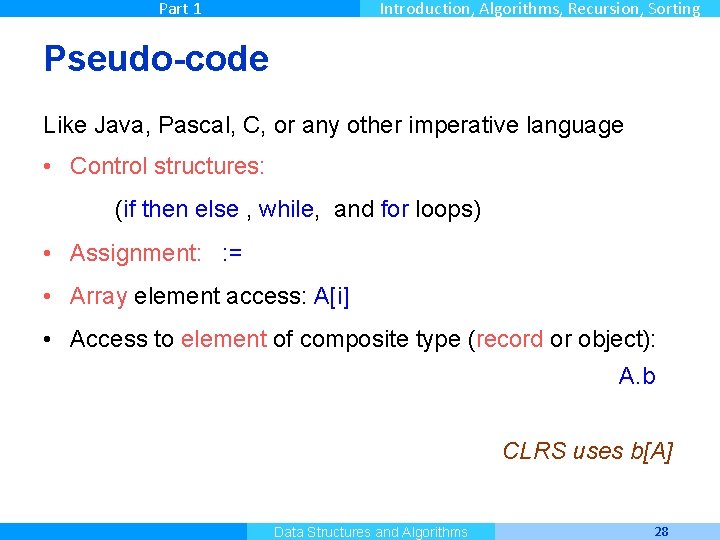
Part 1 Introduction, Algorithms, Recursion, Sorting Pseudo-code Like Java, Pascal, C, or any other imperative language • Control structures: (if then else , while, and for loops) • Assignment: : = • Array element access: A[i] • Access to element of composite type (record or object): A. b CLRS uses b[A] Master Informatique Data Structures and Algorithms 28
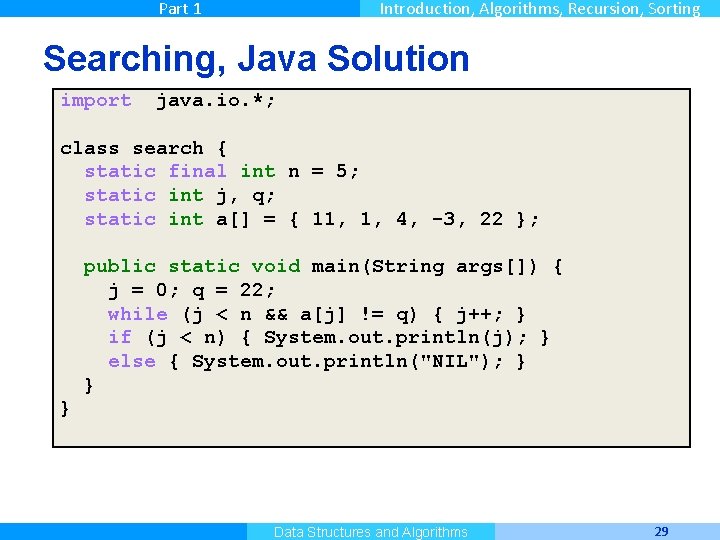
Part 1 Introduction, Algorithms, Recursion, Sorting Searching, Java Solution import java. io. *; class search { static final int n = 5; static int j, q; static int a[] = { 11, 1, 4, -3, 22 }; public static void main(String args[]) { j = 0; q = 22; while (j < n && a[j] != q) { j++; } if (j < n) { System. out. println(j); } else { System. out. println("NIL"); } } } Master Informatique Data Structures and Algorithms 29
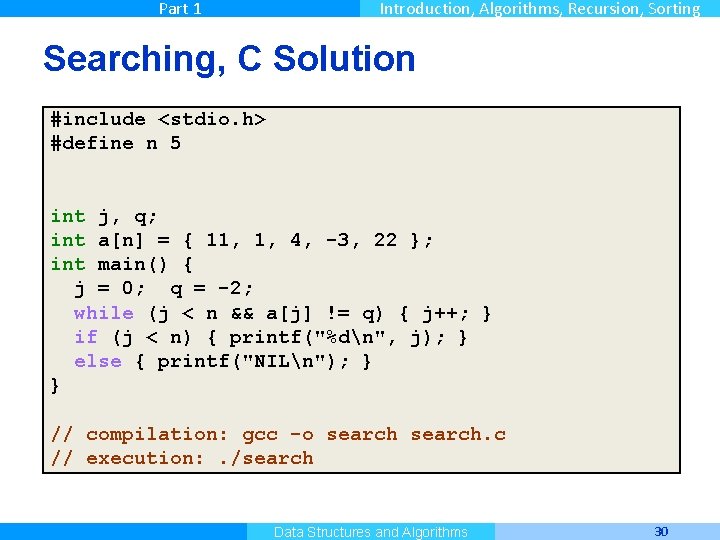
Part 1 Introduction, Algorithms, Recursion, Sorting Searching, C Solution #include <stdio. h> #define n 5 int j, q; int a[n] = { 11, 1, 4, -3, 22 }; int main() { j = 0; q = -2; while (j < n && a[j] != q) { j++; } if (j < n) { printf("%dn", j); } else { printf("NILn"); } } // compilation: gcc -o search. c // execution: . /search Master Informatique Data Structures and Algorithms 30
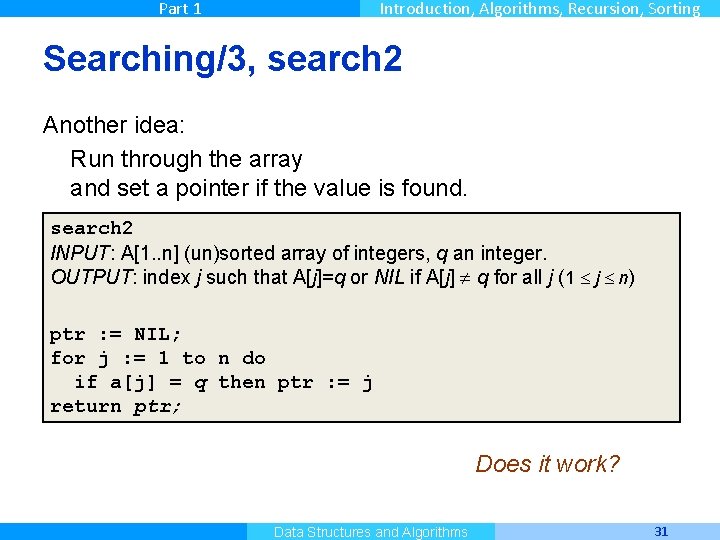
Part 1 Introduction, Algorithms, Recursion, Sorting Searching/3, search 2 Another idea: Run through the array and set a pointer if the value is found. search 2 INPUT: A[1. . n] (un)sorted array of integers, q an integer. OUTPUT: index j such that A[j]=q or NIL if A[j] q for all j (1 j n) ptr : = NIL; for j : = 1 to n do if a[j] = q then ptr : = j return ptr; Does it work? Master Informatique Data Structures and Algorithms 31
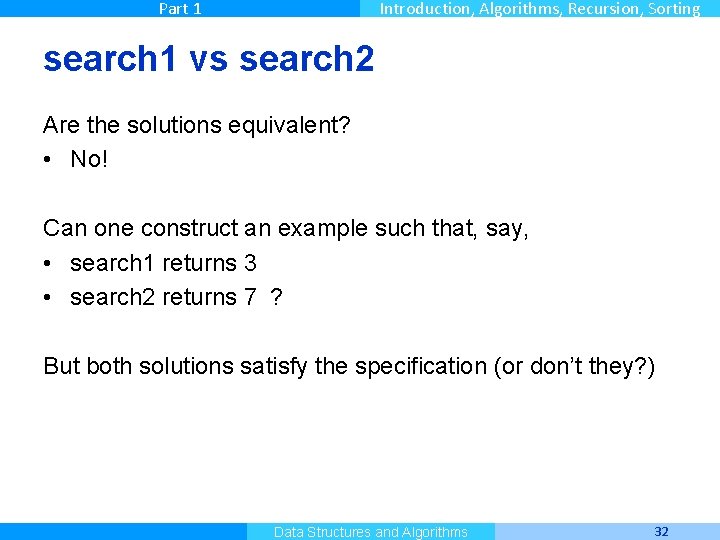
Part 1 Introduction, Algorithms, Recursion, Sorting search 1 vs search 2 Are the solutions equivalent? • No! Can one construct an example such that, say, • search 1 returns 3 • search 2 returns 7 ? But both solutions satisfy the specification (or don’t they? ) Master Informatique Data Structures and Algorithms 32
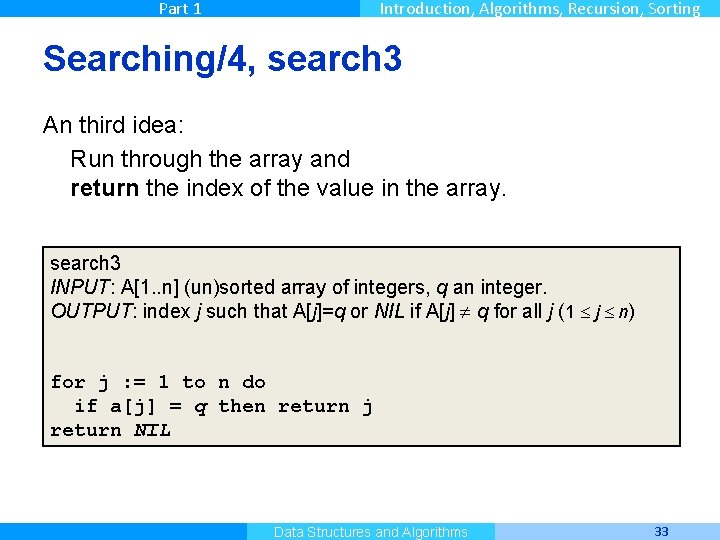
Part 1 Introduction, Algorithms, Recursion, Sorting Searching/4, search 3 An third idea: Run through the array and return the index of the value in the array. search 3 INPUT: A[1. . n] (un)sorted array of integers, q an integer. OUTPUT: index j such that A[j]=q or NIL if A[j] q for all j (1 j n) for j : = 1 to n do if a[j] = q then return j return NIL Master Informatique Data Structures and Algorithms 33
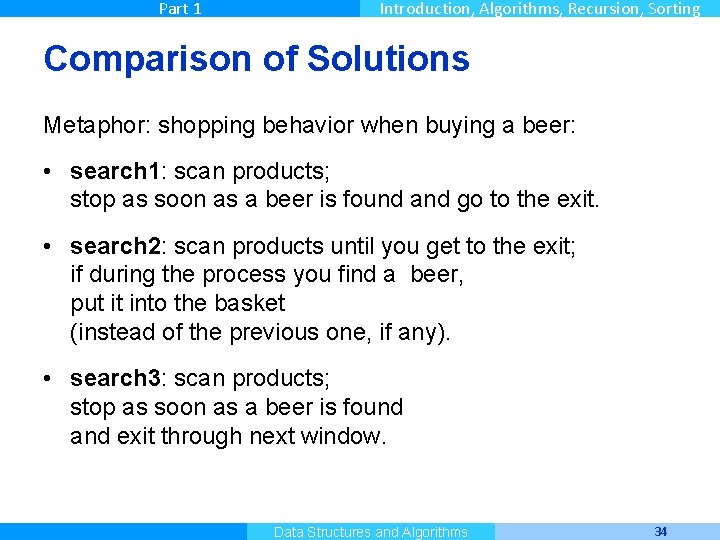
Part 1 Introduction, Algorithms, Recursion, Sorting Comparison of Solutions Metaphor: shopping behavior when buying a beer: • search 1: scan products; stop as soon as a beer is found and go to the exit. • search 2: scan products until you get to the exit; if during the process you find a beer, put it into the basket (instead of the previous one, if any). • search 3: scan products; stop as soon as a beer is found and exit through next window. Master Informatique Data Structures and Algorithms 34
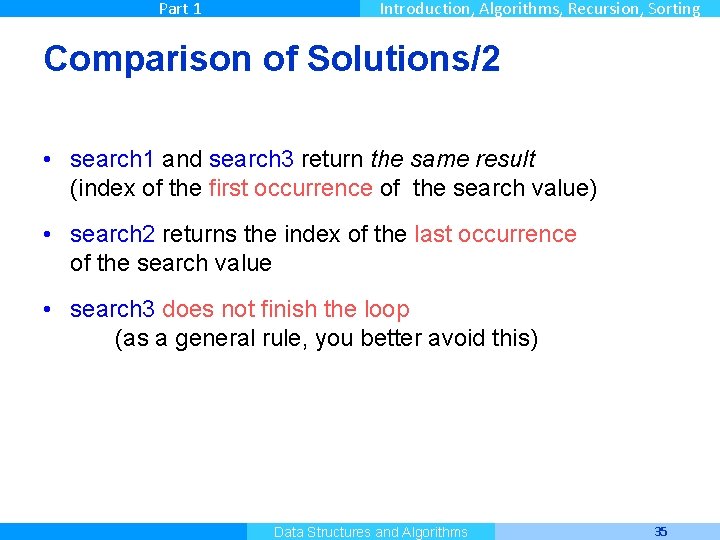
Part 1 Introduction, Algorithms, Recursion, Sorting Comparison of Solutions/2 • search 1 and search 3 return the same result (index of the first occurrence of the search value) • search 2 returns the index of the last occurrence of the search value • search 3 does not finish the loop (as a general rule, you better avoid this) Master Informatique Data Structures and Algorithms 35
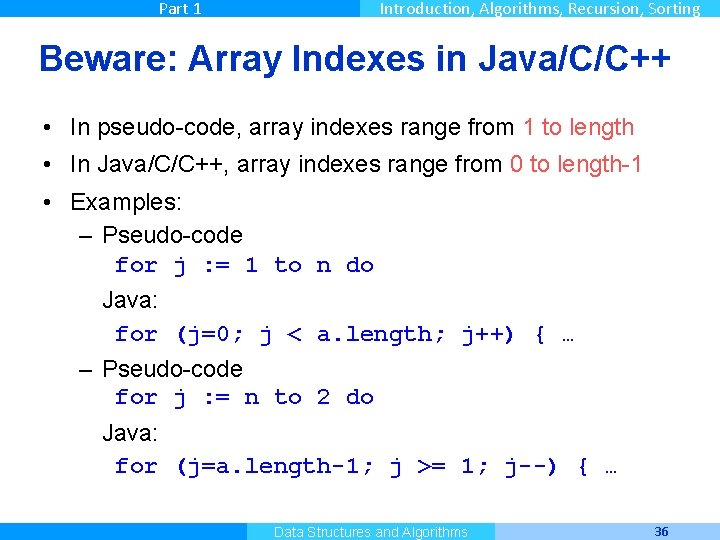
Part 1 Introduction, Algorithms, Recursion, Sorting Beware: Array Indexes in Java/C/C++ • In pseudo code, array indexes range from 1 to length • In Java/C/C++, array indexes range from 0 to length 1 • Examples: – Pseudo code for j : = 1 to n do Java: for (j=0; j < a. length; j++) { … – Pseudo code for j : = n to 2 do Java: for (j=a. length-1; j >= 1; j--) { … Master Informatique Data Structures and Algorithms 36
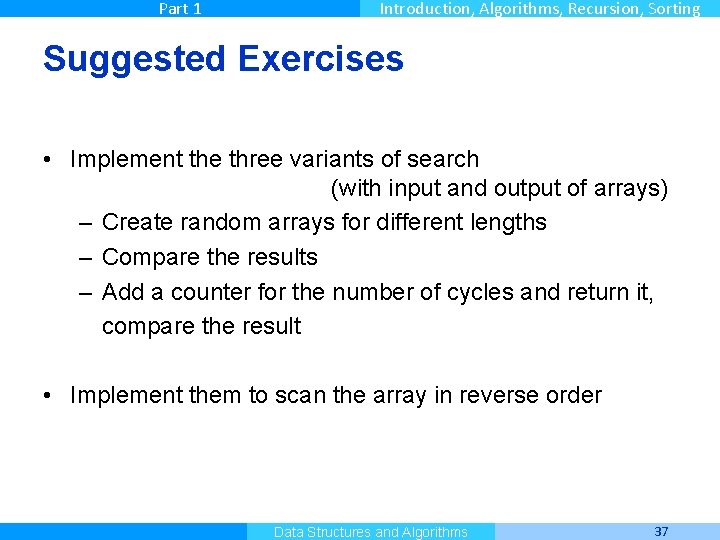
Part 1 Introduction, Algorithms, Recursion, Sorting Suggested Exercises • Implement the three variants of search (with input and output of arrays) – Create random arrays for different lengths – Compare the results – Add a counter for the number of cycles and return it, compare the result • Implement them to scan the array in reverse order Master Informatique Data Structures and Algorithms 37
Part 1 Introduction, Algorithms, Recursion, Sorting DSA, Part 1: • Introduction, syllabus, organisation • Algorithms • Recursion (principle, trace, factorial, Fibonacci) • Sorting (bubble, insertion, selection) Master Informatique Data Structures and Algorithms 38
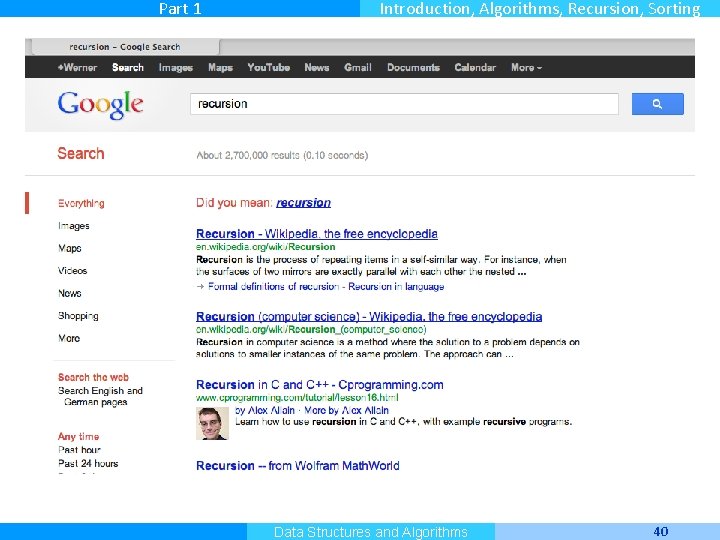
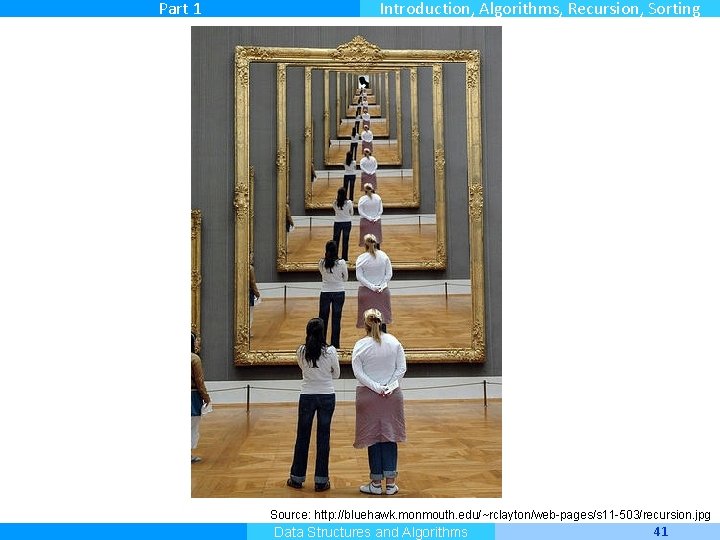
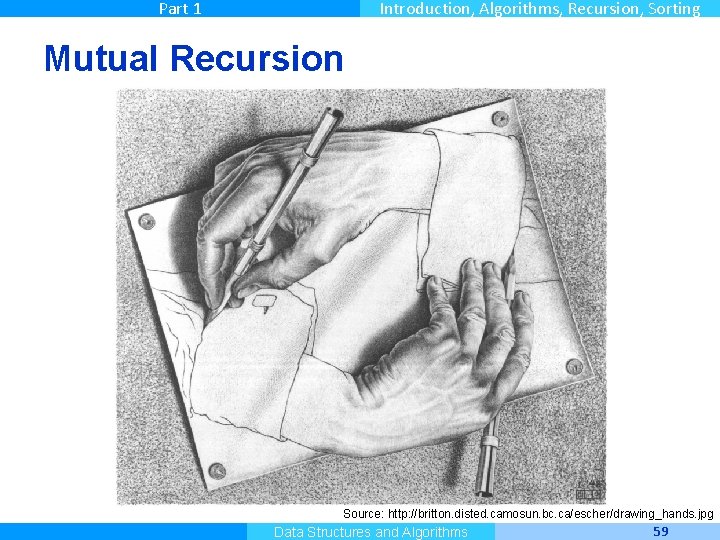
Part 1 Introduction, Algorithms, Recursion, Sorting Recursion An object is recursive if • a part of the object refers to the entire object, or • one part refers to another part and vice versa (mutual recursion) Master Informatique Data Structures and Algorithms 39
Part 1 Master Informatique Introduction, Algorithms, Recursion, Sorting Data Structures and Algorithms 40
Part 1 Introduction, Algorithms, Recursion, Sorting Source: http: //bluehawk. monmouth. edu/~rclayton/web pages/s 11 503/recursion. jpg Master Informatique Data Structures and Algorithms 41
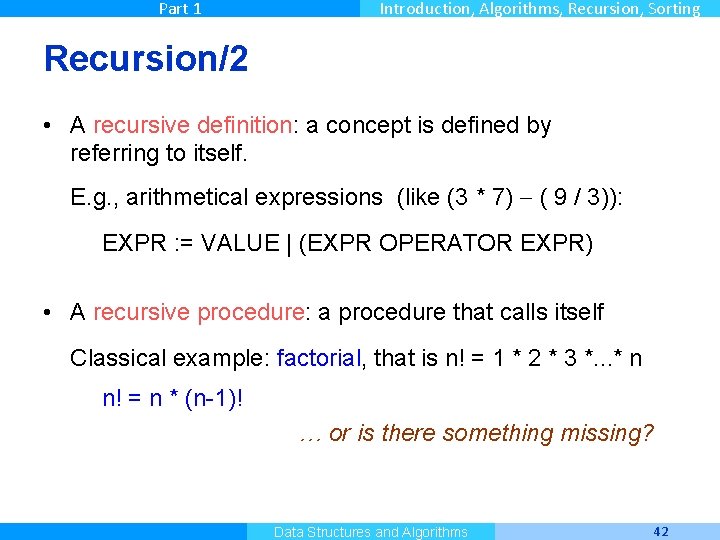
Part 1 Introduction, Algorithms, Recursion, Sorting Recursion/2 • A recursive definition: a concept is defined by referring to itself. E. g. , arithmetical expressions (like (3 * 7) ( 9 / 3)): EXPR : = VALUE | (EXPR OPERATOR EXPR) • A recursive procedure: a procedure that calls itself Classical example: factorial, that is n! = 1 * 2 * 3 *. . . * n n! = n * (n 1)! … or is there something missing? Master Informatique Data Structures and Algorithms 42
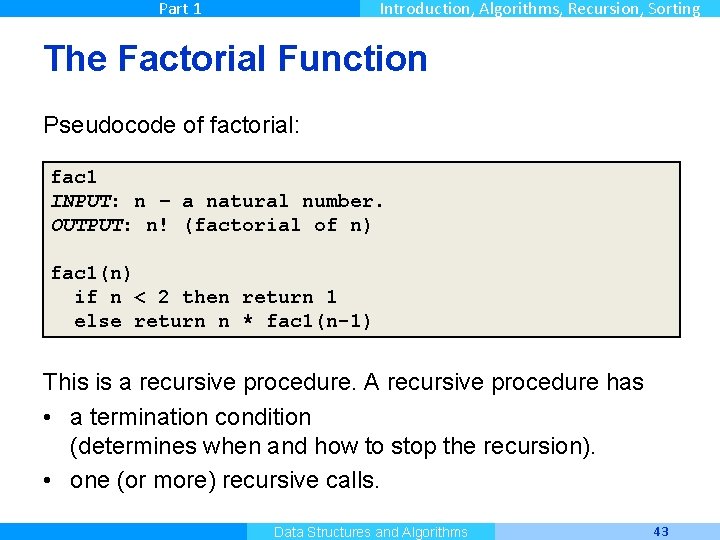
Part 1 Introduction, Algorithms, Recursion, Sorting The Factorial Function Pseudocode of factorial: fac 1 INPUT: n – a natural number. OUTPUT: n! (factorial of n) fac 1(n) if n < 2 then return 1 else return n * fac 1(n-1) This is a recursive procedure. A recursive procedure has • a termination condition (determines when and how to stop the recursion). • one (or more) recursive calls. Master Informatique Data Structures and Algorithms 43
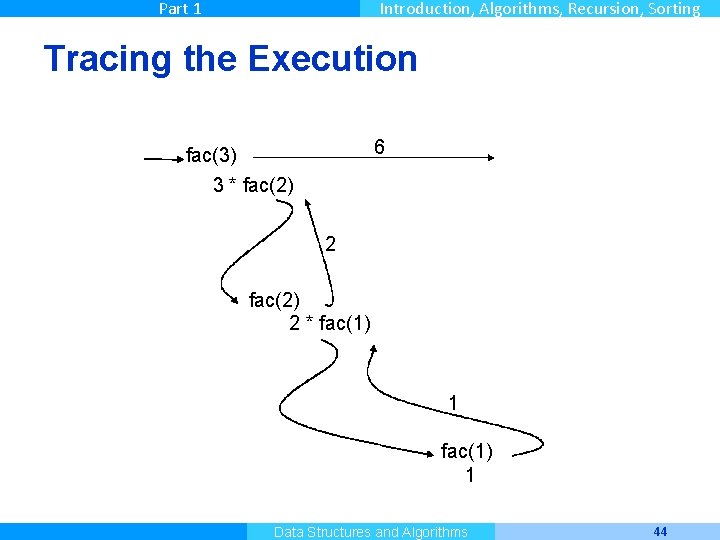
Part 1 Introduction, Algorithms, Recursion, Sorting Tracing the Execution 6 fac(3) 3 * fac(2) 2 * fac(1) 1 Master Informatique Data Structures and Algorithms 44
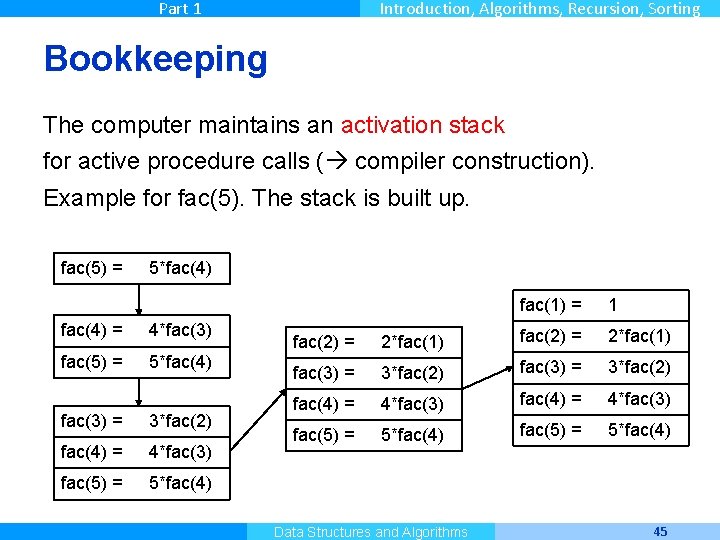
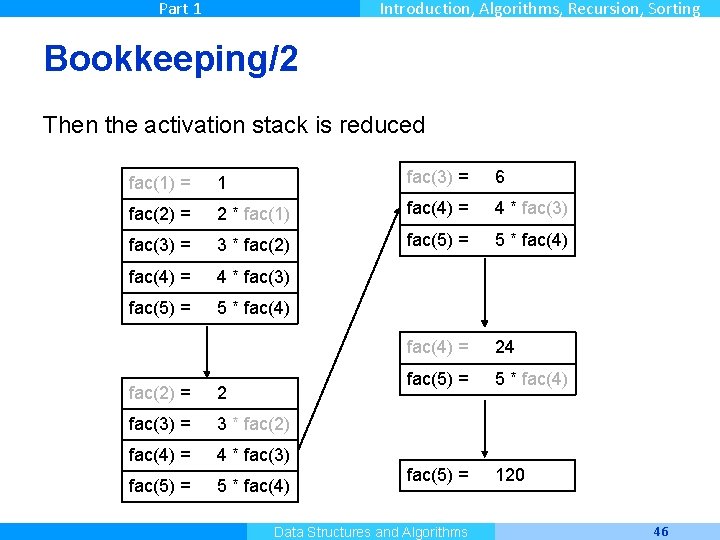
Part 1 Introduction, Algorithms, Recursion, Sorting Bookkeeping The computer maintains an activation stack for active procedure calls ( compiler construction). Example for fac(5). The stack is built up. fac(5) = 5*fac(4) = 4*fac(3) fac(5) = 5*fac(4) fac(3) = 3*fac(2) fac(4) = 4*fac(3) fac(5) = 5*fac(4) fac(1) = 1 fac(2) = 2*fac(1) fac(3) = 3*fac(2) fac(4) = 4*fac(3) fac(5) = 5*fac(4) fac(5) = Master Informatique Data Structures and Algorithms 45
Part 1 Introduction, Algorithms, Recursion, Sorting Bookkeeping/2 Then the activation stack is reduced fac(1) = 1 fac(3) = 6 fac(2) = 2 * fac(1) fac(4) = 4 * fac(3) = 3 * fac(2) fac(5) = 5 * fac(4) = 4 * fac(3) fac(5) = 5 * fac(4) = 24 fac(5) = 5 * fac(4) fac(5) = 120 fac(2) = 2 fac(3) = 3 * fac(2) fac(4) = 4 * fac(3) fac(5) = 5 * fac(4) Master Informatique Data Structures and Algorithms 46
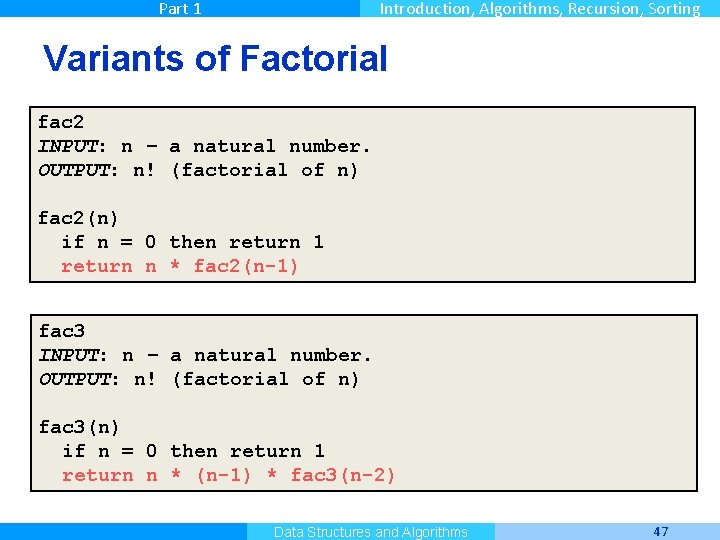
Part 1 Introduction, Algorithms, Recursion, Sorting Variants of Factorial fac 2 INPUT: n – a natural number. OUTPUT: n! (factorial of n) fac 2(n) if n = 0 then return 1 return n * fac 2(n-1) fac 3 INPUT: n – a natural number. OUTPUT: n! (factorial of n) fac 3(n) if n = 0 then return 1 return n * (n-1) * fac 3(n-2) Master Informatique Data Structures and Algorithms 47
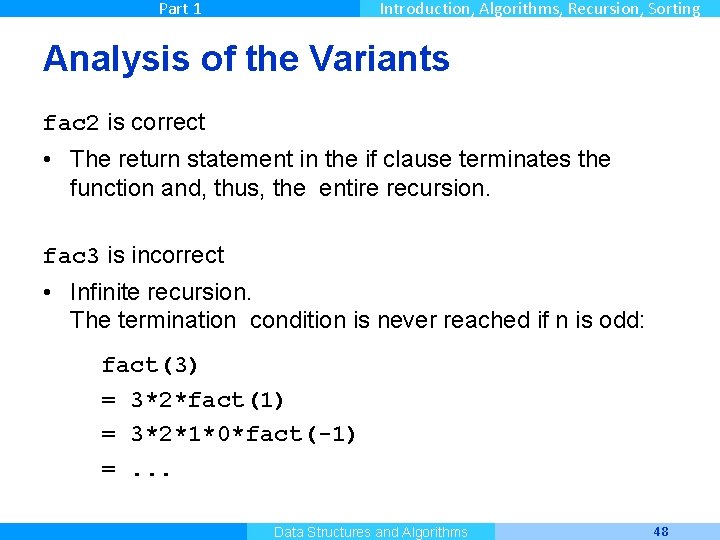
Part 1 Introduction, Algorithms, Recursion, Sorting Analysis of the Variants fac 2 is correct • The return statement in the if clause terminates the function and, thus, the entire recursion. fac 3 is incorrect • Infinite recursion. The termination condition is never reached if n is odd: fact(3) = 3*2*fact(1) = 3*2*1*0*fact(-1) =. . . Master Informatique Data Structures and Algorithms 48
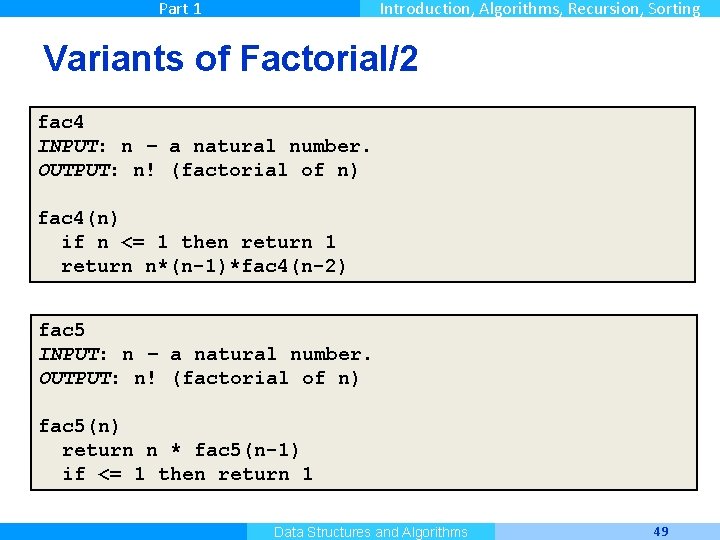
Part 1 Introduction, Algorithms, Recursion, Sorting Variants of Factorial/2 fac 4 INPUT: n – a natural number. OUTPUT: n! (factorial of n) fac 4(n) if n <= 1 then return 1 return n*(n-1)*fac 4(n-2) fac 5 INPUT: n – a natural number. OUTPUT: n! (factorial of n) fac 5(n) return n * fac 5(n-1) if <= 1 then return 1 Master Informatique Data Structures and Algorithms 49
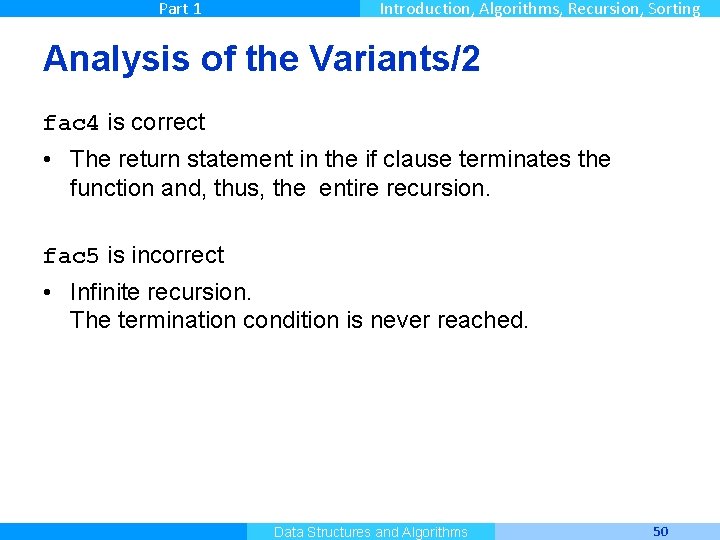
Part 1 Introduction, Algorithms, Recursion, Sorting Analysis of the Variants/2 fac 4 is correct • The return statement in the if clause terminates the function and, thus, the entire recursion. fac 5 is incorrect • Infinite recursion. The termination condition is never reached. Master Informatique Data Structures and Algorithms 50
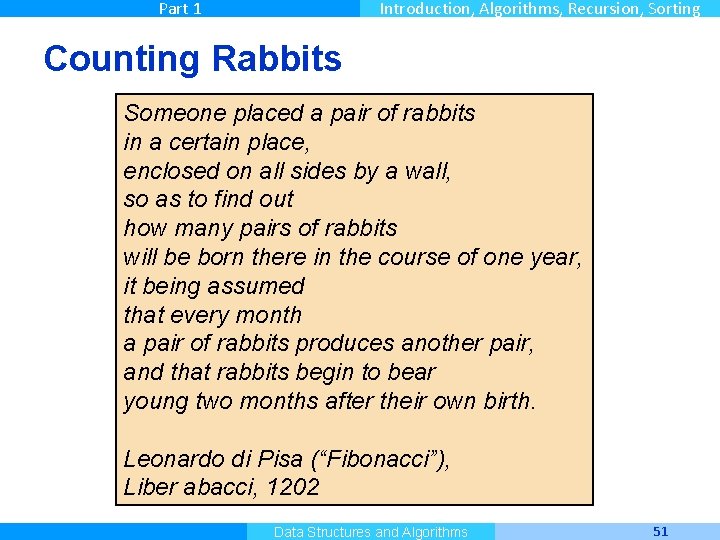
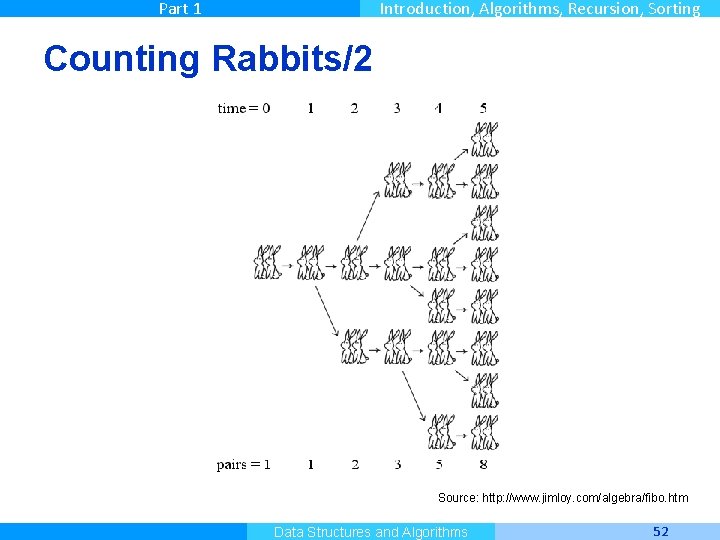
Part 1 Introduction, Algorithms, Recursion, Sorting Counting Rabbits Someone placed a pair of rabbits in a certain place, enclosed on all sides by a wall, so as to find out how many pairs of rabbits will be born there in the course of one year, it being assumed that every month a pair of rabbits produces another pair, and that rabbits begin to bear young two months after their own birth. Leonardo di Pisa (“Fibonacci”), Liber abacci, 1202 Master Informatique Data Structures and Algorithms 51
Part 1 Introduction, Algorithms, Recursion, Sorting Counting Rabbits/2 Source: http: //www. jimloy. com/algebra/fibo. htm Master Informatique Data Structures and Algorithms 52
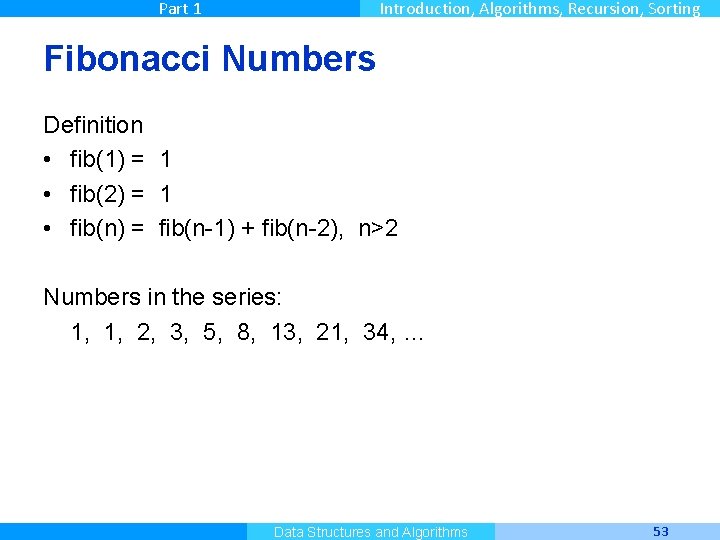
Part 1 Introduction, Algorithms, Recursion, Sorting Fibonacci Numbers Definition • fib(1) = 1 • fib(2) = 1 • fib(n) = fib(n 1) + fib(n 2), n>2 Numbers in the series: 1, 1, 2, 3, 5, 8, 13, 21, 34, … Master Informatique Data Structures and Algorithms 53
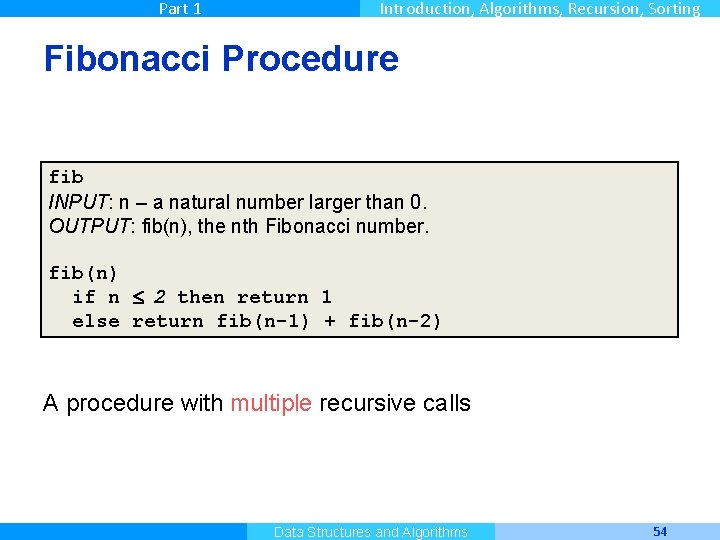
Part 1 Introduction, Algorithms, Recursion, Sorting Fibonacci Procedure fib INPUT: n – a natural number larger than 0. OUTPUT: fib(n), the nth Fibonacci number. fib(n) if n 2 then return 1 else return fib(n-1) + fib(n-2) A procedure with multiple recursive calls Master Informatique Data Structures and Algorithms 54
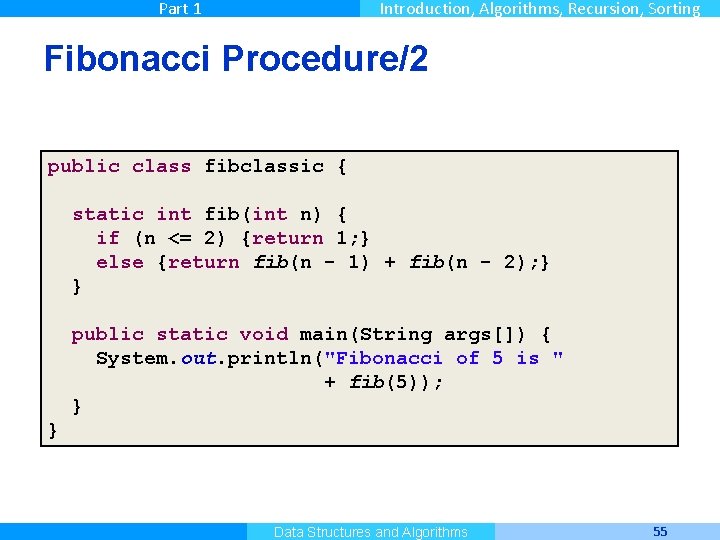
Part 1 Introduction, Algorithms, Recursion, Sorting Fibonacci Procedure/2 public class fibclassic { static int fib(int n) { if (n <= 2) {return 1; } else {return fib(n - 1) + fib(n - 2); } } public static void main(String args[]) { System. out. println("Fibonacci of 5 is " + fib(5)); } } Master Informatique Data Structures and Algorithms 55
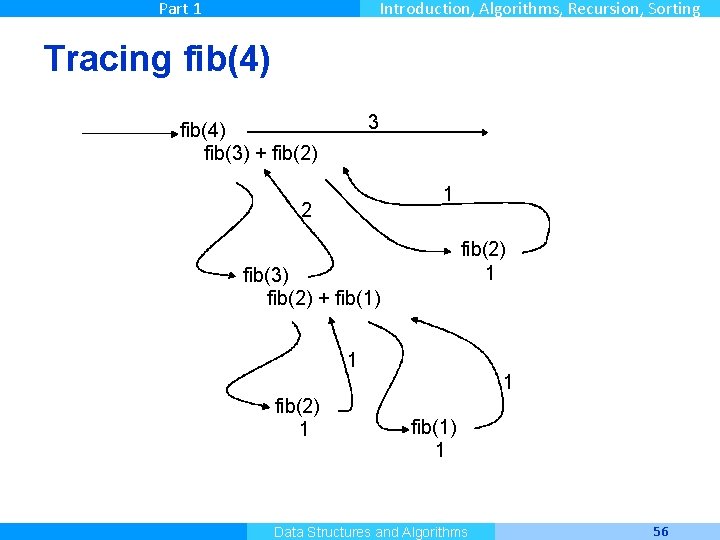
Part 1 Introduction, Algorithms, Recursion, Sorting Tracing fib(4) 3 fib(4) fib(3) + fib(2) 1 2 fib(2) 1 fib(3) fib(2) + fib(1) 1 fib(2) 1 Master Informatique 1 fib(1) 1 Data Structures and Algorithms 56
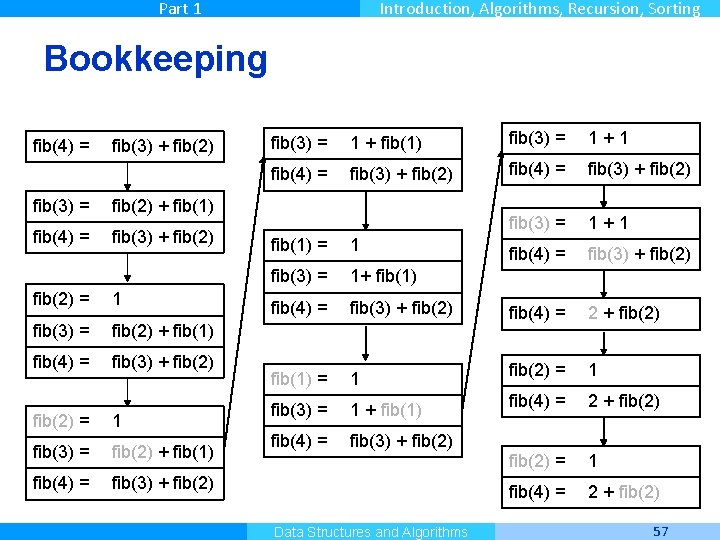
Part 1 Introduction, Algorithms, Recursion, Sorting Bookkeeping fib(4) = fib(3) + fib(2) fib(3) = fib(2) + fib(1) fib(4) = fib(3) + fib(2) = 1 fib(3) = fib(2) + fib(1) fib(4) = fib(3) + fib(2) Master Informatique fib(3) = 1 + fib(1) fib(3) = 1+1 fib(4) = fib(3) + fib(2) fib(1) = 1 fib(3) = 1+ fib(1) fib(4) = fib(3) + fib(2) fib(4) = 2 + fib(2) fib(1) = 1 fib(2) = 1 fib(3) = 1 + fib(1) fib(4) = 2 + fib(2) fib(4) = fib(3) + fib(2) = 1 fib(4) = 2 + fib(2) Data Structures and Algorithms 57
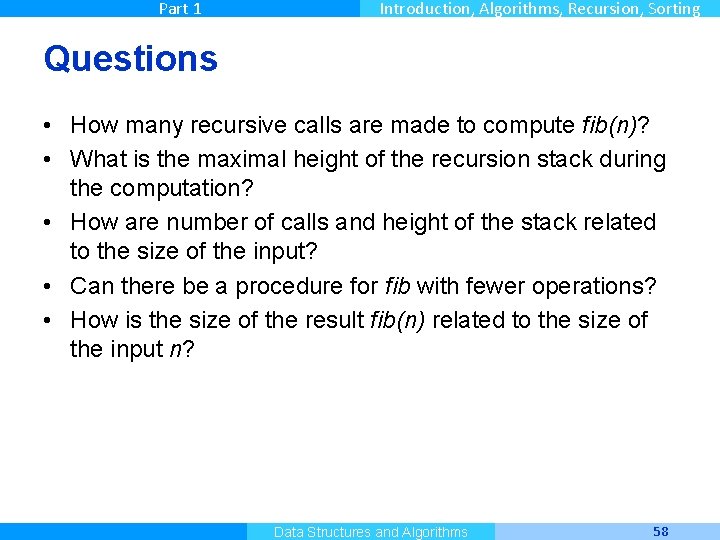
Part 1 Introduction, Algorithms, Recursion, Sorting Questions • How many recursive calls are made to compute fib(n)? • What is the maximal height of the recursion stack during the computation? • How are number of calls and height of the stack related to the size of the input? • Can there be a procedure for fib with fewer operations? • How is the size of the result fib(n) related to the size of the input n? Master Informatique Data Structures and Algorithms 58
Part 1 Introduction, Algorithms, Recursion, Sorting Mutual Recursion Source: http: //britton. disted. camosun. bc. ca/escher/drawing_hands. jpg Master Informatique Data Structures and Algorithms 59
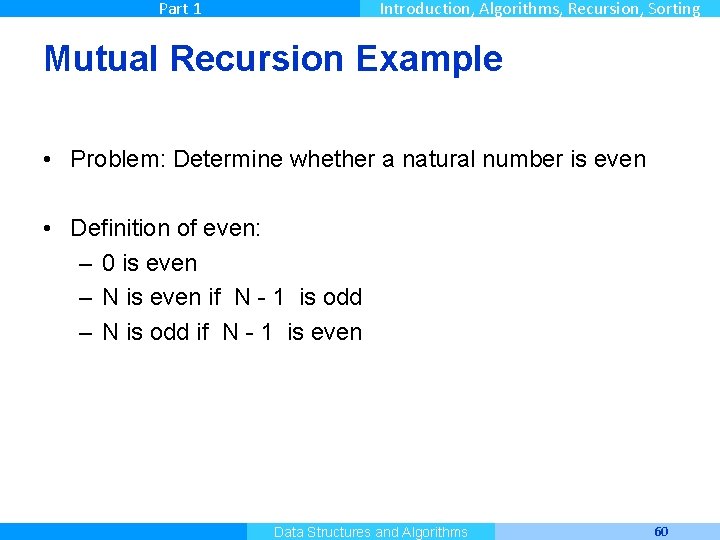
Part 1 Introduction, Algorithms, Recursion, Sorting Mutual Recursion Example • Problem: Determine whether a natural number is even • Definition of even: – 0 is even – N is even if N 1 is odd – N is odd if N 1 is even Master Informatique Data Structures and Algorithms 60
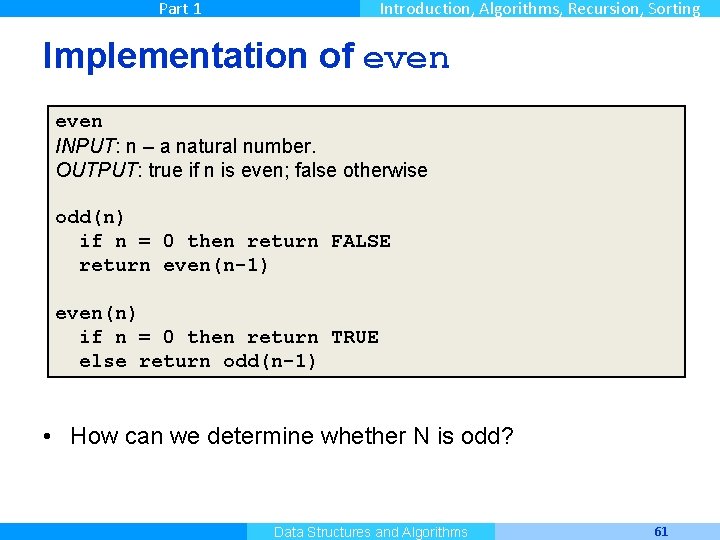
Part 1 Introduction, Algorithms, Recursion, Sorting Implementation of even INPUT: n – a natural number. OUTPUT: true if n is even; false otherwise odd(n) if n = 0 then return FALSE return even(n-1) even(n) if n = 0 then return TRUE else return odd(n-1) • How can we determine whether N is odd? Master Informatique Data Structures and Algorithms 61
Part 1 Introduction, Algorithms, Recursion, Sorting Is Recursion Necessary? • Theory: You can always resort to iteration and explicitly maintain a recursion stack. • Practice: Recursion is elegant and in some cases the best solution by far. • In the previous examples recursion was never appropriate since there exist simple iterative solutions. • Recursion is more expensive than corresponding iterative solutions since bookkeeping is necessary. Master Informatique Data Structures and Algorithms 62
Part 1 Introduction, Algorithms, Recursion, Sorting DSA, Part 1: • Introduction, syllabus, organisation • Algorithms • Recursion (principle, trace, factorial, Fibonacci) • Sorting (bubble, insertion, selection) Master Informatique Data Structures and Algorithms 63
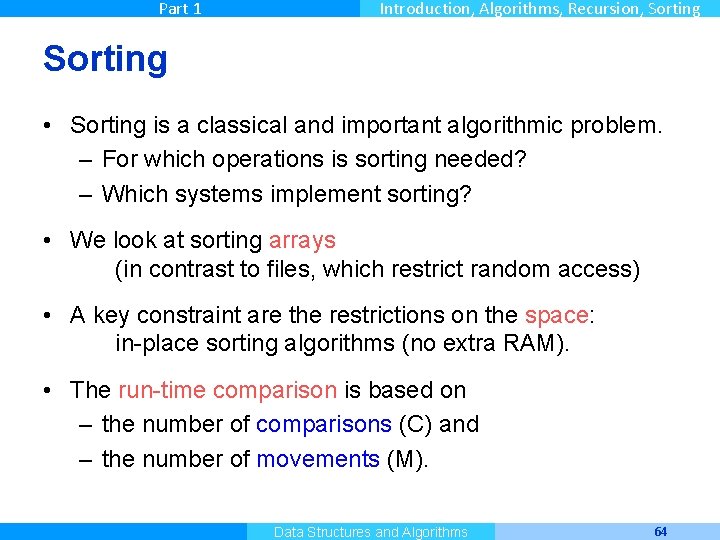
Part 1 Introduction, Algorithms, Recursion, Sorting • Sorting is a classical and important algorithmic problem. – For which operations is sorting needed? – Which systems implement sorting? • We look at sorting arrays (in contrast to files, which restrict random access) • A key constraint are the restrictions on the space: in place sorting algorithms (no extra RAM). • The run time comparison is based on – the number of comparisons (C) and – the number of movements (M). Master Informatique Data Structures and Algorithms 64
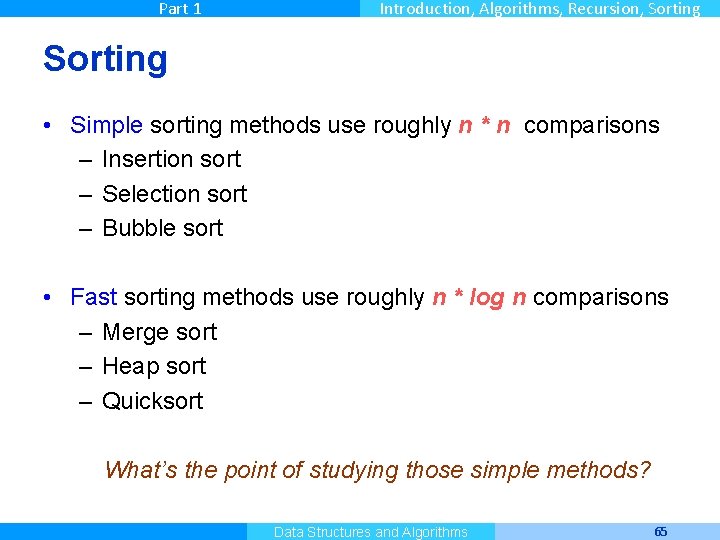
Part 1 Introduction, Algorithms, Recursion, Sorting • Simple sorting methods use roughly n * n comparisons – Insertion sort – Selection sort – Bubble sort • Fast sorting methods use roughly n * log n comparisons – Merge sort – Heap sort – Quicksort What’s the point of studying those simple methods? Master Informatique Data Structures and Algorithms 65
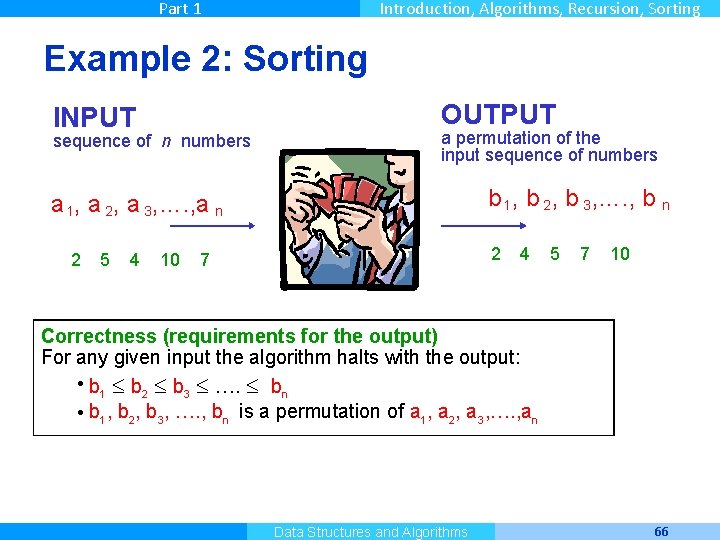
Part 1 Introduction, Algorithms, Recursion, Sorting Example 2: Sorting OUTPUT INPUT a permutation of the input sequence of numbers sequence of n numbers a 1, a 2, a 3, …. , a n 2 5 4 10 Sort b 1 , b 2 , b 3 , …. , b n 2 7 4 5 7 10 Correctness (requirements for the output) For any given input the algorithm halts with the output: • b 1 b 2 b 3 …. bn • b 1 , b 2, b 3 , …. , bn is a permutation of a 1, a 2, a 3 , …. , an Master Informatique Data Structures and Algorithms 66
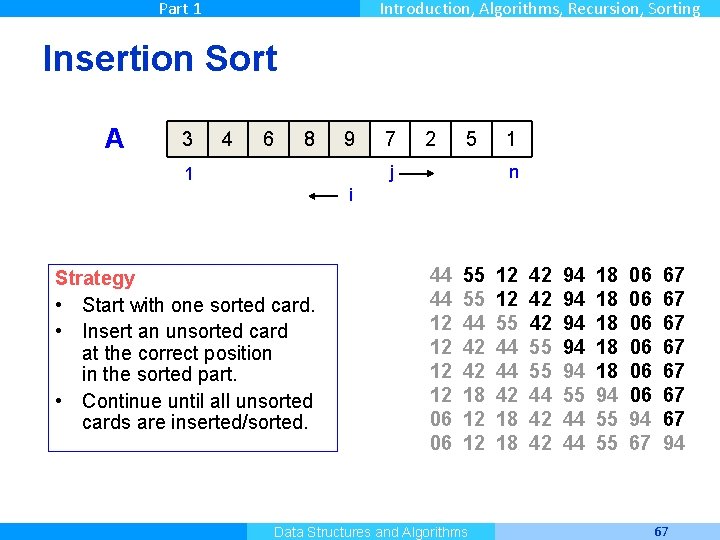
Part 1 Introduction, Algorithms, Recursion, Sorting Insertion Sort A 3 4 6 8 9 7 2 5 n j 1 1 i Strategy • Start with one sorted card. • Insert an unsorted card at the correct position in the sorted part. • Continue until all unsorted cards are inserted/sorted. Master Informatique 44 44 12 12 06 06 55 55 44 42 42 18 12 12 Data Structures and Algorithms 12 12 55 44 44 42 18 18 42 42 42 55 55 44 42 42 94 94 94 55 44 44 18 18 18 94 55 55 06 06 06 94 67 67 94 67
Part 1 Introduction, Algorithms, Recursion, Sorting Insertion Sort/2 INPUT: A[1. . n] – an array of integers OUTPUT: permutation of A s. t. A[1] A[2]. . . A[n] for j : = 2 to n do // A[1. . j-1] sorted key : = A[j]; i : = j-1; while i > 0 and A[i] > key do A[i+1] : = A[i]; i--; A[i+1] : = key The number of comparisons during the j th iteration is – at least 1: Cmin = – at most j 1: Cmax = Master Informatique =n 1 = (n*n - n)/2 Data Structures and Algorithms 68