
Part 1 Historical Background INTRODUCTION TO JAZZ Introduction
Part 1: Historical Background INTRODUCTION TO JAZZ
Introduction to Jazz, 1 Jazz is a combination of blues and ragtime. � Jazz is improvised (made up on the spot). � An American music style. � Born in New Orleans. �
Intro to Jazz, 2 � New Orleans was a melting pot of cultures. � Just prior to the end of the war, there were two types of African Americans that were recognized in New Orleans: �African/Caribbean slaves: those still working under plantation owners. �Creoles of Color: those slaves who married a French or European. Were given the same status as non-slaves in New Orleans.
Intro to Jazz, 3 � After the Civil War, Creoles of Color lost their place in white society. � Jim Crowe Laws force Creoles out of “high society” and into a poverty-stricken part of town, known as storyville.
Intro to Jazz, 4 � � � Two cultures come together as a result of frustration over minstrel shows and Jim Crowe Laws. The mixing of two black cultures is what is known as the reason why Jazz is created. The improvisation of blues music combined with the Classical music training of Creoles of Color To create an upbeat music style that draws from both blues and ragtime.
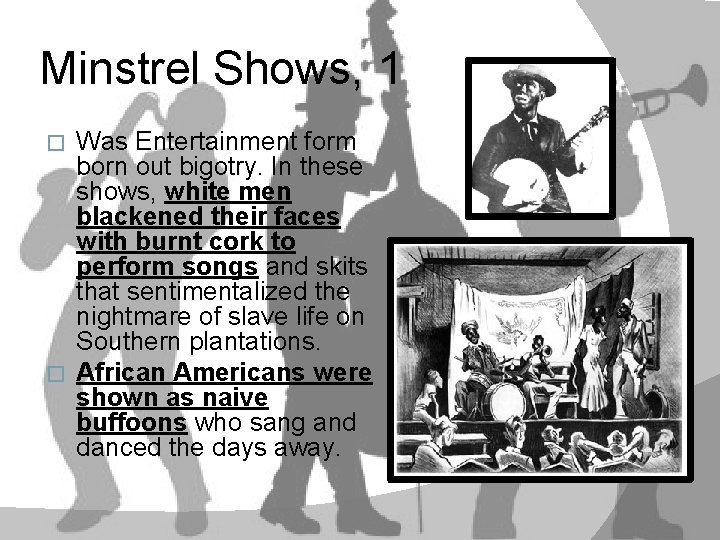
Minstrel Shows, 1 Was Entertainment form born out bigotry. In these shows, white men blackened their faces with burnt cork to perform songs and skits that sentimentalized the nightmare of slave life on Southern plantations. � African Americans were shown as naive buffoons who sang and danced the days away. �
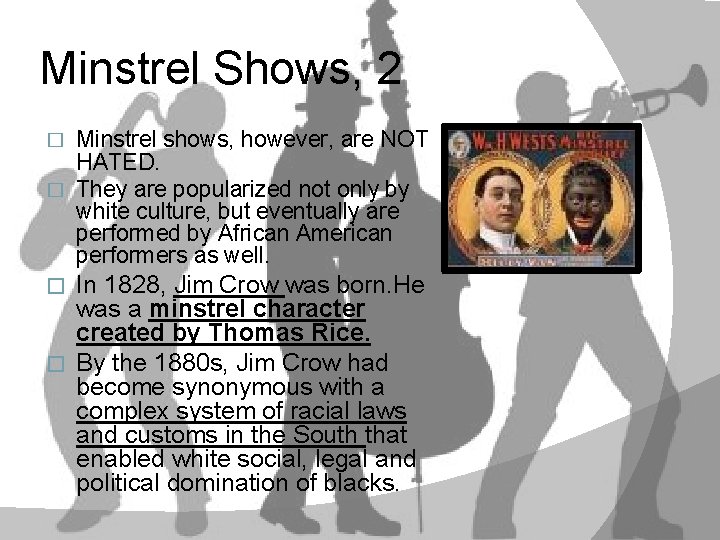
Minstrel Shows, 2 Minstrel shows, however, are NOT HATED. � They are popularized not only by white culture, but eventually are performed by African American performers as well. � In 1828, Jim Crow was born. He was a minstrel character created by Thomas Rice. � By the 1880 s, Jim Crow had become synonymous with a complex system of racial laws and customs in the South that enabled white social, legal and political domination of blacks. �
Part 2: Musicians and the Development of Jazz INTRODUCTION TO JAZZ
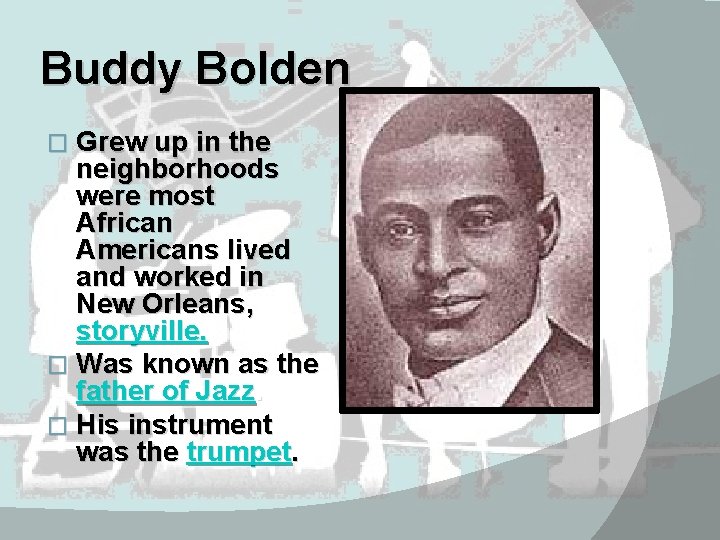
Buddy Bolden � Grew up in the neighborhoods were most African Americans lived and worked in New Orleans, storyville. � Was known as the father of Jazz. � His instrument was the trumpet.
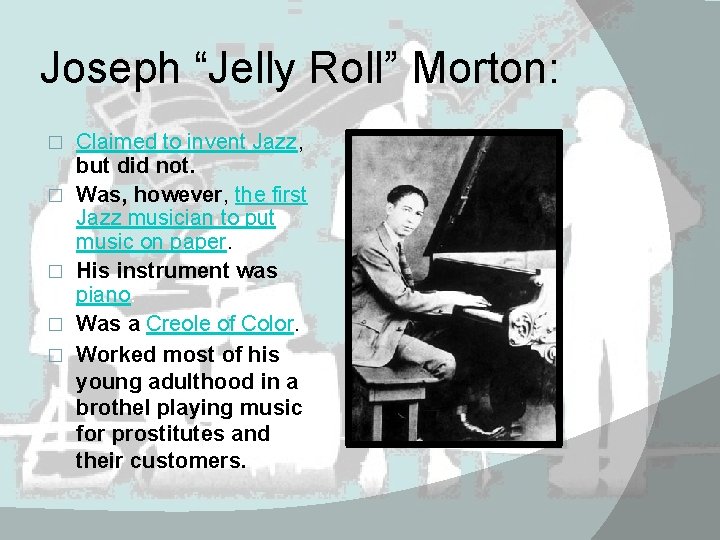
Joseph “Jelly Roll” Morton: � � � Claimed to invent Jazz, but did not. Was, however, the first Jazz musician to put music on paper. His instrument was piano. Was a Creole of Color. Worked most of his young adulthood in a brothel playing music for prostitutes and their customers.
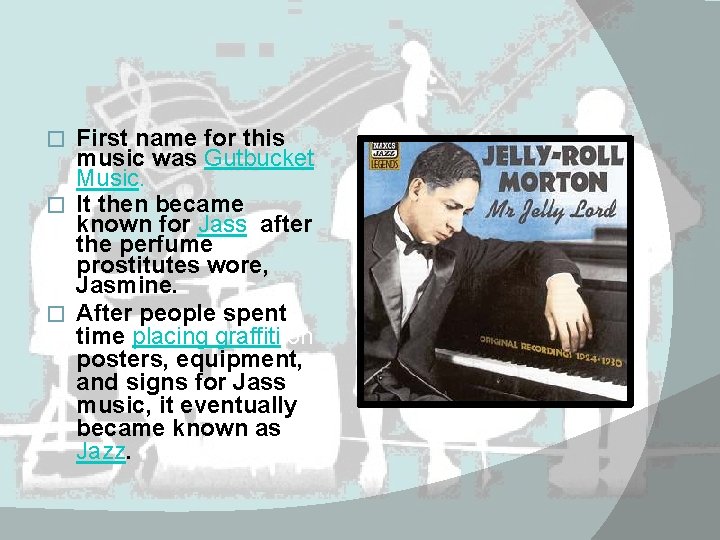
First name for this music was Gutbucket Music. � It then became known for Jass, after the perfume prostitutes wore, Jasmine. � After people spent time placing graffiti on posters, equipment, and signs for Jass music, it eventually became known as Jazz. �
Jazz grows in strength: � The polite and proper society at the time didn’t like Jazz because the music was fast (encouraging dancing) and it had themes unsuited for proper society (depression, sexual content, etc…) � By 1910 Jazz was growing to the peak of its popularity. � New York and Chicago became the new playgrounds for Jazz.
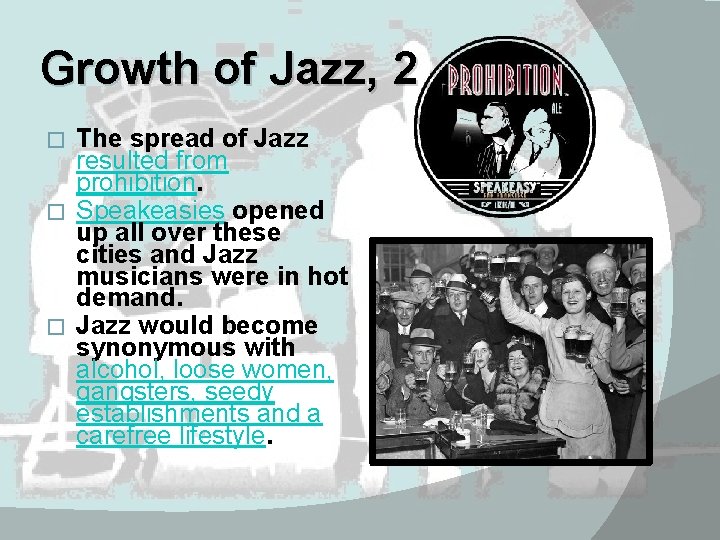
Growth of Jazz, 2 The spread of Jazz resulted from prohibition. � Speakeasies opened up all over these cities and Jazz musicians were in hot demand. � Jazz would become synonymous with alcohol, loose women, gangsters, seedy establishments and a carefree lifestyle. �
Part 3: Jazz at the peak of its popularity INTRO TO JAZZ, 3
Duke Ellington, 1 � Considered one of the greatest jazz composers in the world. � He was known for bringing sophistication to jazz. � He always appeared in tuxes and tails and carried the confidence of the upper class. � He was a Creole of Color
Ellington, 2 � He was a gifted piano player, but is best known for his conduction of an entire orchestra. � While at the Cotton Club in Chicago, Ellington developed a style of Jazz called “Jungle Music. ” � This style focused on the earthy qualities of Africa and the people who lived there.
Ellington, 3 � Was most popular during the 1940 s. � Traveled the world and performed for royalty and presidents. � Was presented the Presidential Medal of Honor of Freedom by the U. S. before he died in 1974.
- Slides: 17