
Part 1 Foundations of Environmental Science Ch 3
- Slides: 40
Part 1: Foundations of Environmental Science Ch 3 Ch 1 An Introduction to Chapter title Science Environmental Part title Overview A General 1 st Mt start (6/9/09) ®® Power. Point Slidespreparedbyby Power. Point Slides Jay Withgott and Heidi Marcum Modified & enforced by M. -H. Kim Copyright © 2006 Pearson Education, Inc. , publishing as Benjamin Cummings Copyright © 2008 Pearson Education, Inc. , publishing as Benjamin Cummings
Current State of the Environment • http: //www. truthbeknown. com/earthstatistics. htm Copyright © 2008 Pearson Education, Inc. , publishing as Benjamin Cummings
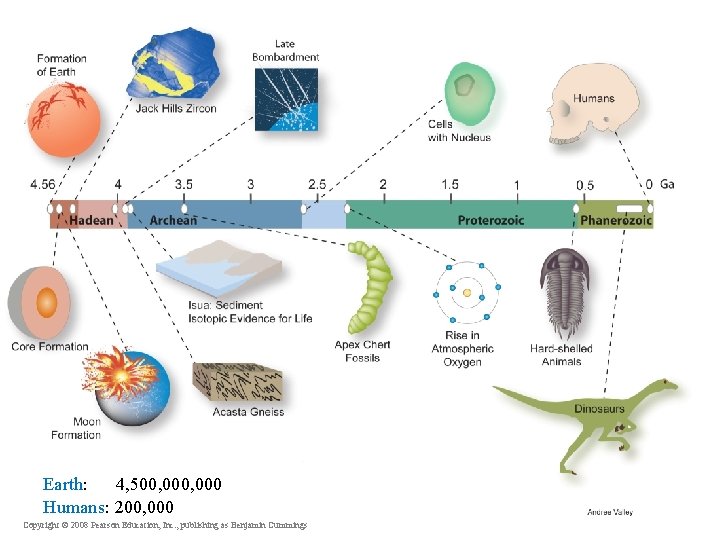
Earth: 4, 500, 000 Humans: 200, 000 Copyright © 2008 Pearson Education, Inc. , publishing as Benjamin Cummings
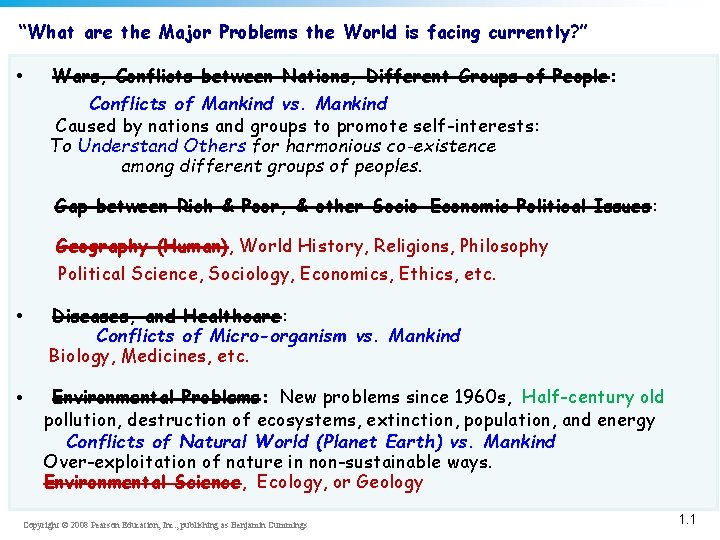
“What are the Major Problems the World is facing currently? ” • Wars, Conflicts between Nations, Different Groups of People: Conflicts of Mankind vs. Mankind Caused by nations and groups to promote self-interests: To Understand Others for harmonious co-existence among different groups of peoples. Gap between Rich & Poor, & other Socio-Economic Political Issues: Geography (Human), World History, Religions, Philosophy Political Science, Sociology, Economics, Ethics, etc. • • Diseases, and Healthcare: Conflicts of Micro-organism vs. Mankind Biology, Medicines, etc. Environmental Problems: New problems since 1960 s, Half-century old pollution, destruction of ecosystems, extinction, population, and energy Conflicts of Natural World (Planet Earth) vs. Mankind Over-exploitation of nature in non-sustainable ways. Environmental Science, Ecology, or Geology Thyeogony, Hesiod Copyright © 2008 Pearson Education, Inc. , publishing as Benjamin Cummings 1. 1
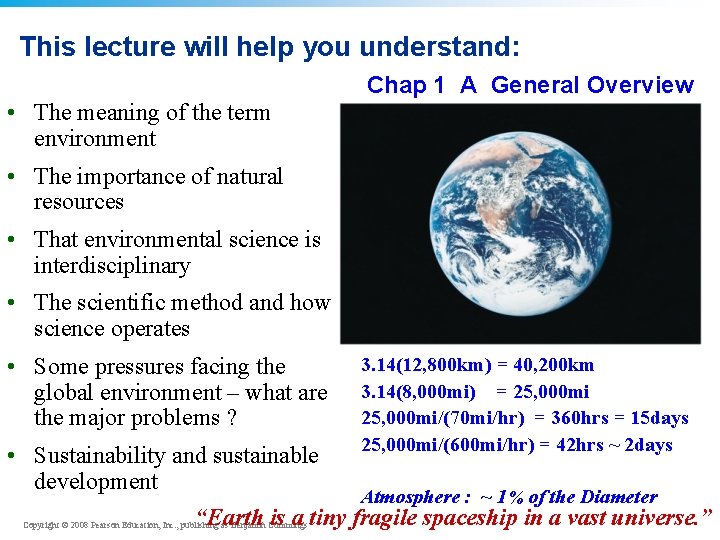
This lecture will help you understand: Chap 1 A General Overview • The meaning of the term environment • The importance of natural resources • That environmental science is interdisciplinary • The scientific method and how science operates • Some pressures facing the global environment – what are the major problems ? 3. 14(12, 800 km) = 40, 200 km 3. 14(8, 000 mi) = 25, 000 mi/(70 mi/hr) = 360 hrs = 15 days 25, 000 mi/(600 mi/hr) = 42 hrs ~ 2 days • Sustainability and sustainable development Atmosphere : ~ 1% of the Diameter “Earth is a tiny fragile spaceship in a vast universe. ” Copyright © 2008 Pearson Education, Inc. , publishing as Benjamin Cummings
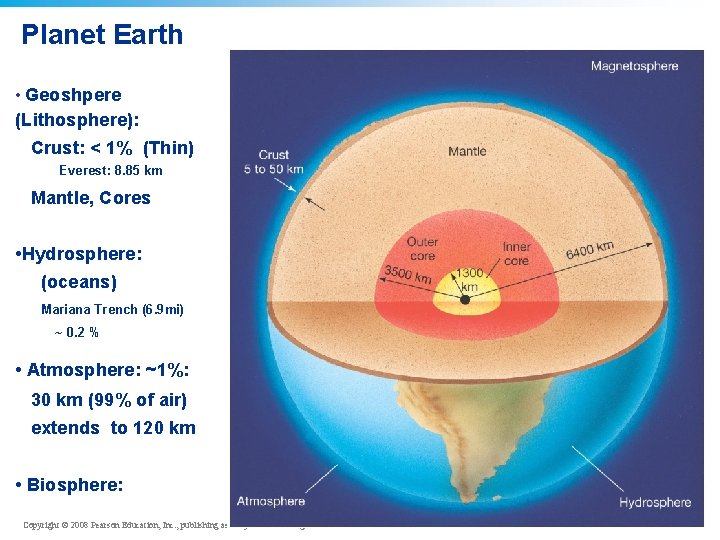
Planet Earth • Geoshpere (Lithosphere): Crust: < 1% (Thin) Everest: 8. 85 km Mantle, Cores • Hydrosphere: (oceans) Mariana Trench (6. 9 mi) ~ 0. 2 % • Atmosphere: ~1%: 30 km (99% of air) extends to 120 km • Biosphere: Copyright © 2008 Pearson Education, Inc. , publishing as Benjamin Cummings
Environment: the total of our surroundings • All the things around us with which we interact: Biotic vs. Abiotic • Living things • Animals, plants, forests, fungi, etc. • Nonliving things • Continents, oceans, clouds, soil, rocks • Our built environment • Buildings, human-created living centers • Social relationships and institutions Copyright © 2008 Pearson Education, Inc. , publishing as Benjamin Cummings
Humans and the world around us • Humans change the environment, often in ways not fully understood • We depend completely on the environment for survival - Increased wealth, health, mobility, leisure time - But, natural systems have been degraded - i. e. , pollution, erosion and species extinction - Environmental changes threaten long-term health and survival • Environmental science is the study of: - How the natural world works - How the environment affects humans and vice versa Copyright © 2008 Pearson Education, Inc. , publishing as Benjamin Cummings
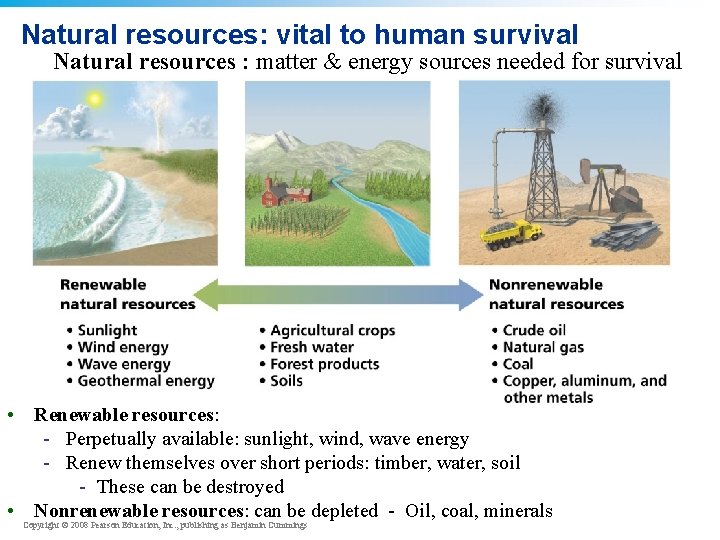
Natural resources: vital to human survival Natural resources : matter & energy sources needed for survival • Renewable resources: - Perpetually available: sunlight, wind, wave energy - Renew themselves over short periods: timber, water, soil - These can be destroyed • Nonrenewable resources: can be depleted - Oil, coal, minerals Copyright © 2008 Pearson Education, Inc. , publishing as Benjamin Cummings
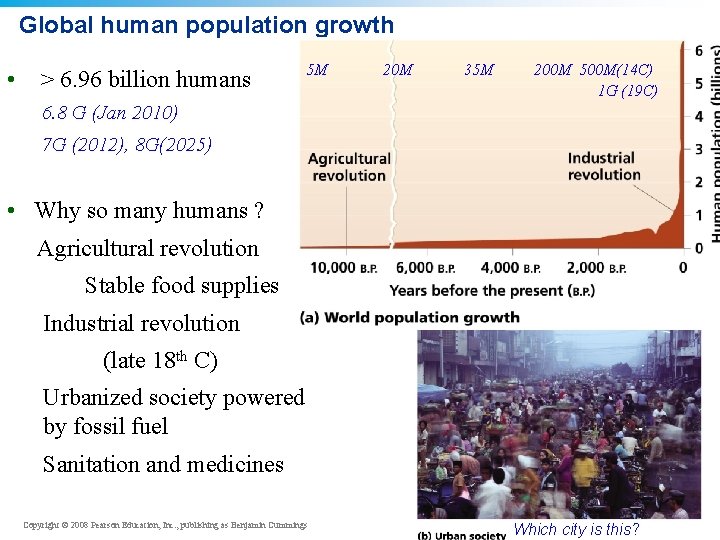
Global human population growth • > 6. 96 billion humans 5 M 20 M 35 M 200 M 500 M(14 C) 1 G (19 C) 6. 8 G (Jan 2010) 7 G (2012), 8 G(2025) • Why so many humans ? Agricultural revolution Stable food supplies Industrial revolution (late 18 th C) Urbanized society powered by fossil fuel Sanitation and medicines Copyright © 2008 Pearson Education, Inc. , publishing as Benjamin Cummings Which city is this?
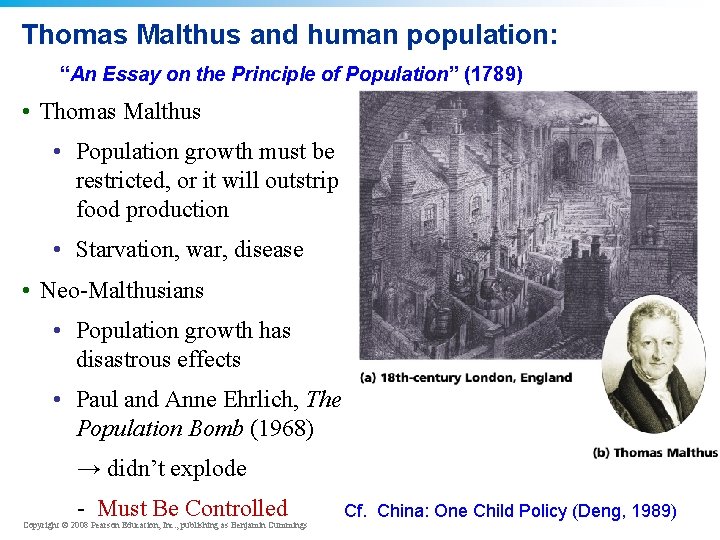
Thomas Malthus and human population: “An Essay on the Principle of Population” (1789) • Thomas Malthus • Population growth must be restricted, or it will outstrip food production • Starvation, war, disease • Neo-Malthusians • Population growth has disastrous effects • Paul and Anne Ehrlich, The Population Bomb (1968) → didn’t explode - Must Be Controlled Copyright © 2008 Pearson Education, Inc. , publishing as Benjamin Cummings Cf. China: One Child Policy (Deng, 1989)
Garrett Hardin’s Tragedy of the Commons (1968) (Fig. 9. 23) • Unregulated exploitation leads to resource depletion - Soil, air, water • Resource users are tempted to increase until the resource is gone • Solution? - Private ownership? - Voluntary organization to enforce responsible use? - Governmental regulations? 2 nd Mtg end (8/21/08) Copyright © 2008 Pearson Education, Inc. , publishing as Benjamin Cummings
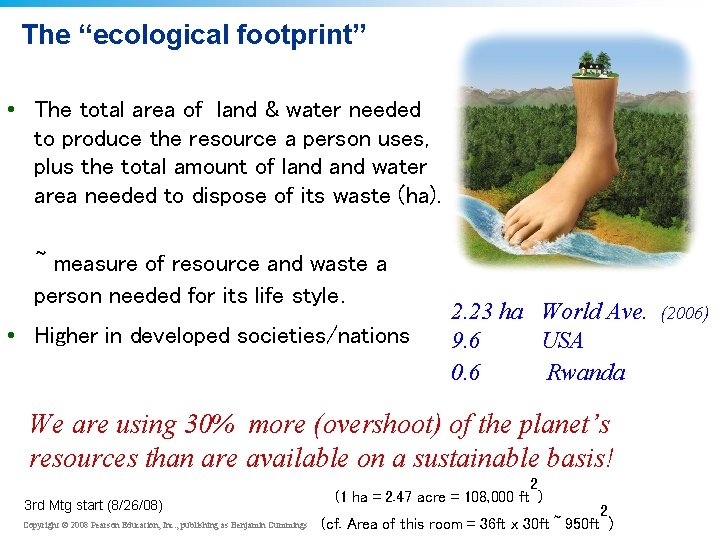
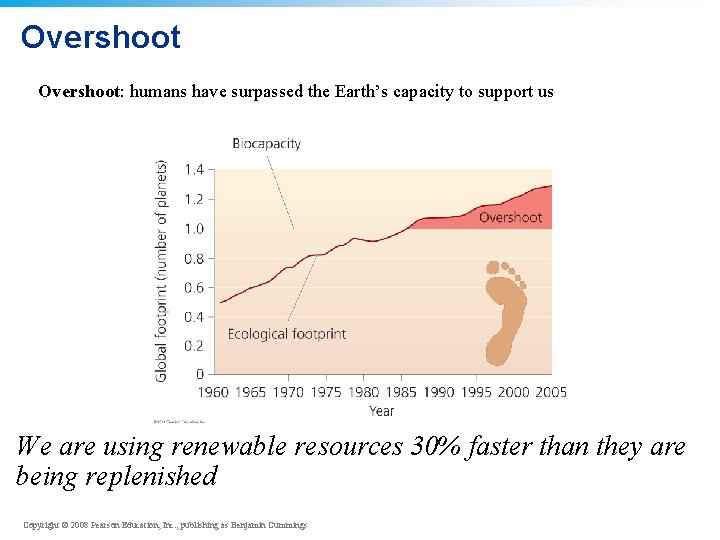
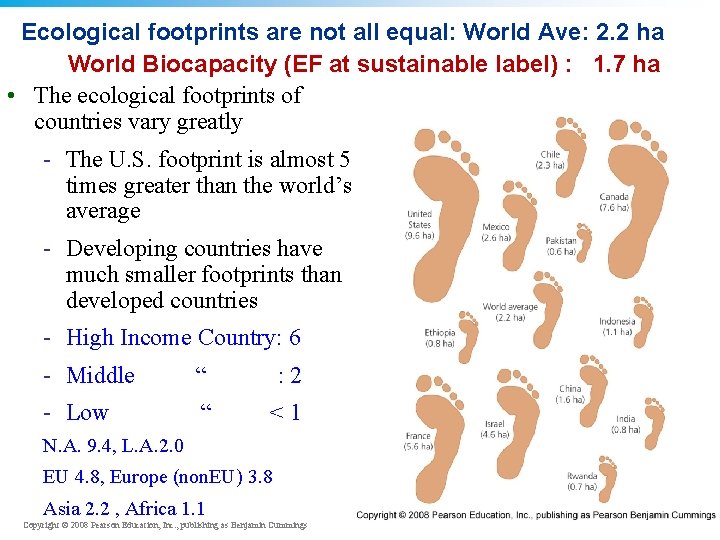
The “ecological footprint” • The total area of land & water needed to produce the resource a person uses, plus the total amount of land water area needed to dispose of its waste (ha). ~ measure of resource and waste a person needed for its life style. • Higher in developed societies/nations 2. 23 ha World Ave. 9. 6 USA 0. 6 Rwanda We are using 30% more (overshoot) of the planet’s resources than are available on a sustainable basis! 3 rd Mtg start (8/26/08) Copyright © 2008 Pearson Education, Inc. , publishing as Benjamin Cummings 2 (1 ha = 2. 47 acre = 108, 000 ft ) 2 (cf. Area of this room = 36 ft x 30 ft ~ 950 ft ) (2006)
Overshoot: humans have surpassed the Earth’s capacity to support us We are using renewable resources 30% faster than they are being replenished Copyright © 2008 Pearson Education, Inc. , publishing as Benjamin Cummings
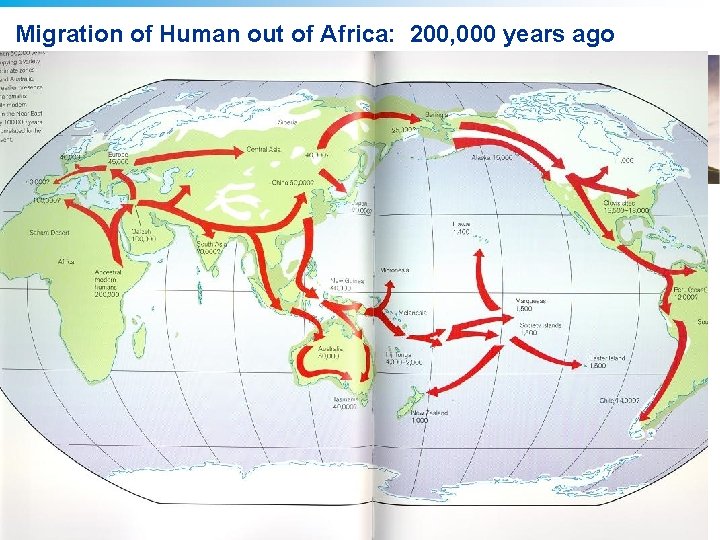
Migration of Human out of Africa: 200, 000 years ago Copyright © 2008 Pearson Education, Inc. , publishing as Benjamin Cummings
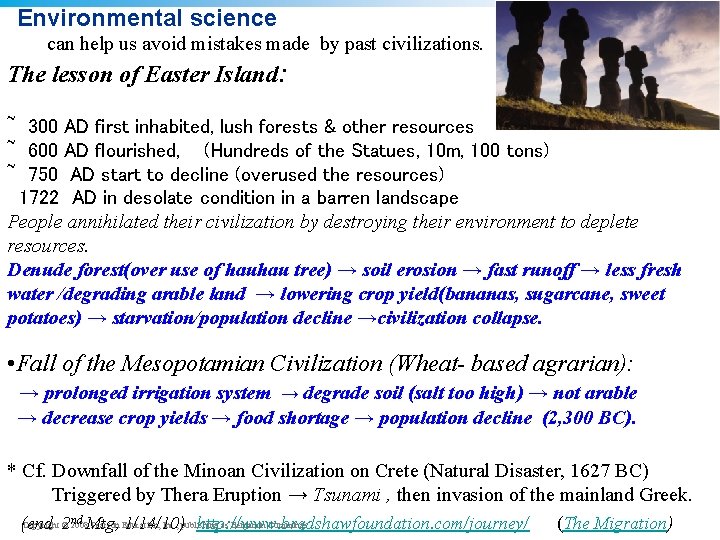
Environmental science can help us avoid mistakes made by past civilizations. The lesson of Easter Island: ~ 300 AD first inhabited, lush forests & other resources ~ 600 AD flourished, (Hundreds of the Statues, 10 m, 100 tons) ~ 750 AD start to decline (overused the resources) 1722 AD in desolate condition in a barren landscape People annihilated their civilization by destroying their environment to deplete resources. Denude forest(over use of hauhau tree) → soil erosion → fast runoff → less fresh water /degrading arable land → lowering crop yield(bananas, sugarcane, sweet potatoes) → starvation/population decline →civilization collapse. • Fall of the Mesopotamian Civilization (Wheat- based agrarian): → prolonged irrigation system → degrade soil (salt too high) → not arable → decrease crop yields → food shortage → population decline (2, 300 BC). * Cf. Downfall of the Minoan Civilization on Crete (Natural Disaster, 1627 BC) Triggered by Thera Eruption → Tsunami , then invasion of the mainland Greek. Copyright 2 © nd 2008 Mtg, Pearson Education, Inc. , publishing as Benjamin Cummings (end 1/14/10) http: //www. bradshawfoundation. com/journey/ (The Migration)
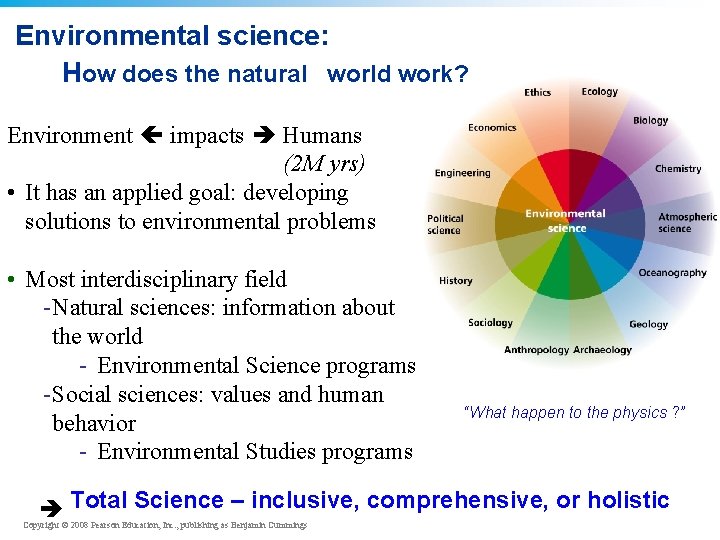
Environmental science: How does the natural world work? Environment impacts Humans (2 M yrs) • It has an applied goal: developing solutions to environmental problems • Most interdisciplinary field - Natural sciences: information about the world - Environmental Science programs - Social sciences: values and human behavior - Environmental Studies programs “What happen to the physics ? ” Total Science – inclusive, comprehensive, or holistic Copyright © 2008 Pearson Education, Inc. , publishing as Benjamin Cummings
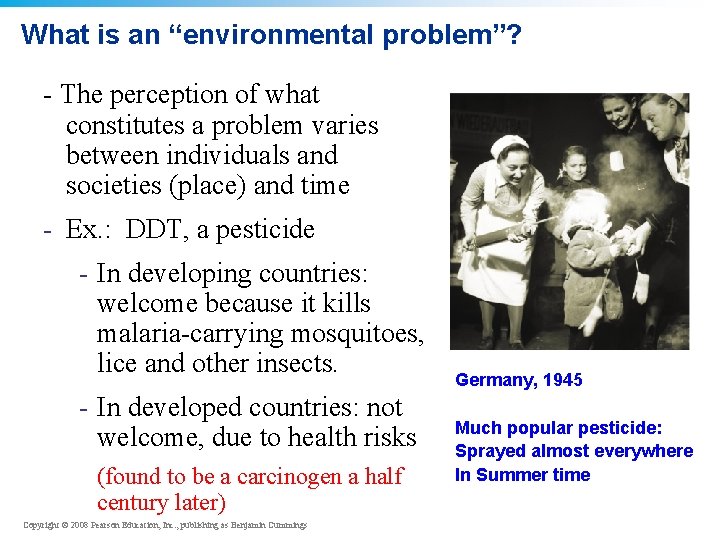
What is an “environmental problem”? - The perception of what constitutes a problem varies between individuals and societies (place) and time - Ex. : DDT, a pesticide - In developing countries: welcome because it kills malaria-carrying mosquitoes, lice and other insects. - In developed countries: not welcome, due to health risks (found to be a carcinogen a half century later) Copyright © 2008 Pearson Education, Inc. , publishing as Benjamin Cummings Germany, 1945 Much popular pesticide: Sprayed almost everywhere In Summer time
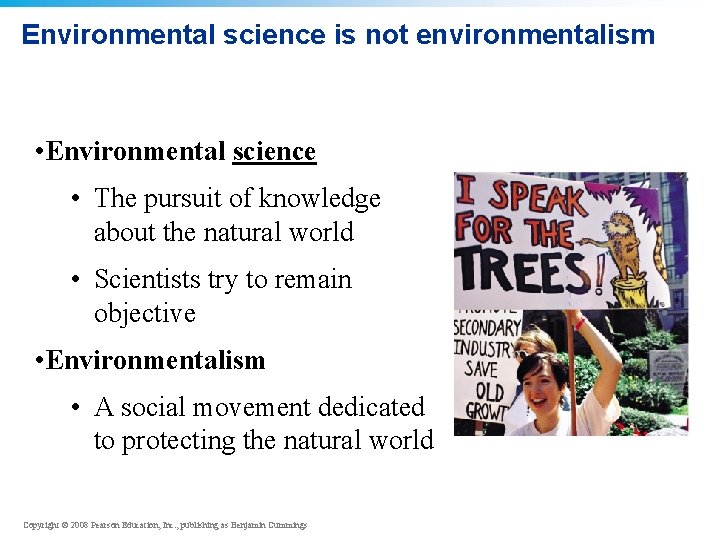
Environmental science is not environmentalism • Environmental science • The pursuit of knowledge about the natural world • Scientists try to remain objective • Environmentalism • A social movement dedicated to protecting the natural world Copyright © 2008 Pearson Education, Inc. , publishing as Benjamin Cummings
Development of Modern Science: 17 th C Copernicus(1473 -43), F. Bacon(1561 -26), R. Decartes(1592 -50), Galileo(1564 -42), Kepler(1571 -60), Boyle(1627 -91), Newton (1642 -27) • Science: , - A systematic process for learning about the world/nature and testing our understanding of it - based on reasoning (as opposed to authority, belief or feeling), facts, observation (experiments), testing, and logic of induction & deduction - The accumulated body of knowledge that results from this process - To sort fact from fiction/myth - Develop solutions to the problems we face Copyright © 2008 Pearson Education, Inc. , publishing as Benjamin Cummings
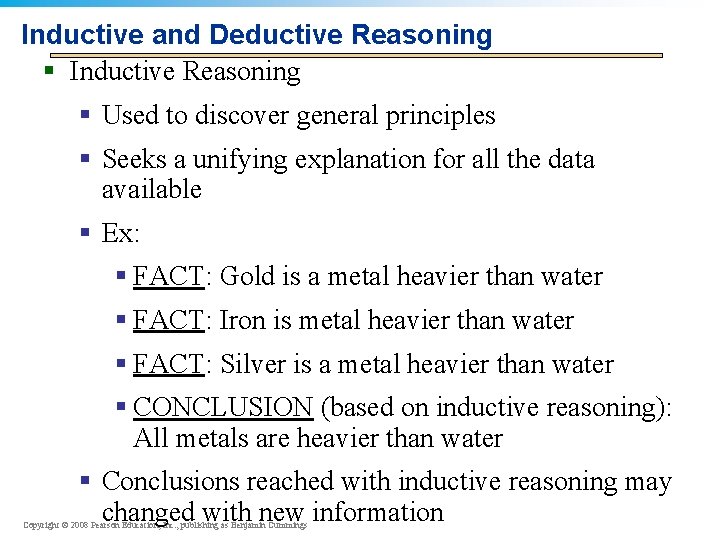
Inductive and Deductive Reasoning § Inductive Reasoning § Used to discover general principles § Seeks a unifying explanation for all the data available § Ex: § FACT: Gold is a metal heavier than water § FACT: Iron is metal heavier than water § FACT: Silver is a metal heavier than water § CONCLUSION (based on inductive reasoning): All metals are heavier than water § Conclusions reached with inductive reasoning may changed with new information Copyright © 2008 Pearson Education, Inc. , publishing as Benjamin Cummings
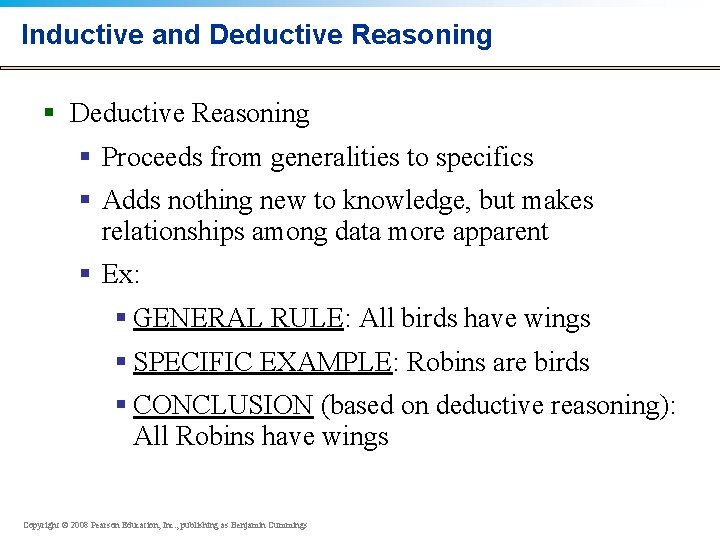
Inductive and Deductive Reasoning § Proceeds from generalities to specifics § Adds nothing new to knowledge, but makes relationships among data more apparent § Ex: § GENERAL RULE: All birds have wings § SPECIFIC EXAMPLE: Robins are birds § CONCLUSION (based on deductive reasoning): All Robins have wings Copyright © 2008 Pearson Education, Inc. , publishing as Benjamin Cummings
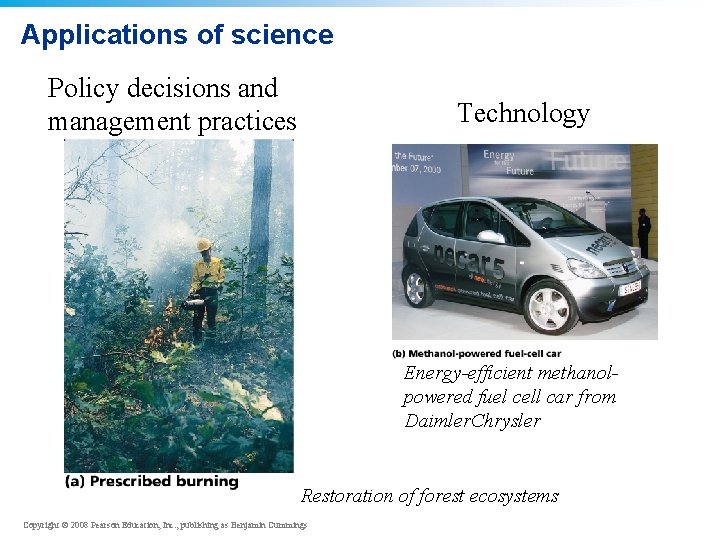
Applications of science Policy decisions and management practices Technology Energy-efficient methanolpowered fuel cell car from Daimler. Chrysler Restoration of forest ecosystems Copyright © 2008 Pearson Education, Inc. , publishing as Benjamin Cummings
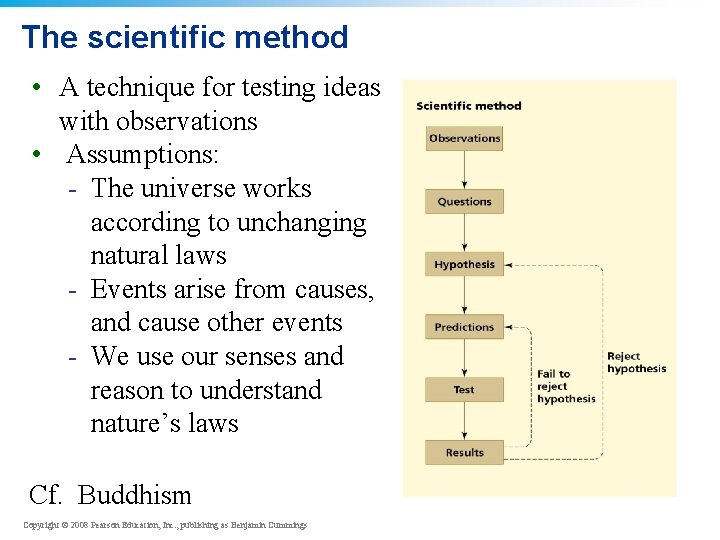
The scientific method • A technique for testing ideas with observations • Assumptions: - The universe works according to unchanging natural laws - Events arise from causes, and cause other events - We use our senses and reason to understand nature’s laws Cf. Buddhism Copyright © 2008 Pearson Education, Inc. , publishing as Benjamin Cummings
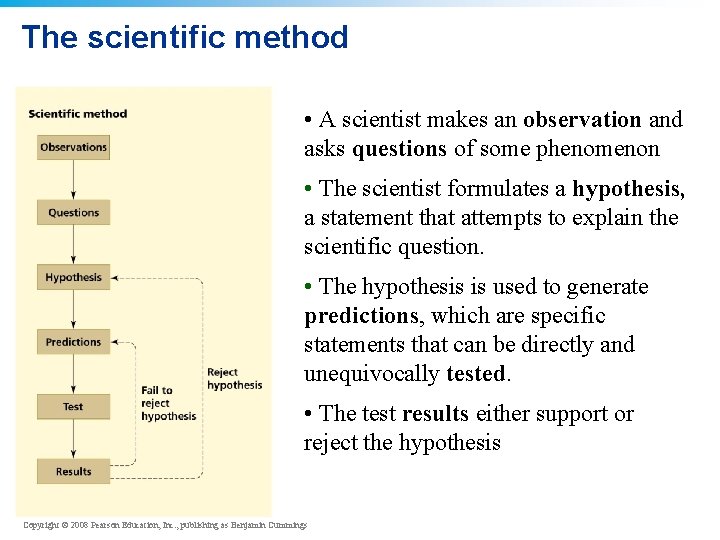
The scientific method • A scientist makes an observation and asks questions of some phenomenon • The scientist formulates a hypothesis, a statement that attempts to explain the scientific question. • The hypothesis is used to generate predictions, which are specific statements that can be directly and unequivocally tested. • The test results either support or reject the hypothesis Copyright © 2008 Pearson Education, Inc. , publishing as Benjamin Cummings
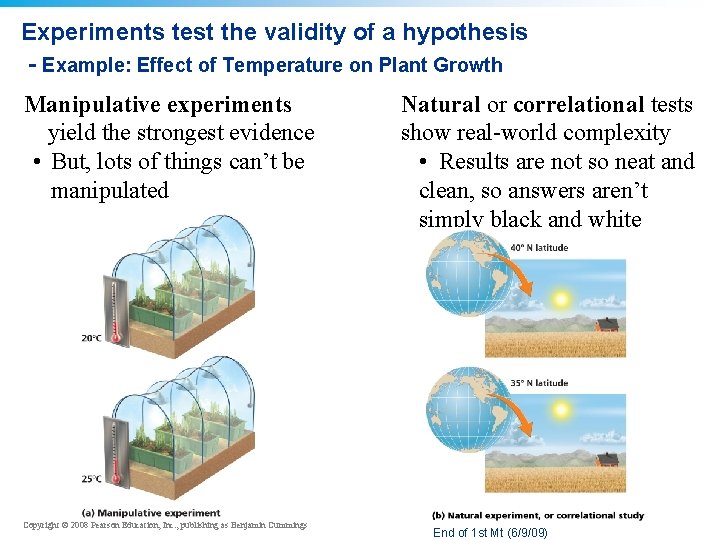
Experiments test the validity of a hypothesis - Example: Effect of Temperature on Plant Growth Manipulative experiments yield the strongest evidence • But, lots of things can’t be manipulated Copyright © 2008 Pearson Education, Inc. , publishing as Benjamin Cummings Natural or correlational tests show real-world complexity • Results are not so neat and clean, so answers aren’t simply black and white End of 1 st Mt (6/9/09)
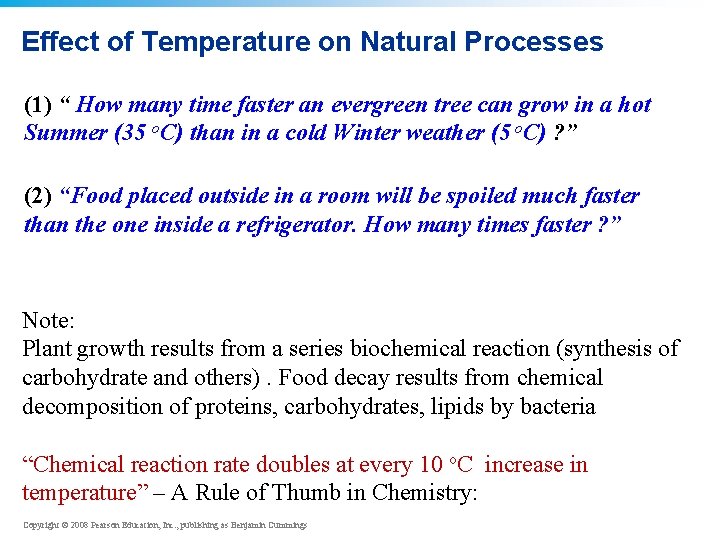
Effect of Temperature on Natural Processes (1) “ How many time faster an evergreen tree can grow in a hot Summer (35 o. C) than in a cold Winter weather (5 o. C) ? ” (2) “Food placed outside in a room will be spoiled much faster than the one inside a refrigerator. How many times faster ? ” Note: Plant growth results from a series biochemical reaction (synthesis of carbohydrate and others). Food decay results from chemical decomposition of proteins, carbohydrates, lipids by bacteria “Chemical reaction rate doubles at every 10 o. C increase in temperature” – A Rule of Thumb in Chemistry: Copyright © 2008 Pearson Education, Inc. , publishing as Benjamin Cummings
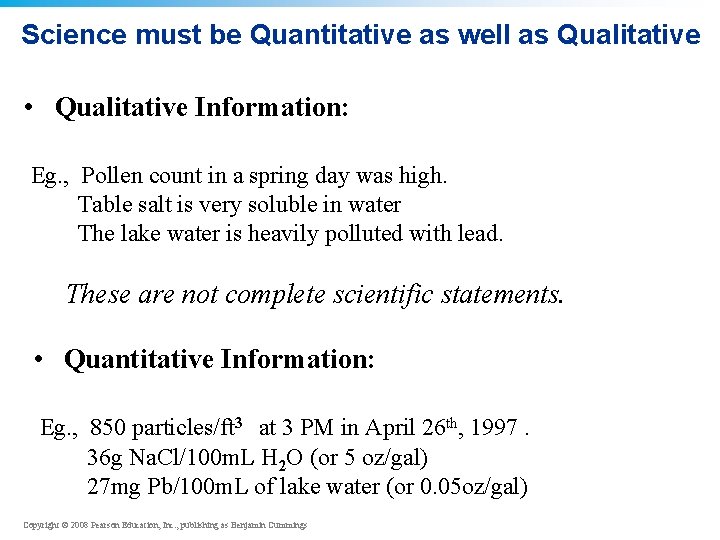
Science must be Quantitative as well as Qualitative • Qualitative Information: Eg. , Pollen count in a spring day was high. Table salt is very soluble in water The lake water is heavily polluted with lead. These are not complete scientific statements. • Quantitative Information: Eg. , 850 particles/ft 3 at 3 PM in April 26 th, 1997. 36 g Na. Cl/100 m. L H 2 O (or 5 oz/gal) 27 mg Pb/100 m. L of lake water (or 0. 05 oz/gal) Copyright © 2008 Pearson Education, Inc. , publishing as Benjamin Cummings
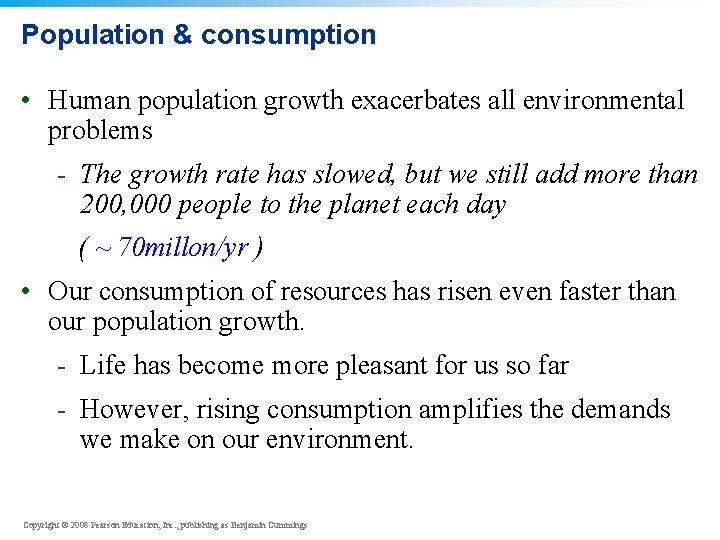
Population & consumption • Human population growth exacerbates all environmental problems - The growth rate has slowed, but we still add more than 200, 000 people to the planet each day ( ~ 70 millon/yr ) • Our consumption of resources has risen even faster than our population growth. - Life has become more pleasant for us so far - However, rising consumption amplifies the demands we make on our environment. Copyright © 2008 Pearson Education, Inc. , publishing as Benjamin Cummings
Ecological footprints are not all equal: World Ave: 2. 2 ha World Biocapacity (EF at sustainable label) : 1. 7 ha • The ecological footprints of countries vary greatly - The U. S. footprint is almost 5 times greater than the world’s average - Developing countries have much smaller footprints than developed countries - High Income Country: 6 - Middle “ : 2 - Low “ <1 N. A. 9. 4, L. A. 2. 0 EU 4. 8, Europe (non. EU) 3. 8 Asia 2. 2 , Africa 1. 1 Copyright © 2008 Pearson Education, Inc. , publishing as Benjamin Cummings
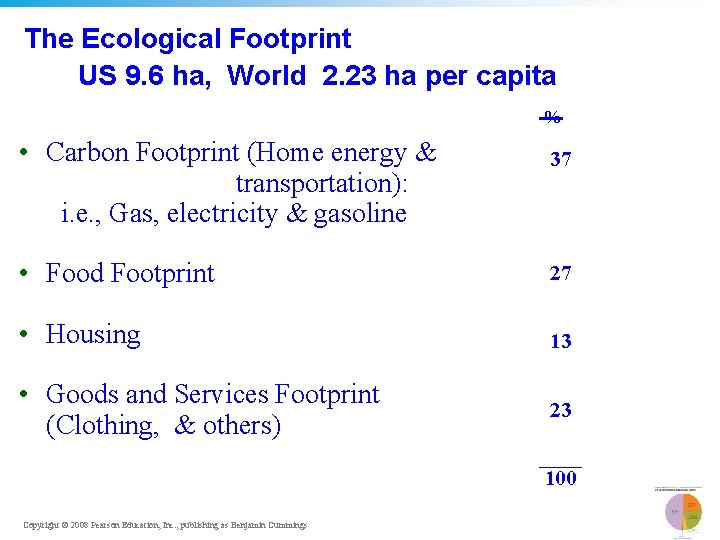
The Ecological Footprint US 9. 6 ha, World 2. 23 ha per capita % • Carbon Footprint (Home energy & transportation): i. e. , Gas, electricity & gasoline 37 • Food Footprint 27 • Housing 13 • Goods and Services Footprint (Clothing, & others) 23 ____ 100 Copyright © 2008 Pearson Education, Inc. , publishing as Benjamin Cummings
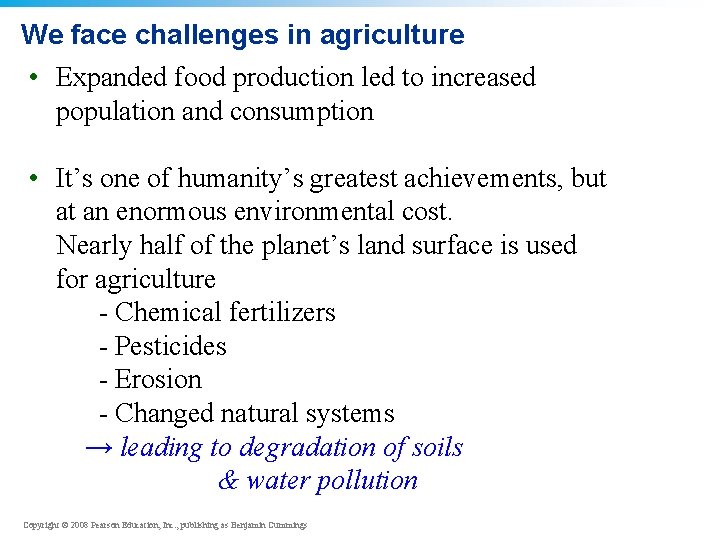
We face challenges in agriculture • Expanded food production led to increased population and consumption • It’s one of humanity’s greatest achievements, but at an enormous environmental cost. Nearly half of the planet’s land surface is used for agriculture - Chemical fertilizers - Pesticides - Erosion - Changed natural systems → leading to degradation of soils & water pollution Copyright © 2008 Pearson Education, Inc. , publishing as Benjamin Cummings
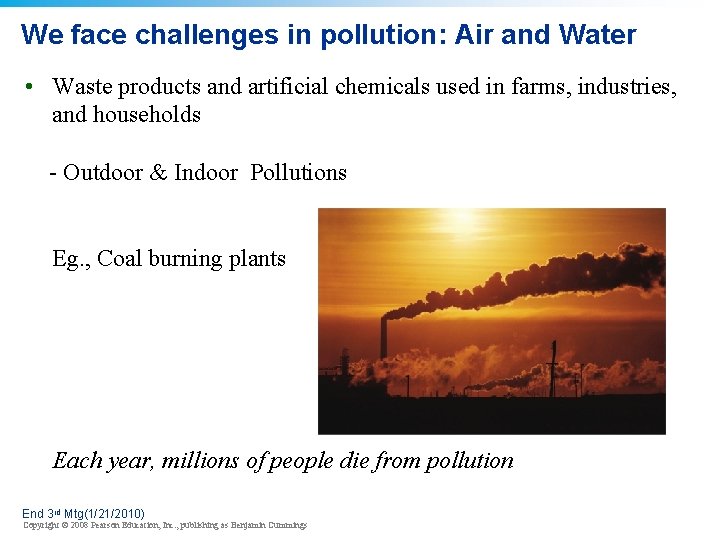
We face challenges in pollution: Air and Water • Waste products and artificial chemicals used in farms, industries, and households - Outdoor & Indoor Pollutions Eg. , Coal burning plants Each year, millions of people die from pollution End 3 rd Mtg(1/21/2010) Copyright © 2008 Pearson Education, Inc. , publishing as Benjamin Cummings
We face challenges in climate • Scientists have firmly concluded that humans are changing the composition of the atmosphere • The Earth’s surface is warming - Melting glaciers - Rising sea levels - Impacted wildlife and crops (Biodiversity) - Increasingly destructive weather (Hot weather cause hurricanes to be more powerful) Since the Industrial Revolution, atmospheric CO 2 concentrations have risen by 37%, to the highest level in 650, 000 years Copyright © 2008 Pearson Education, Inc. , publishing as Benjamin Cummings
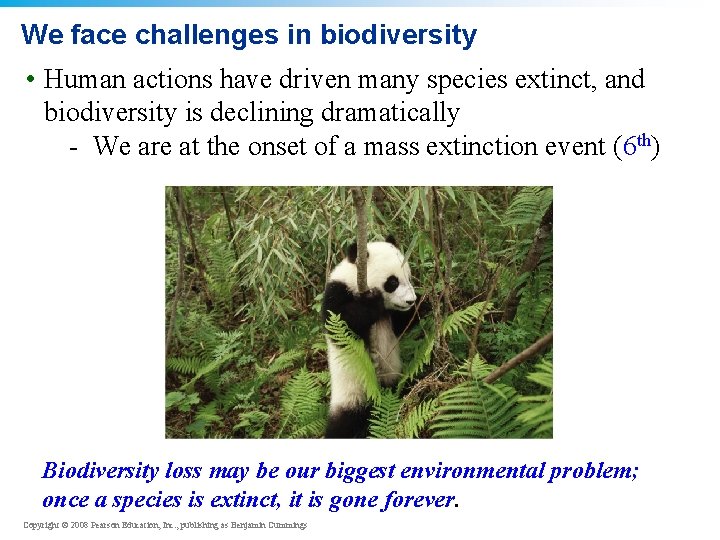
We face challenges in biodiversity • Human actions have driven many species extinct, and biodiversity is declining dramatically - We are at the onset of a mass extinction event (6 th) Biodiversity loss may be our biggest environmental problem; once a species is extinct, it is gone forever. Copyright © 2008 Pearson Education, Inc. , publishing as Benjamin Cummings
The Millennium Ecosystem Assessment (UN) by over 1, 000 scientists, release 2, 005 • The most comprehensive scientific assessment of the condition of the world’s ecological systems • Major findings: • Humans have drastically altered ecosystems • These changes have contributed to human wellbeing and economic development, but at a cost • Environmental degradation could get much worse • Degradation can be reversed, but it requires work Copyright © 2008 Pearson Education, Inc. , publishing as Benjamin Cummings
Our energy choices will affect our future • The lives we live today are due to fossil fuels - Machines - Chemicals - Transportation - Products • Fossil fuels are a one-time bonanza; supplies will certainly decline We have used up ½ of the world’s oil supplies; how will we handle this imminent fossil fuel shortage? Needs other Energies Sources Cf. Wind Energy: US ~2. 5%, Denmark ~ 25% Copyright © 2008 Pearson Education, Inc. , publishing as Benjamin Cummings
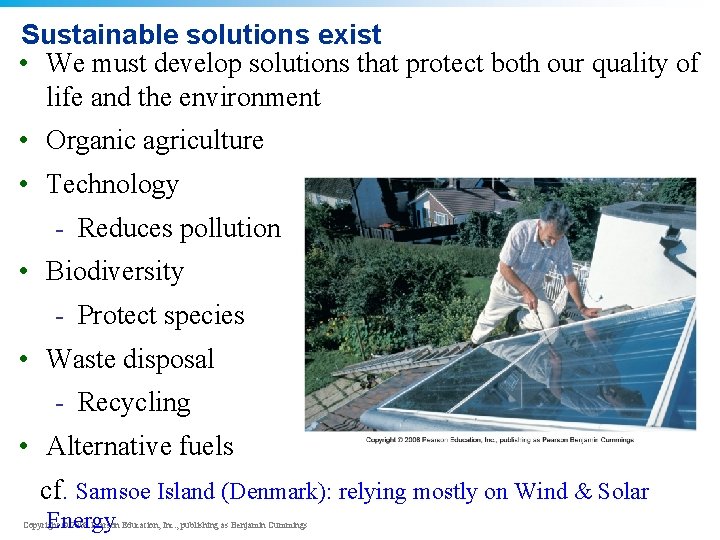
Sustainable solutions exist • We must develop solutions that protect both our quality of life and the environment • Organic agriculture • Technology - Reduces pollution • Biodiversity - Protect species • Waste disposal - Recycling • Alternative fuels cf. Samsoe Island (Denmark): relying mostly on Wind & Solar Energy Copyright © 2008 Pearson Education, Inc. , publishing as Benjamin Cummings
Sustainability: a goal for the future • How can humans live within the planet’s means? - Humans cannot exist without functioning natural systems of environment • Sustainability - Leaves future generations with a rich and full Earth - Conserves the Earth’s natural resources - Maintains fully functioning ecological systems of nature • Sustainable development: the use of resources to satisfy current needs without compromising future availability of resources for generations to come. Copyright © 2008 Pearson Education, Inc. , publishing as Benjamin Cummings
Conclusion • Environmental science helps us understand our relationship with the environment and informs our attempts to solve and prevent problems. • Identifying a problem is the first step in solving it • Solving environmental problems can move us towards health, longevity, peace and prosperity - Environmental science can help us find balanced solutions to environmental problems for sustainable development 3 rd Mtg end (8/26/08) Copyright © 2008 Pearson Education, Inc. , publishing as Benjamin Cummings