
Parsing V Introduction to LR1 Parsers from Cooper
![LR(k) items An LR(k) item is a pair [A, B], where A is a](https://slidetodoc.com/presentation_image/249c85d2a75431191f302255991a26f3/image-9.jpg "LR(k) items An LR(k) item is a pair [A, B], where A is a")
- Slides: 15
Parsing V Introduction to LR(1) Parsers from Cooper & Torczon 1
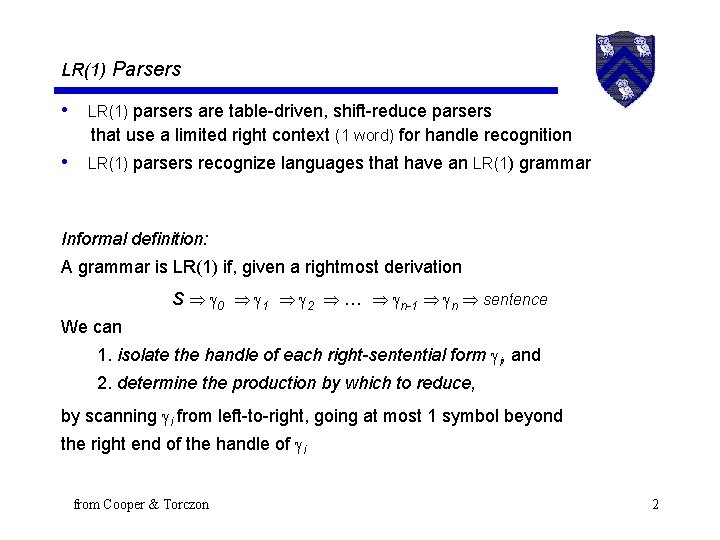
LR(1) Parsers • LR(1) parsers are table-driven, shift-reduce parsers that use a limited right context (1 word) for handle recognition • LR(1) parsers recognize languages that have an LR(1) grammar Informal definition: A grammar is LR(1) if, given a rightmost derivation S 0 1 2 … n-1 n sentence We can 1. isolate the handle of each right-sentential form i, and 2. determine the production by which to reduce, by scanning i from left-to-right, going at most 1 symbol beyond the right end of the handle of i from Cooper & Torczon 2
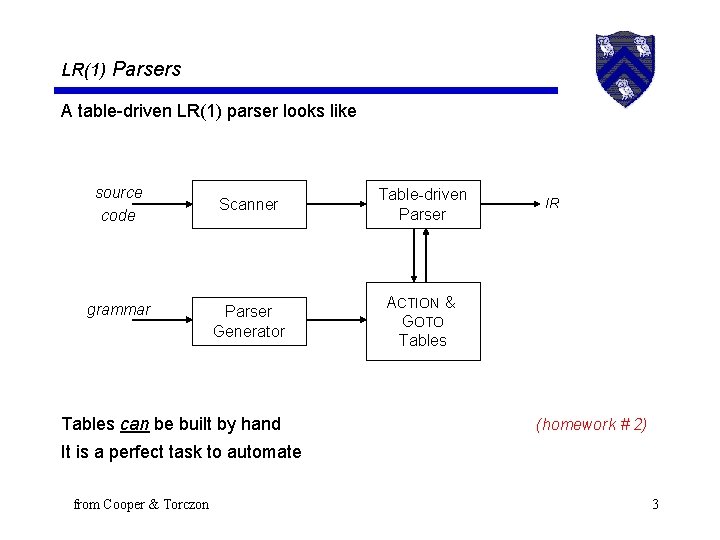
LR(1) Parsers A table-driven LR(1) parser looks like source code grammar Scanner Table-driven Parser Generator ACTION & GOTO Tables can be built by hand IR (homework # 2) It is a perfect task to automate from Cooper & Torczon 3
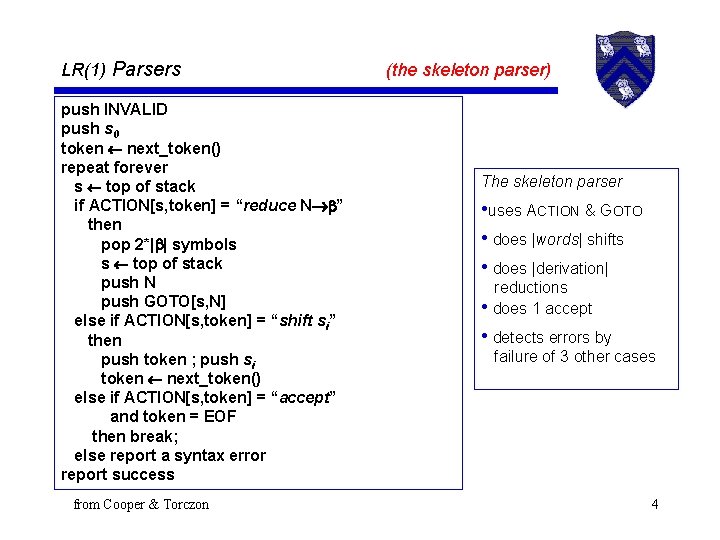
LR(1) Parsers push INVALID push s 0 token next_token() repeat forever s top of stack if ACTION[s, token] = “reduce N ” then pop 2*| | symbols s top of stack push N push GOTO[s, N] else if ACTION[s, token] = “shift si” then push token ; push si token next_token() else if ACTION[s, token] = “accept” and token = EOF then break; else report a syntax error report success from Cooper & Torczon (the skeleton parser) The skeleton parser • uses ACTION & GOTO • does |words| shifts • does |derivation| reductions • does 1 accept • detects errors by failure of 3 other cases 4
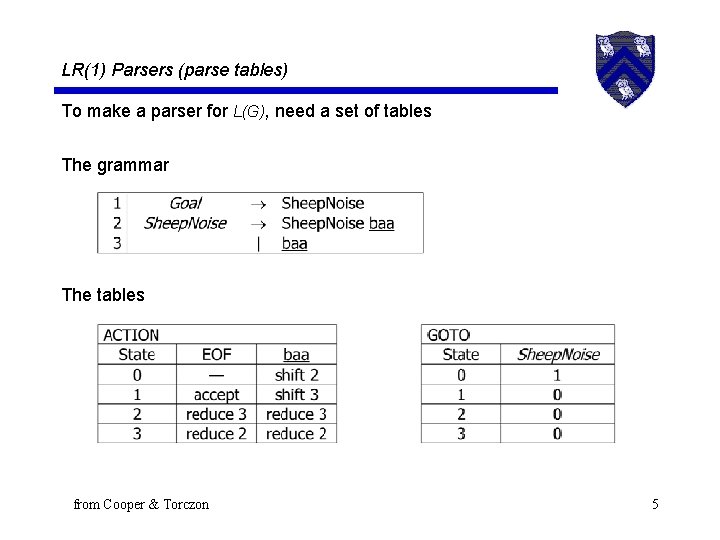
LR(1) Parsers (parse tables) To make a parser for L(G), need a set of tables The grammar The tables from Cooper & Torczon 5
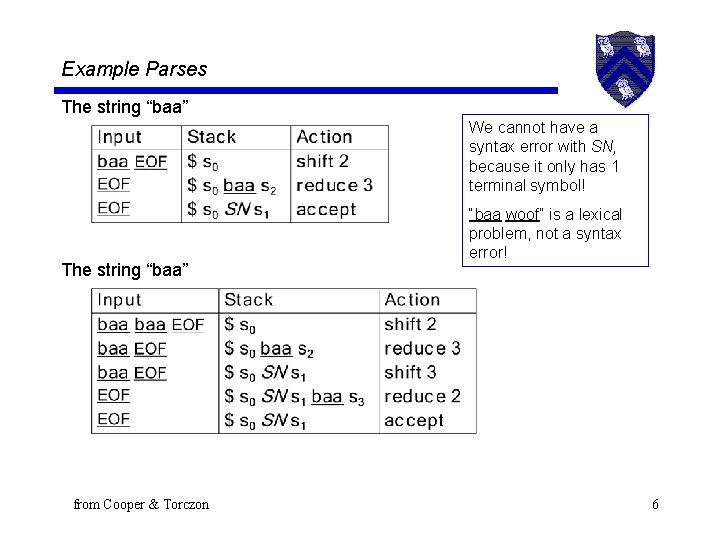
Example Parses The string “baa” We cannot have a syntax error with SN, because it only has 1 terminal symbol! The string “baa” from Cooper & Torczon “baa woof” is a lexical problem, not a syntax error! 6
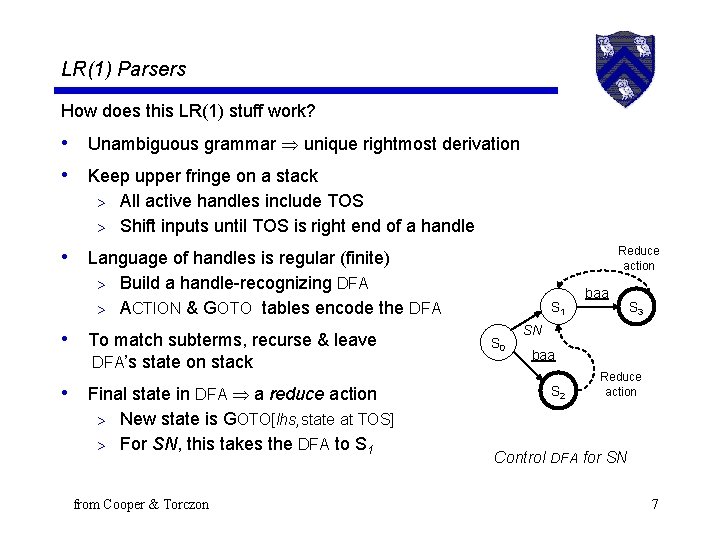
LR(1) Parsers How does this LR(1) stuff work? • Unambiguous grammar unique rightmost derivation • Keep upper fringe on a stack All active handles include TOS > Shift inputs until TOS is right end of a handle > • Language of handles is regular (finite) Reduce action Build a handle-recognizing DFA > ACTION & GOTO tables encode the DFA > • To match subterms, recurse & leave DFA’s state on stack • Final state in DFA a reduce action New state is GOTO[lhs, state at TOS] > For SN, this takes the DFA to S 1 S 0 baa S 3 SN baa S 2 Reduce action > from Cooper & Torczon Control DFA for SN 7
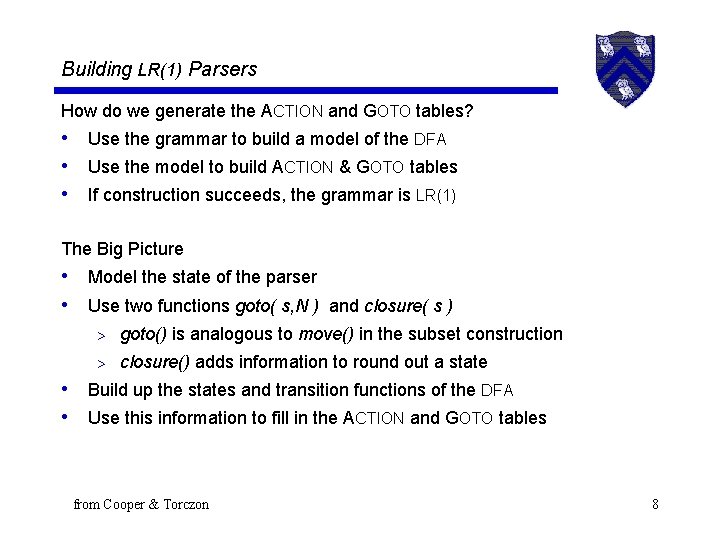
Building LR(1) Parsers How do we generate the ACTION and GOTO tables? • Use the grammar to build a model of the DFA • Use the model to build ACTION & GOTO tables • If construction succeeds, the grammar is LR(1) The Big Picture • Model the state of the parser • Use two functions goto( s, N ) and closure( s ) > goto() is analogous to move() in the subset construction > closure() adds information to round out a state • Build up the states and transition functions of the DFA • Use this information to fill in the ACTION and GOTO tables from Cooper & Torczon 8
LR(k) items An LR(k) item is a pair [A, B], where A is a production with a • at some position in the rhs B is a lookahead string of length ≤ k (words or EOF) The • in an item indicates the position of the top of the stack [ • , a] means that the input seen so far is consistent with the use of immediately after the symbol on top of the stack [ • , a] means that the input sees so far is consistent with the use of at this point in the parse, and that the parser has already recognized . [ • , a] means that the parser has seen , and that a lookahead symbol of a is consistent with reducing to . The table construction algorithm uses items to represent valid configurations of an LR(1) parser from Cooper & Torczon 9
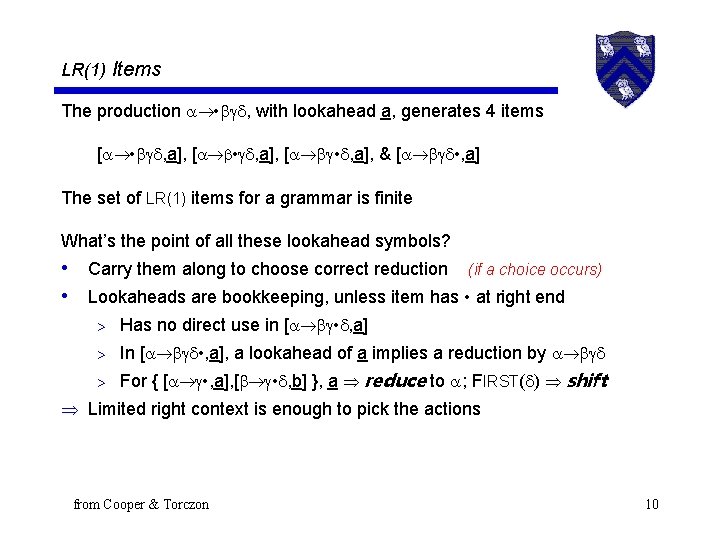
LR(1) Items The production • , with lookahead a, generates 4 items [ • , a], [ • , a], & [ • , a] The set of LR(1) items for a grammar is finite What’s the point of all these lookahead symbols? • Carry them along to choose correct reduction (if a choice occurs) • Lookaheads are bookkeeping, unless item has • at right end > Has no direct use in [ • , a] > In [ • , a], a lookahead of a implies a reduction by > For { [ • , a], [ • , b] }, a reduce to ; FIRST( ) shift Limited right context is enough to pick the actions from Cooper & Torczon 10
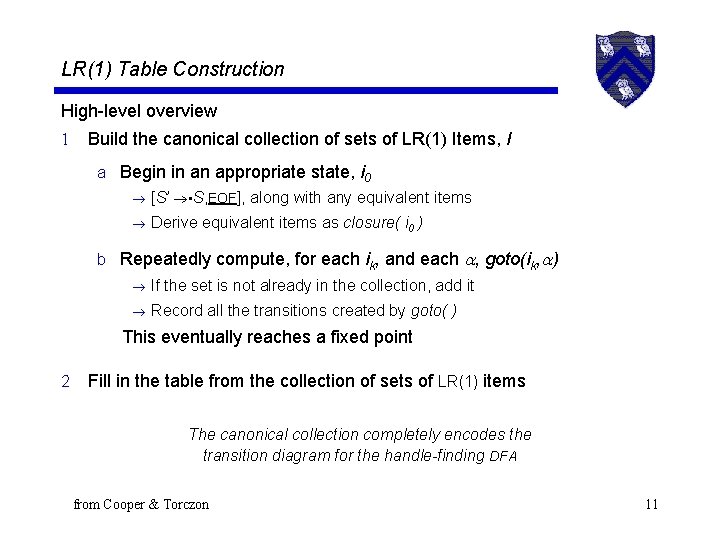
LR(1) Table Construction High-level overview 1 Build the canonical collection of sets of LR(1) Items, I a Begin in an appropriate state, i 0 [S’ • S, EOF], along with any equivalent items Derive equivalent items as closure( i 0 ) b Repeatedly compute, for each ik, and each , goto(ik, ) If the set is not already in the collection, add it Record all the transitions created by goto( ) This eventually reaches a fixed point 2 Fill in the table from the collection of sets of LR(1) items The canonical collection completely encodes the transition diagram for the handle-finding DFA from Cooper & Torczon 11
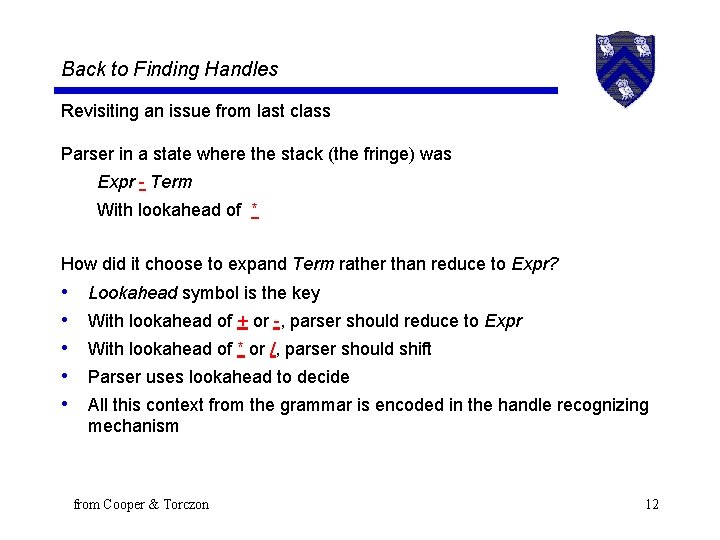
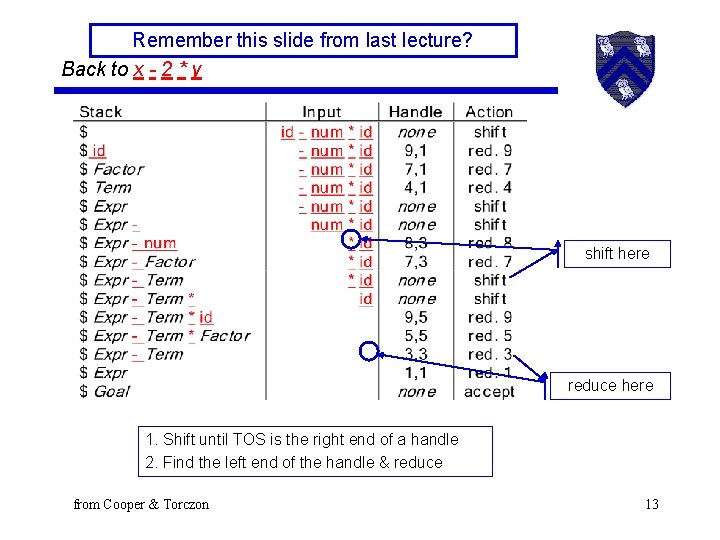
Back to Finding Handles Revisiting an issue from last class Parser in a state where the stack (the fringe) was Expr - Term With lookahead of * How did it choose to expand Term rather than reduce to Expr? • • • Lookahead symbol is the key With lookahead of + or -, parser should reduce to Expr With lookahead of * or /, parser should shift Parser uses lookahead to decide All this context from the grammar is encoded in the handle recognizing mechanism from Cooper & Torczon 12
Remember this slide from last lecture? Back to x - 2 * y shift here reduce here 1. Shift until TOS is the right end of a handle 2. Find the left end of the handle & reduce from Cooper & Torczon 13
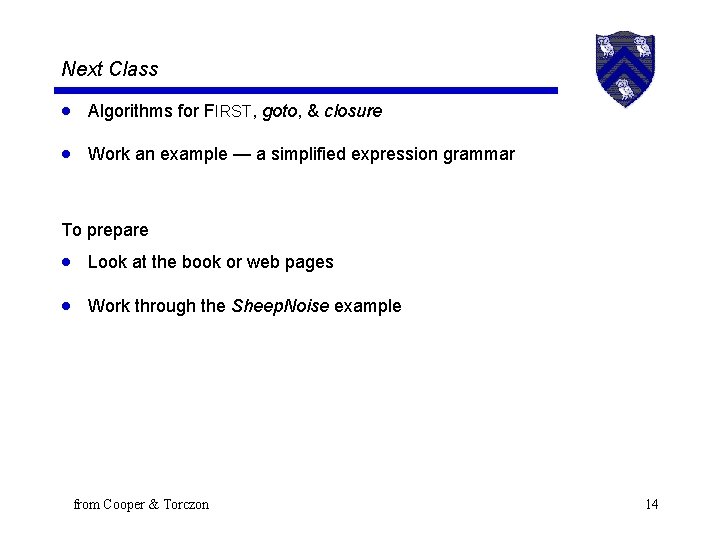
Next Class · Algorithms for FIRST, goto, & closure · Work an example — a simplified expression grammar To prepare · Look at the book or web pages · Work through the Sheep. Noise example from Cooper & Torczon 14
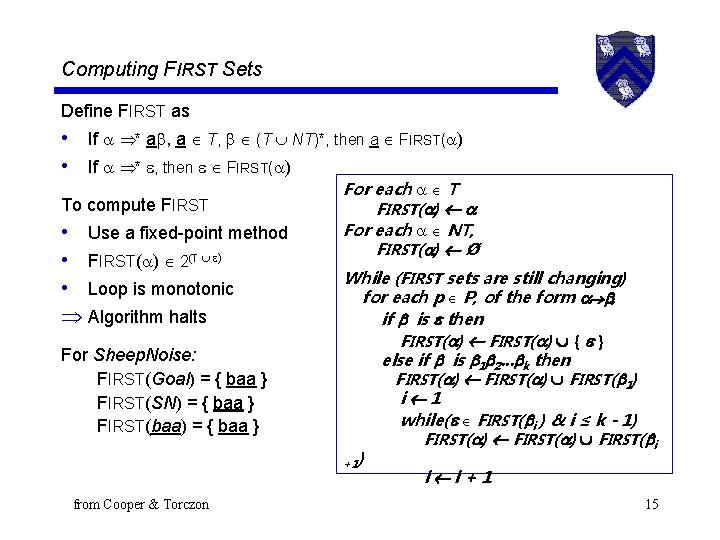
Computing FIRST Sets Define FIRST as • If * a , a T, (T NT)*, then a FIRST( ) • If * , then FIRST( ) To compute FIRST • Use a fixed-point method • FIRST( ) 2(T ) • Loop is monotonic Algorithm halts For Sheep. Noise: FIRST(Goal) = { baa } FIRST(SN) = { baa } FIRST(baa) = { baa } from Cooper & Torczon For each T FIRST( ) For each NT, FIRST( ) Ø While (FIRST sets are still changing) for each p P, of the form , if is then FIRST( ) { } else if is 1 2. . . k then FIRST( ) FIRST( 1) i 1 while( FIRST( i ) & i ≤ k - 1) FIRST( ) FIRST( i +1) i i+1 15