
Parsing using CYK Algorithm Transform grammar into Chomsky



- Slides: 5
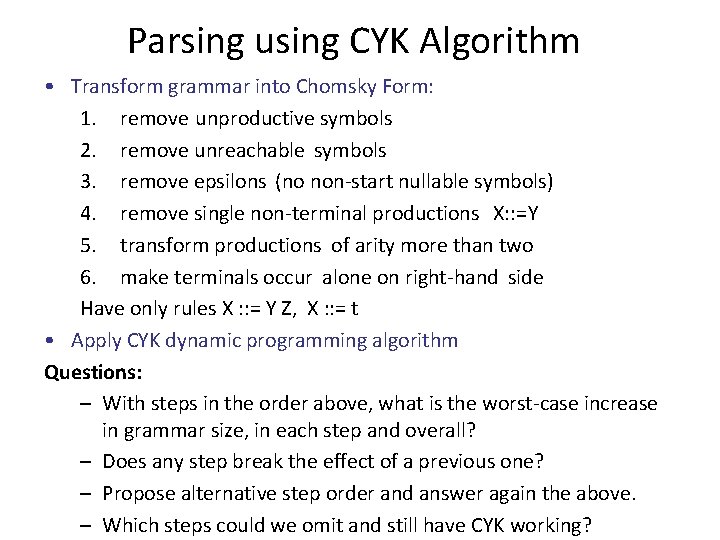
Parsing using CYK Algorithm • Transform grammar into Chomsky Form: 1. remove unproductive symbols 2. remove unreachable symbols 3. remove epsilons (no non-start nullable symbols) 4. remove single non-terminal productions X: : =Y 5. transform productions of arity more than two 6. make terminals occur alone on right-hand side Have only rules X : : = Y Z, X : : = t • Apply CYK dynamic programming algorithm Questions: – With steps in the order above, what is the worst-case increase in grammar size, in each step and overall? – Does any step break the effect of a previous one? – Propose alternative step order and answer again the above. – Which steps could we omit and still have CYK working?
Suggested Order • Removing epsilons (3) can increase grammar size exponentially • This problem is avoided if we make rules binary first (5). • Removing epsilons can make some symbols unreachable, so we can repeat 2 • Resulting order: 1, 2, 5, 3, 4, 2, 6
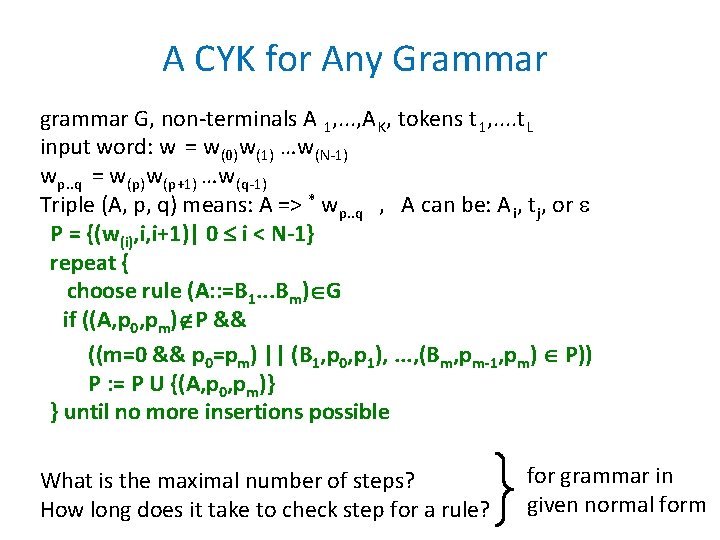
A CYK for Any Grammar grammar G, non-terminals A 1, . . . , A K, tokens t 1, . . t L input word: w = w (0)w (1) …w (N-1) w p. . q = w (p)w (p+1) …w (q-1) Triple (A, p, q) means: A => * w p. . q , A can be: A i, tj, or P = {(w(i), i, i+1)| 0 i < N-1} repeat { choose rule (A: : =B 1. . . Bm) G if ((A, p 0, pm) P && ((m=0 && p 0=pm) || (B 1, p 0, p 1), . . . , (Bm, pm-1, pm) P)) P : = P U {(A, p 0, pm)} } until no more insertions possible What is the maximal number of steps? How long does it take to check step for a rule? for grammar in given normal form
Observation • How many ways are there to split a string of length Q into m segments? • Exponential in m, so algorithm is exponential. • For binary rules, m=2, so algorithm is efficient.
Name Analysis Problems Detected • a class is defined more than once: class A {. . . } class B {. . . } class A {. . . } • a variable is defined more than once: int x; int y; int x; • a class member is overloaded (forbidden in Tool, requires override keyword in Scala): class A { int x; . . . } class B extends A { int x; . . . } • a method argument is shadowed by a local variable declaration (forbidden in Java, Tool): def (x: Int) { var x : Int; . . . } • two method arguments have the same name: def (x: Int, y: Int, x: Int) {. . . } • a class name is used as a symbol (as parent class or type, for instance) but is not declared: class A extends Objekt {} • an identifier is used as a variable but is not declared: def(amount: Int) { total = total + ammount } • the inheritance graph has a cycle: class A extends B {} class B extends C {} class C extends A To make it efficient and clean to check for such errors, we associate mapping from each identifier to the symbol that the identifier represents. • We use Map data structures to maintain this mapping (Map, what else? ) • The rules that specify how declarations are used to construct such maps are given by scope rules of the programming language.