
Paroxysmal Nocturnal Hemoglobinuria Paroxysmal Nocturnal Hemoglobinuria l l
Paroxysmal Nocturnal Hemoglobinuria

Paroxysmal Nocturnal Hemoglobinuria l l l Rare acquired hematopoetic stem cell disorder 1 -10 per million Most frequent in 3 rd decade Asian ancestry RBCs susceptible to complement-mediated lysis Related to lack of cell surface proteins that prevent complement attack
History of PNH l l l 1866—first case report by Gull describing nocturnal hematuria 1882—Strubing recognized PNH as a definite syndrome 1925—Enneking coined the name “Paroxysmal Nocturnal Hemoglobinuria” 1930 s—Ham identified the role of complement and developed the serum test which is still used for diagnosis 1980 s—PNH blood cells found to lack cell surface proteins 1990 s—Somatic mutation identified as PIG-A gene Jack the Ripper


Pathophysiology of PNH l Attachment of cell surface proteins – – l transmembrane hydrophobic sequence anchor embedded within the membrane that the protein attaches to Common variable in all missing cell surface proteins is Glycophosphatidylinositol (GPI) anchor
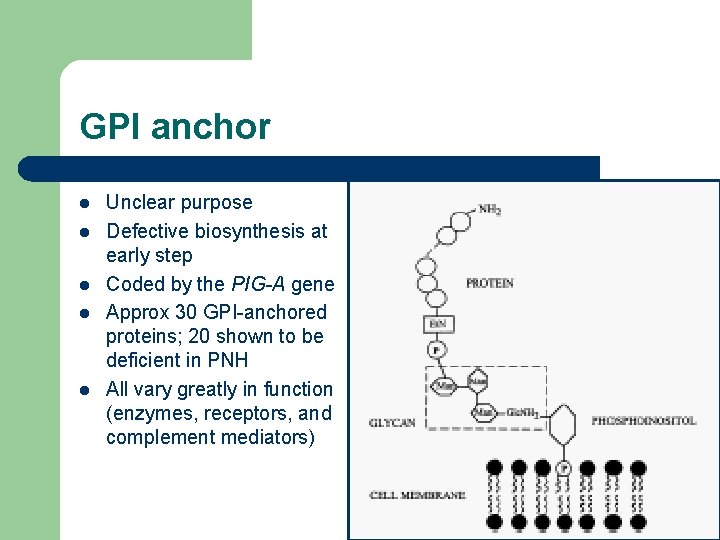
GPI anchor l l l Unclear purpose Defective biosynthesis at early step Coded by the PIG-A gene Approx 30 GPI-anchored proteins; 20 shown to be deficient in PNH All vary greatly in function (enzymes, receptors, and complement mediators)
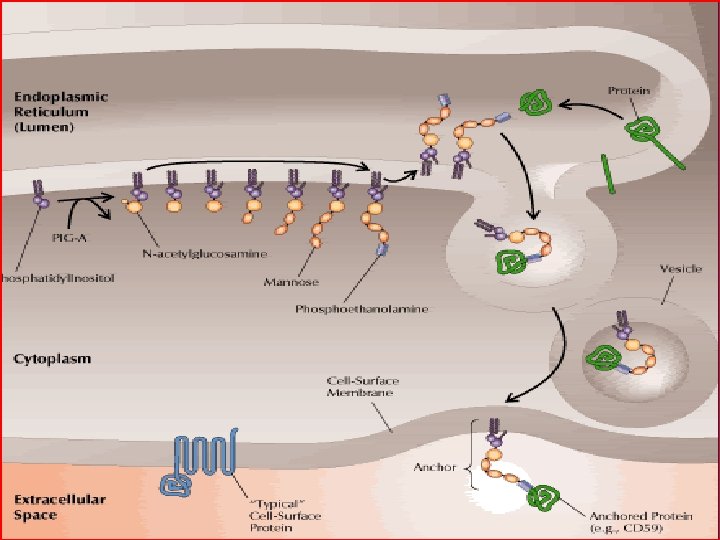
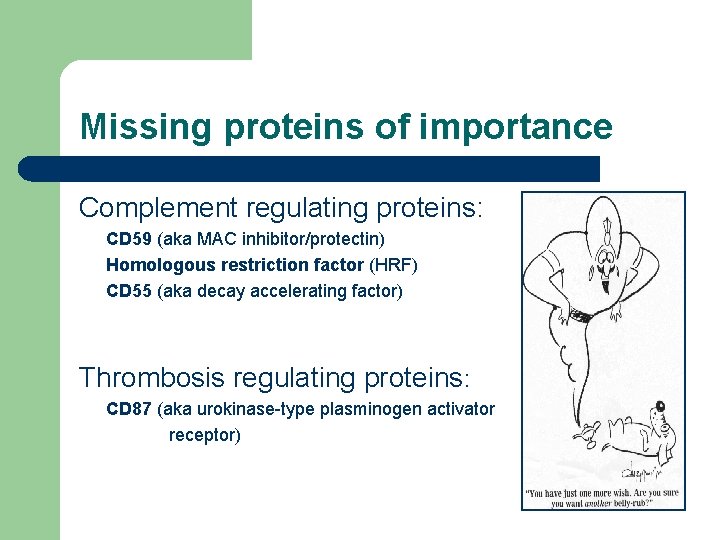
Missing proteins of importance Complement regulating proteins: CD 59 (aka MAC inhibitor/protectin) Homologous restriction factor (HRF) CD 55 (aka decay accelerating factor) Thrombosis regulating proteins: CD 87 (aka urokinase-type plasminogen activator receptor)
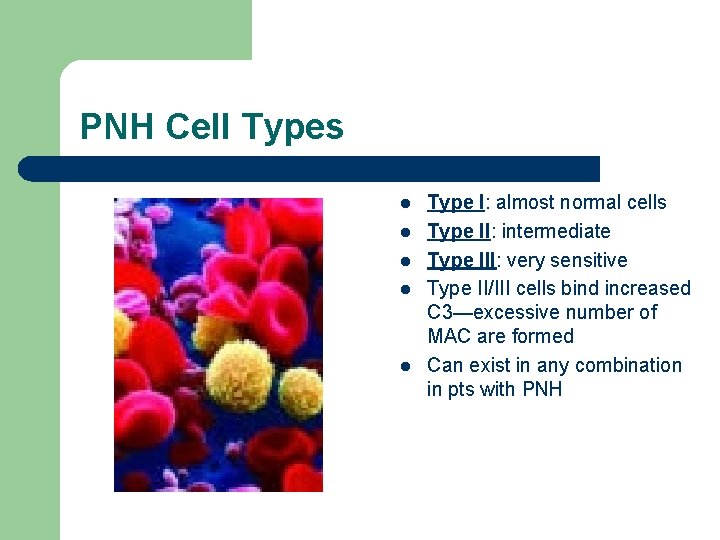
PNH Cell Types l l l Type I: almost normal cells Type II: intermediate Type III: very sensitive Type II/III cells bind increased C 3—excessive number of MAC are formed Can exist in any combination in pts with PNH
Clinical features l l Highly variable Classic Triad – – – l l Hemolytic Anemia Bone Marrow failure (thrombocytopenia/neutropenia) Venous Thrombosis Chronic course with acute exacerbations Exacerbations often associated with infection
Hemolytic Anemia l l l Present to some degree in all cases Degree of hemolysis depends on: – Proportion of sensitive RBCs – Cell type (PNH I-III) – Complement activation (ie infection, allergies, transfusion reaction, etc) Other effects of hemolysis: – – – Iron deficiency ATN/ARF during episodes of massive hemolysis CRF Esophageal spasm (achalasia-like sx) Impotence
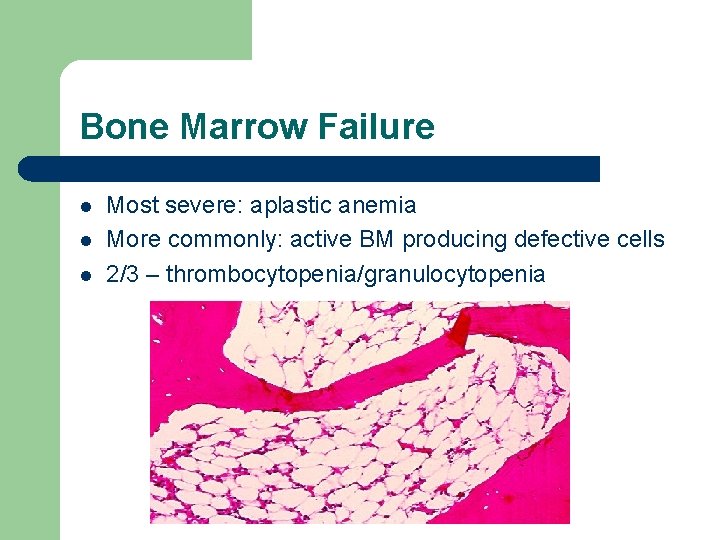
Bone Marrow Failure l l l Most severe: aplastic anemia More commonly: active BM producing defective cells 2/3 – thrombocytopenia/granulocytopenia
Venous Thromboses—the sinister sign l 20% incidence in Europe and US (lower in Asians) l Mainly central thromboses: – – – l l Liver (Budd-Chiari) l hepatic veins can thrombose in acute crisis or insidiously l Tends to persist with periodic exacerbations/remissions l Usually ultimately fatal Cerebral Veins/Sinuses l Less common l Also tends to persist—Poor prognosis Abdominal Veins l Renal/Spleen/Stomach/Intestinal LE DVT more common than in general population, but death by PE rare Arterial thrombosis also rare
Diagnosis l Ham test (acidified-serum lysis test) – – l Gold standard from 1939 until advent of flow cytometry Activation of complement by low p. H; PNH cells lyse High specificity Cannot detect varying degrees of RBC sensitivity Flow Cytometry – – – Increased level of sensitivity: allows detection of 0. 1% GPI-deficient clones Uses monoclonal Ab to missing proteins (CD 55/CD 59) and fluorescence of labeled cells to detect certain cell populations May screen RBCs, Platelets, and Lymphocyte components
Course and Prognosis l l l Life span estimates 10 -15 yrs Approx 25% will survive > 25 yrs Spontaneous recovery in ~15% w/o long-term sequelae
Course and Prognosis l Most common causes of death: – – l May be preceded by or lead to the development of aplastic anemia (AA) – – – l consequences of thrombosis (~33%) effects of BM failure (~10%) Incidence from various studies of 25 -58% Much less risk of thrombosis—less PNH cells overall Possible “natural gene therapy” producing cells which escape destruction in the setting of AA 3 -5% progress to acute leukemia – Likely more related to predisposition in pts with AA, not PNH itself
Treatment l Focus on 3 aspects: – – – l Treat anemia Treat and prevent thromboses Modification of hematopoiesis Mainly focused on control of complications rather than interrupting disease process
Treating Cytopenias l PRBC/Platelet Transfusions – – – l Epogen/Fe. SO 4/Folate – l Replaces destroyed cells Also suppresses erythropoiesis when done on chronic basis Special transfusion considerations only if necessary Expensive, but shown to decrease need for high dose steroids and less transfusions Glucocorticoids – – Unknown MOA Useful in 50% pts Thought to be related to direct prevention of hemolysis 0. 3 -1 mg/kg/day
Treatment and Prevention of Clots l Prevention – l Prophylactic anticoagulation for pts w/o contraindications Treatment – – IV/Oral anticoagulants Thrombolytics: TPA/Streptokinase/Urokinase
Modifying Hematopoiesis l Immunosuppresants – – l l Better response in pts with hypoplastic marrow than hemolysis Mixed results: antithymocyte globulin response rates 0 -63%; cyclosporin not effective Bone Marrow Transplant – Currently most curative and optimal Tx – High risk of morbidity/mortality (10 -20%) – Risk: benefit considering pts with lesser sx – No controlled studies for ethical reasons Gene therapy
- Slides: 20