
PAROTID GLAND By Dr Leena N Associate Professor
PAROTID GLAND By Dr. Leena. N Associate Professor Department of Anatomy
PAROTID GLAND It is the largest of the Salivary glands. Serous gland Weighs about 25 gm
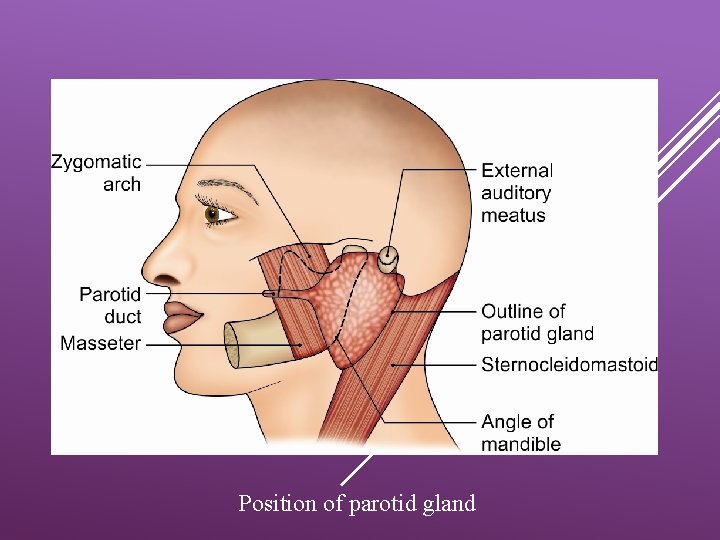
Position of parotid gland
Capsule of Parotid Gland • The investing layer of the deep cervical fascia forms a capsule for the gland. • It is supplied by great auricular nerve. • A portion of the deep lamina, extending between the styloid process and the mandible, is thickened to form the stylomandibular ligament which separates the parotid gland from the submandibular salivary gland. The ligament is pierced by the external carotid artery.
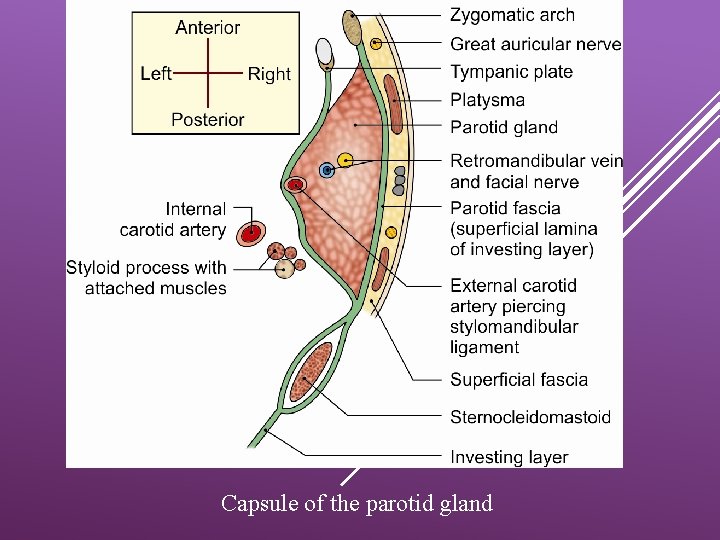
Capsule of the parotid gland
External Features The gland resembles a three-sided pyramid. The gland has four surfaces: a. Superior (base of the pyramid) b. Superficial c. Anteromedial d. Posteromedial The surfaces are separated by three borders: a. Anterior b. Posterior c. Medial/pharyngeal
Relations Apex The cervical branch of the facial nerve and the two divisions of the retromandibular vein emerge near the apex. Surfaces The superior surface or base It is related to a. The cartilaginous part of the external acoustic meatus b. The posterior surface of the temporomandibular joint c. The superficial temporal vessels d. The auriculotemporal nerve
• • Superficial surface covered with: Skin Superficial fascia The parotid fascia • A few deep parotid lymph nodes
THE ANTEROMEDIAL SURFACE It is related to: The posterior border of the ramus of the mandible The masseter The medial pterygoid The lateral surface of the temporomandibular joint. The emerging branches of the facial nerve.
The posteromedial surface Is related to: a. The mastoid process, with the sternocido-mastoid and the posterior belly of the digastric. b. The styloid process, with structures attached to it. c. The external carotid artery and facial nerve enter the gland through this surface.
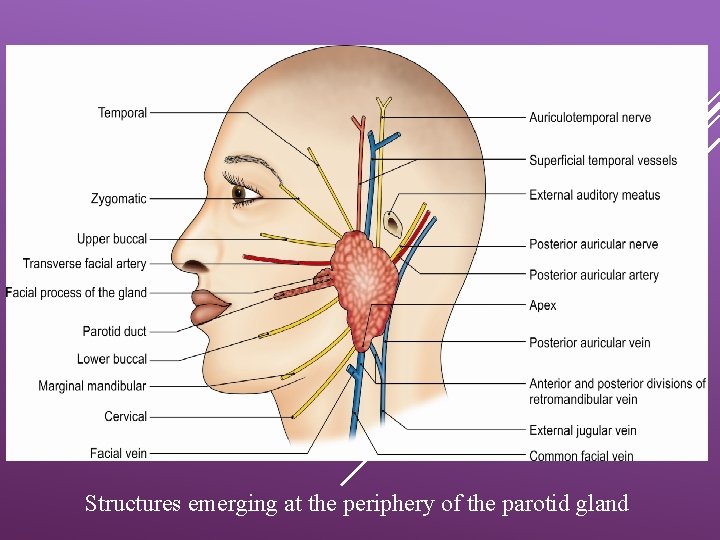
Structures emerging at the periphery of the parotid gland
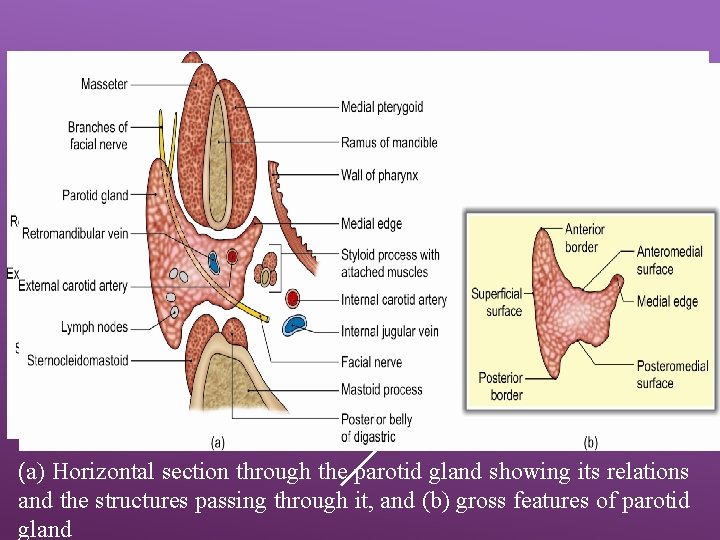
(a) Horizontal section through the parotid gland showing its relations and the structures passing through it, and (b) gross features of parotid gland
Structures within the Parotid Gland From medial to the lateral side, these are as follows. • Arteries: The external carotid artery divides into maxillary artery and superficial temporal artery • Veins: The retromandibular vein • The facial nerve Facial nerve divides into two branches a. Temporofacial: Divides into temporal and zygomatic branches. b. Cervicofacial: Divides into buccal, marginal mandibular and cervical branches. • Parotid lymph nodes
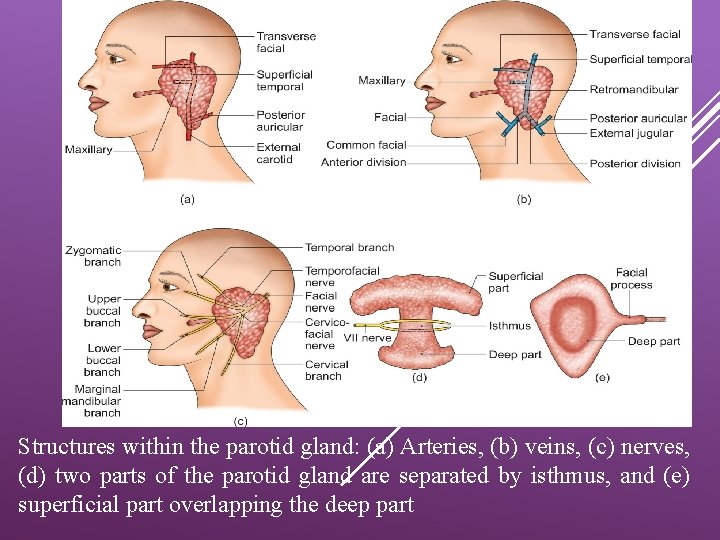
Structures within the parotid gland: (a) Arteries, (b) veins, (c) nerves, (d) two parts of the parotid gland are separated by isthmus, and (e) superficial part overlapping the deep part
Parotid Duct/Stenson’s Duct Parotid duct is thick-walled and is about 5 cm long. It runs forwards and slightly downwards on the masseter. It pierces buccal pad of fat , buccopharyngeal fascia and buccinator. Then forwards for a short distance between the buccinator and the oral mucosa. Finally, the duct turns medially and opens into the vestibule of the mouth opposite the crown of the upper second molar tooth.
Blood Supply The external carotid artery and its branches that arise within the gland
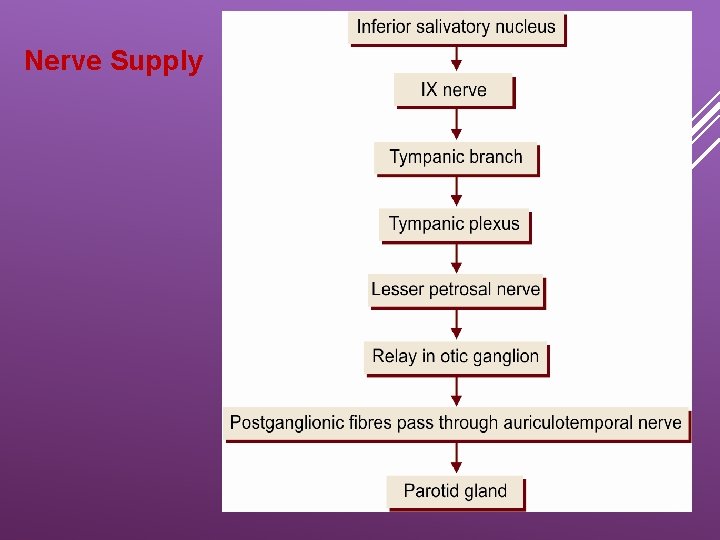
Nerve Supply
Lymphatic Drainage Parotid Lymph Nodes They drain: a. Temple b. Side of the scalp c. Lateral surface of the auricle d. External acoustic meatus e. Middle ear f. Parotid gland g. Upper part of the cheek h. Parts of the eyelids and orbit
Development The parotid gland is ectodermal in origin.
Viral infection of the gland- Mumps. Parotid fascia is very dense and allows very little expansion of the gland. Hence parotid swellings are very painful. Benign and malignant tumours. Facial paralysis can occur as a result of involvement of facial nerve in a malignant growth of parotid gland. During surgical removal of the parotid gland - Parotidectomy, the facial nerve is preserved by removing the gland in two parts, superficial and deep separately. CLINICAL ANATOMY The parotid calculi may get formed in its Stenson’s duct. within the parotid gland or
- Slides: 20