
Parliament and Legislation Revision Which are sources of






- Slides: 44
Parliament and Legislation
Revision Which are sources of English law? What is meant by common law? What is a precedent? Which precedents are binding, and which are persuasive? What can you say about the hierarchy of English courts? Which are three branches of government? What is the purpose of the system of checks and balances?
Complete the following: The legislative power is ususally carried out by a ________, which may bear a name such as _________ or ________. It can consist of one chamber, and then it is called ________, or of two chambers - _______. The principal tasks of legislature are ______ law, approving the state _______ and controlling the work of the _____________.
The legislative power is ususally carried out by a LEGISLATURE, which may bear a name such as PARLIAMENT or ASSEMBLY. It can consist of one chamber, and then it is called UNICAMERAL LEGISLATURE, or of two chambers – BICAMERAL LEGISLATURE. The principal tasks of legislature are ENACTING law, approving the state BUDGET and controlling the work of the EXECUTIVE BRANCH.
Separation of powers Executive – the government Legislative - Parliament Judicial – hierarchy of courts
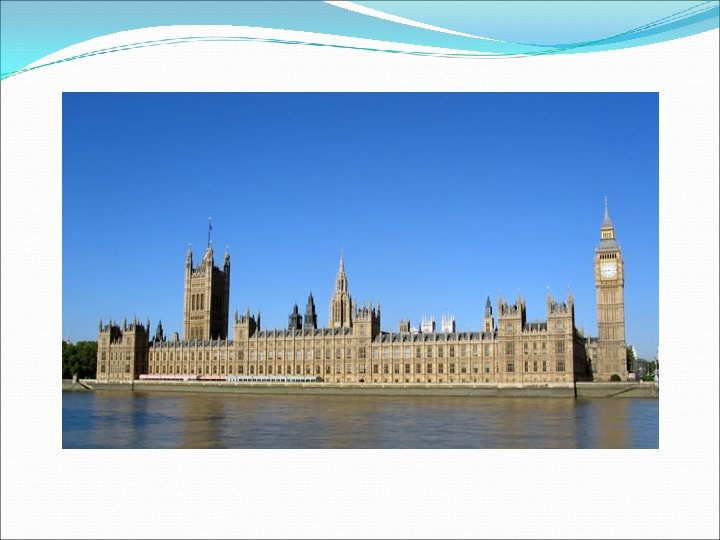
Parliament of the UK
Parliament The highest legislative organ in the UK Constitutionally consists of the Monarch, The House of Lords and the House of Commons The Queen in Parliament represents the supreme authority within the United Kingdom
Functions of Parliament Scrutiny Legislation Debating Budget and taxes
The House of Commons An elected and representative body 650 Members of Parliament (MPs) who represent their constituencies Members are elected at General Elections held every five years Members are paid a salary and an allowance Most MPs are members of one of three main political parties in the UK (Labour, Conservative and Liberal Democrat), while other represent minor parties or are independent
Speaker of the House of Commons presides over the House The traditional guardian of the rights and privileges of the House
Working in Parliament MPs generally spend their time working in the House of Commons This can include raising issues affecting their constituents, attending debates and voting on new laws Working in committees Working in their constituency – MPs often hold ‘surgeries’ in their office
Political parties Most MPs are members of one of three main political parties in the UK – Labour, Conservative and Liberal Democrat Other MPs represent smaller parties or are independent
Video exercise http: //www. youtube. com/watch? v=0 To. Kc. Evq. Xu. M&li st=PL 7 F 1 AFC 4 FF 75 A 3725&index=5&feature=plpp_vide o Listen and answer the following: Who sits at the Speakers’ right side? Who is Sarjeant at Arms? What is Hansard?
The House of Lords in the past In the past mainly a hereditary body Lords Temporal (hereditary peers and peeresses who have not disclaimed their peerage; life peers created by the Crown under the Life Peerages Act of 1958 and Lords of Appeal in Ordinary – Law Lords) Lords Spiritual (the Archbishops of Canterbury and York and 24 senior bishops of the Church of England)
The House of Lords today The Lords currently has over 700 Members, and there are three different types: hereditary Peers, life Peers (Lords Temporal) and bishops (Lords Spiritual) Unlike MPs, the public do not elect the Lords. The majority are appointed by the Queen on the recommendation of the Prime Minister or of the House of Lords Appointments Commission.
Hereditary Peers The right of hereditary Peers to sit and vote in the House of Lords was ended in 1999 by the House of Lords Act but 92 Members were elected internally to remain until the next stage of the Lords reform process.
Life Peers Appointed for their lifetime only, these Lords' titles are not passed on to their children. The Queen formally appoints life Peers on the advice and recommendation of the Prime Minister.
Bishops (Lords Spiritual) A limited number of 26 Church of England archbishops and bishops sit in the House, passing their membership on to the next most senior bishop when they retire.
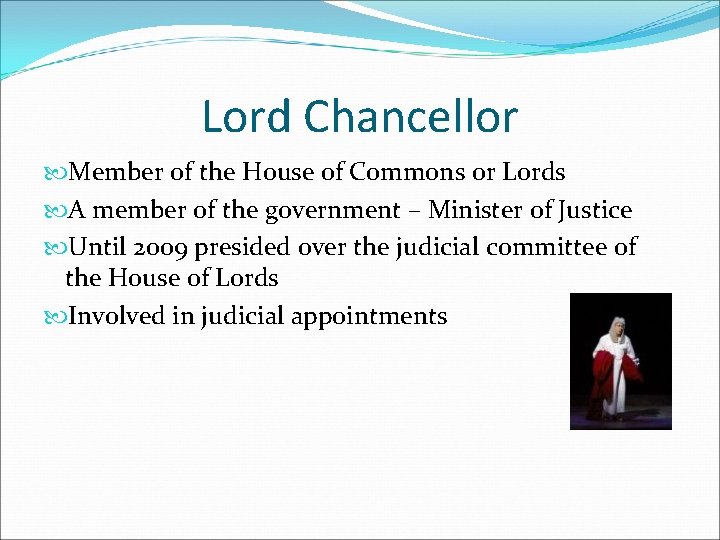
Lord Chancellor Member of the House of Commons or Lords A member of the government – Minister of Justice Until 2009 presided over the judicial committee of the House of Lords Involved in judicial appointments
Video exercise http: //www. youtube. com/watch? v=w. Vllfyv. Gf. U&list=PL 7 F 1 AFC 4 FF 75 A 3725&index=6&feat ure=plpp_video What did you learn about Life Peers? What is the role of the Lord Speaker? What is the Woolsack?
Lord Speaker The Lord Speaker oversees proceedings in the Lords chamber and plays a key role in the Lords Administration. The Lord Speaker also acts as an ambassador for the Lords at home and abroad, explaining and promoting the work of the House of Lords and its contribution to the UK's parliamentary system. presides over business in the Lords chamber from the Woolsack attending and speaking at state and ceremonial occasions on behalf of the Lords representing the Lords to overseas parliaments, attending conferences with speakers of other parliaments, sharing best practice and developing links between parliaments
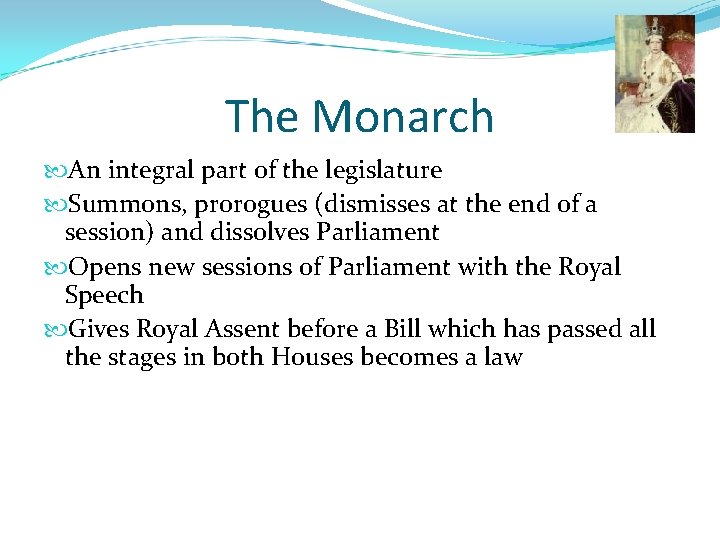
The Monarch An integral part of the legislature Summons, prorogues (dismisses at the end of a session) and dissolves Parliament Opens new sessions of Parliament with the Royal Speech Gives Royal Assent before a Bill which has passed all the stages in both Houses becomes a law
The Royal Speech The Queen's Speech on May 18, 2016 The Queen's Speech is delivered by the Queen from the Throne in the House of Lords. Although the Queen reads the speech, it is written by the government. It contains an outline of its policies and proposed legislation for the new parliamentary session. https: //www. youtube. com/watch? v=E 0 Ucj. SHd 7 mo
Parliamentary sovereignty The most important principle in the UK constitution It makes Parliament the supreme legal authiroty in the UK – the courts cannot overrule its legislation
The UK constitution An “unwritten” constitution – it is not contained in a single source ‘Partly written and wholly uncodified’
Legislative Procedure
Pressure for new laws comes from a variety of sources, mainly: Government policy EU Law Commission reports Reports by other commissions Pressure groups
Pre-parliamentary process The Government sets its legislative programme for the parliamentary session in the Queen’s Speech at the opening of Parliament Consultation – more common in recent years (The Law Commission)
Types of Bill Government Bill – introduced by the Government through the relevant Minister Public Bill – one which relates to matters that affect the public Private Bill – one which relates to the powers and interests of certain individuals or institutions Hybrid Bill – one which features both a public and a private Bill Private Member’s Bill – one introduced by a MP
Passing a Bill A Bill may be started in either the House of Commons or the House of Lords, but it has to go through the same procedure in each House and pass all stages of the legislative procedure in order to become law
Legislative Procedure Principal stages (for government bills) Inspiration Formulation Drafting Parliamentary Scrutiny Voting The Royal Assent Implementation
Inspiration Ideas for a law come from a variety of sources (political parties, Government departments, interest groups, professional bodies)
Formulation Becomes the responsibility of relevant Ministers and civil servants Cabinet committees Consultation with experts, interest groups, trade associations and others likely to be affected by the legislation
Drafting Preparation of a draft bill Draft bills introduced to Parliament
Parliamentary Scrutiny First reading (no debate) Second reading (principle debated on floor) Committee stage (clause-by-clause scrutiny in Standing Committee) Report (amendments considered on floor) Third reading (final version debated) Voting
The Royal Assent The Queen has to sign the Bill Then it becomes an Act of Parliament The Statute Book Implementation – binding for all the courts in the country Interpretation leads to precedents
Repeal If a new statute is clearly contrary to the old one already in the Statute Book, the new one must clearly repeal those parts of the old statute The old statute (or its parts) are no longer valid
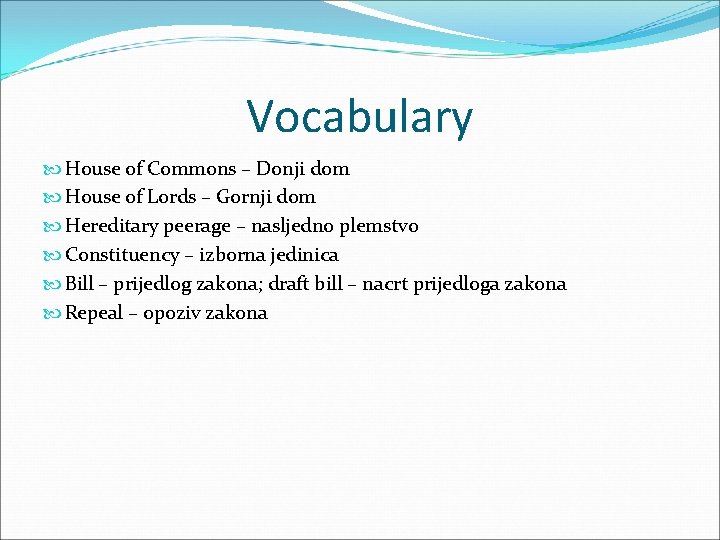
Vocabulary House of Commons – Donji dom House of Lords – Gornji dom Hereditary peerage – nasljedno plemstvo Constituency – izborna jedinica Bill – prijedlog zakona; draft bill – nacrt prijedloga zakona Repeal – opoziv zakona
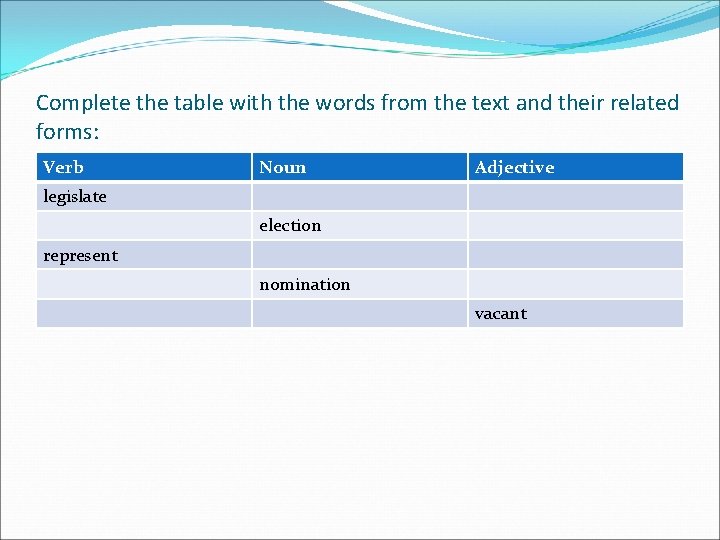
Complete the table with the words from the text and their related forms: Verb Noun Adjective legislate election represent nomination vacant
Match the verbs in the left column with the nouns in the right column: 1. make a. issues debate the government approve work scrutinise laws challenge spending cast changes grant assent win a vote give a seat implement powers
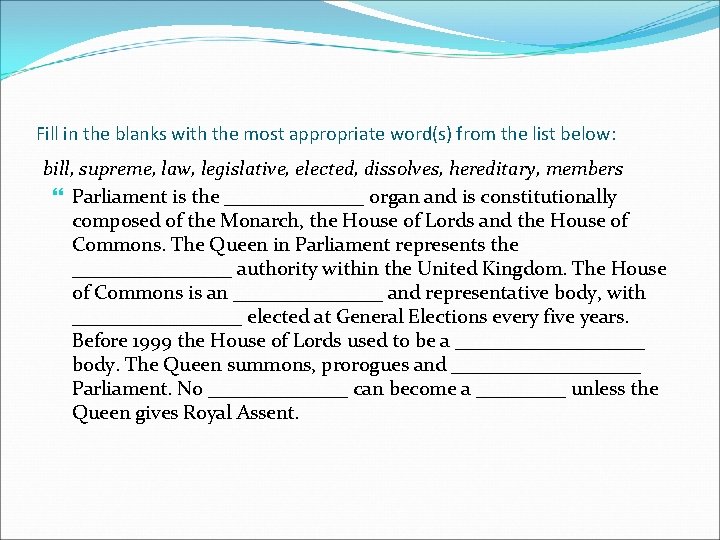
Fill in the blanks with the most appropriate word(s) from the list below: bill, supreme, law, legislative, elected, dissolves, hereditary, members Parliament is the _______ organ and is constitutionally composed of the Monarch, the House of Lords and the House of Commons. The Queen in Parliament represents the ________ authority within the United Kingdom. The House of Commons is an ________ and representative body, with _________ elected at General Elections every five years. Before 1999 the House of Lords used to be a __________ body. The Queen summons, prorogues and __________ Parliament. No _______ can become a _____ unless the Queen gives Royal Assent.
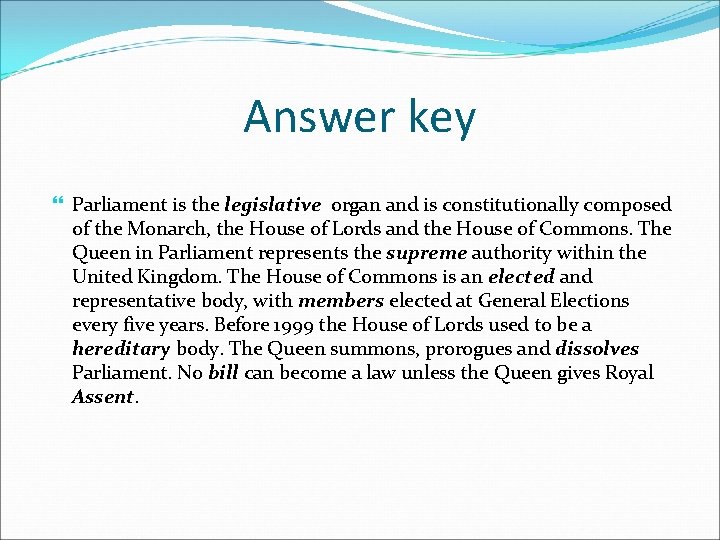
Answer key Parliament is the legislative organ and is constitutionally composed of the Monarch, the House of Lords and the House of Commons. The Queen in Parliament represents the supreme authority within the United Kingdom. The House of Commons is an elected and representative body, with members elected at General Elections every five years. Before 1999 the House of Lords used to be a hereditary body. The Queen summons, prorogues and dissolves Parliament. No bill can become a law unless the Queen gives Royal Assent.
Thank you for attention!