
Parkinsons disease The basics Praveen Dayalu MD Clinical
Parkinson’s disease: The basics Praveen Dayalu, MD Clinical Associate Professor Department of Neurology University of Michigan
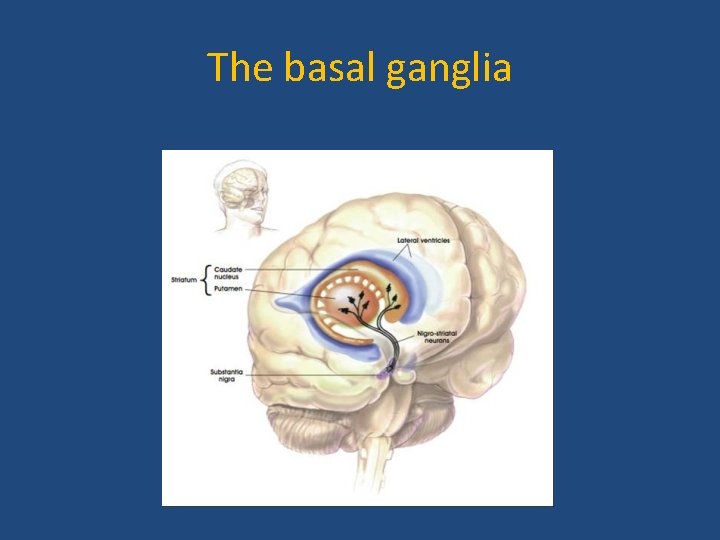
The basal ganglia
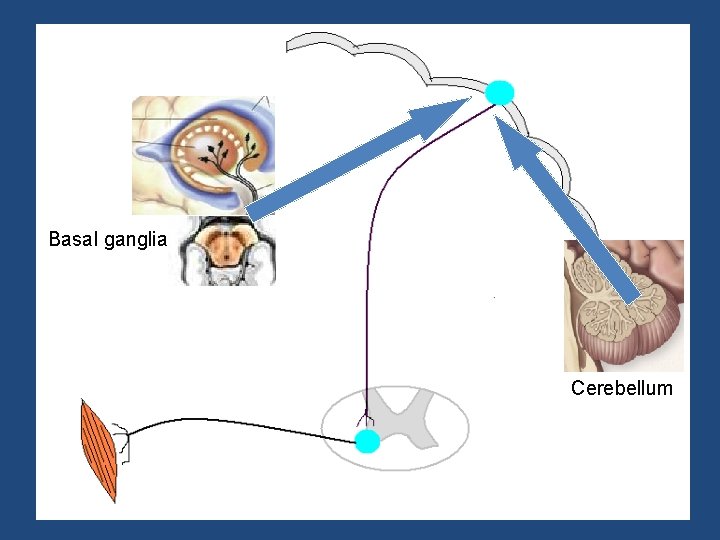
Basal ganglia Cerebellum

Parkinsonism comprises four cardinal motor features • Bradykinesia (slow and small movements). Reduced blink, face expression, and gesturing. Soft voice. Difficulty getting out of chair, shuffling steps, reduced arm swing, freezing • Tremor (usually resting) “pill rolling”, often involves thumb • Rigidity (different from spasticity) • Postural changes. Imbalance, falls; stooped flexed posture

Differential diagnosis of parkinsonism • Parkinson disease (idiopathic or genetic) • Parkinson-plus degenerations (dementia with Lewy bodies, progressive supranuclear palsy, corticobasal degeneration, multiple system atrophy) • Drug-induced parkinsonism (anti-dopaminergics) • Rare but treatable in young people: Wilson disease and Dopa-responsive dystonia • Other: “vascular” parkinsonism, brain trauma, CNS infection
Drug-Induced Parkinsonism • Drugs that reduce dopamine transmission • Antipsychotics / antiemetics: Risperidone, haloperidol, metoclopramide, promethazine, prochlorperazine, etc. • Can be indistinguishable from PD • Clozapine does not seem to cause it; quetiapine appears to have low rates • Management: reduce or discontinue offending agent. Can take months to resolve!
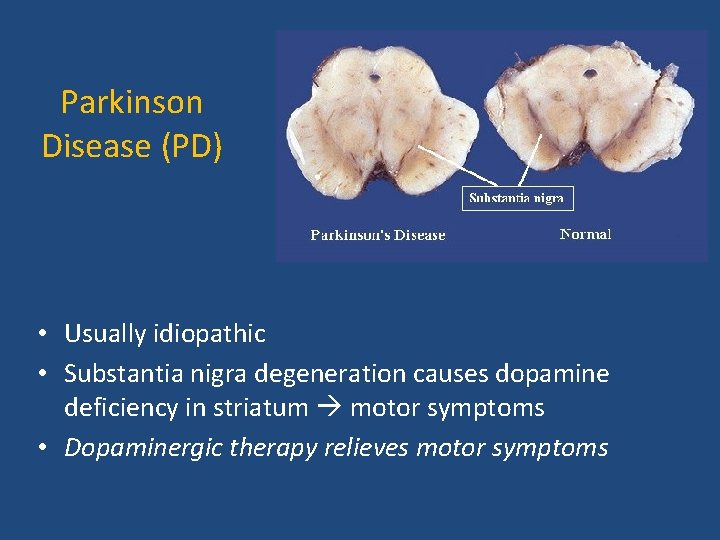
Parkinson Disease (PD) • Usually idiopathic • Substantia nigra degeneration causes dopamine deficiency in striatum motor symptoms • Dopaminergic therapy relieves motor symptoms
Parkinson disease: Common early complaints • • Resting tremor Writing smaller; harder to do buttons Slowness, “weakness”, limb not working well Stiff or achy limb Stoop, shuffle-walk, “dragging” leg(s) Trouble getting out of chairs or turning in bed Low or soft voice • Non-motor: anosmia, dream enactment, constipation, anxiety, depression, “passiveness”

PD: meds for motor symptoms • L-dopa (with carbidopa) is most effective and usually best tolerated • Dopamine agonists (ropinirole, pramipexole) • Others have only modest benefits (MAO-B inhibitors, anticholinergics, amantadine)

Early PD: When to start meds? • Drugs are symptomatic, not neuroprotective or neurotoxic • Level of patient function is best guide • Response to dopaminergic therapy (especially l-dopa) is the best available “test” for PD ** Remember the value of exercise! **
Which treatment to start? • L-dopa most effective for motor symptoms in general (bradykinesia, tremor, gait changes) • Family physicians can start levodopa !! • Dopamine agonists cause more non-motor side effects, and are best avoided in patients above 70
Treatment pearls in early PD • Fear not L-dopa. “Delaying L-dopa” is of no benefit long-term. • Treat more for symptoms and function, and less for how the patient “looks”. • Generics are fine. • Allow adequate dose and time to work before concluding “failure” or “not PD”. • Resting tremor may be medication refractory in some patients; don’t conclude “not PD”.

Levodopa • Most effective overall for motor symptoms • A fine option for initial therapy of PD • By mid to late disease it is almost always needed • Non-motor side effects include nausea, orthostasis, sleepiness, hallucinations; but not as much as other PD drugs • Motor side effect: dyskinesias

Carbidopa/ levodopa dosing • Commonest preparation is regular 25/100 mg. • Try 1 pill PO TID 1. 5 pills TID 2 pills TID. With meals reduces nausea. • 2 weeks between steps to appreciate effect. • No response? At least 900 mg/ d to say “not PD”. • Some patients need QID or more frequent dosing (even Q 3 H in advanced disease). • Typical daily l-dopa dose range: 300 mg to 1500 mg

Dopamine agonists (ropinirole, pramipexole, rotigotine) • Can be monotherapy in early disease; need l-dopa in mid to late disease • Can add to l-dopa to reduce OFF time • Frequent side effects! Nausea, sleep attacks, hypotension, compulsive behaviors, LE edema • More prone than l-dopa to causing hallucinations and confusion. Caution in older or demented patients!
Mid to late PD: a tricky business • More motor complications including dyskinesias and ON-OFF fluctuations • More drug-resistant motor symptoms (e. g. impaired balance with falls) • More nonmotor symptoms (especially dementia and hallucinations) • More medications, so more side effects Managing these complexities requires experience.

“Motor complications” as PD progresses • Fluctuations. Medication wears off before next dose. OFF periods worse as disease progresses. • Dyskinesias (usually at the peak of ON). • Need larger and/or more frequent med doses, or combinations of drugs. • Deep brain stimulation an option for some patients with medically refractory motor complications.
Some motor symptoms may not respond to med adjustments • • • Postural instability and falls Freezing of gait Fatigue Dysarthria, dysphagia Some tremor (!)

Non-motor Symptoms • Psychiatric (depression, anxiety) • Autonomic (blood pressure, genitourinary, GI) • Sleep (REM behavior disorder, insomnia, hypersomnia, sleep apnea) • Fatigue • Cognitive (psychosis, dementia) 20
Why non-motor symptoms? • PD affects many parts of the nervous system • Earliest involvement is in gut nerve plexus, lower brainstem, and olfactory bulb • Pathology moves up the brainstem, also to serotonergic, noradrenergic, and cholinergic nuclei • Non-motor symptoms (e. g. anosmia, constipation, dream enactment) often predate motor symptoms 21
Depression and anxiety • It’s not just because of the stress of the diagnosis • Motor symptoms and wearing off can interact with mood anxiety levels • Can misinterpret “poker face” as depression. Ask the patient! • SSRI’s can work; avoid benzodiazepines 22
Depression and anxiety: other considerations • Consider support services / psychotherapy for patients and caregivers • Geriatric psychiatrists usually have better expertise in this population 23
Autonomic symptoms
Blood pressure dysregulation • Causes orthostatic hypotension and supine hypertension • Syncope can occur, sometimes with injury • Worse with dopamine agonists and higher doses of L-dopa • Lower extremity edema may also reflect vascular dysregulation 25
Recognizing orthostatic hypotension • Not all have the classic lightheaded feeling Other clues: • Abrupt falls • Weakness, buckling, or shaking of legs or body • Being dazed, confused, “goofy” • Coat-hanger ache (neck and shoulders) 26
Managing orthostasis: first steps • Reduce or stop antihypertensives, diuretics, other offenders (including some PD meds) • Don’t over-treat isolated high BPs; 3 minute orthostatic BP gives a clearer picture • Water, water, salt, and water • Elevate head of bed to 30 degrees • Compression stockings (groan) • Teach first-aid/ bystander response 27
Managing orthostasis: prescription meds • Fludrocortisone: retains body sodium (beware of hypokalemia) • Midodrine: raises BP (beware supine hypertension) • Droxidopa: turns to norepinephrine, raises BP (beware supine hypertension) 28
Urinary Symptoms • Urgency, frequency, nocturia are very common • Obstruction/ retention are less common • Incontinence is uncommon early on • Pathophysiology can be complex in any given patient • Confounds: age, prostate issues, motor problems 29

Managing urinary symptoms • Non-pharmacologic (timed voids, head of bed up for nocturia) Bladder antispasmodics: • Oxybutynin, tolterodine, solifenacin, darifenacin: beware anticholinergic brain effects! • Mirabegron– a novel adrenergic drug • Might cause retention, especially in men • Consider urology referral (can also address ED) 30
Constipation in PD May predate motor symptoms by years Slow transit or outlet obstruction Step 1: reasonable dietary fiber, water Step 2: mild osmotic laxatives (e. g. , polyethylene glycol) • For patients not responding to conservative measures, consider specialty referral • • 31
Sleep symptoms
REM sleep behavior disorder • Typically in men, often years before motor symptoms • Complex movements or fighting • Usually early in the morning, varying frequency • Patient or bed partner injury 33
REM sleep behavior disordertreatment • Treat any underlying OSA • Make sleeping environment safer • Melatonin 3 - 12 mg qhs helps mild to moderate symptoms • Clonazepam 0. 25 – 1. 0 mg qhs may be needed for more severe symptoms 34
Obstructive Sleep Apnea • PD patients, even skinny ones, are more at risk for sleep-disordered breathing • Maintain a high level of suspicion • Can present with snoring, daytime somnolence, nighttime awakenings, nocturia, worsening dream enactment… 35
Insomnia • • 36 Can be primary or secondary Address sleep hygiene Review med list Treat nighttime motor symptoms Think about OSA Treat psychiatric comorbidities Sedative/ hypnotics: melatonin, trazodone, mirtazapine, clonazepam (if RBD)
Hypersomnia • • 37 PD increases sleep need for many patients Poor sleep at night (many causes) Think about OSA Review med list (make special note of dopamine agonists, anticholinergics, benzos, other sedatives)
Fatigue • “Tired”, “Wiped out”, “No energy” Is it: Sleepiness? Wearing off? Motor? Mood? • Isolated fatigue can be disabling • No established treatment, though antidepressants and stimulants have been tried • Encourage light exercise, hobbies, etc • We badly need better treatments for this 38

Hallucinations & Dementia in PD • Complicate many longstanding PD cases • Hallucinations are usually visual • Main contributors are disease progression (brain pathologic changes), age, and meds • Older patients much more at risk • Marker for increased morbidity, mortality, and institutionalization
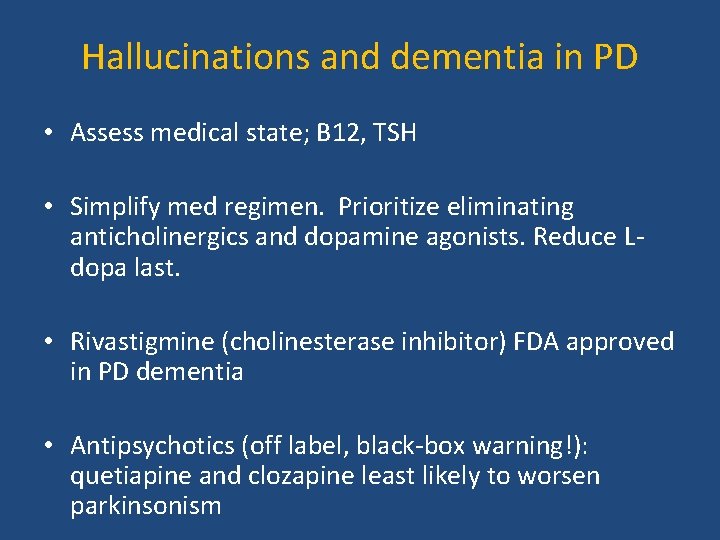
Hallucinations and dementia in PD • Assess medical state; B 12, TSH • Simplify med regimen. Prioritize eliminating anticholinergics and dopamine agonists. Reduce Ldopa last. • Rivastigmine (cholinesterase inhibitor) FDA approved in PD dementia • Antipsychotics (off label, black-box warning!): quetiapine and clozapine least likely to worsen parkinsonism

Case Studies
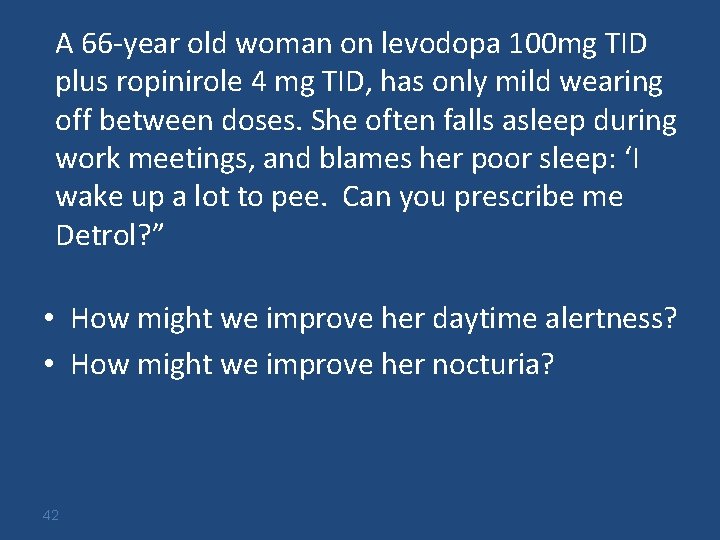
A 66 -year old woman on levodopa 100 mg TID plus ropinirole 4 mg TID, has only mild wearing off between doses. She often falls asleep during work meetings, and blames her poor sleep: ‘I wake up a lot to pee. Can you prescribe me Detrol? ” • How might we improve her daytime alertness? • How might we improve her nocturia? 42
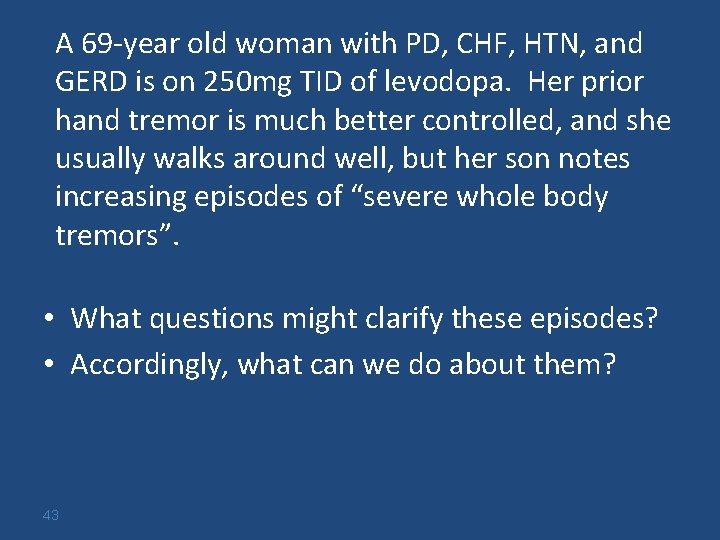
A 69 -year old woman with PD, CHF, HTN, and GERD is on 250 mg TID of levodopa. Her prior hand tremor is much better controlled, and she usually walks around well, but her son notes increasing episodes of “severe whole body tremors”. • What questions might clarify these episodes? • Accordingly, what can we do about them? 43
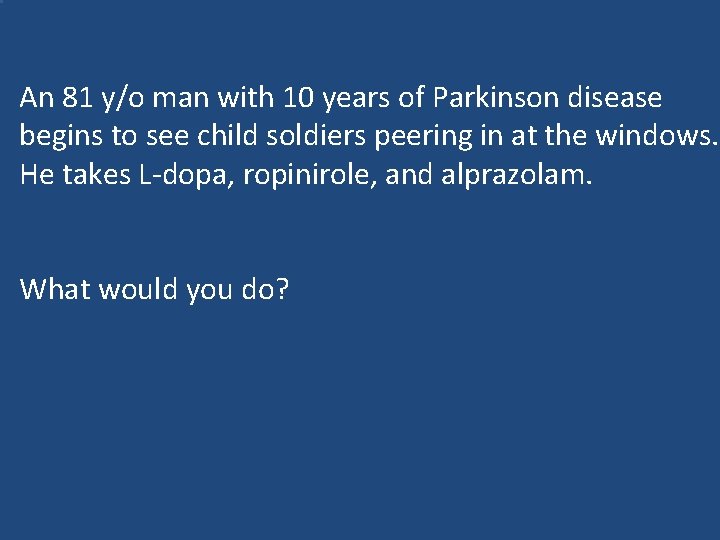
An 81 y/o man with 10 years of Parkinson disease begins to see child soldiers peering in at the windows. He takes L-dopa, ropinirole, and alprazolam. What would you do?
- Slides: 44