
Parkinsons Disease Dr Rachel Cary Warwick Hospital Overview

- Slides: 20
Parkinson’s Disease Dr Rachel Cary, Warwick Hospital
Overview � Hopefully not anything new (!) � Definition of Parkinson’s disease � Aetiology � Presentation � Investigations � Management: conservative, medical, surgical � Prognosis � Parkinson’s plus syndromes
Definition � Parkinson’s disease � The idiopathic syndrome of Parkinsonism � Described by Dr James Parkinson in 1817 – ‘the shaking palsy’ � Parkinsonism � Symptom complex: characterised by bradykinesia, tremor and rigidity (classical triad) � Causes: � Drug induced – anti-dopaminergics e. g. clozapine, metoclopramide, domperidone � Post-encephalitis � Exposure to toxins: e. g. severe CO poisoning
How common is it? � 65. 6 -125 per 100, 000 � Incidence rises steeply with age: � 17. 4 in 100, 000 person years between age 50 -59 � 93. 1 in 100, 000 person years between 70 and 79 years
Risk factors � Age � Male gender � Pesticide exposure � Genetic � ? born in the springtime
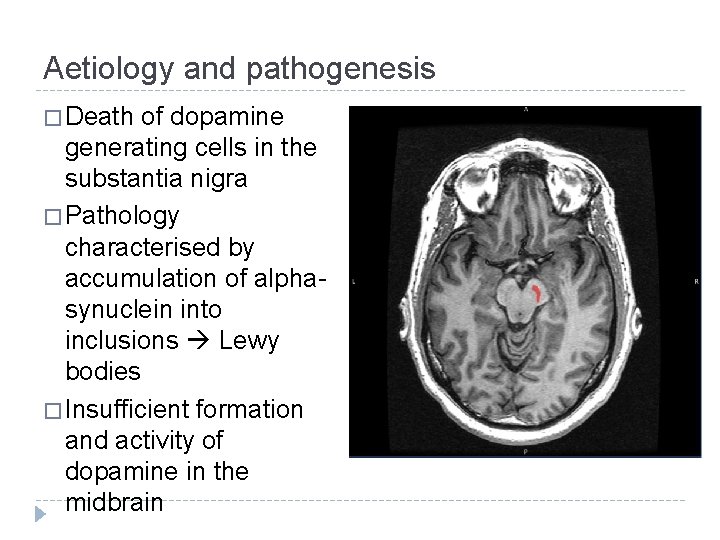
Aetiology and pathogenesis � Death of dopamine generating cells in the substantia nigra � Pathology characterised by accumulation of alphasynuclein into inclusions Lewy bodies � Insufficient formation and activity of dopamine in the midbrain
Presentation: symptoms + signs � Tremor 4 -6 Hz – unilateral onset � Rigidity � Slowness of movement � Postural instability � Gait: festinating, shuffling, reduced arm swing � Gait freezing � Turning en bloc � Hypomimia � Micrographia � Hypophonia
How will you elicit these in an OSCE?
Differential diagnosis � Benign essential tremor � Drug/toxin induced � Huntingon’s disease � Wilson’s disease � Parkinson’s plus syndromes (we’ll come to these later) � Lewy body dementia � CJD � Cerebellar tremor � Pick’s disease
Investigations � Bedside � Clinical tests diagnosis � Blood tests � Imaging � CT Head � Special tests: DAT � SPECT -> type of PET looking at striatal dopamine transporter
Associated diseases � Dementia in 20 -40% � Depression – 45%
Management - conservative � Multidisciplinary management � Parkinson’s nurse � Physiotherapy � Avoid Zimmer frames unless they have wheels and a handbrake � Occupational therapy � Referral to other services as needed
Medical � Dopamine agonists e. g. ropinirole, bromocriptine � MAO inhibitors e. g. selegeline � Levodopa + decarboxylase inhibitor � COMT e. g. entacapaone � Continuous dopamine therapy � Supportive medication e. g. baclofen
Choice of drug � Depends on impact of improving motor disability vs risk of motor complications, and neuropsychiatric complications � Levodopa is the most effective drug: Sinemet, Madopar � Long term levodopa treatment associated with adverse motor effects that limit its use
Surgery � Bilateral subthalamic nucleus stimulation in patients refractory to medical treatment � Globus pallidus interna is also recommended by NICE, but rarely performed in the UK � Thalamic stimulation is an alternative for patients with sever tremor who are unsuitable for STN stimulation
Longer term problems � Motor fluctuations – “on” and “off” � Axial problems not responding to treatment � Balance � Speech � Gait disturbance � Parkinson’s disease dementia
Complications � Infections � Aspiration pneumonia � Pressure sores � Poor nutrition � Falls � Contractures � Bowel and bladder disorders
Prognosis � Slowly progressive � Mean duration 15 years � Large variation in progression
Parkinson’s plus syndromes � Features of Parkinson’s disease with additional features � � � Multiple system atrophy � � � Autonomic dysfunction Ataxia Progressive supranuclear palsy � � � Often symmetrical onset Lack of/irregular resting tremor Reduced response to dopaminergic drugs Often more rapidly progressive Supranuclear opthalmoplegia Neck dystonia Pseudobulbar palsy Frequent falls, imbalance, and difficulty walking Behavioural and cognitive impairment Corticobasal degeneration � � � Alien hand syndrome Apraxia Aphasia
Summary � Parkinsonism � Rigidity, bradykinesia, tremor � Clinical diagnosis � Multidisciplinary team management � Drugs: levodopa and others � Problems associated with long-term usage of levodopa etc. � DBS � Complications � Prognosis and associated comorbidity