
Parkinsons Band 5 rotational staff What is it
Parkinsons Band 5 rotational staff
What is it? . . . Recap. A progressive neurological condition leading to death of the dopaminergic neurons of the Substantia Nigra (Part of the Basal Ganglia responsible for learned voluntary movements) n
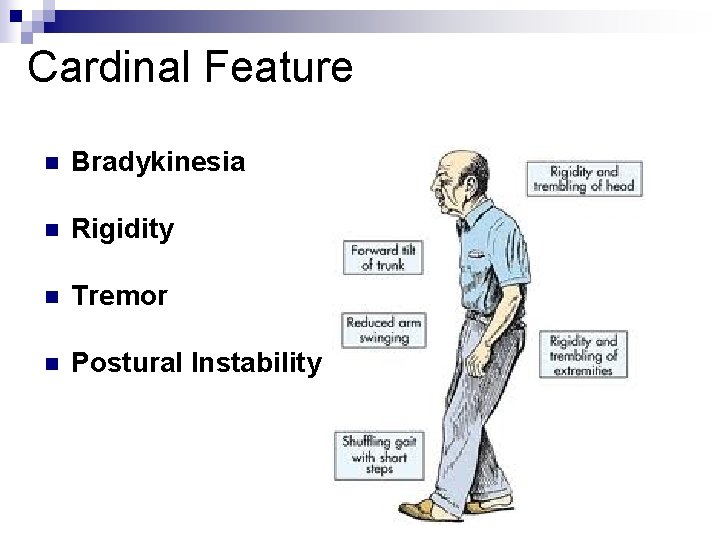
Cardinal Feature n Bradykinesia n Rigidity n Tremor n Postural Instability
Is it PD? Possible indicators of non-idiopathic Parkinsons - Symmetrical onset Poor response to Levodopa medication Early cognitive decline/hallucinations Early falls Down gaze palsy Autonomic signs – postural hypotension - Urinary dysfunction - temp regulation Rapid deterioration
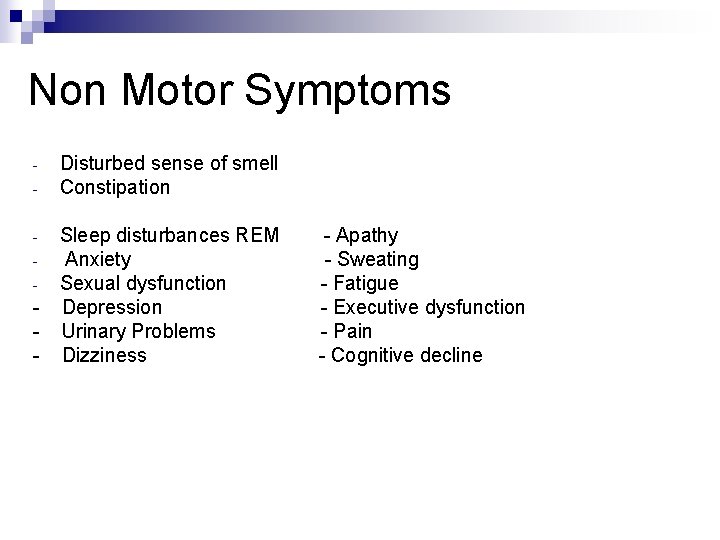
Non Motor Symptoms - - Disturbed sense of smell Constipation Sleep disturbances REM Anxiety Sexual dysfunction Depression Urinary Problems Dizziness - Apathy - Sweating - Fatigue - Executive dysfunction - Pain - Cognitive decline
Group work n Consider early, middle and late stages divide into 3 groups to discuss: n Patient presentation n Physiotherapy Management
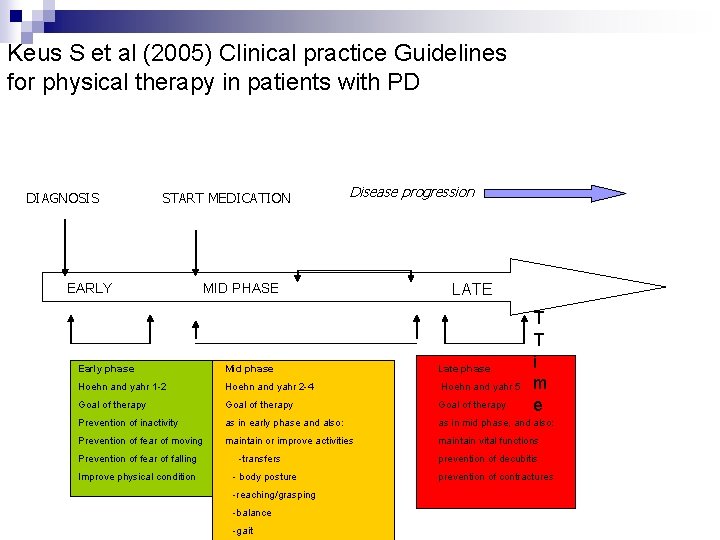
Keus S et al (2005) Clinical practice Guidelines for physical therapy in patients with PD DIAGNOSIS START MEDICATION EARLY Disease progression MID PHASE LATE T T i m e Early phase Mid phase Late phase Hoehn and yahr 1 -2 Hoehn and yahr 2 -4 Hoehn and yahr 5 Goal of therapy Prevention of inactivity as in early phase and also: as in mid phase, and also: Prevention of fear of moving maintain or improve activities maintain vital functions Prevention of fear of falling Improve physical condition -transfers - body posture -reaching/grasping -balance -gait prevention of decubitis prevention of contractures
Role of the basal ganglia n What is the normal function of the basal ganglia?
Cues use cortical mechanisms to activate and sustain movement and by doing so bypass the defective basal ganglia Cognitive (attentional) n Visual n Proprioceptive n Auditory n
Attentional Cues Compensatory movement strategies n Break down complex movement sequences ie. Rolling in bed, sit to stand etc into component parts n We arrange the parts of the movement sequentially n Perform each part individually at a conscious level n Avoid simultaneous motor or cognitive tasks n Use mental rehearsal of the forth coming movement
Visual Cues n Target in the surrounding area ¨ Lines on the floor (50 -60 cm apart) ¨ Coloured markers at eye level ¨ Projection of laser pen handled by pt (w/s) ¨ Use of existing markers i. e tiles/patterns/thresholds
Proprioceptive cues n Somatosensory Cues - Vibration - Weight shift
Auditory Cues External Verbal prompt n Metronome n MP 3/ipod n Apps n
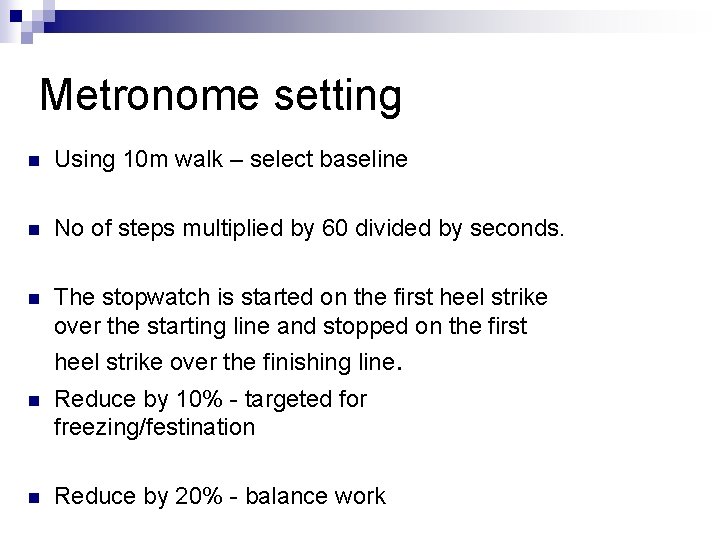
Metronome setting n Using 10 m walk – select baseline n No of steps multiplied by 60 divided by seconds. n The stopwatch is started on the first heel strike over the starting line and stopped on the first heel strike over the finishing line. n Reduce by 10% - targeted for freezing/festination n Reduce by 20% - balance work
Group work n Divided into 3 groups consider how you would use various forms of cueing to perform: Group 1 Sit to Stand n Group 2 Gait n Group 3 Turn on the spot n
Useful Resources n n Dutch Guidelines for Physical Therapy in patients with Parkinson’s Disease 2004 SIGN Guideline No. 113 Diagnosis and Pharmacological Management of PD – Jan 2010 NICE Guideline 35: Parkinson’s Disease. Diagnosis and management in primary and secondary care. RECUE Project CDrom
- Slides: 16