
Parking systems Access Control FAAC J 355 HA
- Slides: 22
Parking systems & Access Control FAAC J 355 HA M 30 -P 1 crash rated bollard Bologna October 13, 2011
Summary § Why a crash rated bollard? § Strenghts §Technical features
Why a FAAC crash rated bollard? § Perimeter protection is a fast growing market due to worldwide increase of security request § Lower security bollards resistance class M 30 (former K 4)is the widest application as volumes
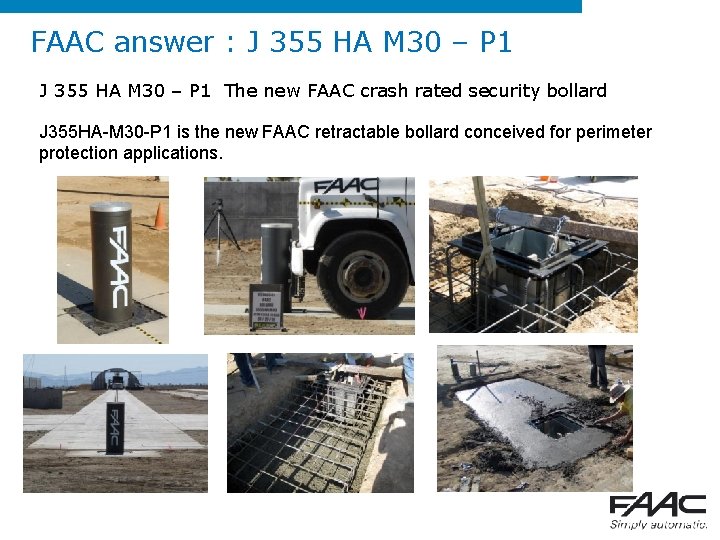
FAAC answer : J 355 HA M 30 – P 1 The new FAAC crash rated security bollard J 355 HA-M 30 -P 1 is the new FAAC retractable bollard conceived for perimeter protection applications.
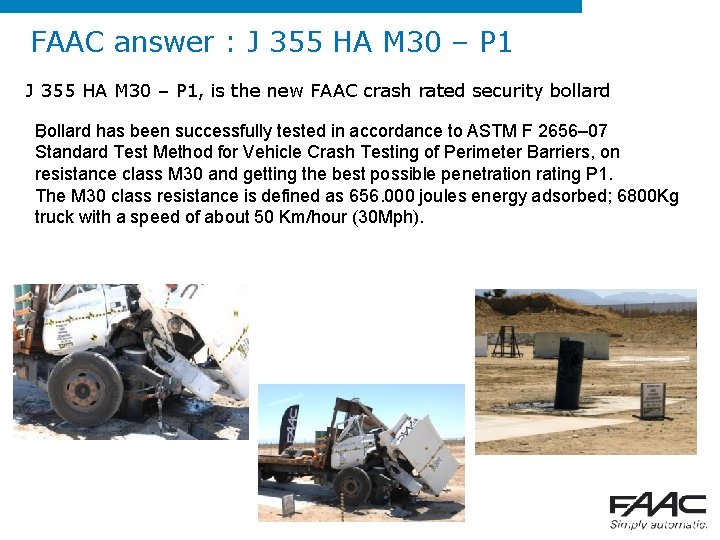
FAAC answer : J 355 HA M 30 – P 1, is the new FAAC crash rated security bollard Bollard has been successfully tested in accordance to ASTM F 2656– 07. Standard Test Method for Vehicle Crash Testing of Perimeter Barriers, on resistance class M 30 and getting the best possible penetration rating P 1. The M 30 class resistance is defined as 656. 000 joules energy adsorbed; 6800 Kg truck with a speed of about 50 Km/hour (30 Mph).
Summary § Why a crash rated bollard? § Strenghts §Technical features
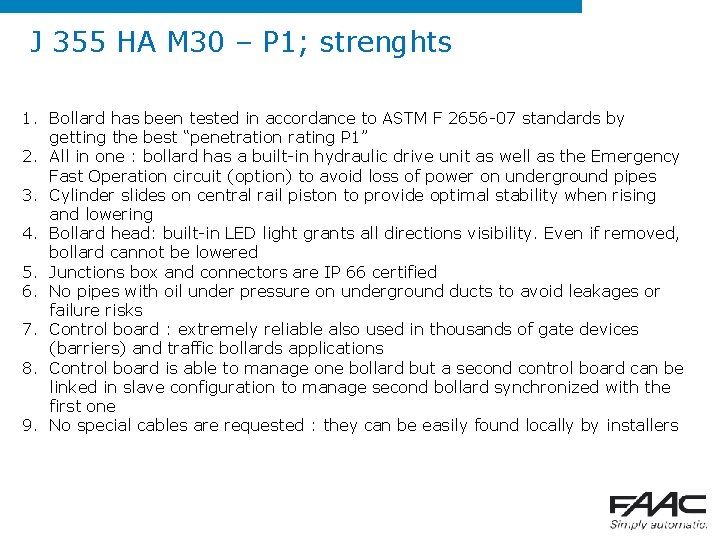
J 355 HA M 30 – P 1; strenghts 1. Bollard has been tested in accordance to ASTM F 2656 -07 standards by getting the best “penetration rating P 1” 2. All in one : bollard has a built-in hydraulic drive unit as well as the Emergency Fast Operation circuit (option) to avoid loss of power on underground pipes 3. Cylinder slides on central rail piston to provide optimal stability when rising and lowering 4. Bollard head: built-in LED light grants all directions visibility. Even if removed, bollard cannot be lowered 5. Junctions box and connectors are IP 66 certified 6. No pipes with oil under pressure on underground ducts to avoid leakages or failure risks 7. Control board : extremely reliable also used in thousands of gate devices (barriers) and traffic bollards applications 8. Control board is able to manage one bollard but a second control board can be linked in slave configuration to manage second bollard synchronized with the first one 9. No special cables are requested : they can be easily found locally by installers
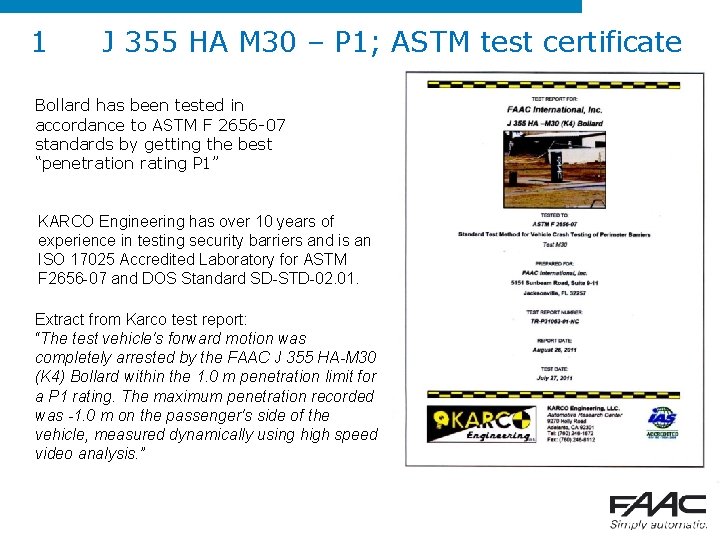
1 J 355 HA M 30 – P 1; ASTM test certificate Bollard has been tested in accordance to ASTM F 2656 -07 standards by getting the best “penetration rating P 1” KARCO Engineering has over 10 years of experience in testing security barriers and is an ISO 17025 Accredited Laboratory for ASTM F 2656 -07 and DOS Standard SD-STD-02. 01. Extract from Karco test report: “The test vehicle's forward motion was completely arrested by the FAAC J 355 HA-M 30 (K 4) Bollard within the 1. 0 m penetration limit for a P 1 rating. The maximum penetration recorded was -1. 0 m on the passenger's side of the vehicle, measured dynamically using high speed video analysis. ”
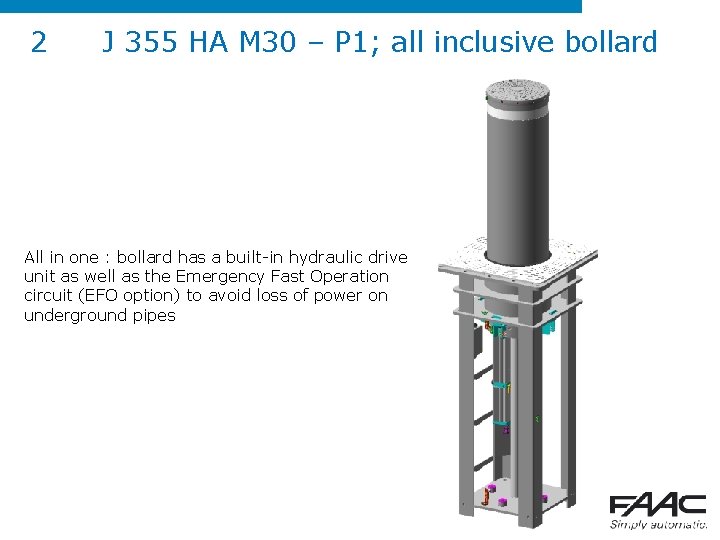
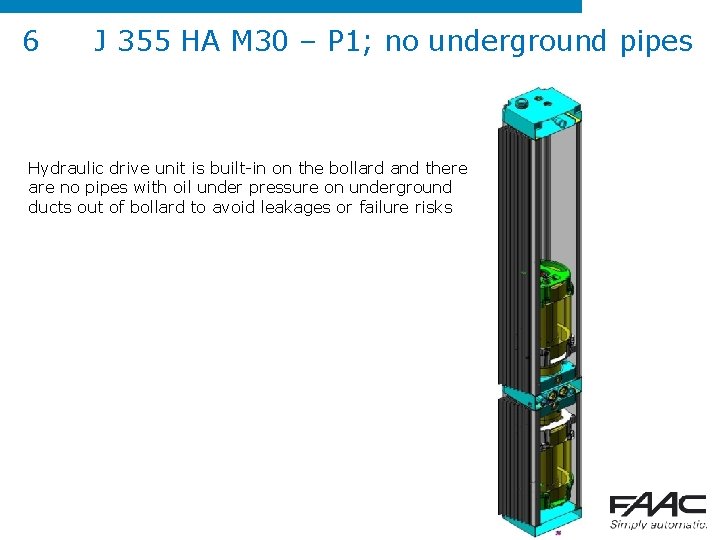
2 J 355 HA M 30 – P 1; all inclusive bollard All in one : bollard has a built-in hydraulic drive unit as well as the Emergency Fast Operation circuit (EFO option) to avoid loss of power on underground pipes
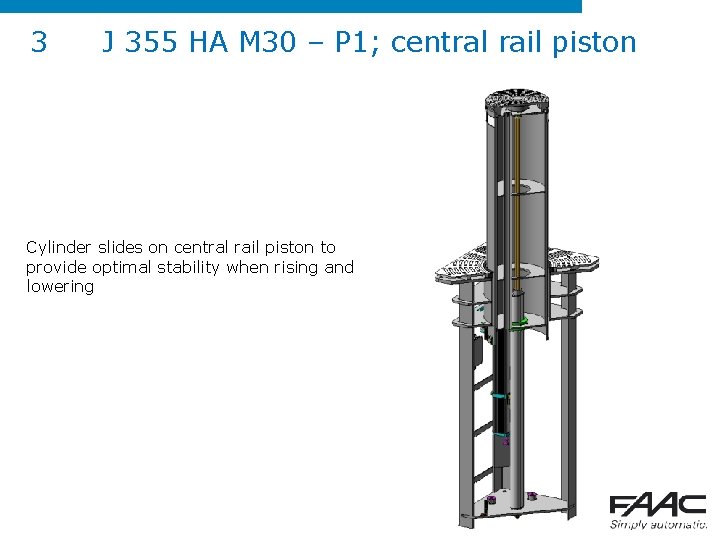
3 J 355 HA M 30 – P 1; central rail piston Cylinder slides on central rail piston to provide optimal stability when rising and lowering
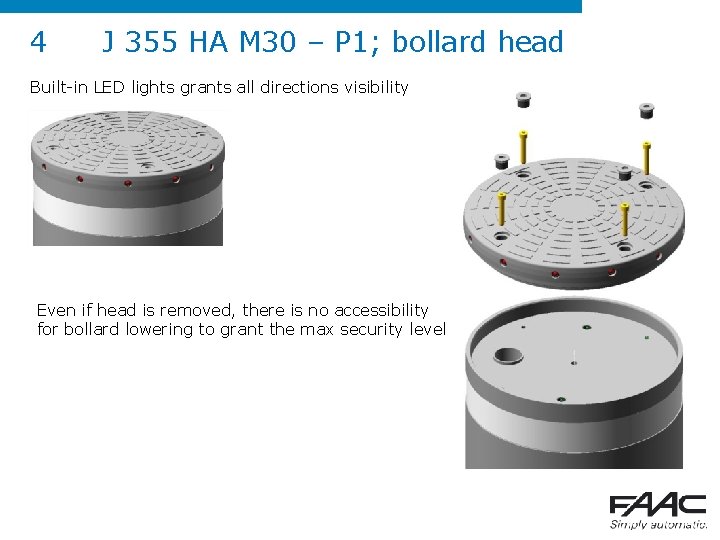
4 J 355 HA M 30 – P 1; bollard head Built-in LED lights grants all directions visibility Even if head is removed, there is no accessibility for bollard lowering to grant the max security level
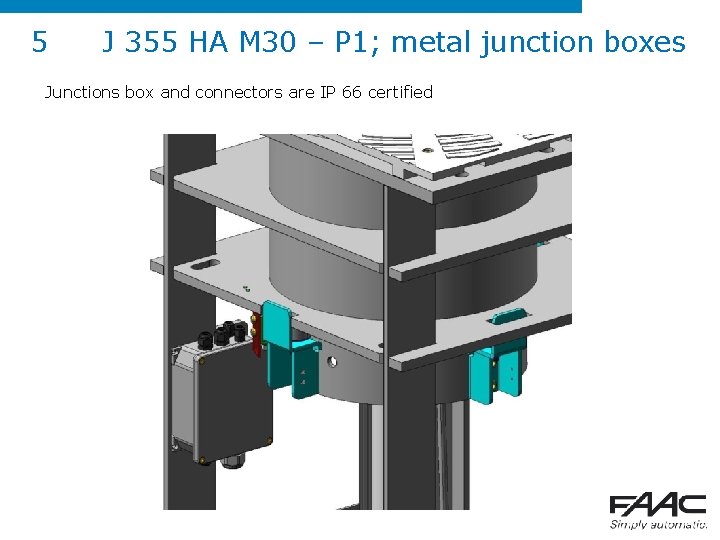
5 J 355 HA M 30 – P 1; metal junction boxes Junctions box and connectors are IP 66 certified
6 J 355 HA M 30 – P 1; no underground pipes Hydraulic drive unit is built-in on the bollard and there are no pipes with oil under pressure on underground ducts out of bollard to avoid leakages or failure risks
7 J 355 HA M 30 – P 1; JE control board Control board : extremely reliable electronic also used in thousands of gate devices and traffic bollards applications Same control board also operates the FAAC traffic bollards J 275 HA. Control board has several default programs including the one to manage the new J 355 HA M 30 -P 1 It is provided on plastic enclosure E model, IP 55.
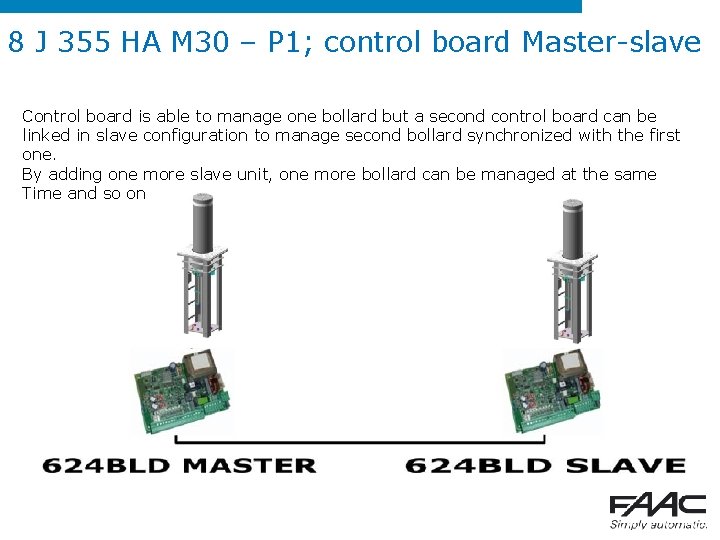
8 J 355 HA M 30 – P 1; control board Master-slave Control board is able to manage one bollard but a second control board can be linked in slave configuration to manage second bollard synchronized with the first one. By adding one more slave unit, one more bollard can be managed at the same Time and so on
9 J 355 HA M 30 – P 1; wiring No special cables are requested : they can be easily found locally by installers Same as FAAC traffic bollard J 275 HA, cables are not to be purchased on order stage No worries for a too short cable that can be cut on site according to needs
Summary § Why a crash rated bollard? § Strenghts §Technical features, options, accessories
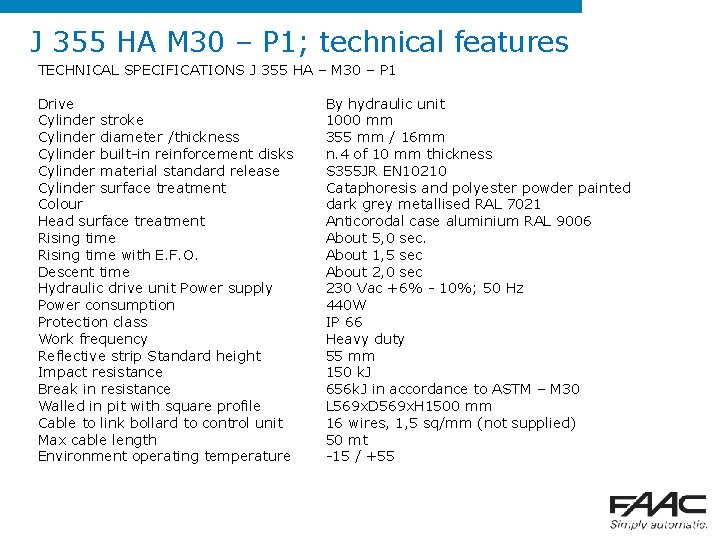
J 355 HA M 30 – P 1; technical features TECHNICAL SPECIFICATIONS J 355 HA – M 30 – P 1 Drive Cylinder stroke Cylinder diameter /thickness Cylinder built-in reinforcement disks Cylinder material standard release Cylinder surface treatment Colour Head surface treatment Rising time with E. F. O. Descent time Hydraulic drive unit Power supply Power consumption Protection class Work frequency Reflective strip Standard height Impact resistance Break in resistance Walled in pit with square profile Cable to link bollard to control unit Max cable length Environment operating temperature By hydraulic unit 1000 mm 355 mm / 16 mm n. 4 of 10 mm thickness S 355 JR EN 10210 Cataphoresis and polyester powder painted dark grey metallised RAL 7021 Anticorodal case aluminium RAL 9006 About 5, 0 sec. About 1, 5 sec About 2, 0 sec 230 Vac +6% - 10%; 50 Hz 440 W IP 66 Heavy duty 55 mm 150 k. J 656 k. J in accordance to ASTM – M 30 L 569 x. D 569 x. H 1500 mm 16 wires, 1, 5 sq/mm (not supplied) 50 mt -15 / +55
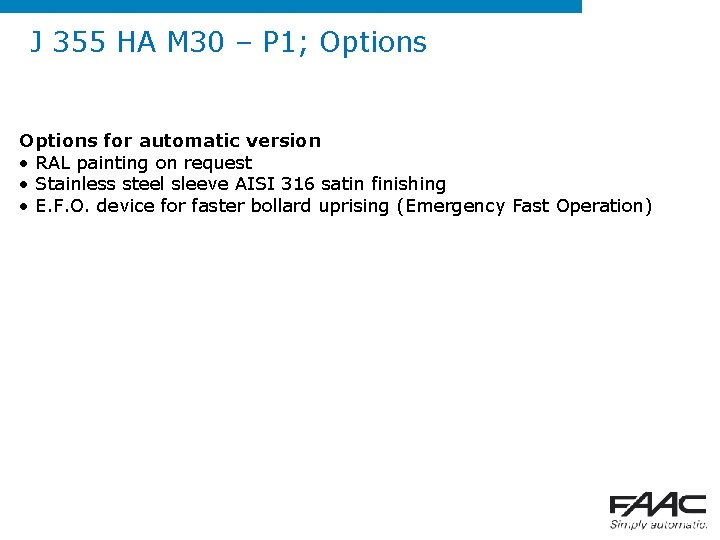
J 355 HA M 30 – P 1; Options for automatic version • RAL painting on request • Stainless steel sleeve AISI 316 satin finishing • E. F. O. device for faster bollard uprising (Emergency Fast Operation)
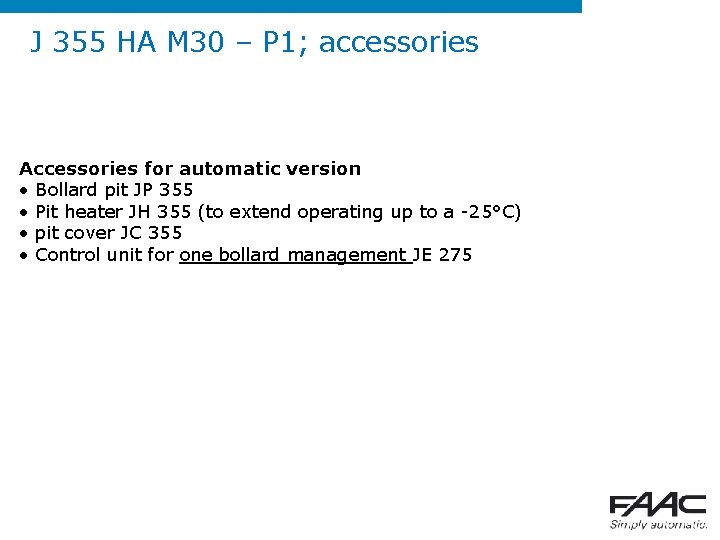
J 355 HA M 30 – P 1; accessories Accessories for automatic version • Bollard pit JP 355 • Pit heater JH 355 (to extend operating up to a -25°C) • pit cover JC 355 • Control unit for one bollard management JE 275
Product availability Q 1 2012 (estimation)
Questions & answers